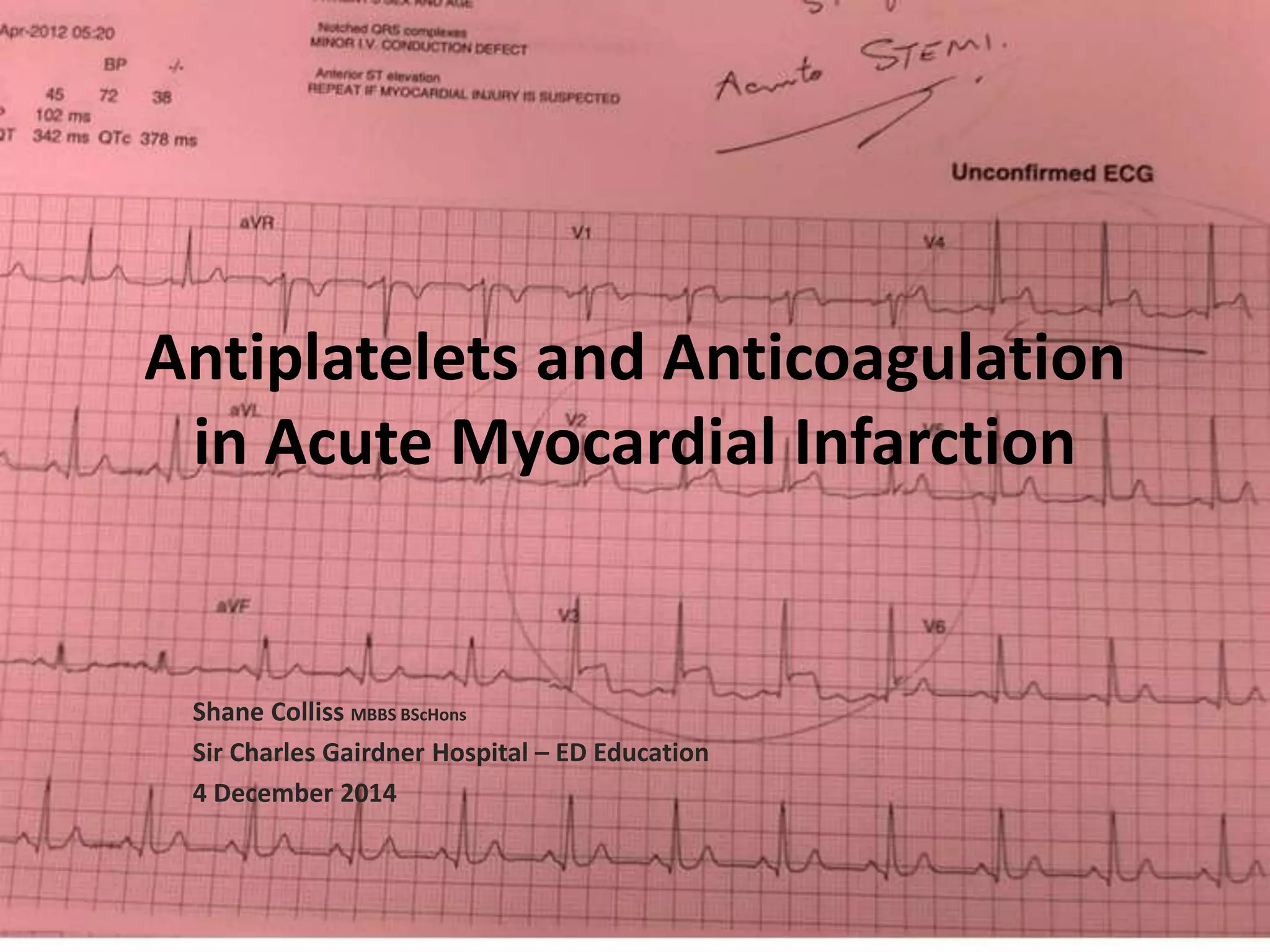
Antiplatelets and Anticoagulation 
in Acute Myocardial Infarction 
Shane Colliss MBBS BScHons 
Sir Charles Gairdner Hospital – ED Education 
4 December 2014
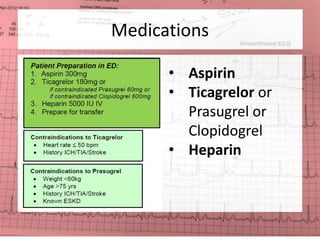
Medications 
• Aspirin 
• Ticagrelor or 
Prasugrel or 
Clopidogrel 
• Heparin
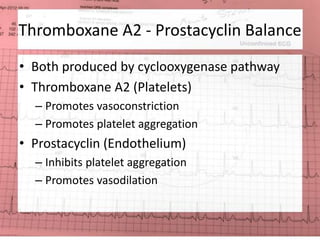
Thromboxane A2 - Prostacyclin Balance 
• Both produced by cyclooxygenase pathway 
• Thromboxane A2 (Platelets) 
– Promotes vasoconstriction 
– Promotes platelet aggregation 
• Prostacyclin (Endothelium) 
– Inhibits platelet aggregation 
– Promotes vasodilation
Aspirin 
• Aspirin causes irreversible inhibition of COX 
– Endothelial cells produce new COX within hours 
– Platelets cannot synthesise new COX 
• Platelet half life 4 days 
• Balance shifted towards prostacyclin effects of 
inhibition of platelet aggregation (and 
vasodilation)
Aspirin 
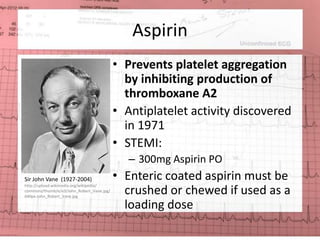
• Prevents platelet aggregation 
by inhibiting production of 
thromboxane A2 
• Antiplatelet activity discovered 
in 1971 
• STEMI: 
– 300mg Aspirin PO 
• Enteric coated aspirin must be 
crushed or chewed if used as a 
loading dose 
Sir John Vane (1927-2004) 
http://upload.wikimedia.org/wikipedia/ 
commons/thumb/e/e3/John_Robert_Vane.jpg/ 
640px-John_Robert_Vane.jpg
Aspirin 
• Second International Study of Infarct Survival 
(ISIS2)(Lancet 1988) 
– 17,187 patients given 30 days of treatment with 
162mg aspirin vs placebo starting within 24hours of 
onset of AMI symptoms 
– Risk reduction at 5 weeks: 
• Vascular mortality – 23% 
• Non-fatal reinfarction – 49% 
• Non-fatal stroke – 46% 
– No increase in haemorrhagic stroke or GI bleeding 
– Small increase in minor bleeding
P2Y Receptors 
• ADP receptors found on most tissue 
• G protein coupling 
• P2Y12 found mainly on the surface of platelets 
Dorsam RT, Kunapuli SP (2004). "Central role of the P2Y12 receptor in platelet activation". J. Clin. Invest. 113 (3): 340–5
Ticagrelor (Brilinta) 
• Reversibly binds ADP 
receptor antagonist on P2Y12 
resulting in ADP mediated 
prevention of platelet 
activation and aggregation 
• More rapid onset and more 
profound antiplatelet activity 
compared with Clopidogrel 
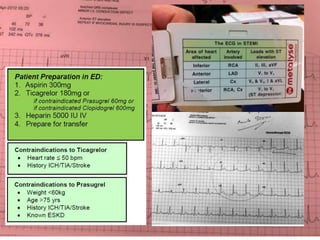
• STEMI: 
– Ticagrelor 180mg PO 
• 2x 90mg tablets 
http://www.signspecialist.com/decals/ 
mascot2/images/Tiger%20Claws.jpg
Ticagrelor 
• Contraindications 
– Heart rate <50 
• Potential for inducing bradyarrhythmia and ventricular 
pauses 
– History of CVA/TIA/ICH
Ticagrelor 
• Ticagrelor versus Clopidogrel in patients with 
acute coronary syndromes (Wallentin et al. N Engl J 
Med. 2009;361(11):1045) 
– 18,624 patients double-blinded and randomised to 
Ticagrelor 180mg loading dose (90mg BD 
maintenance) or Clopidogrel 300-600mg loading dose 
(75mg daily maintenance) 
– Death from vascular cause (MI or CVA) (Primary 
Endpoint) 
• Ticagrelor 9.8% vs Clopidogrel 11.7% 
– Ticagrelor associated with higher rate of major 
bleeding including fatal intracranial bleeding
Ticagrelor 
• Prehospital Ticagrelor in ST-Segment Elevation 
Myocardial Infarction (Montalescot et al. N Engl J Med. 
2014 Sep) 
– 1,862 patients with STEMI were randomized to 
prehospital or in-hospital ticagrelor loading 
– No significant difference in major adverse 
outcomes 
– Reduced rate of stent thrombosis in prehospital 
ticagrelor group (0% vs 0.8% in the first 24hours, 
0.2% vs 1.2% at 30 days)
Ticagrelor 
• Comparison of prasugrel and ticagrelor loading 
doses in ST-segment elevation myocardial 
infarction patients: RAPID (Rapid Activity of 
Platelet Inhibitor Drugs) primary PCI study. (Parodi 
et al. J Am Coll Cardiol. 2013;61(15):1601.) 
– Monitored the action of the two antiplatelet 
medications over 12hrs in 50 patients with STEMI. 
– Both drugs were effective platelet inhibitors in only 
half the patients at 2hrs, but effective in most patients 
at 4hrs. 
– Morphine delayed the onset of antiplatelet activity.
Prasugrel (Effient) 
• Inhibits platelet activation and aggregation 
through irreversibly binding its active 
metabolite to the P2Y12 ADP-receptor s on 
platelets 
• Peak plasma concentration 
• STEMI: 
– 60mg Prasugrel PO 
• 6x 10mg tablets
Prasugrel 
• Contraindications 
– Weight < 60kg 
– Age > 75 
– History of TIA/CVA/ICH 
– End stage kidney disease
Prasugrel 
• Prasugrel versus clopidogrel in patients with acute 
coronary syndromes. (Wiviott et al. N Engl J Med. 
2007;357(20):2001.) 
– 13,608 patients with moderate-high risk ACS were 
randomly assigned to receive prasugrel (60mg loading and 
10mg daily maintenance) or clopidogrel (300mg loading 
and 75mg daily maintenance) 
– Prasugrel associated with significantly reduced rates of 
ischaemic events (9.9% vs 12.1%), but with in increased 
risk of major bleeding (including fatal bleeding 0.4% vs 
0.1%). 
– No significant mortality difference between the groups.
Clopidogrel (Plavix) 
• Inhibits platelet activation and aggregation 
through irreversible binding of its active 
metabolite to platelet P2Y12 ADP-receptors 
• STEMI: 
– 600mg Clopidogrel PO 
• 8x 75mg tablets
Clopidogrel 
• Addition of clopidogrel to aspirin and fibrinolytic 
therapy for myocardial infarction with ST-segment 
elevation. (Sabatine et al, N Engl J Med. 
2005;352(12):1179) 
– 3,491 patients aged 18-75yrs presenting within 12hrs 
of onset of STEMI were randomly assigned to receive 
300mg clopidogrel loading dose (75mg daily 
maintenance) or placebo, as well as aspirin loading 
and fibrinolysis 
– Primary efficacy endpoint of death, occluded infarct-related 
artery or recurrent MI before angiography 
(performed 48-192hrs after medications commenced) 
• Placebo 21.7% vs Clopidogrel 15.0% (=36% risk reduction)
Clopidogrel 
• Addition of clopidogrel to aspirin in 45,852 
patients with acute myocardial infarction: 
randomised placebo-controlled trial. (Chen et al. 
Lancet. 2005 Nov;366(9497):1607-21.) 
– 45,852 patients with suspected MI (93% STEMI or 
BBB, 7% NSTEMI) and randomized to placebo or 
Clopidogrel 75mg daily continuing until discharge or 
up to 4 weeks 
– Clopidogrel group had 9% relative reduction in death, 
reinfarction or stroke (9.2% vs 10.1%) 
– Significant bleeding (transfusion, cerebral or fatal) 
rates were 0.58% (clopidogrel) vs 0.55% (placebo)
Antithrombin III 
• Circulating protease inhibitor 
• Binds to proteases in the coagulation system 
– Blocks their activity as clotting factors 
• Most important: Thrombin (IIa), IXa, Xa 
• Heparin increases rate of reaction by 1000x
Heparin 
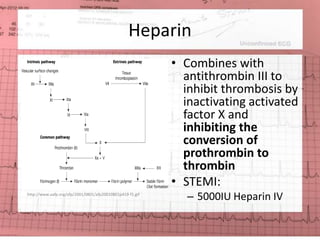
• Combines with 
antithrombin III to 
inhibit thrombosis by 
inactivating activated 
factor X and 
inhibiting the 
conversion of 
prothrombin to 
thrombin 
• STEMI: 
– 5000IU Heparin IV http://www.aafp.org/afp/2001/0801/afp20010801p419-f1.gif
Heparin 
• Clinical effects of anticoagulant therapy in suspected acute 
myocardial infarction: systematic overview of randomised 
trials. (Collins et al. BMJ. 1996;313(7058):652.) 
– Meta-analysis of 27 trials using oral antiplatelets and IV or 
subcut heparin. 68,000 patients received aspirin with the other 
medications. 5000 patients did not receive aspirin. 
– In the absence of aspirin – anticoagulant therapy reduced 
mortality by 25% (35 fewer deaths per 1000). In the presence 
of aspirin – heparin use reduced mortality by 6% (5 fewer per 
1000). 
– “The clinical evidence from randomised trials does not justify 
the routine addition of either intravenous or subcutaneous 
heparin to aspirin in the treatment of acute myocardial 
infarction (irrespective of whether any type of fibrinolytic 
therapy is used)”
Heparin 
• Unfractionated heparin and low-molecular-weight 
heparin in acute coronary syndrome 
without ST elevation: a meta-analysis (Eikelboom et 
al The Lancet 2000 June 355:9212 1936-1942) 
– In 12 trials of 17,157 patients receiving short term 
unfractionated or LMWH were compared with 
placebo. 
– Patients treated with aspirin and heparin or LMWH 
had half the risk of death and MI. 
– Patients treated for longer than 7 days with heparin 
had a significant increase in major bleeding risk.
Uh oh! 
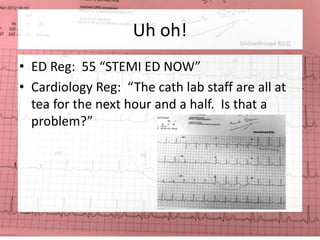
• ED Reg: 55 “STEMI ED NOW” 
• Cardiology Reg: “The cath lab staff are all at 
tea for the next hour and a half. Is that a 
problem?”
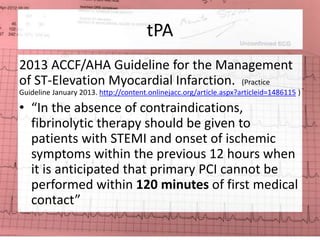
tPA 
2013 ACCF/AHA Guideline for the Management 
of ST-Elevation Myocardial Infarction. (Practice 
Guideline January 2013. http://content.onlinejacc.org/article.aspx?articleid=1486115 ) 
• “In the absence of contraindications, 
fibrinolytic therapy should be given to 
patients with STEMI and onset of ischemic 
symptoms within the previous 12 hours when 
it is anticipated that primary PCI cannot be 
performed within 120 minutes of first medical 
contact”
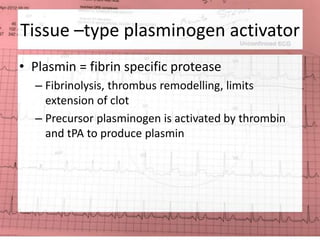
Tissue –type plasminogen activator 
• Plasmin = fibrin specific protease 
– Fibrinolysis, thrombus remodelling, limits 
extension of clot 
– Precursor plasminogen is activated by thrombin 
and tPA to produce plasmin
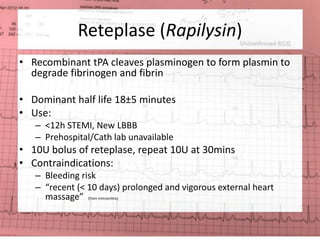
Reteplase (Rapilysin) 
• Recombinant tPA cleaves plasminogen to form plasmin to 
degrade fibrinogen and fibrin 
• Dominant half life 18±5 minutes 
• Use: 
– <12h STEMI, New LBBB 
– Prehospital/Cath lab unavailable 
• 10U bolus of reteplase, repeat 10U at 30mins 
• Contraindications: 
– Bleeding risk 
– “recent (< 10 days) prolonged and vigorous external heart 
massage” (from mimsonline)
Antiplatelets and anticoagulation in AMI

Antiplatelets and anticoagulation in AMI

  • 1.
    Antiplatelets and Anticoagulation in Acute Myocardial Infarction Shane Colliss MBBS BScHons Sir Charles Gairdner Hospital – ED Education 4 December 2014
  • 3.
    Medications • Aspirin • Ticagrelor or Prasugrel or Clopidogrel • Heparin
  • 4.
    Thromboxane A2 -Prostacyclin Balance • Both produced by cyclooxygenase pathway • Thromboxane A2 (Platelets) – Promotes vasoconstriction – Promotes platelet aggregation • Prostacyclin (Endothelium) – Inhibits platelet aggregation – Promotes vasodilation
  • 5.
    Aspirin • Aspirincauses irreversible inhibition of COX – Endothelial cells produce new COX within hours – Platelets cannot synthesise new COX • Platelet half life 4 days • Balance shifted towards prostacyclin effects of inhibition of platelet aggregation (and vasodilation)
  • 6.
    Aspirin • Preventsplatelet aggregation by inhibiting production of thromboxane A2 • Antiplatelet activity discovered in 1971 • STEMI: – 300mg Aspirin PO • Enteric coated aspirin must be crushed or chewed if used as a loading dose Sir John Vane (1927-2004) http://upload.wikimedia.org/wikipedia/ commons/thumb/e/e3/John_Robert_Vane.jpg/ 640px-John_Robert_Vane.jpg
  • 7.
    Aspirin • SecondInternational Study of Infarct Survival (ISIS2)(Lancet 1988) – 17,187 patients given 30 days of treatment with 162mg aspirin vs placebo starting within 24hours of onset of AMI symptoms – Risk reduction at 5 weeks: • Vascular mortality – 23% • Non-fatal reinfarction – 49% • Non-fatal stroke – 46% – No increase in haemorrhagic stroke or GI bleeding – Small increase in minor bleeding
  • 8.
    P2Y Receptors •ADP receptors found on most tissue • G protein coupling • P2Y12 found mainly on the surface of platelets Dorsam RT, Kunapuli SP (2004). "Central role of the P2Y12 receptor in platelet activation". J. Clin. Invest. 113 (3): 340–5
  • 9.
    Ticagrelor (Brilinta) •Reversibly binds ADP receptor antagonist on P2Y12 resulting in ADP mediated prevention of platelet activation and aggregation • More rapid onset and more profound antiplatelet activity compared with Clopidogrel • STEMI: – Ticagrelor 180mg PO • 2x 90mg tablets http://www.signspecialist.com/decals/ mascot2/images/Tiger%20Claws.jpg
  • 10.
    Ticagrelor • Contraindications – Heart rate <50 • Potential for inducing bradyarrhythmia and ventricular pauses – History of CVA/TIA/ICH
  • 11.
    Ticagrelor • Ticagrelorversus Clopidogrel in patients with acute coronary syndromes (Wallentin et al. N Engl J Med. 2009;361(11):1045) – 18,624 patients double-blinded and randomised to Ticagrelor 180mg loading dose (90mg BD maintenance) or Clopidogrel 300-600mg loading dose (75mg daily maintenance) – Death from vascular cause (MI or CVA) (Primary Endpoint) • Ticagrelor 9.8% vs Clopidogrel 11.7% – Ticagrelor associated with higher rate of major bleeding including fatal intracranial bleeding
  • 12.
    Ticagrelor • PrehospitalTicagrelor in ST-Segment Elevation Myocardial Infarction (Montalescot et al. N Engl J Med. 2014 Sep) – 1,862 patients with STEMI were randomized to prehospital or in-hospital ticagrelor loading – No significant difference in major adverse outcomes – Reduced rate of stent thrombosis in prehospital ticagrelor group (0% vs 0.8% in the first 24hours, 0.2% vs 1.2% at 30 days)
  • 13.
    Ticagrelor • Comparisonof prasugrel and ticagrelor loading doses in ST-segment elevation myocardial infarction patients: RAPID (Rapid Activity of Platelet Inhibitor Drugs) primary PCI study. (Parodi et al. J Am Coll Cardiol. 2013;61(15):1601.) – Monitored the action of the two antiplatelet medications over 12hrs in 50 patients with STEMI. – Both drugs were effective platelet inhibitors in only half the patients at 2hrs, but effective in most patients at 4hrs. – Morphine delayed the onset of antiplatelet activity.
  • 14.
    Prasugrel (Effient) •Inhibits platelet activation and aggregation through irreversibly binding its active metabolite to the P2Y12 ADP-receptor s on platelets • Peak plasma concentration • STEMI: – 60mg Prasugrel PO • 6x 10mg tablets
  • 15.
    Prasugrel • Contraindications – Weight < 60kg – Age > 75 – History of TIA/CVA/ICH – End stage kidney disease
  • 16.
    Prasugrel • Prasugrelversus clopidogrel in patients with acute coronary syndromes. (Wiviott et al. N Engl J Med. 2007;357(20):2001.) – 13,608 patients with moderate-high risk ACS were randomly assigned to receive prasugrel (60mg loading and 10mg daily maintenance) or clopidogrel (300mg loading and 75mg daily maintenance) – Prasugrel associated with significantly reduced rates of ischaemic events (9.9% vs 12.1%), but with in increased risk of major bleeding (including fatal bleeding 0.4% vs 0.1%). – No significant mortality difference between the groups.
  • 17.
    Clopidogrel (Plavix) •Inhibits platelet activation and aggregation through irreversible binding of its active metabolite to platelet P2Y12 ADP-receptors • STEMI: – 600mg Clopidogrel PO • 8x 75mg tablets
  • 18.
    Clopidogrel • Additionof clopidogrel to aspirin and fibrinolytic therapy for myocardial infarction with ST-segment elevation. (Sabatine et al, N Engl J Med. 2005;352(12):1179) – 3,491 patients aged 18-75yrs presenting within 12hrs of onset of STEMI were randomly assigned to receive 300mg clopidogrel loading dose (75mg daily maintenance) or placebo, as well as aspirin loading and fibrinolysis – Primary efficacy endpoint of death, occluded infarct-related artery or recurrent MI before angiography (performed 48-192hrs after medications commenced) • Placebo 21.7% vs Clopidogrel 15.0% (=36% risk reduction)
  • 19.
    Clopidogrel • Additionof clopidogrel to aspirin in 45,852 patients with acute myocardial infarction: randomised placebo-controlled trial. (Chen et al. Lancet. 2005 Nov;366(9497):1607-21.) – 45,852 patients with suspected MI (93% STEMI or BBB, 7% NSTEMI) and randomized to placebo or Clopidogrel 75mg daily continuing until discharge or up to 4 weeks – Clopidogrel group had 9% relative reduction in death, reinfarction or stroke (9.2% vs 10.1%) – Significant bleeding (transfusion, cerebral or fatal) rates were 0.58% (clopidogrel) vs 0.55% (placebo)
  • 20.
    Antithrombin III •Circulating protease inhibitor • Binds to proteases in the coagulation system – Blocks their activity as clotting factors • Most important: Thrombin (IIa), IXa, Xa • Heparin increases rate of reaction by 1000x
  • 21.
    Heparin • Combineswith antithrombin III to inhibit thrombosis by inactivating activated factor X and inhibiting the conversion of prothrombin to thrombin • STEMI: – 5000IU Heparin IV http://www.aafp.org/afp/2001/0801/afp20010801p419-f1.gif
  • 22.
    Heparin • Clinicaleffects of anticoagulant therapy in suspected acute myocardial infarction: systematic overview of randomised trials. (Collins et al. BMJ. 1996;313(7058):652.) – Meta-analysis of 27 trials using oral antiplatelets and IV or subcut heparin. 68,000 patients received aspirin with the other medications. 5000 patients did not receive aspirin. – In the absence of aspirin – anticoagulant therapy reduced mortality by 25% (35 fewer deaths per 1000). In the presence of aspirin – heparin use reduced mortality by 6% (5 fewer per 1000). – “The clinical evidence from randomised trials does not justify the routine addition of either intravenous or subcutaneous heparin to aspirin in the treatment of acute myocardial infarction (irrespective of whether any type of fibrinolytic therapy is used)”
  • 23.
    Heparin • Unfractionatedheparin and low-molecular-weight heparin in acute coronary syndrome without ST elevation: a meta-analysis (Eikelboom et al The Lancet 2000 June 355:9212 1936-1942) – In 12 trials of 17,157 patients receiving short term unfractionated or LMWH were compared with placebo. – Patients treated with aspirin and heparin or LMWH had half the risk of death and MI. – Patients treated for longer than 7 days with heparin had a significant increase in major bleeding risk.
  • 24.
    Uh oh! •ED Reg: 55 “STEMI ED NOW” • Cardiology Reg: “The cath lab staff are all at tea for the next hour and a half. Is that a problem?”
  • 25.
    tPA 2013 ACCF/AHAGuideline for the Management of ST-Elevation Myocardial Infarction. (Practice Guideline January 2013. http://content.onlinejacc.org/article.aspx?articleid=1486115 ) • “In the absence of contraindications, fibrinolytic therapy should be given to patients with STEMI and onset of ischemic symptoms within the previous 12 hours when it is anticipated that primary PCI cannot be performed within 120 minutes of first medical contact”
  • 26.
    Tissue –type plasminogenactivator • Plasmin = fibrin specific protease – Fibrinolysis, thrombus remodelling, limits extension of clot – Precursor plasminogen is activated by thrombin and tPA to produce plasmin
  • 27.
    Reteplase (Rapilysin) •Recombinant tPA cleaves plasminogen to form plasmin to degrade fibrinogen and fibrin • Dominant half life 18±5 minutes • Use: – <12h STEMI, New LBBB – Prehospital/Cath lab unavailable • 10U bolus of reteplase, repeat 10U at 30mins • Contraindications: – Bleeding risk – “recent (< 10 days) prolonged and vigorous external heart massage” (from mimsonline)