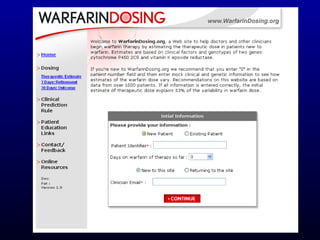
Pharmacogenomics: Using Genetic Testing to Guide Warfarin Therapy   Dan Jonas, MD, MPH Noon Conference October 29, 2007                             
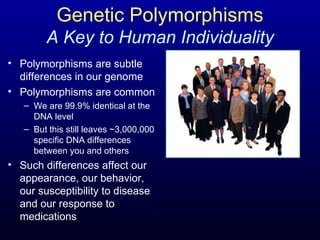
Genetic Polymorphisms A Key to Human Individuality Polymorphisms are subtle differences in our genome Polymorphisms are common We are 99.9% identical at the DNA level But this still leaves ~3,000,000 specific DNA differences between you and others Such differences affect our appearance, our behavior, our susceptibility to disease and our response to medications
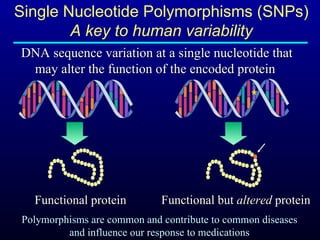
Single Nucleotide Polymorphisms (SNPs) A key to human variability DNA sequence variation at a single nucleotide that may alter the function of the encoded protein  Polymorphisms are common and   contribute to common diseases and influence our response to medications * Functional but  altered  protein Functional protein
What is Pharmacogenomics (PGx)? The study of how variations in the human genome affect the response to medications Tailoring treatments to unique genetic profiles “ personalized” or “individualized” medicine Some use terms interchangeably with PGx But, PGx is just one aspect of PM
Individualized Medicine Current drug therapy in medicine: Efficacy may vary widely  Resulting in wasted resources and time Adverse effects are common  and unpredictable Complications and deaths Genetically guided therapy Direct treatment in an individualized manner To better target those most likely to benefit and least likely to be harmed Determine who to treat at all (e.g. prostate cancer?)
Pharmacogenomics The variable efficacy and unpredictability of adverse effects likely has a significant genetic component Secondary to polymorphisms Drug target polymorphisms Polymorphisms in metabolic / drug excretion pathways Cytochrome P450 Implications for drug development / discovery
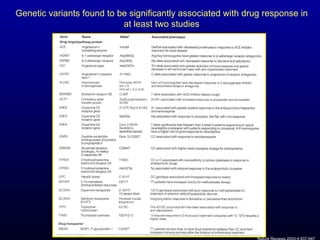
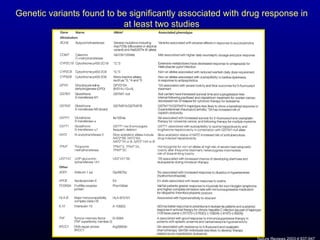
Goldstein DB, et al. Nature Reviews 2003;4: 937-947 Genetic variants found to be significantly associated with drug response in at least two studies Nature Reviews 2003;4:937-947
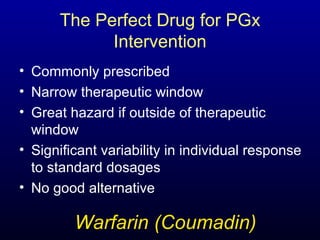
Commonly prescribed Narrow therapeutic window Great hazard if outside of therapeutic window Significant variability in individual response to standard dosages No good alternative The Perfect Drug for PGx Intervention Warfarin (Coumadin)
Warfarin Commonly prescribed (2 million per year in the US) High rate of adverse events Warfarin maintenance doses are characterized by large interindividual variability Maintenance doses can range 50-fold (eg, daily dose requirements range from 0.5 to 25 mg) Warfarin is THE example of a narrow therapeutic index There have been several efforts to define this interindividual variability using genetic and non-genetic factors
Factors that Correlate w/ Warfarin Dose Age Body surface area (BSA) or weight Amiodarone dose Other drugs (e.g. HMG CoA Reductase inhibitors) Target INR Race Sex Plasma vitamin K level Decompensated CHF or post-operative state The patient’s genetic status with regard to polymorphisms
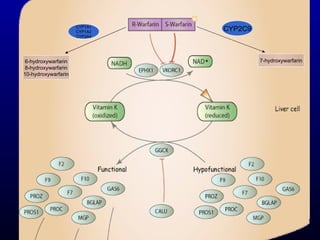
Genes important for Warfarin Pharmacogenetics   CYP2C9 Metabolizes >90% of active Warfarin  Variant alleles associated with increased sensitivity to Warfarin (CYP2C9*2, *3) Vitamin K epoxide reductase (VKOR) Inhibited by Warfarin Important for replenishment of vitamin K Variant alleles of  VKORC1  gene associated with altered response to Warfarin
 
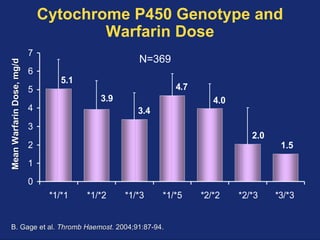
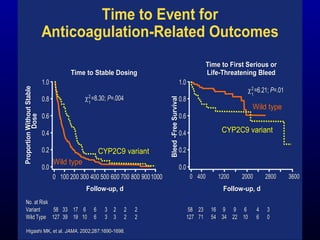
CYP2C9  variant alleles CYP2C9*2, CYP2C9*3 – most common variants Seen in 20-40% of Caucasians, <10% Asians and African Americans Associated with reduced CYP2C9 enzyme activity Variant alleles associated with  lower mean doses of Warfarin longer times to stabilization of INR higher risk for bleeding events
 
 
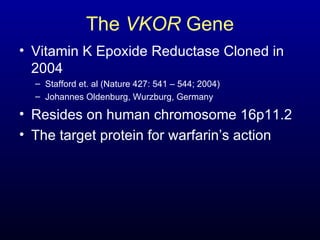
The  VKOR  Gene Vitamin K Epoxide Reductase Cloned in 2004 Stafford et. al (Nature 427: 541 – 544; 2004)  Johannes Oldenburg, Wurzburg, Germany Resides on human chromosome 16p11.2  The target protein for warfarin’s action
Effect of VKORC1 Haplotype A or B on Warfarin dosage  Rieder et al.  New England Journal of Medicine 2005
Individual Variability in Warfarin Dose Warfarin maintenance dose (mg/day) SENSITIVITY CYP2C9  coding SNPs  RESISTANCE VKORC1  coding SNPs Frequency Common  VKORC1  non-coding SNPs Adapted from Rettie and Tai, Molecular Interventions 2006 (*3/*3) 0.5 5 15
 
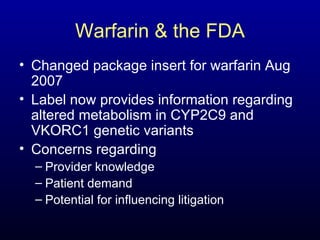
Warfarin & the FDA Changed package insert for warfarin Aug 2007 Label now provides information regarding altered metabolism in CYP2C9 and VKORC1 genetic variants Concerns regarding Provider knowledge Patient demand Potential for influencing litigation
What is the clinical evidence? FDA working group selected relevant studies A number found strong associations cross-sectional studies in many populations Lower dose requirements with CYP2C9 3 prospective studies Caraco 2007; Millican 2007; Limdi 2007
Caraco et al.   Controlled trial, prospective (“randomized” by MRN); N=283 enrolled, 191 analyzed Control group:  all started on 5mg and adjust dose based on pre-established protocol Required daily monitoring of INR for initial 8 days Intervention group: CYP2C9 genotype-adjusted protocol Altered recommended dose by a set % for each of 6 different genotypes (*1/*1, *1/*2, *1/*3, etc.) Results: stable anticoagulation 18.1 days earlier TTR 80.4% vs 63.4% (P < 0.001) Clin Pharmacol Ther. 2007 Sep 12; [Epub ahead of print]; Hadassah University, Israel
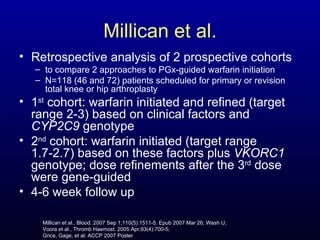
Millican et al. Retrospective analysis of 2 prospective cohorts to compare 2 approaches to PGx-guided warfarin initiation N=118 (46 and 72) patients scheduled for primary or revision total knee or hip arthroplasty 1 st  cohort: warfarin initiated and refined (target range 2-3) based on clinical factors and  CYP2C9  genotype  2 nd  cohort: warfarin initiated (target range 1.7-2.7) based on these factors plus  VKORC1  genotype; dose refinements after the 3 rd  dose were gene-guided 4-6 week follow up Millican et al., Blood. 2007 Sep 1;110(5):1511-5. Epub 2007 Mar 26; Wash U; Voora et al., Thromb Haemost. 2005 Apr;93(4):700-5; Grice, Gage, et al. ACCP 2007 Poster
Limdi et al. Large prospective cohort study (N=490) with 2 year follow up All patients treated with standardized approach to warfarin dose adjustments Results: Variant CYP2C9 genotype Increased risk for major hemorrhage (HR 3.0; 95% CI 1.1-8.0) a , but not minor hemorrhage Variant VKORC1 genotype (1173C/T) Did not confer an increase in risk for major or minor Limidi et al., Clin Pharmacol Ther. 2007 Jul 25; [Epub ahead of print]; UAB   a Adjusted for age, gender, race, BMI, VKORC1, vitamin K and alcohol intake, warfarin dose, interacting drugs, number of comorbid conditions, and INR at the time of the event
Pharmacogenomics at UNC to Guide Warfarin Therapy Incorporate PGx guidance in warfarin dosing at UNC through implementation of a randomized trial Integrated effort--Genetics, clinical labs, pharmacy, and providers PGx has the most to offer in choosing the  initial dosing  of warfarin Subsequent dosage adjustments will still be primarily guided by following INRs Thus, we need rapid identification of patients placed on warfarin
Structure of the UNC Warfarin PGx Study Inclusion criteria: Adults (≥ 18) newly starting warfarin Planned ≥ 3 months of anticoagulation with target INR ≥ 2. Following up at UNC (ACC or Family Practice) Exclsuion criteria: History of treatment with warfarin and know dose requirement unable to complete the study materials (questionnaires) with or without assistance (e.g. dementia), including non-English speaking patients  Pregnancy Treating physician opposed to enrolling
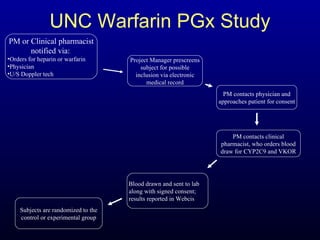
UNC Warfarin PGx Study PM or Clinical pharmacist notified via:   Orders for heparin or warfarin  Physician U/S Doppler tech Project Manager prescreens subject for possible inclusion via electronic medical record PM contacts physician and approaches patient for consent PM contacts clinical pharmacist, who orders blood draw for CYP2C9 and VKOR Blood drawn and sent to lab along with signed consent; results reported in Webcis Subjects are randomized to the control or experimental group
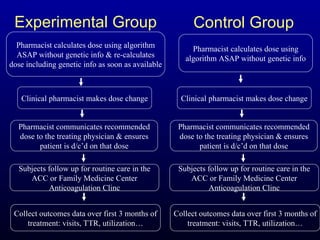
Experimental Group Pharmacist calculates dose using algorithm ASAP without genetic info & re-calculates dose including genetic info as soon as available Pharmacist communicates recommended dose to the treating physician & ensures patient is d/c’d on that dose Pharmacist calculates dose using algorithm ASAP without genetic info Clinical pharmacist makes dose change Subjects follow up for routine care in the ACC or Family Medicine Center Anticoagulation Clinc Control Group Collect outcomes data over first 3 months of treatment: visits, TTR, utilization… Pharmacist communicates recommended dose to the treating physician & ensures patient is d/c’d on that dose Clinical pharmacist makes dose change Subjects follow up for routine care in the ACC or Family Medicine Center Anticoagulation Clinc Collect outcomes data over first 3 months of treatment: visits, TTR, utilization…
Outcomes Time in therapeutic range (TTR) # of visits required Complications Minor and Major bleeding INRs > 4 Process measures Genotyping turn-around-time Provider knowledge and attitudes Cost-effectiveness
When Starting Warfarin… consider  Genotype! Warfarin genotyping panel (pertinent VKOR and CYP polymorphisms) will be available soon In the context of the study For clinical use
 
Thank You! Genetics and Medicine: Jim Evans Betsy Bryant  Brent Ferrell  Leslie Lange Kristy Lee Kandamurugu Manickam  Stephan Moll Cécile Skrzynia Marcia Van Riper Maimoona Zariwala Pharmacy and Institute for Pharmacogenomics and Individualized Therapy Howard McLeod Stephen Eckel John Valgus Laboratory Medicine Karen Weck Jessica Booker  Mike Langley Family Practice Sarah Ford DEPARTMENT OF GENETICS
 
EXTRA SLIDES
Prevalence of genetic variations influencing warfarin maintenance dose CYP2C9 ~4% PM’s (two inactive alleles eg. *3/*3) ~35% IM’s (one inactive allele eg. *1/*3) ~60% EM’s (two active alleles eg *1/*1) VKORC1 ~37% GG, highest maintenance doses ~47% AG, intermediate maintenance doses ~16% AA, lowest maintenance doses
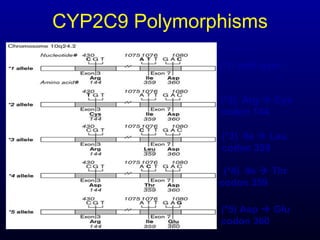
CYP2C9 Polymorphisms (*2)  Arg    Cys  codon 144 (*3)  Ile    Leu  codon 359 (*4)  Ile    Thr  codon 359 (*5) Asp    Glu  codon 360 (*1) wild type
Individualized Medicine   Predisposition and Screening The current status of disease screening in medicine In spite of aggregate benefit… Relatively little benefit to a given individual Actual harm to some Tremendous waste of resources Genetically guided screening holds the promise of: Preventing disease in those susceptible Early detection Rational use of society’s limited resources
CYP450 Gene Nomenclature CYP 2 C 19 *1  (normal allele) Variant alleles (named in order of discovery):  CYP 2 C 19 *2   CYP 2 C 19 *3 CYP 2 C 19 *4 Family  Subfamily  Gene  Allele Variant
Major CYP450 enzymes involved in drug metabolism  CYP1A2 CYP2C9 CYP2C19 genetically variable  CYP2D6 CYP2E1 CYP3A4 CYP3A5
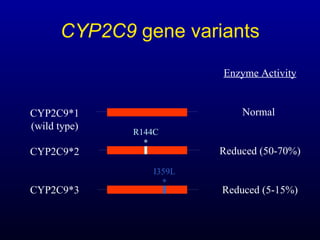
CYP2C9  gene variants Enzyme Activity Normal  Reduced (50-70%) Reduced (5-15%) I359L * R144C * CYP2C9*1 (wild type) CYP2C9*2 CYP2C9*3
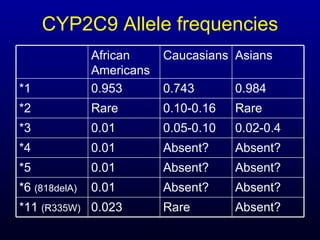
CYP2C9 Allele frequencies Absent? Rare 0.023 *11  (R335W) Absent? Absent? 0.01 *6  (818delA) Absent? Absent? 0.01 *5 Absent? Absent? 0.01 *4 0.02-0.4 0.05-0.10 0.01 *3 Rare 0.10-0.16 Rare *2 0.984 0.743 0.953 *1 Asians Caucasians African Americans
VKORC1  gene variants Enzyme Clinical Activity Effect   spontaneous bleeding  (VKCFD2) Warfarin Warfarin resistance binding? OR    OR  Warfarin dose    R98W *  SNPs
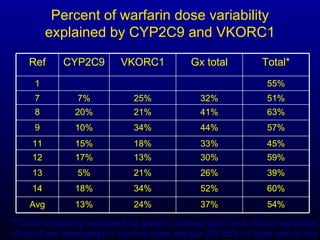
Percent of warfarin dose variability explained by CYP2C9 and VKORC1 *Total variability explained by genetic, demographic and clinical variables Clinical and demographic factors alone explain 20-25% of dose variability 60% 52% 34% 18% 14 54% 37% 24% 13% Avg 59% 30% 13% 17% 12 21% 18% 34% 21% 25% VKORC1 26% 33% 44% 41% 32% Gx total 39% 5% 13 57% 10% 9 45% 15% 11 63% 20% 8 51% 7% 7 55% 1 Total* CYP2C9 Ref
Warfarin dose variance in European Caucasians VKORC1 genotype  CYP2C9*2,*3  Dosing algorithms (VKORC1+ CYP2C9 + age + body mass  +other meds)  Other factors??? 21-25% of dose variance 6-10% of dose variance 50-60%  40-50%
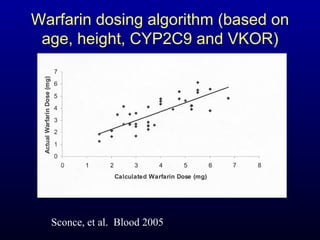
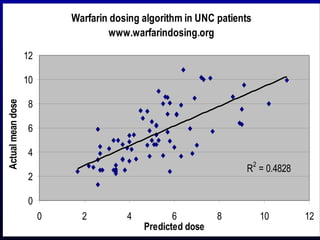
Warfarin dosing algorithm (based on age, height, CYP2C9 and VKOR) Sconce, et al.  Blood 2005
 
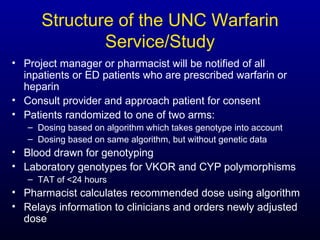
Structure of the UNC Warfarin Service/Study Project manager or pharmacist will be notified of all inpatients or ED patients who are prescribed warfarin or heparin Consult provider and approach patient for consent Patients randomized to one of two arms:  Dosing based on algorithm which takes genotype into account Dosing based on same algorithm, but without genetic data Blood drawn for genotyping Laboratory genotypes for VKOR and CYP polymorphisms TAT of <24 hours Pharmacist calculates recommended dose using algorithm Relays information to clinicians and orders newly adjusted dose
Provider Education Crucial to success of efforts to incorporate PGx into clinical practice If providers consider genotyping before giving the first dose more beneficial impact on proper optimal dosing will result Educate providers about utility of genotyping to stimulate orders at the time which warfarin is first considered Attendings House staff Nursing  Pharmacy personnel We will also take this opportunity to survey attitudes and knowledge about PGx before,during and after the study Of providers Of patients
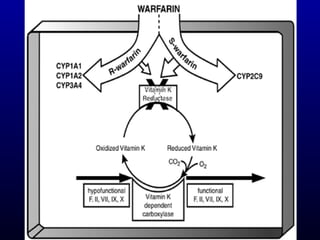
CYP2C9 7-hydroxywarfarin 6-hydroxywarfarin 8-hydroxywarfarin 10-hydroxywarfarin CYP1A1 CYP1A2 CYP3A4

10.29.07 Coumadin P Gx Jonas

  • 1.
    Pharmacogenomics: Using GeneticTesting to Guide Warfarin Therapy Dan Jonas, MD, MPH Noon Conference October 29, 2007                             
  • 2.
    Genetic Polymorphisms AKey to Human Individuality Polymorphisms are subtle differences in our genome Polymorphisms are common We are 99.9% identical at the DNA level But this still leaves ~3,000,000 specific DNA differences between you and others Such differences affect our appearance, our behavior, our susceptibility to disease and our response to medications
  • 3.
    Single Nucleotide Polymorphisms(SNPs) A key to human variability DNA sequence variation at a single nucleotide that may alter the function of the encoded protein Polymorphisms are common and contribute to common diseases and influence our response to medications * Functional but altered protein Functional protein
  • 4.
    What is Pharmacogenomics(PGx)? The study of how variations in the human genome affect the response to medications Tailoring treatments to unique genetic profiles “ personalized” or “individualized” medicine Some use terms interchangeably with PGx But, PGx is just one aspect of PM
  • 5.
    Individualized Medicine Currentdrug therapy in medicine: Efficacy may vary widely Resulting in wasted resources and time Adverse effects are common and unpredictable Complications and deaths Genetically guided therapy Direct treatment in an individualized manner To better target those most likely to benefit and least likely to be harmed Determine who to treat at all (e.g. prostate cancer?)
  • 6.
    Pharmacogenomics The variableefficacy and unpredictability of adverse effects likely has a significant genetic component Secondary to polymorphisms Drug target polymorphisms Polymorphisms in metabolic / drug excretion pathways Cytochrome P450 Implications for drug development / discovery
  • 7.
    Goldstein DB, etal. Nature Reviews 2003;4: 937-947 Genetic variants found to be significantly associated with drug response in at least two studies Nature Reviews 2003;4:937-947
  • 8.
    Goldstein DB, etal. Nature Reviews 2003;4: 937-947 Genetic variants found to be significantly associated with drug response in at least two studies Nature Reviews 2003;4:937-947
  • 9.
    Commonly prescribed Narrowtherapeutic window Great hazard if outside of therapeutic window Significant variability in individual response to standard dosages No good alternative The Perfect Drug for PGx Intervention Warfarin (Coumadin)
  • 10.
    Warfarin Commonly prescribed(2 million per year in the US) High rate of adverse events Warfarin maintenance doses are characterized by large interindividual variability Maintenance doses can range 50-fold (eg, daily dose requirements range from 0.5 to 25 mg) Warfarin is THE example of a narrow therapeutic index There have been several efforts to define this interindividual variability using genetic and non-genetic factors
  • 11.
    Factors that Correlatew/ Warfarin Dose Age Body surface area (BSA) or weight Amiodarone dose Other drugs (e.g. HMG CoA Reductase inhibitors) Target INR Race Sex Plasma vitamin K level Decompensated CHF or post-operative state The patient’s genetic status with regard to polymorphisms
  • 12.
    Genes important forWarfarin Pharmacogenetics CYP2C9 Metabolizes >90% of active Warfarin Variant alleles associated with increased sensitivity to Warfarin (CYP2C9*2, *3) Vitamin K epoxide reductase (VKOR) Inhibited by Warfarin Important for replenishment of vitamin K Variant alleles of VKORC1 gene associated with altered response to Warfarin
  • 13.
  • 14.
    CYP2C9 variantalleles CYP2C9*2, CYP2C9*3 – most common variants Seen in 20-40% of Caucasians, <10% Asians and African Americans Associated with reduced CYP2C9 enzyme activity Variant alleles associated with lower mean doses of Warfarin longer times to stabilization of INR higher risk for bleeding events
  • 15.
  • 16.
  • 17.
    The VKOR Gene Vitamin K Epoxide Reductase Cloned in 2004 Stafford et. al (Nature 427: 541 – 544; 2004) Johannes Oldenburg, Wurzburg, Germany Resides on human chromosome 16p11.2 The target protein for warfarin’s action
  • 18.
    Effect of VKORC1Haplotype A or B on Warfarin dosage Rieder et al. New England Journal of Medicine 2005
  • 19.
    Individual Variability inWarfarin Dose Warfarin maintenance dose (mg/day) SENSITIVITY CYP2C9 coding SNPs RESISTANCE VKORC1 coding SNPs Frequency Common VKORC1 non-coding SNPs Adapted from Rettie and Tai, Molecular Interventions 2006 (*3/*3) 0.5 5 15
  • 20.
  • 21.
    Warfarin & theFDA Changed package insert for warfarin Aug 2007 Label now provides information regarding altered metabolism in CYP2C9 and VKORC1 genetic variants Concerns regarding Provider knowledge Patient demand Potential for influencing litigation
  • 22.
    What is theclinical evidence? FDA working group selected relevant studies A number found strong associations cross-sectional studies in many populations Lower dose requirements with CYP2C9 3 prospective studies Caraco 2007; Millican 2007; Limdi 2007
  • 23.
    Caraco et al. Controlled trial, prospective (“randomized” by MRN); N=283 enrolled, 191 analyzed Control group: all started on 5mg and adjust dose based on pre-established protocol Required daily monitoring of INR for initial 8 days Intervention group: CYP2C9 genotype-adjusted protocol Altered recommended dose by a set % for each of 6 different genotypes (*1/*1, *1/*2, *1/*3, etc.) Results: stable anticoagulation 18.1 days earlier TTR 80.4% vs 63.4% (P < 0.001) Clin Pharmacol Ther. 2007 Sep 12; [Epub ahead of print]; Hadassah University, Israel
  • 24.
    Millican et al.Retrospective analysis of 2 prospective cohorts to compare 2 approaches to PGx-guided warfarin initiation N=118 (46 and 72) patients scheduled for primary or revision total knee or hip arthroplasty 1 st cohort: warfarin initiated and refined (target range 2-3) based on clinical factors and CYP2C9 genotype 2 nd cohort: warfarin initiated (target range 1.7-2.7) based on these factors plus VKORC1 genotype; dose refinements after the 3 rd dose were gene-guided 4-6 week follow up Millican et al., Blood. 2007 Sep 1;110(5):1511-5. Epub 2007 Mar 26; Wash U; Voora et al., Thromb Haemost. 2005 Apr;93(4):700-5; Grice, Gage, et al. ACCP 2007 Poster
  • 25.
    Limdi et al.Large prospective cohort study (N=490) with 2 year follow up All patients treated with standardized approach to warfarin dose adjustments Results: Variant CYP2C9 genotype Increased risk for major hemorrhage (HR 3.0; 95% CI 1.1-8.0) a , but not minor hemorrhage Variant VKORC1 genotype (1173C/T) Did not confer an increase in risk for major or minor Limidi et al., Clin Pharmacol Ther. 2007 Jul 25; [Epub ahead of print]; UAB a Adjusted for age, gender, race, BMI, VKORC1, vitamin K and alcohol intake, warfarin dose, interacting drugs, number of comorbid conditions, and INR at the time of the event
  • 26.
    Pharmacogenomics at UNCto Guide Warfarin Therapy Incorporate PGx guidance in warfarin dosing at UNC through implementation of a randomized trial Integrated effort--Genetics, clinical labs, pharmacy, and providers PGx has the most to offer in choosing the initial dosing of warfarin Subsequent dosage adjustments will still be primarily guided by following INRs Thus, we need rapid identification of patients placed on warfarin
  • 27.
    Structure of theUNC Warfarin PGx Study Inclusion criteria: Adults (≥ 18) newly starting warfarin Planned ≥ 3 months of anticoagulation with target INR ≥ 2. Following up at UNC (ACC or Family Practice) Exclsuion criteria: History of treatment with warfarin and know dose requirement unable to complete the study materials (questionnaires) with or without assistance (e.g. dementia), including non-English speaking patients Pregnancy Treating physician opposed to enrolling
  • 28.
    UNC Warfarin PGxStudy PM or Clinical pharmacist notified via: Orders for heparin or warfarin Physician U/S Doppler tech Project Manager prescreens subject for possible inclusion via electronic medical record PM contacts physician and approaches patient for consent PM contacts clinical pharmacist, who orders blood draw for CYP2C9 and VKOR Blood drawn and sent to lab along with signed consent; results reported in Webcis Subjects are randomized to the control or experimental group
  • 29.
    Experimental Group Pharmacistcalculates dose using algorithm ASAP without genetic info & re-calculates dose including genetic info as soon as available Pharmacist communicates recommended dose to the treating physician & ensures patient is d/c’d on that dose Pharmacist calculates dose using algorithm ASAP without genetic info Clinical pharmacist makes dose change Subjects follow up for routine care in the ACC or Family Medicine Center Anticoagulation Clinc Control Group Collect outcomes data over first 3 months of treatment: visits, TTR, utilization… Pharmacist communicates recommended dose to the treating physician & ensures patient is d/c’d on that dose Clinical pharmacist makes dose change Subjects follow up for routine care in the ACC or Family Medicine Center Anticoagulation Clinc Collect outcomes data over first 3 months of treatment: visits, TTR, utilization…
  • 30.
    Outcomes Time intherapeutic range (TTR) # of visits required Complications Minor and Major bleeding INRs > 4 Process measures Genotyping turn-around-time Provider knowledge and attitudes Cost-effectiveness
  • 31.
    When Starting Warfarin…consider Genotype! Warfarin genotyping panel (pertinent VKOR and CYP polymorphisms) will be available soon In the context of the study For clinical use
  • 32.
  • 33.
    Thank You! Geneticsand Medicine: Jim Evans Betsy Bryant Brent Ferrell Leslie Lange Kristy Lee Kandamurugu Manickam Stephan Moll Cécile Skrzynia Marcia Van Riper Maimoona Zariwala Pharmacy and Institute for Pharmacogenomics and Individualized Therapy Howard McLeod Stephen Eckel John Valgus Laboratory Medicine Karen Weck Jessica Booker Mike Langley Family Practice Sarah Ford DEPARTMENT OF GENETICS
  • 34.
  • 35.
  • 36.
    Prevalence of geneticvariations influencing warfarin maintenance dose CYP2C9 ~4% PM’s (two inactive alleles eg. *3/*3) ~35% IM’s (one inactive allele eg. *1/*3) ~60% EM’s (two active alleles eg *1/*1) VKORC1 ~37% GG, highest maintenance doses ~47% AG, intermediate maintenance doses ~16% AA, lowest maintenance doses
  • 37.
    CYP2C9 Polymorphisms (*2) Arg  Cys codon 144 (*3) Ile  Leu codon 359 (*4) Ile  Thr codon 359 (*5) Asp  Glu codon 360 (*1) wild type
  • 38.
    Individualized Medicine Predisposition and Screening The current status of disease screening in medicine In spite of aggregate benefit… Relatively little benefit to a given individual Actual harm to some Tremendous waste of resources Genetically guided screening holds the promise of: Preventing disease in those susceptible Early detection Rational use of society’s limited resources
  • 39.
    CYP450 Gene NomenclatureCYP 2 C 19 *1 (normal allele) Variant alleles (named in order of discovery): CYP 2 C 19 *2 CYP 2 C 19 *3 CYP 2 C 19 *4 Family Subfamily Gene Allele Variant
  • 40.
    Major CYP450 enzymesinvolved in drug metabolism CYP1A2 CYP2C9 CYP2C19 genetically variable CYP2D6 CYP2E1 CYP3A4 CYP3A5
  • 41.
    CYP2C9 genevariants Enzyme Activity Normal Reduced (50-70%) Reduced (5-15%) I359L * R144C * CYP2C9*1 (wild type) CYP2C9*2 CYP2C9*3
  • 42.
    CYP2C9 Allele frequenciesAbsent? Rare 0.023 *11 (R335W) Absent? Absent? 0.01 *6 (818delA) Absent? Absent? 0.01 *5 Absent? Absent? 0.01 *4 0.02-0.4 0.05-0.10 0.01 *3 Rare 0.10-0.16 Rare *2 0.984 0.743 0.953 *1 Asians Caucasians African Americans
  • 43.
    VKORC1 genevariants Enzyme Clinical Activity Effect spontaneous bleeding (VKCFD2) Warfarin Warfarin resistance binding? OR OR Warfarin dose R98W *  SNPs
  • 44.
    Percent of warfarindose variability explained by CYP2C9 and VKORC1 *Total variability explained by genetic, demographic and clinical variables Clinical and demographic factors alone explain 20-25% of dose variability 60% 52% 34% 18% 14 54% 37% 24% 13% Avg 59% 30% 13% 17% 12 21% 18% 34% 21% 25% VKORC1 26% 33% 44% 41% 32% Gx total 39% 5% 13 57% 10% 9 45% 15% 11 63% 20% 8 51% 7% 7 55% 1 Total* CYP2C9 Ref
  • 45.
    Warfarin dose variancein European Caucasians VKORC1 genotype CYP2C9*2,*3 Dosing algorithms (VKORC1+ CYP2C9 + age + body mass +other meds) Other factors??? 21-25% of dose variance 6-10% of dose variance 50-60% 40-50%
  • 46.
    Warfarin dosing algorithm(based on age, height, CYP2C9 and VKOR) Sconce, et al. Blood 2005
  • 47.
  • 48.
    Structure of theUNC Warfarin Service/Study Project manager or pharmacist will be notified of all inpatients or ED patients who are prescribed warfarin or heparin Consult provider and approach patient for consent Patients randomized to one of two arms: Dosing based on algorithm which takes genotype into account Dosing based on same algorithm, but without genetic data Blood drawn for genotyping Laboratory genotypes for VKOR and CYP polymorphisms TAT of <24 hours Pharmacist calculates recommended dose using algorithm Relays information to clinicians and orders newly adjusted dose
  • 49.
    Provider Education Crucialto success of efforts to incorporate PGx into clinical practice If providers consider genotyping before giving the first dose more beneficial impact on proper optimal dosing will result Educate providers about utility of genotyping to stimulate orders at the time which warfarin is first considered Attendings House staff Nursing Pharmacy personnel We will also take this opportunity to survey attitudes and knowledge about PGx before,during and after the study Of providers Of patients
  • 50.
    CYP2C9 7-hydroxywarfarin 6-hydroxywarfarin8-hydroxywarfarin 10-hydroxywarfarin CYP1A1 CYP1A2 CYP3A4

Editor's Notes

  • #2 The Right Dose of Warfarin for Every Patient