DAPT TRIAL
DR. SAITEJ REDDY
 Introduction
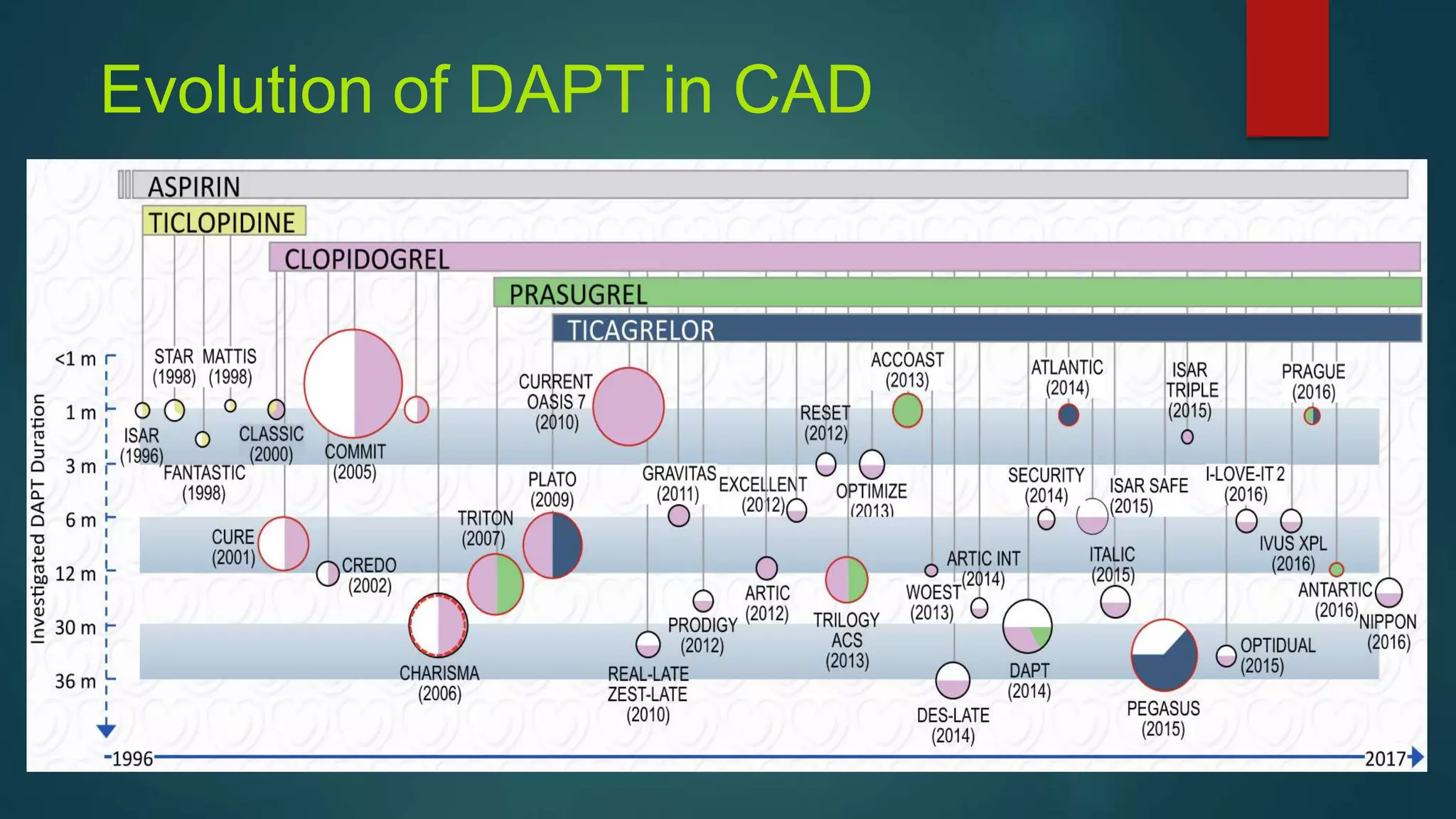
 Evolution of DAPT in CAD
 Duration of antiplatelet therapy
 DAPT trial
 DAPT score
 PRECISE DAPT score
 Changed recommendations on DAPT
INTRODUCTION
• Currently coronary stenting is widely done all over the world for ischemic heart disease
and its well know complication is restenosis and stent thrombosis.
• Although DES reduce the rate of restenosis as compared with BMS, there is concern that
DES may be associated with a risk of stent thrombosis
• Early stent thrombosis <30 days.
• late stent thrombosis >30 days to 1 year.
• very late stent thrombosis >1 year.
 Antiplatelet therapy represents the cornerstone of antithrombotic therapy
after coronary stenting.
 With the passing of time, the importance of aspirin has been diminished by
newer P2Y12 inhibitors that assure a faster onset of action and more
consistent inhibitor properties.
• Aspirin is irreversible inhibitor of cox-1 enzyme, which plays a critical role in the synthesis
of TxA2, a mediator of vasoconstriction and a stimulator of platelet aggregation.
• Rational of dual antiplatelet agents: why aspirin is not enough?
• Aspirin interferes partially with inhibition of platelets(inhibits TxA2 only) but platelets
remain responsive to other stimuli like ADP
• Residual platelet reactivity despite chronic aspirin therapy
• Aspirin resistance
Evolution of DAPT in CAD
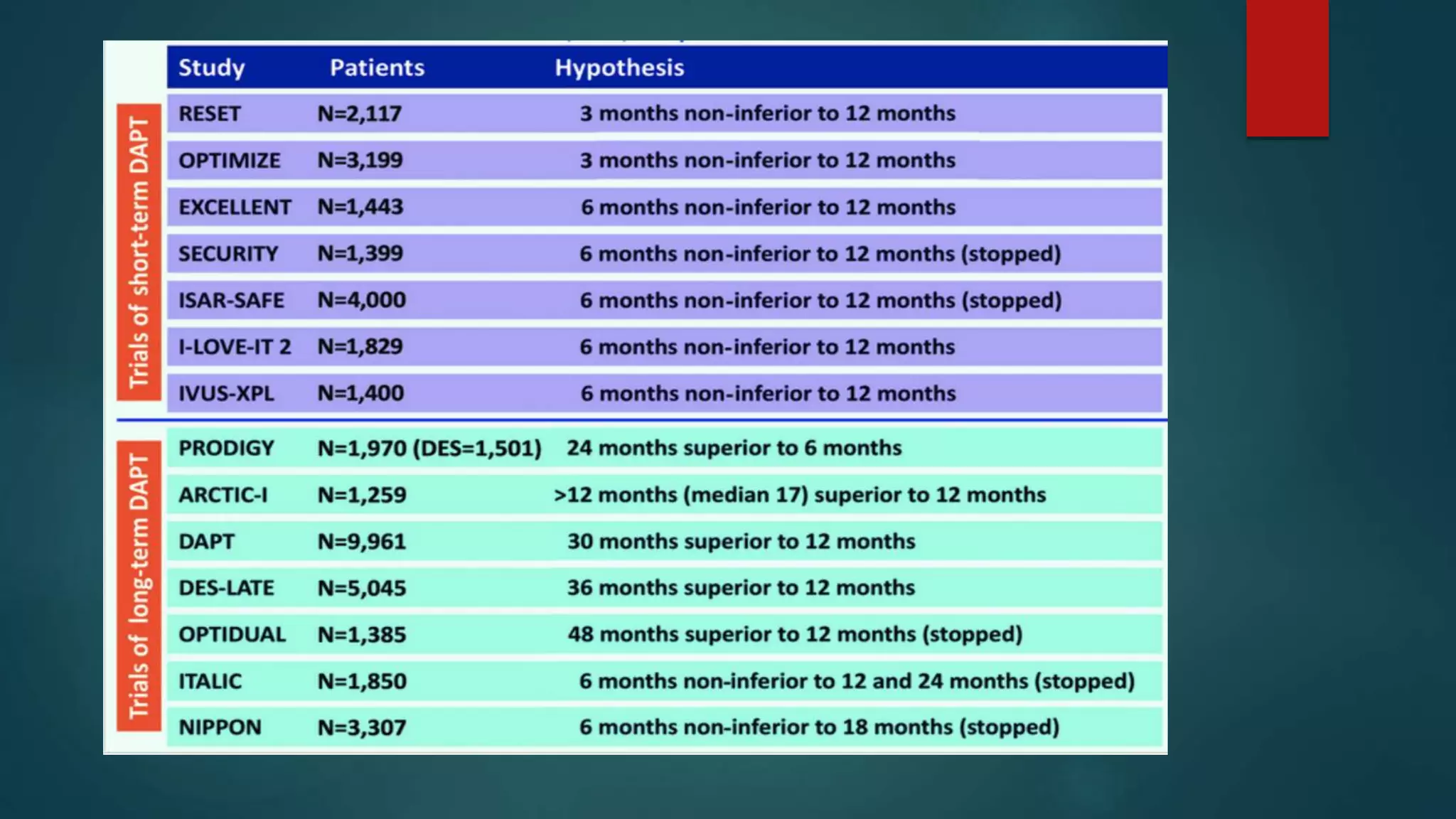
Duration of antiplatelet therapy
Traditionally
• Standard DAPT - 12 months
• Short DAPT(S-DAPT) - 3 to 6 months
• Longer DAPT(L-DAPT) - >12 months
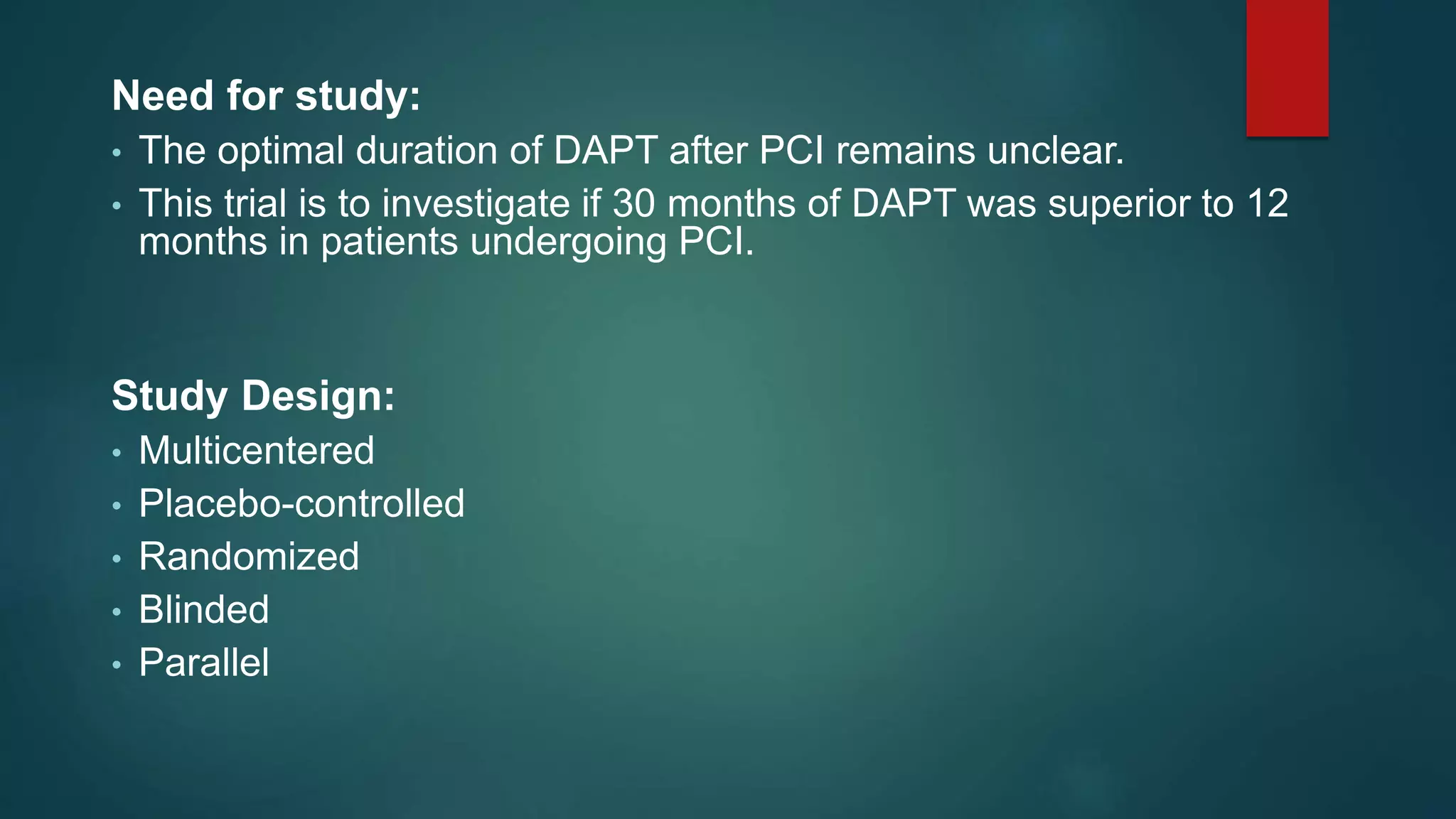
Need for study:
• The optimal duration of DAPT after PCI remains unclear.
• This trial is to investigate if 30 months of DAPT was superior to 12
months in patients undergoing PCI.
Study Design:
• Multicentered
• Placebo-controlled
• Randomized
• Blinded
• Parallel
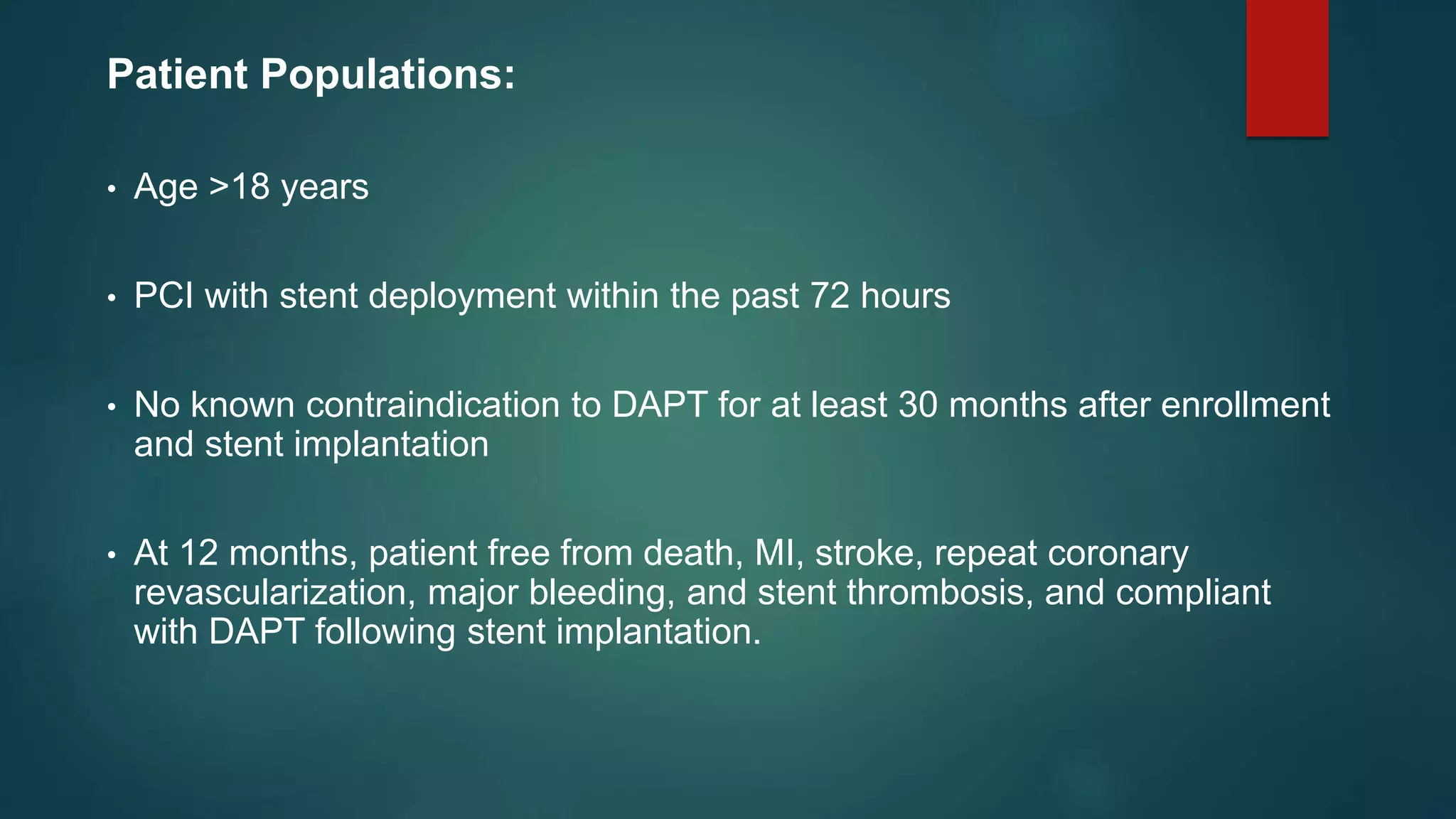
Patient Populations:
• Age >18 years
• PCI with stent deployment within the past 72 hours
• No known contraindication to DAPT for at least 30 months after enrollment
and stent implantation
• At 12 months, patient free from death, MI, stroke, repeat coronary
revascularization, major bleeding, and stent thrombosis, and compliant
with DAPT following stent implantation.
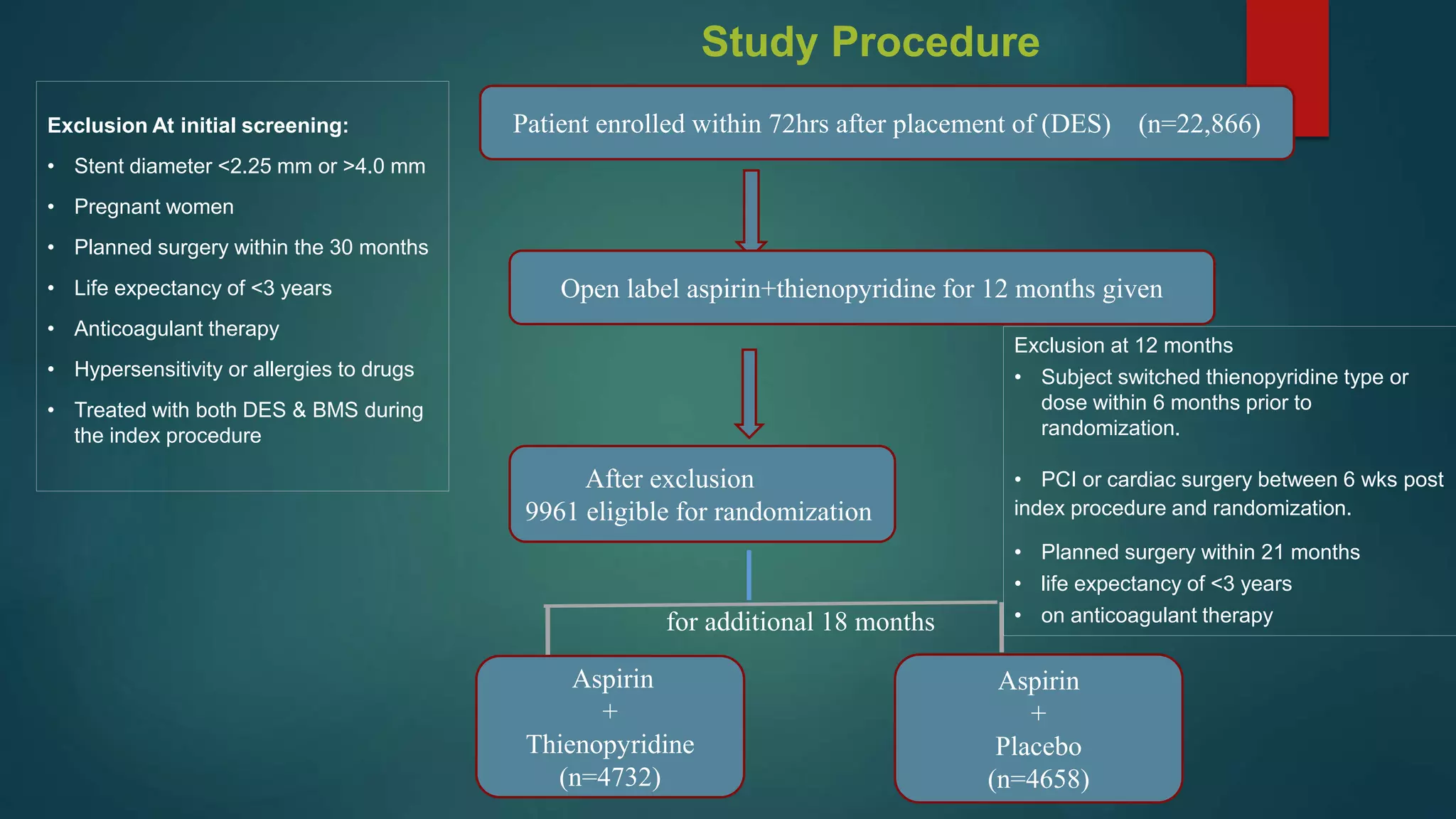
Study Procedure
Patient enrolled within 72hrs after placement of (DES) (n=22,866)
Open label aspirin+thienopyridine for 12 months given
After exclusion
9961 eligible for randomization
Aspirin
+
Thienopyridine
(n=4732)
Aspirin
+
Placebo
(n=4658)
for additional 18 months
Exclusion at 12 months
• Subject switched thienopyridine type or
dose within 6 months prior to
randomization.
• PCI or cardiac surgery between 6 wks post
index procedure and randomization.
• Planned surgery within 21 months
• life expectancy of <3 years
• on anticoagulant therapy
Exclusion At initial screening:
• Stent diameter <2.25 mm or >4.0 mm
• Pregnant women
• Planned surgery within the 30 months
• Life expectancy of <3 years
• Anticoagulant therapy
• Hypersensitivity or allergies to drugs
• Treated with both DES & BMS during
the index procedure
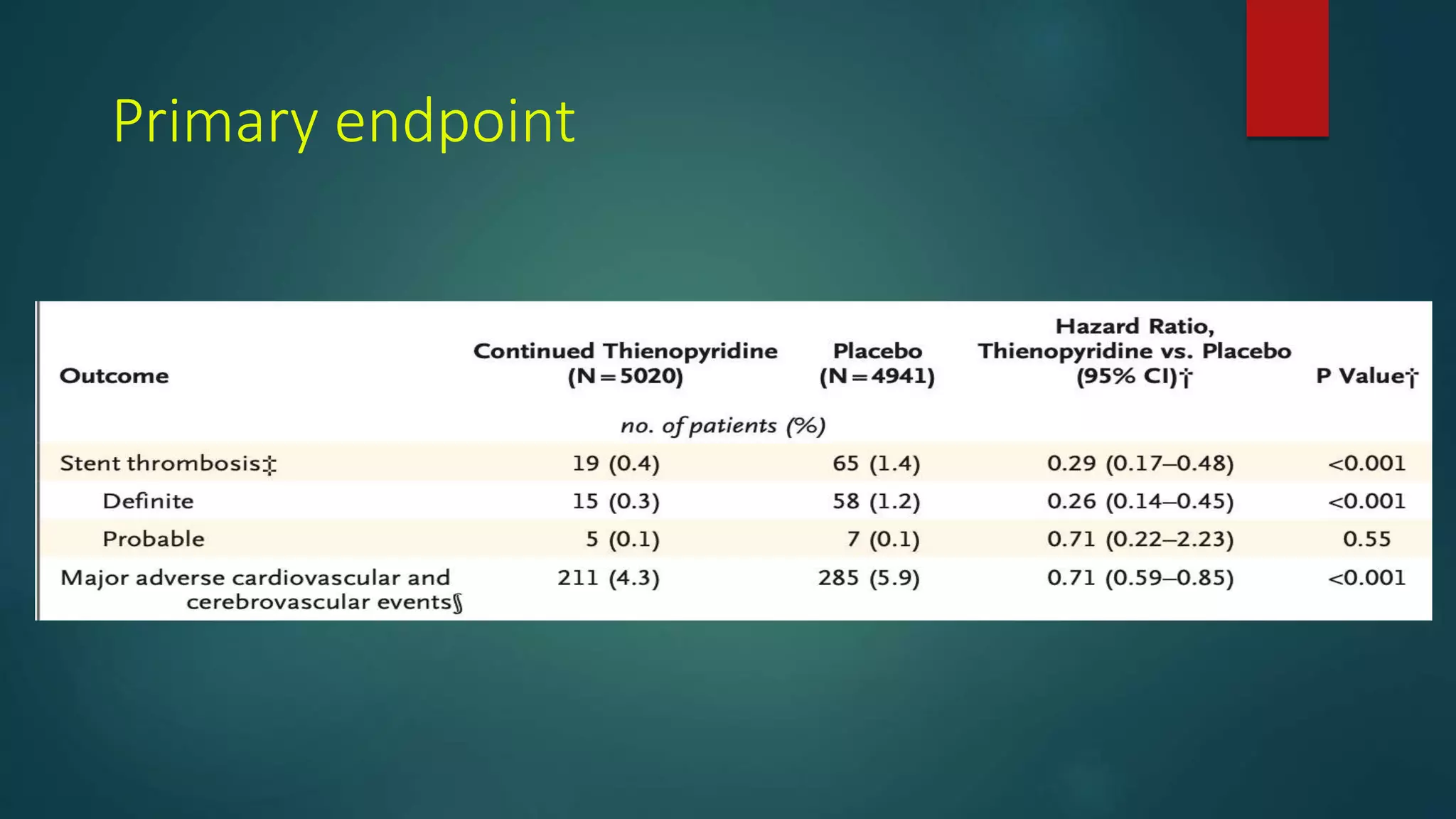
Primary Endpoint:
 Efficacy endpoint
• MACCE at 18 months following enrollment (30 months from index
procedure)
• Stent thrombosis at 18 months
 Safety endpoint
• Moderate or severe GUSTO bleeding at 18 months
Secondary Endpoint:
• All-cause mortality
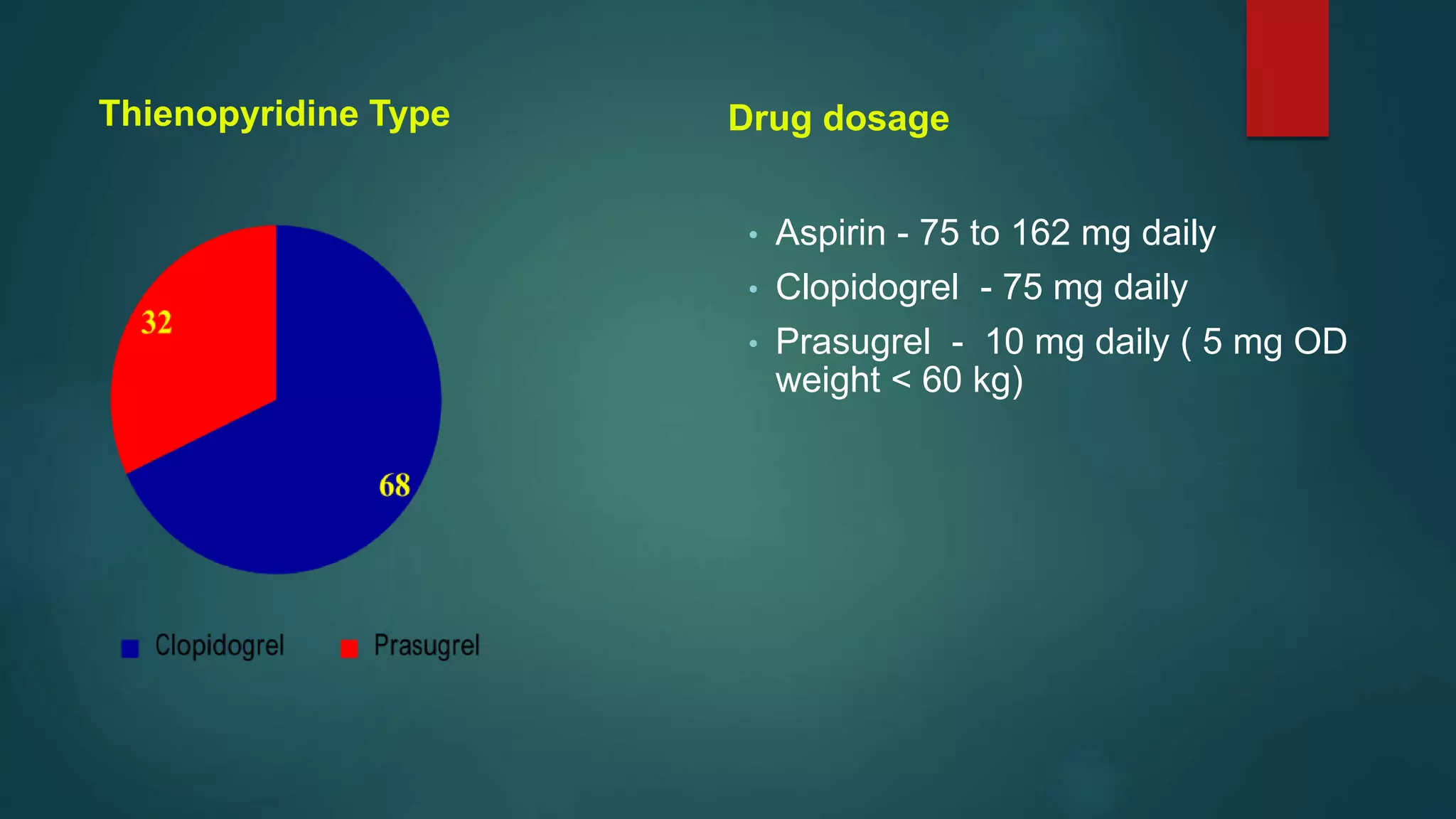
Thienopyridine Type
• Aspirin - 75 to 162 mg daily
• Clopidogrel - 75 mg daily
• Prasugrel - 10 mg daily ( 5 mg OD
weight < 60 kg)
Drug dosage
Thienopyridine Placebo
Primary endpoint
Secondary endpoint
 In prolonged DAPT group(per 1000pts/yr)
• 20 fewer MI
• 09 more bleeding episodes
• 05 more overall mortality
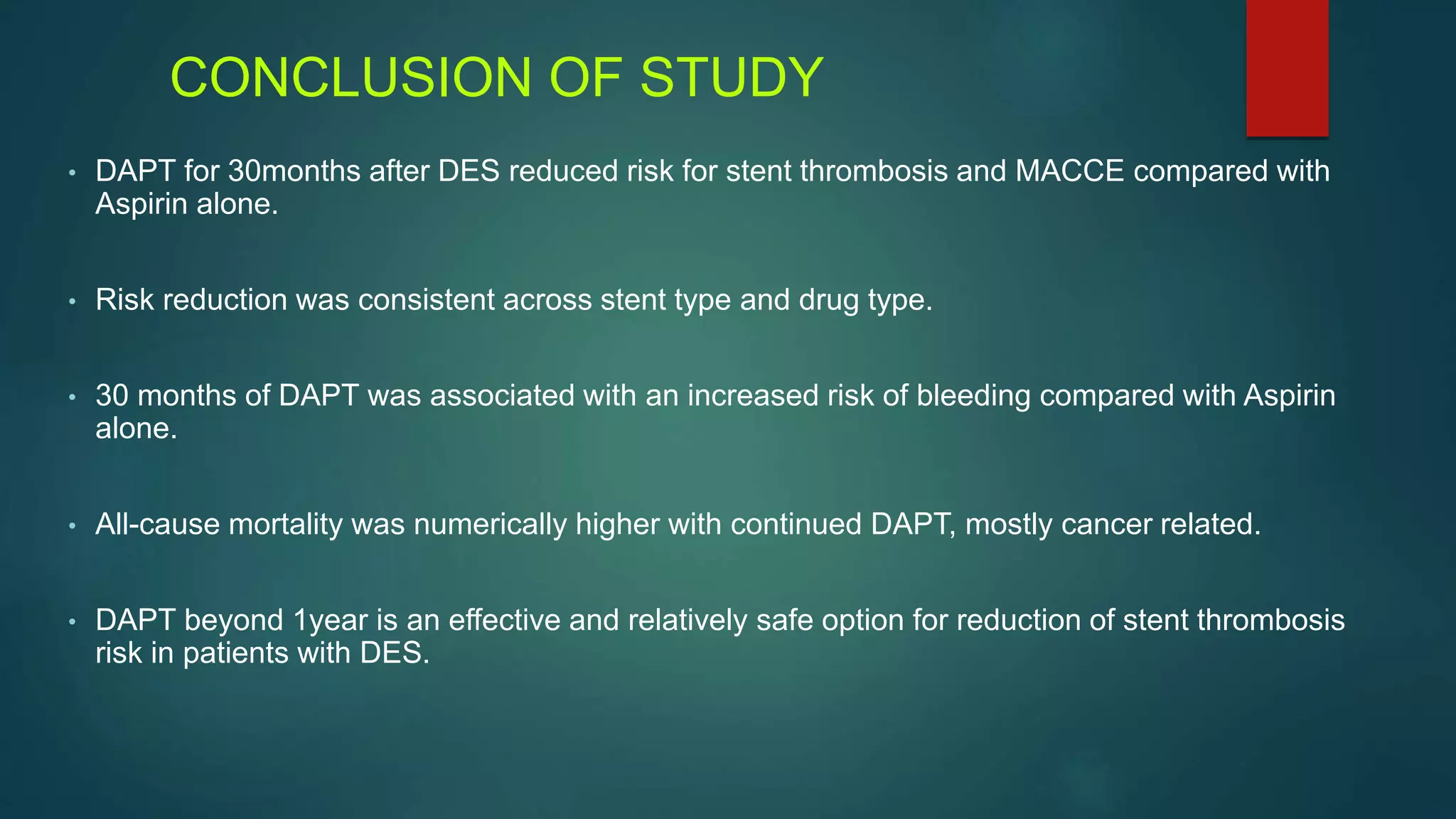
CONCLUSION OF STUDY
• DAPT for 30months after DES reduced risk for stent thrombosis and MACCE compared with
Aspirin alone.
• Risk reduction was consistent across stent type and drug type.
• 30 months of DAPT was associated with an increased risk of bleeding compared with Aspirin
alone.
• All-cause mortality was numerically higher with continued DAPT, mostly cancer related.
• DAPT beyond 1year is an effective and relatively safe option for reduction of stent thrombosis
risk in patients with DES.
LIMITATIONS OF STUDY
• Only patients who did not have MACCE, stent thrombosis, or moderate or
severe bleeding were included, indicating the study population is low risk
for adverse events.
• Direct comparisons between different stent types or drugs was not done.
DAPT SCORE
• DAPT score is derived from secondary analysis of DAPT trial.
• Among DAPT Study patients, a prediction rule was derived stratifying
patients into groups to distinguish ischemic and bleeding risk 12 to 30
months after PCI.
• Validation was internal via bootstrap resampling and external among 8136
patients from 36 countries randomized in the PROTECT trial.
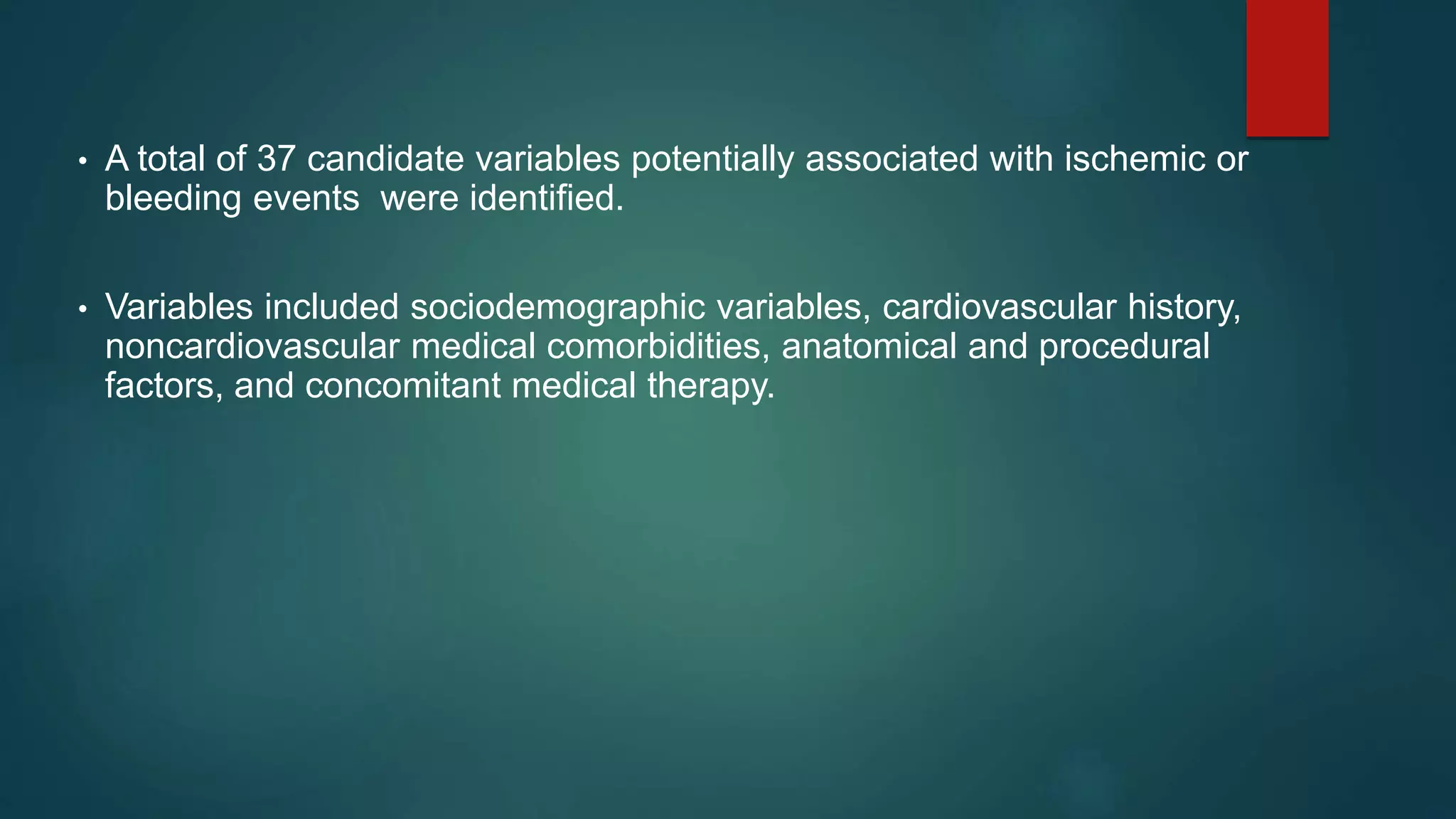
• A total of 37 candidate variables potentially associated with ischemic or
bleeding events were identified.
• Variables included sociodemographic variables, cardiovascular history,
noncardiovascular medical comorbidities, anatomical and procedural
factors, and concomitant medical therapy.
high score group - score ≥2
low score group - score <2
DAPT longer than 12 months is
recommended for those with a
DAPT score ≥ 2.
A score of ≥2 is associated with a
favorable benefit/risk ratio
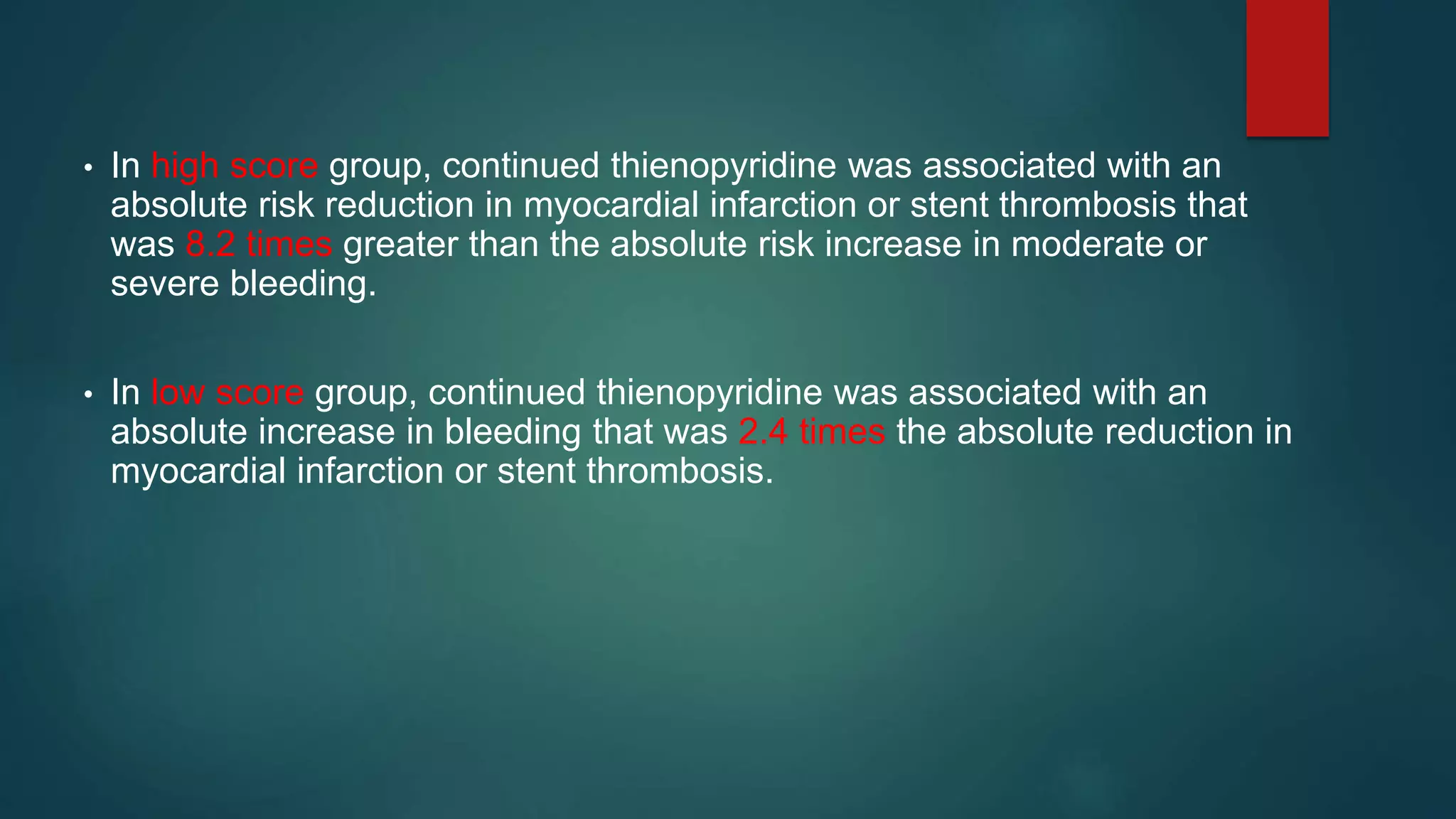
• In high score group, continued thienopyridine was associated with an
absolute risk reduction in myocardial infarction or stent thrombosis that
was 8.2 times greater than the absolute risk increase in moderate or
severe bleeding.
• In low score group, continued thienopyridine was associated with an
absolute increase in bleeding that was 2.4 times the absolute reduction in
myocardial infarction or stent thrombosis.
 The score has been developed from a collaborative dataset including
14,963 patients from 8 randomized clinical trials.
 Validated in patients treated with PCI from the PLATelet inhibition
and patient Outcomes (PLATO) trial (n=8595) and BernPCI registry
(n=6172).
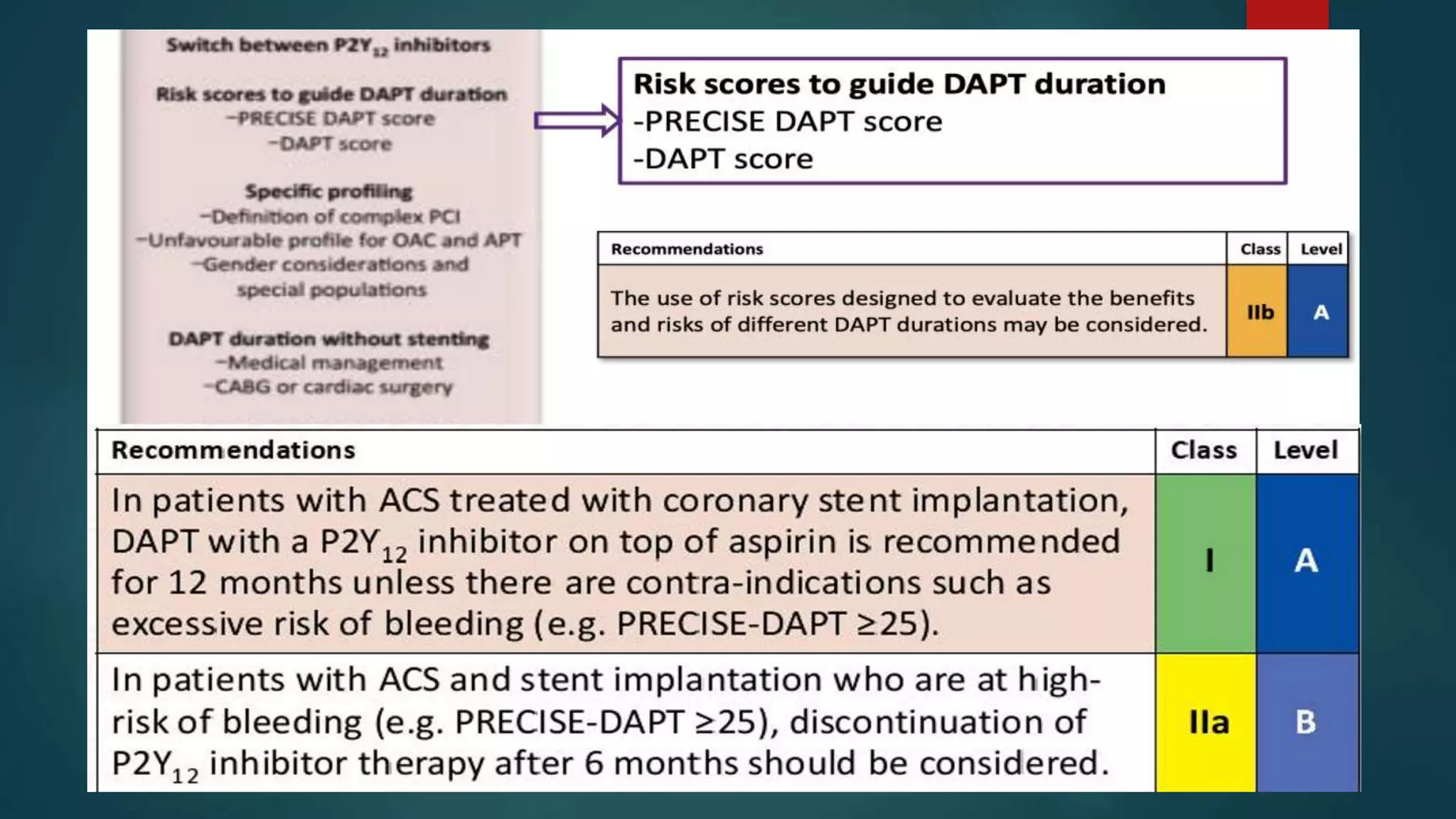
high bleeding risk (PRECISE-DAPT score ≥25)
non-high bleeding risk (PRECISE-DAPT score <25)
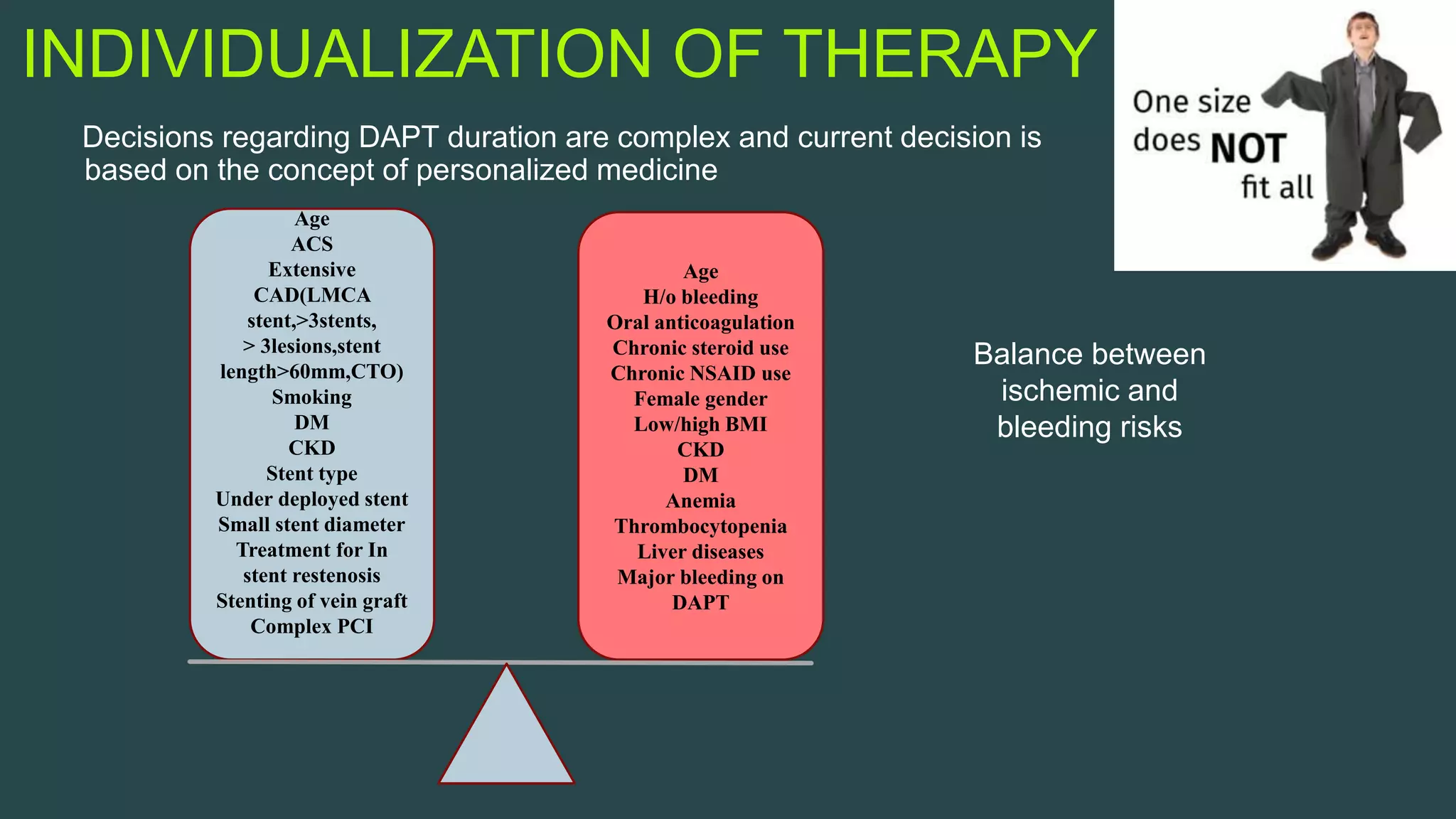
INDIVIDUALIZATION OF THERAPY
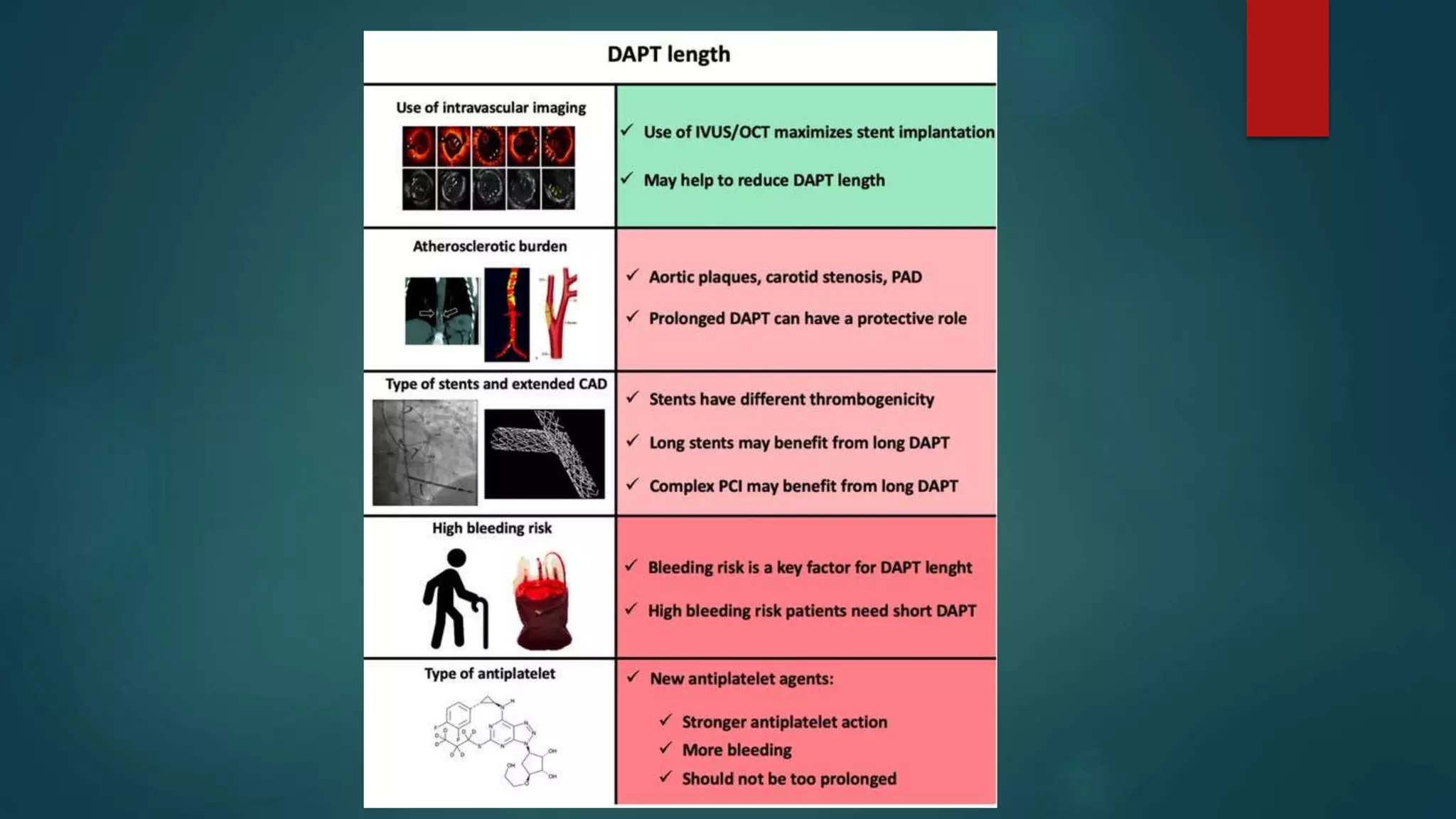
Decisions regarding DAPT duration are complex and current decision is
based on the concept of personalized medicine
Age
ACS
Extensive
CAD(LMCA
stent,>3stents,
> 3lesions,stent
length>60mm,CTO)
Smoking
DM
CKD
Stent type
Under deployed stent
Small stent diameter
Treatment for In
stent restenosis
Stenting of vein graft
Complex PCI
Age
H/o bleeding
Oral anticoagulation
Chronic steroid use
Chronic NSAID use
Female gender
Low/high BMI
CKD
DM
Anemia
Thrombocytopenia
Liver diseases
Major bleeding on
DAPT
Balance between
ischemic and
bleeding risks
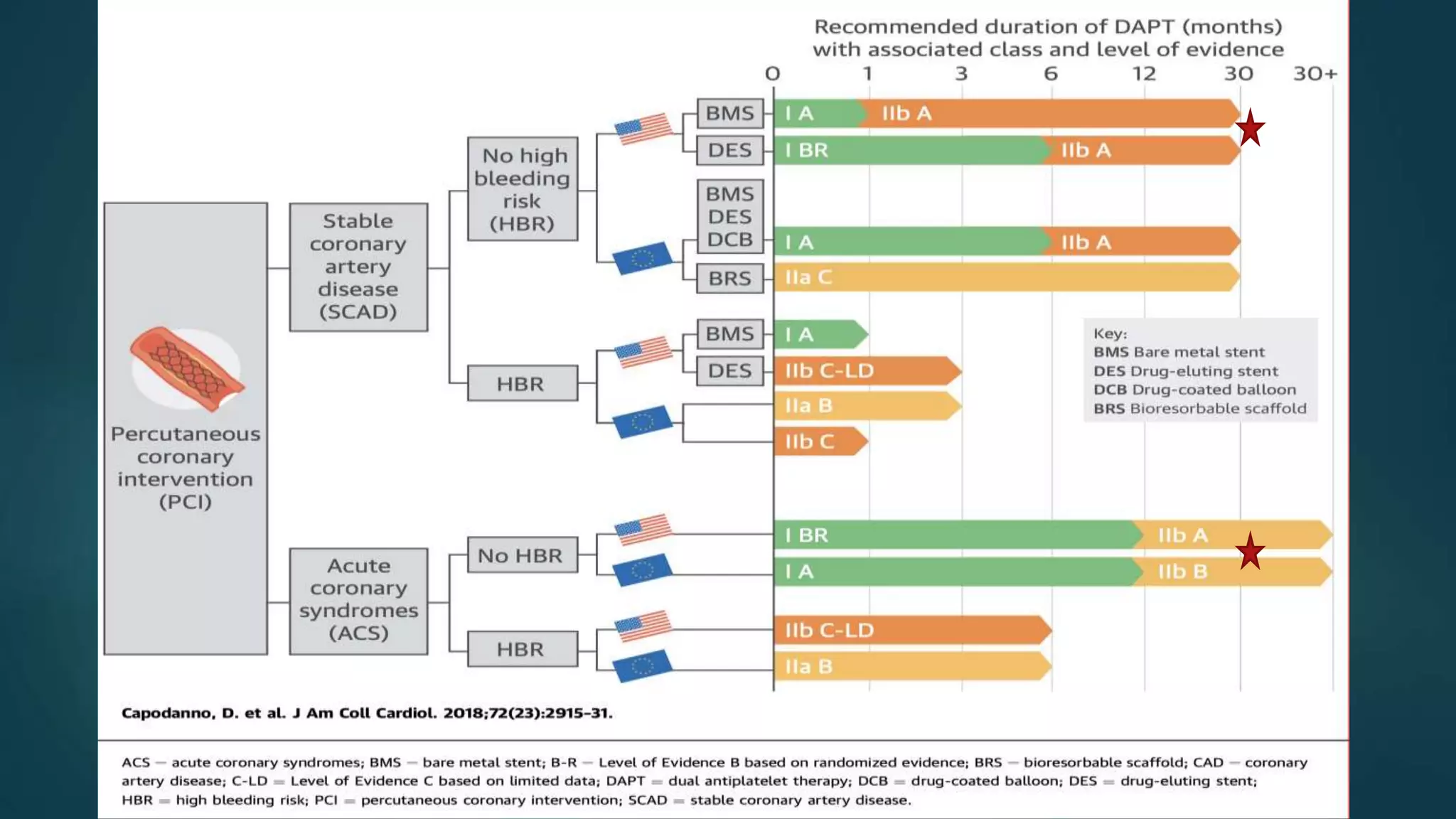
2017 ESC focused update on DAPT
ACC/AHA 2016
TAKE HOME MESSAGE
• The DAPT trial suggests that although there may be an ischemic benefit with
prolonged DAPT therapy, there is a price to pay in terms of bleeding risk.
• The excess in mortality is concerning, and appears to be predominantly due to
cancer-related mortality.
• The data on the duration of DAPT in patients with CAD continues to evolve
especially with the availability of newer stent designs and potent antiplatelet agents
and newer oral anticoagulants.
• Novel DES has been shown to be safer than BMS.
• Bleeding risks scores like DAPT and PRECISE DAPT score is applied in decision
making.
• The concept of individualization of therapy(personalized medicine) is gaining
importance.
DAPT trial

DAPT trial

  • 1.
  • 2.
     Introduction  Evolutionof DAPT in CAD  Duration of antiplatelet therapy  DAPT trial  DAPT score  PRECISE DAPT score  Changed recommendations on DAPT
  • 3.
    INTRODUCTION • Currently coronarystenting is widely done all over the world for ischemic heart disease and its well know complication is restenosis and stent thrombosis. • Although DES reduce the rate of restenosis as compared with BMS, there is concern that DES may be associated with a risk of stent thrombosis • Early stent thrombosis <30 days. • late stent thrombosis >30 days to 1 year. • very late stent thrombosis >1 year.
  • 4.
     Antiplatelet therapyrepresents the cornerstone of antithrombotic therapy after coronary stenting.  With the passing of time, the importance of aspirin has been diminished by newer P2Y12 inhibitors that assure a faster onset of action and more consistent inhibitor properties.
  • 5.
    • Aspirin isirreversible inhibitor of cox-1 enzyme, which plays a critical role in the synthesis of TxA2, a mediator of vasoconstriction and a stimulator of platelet aggregation. • Rational of dual antiplatelet agents: why aspirin is not enough? • Aspirin interferes partially with inhibition of platelets(inhibits TxA2 only) but platelets remain responsive to other stimuli like ADP • Residual platelet reactivity despite chronic aspirin therapy • Aspirin resistance
  • 6.
  • 7.
    Duration of antiplatelettherapy Traditionally • Standard DAPT - 12 months • Short DAPT(S-DAPT) - 3 to 6 months • Longer DAPT(L-DAPT) - >12 months
  • 11.
    Need for study: •The optimal duration of DAPT after PCI remains unclear. • This trial is to investigate if 30 months of DAPT was superior to 12 months in patients undergoing PCI. Study Design: • Multicentered • Placebo-controlled • Randomized • Blinded • Parallel
  • 12.
    Patient Populations: • Age>18 years • PCI with stent deployment within the past 72 hours • No known contraindication to DAPT for at least 30 months after enrollment and stent implantation • At 12 months, patient free from death, MI, stroke, repeat coronary revascularization, major bleeding, and stent thrombosis, and compliant with DAPT following stent implantation.
  • 13.
    Study Procedure Patient enrolledwithin 72hrs after placement of (DES) (n=22,866) Open label aspirin+thienopyridine for 12 months given After exclusion 9961 eligible for randomization Aspirin + Thienopyridine (n=4732) Aspirin + Placebo (n=4658) for additional 18 months Exclusion at 12 months • Subject switched thienopyridine type or dose within 6 months prior to randomization. • PCI or cardiac surgery between 6 wks post index procedure and randomization. • Planned surgery within 21 months • life expectancy of <3 years • on anticoagulant therapy Exclusion At initial screening: • Stent diameter <2.25 mm or >4.0 mm • Pregnant women • Planned surgery within the 30 months • Life expectancy of <3 years • Anticoagulant therapy • Hypersensitivity or allergies to drugs • Treated with both DES & BMS during the index procedure
  • 14.
    Primary Endpoint:  Efficacyendpoint • MACCE at 18 months following enrollment (30 months from index procedure) • Stent thrombosis at 18 months  Safety endpoint • Moderate or severe GUSTO bleeding at 18 months Secondary Endpoint: • All-cause mortality
  • 16.
    Thienopyridine Type • Aspirin- 75 to 162 mg daily • Clopidogrel - 75 mg daily • Prasugrel - 10 mg daily ( 5 mg OD weight < 60 kg) Drug dosage
  • 17.
  • 18.
  • 20.
  • 21.
     In prolongedDAPT group(per 1000pts/yr) • 20 fewer MI • 09 more bleeding episodes • 05 more overall mortality
  • 22.
    CONCLUSION OF STUDY •DAPT for 30months after DES reduced risk for stent thrombosis and MACCE compared with Aspirin alone. • Risk reduction was consistent across stent type and drug type. • 30 months of DAPT was associated with an increased risk of bleeding compared with Aspirin alone. • All-cause mortality was numerically higher with continued DAPT, mostly cancer related. • DAPT beyond 1year is an effective and relatively safe option for reduction of stent thrombosis risk in patients with DES.
  • 23.
    LIMITATIONS OF STUDY •Only patients who did not have MACCE, stent thrombosis, or moderate or severe bleeding were included, indicating the study population is low risk for adverse events. • Direct comparisons between different stent types or drugs was not done.
  • 24.
  • 25.
    • DAPT scoreis derived from secondary analysis of DAPT trial. • Among DAPT Study patients, a prediction rule was derived stratifying patients into groups to distinguish ischemic and bleeding risk 12 to 30 months after PCI. • Validation was internal via bootstrap resampling and external among 8136 patients from 36 countries randomized in the PROTECT trial.
  • 26.
    • A totalof 37 candidate variables potentially associated with ischemic or bleeding events were identified. • Variables included sociodemographic variables, cardiovascular history, noncardiovascular medical comorbidities, anatomical and procedural factors, and concomitant medical therapy.
  • 27.
    high score group- score ≥2 low score group - score <2 DAPT longer than 12 months is recommended for those with a DAPT score ≥ 2. A score of ≥2 is associated with a favorable benefit/risk ratio
  • 28.
    • In highscore group, continued thienopyridine was associated with an absolute risk reduction in myocardial infarction or stent thrombosis that was 8.2 times greater than the absolute risk increase in moderate or severe bleeding. • In low score group, continued thienopyridine was associated with an absolute increase in bleeding that was 2.4 times the absolute reduction in myocardial infarction or stent thrombosis.
  • 29.
     The scorehas been developed from a collaborative dataset including 14,963 patients from 8 randomized clinical trials.  Validated in patients treated with PCI from the PLATelet inhibition and patient Outcomes (PLATO) trial (n=8595) and BernPCI registry (n=6172).
  • 31.
    high bleeding risk(PRECISE-DAPT score ≥25) non-high bleeding risk (PRECISE-DAPT score <25)
  • 33.
    INDIVIDUALIZATION OF THERAPY Decisionsregarding DAPT duration are complex and current decision is based on the concept of personalized medicine Age ACS Extensive CAD(LMCA stent,>3stents, > 3lesions,stent length>60mm,CTO) Smoking DM CKD Stent type Under deployed stent Small stent diameter Treatment for In stent restenosis Stenting of vein graft Complex PCI Age H/o bleeding Oral anticoagulation Chronic steroid use Chronic NSAID use Female gender Low/high BMI CKD DM Anemia Thrombocytopenia Liver diseases Major bleeding on DAPT Balance between ischemic and bleeding risks
  • 36.
    2017 ESC focusedupdate on DAPT
  • 38.
  • 41.
    TAKE HOME MESSAGE •The DAPT trial suggests that although there may be an ischemic benefit with prolonged DAPT therapy, there is a price to pay in terms of bleeding risk. • The excess in mortality is concerning, and appears to be predominantly due to cancer-related mortality. • The data on the duration of DAPT in patients with CAD continues to evolve especially with the availability of newer stent designs and potent antiplatelet agents and newer oral anticoagulants. • Novel DES has been shown to be safer than BMS. • Bleeding risks scores like DAPT and PRECISE DAPT score is applied in decision making. • The concept of individualization of therapy(personalized medicine) is gaining importance.