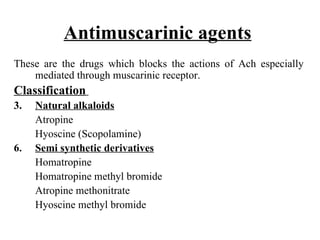
Antimuscarinic agents   These are the drugs which blocks the actions of Ach especially mediated through muscarinic receptor. Classification   Natural alkaloids Atropine  Hyoscine (Scopolamine) Semi synthetic derivatives Homatropine Homatropine methyl bromide Atropine methonitrate Hyoscine methyl bromide
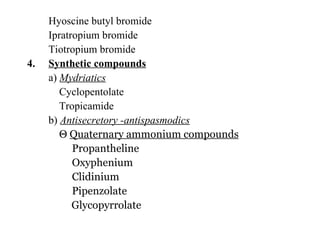
Hyoscine butyl bromide Ipratropium bromide Tiotropium bromide Synthetic compounds a)  Mydriatics Cyclopentolate Tropicamide b)  Antisecretory -antispasmodics Θ   Quaternary ammonium compounds   Propantheline   Oxyphenium   Clidinium   Pipenzolate   Glycopyrrolate
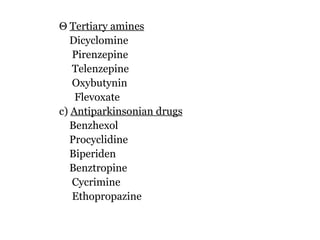
Θ   Tertiary amines   Dicyclomine   Pirenzepine   Telenzepine   Oxybutynin   Flevoxate c)  Antiparkinsonian drugs   Benzhexol   Procyclidine   Biperiden   Benztropine   Cycrimine   Ethopropazine
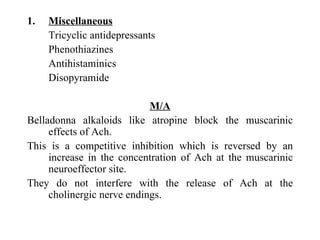
Miscellaneous Tricyclic antidepressants Phenothiazines Antihistaminics Disopyramide M/A Belladonna alkaloids like atropine block the muscarinic effects of Ach.  This is a competitive inhibition which is reversed by an increase in the concentration of Ach at the muscarinic neuroeffector site. They do not interfere with the release of Ach at the cholinergic nerve endings.
Pharmacological actions CNS   At low doses atropine do not cross BBB. At higher doses it produce CNS stimulant action. ` Hyoscine produce CNS depressant effect even at low doses. Atropine stimulates many medullary centers – vagal, respiratory, vasomotor. It depresses vestibular excitation and has antimotion sickness property. It suppresses the tremor and rigidity of parkinsonism by blocking the cholinergic over activity in basal ganglia.
In high doses cause cortical excitation, restlessness, disorientation, hallucinations and delirium followed by respiratory depression and coma. CVS In heart, M 2  receptor is blocked by atropine in S.A node and A.V node leads to tachycardia. It also blocks muscarinic autoreceptors on vagal nerve endings augmenting ach release, this leads to  Predominant bradycardia and finally tachycardia.
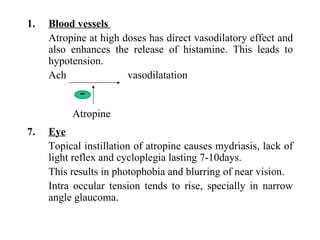
Blood vessels  Atropine at high doses has direct vasodilatory effect and also enhances the release of histamine. This leads to hypotension. Ach  vasodilatation  Eye Topical instillation of atropine causes mydriasis, lack of light reflex and cycloplegia lasting 7-10days.  This results in photophobia and blurring of near vision. Intra occular tension tends to rise, specially in narrow angle glaucoma. ־ Atropine
Smooth muscle All visceral smooth muscles are relaxed by atropine (M 3  blocked). The tone & contraction of stomach and intestine are reduced; the passage of chyme is slowed – constipation may occur, spasm may be relieved. Atropine causes bronchodilatation and reduces air way resistance, specially in COPD and asthma patients. It has a relaxant action on ureter and urinary bladder; Urinary retention may occur in older males with BPH. relaxation of biliary tract and uterus is minimal.
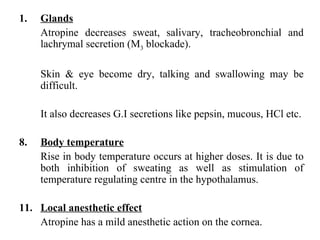
Glands Atropine decreases sweat, salivary, tracheobronchial and lachrymal secretion (M 3  blockade). Skin & eye become dry, talking and swallowing may be difficult. It also decreases G.I secretions like pepsin, mucous, HCl etc. Body temperature Rise in body temperature occurs at higher doses. It is due to both inhibition of sweating as well as stimulation of temperature regulating centre in the hypothalamus. Local anesthetic effect Atropine has a mild anesthetic action on the cornea.
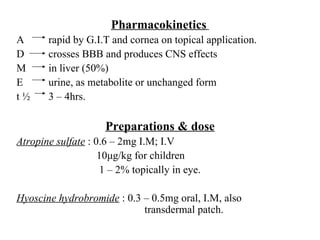
Pharmacokinetics   A rapid by G.I.T and cornea on topical application. D crosses BBB and produces CNS effects M in liver (50%) E urine, as metabolite or unchanged form t ½  3 – 4hrs. Preparations & dose Atropine sulfate  : 0.6 – 2mg I.M; I.V   10 μ g/kg for children   1 – 2% topically in eye. Hyoscine hydrobromide  : 0.3 – 0.5mg oral, I.M, also  transdermal patch.
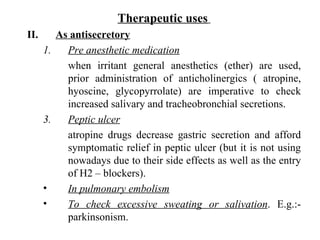
Therapeutic uses   As antisecretory Pre anesthetic medication when irritant general anesthetics (ether) are used, prior administration of anticholinergics ( atropine, hyoscine, glycopyrrolate) are imperative to check increased salivary and tracheobronchial secretions. Peptic ulcer atropine drugs decrease gastric secretion and afford symptomatic relief in peptic ulcer (but it is not using nowadays due to their side effects as well as the entry of H2 – blockers). In pulmonary embolism To check excessive sweating or salivation . E.g.:- parkinsonism.
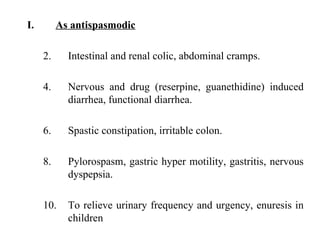
As antispasmodic Intestinal and renal colic, abdominal cramps. Nervous and drug (reserpine, guanethidine) induced diarrhea, functional diarrhea. Spastic constipation, irritable colon. Pylorospasm, gastric hyper motility, gastritis, nervous dyspepsia. To relieve urinary frequency and urgency, enuresis in children
Bronchial asthma, asthmatic bronchitis, COPD These drugs are less effective than adrenergic drugs. Ipratropium bromide is used in COPD. It has additive bronchodilator action with adrenergic drugs and theophylline. As mydriatic & cycloplegic   Diagnostic  :- for testing error of refraction, both mydriasis and cycloplegia are needed. Tropicamide is used widely. To facilitate fundoscopy only mydriasis is needed. Therapeutic  :- atropine is used in the treatment of iritis, iridocyclitis, choroiditis, keratitis and corneal ulcer.
As cardiac vagolytic Atropine is useful in counteracting bradycardia and partial heart block in selected patients where increased vagal tone is responsible, e.g.:- in some cases of M.I, digitalis toxicity. For central action   Parkinsonism  These drugs are used only in mild cases because they are less effective than L-dopa. Motion sickness Hyoscine is most effective. 3. Hyoscine has been used to produce sedation and amnesia during labour and to control maniacal states.
To antagonize muscarinic effects of drugs & poisons Atropine is an antidote for anti chE and early mushroom poisoning. It also block muscarinic actions of neostigmine used for myasthenia gravis, decurarization or cobra envenomation.
Contraindications  Θ Narrow iridocorneal angle – may precipitate acute  congestive glaucoma. Θ In patients with BPH – urinary retention may occur.
Interactions  Absorption of most drugs is slowed.  L-dopa dose should be increased in presence of these drugs, because the absorption slower and greater peripheral degradation occurs, thereby less of it reaches the brain. But in case of tetracycline and digoxin absorption may be increased due to longer transit time in the G.I.T. Antacids interfere with absorption of anticholinergics. Antihistaminics, tricyclic antidepressants, phenothiazines, pethidine have anticholinergic property – additive side effects with atropinic drugs. MAO inhibitors interfere with metabolism of anticholinergic antiparkinsonian drugs  - delirium may occur.

Antimuscarinic Agents

  • 1.
    Antimuscarinic agents These are the drugs which blocks the actions of Ach especially mediated through muscarinic receptor. Classification Natural alkaloids Atropine Hyoscine (Scopolamine) Semi synthetic derivatives Homatropine Homatropine methyl bromide Atropine methonitrate Hyoscine methyl bromide
  • 2.
    Hyoscine butyl bromideIpratropium bromide Tiotropium bromide Synthetic compounds a) Mydriatics Cyclopentolate Tropicamide b) Antisecretory -antispasmodics Θ Quaternary ammonium compounds Propantheline Oxyphenium Clidinium Pipenzolate Glycopyrrolate
  • 3.
    Θ Tertiary amines Dicyclomine Pirenzepine Telenzepine Oxybutynin Flevoxate c) Antiparkinsonian drugs Benzhexol Procyclidine Biperiden Benztropine Cycrimine Ethopropazine
  • 4.
    Miscellaneous Tricyclic antidepressantsPhenothiazines Antihistaminics Disopyramide M/A Belladonna alkaloids like atropine block the muscarinic effects of Ach. This is a competitive inhibition which is reversed by an increase in the concentration of Ach at the muscarinic neuroeffector site. They do not interfere with the release of Ach at the cholinergic nerve endings.
  • 5.
    Pharmacological actions CNS At low doses atropine do not cross BBB. At higher doses it produce CNS stimulant action. ` Hyoscine produce CNS depressant effect even at low doses. Atropine stimulates many medullary centers – vagal, respiratory, vasomotor. It depresses vestibular excitation and has antimotion sickness property. It suppresses the tremor and rigidity of parkinsonism by blocking the cholinergic over activity in basal ganglia.
  • 6.
    In high dosescause cortical excitation, restlessness, disorientation, hallucinations and delirium followed by respiratory depression and coma. CVS In heart, M 2 receptor is blocked by atropine in S.A node and A.V node leads to tachycardia. It also blocks muscarinic autoreceptors on vagal nerve endings augmenting ach release, this leads to Predominant bradycardia and finally tachycardia.
  • 7.
    Blood vessels Atropine at high doses has direct vasodilatory effect and also enhances the release of histamine. This leads to hypotension. Ach vasodilatation Eye Topical instillation of atropine causes mydriasis, lack of light reflex and cycloplegia lasting 7-10days. This results in photophobia and blurring of near vision. Intra occular tension tends to rise, specially in narrow angle glaucoma. ־ Atropine
  • 8.
    Smooth muscle Allvisceral smooth muscles are relaxed by atropine (M 3 blocked). The tone & contraction of stomach and intestine are reduced; the passage of chyme is slowed – constipation may occur, spasm may be relieved. Atropine causes bronchodilatation and reduces air way resistance, specially in COPD and asthma patients. It has a relaxant action on ureter and urinary bladder; Urinary retention may occur in older males with BPH. relaxation of biliary tract and uterus is minimal.
  • 9.
    Glands Atropine decreasessweat, salivary, tracheobronchial and lachrymal secretion (M 3 blockade). Skin & eye become dry, talking and swallowing may be difficult. It also decreases G.I secretions like pepsin, mucous, HCl etc. Body temperature Rise in body temperature occurs at higher doses. It is due to both inhibition of sweating as well as stimulation of temperature regulating centre in the hypothalamus. Local anesthetic effect Atropine has a mild anesthetic action on the cornea.
  • 10.
    Pharmacokinetics A rapid by G.I.T and cornea on topical application. D crosses BBB and produces CNS effects M in liver (50%) E urine, as metabolite or unchanged form t ½ 3 – 4hrs. Preparations & dose Atropine sulfate : 0.6 – 2mg I.M; I.V 10 μ g/kg for children 1 – 2% topically in eye. Hyoscine hydrobromide : 0.3 – 0.5mg oral, I.M, also transdermal patch.
  • 11.
    Therapeutic uses As antisecretory Pre anesthetic medication when irritant general anesthetics (ether) are used, prior administration of anticholinergics ( atropine, hyoscine, glycopyrrolate) are imperative to check increased salivary and tracheobronchial secretions. Peptic ulcer atropine drugs decrease gastric secretion and afford symptomatic relief in peptic ulcer (but it is not using nowadays due to their side effects as well as the entry of H2 – blockers). In pulmonary embolism To check excessive sweating or salivation . E.g.:- parkinsonism.
  • 12.
    As antispasmodic Intestinaland renal colic, abdominal cramps. Nervous and drug (reserpine, guanethidine) induced diarrhea, functional diarrhea. Spastic constipation, irritable colon. Pylorospasm, gastric hyper motility, gastritis, nervous dyspepsia. To relieve urinary frequency and urgency, enuresis in children
  • 13.
    Bronchial asthma, asthmaticbronchitis, COPD These drugs are less effective than adrenergic drugs. Ipratropium bromide is used in COPD. It has additive bronchodilator action with adrenergic drugs and theophylline. As mydriatic & cycloplegic Diagnostic :- for testing error of refraction, both mydriasis and cycloplegia are needed. Tropicamide is used widely. To facilitate fundoscopy only mydriasis is needed. Therapeutic :- atropine is used in the treatment of iritis, iridocyclitis, choroiditis, keratitis and corneal ulcer.
  • 14.
    As cardiac vagolyticAtropine is useful in counteracting bradycardia and partial heart block in selected patients where increased vagal tone is responsible, e.g.:- in some cases of M.I, digitalis toxicity. For central action Parkinsonism These drugs are used only in mild cases because they are less effective than L-dopa. Motion sickness Hyoscine is most effective. 3. Hyoscine has been used to produce sedation and amnesia during labour and to control maniacal states.
  • 15.
    To antagonize muscariniceffects of drugs & poisons Atropine is an antidote for anti chE and early mushroom poisoning. It also block muscarinic actions of neostigmine used for myasthenia gravis, decurarization or cobra envenomation.
  • 16.
    Contraindications ΘNarrow iridocorneal angle – may precipitate acute congestive glaucoma. Θ In patients with BPH – urinary retention may occur.
  • 17.
    Interactions Absorptionof most drugs is slowed. L-dopa dose should be increased in presence of these drugs, because the absorption slower and greater peripheral degradation occurs, thereby less of it reaches the brain. But in case of tetracycline and digoxin absorption may be increased due to longer transit time in the G.I.T. Antacids interfere with absorption of anticholinergics. Antihistaminics, tricyclic antidepressants, phenothiazines, pethidine have anticholinergic property – additive side effects with atropinic drugs. MAO inhibitors interfere with metabolism of anticholinergic antiparkinsonian drugs - delirium may occur.