Antimicrobial Drugs
PHARMACOLOGY AND TOXICOLOGY II
Presented for Department of Pharmacy
University of Darussalam Gontor - Indonesia
Surya Amal
Antimicrobial Drugs
Part I
Learning ObjectivesLearning Objectives
1. Memahami pengertian, penyebab, mekanisme
terjadinya, penyebaran, dan akibat yang
ditimbulkan oleh penyakit infeksi serta prinsipditimbulkan oleh penyakit infeksi serta prinsip
pengobatan dengan kemoterapi.
2. Penggolongan Obat-Obat Antiinfeksi.
BackgroundBackground
• Before antimicrobials discovered, large
number of people died from common
illnesses
• Now many illnesses easily treated with
antimicrobials
• However, many antimicrobial drugs are
becoming less useful
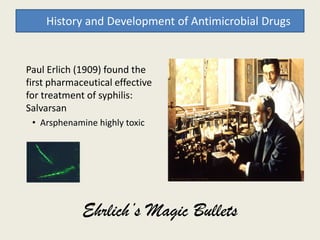
Paul Erlich (1909) found the
first pharmaceutical effective
for treatment of syphilis:
Salvarsan
• Arsphenamine highly toxic
History and Development of Antimicrobial Drugs
• Arsphenamine highly toxic
Ehrlich’s Magic Bullets
History and Development of Antimicrobial Drugs
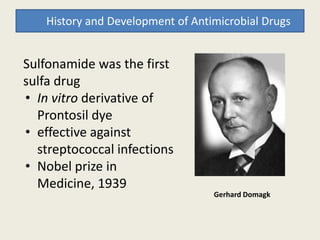
Sulfonamide was the first
sulfa drug
• In vitro derivative of
Prontosil dyeProntosil dye
• effective against
streptococcal infections
• Nobel prize in
Medicine, 1939
Gerhard Domagk
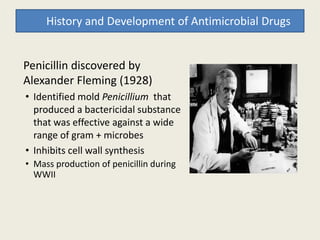
Penicillin discovered by
Alexander Fleming (1928)
• Identified mold Penicillium that
produced a bactericidal substance
that was effective against a wide
History and Development of Antimicrobial Drugs
that was effective against a wide
range of gram + microbes
• Inhibits cell wall synthesis
• Mass production of penicillin during
WWII
History and Development of Antimicrobial Drugs
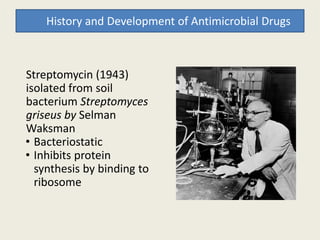
Streptomycin (1943)
isolated from soil
bacterium Streptomyces
griseus by Selmangriseus by Selman
Waksman
• Bacteriostatic
• Inhibits protein
synthesis by binding to
ribosome
History and Development of Antimicrobial Drugs
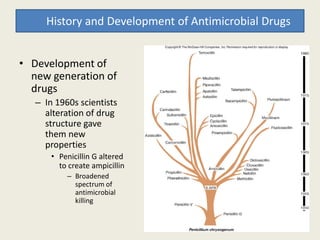
• Development of
new generation of
drugs
– In 1960s scientists
alteration of drug
structure gavestructure gave
them new
properties
• Penicillin G altered
to create ampicillin
– Broadened
spectrum of
antimicrobial
killing
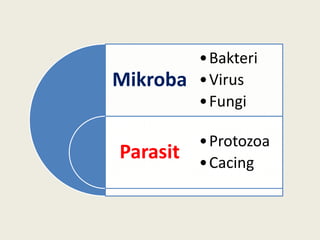
Mikroba
•Bakteri
•Virus
•Fungi
Parasit
•Protozoa
•Cacing
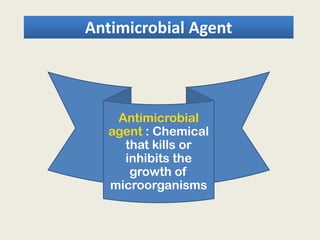
Antimicrobial Agent
AntimicrobialAntimicrobial
agent : Chemical
that kills or
inhibits the
growth of
microorganisms
Features of Antimicrobial Drugs
• Most modern antibiotics come from organisms
living in the soil
– Includes bacterial species Streptomyces and Bacillus
as well as fungi Penicillium and Cephalosporium
• To commercially produce antibiotics• To commercially produce antibiotics
– Strain is grown until maximum antibiotic
concentration is reached
– Drug is extracted from broth medium
– Extensively purified
– May be chemically altered
• Termed semi-synthetic
AntibioticAntibiotic
• Antibiotic: Chemical produced by
a microorganism that kills or
inhibits the growth of anotherinhibits the growth of another
microorganism
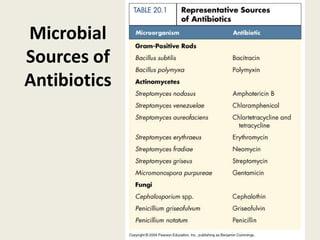
Microbial
Sources of
Antibiotics
Prinsip Terapi Antimikrobial
1. Suatu antimikroba/antibiotika seharusnya
membunuh atau menghambat pertumbuhan
bakteri tanpa berbahaya terhadap tubuhbakteri tanpa berbahaya terhadap tubuh
manusia sebagai inangnya.
2. Obat berpenetrasi ke jaringan tubuh yang
dituju, dan menuju ke mikroorganisme target
secara spesifik.
o Bakteriostatis  penghambatan pertumbuhan atau
multiplikasi suatu bakteri
o Bakterisidal  bersifat destruktif (membunuh) bakteri
tertentu.
o Desinfektan = bahan kimia yang digunakan untuk
membunuh organisme patogen dilakukan terhadap
benda mati.
Terms that relate to antimicrobial medications
benda mati.
KHM (Kadar Hambat Minimum) = kadar minimum obat
yang diperlukan untuk menghambat pertumbuhan
mikroba/bakteri.
KBM (Kadar Bunuh Minimum) = kadar minimum obat
yang diperlukan untuk membunuh mikroba atau bakteri.
Chemotherapy
• The use of drugs to treat a disease
• Selective toxicity: A drug that kills
harmful microbes without damaging
the host.
Infeksi adalah proses masuknya organisme di
dalam tubuh.
Sensivitas individu terhadap mikroorganisme
Sensitivity
Sensivitas individu terhadap mikroorganisme
tergantung :
 Jumlah mikroba atau organisme patogen
 Tingkat Keganasan
 Daya tahan tubuh
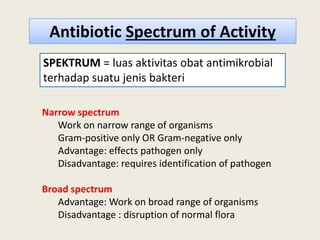
Antibiotic Spectrum of Activity
SPEKTRUM = luas aktivitas obat antimikrobial
terhadap suatu jenis bakteri
Narrow spectrum
Work on narrow range of organismsWork on narrow range of organisms
Gram-positive only OR Gram-negative only
Advantage: effects pathogen only
Disadvantage: requires identification of pathogen
Broad spectrum
Advantage: Work on broad range of organisms
Disadvantage : disruption of normal flora
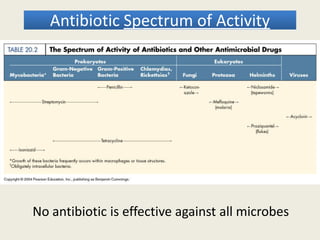
Antibiotic Spectrum of ActivityAntibiotic Spectrum of Activity
No antibiotic is effective against all microbes
Mechanisms of Antimicrobial Action
• Bacteria have their own enzymes for
– Cell wall formation
– Protein synthesis
– DNA replication
– RNA synthesis
– Synthesis of essential metabolites
Viruses use host enzymes inside host cells
Synthesis of essential metabolites
• Viruses use host enzymes inside host cells
• Fungi and protozoa have own eukaryotic enzymes
• The more similar the pathogen and host enzymes,
the more side effects the antimicrobials will have
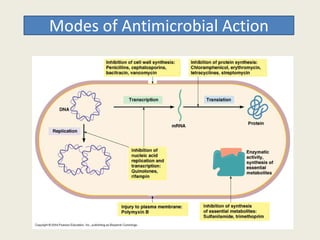
Modes of Antimicrobial Action
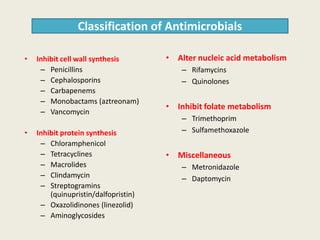
Classification of Antimicrobials
• Inhibit cell wall synthesis
– Penicillins
– Cephalosporins
– Carbapenems
– Monobactams (aztreonam)
– Vancomycin
• Alter nucleic acid metabolism
– Rifamycins
– Quinolones
• Inhibit folate metabolism
– Trimethoprim
• Inhibit protein synthesis
– Chloramphenicol
– Tetracyclines
– Macrolides
– Clindamycin
– Streptogramins
(quinupristin/dalfopristin)
– Oxazolidinones (linezolid)
– Aminoglycosides
– Trimethoprim
– Sulfamethoxazole
• Miscellaneous
– Metronidazole
– Daptomycin
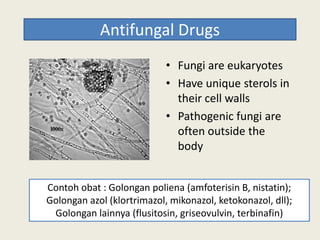
Antifungal Drugs
• Fungi are eukaryotes
• Have unique sterols in
their cell walls
• Pathogenic fungi are• Pathogenic fungi are
often outside the
body
Contoh obat : Golongan poliena (amfoterisin B, nistatin);
Golongan azol (klortrimazol, mikonazol, ketokonazol, dll);
Golongan lainnya (flusitosin, griseovulvin, terbinafin)
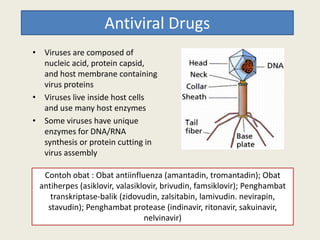
Antiviral Drugs
• Viruses are composed of
nucleic acid, protein capsid,
and host membrane containing
virus proteins
• Viruses live inside host cells
and use many host enzymes
• Some viruses have unique• Some viruses have unique
enzymes for DNA/RNA
synthesis or protein cutting in
virus assembly
Contoh obat : Obat antiinfluenza (amantadin, tromantadin); Obat
antiherpes (asiklovir, valasiklovir, brivudin, famsiklovir); Penghambat
transkriptase-balik (zidovudin, zalsitabin, lamivudin. nevirapin,
stavudin); Penghambat protease (indinavir, ritonavir, sakuinavir,
nelvinavir)
Adverse Effects of Antimicrobial DrugsAdverse Effects of Antimicrobial Drugs
1. Allergic Reactions: some people
develop hypersensitivities to
antimicrobials
2. Toxic Effects: some antimicrobials toxic2. Toxic Effects: some antimicrobials toxic
at high concentrations or cause adverse
effects
3. Suppression of normal flora: when
normal flora killed, other pathogens
may be able to grow to high numbers
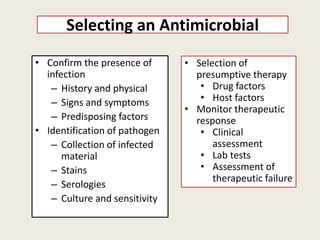
Selecting an Antimicrobial
• Confirm the presence of
infection
– History and physical
– Signs and symptoms
– Predisposing factors
• Selection of
presumptive therapy
• Drug factors
• Host factors
• Monitor therapeutic
response– Predisposing factors
• Identification of pathogen
– Collection of infected
material
– Stains
– Serologies
– Culture and sensitivity
response
• Clinical
assessment
• Lab tests
• Assessment of
therapeutic failure
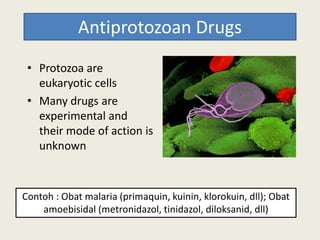
Antiprotozoan Drugs
• Protozoa are
eukaryotic cells
• Many drugs are
experimental andexperimental and
their mode of action is
unknown
Contoh : Obat malaria (primaquin, kuinin, klorokuin, dll); Obat
amoebisidal (metronidazol, tinidazol, diloksanid, dll)
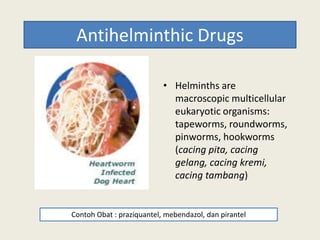
Antihelminthic Drugs
• Helminths are
macroscopic multicellular
eukaryotic organisms:
tapeworms, roundworms,tapeworms, roundworms,
pinworms, hookworms
(cacing pita, cacing
gelang, cacing kremi,
cacing tambang)
Contoh Obat : praziquantel, mebendazol, dan pirantel
ANTIMICROBIAL DRUGS (part I)

ANTIMICROBIAL DRUGS (part I)

  • 1.
    Antimicrobial Drugs PHARMACOLOGY ANDTOXICOLOGY II Presented for Department of Pharmacy University of Darussalam Gontor - Indonesia Surya Amal Antimicrobial Drugs Part I
  • 2.
    Learning ObjectivesLearning Objectives 1.Memahami pengertian, penyebab, mekanisme terjadinya, penyebaran, dan akibat yang ditimbulkan oleh penyakit infeksi serta prinsipditimbulkan oleh penyakit infeksi serta prinsip pengobatan dengan kemoterapi. 2. Penggolongan Obat-Obat Antiinfeksi.
  • 3.
    BackgroundBackground • Before antimicrobialsdiscovered, large number of people died from common illnesses • Now many illnesses easily treated with antimicrobials • However, many antimicrobial drugs are becoming less useful
  • 4.
    Paul Erlich (1909)found the first pharmaceutical effective for treatment of syphilis: Salvarsan • Arsphenamine highly toxic History and Development of Antimicrobial Drugs • Arsphenamine highly toxic Ehrlich’s Magic Bullets
  • 5.
    History and Developmentof Antimicrobial Drugs Sulfonamide was the first sulfa drug • In vitro derivative of Prontosil dyeProntosil dye • effective against streptococcal infections • Nobel prize in Medicine, 1939 Gerhard Domagk
  • 6.
    Penicillin discovered by AlexanderFleming (1928) • Identified mold Penicillium that produced a bactericidal substance that was effective against a wide History and Development of Antimicrobial Drugs that was effective against a wide range of gram + microbes • Inhibits cell wall synthesis • Mass production of penicillin during WWII
  • 7.
    History and Developmentof Antimicrobial Drugs Streptomycin (1943) isolated from soil bacterium Streptomyces griseus by Selmangriseus by Selman Waksman • Bacteriostatic • Inhibits protein synthesis by binding to ribosome
  • 8.
    History and Developmentof Antimicrobial Drugs • Development of new generation of drugs – In 1960s scientists alteration of drug structure gavestructure gave them new properties • Penicillin G altered to create ampicillin – Broadened spectrum of antimicrobial killing
  • 9.
  • 10.
    Antimicrobial Agent AntimicrobialAntimicrobial agent :Chemical that kills or inhibits the growth of microorganisms
  • 11.
    Features of AntimicrobialDrugs • Most modern antibiotics come from organisms living in the soil – Includes bacterial species Streptomyces and Bacillus as well as fungi Penicillium and Cephalosporium • To commercially produce antibiotics• To commercially produce antibiotics – Strain is grown until maximum antibiotic concentration is reached – Drug is extracted from broth medium – Extensively purified – May be chemically altered • Termed semi-synthetic
  • 12.
    AntibioticAntibiotic • Antibiotic: Chemicalproduced by a microorganism that kills or inhibits the growth of anotherinhibits the growth of another microorganism
  • 13.
  • 14.
    Prinsip Terapi Antimikrobial 1.Suatu antimikroba/antibiotika seharusnya membunuh atau menghambat pertumbuhan bakteri tanpa berbahaya terhadap tubuhbakteri tanpa berbahaya terhadap tubuh manusia sebagai inangnya. 2. Obat berpenetrasi ke jaringan tubuh yang dituju, dan menuju ke mikroorganisme target secara spesifik.
  • 15.
    o Bakteriostatis penghambatan pertumbuhan atau multiplikasi suatu bakteri o Bakterisidal  bersifat destruktif (membunuh) bakteri tertentu. o Desinfektan = bahan kimia yang digunakan untuk membunuh organisme patogen dilakukan terhadap benda mati. Terms that relate to antimicrobial medications benda mati. KHM (Kadar Hambat Minimum) = kadar minimum obat yang diperlukan untuk menghambat pertumbuhan mikroba/bakteri. KBM (Kadar Bunuh Minimum) = kadar minimum obat yang diperlukan untuk membunuh mikroba atau bakteri.
  • 16.
    Chemotherapy • The useof drugs to treat a disease • Selective toxicity: A drug that kills harmful microbes without damaging the host.
  • 17.
    Infeksi adalah prosesmasuknya organisme di dalam tubuh. Sensivitas individu terhadap mikroorganisme Sensitivity Sensivitas individu terhadap mikroorganisme tergantung :  Jumlah mikroba atau organisme patogen  Tingkat Keganasan  Daya tahan tubuh
  • 18.
    Antibiotic Spectrum ofActivity SPEKTRUM = luas aktivitas obat antimikrobial terhadap suatu jenis bakteri Narrow spectrum Work on narrow range of organismsWork on narrow range of organisms Gram-positive only OR Gram-negative only Advantage: effects pathogen only Disadvantage: requires identification of pathogen Broad spectrum Advantage: Work on broad range of organisms Disadvantage : disruption of normal flora
  • 19.
    Antibiotic Spectrum ofActivityAntibiotic Spectrum of Activity No antibiotic is effective against all microbes
  • 20.
    Mechanisms of AntimicrobialAction • Bacteria have their own enzymes for – Cell wall formation – Protein synthesis – DNA replication – RNA synthesis – Synthesis of essential metabolites Viruses use host enzymes inside host cells Synthesis of essential metabolites • Viruses use host enzymes inside host cells • Fungi and protozoa have own eukaryotic enzymes • The more similar the pathogen and host enzymes, the more side effects the antimicrobials will have
  • 21.
  • 22.
    Classification of Antimicrobials •Inhibit cell wall synthesis – Penicillins – Cephalosporins – Carbapenems – Monobactams (aztreonam) – Vancomycin • Alter nucleic acid metabolism – Rifamycins – Quinolones • Inhibit folate metabolism – Trimethoprim • Inhibit protein synthesis – Chloramphenicol – Tetracyclines – Macrolides – Clindamycin – Streptogramins (quinupristin/dalfopristin) – Oxazolidinones (linezolid) – Aminoglycosides – Trimethoprim – Sulfamethoxazole • Miscellaneous – Metronidazole – Daptomycin
  • 24.
    Antifungal Drugs • Fungiare eukaryotes • Have unique sterols in their cell walls • Pathogenic fungi are• Pathogenic fungi are often outside the body Contoh obat : Golongan poliena (amfoterisin B, nistatin); Golongan azol (klortrimazol, mikonazol, ketokonazol, dll); Golongan lainnya (flusitosin, griseovulvin, terbinafin)
  • 25.
    Antiviral Drugs • Virusesare composed of nucleic acid, protein capsid, and host membrane containing virus proteins • Viruses live inside host cells and use many host enzymes • Some viruses have unique• Some viruses have unique enzymes for DNA/RNA synthesis or protein cutting in virus assembly Contoh obat : Obat antiinfluenza (amantadin, tromantadin); Obat antiherpes (asiklovir, valasiklovir, brivudin, famsiklovir); Penghambat transkriptase-balik (zidovudin, zalsitabin, lamivudin. nevirapin, stavudin); Penghambat protease (indinavir, ritonavir, sakuinavir, nelvinavir)
  • 26.
    Adverse Effects ofAntimicrobial DrugsAdverse Effects of Antimicrobial Drugs 1. Allergic Reactions: some people develop hypersensitivities to antimicrobials 2. Toxic Effects: some antimicrobials toxic2. Toxic Effects: some antimicrobials toxic at high concentrations or cause adverse effects 3. Suppression of normal flora: when normal flora killed, other pathogens may be able to grow to high numbers
  • 27.
    Selecting an Antimicrobial •Confirm the presence of infection – History and physical – Signs and symptoms – Predisposing factors • Selection of presumptive therapy • Drug factors • Host factors • Monitor therapeutic response– Predisposing factors • Identification of pathogen – Collection of infected material – Stains – Serologies – Culture and sensitivity response • Clinical assessment • Lab tests • Assessment of therapeutic failure
  • 28.
    Antiprotozoan Drugs • Protozoaare eukaryotic cells • Many drugs are experimental andexperimental and their mode of action is unknown Contoh : Obat malaria (primaquin, kuinin, klorokuin, dll); Obat amoebisidal (metronidazol, tinidazol, diloksanid, dll)
  • 29.
    Antihelminthic Drugs • Helminthsare macroscopic multicellular eukaryotic organisms: tapeworms, roundworms,tapeworms, roundworms, pinworms, hookworms (cacing pita, cacing gelang, cacing kremi, cacing tambang) Contoh Obat : praziquantel, mebendazol, dan pirantel