ANTIMICROBIAL RESISTANCE
Prof. Khalifa Sifaw
Ghenghesh
Each

class of antimicrobial agent
has a unique mode of action.

Some

antibiotics differ in their
action on Gram+ve and Gram-ve
bacteria due to the difference in
the cell wall structure of such
bacteria.

Other

antibiotics are active on
both types of bacteria >> Broad
spectrum antibiotics.
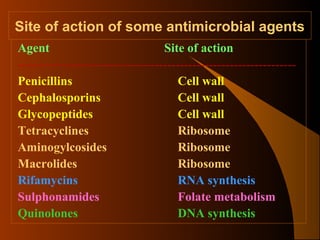
Site of action of some antimicrobial agents
Agent
Site of action
------------------------------------------------------------------Penicillins
Cell wall
Cephalosporins
Cell wall
Glycopeptides
Cell wall
Tetracyclines
Ribosome
Aminogylcosides
Ribosome
Macrolides
Ribosome
Rifamycins
RNA synthesis
Sulphonamides
Folate metabolism
Quinolones
DNA synthesis
 Antimicrobial

to:

agents can be classified

– Bacteriostatic:


Inhibits growth and multiplication of bacteria.

– Bactericidal:


Kills bacteria.
Bacterial Mechanisms of Antibiotic
Resistance
1. Production of enzymes that destroy the
antibiotic before it reaches its target.


β-lactamases:
– In G -ve:




β-lactam drug enters the cell through the
porin channels where it encounters the βlactamases in the periplasmic space.
β-lactamases destroy the β-lactam molecules
before they reach their PBP targets.

– In G +ve:


β-lactamases excreted extracellularly. Thus βlactam drugs are inactivated outside the cell.
2. The cell wall becomes impermeable
to antibiotics.
G

–ve bacteria may become resistant to
β-lactam drugs by developing
permeability barriers.

 This

caused by altered porin channels
that no longer allow the entrance and
passage of drug molecules into the cell.
3. Alteration of the target site by
mutation
 PBP

alteration through mutation in
G+ve bacteria.
 The β-lactam can no longer bind to it
and the cell becomes resistant to the
drug.
 Also occurs in G –ve bacteria.
4. Possession of an efflux pump
 Efflux

pump is a channel in the cell
that actively exports tetracycline
molecules and other drugs out of the
cell as fast as they are transported or
diffuse into the cell.

 The

antibiotic can not reach its target.
5. Alteration of specific metabolic
pathways
 By

mutation or acquisition of genes
encoding an alternative metabolic
pathway so that the drug can not
exert an effect.
Intrinsic Resistance
 Escherichia

coli intrinsically
resistant to vancomycin because
vancomycin is too large to pass
through porin channels.

 Gram

+ve bacteria have no porins
and thus are not intrinsically
resistant to vancomycin.
Acquired Resistance
Susceptible bacteria can acquire
resistance to antibiotics by:
1. Genetic mutation:


 During multiplication of G -ve bacteria
one cell undergoes a mutation to
streptomycin for example.
 When the population of cells is exposed
to streptomycin only the mutant
streptomycin-resistant cell survives.
 This resistant cell now multiplies and a
streptomycin-resistant population arises.
2. Acquisition of resistance:
 By Conjugation:




When two bacterial cells are in close proximity
a bridge-like structure (Pilus) forms between
them.
If one of the cell carries a plasmid encoding
ampicillin resistance gene this plasmid can be
transferred to the other cell.

 By Transformation:





Gram-ve bacteria encounter a fragment of DNA
contains a gentamicin-resistance gene. This
gene has been released from a Gr +ve bacteria
during cell lysis.
The DNA fragment is taken into the cell during
transformation.
The gene is incorporated into host’s
chromosome by recombination.
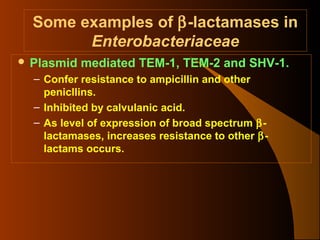
Some examples of β-lactamases in
Enterobacteriaceae
 Plasmid

mediated TEM-1, TEM-2 and SHV-1.

– Confer resistance to ampicillin and other
penicllins.
– Inhibited by calvulanic acid.
– As level of expression of broad spectrum βlactamases, increases resistance to other βlactams occurs.
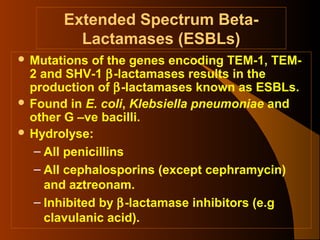
Extended Spectrum BetaLactamases (ESBLs)
 Mutations

of the genes encoding TEM-1, TEM2 and SHV-1 β-lactamases results in the
production of β-lactamases known as ESBLs.
 Found in E. coli, Klebsiella pneumoniae and
other G –ve bacilli.
 Hydrolyse:
– All penicillins
– All cephalosporins (except cephramycin)
and aztreonam.
– Inhibited by β-lactamase inhibitors (e.g
clavulanic acid).
 Resistance

to antimicrobial drugs is
a major problem that inflicts the
whole world.

 The

problem is still worse in
developing countries where lack of
antimicrobial-resistance surveys
and control policies are the norm.
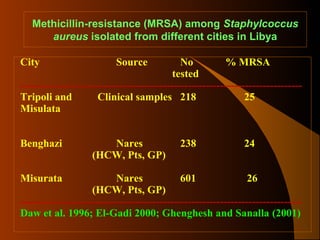
Methicillin-resistance (MRSA) among Staphylcoccus
aureus isolated from different cities in Libya
City

No
% MRSA
tested
------------------------------------------------------------------------------Tripoli and
Clinical samples 218
25
Misulata
Benghazi
Misurata

Source

Nares
(HCW, Pts, GP)

238

24

Nares
601
26
(HCW, Pts, GP)
------------------------------------------------------------------------------Daw et al. 1996; El-Gadi 2000; Ghenghesh and Sanalla (2001)
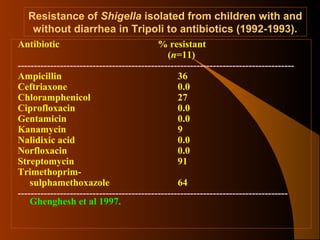
Resistance of Shigella isolated from children with and
without diarrhea in Tripoli to antibiotics (1992-1993).
Antibiotic

% resistant
(n=11)
------------------------------------------------------------------------------------Ampicillin
36
Ceftriaxone
0.0
Chloramphenicol
27
Ciprofloxacin
0.0
Gentamicin
0.0
Kanamycin
9
Nalidixic acid
0.0
Norfloxacin
0.0
Streptomycin
91
Trimethoprimsulphamethoxazole
64
----------------------------------------------------------------------------------Ghenghesh et al 1997.
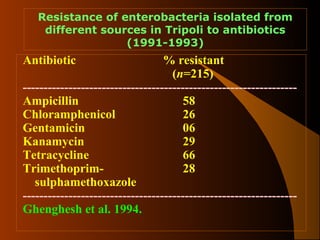
Resistance of enterobacteria isolated from
different sources in Tripoli to antibiotics
(1991-1993)

Antibiotic

% resistant
(n=215)
-----------------------------------------------------------------Ampicillin
58
Chloramphenicol
26
Gentamicin
06
Kanamycin
29
Tetracycline
66
Trimethoprim28
sulphamethoxazole
-----------------------------------------------------------------Ghenghesh et al. 1994.
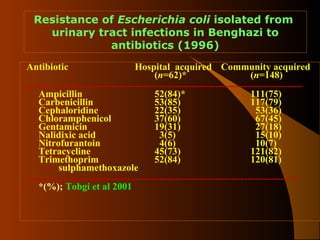
Resistance of Escherichia coli isolated from
urinary tract infections in Benghazi to
antibiotics (1996)
Antibiotic

Hospital acquired Community acquired
(n=62)*
(n=148)
------------------------------------------------------------------------------------Ampicillin
52(84)*
111(75)
Carbenicillin
53(85)
117(79)
Cephaloridine
22(35)
53(36)
Chloramphenicol
37(60)
67(45)
Gentamicin
19(31)
27(18)
Nalidixic acid
3(5)
15(10)
Nitrofurantoin
4(6)
10(7)
Tetracycline
45(73)
121(82)
Trimethoprim
52(84)
120(81)
sulphamethoxazole
-----------------------------------------------------------------------------------*(%); Tobgi et al 2001
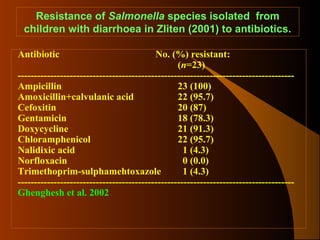
Resistance of Salmonella species isolated from
children with diarrhoea in Zliten (2001) to antibiotics.
Antibiotic

No. (%) resistant:
(n=23)
------------------------------------------------------------------------------------Ampicillin
23 (100)
Amoxicillin+calvulanic acid
22 (95.7)
Cefoxitin
20 (87)
Gentamicin
18 (78.3)
Doxycycline
21 (91.3)
Chloramphenicol
22 (95.7)
Nalidixic acid
1 (4.3)
Norfloxacin
0 (0.0)
Trimethoprim-sulphamehtoxazole
1 (4.3)
------------------------------------------------------------------------------------Ghenghesh et al. 2002
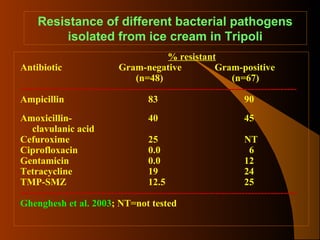
Resistance of different bacterial pathogens
isolated from ice cream in Tripoli
% resistant
Antibiotic
Gram-negative
Gram-positive
(n=48)
(n=67)
------------------------------------------------------------------------------------Ampicillin
83
90
Amoxicillin40
45
clavulanic acid
Cefuroxime
25
NT
Ciprofloxacin
0.0
6
Gentamicin
0.0
12
Tetracycline
19
24
TMP-SMZ
12.5
25
------------------------------------------------------------------------------------Ghenghesh et al. 2003; NT=not tested
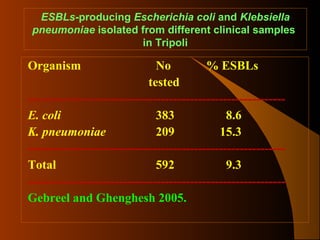
ESBLs-producing Escherichia coli and Klebsiella
pneumoniae isolated from different clinical samples
in Tripoli

Organism

No
% ESBLs
tested
-------------------------------------------------------------E. coli
383
8.6
K. pneumoniae
209
15.3
-------------------------------------------------------------Total
592
9.3
-------------------------------------------------------------Gebreel and Ghenghesh 2005.
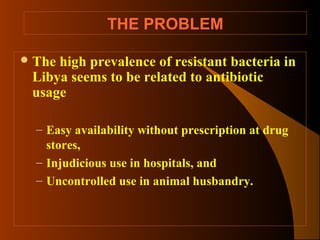
THE PROBLEM
 The

high prevalence of resistant bacteria in
Libya seems to be related to antibiotic
usage
– Easy availability without prescription at drug
stores,
– Injudicious use in hospitals, and
– Uncontrolled use in animal husbandry.
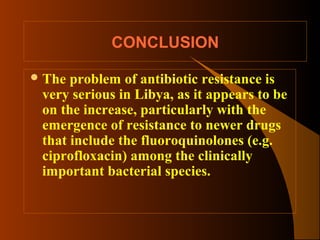
CONCLUSION
 The

problem of antibiotic resistance is
very serious in Libya, as it appears to be
on the increase, particularly with the
emergence of resistance to newer drugs
that include the fluoroquinolones (e.g.
ciprofloxacin) among the clinically
important bacterial species.
RECOMMENDATIONS
 It

is urgently required:

– To ban the sale of antibiotics without prescription,
– To use antibiotics more judiciously in hospitals by
intensive teaching of the principles of the use of
antibiotics, and
– To establish better control measures of nosocomial
infections.
 Regulation

of antimicrobials for other than human use
is also required.
 These issues are not easy to address and require the
collective action of health authorities, the
pharmaceutical community, health care providers,
and consumers

Antimicrobial resistance

  • 1.
  • 2.
    Each class of antimicrobialagent has a unique mode of action. Some antibiotics differ in their action on Gram+ve and Gram-ve bacteria due to the difference in the cell wall structure of such bacteria. Other antibiotics are active on both types of bacteria >> Broad spectrum antibiotics.
  • 3.
    Site of actionof some antimicrobial agents Agent Site of action ------------------------------------------------------------------Penicillins Cell wall Cephalosporins Cell wall Glycopeptides Cell wall Tetracyclines Ribosome Aminogylcosides Ribosome Macrolides Ribosome Rifamycins RNA synthesis Sulphonamides Folate metabolism Quinolones DNA synthesis
  • 4.
     Antimicrobial to: agents canbe classified – Bacteriostatic:  Inhibits growth and multiplication of bacteria. – Bactericidal:  Kills bacteria.
  • 5.
    Bacterial Mechanisms ofAntibiotic Resistance
  • 6.
    1. Production ofenzymes that destroy the antibiotic before it reaches its target.  β-lactamases: – In G -ve:   β-lactam drug enters the cell through the porin channels where it encounters the βlactamases in the periplasmic space. β-lactamases destroy the β-lactam molecules before they reach their PBP targets. – In G +ve:  β-lactamases excreted extracellularly. Thus βlactam drugs are inactivated outside the cell.
  • 7.
    2. The cellwall becomes impermeable to antibiotics. G –ve bacteria may become resistant to β-lactam drugs by developing permeability barriers.  This caused by altered porin channels that no longer allow the entrance and passage of drug molecules into the cell.
  • 8.
    3. Alteration ofthe target site by mutation  PBP alteration through mutation in G+ve bacteria.  The β-lactam can no longer bind to it and the cell becomes resistant to the drug.  Also occurs in G –ve bacteria.
  • 9.
    4. Possession ofan efflux pump  Efflux pump is a channel in the cell that actively exports tetracycline molecules and other drugs out of the cell as fast as they are transported or diffuse into the cell.  The antibiotic can not reach its target.
  • 10.
    5. Alteration ofspecific metabolic pathways  By mutation or acquisition of genes encoding an alternative metabolic pathway so that the drug can not exert an effect.
  • 11.
    Intrinsic Resistance  Escherichia coliintrinsically resistant to vancomycin because vancomycin is too large to pass through porin channels.  Gram +ve bacteria have no porins and thus are not intrinsically resistant to vancomycin.
  • 12.
    Acquired Resistance Susceptible bacteriacan acquire resistance to antibiotics by: 1. Genetic mutation:   During multiplication of G -ve bacteria one cell undergoes a mutation to streptomycin for example.  When the population of cells is exposed to streptomycin only the mutant streptomycin-resistant cell survives.  This resistant cell now multiplies and a streptomycin-resistant population arises.
  • 13.
    2. Acquisition ofresistance:  By Conjugation:   When two bacterial cells are in close proximity a bridge-like structure (Pilus) forms between them. If one of the cell carries a plasmid encoding ampicillin resistance gene this plasmid can be transferred to the other cell.  By Transformation:    Gram-ve bacteria encounter a fragment of DNA contains a gentamicin-resistance gene. This gene has been released from a Gr +ve bacteria during cell lysis. The DNA fragment is taken into the cell during transformation. The gene is incorporated into host’s chromosome by recombination.
  • 14.
    Some examples ofβ-lactamases in Enterobacteriaceae  Plasmid mediated TEM-1, TEM-2 and SHV-1. – Confer resistance to ampicillin and other penicllins. – Inhibited by calvulanic acid. – As level of expression of broad spectrum βlactamases, increases resistance to other βlactams occurs.
  • 15.
    Extended Spectrum BetaLactamases(ESBLs)  Mutations of the genes encoding TEM-1, TEM2 and SHV-1 β-lactamases results in the production of β-lactamases known as ESBLs.  Found in E. coli, Klebsiella pneumoniae and other G –ve bacilli.  Hydrolyse: – All penicillins – All cephalosporins (except cephramycin) and aztreonam. – Inhibited by β-lactamase inhibitors (e.g clavulanic acid).
  • 16.
     Resistance to antimicrobialdrugs is a major problem that inflicts the whole world.  The problem is still worse in developing countries where lack of antimicrobial-resistance surveys and control policies are the norm.
  • 17.
    Methicillin-resistance (MRSA) amongStaphylcoccus aureus isolated from different cities in Libya City No % MRSA tested ------------------------------------------------------------------------------Tripoli and Clinical samples 218 25 Misulata Benghazi Misurata Source Nares (HCW, Pts, GP) 238 24 Nares 601 26 (HCW, Pts, GP) ------------------------------------------------------------------------------Daw et al. 1996; El-Gadi 2000; Ghenghesh and Sanalla (2001)
  • 18.
    Resistance of Shigellaisolated from children with and without diarrhea in Tripoli to antibiotics (1992-1993). Antibiotic % resistant (n=11) ------------------------------------------------------------------------------------Ampicillin 36 Ceftriaxone 0.0 Chloramphenicol 27 Ciprofloxacin 0.0 Gentamicin 0.0 Kanamycin 9 Nalidixic acid 0.0 Norfloxacin 0.0 Streptomycin 91 Trimethoprimsulphamethoxazole 64 ----------------------------------------------------------------------------------Ghenghesh et al 1997.
  • 19.
    Resistance of enterobacteriaisolated from different sources in Tripoli to antibiotics (1991-1993) Antibiotic % resistant (n=215) -----------------------------------------------------------------Ampicillin 58 Chloramphenicol 26 Gentamicin 06 Kanamycin 29 Tetracycline 66 Trimethoprim28 sulphamethoxazole -----------------------------------------------------------------Ghenghesh et al. 1994.
  • 20.
    Resistance of Escherichiacoli isolated from urinary tract infections in Benghazi to antibiotics (1996) Antibiotic Hospital acquired Community acquired (n=62)* (n=148) ------------------------------------------------------------------------------------Ampicillin 52(84)* 111(75) Carbenicillin 53(85) 117(79) Cephaloridine 22(35) 53(36) Chloramphenicol 37(60) 67(45) Gentamicin 19(31) 27(18) Nalidixic acid 3(5) 15(10) Nitrofurantoin 4(6) 10(7) Tetracycline 45(73) 121(82) Trimethoprim 52(84) 120(81) sulphamethoxazole -----------------------------------------------------------------------------------*(%); Tobgi et al 2001
  • 21.
    Resistance of Salmonellaspecies isolated from children with diarrhoea in Zliten (2001) to antibiotics. Antibiotic No. (%) resistant: (n=23) ------------------------------------------------------------------------------------Ampicillin 23 (100) Amoxicillin+calvulanic acid 22 (95.7) Cefoxitin 20 (87) Gentamicin 18 (78.3) Doxycycline 21 (91.3) Chloramphenicol 22 (95.7) Nalidixic acid 1 (4.3) Norfloxacin 0 (0.0) Trimethoprim-sulphamehtoxazole 1 (4.3) ------------------------------------------------------------------------------------Ghenghesh et al. 2002
  • 22.
    Resistance of differentbacterial pathogens isolated from ice cream in Tripoli % resistant Antibiotic Gram-negative Gram-positive (n=48) (n=67) ------------------------------------------------------------------------------------Ampicillin 83 90 Amoxicillin40 45 clavulanic acid Cefuroxime 25 NT Ciprofloxacin 0.0 6 Gentamicin 0.0 12 Tetracycline 19 24 TMP-SMZ 12.5 25 ------------------------------------------------------------------------------------Ghenghesh et al. 2003; NT=not tested
  • 23.
    ESBLs-producing Escherichia coliand Klebsiella pneumoniae isolated from different clinical samples in Tripoli Organism No % ESBLs tested -------------------------------------------------------------E. coli 383 8.6 K. pneumoniae 209 15.3 -------------------------------------------------------------Total 592 9.3 -------------------------------------------------------------Gebreel and Ghenghesh 2005.
  • 24.
    THE PROBLEM  The highprevalence of resistant bacteria in Libya seems to be related to antibiotic usage – Easy availability without prescription at drug stores, – Injudicious use in hospitals, and – Uncontrolled use in animal husbandry.
  • 25.
    CONCLUSION  The problem ofantibiotic resistance is very serious in Libya, as it appears to be on the increase, particularly with the emergence of resistance to newer drugs that include the fluoroquinolones (e.g. ciprofloxacin) among the clinically important bacterial species.
  • 26.
    RECOMMENDATIONS  It is urgentlyrequired: – To ban the sale of antibiotics without prescription, – To use antibiotics more judiciously in hospitals by intensive teaching of the principles of the use of antibiotics, and – To establish better control measures of nosocomial infections.  Regulation of antimicrobials for other than human use is also required.  These issues are not easy to address and require the collective action of health authorities, the pharmaceutical community, health care providers, and consumers