Teaching or Learning Methods and Good Language Learner
GROUP 11: - Eko Ridho Alreza
- Ryanshan Gunawan
Introduction
Individual learner variables have been increasingly
recognized as important factors in students
success or otherwise as language learners.
However, in order to understand what it is that
makes a good language learner, it is important to
look at not only the characteristic of the
individual learner, but at “the context in which
individual learn (Norton and Toohey, 2001, p.318).
An important theoretical principle
underlying the communicative language
teaching movement was called
“Communicative competence”.
Communicative competence is ability to
use language to convey and interpret
meaning, and it was later divided by
Canale and Swain (1980) into four
separate components:
Grammatical Competence
Discourse Competence
Sociolinguistic Competence
Strategic Competence
Another one of communicative
language teaching theory is the
belief that how language
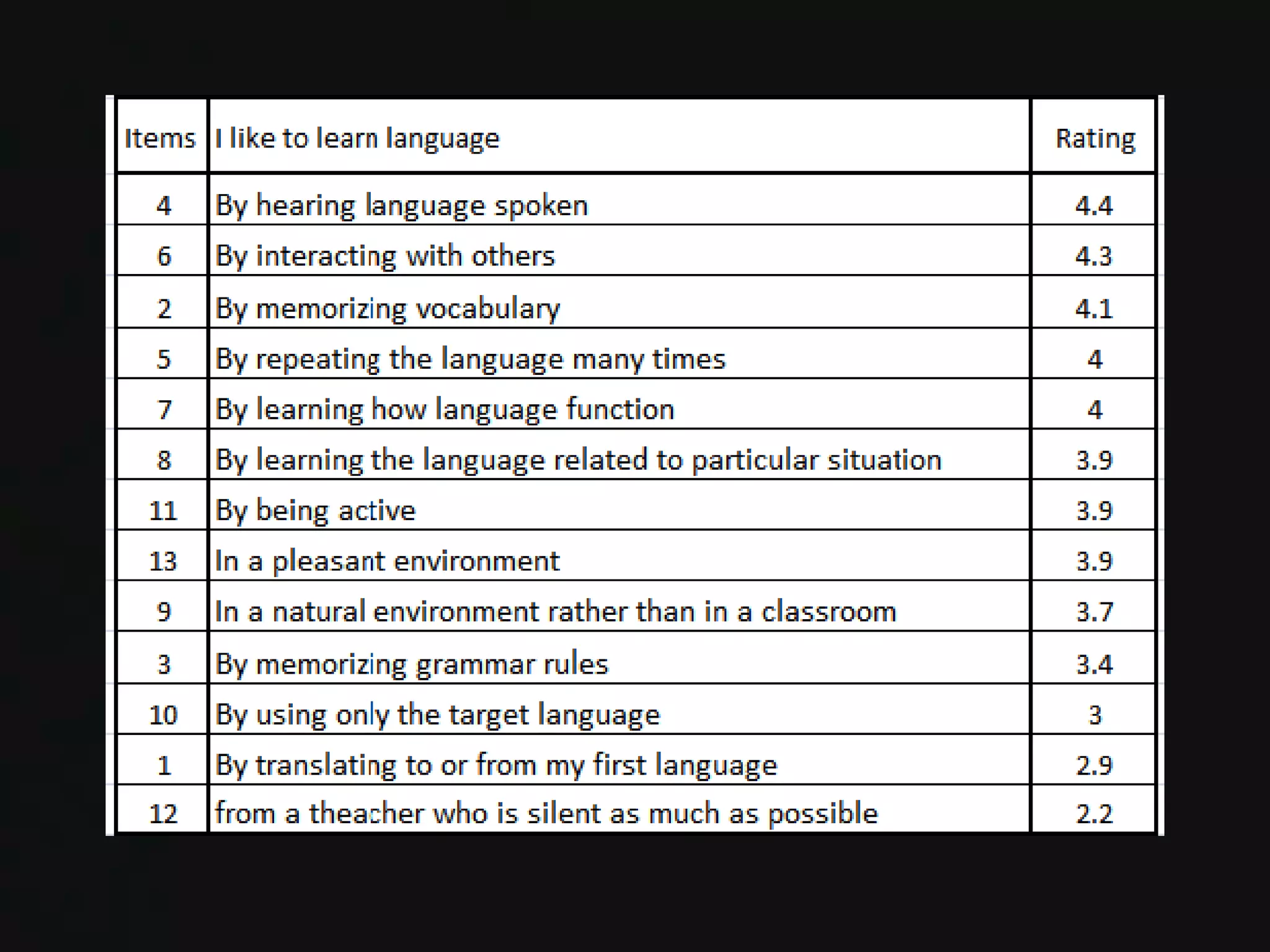
function is more important
than knowledge of form
structure.
Other less widely adopted language
teaching and learning methods and
approaches include, among others:
 Situational language teaching (whereby
grammar and vocabulary are practiced
through situations)
 the natural method (which emphasizes
natural acquisition rather than formal
grammar study)
 the direct method (which uses only the
target language)
 the total-physical response method (which
stresses the importance of motor activity)
 the silent way (which encourages the
teacher to be silent as much as possible)
 suggestopedia (which attempts to harness
the influence of suggestion, such as music
or art, on human behavior)
The Participants
The participants were 37 students who came from variety of
background those included in this research were at intermediate level
or above, and so had already demonstrated language learning ability .
Learners taken not to suggest by implication that lower level learners
are necessarily “bad” learners (they may, in fact, make rapid progress
from an initial low-level placement), the questionnaire was
considered by teacher of the lower-level classes to be too difficult and
time consuming at that point in time. Therefore, those classes chosen
to be included in this study consisted of already quite successful or
good language learners.
Ongoing of the Research Project
Does the research show the same result if it takes in
another place?
How about the age? Does that affect to the progress?
Conclusion
Good learners use a wide variety of learning methods,
rather than keeping rigidly to a single methods which
best suit the needs of the particular learners in a given
situation. They need to be resourceful, flexible and ready
to adapt and try a variety of methods in order to help
their students got success in language learning
Thank You

Teaching or Learning Methods and Good Language Learner

  • 1.
    Teaching or LearningMethods and Good Language Learner GROUP 11: - Eko Ridho Alreza - Ryanshan Gunawan
  • 2.
    Introduction Individual learner variableshave been increasingly recognized as important factors in students success or otherwise as language learners. However, in order to understand what it is that makes a good language learner, it is important to look at not only the characteristic of the individual learner, but at “the context in which individual learn (Norton and Toohey, 2001, p.318).
  • 3.
    An important theoreticalprinciple underlying the communicative language teaching movement was called “Communicative competence”. Communicative competence is ability to use language to convey and interpret meaning, and it was later divided by Canale and Swain (1980) into four separate components:
  • 4.
  • 5.
    Another one ofcommunicative language teaching theory is the belief that how language function is more important than knowledge of form structure.
  • 6.
    Other less widelyadopted language teaching and learning methods and approaches include, among others:  Situational language teaching (whereby grammar and vocabulary are practiced through situations)  the natural method (which emphasizes natural acquisition rather than formal grammar study)  the direct method (which uses only the target language)  the total-physical response method (which stresses the importance of motor activity)  the silent way (which encourages the teacher to be silent as much as possible)  suggestopedia (which attempts to harness the influence of suggestion, such as music or art, on human behavior)
  • 7.
    The Participants The participantswere 37 students who came from variety of background those included in this research were at intermediate level or above, and so had already demonstrated language learning ability . Learners taken not to suggest by implication that lower level learners are necessarily “bad” learners (they may, in fact, make rapid progress from an initial low-level placement), the questionnaire was considered by teacher of the lower-level classes to be too difficult and time consuming at that point in time. Therefore, those classes chosen to be included in this study consisted of already quite successful or good language learners.
  • 9.
    Ongoing of theResearch Project Does the research show the same result if it takes in another place? How about the age? Does that affect to the progress?
  • 10.
    Conclusion Good learners usea wide variety of learning methods, rather than keeping rigidly to a single methods which best suit the needs of the particular learners in a given situation. They need to be resourceful, flexible and ready to adapt and try a variety of methods in order to help their students got success in language learning
  • 11.

Editor's Notes