ANTIMICROBIAL DRUGS
dr. Dita Hasni, M.Biomed
WHAT WE LEARN
Introduction of antimicrobial drugs
Penicillin
Cephalosporin
Quinolon
Aminoglycoside
INTRODUCTION TO ANTIMICROBIAL CHEMOTHERAPY
(GENERAL PRINCIPLES)
1.
Mechanisms of actions of different groups of
antibiotics.
Mechanisms by which pathogens acquire and
express resistance to antibiotics.
Combination therapy (use of two or more
drugs concomitantly).
Host determinants that influence the selection
and efficacy of antibiotics.
MECHANISMS OF ACTION OF
ANTIBACTERIAL DRUGS
Inhibit cell wall synthesis
Inhibit protein synthesis
Inhibit nucleic acid synthesis
Injury to plasma membrane
Inhibit synthesis of essential metabolites
MECHANISMS OF ACTIONS OF ANTIMICROBIAL DRUGS
FEATURES OF ANTIMICROBIAL DRUGS:
ANTIMICROBIAL ACTION
• inhibit growth of
microorganisms
Bacteriostatic:
• Kill microorganismsBactericidal
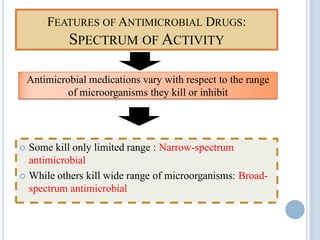
FEATURES OF ANTIMICROBIAL DRUGS:
SPECTRUM OF ACTIVITY
 Some kill only limited range : Narrow-spectrum
antimicrobial
 While others kill wide range of microorganisms: Broad-
spectrum antimicrobial
Antimicrobial medications vary with respect to the range
of microorganisms they kill or inhibit
RESISTANCE
Failure to reach the target
The drug is inactivated
The target is altered
EFFECTIVENESS OF COMBINATION THERAPY
Synergistic effect
Additive effect
Antagonism effect
IMPORTANT HOST DETERMINANTS
Hepatic function
Kidney function
Host defense
mechanism
UNTOWARD EFFECTS OF ANTIBIOTICS
Reactions due to toxic properties of
antibiotics.
Hypersensitivity reactions
Superinfection (or also called
Suprainfection)
ANTIMICROBIAL DRUGS
Dose-dependent Time-dependent
Antibacterial effect directly
depends on their
concentrations in the locus of
inflammation
(high doses 1-2 times/24h)
Aminoglycosides
Fluoroqinolones
Metronidazol
Amphotericin B
Effectiveness depends on a
period of time, during which
concentration in blood
overwhelms MIC for a
particular causative agent
(constant i.v. infusion or 3-6
times/24h)
Beta-lactames
Glycopeptides
Macrolides
Linkozamides
PROPERTIES OF AN IDEAL ANTIBIOTIC
broad spectrum
stable--long
shelf life
soluble in body
fluids
stable toxicity Nonallergenic reasonable cost
selectively toxic
not likely to
induce bacterial
resistance
PENICILLIN AND CEPHALOSPORIN
PROTOTYPES (-LACTAMS & RELATED AGENTS)
Penicillins: penicillin G; phenoxymethyl penicillin (pen V)
methicillin; oxacillin
ampicillin; amoxicillin; carbenicillin; ticarcillin
Cephalosporins: First Gen.: cephalexin; cephalothin
Second Gen.: cefoxitin; cefaclor
Third Gen.: cefotaxime; cefoperazone;
ceftriaxone
Fourth Gen.: cefepime
-Lactam related agents: Antibiotics: imipenem; aztreonam
-Lactamase inhibitors: sulbactam;
clavulanic acid
ANTIMICROBIAL SPECTRUM (THERAPEUTIC USES)
Penicillin G is primarily a narrow spectrum antibiotic, and mainly Gram (+) organisms are
susceptible. However, there are Gram (-) organisms that are very sensitive to the agent.
a) Sensitive G(+) cocci: Pneumococci, Strep.
Pneumoniae,
b) Sensitive G(-) cocci: N. meningitidis N. gonorrhea,
c) Other cocci and G(+) and G(-) bacilli require test for the drug sensitivity
because of frequent resistance to penicillin G. However, Treponema
pallidum (syphillis), Treponema pertenue and Actinomyces israeli etc are still sensitive
to the agent.
ANTIBACTERIAL ACTION MECHANISMS OF -LACTAM
• --The last step of peptidoglycan synthesis
1. Competitive inhibition of
TRANSPEPTIDASE.
• --Inhibition of SEPTUM formation
(Penicillin Binding Protein mechanism)
2. Alteration of bacterial
morphology.
• --Stimulation of bacterial cell lysis (PBP
mechanism)
3. Inhibition of availability of
Autolysin Inhibitor.
MECHANISMS UNDERLYING BACTERIAL
RESISTANCE TO -LACTAMS
Production of -LACTAMASE
Alteration in penicillin binding proteins
(PBP)
Decreased entry of -lactams (cell
membrane and cell wall structure; porin
mechanism)
Increased efflux of -lactams
QUINOLONES (GABA ANTAGONISTS)
 Inhibit DNA gyrase.
 Nalidixic acid – used only for UTIs.
 Ciprofloxin (6-fluoro substituent) that greatly
enhances its effectiveness against both gram- and
gram+ bacteria.
Well-absorbed both orally and i.v.
Eliminated largely unchanged by the kidneys.
Side-effects (headache, vomiting, nausea) are rare; but
convulsions may occur.
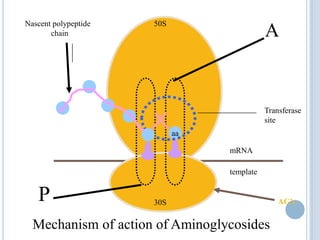
AMINOGLIKOSIDA
aa
A
50S
30S
mRNA
template
Transferase
site
P
Nascent polypeptide
chain
Mechanism of action of Aminoglycosides
AG’s
50S
5’
5’
3’
5’ 3’
AUG
5’ 3’
AUG
30S
3’AUG
X
Blocks initiation
Premature termination
Wrong amino acid is
incorporated
+ aminoglycoside
mRNA translation
Effects of Aminoglycosides
Mature protein
Growing polypeptide
30S
Aminoglycosides on Protein Synthesis
50S
5’ 3’
Blocks initiation
3’5’
Premature termination
5’ 3’AUG
mRNA translation
+
Amino
Glycoside
3’5’
Incorporation of wrong amino acid
X
Mature Protein
Growing Polypeptide
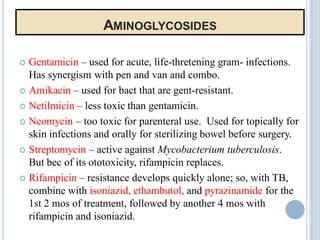
AMINOGLYCOSIDES
 Gentamicin – used for acute, life-thretening gram- infections.
Has synergism with pen and van and combo.
 Amikacin – used for bact that are gent-resistant.
 Netilmicin – less toxic than gentamicin.
 Neomycin – too toxic for parenteral use. Used for topically for
skin infections and orally for sterilizing bowel before surgery.
 Streptomycin – active against Mycobacterium tuberculosis.
But bec of its ototoxicity, rifampicin replaces.
 Rifampicin – resistance develops quickly alone; so, with TB,
combine with isoniazid, ethambutol, and pyrazinamide for the
1st 2 mos of treatment, followed by another 4 mos with
rifampicin and isoniazid.
TOXICITY
Ototoxicity
(Vestibular and Auditory).
Nephrotoxicity.
Neuromuscular Blockade.
Obat antimikroba
Obat antimikroba

Obat antimikroba

  • 1.
  • 2.
    WHAT WE LEARN Introductionof antimicrobial drugs Penicillin Cephalosporin Quinolon Aminoglycoside
  • 3.
    INTRODUCTION TO ANTIMICROBIALCHEMOTHERAPY (GENERAL PRINCIPLES) 1. Mechanisms of actions of different groups of antibiotics. Mechanisms by which pathogens acquire and express resistance to antibiotics. Combination therapy (use of two or more drugs concomitantly). Host determinants that influence the selection and efficacy of antibiotics.
  • 5.
    MECHANISMS OF ACTIONOF ANTIBACTERIAL DRUGS Inhibit cell wall synthesis Inhibit protein synthesis Inhibit nucleic acid synthesis Injury to plasma membrane Inhibit synthesis of essential metabolites
  • 6.
    MECHANISMS OF ACTIONSOF ANTIMICROBIAL DRUGS
  • 7.
    FEATURES OF ANTIMICROBIALDRUGS: ANTIMICROBIAL ACTION • inhibit growth of microorganisms Bacteriostatic: • Kill microorganismsBactericidal
  • 8.
    FEATURES OF ANTIMICROBIALDRUGS: SPECTRUM OF ACTIVITY  Some kill only limited range : Narrow-spectrum antimicrobial  While others kill wide range of microorganisms: Broad- spectrum antimicrobial Antimicrobial medications vary with respect to the range of microorganisms they kill or inhibit
  • 10.
    RESISTANCE Failure to reachthe target The drug is inactivated The target is altered
  • 12.
    EFFECTIVENESS OF COMBINATIONTHERAPY Synergistic effect Additive effect Antagonism effect
  • 13.
    IMPORTANT HOST DETERMINANTS Hepaticfunction Kidney function Host defense mechanism
  • 14.
    UNTOWARD EFFECTS OFANTIBIOTICS Reactions due to toxic properties of antibiotics. Hypersensitivity reactions Superinfection (or also called Suprainfection)
  • 15.
    ANTIMICROBIAL DRUGS Dose-dependent Time-dependent Antibacterialeffect directly depends on their concentrations in the locus of inflammation (high doses 1-2 times/24h) Aminoglycosides Fluoroqinolones Metronidazol Amphotericin B Effectiveness depends on a period of time, during which concentration in blood overwhelms MIC for a particular causative agent (constant i.v. infusion or 3-6 times/24h) Beta-lactames Glycopeptides Macrolides Linkozamides
  • 17.
    PROPERTIES OF ANIDEAL ANTIBIOTIC broad spectrum stable--long shelf life soluble in body fluids stable toxicity Nonallergenic reasonable cost selectively toxic not likely to induce bacterial resistance
  • 18.
  • 19.
    PROTOTYPES (-LACTAMS &RELATED AGENTS) Penicillins: penicillin G; phenoxymethyl penicillin (pen V) methicillin; oxacillin ampicillin; amoxicillin; carbenicillin; ticarcillin Cephalosporins: First Gen.: cephalexin; cephalothin Second Gen.: cefoxitin; cefaclor Third Gen.: cefotaxime; cefoperazone; ceftriaxone Fourth Gen.: cefepime -Lactam related agents: Antibiotics: imipenem; aztreonam -Lactamase inhibitors: sulbactam; clavulanic acid
  • 22.
    ANTIMICROBIAL SPECTRUM (THERAPEUTICUSES) Penicillin G is primarily a narrow spectrum antibiotic, and mainly Gram (+) organisms are susceptible. However, there are Gram (-) organisms that are very sensitive to the agent. a) Sensitive G(+) cocci: Pneumococci, Strep. Pneumoniae, b) Sensitive G(-) cocci: N. meningitidis N. gonorrhea, c) Other cocci and G(+) and G(-) bacilli require test for the drug sensitivity because of frequent resistance to penicillin G. However, Treponema pallidum (syphillis), Treponema pertenue and Actinomyces israeli etc are still sensitive to the agent.
  • 23.
    ANTIBACTERIAL ACTION MECHANISMSOF -LACTAM • --The last step of peptidoglycan synthesis 1. Competitive inhibition of TRANSPEPTIDASE. • --Inhibition of SEPTUM formation (Penicillin Binding Protein mechanism) 2. Alteration of bacterial morphology. • --Stimulation of bacterial cell lysis (PBP mechanism) 3. Inhibition of availability of Autolysin Inhibitor.
  • 25.
    MECHANISMS UNDERLYING BACTERIAL RESISTANCETO -LACTAMS Production of -LACTAMASE Alteration in penicillin binding proteins (PBP) Decreased entry of -lactams (cell membrane and cell wall structure; porin mechanism) Increased efflux of -lactams
  • 26.
    QUINOLONES (GABA ANTAGONISTS) Inhibit DNA gyrase.  Nalidixic acid – used only for UTIs.  Ciprofloxin (6-fluoro substituent) that greatly enhances its effectiveness against both gram- and gram+ bacteria. Well-absorbed both orally and i.v. Eliminated largely unchanged by the kidneys. Side-effects (headache, vomiting, nausea) are rare; but convulsions may occur.
  • 28.
  • 29.
  • 30.
    50S 5’ 5’ 3’ 5’ 3’ AUG 5’ 3’ AUG 30S 3’AUG X Blocksinitiation Premature termination Wrong amino acid is incorporated + aminoglycoside mRNA translation Effects of Aminoglycosides Mature protein Growing polypeptide
  • 31.
    30S Aminoglycosides on ProteinSynthesis 50S 5’ 3’ Blocks initiation 3’5’ Premature termination 5’ 3’AUG mRNA translation + Amino Glycoside 3’5’ Incorporation of wrong amino acid X Mature Protein Growing Polypeptide
  • 32.
    AMINOGLYCOSIDES  Gentamicin –used for acute, life-thretening gram- infections. Has synergism with pen and van and combo.  Amikacin – used for bact that are gent-resistant.  Netilmicin – less toxic than gentamicin.  Neomycin – too toxic for parenteral use. Used for topically for skin infections and orally for sterilizing bowel before surgery.  Streptomycin – active against Mycobacterium tuberculosis. But bec of its ototoxicity, rifampicin replaces.  Rifampicin – resistance develops quickly alone; so, with TB, combine with isoniazid, ethambutol, and pyrazinamide for the 1st 2 mos of treatment, followed by another 4 mos with rifampicin and isoniazid.
  • 33.