Presented by AYUSH ROY
M.PHARM, 2nd Semester Pharmacology
(2023-25)
Antiemetics
SCHOOL OF PHARMACEUTICAL SCIENCES
GIRIJANANDA CHOWDHURY UNIVERSITY
CONTENT
i. Introduction to Emesis
ii. Types of emesis and their Mechanism
iii.Anti emetics classification and Mechanism
INTRODUCTION TO EMESIS
▪ Emesis, commonly known as vomiting, is a complex physiological process characterized
by the forceful expulsion of the contents of the stomach and, at times, the small intestine
through the mouth.
▪ It is a protective reflex aimed at removing harmful substances, irritants, or toxins from
the digestive tract.
Some common types of vomiting based on various factors, including the underlying cause, the
nature of the vomiting episode:
1. Acute Vomiting: Sudden throwing up due to things like infections, food poisoning, motion
sickness, or medicines.
2. Chronic Vomiting: Happens repeatedly over a long time and can be caused by conditions like
stomach problems or inflammation in the gut.
3. Motion Sickness: Feeling nauseous and vomiting due to motion, like when traveling by car,
boat, or plane. It happens because the brain gets mixed signals from the inner ears, eyes, and
sensory nerves, causing discomfort and vomiting.
TYPES
4. Morning Sickness: Nausea and vomiting, often in the morning, commonly experienced by
pregnant women.
5. Bilious Vomiting: Vomiting bile, a yellow-green fluid from the liver. It can occur when the
stomach is empty and might indicate issues like intestinal blockages
PHYSIOLOGY OF EMESIS
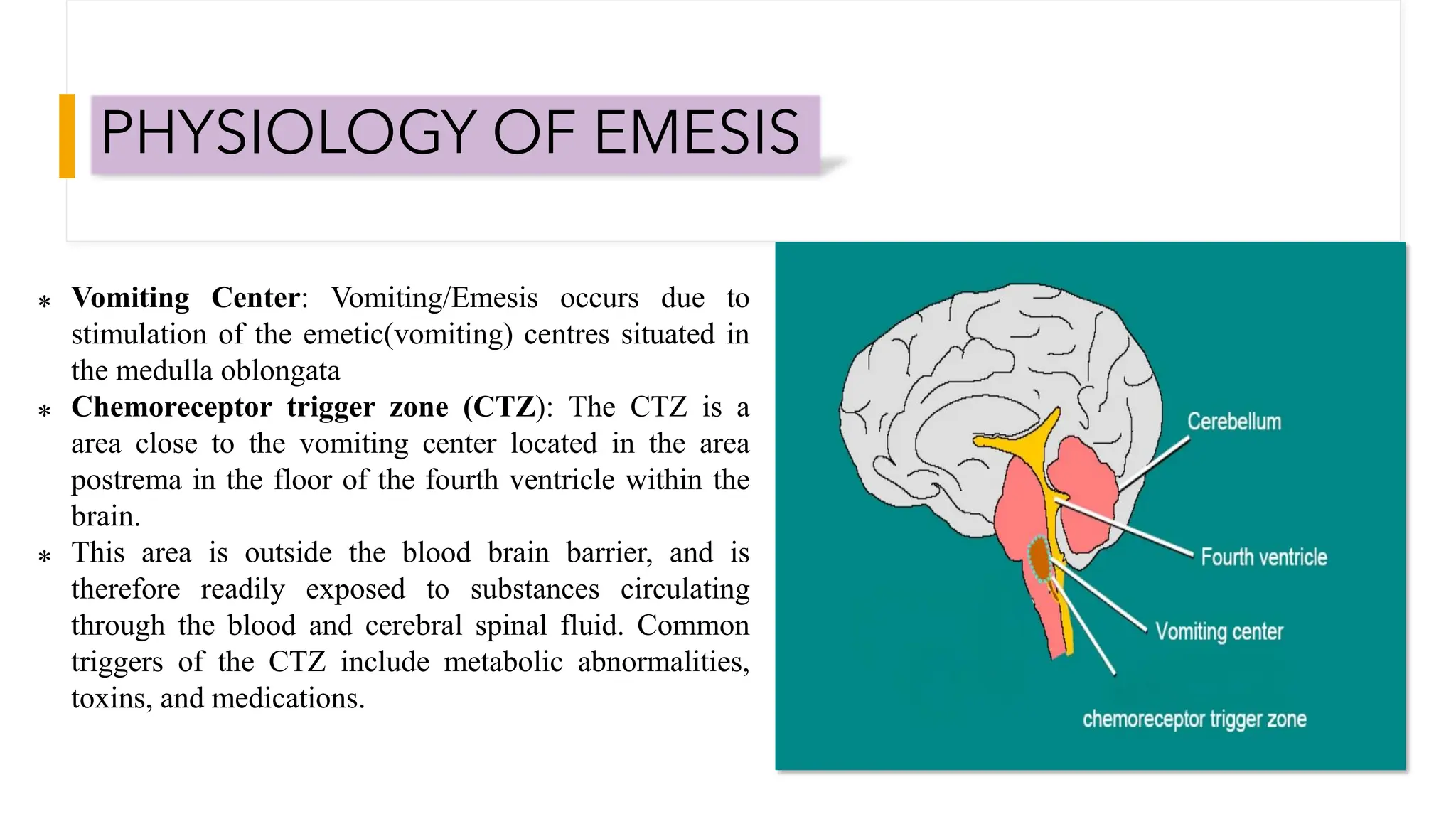
⁎ Vomiting Center: Vomiting/Emesis occurs due to
stimulation of the emetic(vomiting) centres situated in
the medulla oblongata
⁎ Chemoreceptor trigger zone (CTZ): The CTZ is a
area close to the vomiting center located in the area
postrema in the floor of the fourth ventricle within the
brain.
⁎ This area is outside the blood brain barrier, and is
therefore readily exposed to substances circulating
through the blood and cerebral spinal fluid. Common
triggers of the CTZ include metabolic abnormalities,
toxins, and medications.
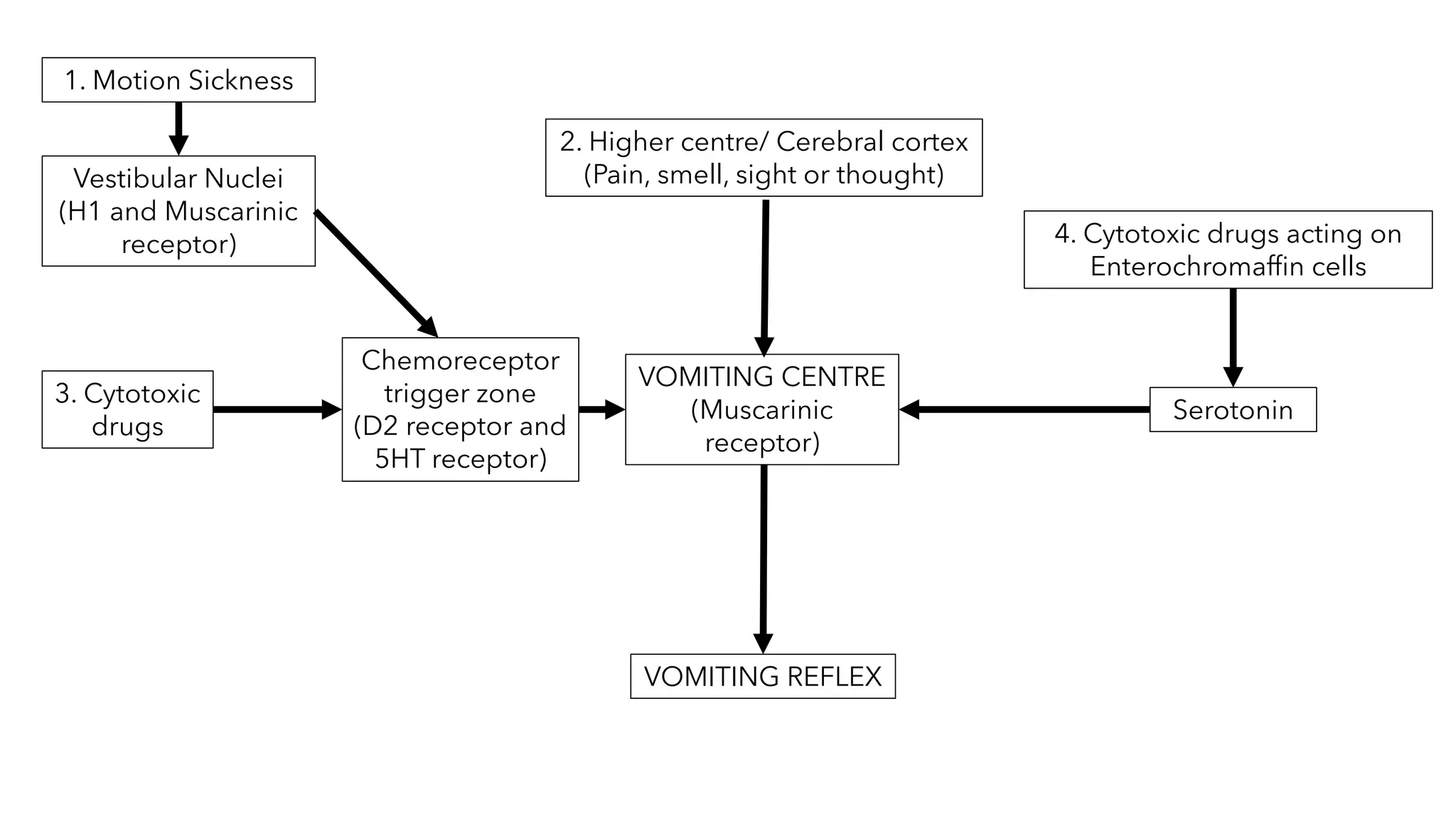
VOMITING CENTRE
(Muscarinic
receptor)
Chemoreceptor
trigger zone
(D2 receptor and
5HT receptor)
2. Higher centre/ Cerebral cortex
(Pain, smell, sight or thought)
VOMITING REFLEX
1. Motion Sickness
Vestibular Nuclei
(H1 and Muscarinic
receptor)
3. Cytotoxic
drugs
4. Cytotoxic drugs acting on
Enterochromaffin cells
Serotonin
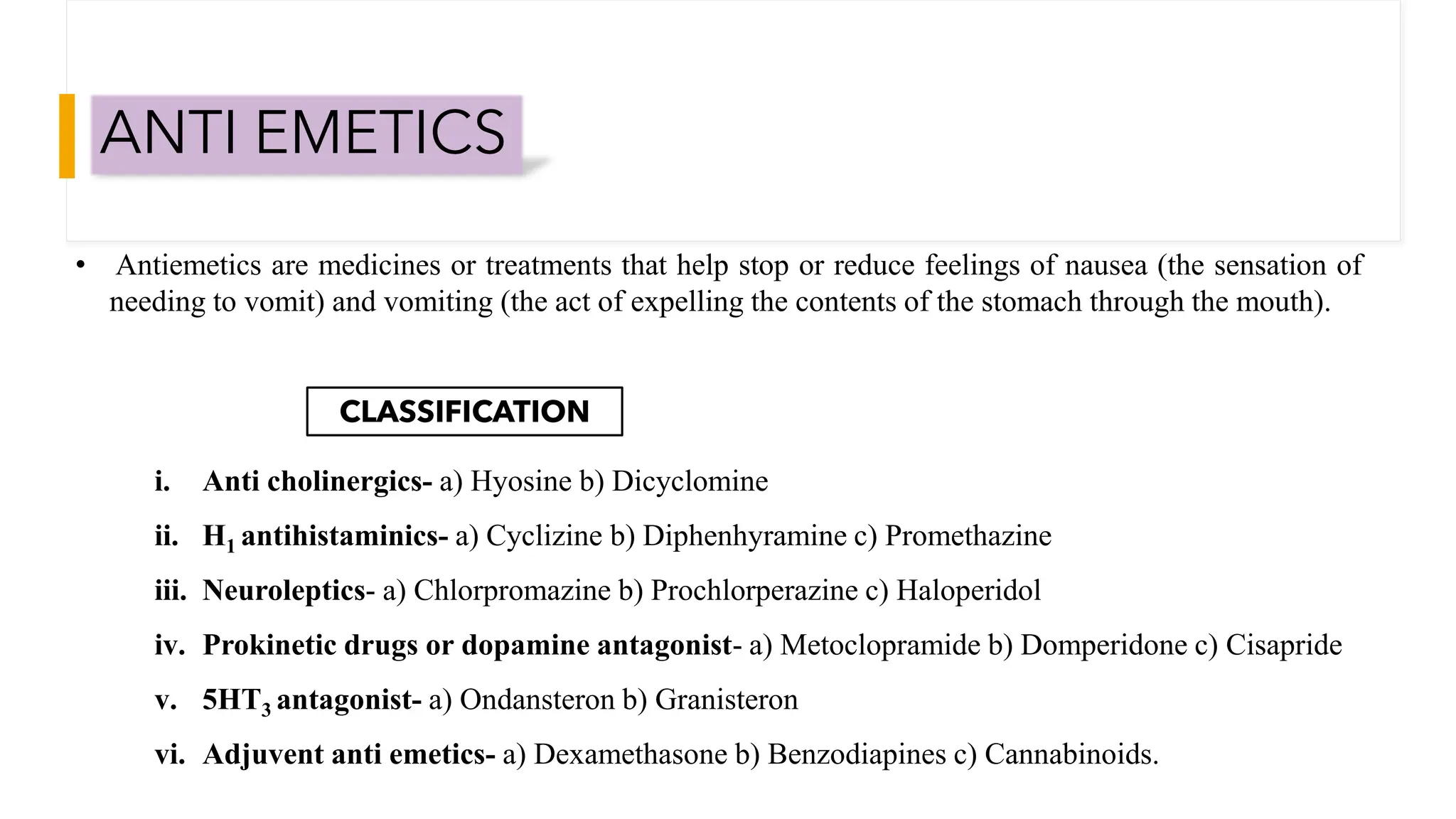
ANTI EMETICS
i. Anti cholinergics- a) Hyosine b) Dicyclomine
ii. H1 antihistaminics- a) Cyclizine b) Diphenhyramine c) Promethazine
iii. Neuroleptics- a) Chlorpromazine b) Prochlorperazine c) Haloperidol
iv. Prokinetic drugs or dopamine antagonist- a) Metoclopramide b) Domperidone c) Cisapride
v. 5HT3 antagonist- a) Ondansteron b) Granisteron
vi. Adjuvent anti emetics- a) Dexamethasone b) Benzodiapines c) Cannabinoids.
• Antiemetics are medicines or treatments that help stop or reduce feelings of nausea (the sensation of
needing to vomit) and vomiting (the act of expelling the contents of the stomach through the mouth).
CLASSIFICATION
1. Anti-cholinergics (Hyosine, Dicyclomine)
➢ Hyoscine is the most effective drug for motion sickness.
➢ It produces sedation & other anti-cholinergic side effects.
➢ It acts probably blocking conduction of nerve impulse across
the cholinergic link in the pathway leading from the vestibular
apparatus to the vomiting centre.
➢ A trans-dermal patch containing 1.5 mg of hyoscine to be
delivered over 3 days has been developed.
➢ If it is applied behind the pinna, it suppresses motion sickness
while produces only mild side effects.
2. H1 anti-histaminics (Cyclizine, Diphenhyramine, Promethazine)
➢ Some anti-histaminics are antiemetic useful mainly in motion sickness & a lesser extent in morning
sickness.
➢ It is useful in post operative & some other forms of vomiting.
3. Neuroleptics (Chlorpromazine, Prochlorperazine, Haloperidol)
➢ Neuroleptic drugs are primarily used to treat psychiatric disorders such as schizophrenia, bipolar
disorder, and psychotic disorders.
➢ Neuroleptics act by blocking D2 receptors in the CTZ.
➢ Antiemetic dose is lower generally than antipsychotic doses.
➢ Side effects – Sedation ,Extra pyramidal signs(group of movement disorders) .
4. Prokinetic drug and 5HT3 Antagonist
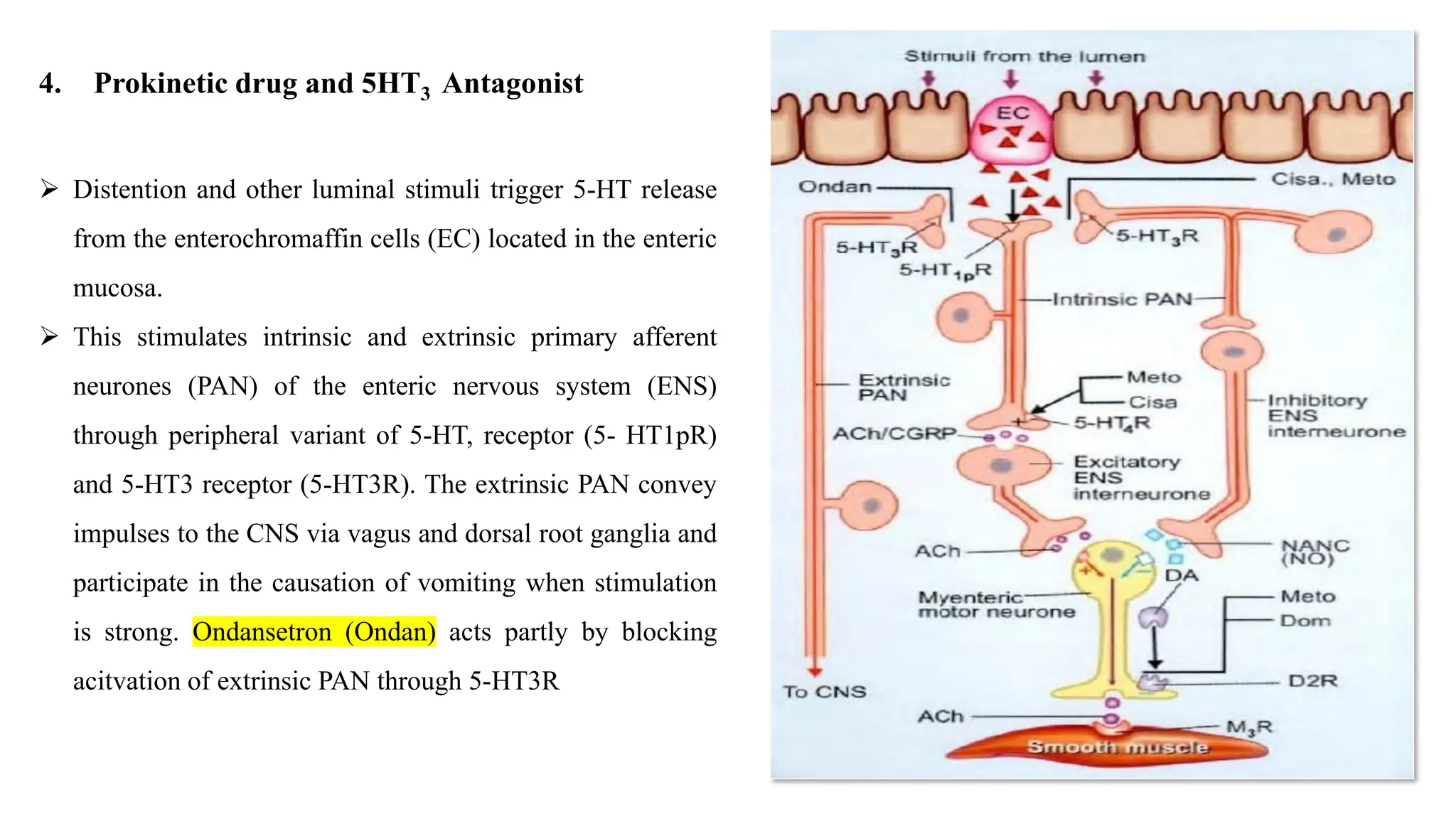
➢ Distention and other luminal stimuli trigger 5-HT release
from the enterochromaffin cells (EC) located in the enteric
mucosa.
➢ This stimulates intrinsic and extrinsic primary afferent
neurones (PAN) of the enteric nervous system (ENS)
through peripheral variant of 5-HT, receptor (5- HT1pR)
and 5-HT3 receptor (5-HT3R). The extrinsic PAN convey
impulses to the CNS via vagus and dorsal root ganglia and
participate in the causation of vomiting when stimulation
is strong. Ondansetron (Ondan) acts partly by blocking
acitvation of extrinsic PAN through 5-HT3R
➢ The intrinsic PAN interact with excitatory and inhibitory interneurons of the ENS to mediate both
contraction (of proximal gut muscles) and relaxation (of distal gut muscles) to coordinate the peristaltic
reflex respectively through release of acetylcholine (ACh) and non adrenergic-noncholinergic (NANC)
transmitter, which mainly is nitric oxide (NO).
➢ Cisapride (Cisa) and metoclopramide (Meto) activate the prejunctional 5-HT4 receptors (5-HT4R)
Iocated on the terminals of the intrinsic PAN and promote Ach release, and thereby the contractile
activity.
➢ The weak 5-HT3 blocking action of Cisa. and Meto., in addition, reduces activity in the inhibitory
interneurons activity .
➢ Domperidone (Dom) and Metoplopramide also block the action of dopamine (DA) on prejunctional
D2 receptor (D2R) which normally inhibits ACh release from the myenteric motor neuron, and thus
causes smooth muscle contraction acting through muscarinic M3 receptor
5. Adjuvant Antiemetics (Dexamethasone, Benzodiapines, Cannabinoids)
➢ Corticosteroids can treat nausea and vomiting due to moderately emetogenic chemotherapy
➢ But are more often employed to augment the efficacy of other primary antiemetic drugs like
metoclopramide and ondansetron.
➢ The weak antiemetic property of BZDs is primarily based on the sedative action.
➢ Used as adjuvant to metoclopramide/ondansetron.
THANK YOU
15

Antiemetics Pharmacology Presentation.ppt

  • 1.
    Presented by AYUSHROY M.PHARM, 2nd Semester Pharmacology (2023-25) Antiemetics SCHOOL OF PHARMACEUTICAL SCIENCES GIRIJANANDA CHOWDHURY UNIVERSITY
  • 2.
    CONTENT i. Introduction toEmesis ii. Types of emesis and their Mechanism iii.Anti emetics classification and Mechanism
  • 3.
    INTRODUCTION TO EMESIS ▪Emesis, commonly known as vomiting, is a complex physiological process characterized by the forceful expulsion of the contents of the stomach and, at times, the small intestine through the mouth. ▪ It is a protective reflex aimed at removing harmful substances, irritants, or toxins from the digestive tract.
  • 4.
    Some common typesof vomiting based on various factors, including the underlying cause, the nature of the vomiting episode: 1. Acute Vomiting: Sudden throwing up due to things like infections, food poisoning, motion sickness, or medicines. 2. Chronic Vomiting: Happens repeatedly over a long time and can be caused by conditions like stomach problems or inflammation in the gut. 3. Motion Sickness: Feeling nauseous and vomiting due to motion, like when traveling by car, boat, or plane. It happens because the brain gets mixed signals from the inner ears, eyes, and sensory nerves, causing discomfort and vomiting. TYPES
  • 5.
    4. Morning Sickness:Nausea and vomiting, often in the morning, commonly experienced by pregnant women. 5. Bilious Vomiting: Vomiting bile, a yellow-green fluid from the liver. It can occur when the stomach is empty and might indicate issues like intestinal blockages
  • 6.
    PHYSIOLOGY OF EMESIS ⁎Vomiting Center: Vomiting/Emesis occurs due to stimulation of the emetic(vomiting) centres situated in the medulla oblongata ⁎ Chemoreceptor trigger zone (CTZ): The CTZ is a area close to the vomiting center located in the area postrema in the floor of the fourth ventricle within the brain. ⁎ This area is outside the blood brain barrier, and is therefore readily exposed to substances circulating through the blood and cerebral spinal fluid. Common triggers of the CTZ include metabolic abnormalities, toxins, and medications.
  • 8.
    VOMITING CENTRE (Muscarinic receptor) Chemoreceptor trigger zone (D2receptor and 5HT receptor) 2. Higher centre/ Cerebral cortex (Pain, smell, sight or thought) VOMITING REFLEX 1. Motion Sickness Vestibular Nuclei (H1 and Muscarinic receptor) 3. Cytotoxic drugs 4. Cytotoxic drugs acting on Enterochromaffin cells Serotonin
  • 9.
    ANTI EMETICS i. Anticholinergics- a) Hyosine b) Dicyclomine ii. H1 antihistaminics- a) Cyclizine b) Diphenhyramine c) Promethazine iii. Neuroleptics- a) Chlorpromazine b) Prochlorperazine c) Haloperidol iv. Prokinetic drugs or dopamine antagonist- a) Metoclopramide b) Domperidone c) Cisapride v. 5HT3 antagonist- a) Ondansteron b) Granisteron vi. Adjuvent anti emetics- a) Dexamethasone b) Benzodiapines c) Cannabinoids. • Antiemetics are medicines or treatments that help stop or reduce feelings of nausea (the sensation of needing to vomit) and vomiting (the act of expelling the contents of the stomach through the mouth). CLASSIFICATION
  • 10.
    1. Anti-cholinergics (Hyosine,Dicyclomine) ➢ Hyoscine is the most effective drug for motion sickness. ➢ It produces sedation & other anti-cholinergic side effects. ➢ It acts probably blocking conduction of nerve impulse across the cholinergic link in the pathway leading from the vestibular apparatus to the vomiting centre. ➢ A trans-dermal patch containing 1.5 mg of hyoscine to be delivered over 3 days has been developed. ➢ If it is applied behind the pinna, it suppresses motion sickness while produces only mild side effects.
  • 11.
    2. H1 anti-histaminics(Cyclizine, Diphenhyramine, Promethazine) ➢ Some anti-histaminics are antiemetic useful mainly in motion sickness & a lesser extent in morning sickness. ➢ It is useful in post operative & some other forms of vomiting. 3. Neuroleptics (Chlorpromazine, Prochlorperazine, Haloperidol) ➢ Neuroleptic drugs are primarily used to treat psychiatric disorders such as schizophrenia, bipolar disorder, and psychotic disorders. ➢ Neuroleptics act by blocking D2 receptors in the CTZ. ➢ Antiemetic dose is lower generally than antipsychotic doses. ➢ Side effects – Sedation ,Extra pyramidal signs(group of movement disorders) .
  • 12.
    4. Prokinetic drugand 5HT3 Antagonist ➢ Distention and other luminal stimuli trigger 5-HT release from the enterochromaffin cells (EC) located in the enteric mucosa. ➢ This stimulates intrinsic and extrinsic primary afferent neurones (PAN) of the enteric nervous system (ENS) through peripheral variant of 5-HT, receptor (5- HT1pR) and 5-HT3 receptor (5-HT3R). The extrinsic PAN convey impulses to the CNS via vagus and dorsal root ganglia and participate in the causation of vomiting when stimulation is strong. Ondansetron (Ondan) acts partly by blocking acitvation of extrinsic PAN through 5-HT3R
  • 13.
    ➢ The intrinsicPAN interact with excitatory and inhibitory interneurons of the ENS to mediate both contraction (of proximal gut muscles) and relaxation (of distal gut muscles) to coordinate the peristaltic reflex respectively through release of acetylcholine (ACh) and non adrenergic-noncholinergic (NANC) transmitter, which mainly is nitric oxide (NO). ➢ Cisapride (Cisa) and metoclopramide (Meto) activate the prejunctional 5-HT4 receptors (5-HT4R) Iocated on the terminals of the intrinsic PAN and promote Ach release, and thereby the contractile activity. ➢ The weak 5-HT3 blocking action of Cisa. and Meto., in addition, reduces activity in the inhibitory interneurons activity . ➢ Domperidone (Dom) and Metoplopramide also block the action of dopamine (DA) on prejunctional D2 receptor (D2R) which normally inhibits ACh release from the myenteric motor neuron, and thus causes smooth muscle contraction acting through muscarinic M3 receptor
  • 14.
    5. Adjuvant Antiemetics(Dexamethasone, Benzodiapines, Cannabinoids) ➢ Corticosteroids can treat nausea and vomiting due to moderately emetogenic chemotherapy ➢ But are more often employed to augment the efficacy of other primary antiemetic drugs like metoclopramide and ondansetron. ➢ The weak antiemetic property of BZDs is primarily based on the sedative action. ➢ Used as adjuvant to metoclopramide/ondansetron.
  • 15.