Mechanism of Action
      Classes of Antidepressant
                    Medications
Clinical Effects and Side Effects
Things I always wanted to know about
depression, but I forgot I did not know
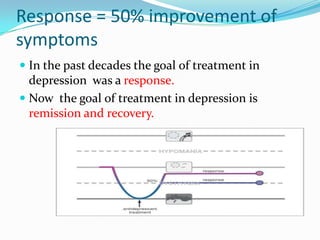
Response = 50% improvement of
symptoms
 In the past decades the goal of treatment in
  depression was a response.
 Now the goal of treatment in depression is
  remission and recovery.
Remission vs. Recovery
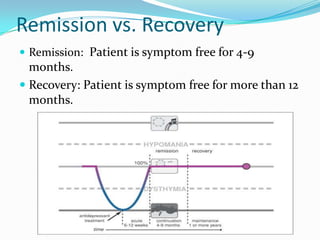
 Remission: Patient is symptom free for 4-9
  months.
 Recovery: Patient is symptom free for more than 12
  months.
STAR*D Study
 In a large NIMH study called Sequenced Treatment
 Alternatives to Relieve Depression(STAR*D) the goal
 of treatment was remission.

 Only 1/3 of patients on Citalopram monotherapy
  remitted.
 2/3 of patients failed to remit to Citalopram alone.


 If we are talking response instead of remission – 60-
 70% of patients respond to SSRI monotherapy.
Relapse vs. Recurrence

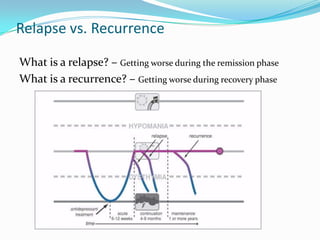
What is a relapse? – Getting worse during the remission phase
What is a recurrence? – Getting worse during recovery phase
Remission rates in MDD
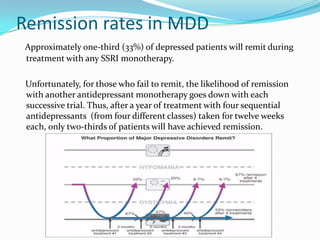
 Approximately one-third (33%) of depressed patients will remit during
 treatment with any SSRI monotherapy.

 Unfortunately, for those who fail to remit, the likelihood of remission
 with another antidepressant monotherapy goes down with each
 successive trial. Thus, after a year of treatment with four sequential
 antidepressants (from four different classes) taken for twelve weeks
 each, only two-thirds of patients will have achieved remission.
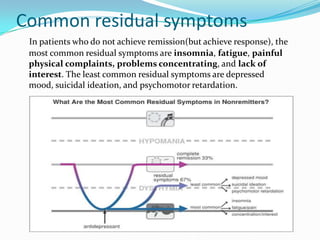
Common residual symptoms
 In patients who do not achieve remission(but achieve response), the
 most common residual symptoms are insomnia, fatigue, painful
 physical complaints, problems concentrating, and lack of
 interest. The least common residual symptoms are depressed
 mood, suicidal ideation, and psychomotor retardation.
Antidepressants - Actions
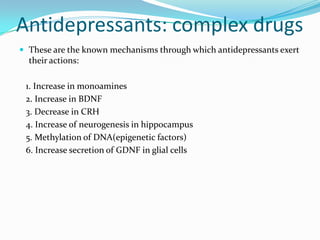
Antidepressants: complex drugs
 These are the known mechanisms through which antidepressants exert
  their actions:

 1. Increase in monoamines
 2. Increase in BDNF
 3. Decrease in CRH
 4. Increase of neurogenesis in hippocampus
 5. Methylation of DNA(epigenetic factors)
 6. Increase secretion of GDNF in glial cells
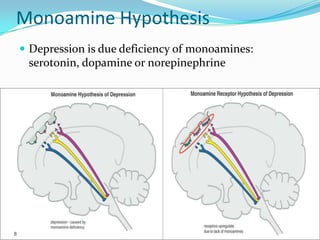
Monoamine Hypothesis
 Depression is due deficiency of monoamines:
 serotonin, dopamine or norepinephrine
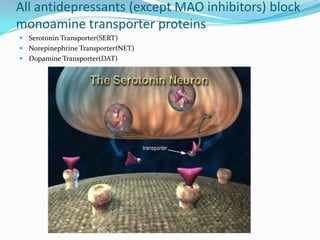
All antidepressants (except MAO inhibitors) block
monoamine transporter proteins
 Serotonin Transporter(SERT)
 Norepinephrine Transporter(NET)
 Dopamine Transporter(DAT)
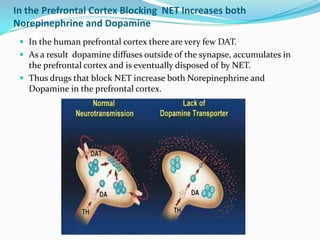
In the Prefrontal Cortex Blocking NET Increases both
Norepinephrine and Dopamine
  In the human prefrontal cortex there are very few DAT.
  As a result dopamine diffuses outside of the synapse, accumulates in
   the prefrontal cortex and is eventually disposed of by NET.
  Thus drugs that block NET increase both Norepinephrine and
   Dopamine in the prefrontal cortex.
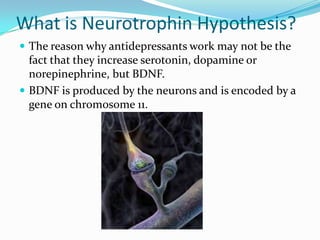
What is Neurotrophin Hypothesis?
 The reason why antidepressants work may not be the
  fact that they increase serotonin, dopamine or
  norepinephrine, but BDNF.
 BDNF is produced by the neurons and is encoded by a
  gene on chromosome 11.
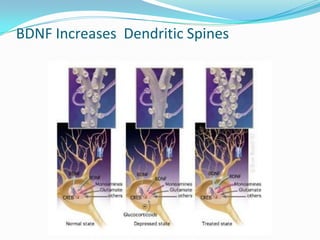
BDNF Increases Dendritic Spines
Actions of BDNF
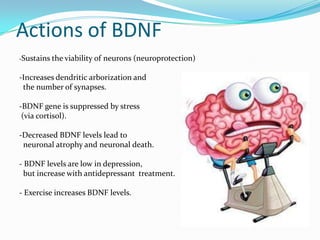
-Sustains the viability of   neurons (neuroprotection)

-Increases dendritic arborization and
 the number of synapses.

-BDNF gene is suppressed by stress
 (via cortisol).

-Decreased BDNF levels lead to
 neuronal atrophy and neuronal death.

- BDNF levels are low in depression,
  but increase with antidepressant treatment.

- Exercise increases BDNF levels.
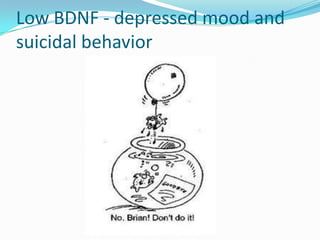
Low BDNF - depressed mood and
suicidal behavior
Antidepressant Classes
 Serotonin Selective Reuptake Inhibitors(SSRIs)
 Serotonin Norepinephrine Reuptake Inhibitors(SNRIs)
 Norepinephrine and Dopamine Reuptake
    Inhibitors(NDRIs)
   Selective Norepinephrine Reuptake Inhibitors(NRIs)
   Alpha 2 Antagonists as serotonin and norepinephrine
    Disinhibitors(SNDIs)
   Serotonin Antagonist/Reuptake Inhibitors(SARIs)
   Serotonin Partial Agonist Reuptake Inhibitor (SPARI)
   Tricyclic Antidepressants(TCA)
   Monoamine Oxidase Inhibitors(MAOI)
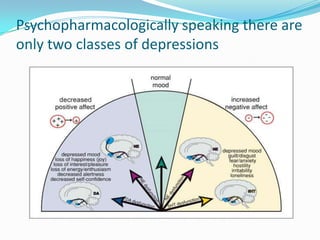
Psychopharmacologically speaking there are
only two classes of depressions
Serotonin Selective Reuptake
Inhibitors (SSRIs)
 Six agents are in this class:
  Fluoxetine, Paroxetine, Sertaline, Fluvoxamine, Citalopram
  and Escitalopram.

 Fluvoxamine does not have an FDA indication for
  depression. It was approved for social phobia and OCD. In
  other countries it is being used for depression.

 Three agents come in CR form: Fluoxetine, Paroxetine and
  Fluvoxamine.

 All are generic except the CR preparations.
SSRIs overview
 Efficacy(FDA approved) for:
 MDD (all except Fluvoxamine)
 OCD( all except Citalopram and Escitalopram)
 Social Phobia(Sertaline, Fluvoxamine, and Paroxetine)
 PTSD(Sertaline and Paroxetine)
 Bulimia(Fluoxetine)
 GAD(Paroxetine and Escitalopram)
 PMDD(Fluoxetine, Paroxetine CR and Sertaline)

 Side Effects: GI, decreased libido, delayed
 ejaculation, headaches and Insomnia/Somnolence.
Serotonin Norepinephrine
Reuptake Inhibitors(SNRIs)
 Four agents: Venlafaxine, Desvenlafaxine, Duloxetine and
 Milnacipran
 Efficacy(FDA approved) for:
 -Venlafaxine(MDD, GAD, Social Phobia)
 -Desvenlafaxine(MDD)
 -Duloxetine(MDD, GAD, neuropathic pain, fibromyalgia)
 -Milnacipran(fibromyalgia)
 Off label uses:
 Venlafaxine (ADHD)
 Duloxetine (stress urinary incontinence)
 Desvenlafaxine(vasomotor symptoms associated with
 menopause)
Norepinephrine and Dopamine
Reuptake Inhibitors(NDRIs)
 One drug: Bupropion
 FDA indication: MDD, smoking cessation and SAD.
 Off label use: depression in cardiac patients, adjunct to
  SSRIs (for depressed mood as well as to counteract sexual
  side effects), substance abuse problems, ADHD and weight
  loss.
 Mechanism of Action: mild dopamine reuptake
  inhibitor, norepinephrine reuptake inhibitor (via its
  metabolite hydroxybupropion).
 Adverse effects: 4/1000 risk for seizure disorder in
  immediate-release formulations (doses higher than 450
  mg/day) and 1/1000 in sustained release
  formulations(identical to all other antidepressants).
Selective Norepinephrine Reuptake
Inhibitors(NRIs)
 Two drugs: Atomoxetine and Reboxetine(not
  approved in US).
 Mechanism of Action: Block norepinephrine
  transportes. In the prefrontal cortex there are very few
  dopamine transporters. Norepinephrine transporters
  dispose of both norepinephrine and dopamine. For
  this reason when the norepinephrine transporters are
  blocked the levels of both NE and DA are increased.
 Atomoxetine (Strattera) has the FDA indication for
  ADHD, but off label it is used as antidepressant.
Alpha 2 Antagonists as Serotonin and
Norepinephrine Disinhibitors(SNDIs)
 One drug: Mirtazapine
 FDA indication: MDD
 Off label uses: panic d/o, GAD, negative symptoms of
  schizophrenia, anti-nausea medication in chemotherapy
  patients(Kim 2008)and post operative nausea(Chen 2008).
 In STAR*D trial the combination of Mirtazapine(average
  dose 36 mg/day) with Venlafaxine (average dose 210
  mg/day) resulted in remission of 13% of patients who failed
  three consecutive antidepressant trials(McGrath 2006).
 Mechanism of action: Blocks alpha 2 adrenergic
  receptors presynaptically(autoreceptors) on
  noradrenergic and serotonergic neurons, leading to
  disinhibition of serotonin and norepinephrine. In
  addition, mirtazapine blocks 5HT2A, 5HT2C and 5HT3
  postsynaptically.
Serotonin Antagonist/Reuptake
Inhibitors(SARIs)

 Two agents: Trazodone, Nefazodone
 Both have FDA indication for MDD.
 Off label use:
 anxiety (Trazodone),
 PTSD (Nefazodone one of the most prescribed drugs for PTSD).
 Depression with co-morbid substance abuse (Nefazodone).
 Mechanism of Action: presynaptically blocks the serotonin
 transporters and 5HT1A
 postsynaptically blocks 5HT2A, 5HT2C

 Adverse effects: liver damage (risk 1/250,000 per patient/year) =
 If a quarter of a million patients were taking Nefazodone for a
 year , one patient would be expected to develop liver damage.
Serotonin Partial Agonist Reuptake
Inhibitor (SPARI)
 Vilazodone (Viibryd) approved in January 2011.
  FDA approved for Major Depressive Disorder
  Off label used for Anxiety
 Mechanism of action:
-blocks serotonin reuptake pumps
-partial agonist at presynaptic somatodendritic 5HT 1A
Dosage:
40 mg once daily with food (taken on empty stomach 50%
reduced absorbtion
Side effects: nausea, diarrhea, insomnia, rare hyponatremia
Tricyclic Antidepressants(TCA)
 Efficacy: Second or third line agents for MDD,
  Panic d/o, OCD (FDA approved Clomipramine), Pain
  Syndromes, Migraine prophylaxis, Enuresis (FDA approved
  Imipramine).

 Side Effects: dry mouth, urinary
  retention, constipation, blurred vision, confusion, weight
  gain, sedation, sexual dysfunction, orthostasis, tachycardia and
  cardiac conduction abnormalities.

 Drug interactions: TCA increase warfarin levels, cimetidine
  increases TCA levels, clonidine – hypertensive crises(avoid), oral
  contraceptives – increase TCA levels, SSRIs increase TCA
  levels, quinidine with TCA- increase in arrhythmias(avoid), L-
  dopa decreases TCA levels, sympathomimetics with TCAs – risk
  for arrhythmia, HTN, tachycardia.
MAO Inhibitors (MAOI)
  Efficacy: Third line agents for MDD, second line for
   Parkinson’s disease(Selegiline).

  FDA indications: treatment resistant depression.

   Selegiline(Emsam) was approved by the FDA in 2006 in the transdermal
   form for depression (oral Selegiline is not approved for depression).

   The Selegiline dilemma: Selegiline is a MAO-B inhibitor and in the doses
   used for Parkinson’s disease (5-10 mg a day) has a low risk for hypertensive
   crises. Unfortunately for the treatment of depression higher doses (40-60
   mg a day) are needed. At these high doses the drug affects both MAO-A
   and MAO-B and the risk for hypertensive crises is high.

   The transdermal Selegiline(Emsam) bypasses the gut and the liver and thus
   allows for use of higher doses with lower risk for hypertensive crises(below
   60 mg a day).
Drug Interactions and Adverse
Effects
 Risk of serious drug interactions is limited with SSRIs, except in two
  circumstances:
 -Fatalities have been reported from serotonin syndrome when used in
  close proximity with MAOI, even if the drugs were not used
  concurrently.
 -Inhibition of 2D6 enzyme by the SSRIs.
   Many drugs are metabolized by this enzyme, including TCA, type 1C
  antiarrhythmic agents, some beta blockers, benztropine and many
  antipsychotics.
  SSRIs inhibit 2D6, leading to increased plasma levels of other agents (8
  fold increase in TCA plasma levels have been reported when used
  together).
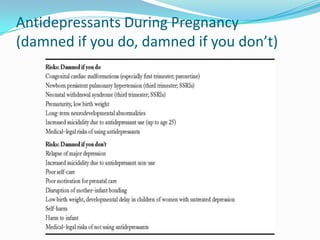
Antidepressants During Pregnancy
(damned if you do, damned if you don’t)
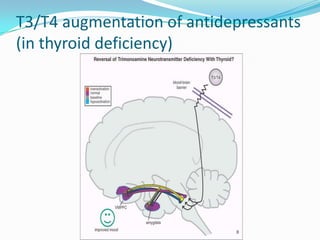
T3/T4 augmentation of antidepressants
(in thyroid deficiency)
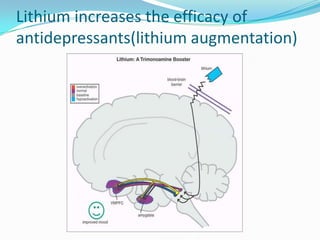
Lithium increases the efficacy of
antidepressants(lithium augmentation)
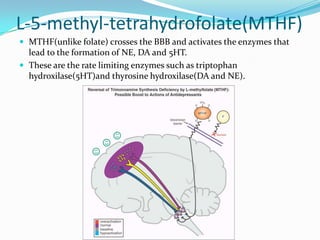
L-5-methyl-tetrahydrofolate(MTHF)
 MTHF(unlike folate) crosses the BBB and activates the enzymes that
  lead to the formation of NE, DA and 5HT.
 These are the rate limiting enzymes such as triptophan
  hydroxilase(5HT)and thyrosine hydroxilase(DA and NE).
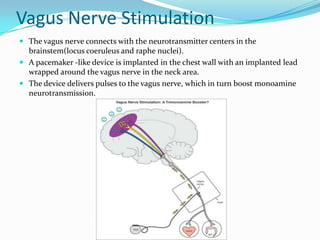
Vagus Nerve Stimulation
 The vagus nerve connects with the neurotransmitter centers in the
  brainstem(locus coeruleus and raphe nuclei).
 A pacemaker -like device is implanted in the chest wall with an implanted lead
  wrapped around the vagus nerve in the neck area.
 The device delivers pulses to the vagus nerve, which in turn boost monoamine
  neurotransmission.
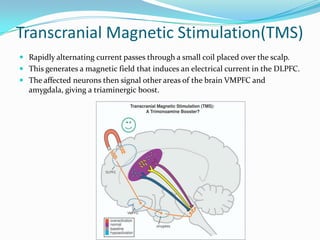
Transcranial Magnetic Stimulation(TMS)
 Rapidly alternating current passes through a small coil placed over the scalp.
 This generates a magnetic field that induces an electrical current in the DLPFC.
 The affected neurons then signal other areas of the brain VMPFC and
  amygdala, giving a triaminergic boost.
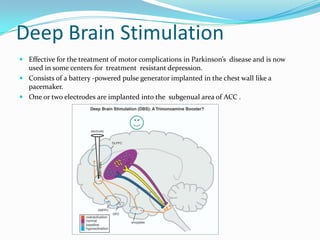
Deep Brain Stimulation
 Effective for the treatment of motor complications in Parkinson’s disease and is now
  used in some centers for treatment resistant depression.
 Consists of a battery -powered pulse generator implanted in the chest wall like a
  pacemaker.
 One or two electrodes are implanted into the subgenual area of ACC .
Putative New Generation
antidepressants
 Corticotropin-Releasing Hormone Receptor
    Antagonists(CRH1, CRH2)
   Vasopresin Receptor Antagonists(V1A, V1B)
   Glucocorticoid Receptor Antagonists(GR, MR)
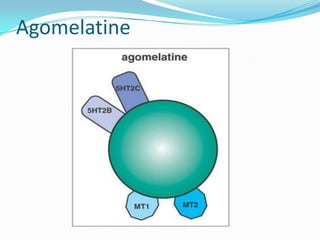
   Agomelatine
   Glutamate Blockers(AMPA blockers, NMDA blockers)
   Neuropeptides(substance P, Galanin, Orexigenic
    Peptides)
   GSK 3 inhibitors
   Neurogenesis Enhancers(BDNF, GDNF)
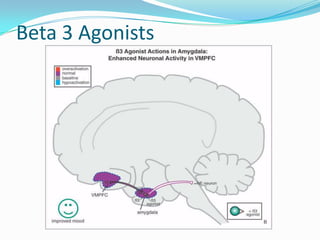
   Beta 3 agonists
Glucocorticoid Receptor Antagonists
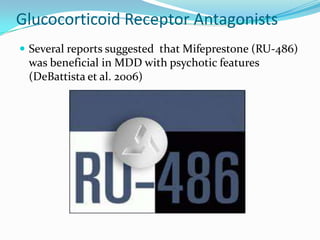
 Several reports suggested that Mifeprestone (RU-486)
 was beneficial in MDD with psychotic features
 (DeBattista et al. 2006)
Agomelatine
Beta 3 Agonists
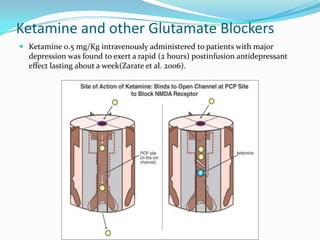
Ketamine and other Glutamate Blockers
 Ketamine 0.5 mg/Kg intravenously administered to patients with major
  depression was found to exert a rapid (2 hours) postinfusion antidepressant
  effect lasting about a week(Zarate et al. 2006).
References:
 Stahl’s Essential Psychopharmacology, Third
  Edition, 2010
 Textbook of Psychopharmacology, Fourt
  Edition, Schatzberg, Nemeroff, 2010
 Brain Protection in Schizophrenia, Mood and
  Cognitive Disorders, Ritsner et al, 2010

Antidepressants Update

  • 1.
    Mechanism of Action Classes of Antidepressant Medications Clinical Effects and Side Effects
  • 2.
    Things I alwayswanted to know about depression, but I forgot I did not know
  • 3.
    Response = 50%improvement of symptoms  In the past decades the goal of treatment in depression was a response.  Now the goal of treatment in depression is remission and recovery.
  • 4.
    Remission vs. Recovery Remission: Patient is symptom free for 4-9 months.  Recovery: Patient is symptom free for more than 12 months.
  • 5.
    STAR*D Study  Ina large NIMH study called Sequenced Treatment Alternatives to Relieve Depression(STAR*D) the goal of treatment was remission.  Only 1/3 of patients on Citalopram monotherapy remitted.  2/3 of patients failed to remit to Citalopram alone.  If we are talking response instead of remission – 60- 70% of patients respond to SSRI monotherapy.
  • 6.
    Relapse vs. Recurrence Whatis a relapse? – Getting worse during the remission phase What is a recurrence? – Getting worse during recovery phase
  • 7.
    Remission rates inMDD Approximately one-third (33%) of depressed patients will remit during treatment with any SSRI monotherapy. Unfortunately, for those who fail to remit, the likelihood of remission with another antidepressant monotherapy goes down with each successive trial. Thus, after a year of treatment with four sequential antidepressants (from four different classes) taken for twelve weeks each, only two-thirds of patients will have achieved remission.
  • 8.
    Common residual symptoms In patients who do not achieve remission(but achieve response), the most common residual symptoms are insomnia, fatigue, painful physical complaints, problems concentrating, and lack of interest. The least common residual symptoms are depressed mood, suicidal ideation, and psychomotor retardation.
  • 9.
  • 10.
    Antidepressants: complex drugs These are the known mechanisms through which antidepressants exert their actions: 1. Increase in monoamines 2. Increase in BDNF 3. Decrease in CRH 4. Increase of neurogenesis in hippocampus 5. Methylation of DNA(epigenetic factors) 6. Increase secretion of GDNF in glial cells
  • 11.
    Monoamine Hypothesis  Depressionis due deficiency of monoamines: serotonin, dopamine or norepinephrine
  • 12.
    All antidepressants (exceptMAO inhibitors) block monoamine transporter proteins  Serotonin Transporter(SERT)  Norepinephrine Transporter(NET)  Dopamine Transporter(DAT)
  • 13.
    In the PrefrontalCortex Blocking NET Increases both Norepinephrine and Dopamine  In the human prefrontal cortex there are very few DAT.  As a result dopamine diffuses outside of the synapse, accumulates in the prefrontal cortex and is eventually disposed of by NET.  Thus drugs that block NET increase both Norepinephrine and Dopamine in the prefrontal cortex.
  • 14.
    What is NeurotrophinHypothesis?  The reason why antidepressants work may not be the fact that they increase serotonin, dopamine or norepinephrine, but BDNF.  BDNF is produced by the neurons and is encoded by a gene on chromosome 11.
  • 15.
  • 16.
    Actions of BDNF -Sustainsthe viability of neurons (neuroprotection) -Increases dendritic arborization and the number of synapses. -BDNF gene is suppressed by stress (via cortisol). -Decreased BDNF levels lead to neuronal atrophy and neuronal death. - BDNF levels are low in depression, but increase with antidepressant treatment. - Exercise increases BDNF levels.
  • 17.
    Low BDNF -depressed mood and suicidal behavior
  • 18.
    Antidepressant Classes  SerotoninSelective Reuptake Inhibitors(SSRIs)  Serotonin Norepinephrine Reuptake Inhibitors(SNRIs)  Norepinephrine and Dopamine Reuptake Inhibitors(NDRIs)  Selective Norepinephrine Reuptake Inhibitors(NRIs)  Alpha 2 Antagonists as serotonin and norepinephrine Disinhibitors(SNDIs)  Serotonin Antagonist/Reuptake Inhibitors(SARIs)  Serotonin Partial Agonist Reuptake Inhibitor (SPARI)  Tricyclic Antidepressants(TCA)  Monoamine Oxidase Inhibitors(MAOI)
  • 19.
    Psychopharmacologically speaking thereare only two classes of depressions
  • 20.
    Serotonin Selective Reuptake Inhibitors(SSRIs)  Six agents are in this class: Fluoxetine, Paroxetine, Sertaline, Fluvoxamine, Citalopram and Escitalopram.  Fluvoxamine does not have an FDA indication for depression. It was approved for social phobia and OCD. In other countries it is being used for depression.  Three agents come in CR form: Fluoxetine, Paroxetine and Fluvoxamine.  All are generic except the CR preparations.
  • 21.
    SSRIs overview Efficacy(FDAapproved) for:  MDD (all except Fluvoxamine)  OCD( all except Citalopram and Escitalopram)  Social Phobia(Sertaline, Fluvoxamine, and Paroxetine)  PTSD(Sertaline and Paroxetine)  Bulimia(Fluoxetine)  GAD(Paroxetine and Escitalopram)  PMDD(Fluoxetine, Paroxetine CR and Sertaline)  Side Effects: GI, decreased libido, delayed ejaculation, headaches and Insomnia/Somnolence.
  • 22.
    Serotonin Norepinephrine Reuptake Inhibitors(SNRIs) Four agents: Venlafaxine, Desvenlafaxine, Duloxetine and Milnacipran Efficacy(FDA approved) for: -Venlafaxine(MDD, GAD, Social Phobia) -Desvenlafaxine(MDD) -Duloxetine(MDD, GAD, neuropathic pain, fibromyalgia) -Milnacipran(fibromyalgia) Off label uses: Venlafaxine (ADHD) Duloxetine (stress urinary incontinence) Desvenlafaxine(vasomotor symptoms associated with menopause)
  • 23.
    Norepinephrine and Dopamine ReuptakeInhibitors(NDRIs)  One drug: Bupropion  FDA indication: MDD, smoking cessation and SAD.  Off label use: depression in cardiac patients, adjunct to SSRIs (for depressed mood as well as to counteract sexual side effects), substance abuse problems, ADHD and weight loss.  Mechanism of Action: mild dopamine reuptake inhibitor, norepinephrine reuptake inhibitor (via its metabolite hydroxybupropion).  Adverse effects: 4/1000 risk for seizure disorder in immediate-release formulations (doses higher than 450 mg/day) and 1/1000 in sustained release formulations(identical to all other antidepressants).
  • 24.
    Selective Norepinephrine Reuptake Inhibitors(NRIs) Two drugs: Atomoxetine and Reboxetine(not approved in US).  Mechanism of Action: Block norepinephrine transportes. In the prefrontal cortex there are very few dopamine transporters. Norepinephrine transporters dispose of both norepinephrine and dopamine. For this reason when the norepinephrine transporters are blocked the levels of both NE and DA are increased.  Atomoxetine (Strattera) has the FDA indication for ADHD, but off label it is used as antidepressant.
  • 25.
    Alpha 2 Antagonistsas Serotonin and Norepinephrine Disinhibitors(SNDIs)  One drug: Mirtazapine  FDA indication: MDD  Off label uses: panic d/o, GAD, negative symptoms of schizophrenia, anti-nausea medication in chemotherapy patients(Kim 2008)and post operative nausea(Chen 2008).  In STAR*D trial the combination of Mirtazapine(average dose 36 mg/day) with Venlafaxine (average dose 210 mg/day) resulted in remission of 13% of patients who failed three consecutive antidepressant trials(McGrath 2006).  Mechanism of action: Blocks alpha 2 adrenergic receptors presynaptically(autoreceptors) on noradrenergic and serotonergic neurons, leading to disinhibition of serotonin and norepinephrine. In addition, mirtazapine blocks 5HT2A, 5HT2C and 5HT3 postsynaptically.
  • 26.
    Serotonin Antagonist/Reuptake Inhibitors(SARIs) Twoagents: Trazodone, Nefazodone Both have FDA indication for MDD. Off label use: anxiety (Trazodone), PTSD (Nefazodone one of the most prescribed drugs for PTSD). Depression with co-morbid substance abuse (Nefazodone). Mechanism of Action: presynaptically blocks the serotonin transporters and 5HT1A postsynaptically blocks 5HT2A, 5HT2C Adverse effects: liver damage (risk 1/250,000 per patient/year) = If a quarter of a million patients were taking Nefazodone for a year , one patient would be expected to develop liver damage.
  • 27.
    Serotonin Partial AgonistReuptake Inhibitor (SPARI)  Vilazodone (Viibryd) approved in January 2011. FDA approved for Major Depressive Disorder Off label used for Anxiety  Mechanism of action: -blocks serotonin reuptake pumps -partial agonist at presynaptic somatodendritic 5HT 1A Dosage: 40 mg once daily with food (taken on empty stomach 50% reduced absorbtion Side effects: nausea, diarrhea, insomnia, rare hyponatremia
  • 28.
    Tricyclic Antidepressants(TCA)  Efficacy:Second or third line agents for MDD, Panic d/o, OCD (FDA approved Clomipramine), Pain Syndromes, Migraine prophylaxis, Enuresis (FDA approved Imipramine).  Side Effects: dry mouth, urinary retention, constipation, blurred vision, confusion, weight gain, sedation, sexual dysfunction, orthostasis, tachycardia and cardiac conduction abnormalities.  Drug interactions: TCA increase warfarin levels, cimetidine increases TCA levels, clonidine – hypertensive crises(avoid), oral contraceptives – increase TCA levels, SSRIs increase TCA levels, quinidine with TCA- increase in arrhythmias(avoid), L- dopa decreases TCA levels, sympathomimetics with TCAs – risk for arrhythmia, HTN, tachycardia.
  • 29.
    MAO Inhibitors (MAOI)  Efficacy: Third line agents for MDD, second line for Parkinson’s disease(Selegiline).  FDA indications: treatment resistant depression. Selegiline(Emsam) was approved by the FDA in 2006 in the transdermal form for depression (oral Selegiline is not approved for depression). The Selegiline dilemma: Selegiline is a MAO-B inhibitor and in the doses used for Parkinson’s disease (5-10 mg a day) has a low risk for hypertensive crises. Unfortunately for the treatment of depression higher doses (40-60 mg a day) are needed. At these high doses the drug affects both MAO-A and MAO-B and the risk for hypertensive crises is high. The transdermal Selegiline(Emsam) bypasses the gut and the liver and thus allows for use of higher doses with lower risk for hypertensive crises(below 60 mg a day).
  • 30.
    Drug Interactions andAdverse Effects  Risk of serious drug interactions is limited with SSRIs, except in two circumstances:  -Fatalities have been reported from serotonin syndrome when used in close proximity with MAOI, even if the drugs were not used concurrently.  -Inhibition of 2D6 enzyme by the SSRIs. Many drugs are metabolized by this enzyme, including TCA, type 1C antiarrhythmic agents, some beta blockers, benztropine and many antipsychotics. SSRIs inhibit 2D6, leading to increased plasma levels of other agents (8 fold increase in TCA plasma levels have been reported when used together).
  • 31.
    Antidepressants During Pregnancy (damnedif you do, damned if you don’t)
  • 32.
    T3/T4 augmentation ofantidepressants (in thyroid deficiency)
  • 33.
    Lithium increases theefficacy of antidepressants(lithium augmentation)
  • 34.
    L-5-methyl-tetrahydrofolate(MTHF)  MTHF(unlike folate)crosses the BBB and activates the enzymes that lead to the formation of NE, DA and 5HT.  These are the rate limiting enzymes such as triptophan hydroxilase(5HT)and thyrosine hydroxilase(DA and NE).
  • 35.
    Vagus Nerve Stimulation The vagus nerve connects with the neurotransmitter centers in the brainstem(locus coeruleus and raphe nuclei).  A pacemaker -like device is implanted in the chest wall with an implanted lead wrapped around the vagus nerve in the neck area.  The device delivers pulses to the vagus nerve, which in turn boost monoamine neurotransmission.
  • 36.
    Transcranial Magnetic Stimulation(TMS) Rapidly alternating current passes through a small coil placed over the scalp.  This generates a magnetic field that induces an electrical current in the DLPFC.  The affected neurons then signal other areas of the brain VMPFC and amygdala, giving a triaminergic boost.
  • 37.
    Deep Brain Stimulation Effective for the treatment of motor complications in Parkinson’s disease and is now used in some centers for treatment resistant depression.  Consists of a battery -powered pulse generator implanted in the chest wall like a pacemaker.  One or two electrodes are implanted into the subgenual area of ACC .
  • 38.
    Putative New Generation antidepressants Corticotropin-Releasing Hormone Receptor Antagonists(CRH1, CRH2)  Vasopresin Receptor Antagonists(V1A, V1B)  Glucocorticoid Receptor Antagonists(GR, MR)  Agomelatine  Glutamate Blockers(AMPA blockers, NMDA blockers)  Neuropeptides(substance P, Galanin, Orexigenic Peptides)  GSK 3 inhibitors  Neurogenesis Enhancers(BDNF, GDNF)  Beta 3 agonists
  • 39.
    Glucocorticoid Receptor Antagonists Several reports suggested that Mifeprestone (RU-486) was beneficial in MDD with psychotic features (DeBattista et al. 2006)
  • 40.
  • 41.
  • 42.
    Ketamine and otherGlutamate Blockers  Ketamine 0.5 mg/Kg intravenously administered to patients with major depression was found to exert a rapid (2 hours) postinfusion antidepressant effect lasting about a week(Zarate et al. 2006).
  • 43.
    References:  Stahl’s EssentialPsychopharmacology, Third Edition, 2010  Textbook of Psychopharmacology, Fourt Edition, Schatzberg, Nemeroff, 2010  Brain Protection in Schizophrenia, Mood and Cognitive Disorders, Ritsner et al, 2010