HISTORY
The condition was mentioned by Galen in the second century.
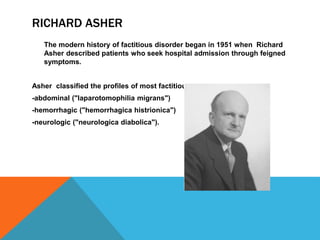
RICHARD ASHER
The modern history of factitious disorder began in 1951 when Richard
Asher described patients who seek hospital admission through feigned
symptoms.
Asher classified the profiles of most factitious patients into:
-abdominal ("laparotomophilia migrans")
-hemorrhagic ("hemorrhagica histrionica")
-neurologic ("neurologica diabolica").
DISEASE LABELS:
"hospital hoboes"
"hospital addicts"
"polysurgery addicts"
"professional patients,"
"pathomimes" [
"hospital vagrants"
"partial suicide," (a compromise behavior designed unconsciously) to
forestall total self-destruction )
DEFINITION
Factitious disorder refers to the psychiatric condition in which a patient
deliberately produces or falsifies symptoms of illness for the sole
purpose of assuming the sick role.
According to one estimate, the unnecessary tests and waste of other
medical resources caused by FD cost the United States $40 million per
year.
The name factitious comes from a Latin word that means "artificial" or
"contrived."
GANSER SYNDROME
Ganser syndrome is a rare dissociative disorder previously classified as a
factitious disorder.
It is characterized by nonsensical or wrong answers to questions or doing
things incorrectly, other dissociative symptoms such as fugue, amnesia
or conversion disorder, often with visual pseudohallucinations and a
decreased state of consciousness.
It is also sometimes called nonsense syndrome.
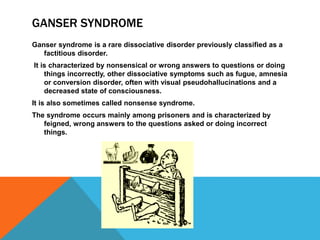
The syndrome occurs mainly among prisoners and is characterized by
feigned, wrong answers to the questions asked or doing incorrect
things.
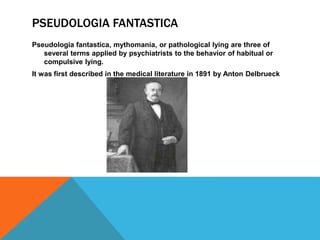
PSEUDOLOGIA FANTASTICA
Pseudologia fantastica, mythomania, or pathological lying are three of
several terms applied by psychiatrists to the behavior of habitual or
compulsive lying.
It was first described in the medical literature in 1891 by Anton Delbrueck
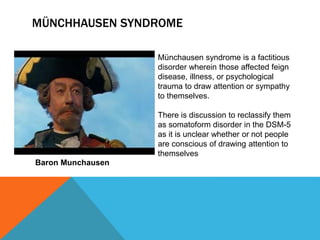
MÜNCHHAUSEN SYNDROME
Münchausen syndrome is a factitious
disorder wherein those affected feign
disease, illness, or psychological
trauma to draw attention or sympathy
to themselves.
There is discussion to reclassify them
as somatoform disorder in the DSM-5
as it is unclear whether or not people
are conscious of drawing attention to
themselves
Baron Munchausen
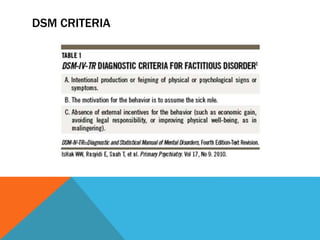
DSM CRITERIA
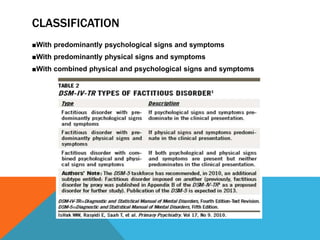
CLASSIFICATION
■With predominantly psychological signs and symptoms
■With predominantly physical signs and symptoms
■With combined physical and psychological signs and symptoms
CAUSES
The causes of factitious disorder, whether physical or psychiatric, are
difficult to determine because these patients are often lost to follow-up
when they sign out of the hospital.
PSYCHODYNAMIC EXPLANATIONS
Patients with FD are trying to re-enact unresolved childhood issues with parents.
They have underlying problems with masochism.
They need to be the center of attention and feel important.
They need to receive care and nurturance.
They are bothered by feelings of vulnerability.
Deceiving a physician allows them to feel superior to an authority figure.
RISK FACTORS
There are several known risk factors for factitious disorder, including:
The presence of other mental or physical disorders in childhood that
resulted in the patient's getting considerable medical attention.
A history of significant past relationships with doctors, or of grudges
against them.
Present diagnosis of borderline, narcissistic, or antisocial personality
disorder.
PREDISPOSING FACTORS
The presence of other mental disorders or general medical conditions
during childhood or adolescence that may have led to extensive
medical treatment and hospitalization;
Family disruption or emotional and/or physical abuse in childhood;
A grudge against the medical profession; employment in a medically-
related position;
Presence of a severe personality disorder (Feldman, 2004).
DEMOGRAPHICS
Some researchers have suggested that patients with factitious disorder
often present in childhood with traumatic events, such as abuse and
deprivation, as well as numerous hospitalizations;
As adults, they lack support from relatives and friends (Szoke, 1999).
Because they lack such support, it has been theorized that
hospitalization is unconsciously used to recreate the desired parent-
child bond that they lacked in reality (Kaplan, Sadock & Grebb, 1994).
UNSTABLE INTERPERSONAL RELATIONSHIPS
These patients often resemble persons with borderline personality in that
they manifest identity disturbance, unstable interpersonal relationships
and recurrent suicidal or self-mutilating behaviors; in addition, their
deceitfulness, lack of remorse, reckless disregard for their own safety
and repeated failure to sustain consistent work behavior resemble
antisocial personality disorder (Szoke, 1999).
It has also been theorized that Munchausen patients are motivated by a
desire to be cared for, a need for attention, dependency, an ambivalence
toward doctors or an existing personality disorder (HealthAtoZ, 2002).
They may delight in outwitting the medical profession, whom they regard
as highly trained (Feldman, 2004).
TREATMENT
Effectiveness of different psychotherapeutic approaches is limited by the
fact that few people diagnosed with FD remain in long-term treatment.
In many cases, however, the factitious disorder improves or resolves if
the individual receives appropriate therapy for a co-morbid psychiatric
disorder. Ganser syndrome usually resolves completely with supportive
psychotherapy .
One approach that has proven helpful in confronting patients with an
examiner's suspicions is a supportive manner that focuses on the
individual's emotional distress as the source of the illness rather than
on the anger or righteous indignation of hospital staff. Although most
individuals with FD refuse psychiatric treatment when it is offered,
those who accept it appear to benefit most from supportive rather than
insight-oriented therapy
TESTING
In order to assess reports of pain, the McGill Pain Questionnaire (MPQ)
and the Modified Somatic Perception Questionnaire (MSPQ) were
compared (Larrabee, 2003). The study found that the MPQ was better
than the MSPQ at detecting exaggerated pain symptoms; however, the
author cautions that elevations in scores should not be used
independently to detect malingering (Larrabee, 2003).
A study of the Lees-Haley Fake Bad Scale and its ability to measure
somatic malingering was utilized on 408 persons in a chronic pain
group (among other groups) (Butcher, Arbisib, Atlisa & McNulty, 2003).
The study found that the FBS is more likely to measure general
maladjustment and somatic complaints, rather than malingering.
TREATMENT
Doctors are advised not to merely dismiss patients who are presenting with
nonorganic pain, as these patients are often very psychologically invested in
their pain (Kiester & Duke, 1999).
They should be confronted with their diagnosis without suggesting guilt or
reproach (Merck Manual, 2006). They suggest giving patients a “ladder to
climb out of their symptoms,” by explaining to them that they do not have a
serious physical problem, and then directing them to therapies that can help
them (Kiester & Duke, 1999).
These therapies may include psychotherapy. Those found to be malingerers
should be told outright that they cannot help them; this is useful in
maintaining the integrity of the doctor, while not enabling the patient.
It is suggested that examining doctors not assume that there are no physical
problems co-occurring with a factitious disorder; they also suggest that the
patient be kept in the hospital and placed in long-term treatment with a
mental health professional, despite the small likelihood that the factitious
disorder will be cured (Healthinmind, 2003).
REFERENCES
Daly, Robert C., MPH, and Can M. Savasman, MD. "Ganser Syndrome." eMedicine Journal 3, no. 1
(January 14, 2002).
Elwyn, Todd S., MD, and Iqbal Ahmed, MD. "Factitious Disorder." eMedicine Journal 2, no. 11
(November 5, 2001).
Feldman, Marc D., and Charles V. Ford. "Liejacking." Journal of the American Medical Association
271 (May 25, 1994): 574.
Gordon, Leo A. "Munchausen Patients Have Found the Computer." Medical Economics 74
(September 8, 1997): 118-122.
Libow, Judith A., MD. "Child and Adolescent Illness Falsification." Pediatrics 105 (February 2000): 58-
64.
McEwen, Donna R., BSN. "Recognizing Munchausen's Syndrome." AORN Journal 67 (February
1998): 206-211.
Paulk, David. "Munchausen Syndrome by Proxy." Clinician Reviews 11 (August 2001): 783-791.
Snyder, S. L., M. S. Buchsbaum, and R. C. Krishna. "Unusual Visual Symptoms and Ganser-Like
State Due to Cerebral Injury: A Case Study Using (18)F-Deoxyglucose Positron Emission
Tomography." Behavioral Neurology 11 (1998): 51-54.
Stephenson, Joan. "Patient Pretenders Weave Tangled 'Web' of Deceit." Journal of the American
Medical Association 280 (October 21, 1998): 1297.
Stern, Theodore A. "How to Spot the Patient Who's Faking It." Medical Economics Journal 76 (May
24, 1999): 54-56.
Szoke, Andrei, MD, and Didier Boillet, MD. "Factitious Disorder with Psychological Signs and
Symptoms: Case Reports and Proposals for Improving Diagnosis." Psychiatry On-Line , 1999.

Factitious disorders

  • 2.
    HISTORY The condition wasmentioned by Galen in the second century.
  • 3.
    RICHARD ASHER The modernhistory of factitious disorder began in 1951 when Richard Asher described patients who seek hospital admission through feigned symptoms. Asher classified the profiles of most factitious patients into: -abdominal ("laparotomophilia migrans") -hemorrhagic ("hemorrhagica histrionica") -neurologic ("neurologica diabolica").
  • 4.
    DISEASE LABELS: "hospital hoboes" "hospitaladdicts" "polysurgery addicts" "professional patients," "pathomimes" [ "hospital vagrants" "partial suicide," (a compromise behavior designed unconsciously) to forestall total self-destruction )
  • 5.
    DEFINITION Factitious disorder refersto the psychiatric condition in which a patient deliberately produces or falsifies symptoms of illness for the sole purpose of assuming the sick role. According to one estimate, the unnecessary tests and waste of other medical resources caused by FD cost the United States $40 million per year. The name factitious comes from a Latin word that means "artificial" or "contrived."
  • 6.
    GANSER SYNDROME Ganser syndromeis a rare dissociative disorder previously classified as a factitious disorder. It is characterized by nonsensical or wrong answers to questions or doing things incorrectly, other dissociative symptoms such as fugue, amnesia or conversion disorder, often with visual pseudohallucinations and a decreased state of consciousness. It is also sometimes called nonsense syndrome. The syndrome occurs mainly among prisoners and is characterized by feigned, wrong answers to the questions asked or doing incorrect things.
  • 7.
    PSEUDOLOGIA FANTASTICA Pseudologia fantastica,mythomania, or pathological lying are three of several terms applied by psychiatrists to the behavior of habitual or compulsive lying. It was first described in the medical literature in 1891 by Anton Delbrueck
  • 8.
    MÜNCHHAUSEN SYNDROME Münchausen syndromeis a factitious disorder wherein those affected feign disease, illness, or psychological trauma to draw attention or sympathy to themselves. There is discussion to reclassify them as somatoform disorder in the DSM-5 as it is unclear whether or not people are conscious of drawing attention to themselves Baron Munchausen
  • 9.
  • 10.
    CLASSIFICATION ■With predominantly psychologicalsigns and symptoms ■With predominantly physical signs and symptoms ■With combined physical and psychological signs and symptoms
  • 11.
    CAUSES The causes offactitious disorder, whether physical or psychiatric, are difficult to determine because these patients are often lost to follow-up when they sign out of the hospital.
  • 12.
    PSYCHODYNAMIC EXPLANATIONS Patients withFD are trying to re-enact unresolved childhood issues with parents. They have underlying problems with masochism. They need to be the center of attention and feel important. They need to receive care and nurturance. They are bothered by feelings of vulnerability. Deceiving a physician allows them to feel superior to an authority figure.
  • 13.
    RISK FACTORS There areseveral known risk factors for factitious disorder, including: The presence of other mental or physical disorders in childhood that resulted in the patient's getting considerable medical attention. A history of significant past relationships with doctors, or of grudges against them. Present diagnosis of borderline, narcissistic, or antisocial personality disorder.
  • 14.
    PREDISPOSING FACTORS The presenceof other mental disorders or general medical conditions during childhood or adolescence that may have led to extensive medical treatment and hospitalization; Family disruption or emotional and/or physical abuse in childhood; A grudge against the medical profession; employment in a medically- related position; Presence of a severe personality disorder (Feldman, 2004).
  • 15.
    DEMOGRAPHICS Some researchers havesuggested that patients with factitious disorder often present in childhood with traumatic events, such as abuse and deprivation, as well as numerous hospitalizations; As adults, they lack support from relatives and friends (Szoke, 1999). Because they lack such support, it has been theorized that hospitalization is unconsciously used to recreate the desired parent- child bond that they lacked in reality (Kaplan, Sadock & Grebb, 1994).
  • 16.
    UNSTABLE INTERPERSONAL RELATIONSHIPS Thesepatients often resemble persons with borderline personality in that they manifest identity disturbance, unstable interpersonal relationships and recurrent suicidal or self-mutilating behaviors; in addition, their deceitfulness, lack of remorse, reckless disregard for their own safety and repeated failure to sustain consistent work behavior resemble antisocial personality disorder (Szoke, 1999). It has also been theorized that Munchausen patients are motivated by a desire to be cared for, a need for attention, dependency, an ambivalence toward doctors or an existing personality disorder (HealthAtoZ, 2002). They may delight in outwitting the medical profession, whom they regard as highly trained (Feldman, 2004).
  • 17.
    TREATMENT Effectiveness of differentpsychotherapeutic approaches is limited by the fact that few people diagnosed with FD remain in long-term treatment. In many cases, however, the factitious disorder improves or resolves if the individual receives appropriate therapy for a co-morbid psychiatric disorder. Ganser syndrome usually resolves completely with supportive psychotherapy . One approach that has proven helpful in confronting patients with an examiner's suspicions is a supportive manner that focuses on the individual's emotional distress as the source of the illness rather than on the anger or righteous indignation of hospital staff. Although most individuals with FD refuse psychiatric treatment when it is offered, those who accept it appear to benefit most from supportive rather than insight-oriented therapy
  • 18.
    TESTING In order toassess reports of pain, the McGill Pain Questionnaire (MPQ) and the Modified Somatic Perception Questionnaire (MSPQ) were compared (Larrabee, 2003). The study found that the MPQ was better than the MSPQ at detecting exaggerated pain symptoms; however, the author cautions that elevations in scores should not be used independently to detect malingering (Larrabee, 2003). A study of the Lees-Haley Fake Bad Scale and its ability to measure somatic malingering was utilized on 408 persons in a chronic pain group (among other groups) (Butcher, Arbisib, Atlisa & McNulty, 2003). The study found that the FBS is more likely to measure general maladjustment and somatic complaints, rather than malingering.
  • 19.
    TREATMENT Doctors are advisednot to merely dismiss patients who are presenting with nonorganic pain, as these patients are often very psychologically invested in their pain (Kiester & Duke, 1999). They should be confronted with their diagnosis without suggesting guilt or reproach (Merck Manual, 2006). They suggest giving patients a “ladder to climb out of their symptoms,” by explaining to them that they do not have a serious physical problem, and then directing them to therapies that can help them (Kiester & Duke, 1999). These therapies may include psychotherapy. Those found to be malingerers should be told outright that they cannot help them; this is useful in maintaining the integrity of the doctor, while not enabling the patient. It is suggested that examining doctors not assume that there are no physical problems co-occurring with a factitious disorder; they also suggest that the patient be kept in the hospital and placed in long-term treatment with a mental health professional, despite the small likelihood that the factitious disorder will be cured (Healthinmind, 2003).
  • 20.
    REFERENCES Daly, Robert C.,MPH, and Can M. Savasman, MD. "Ganser Syndrome." eMedicine Journal 3, no. 1 (January 14, 2002). Elwyn, Todd S., MD, and Iqbal Ahmed, MD. "Factitious Disorder." eMedicine Journal 2, no. 11 (November 5, 2001). Feldman, Marc D., and Charles V. Ford. "Liejacking." Journal of the American Medical Association 271 (May 25, 1994): 574. Gordon, Leo A. "Munchausen Patients Have Found the Computer." Medical Economics 74 (September 8, 1997): 118-122. Libow, Judith A., MD. "Child and Adolescent Illness Falsification." Pediatrics 105 (February 2000): 58- 64. McEwen, Donna R., BSN. "Recognizing Munchausen's Syndrome." AORN Journal 67 (February 1998): 206-211. Paulk, David. "Munchausen Syndrome by Proxy." Clinician Reviews 11 (August 2001): 783-791. Snyder, S. L., M. S. Buchsbaum, and R. C. Krishna. "Unusual Visual Symptoms and Ganser-Like State Due to Cerebral Injury: A Case Study Using (18)F-Deoxyglucose Positron Emission Tomography." Behavioral Neurology 11 (1998): 51-54. Stephenson, Joan. "Patient Pretenders Weave Tangled 'Web' of Deceit." Journal of the American Medical Association 280 (October 21, 1998): 1297. Stern, Theodore A. "How to Spot the Patient Who's Faking It." Medical Economics Journal 76 (May 24, 1999): 54-56. Szoke, Andrei, MD, and Didier Boillet, MD. "Factitious Disorder with Psychological Signs and Symptoms: Case Reports and Proposals for Improving Diagnosis." Psychiatry On-Line , 1999.