Presented To : Presented by:
Dr. Bharathi D. R . Sharanappa
Professor Reg no: 22MPY113
Department of Pharmacology M Pharm 1st semester
SACCP, B. G. Nagara Department of Pharmacology
SACCP, B. G. Nagara
Depression
1
Contents:
 Introduction
Antidepressant drugs
Mechanism of actions
References
Depression
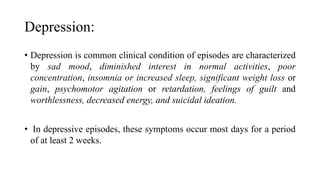
Depression:
• Depression is common clinical condition of episodes are characterized
by sad mood, diminished interest in normal activities, poor
concentration, insomnia or increased sleep, significant weight loss or
gain, psychomotor agitation or retardation, feelings of guilt and
worthlessness, decreased energy, and suicidal ideation.
• In depressive episodes, these symptoms occur most days for a period
of at least 2 weeks.
Types of depression:
• Major depression
• Persistent depressive disorder (dysthymia)
• Bipolar depression / Manic depression
• Atypical depression
Mechanism Of Depression:
• Depression is associated with changes in the level of neurotransmitters in
the brain that help nerve cells to communicate. Ex: Serotonin, Dopamine,
Norepinephrine etc
• The level can be influenced by physical illness, genetics, substance abuse,
diet, hormonal changes, brain injuries or social circumstances.
Antidepressants:
• Drug which enhance alertness and may result in an increased output of
behavior.
• Potentiate directly or indirectly the action of
- Dopamine
- Serotonin
- Nor adrenaline
• the purpose of antidepressants is to increase the neurotransmitter release
in synapse.
• They are used for the relief of symptoms of moderate and severe depression.
• Antidepressants are taken for at least 4-6 months.
• They can be used alone or in combination with other medications
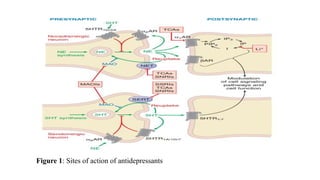
Figure 1: Sites of action of antidepressants
Classes of Antidepressant agents:
a) Selective serotonin reuptake inhibitors (SSRIs)
b) Serotonin-Norepinephrine Reuptake Inhibitors (SNRIs)
c) Monoamine oxidase inhibitors (MAOIs).
d) Tricyclic anti-depressants (TCAs).
e) Atypical anti-depressants (Others)
Selective serotonin reuptake inhibitors (SSRIs):
• The SSRIs are effective in treating major depression and also effective in
treatment of generalized anxiety, panic.
• The reuptake of 5HT into presynaptic terminals is mediated by SERT;
neuronal uptake is the primary process by which neurotransmission via 5HT is
terminated (Ref Figure 1).
• SSRIs block reuptake and enhance and prolong serotonergic
neurotransmission. SSRIs used clinically are relatively selective for inhibition
of SERT over NET .
• The stimulation of 5HT1A , 5HT7, and 5HT1D autoreceptors on raphe
nucleus cell bodies and serotonergic terminals brought on by SSRI
therapy lowers 5HT synthesis and release.
• With repeated treatment with SSRIs, there is a gradual downregulation
and desensitization of these autoreceptor mechanisms
• Other postsynaptic 5HT receptors probably continue to respond to
increases synaptic concentrations of 5HT and contribute to the
therapeutic benefits of SSRIs.
• Repeated treatment with SSRIs reduces the expression of SERT,
resulting in reduces releasing of 5HT and increases serotonergic
neurotransmission.
• Examples: Fluoxetine
Fluvoxamine
Paroxetine
Sertraline
Citalopram
Escitalopram
Dapoxetine
Serotonin-Norepinephrine Reuptake Inhibitors
(SNRIs):
• The SNRIs inhibit both SERT and NET and cause enhanced
serotonergic or noradrenergic neurotransmission. Similar to the
action of SSRIs
• Initially inhibition of SERT causes activation of 5HT1A and 5HT1D
autoreceptors, resulting in a decrease in serotonergic
neurotransmission by a negative-feedback mechanism until these
serotonergic autoreceptors are desensitized
• Then SNRIs are causes increase the 5HT concentration in serotonergic
terminals by blocking the reuptake of 5HT through SERT and NET
• These SNRIs shows increased response compared to SSRIs
• Eg: venlafaxine
Duloxetine
Monoamine oxidase inhibitors (MAOIs):
• MAO (MAO-A and MAO-B) are widely distributed mitochondrial
enzymes. .
• MAO-A is located in the layer of term placenta and liver, and also In the
brain, located in all regions containing catecholamines.
• MAO-B is found primarily in regions that are known to synthesize and
store 5HT.
• In presynaptic nerve terminals, MAO metabolizes serotonin, dopamine
and norepinephrine via oxidative deamination.
• MAO-A preferentially metabolizes 5HT and NE and can metabolize
DA
• MAO metabolizes transmitter that is released within the nerve terminal
or In cytosol as a result of reuptake and NT not yet reached the storage
vesicle.
• These agents irreversibly inhibit both MAO-A and MAO-B, thereby
inhibiting the capacity to metabolize endogenous monoamines such as
NE and 5HT. Refer Fig:1
• Ex: Selegiline
Phenelzine
Isocarboxazid
• Selegiline is an irreversible MAO inhibitor that inhibits MAO-B. at
higher doses, selegiline will also inhibit MAO-A.
• Selegiline is available as a transdermal patch for the treatment of
depression Refer Fig:1
Tricyclic anti-depressants (TCAs):
• These are first generation of antidepressants
• Inhibit the re-uptake of neurotransmitters. mainly inhibit serotonin,
nor epinephrine or dopamine reuptake at pre synaptic nerve terminals
thus lead to increased concentration of these transmitters in the
synaptic cleft. Refer Fig:1
• TCAs can exert serious side effects compared to other class of
antidepressants
• Ex: Imipramine
Amoxapine
Clomipramine
Desipramin
Doxepin
Atypical anti-depressants :
• Atypical antidepressants are frequently used in patients with major
depression during first-line treatment with selective serotonin reuptake
inhibitors (SSRIs)
• acts via multiple mechanisms that differ somewhat from the mechanisms
of SSRIs and SNRIs
• It enhances both noradrenergic and dopaminergic neurotransmission via
inhibition of reuptake by NET and DAT
• And also may involve the presynaptic release of NE and DA and effects
on VMAT2
• Ex: Bupropion
Atomoxetine
Mirtazapine
Nefazodone
• Bupropion is widely used in combination with SSRIs with the intent of
obtaining a greater antidepressant response.
Abbreviations:
• SERT: 5HT transporter
• NET: Norepinephrine transporter
• NE: norepinephrine
• SNRI: serotonin-norepinephrine reuptake inhibitor
• SSRI: selective serotonin reuptake inhibitor
• TCA: tricyclic antidepressant
• VMAT2: vesicular monoamine transporter
Reference:
• Goodman & Gillman's The Pharmacological Basis of Therapeutics
Chapter 15 Drug Therapy of Depression and Anxiety Disorders
Section II neuropharmacology ( page no 267 – 274 ) .
Depression.pptx

Depression.pptx

  • 1.
    Presented To :Presented by: Dr. Bharathi D. R . Sharanappa Professor Reg no: 22MPY113 Department of Pharmacology M Pharm 1st semester SACCP, B. G. Nagara Department of Pharmacology SACCP, B. G. Nagara Depression 1
  • 2.
  • 3.
    Depression: • Depression iscommon clinical condition of episodes are characterized by sad mood, diminished interest in normal activities, poor concentration, insomnia or increased sleep, significant weight loss or gain, psychomotor agitation or retardation, feelings of guilt and worthlessness, decreased energy, and suicidal ideation. • In depressive episodes, these symptoms occur most days for a period of at least 2 weeks.
  • 4.
    Types of depression: •Major depression • Persistent depressive disorder (dysthymia) • Bipolar depression / Manic depression • Atypical depression
  • 5.
    Mechanism Of Depression: •Depression is associated with changes in the level of neurotransmitters in the brain that help nerve cells to communicate. Ex: Serotonin, Dopamine, Norepinephrine etc • The level can be influenced by physical illness, genetics, substance abuse, diet, hormonal changes, brain injuries or social circumstances.
  • 6.
    Antidepressants: • Drug whichenhance alertness and may result in an increased output of behavior. • Potentiate directly or indirectly the action of - Dopamine - Serotonin - Nor adrenaline • the purpose of antidepressants is to increase the neurotransmitter release in synapse.
  • 7.
    • They areused for the relief of symptoms of moderate and severe depression. • Antidepressants are taken for at least 4-6 months. • They can be used alone or in combination with other medications
  • 8.
    Figure 1: Sitesof action of antidepressants
  • 9.
    Classes of Antidepressantagents: a) Selective serotonin reuptake inhibitors (SSRIs) b) Serotonin-Norepinephrine Reuptake Inhibitors (SNRIs) c) Monoamine oxidase inhibitors (MAOIs). d) Tricyclic anti-depressants (TCAs). e) Atypical anti-depressants (Others)
  • 10.
    Selective serotonin reuptakeinhibitors (SSRIs): • The SSRIs are effective in treating major depression and also effective in treatment of generalized anxiety, panic. • The reuptake of 5HT into presynaptic terminals is mediated by SERT; neuronal uptake is the primary process by which neurotransmission via 5HT is terminated (Ref Figure 1). • SSRIs block reuptake and enhance and prolong serotonergic neurotransmission. SSRIs used clinically are relatively selective for inhibition of SERT over NET .
  • 11.
    • The stimulationof 5HT1A , 5HT7, and 5HT1D autoreceptors on raphe nucleus cell bodies and serotonergic terminals brought on by SSRI therapy lowers 5HT synthesis and release. • With repeated treatment with SSRIs, there is a gradual downregulation and desensitization of these autoreceptor mechanisms • Other postsynaptic 5HT receptors probably continue to respond to increases synaptic concentrations of 5HT and contribute to the therapeutic benefits of SSRIs.
  • 12.
    • Repeated treatmentwith SSRIs reduces the expression of SERT, resulting in reduces releasing of 5HT and increases serotonergic neurotransmission. • Examples: Fluoxetine Fluvoxamine Paroxetine Sertraline Citalopram Escitalopram Dapoxetine
  • 13.
    Serotonin-Norepinephrine Reuptake Inhibitors (SNRIs): •The SNRIs inhibit both SERT and NET and cause enhanced serotonergic or noradrenergic neurotransmission. Similar to the action of SSRIs • Initially inhibition of SERT causes activation of 5HT1A and 5HT1D autoreceptors, resulting in a decrease in serotonergic neurotransmission by a negative-feedback mechanism until these serotonergic autoreceptors are desensitized
  • 14.
    • Then SNRIsare causes increase the 5HT concentration in serotonergic terminals by blocking the reuptake of 5HT through SERT and NET • These SNRIs shows increased response compared to SSRIs • Eg: venlafaxine Duloxetine
  • 15.
    Monoamine oxidase inhibitors(MAOIs): • MAO (MAO-A and MAO-B) are widely distributed mitochondrial enzymes. . • MAO-A is located in the layer of term placenta and liver, and also In the brain, located in all regions containing catecholamines. • MAO-B is found primarily in regions that are known to synthesize and store 5HT. • In presynaptic nerve terminals, MAO metabolizes serotonin, dopamine and norepinephrine via oxidative deamination.
  • 16.
    • MAO-A preferentiallymetabolizes 5HT and NE and can metabolize DA • MAO metabolizes transmitter that is released within the nerve terminal or In cytosol as a result of reuptake and NT not yet reached the storage vesicle. • These agents irreversibly inhibit both MAO-A and MAO-B, thereby inhibiting the capacity to metabolize endogenous monoamines such as NE and 5HT. Refer Fig:1
  • 17.
    • Ex: Selegiline Phenelzine Isocarboxazid •Selegiline is an irreversible MAO inhibitor that inhibits MAO-B. at higher doses, selegiline will also inhibit MAO-A. • Selegiline is available as a transdermal patch for the treatment of depression Refer Fig:1
  • 18.
    Tricyclic anti-depressants (TCAs): •These are first generation of antidepressants • Inhibit the re-uptake of neurotransmitters. mainly inhibit serotonin, nor epinephrine or dopamine reuptake at pre synaptic nerve terminals thus lead to increased concentration of these transmitters in the synaptic cleft. Refer Fig:1
  • 19.
    • TCAs canexert serious side effects compared to other class of antidepressants • Ex: Imipramine Amoxapine Clomipramine Desipramin Doxepin
  • 20.
    Atypical anti-depressants : •Atypical antidepressants are frequently used in patients with major depression during first-line treatment with selective serotonin reuptake inhibitors (SSRIs) • acts via multiple mechanisms that differ somewhat from the mechanisms of SSRIs and SNRIs • It enhances both noradrenergic and dopaminergic neurotransmission via inhibition of reuptake by NET and DAT • And also may involve the presynaptic release of NE and DA and effects on VMAT2
  • 21.
    • Ex: Bupropion Atomoxetine Mirtazapine Nefazodone •Bupropion is widely used in combination with SSRIs with the intent of obtaining a greater antidepressant response.
  • 22.
    Abbreviations: • SERT: 5HTtransporter • NET: Norepinephrine transporter • NE: norepinephrine • SNRI: serotonin-norepinephrine reuptake inhibitor • SSRI: selective serotonin reuptake inhibitor • TCA: tricyclic antidepressant • VMAT2: vesicular monoamine transporter
  • 23.
    Reference: • Goodman &Gillman's The Pharmacological Basis of Therapeutics Chapter 15 Drug Therapy of Depression and Anxiety Disorders Section II neuropharmacology ( page no 267 – 274 ) .