SSRIs and SNRIs:In adults Dr. Syed Faheem Shams Student of MD (Part-II)  Psychiatry, BSMMU
Depression 3 rd   largest cause of burden of disease GLOBAL BURDEN OF DISEASE STUDY 1995 SHOWS UNIPOLAR DEPRESSION  2nd  to Coronary disease by  2020 ; 1 st  by 2030
Prevalence in Bangladesh WHO + NIMH---- ‘03-‘05 Psychiatric disorder ---- >18 yrs ---  16.05%. MDD--- 4.6% GAD--- 2.9% Somatoform D--- 1.4% Panic--- 1.3% Agorophobia—0.9% OCD--- 0.5% Simple Phobia--- 0.3%
Antidepressants Tricyclic antidepressants (TCA)   Monoamine oxidase inhibitors (MAOI) Selective Serotonin Re-uptake Inhibitors (SSRI) Other and atypical antidepressant Serotonin-2 Antagonists/Reuptake Inhibitors (SARI)  Serotonin and Noradrenaline Reuptake Inhibitors (SNRI) Noradrenaline and Dopamine Reuptake Inhibitors (NDRI) Noradrenaline Reuptake Inhibitors (NaRI) Noradrenergic/Specific Serotonergic Antidepressants (NaSSA)
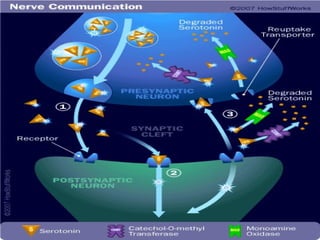
HOW DOES THE MOST ANTIDEPRESSANTS WORK??
Neurotransmitter Receptor Hypothesis of Antidepressant Action Decreased state due to up-regulation of receptors Stahl S M,  Essential Psychopharmacology  (2000)
Neurotransmitter Receptor Hypothesis of Antidepressant Action Antidepressant blocks the reuptake pump, causing more NT to be in the synapse Increase in NT causes receptors to down-regulate Stahl S M,  Essential Psychopharmacology  (2000)
SSRI’s Citalopram Escitalopram Fluoxetine Sertraline Fluvoxamine Paroxetine Fluoxetine Sertraline
SNRI--- Venlafaxine Duloxetine NaSSA --- Mirtazapine SARI--- Trazodone NDRI--- Buproprion NaRI--- Reboxetine
Why selective?? Affect only the reuptake pumps responsible for 5HT Because of this, SSRIs lack some of the side effects of the more general drugs
History Of SSRI’s SSRI’s were introduced in 1987  The first was Fluoxetine (Prozac:Eli Lilly & Company) FDA approved 1987 Sertraline (Zoloft; Pfizer, Inc) FDA approved 1991 Paroxetine (Paxil; GlaxoSmithKline) FDA approved 1992 Citalopram (Celexa; Forest Pharmaceuticals) FDA approved 2000 Escitalopram (Lexapro; Forest Pharmaceuticals) FDA approved 2002
Serotonin Also known as 5-HT, derived from tryptophan (amino acid) It is widely distributed in the animal and vegetable kingdoms In mammals it is found in --- gastrointestinal enterochromaffin cells blood platelets Brain nerve tissue (McGraw-Hill Encyclopedia of Science and Technology, 2005)
Serotonin (contd.) Serotonin is concentrated in certain areas of the brain--- the hypothalamus  midbrain  the cortex  Cerebellum
 
 
Other indications of SSRI Anxiety disorders : generalized anxiety panic disorder  social phobia  obsessive-compulsive disorder Bulimia nervosa Pathological gambling
SNRIs SNRIs were developed more recently than SSRIs Relatively few  Their efficacy as well as their tolerability appears to be somewhat better than the TCA’s.
Venlafaxine venlafaxine is approximately 3- to 5-fold more potent at inhibiting serotonin than noradrenaline reuptake It has low affinity for cholinergic, histamine H1 and adrenergic receptors. Venlafaxine is the first and most commonly used SNRI. Venlafaxine
Recognized minimum effective doses in MDD SSRIs Citalopram 20 mg/day  Escitalopram 10 mg/day  Fluoxetine 20 mg/day  Fluvoxamine 50 mg/day  Paroxetine 20 mg/day  Sertraline 50 mg/day
Recognized minimum effective doses – antidepressants  (except TCAs) Others Duloxetine 60 mg/day  Mirtazapine 30 mg/day  Reboxetine 8 mg/day  Trazodone 150 mg/day  Venlafaxine 75 mg/day
Licensed Dosing Citalopram--- 20-60mg/day Escitalopram--- 10-20mg/day Fluoxetine--- 20-60mg/day Sertraline--- 50-200mg/day Fluvoxamine--- 100-300mg/day Paroxetine--- 20-60mg/day
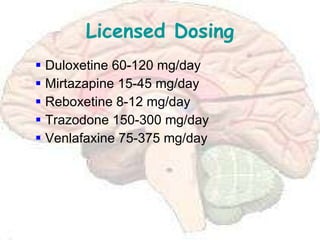
Licensed Dosing Duloxetine 60-120 mg/day  Mirtazapine 15-45 mg/day  Reboxetine 8-12 mg/day  Trazodone 150-300 mg/day  Venlafaxine 75-375 mg/day
Plasma half life Fluvoxamine Paroxetine Sertraline Fluoxetine Escitalopram Citalopram 17-22h 24h 26h 4-6 days 30h 33h
Adverse Effects (A/Es) of SSRIs Nausea, vomiting, dyspepsia Irritability/ agitation Insomnia Skin rash Sexual dysfunction Hyponatraemia Cutaneous/ GI bleeding Discontinuation syndrome
Adverse Effects (A/Es) of SSRIs Nausea+ Fluvoxamine Discontinuation sym++ Paroxetine A/E Sertraline Insomnia++ Agitation++ Rash+ Fluoxetine A/E Escitalopram Agitation, Insomnia Citalopram
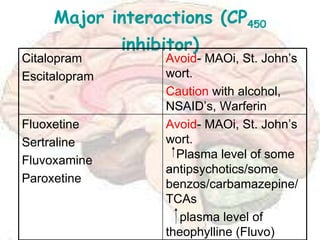
Major interactions (CP 450  inhibitor) Fluoxetine Sertraline Fluvoxamine Paroxetine Citalopram Escitalopram Avoid - MAOi, St. John’s wort.   Plasma level of some antipsychotics/some benzos/carbamazepine/TCAs plasma level of theophylline (Fluvo) Avoid - MAOi, St. John’s wort.  Caution  with alcohol, NSAID’s, Warferin
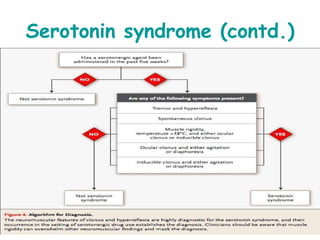
Serotonin syndrome
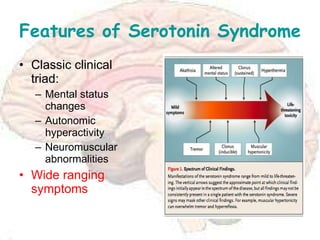
Features of Serotonin Syndrome Classic clinical triad: Mental status changes Autonomic hyperactivity Neuromuscular abnormalities Wide ranging symptoms
Serotonin syndrome (contd.)
Discontinuation Symptoms Paroxetine   commonest Venlafaxine
Antidepressant-induced hyponatraemia Risk factors Old age Female sex Low body weight Low baseline sodium concentration Some drug treatments (e.g. diuretics, NSAIDs, carbamazepine, cancer chemotherapy) Reduced renal function (especially acute and chronic renal failure) Medical co-morbidity (e.g. hypothyroidism, diabetes, COPD, hypertension, head injury, CAD, various cancers) Warm weather (summer)
Antidepressant-induced hyponatraemia-  monitoring All patients taking antidepressants should be observed for signs of hyponatraemia ( dizziness, nausea, lethargy, confusion, cramps, seizures ). Serum sodium should be determined (at baseline  and 2 and 4 weeks, and then  3- monthly ) for those at high risk of drug- induced hyponatraemia.
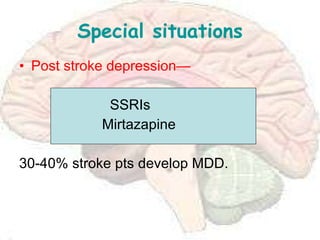
Special situations Post stroke depression— SSRIs Mirtazapine  30-40% stroke pts develop MDD.
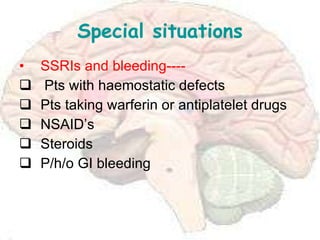
Special situations SSRIs and bleeding---- Pts with haemostatic defects Pts taking warferin or antiplatelet drugs NSAID’s  Steroids P/h/o GI bleeding
Special situations In Diabetes Mellitus --- SSRI’s SNRI’s Mirtazapine TCA
Special situations In elder people–  SSRI’s In Post MI patients- SSRI’s Mirtazapine
Special situations In pregnancy- -- Fluoxetine TCAs In breast feeding mother- -- Sertraline Paroxetine
Special situations In renal impairment — Citalopram Sertraline In hepatic impairment — Citalopram  Paroxetine
Key points that patients should know A  single episode  of depression should be treated for at least  6–9 months  after remission The risk of  recurrence  of depressive illness is  high  and  increases  with each episode Those who have had  multiple episodes  may require treatment for  many years  .The chances of staying well are greatly increased by taking antidepressants
Key points that patients should know Antidepressants are:  effective  not addictive  not known to lose their efficacy over time  not known to cause new long-term side effects The medication needs to be  reduced slowly  under the supervision of a doctor
Key points that patients should know Medication needs to be continued at the treatment dose. If  side effects  are intolerable, it may be possible to find a more suitable alternative If patients  decide to stop  their medication, this must not be done suddenly, as this may lead to unpleasant discontinuation effects
NICE guidelines on the treatment of depression Antidepressants are not recommended as first-line treatment in recent-onset, mild depression Antidepressants are recommended for the treatment of  moderate to severe  depression and for dysthymia
NICE guidelines on the treatment of depression For  severe depression , a combination of an antidepressant and CBT is recommended For  treatment-resistant depression  recommended strategies include augmentation with lithium, an antipsychotic or a second antidepressant Patients with two prior episodes and functional impairment should be treated for at least  2 years The use of  ECT  is supported in severe and treatment-resistant depression
NICE guidelines on the treatment of depression When an antidepressant is prescribed, a generic  SSRI  is recommended All patients should be informed about the  withdrawal (discontinuation) effects  of antidepressants
NICE guidelines on the treatment of anxiety disorders with SSRIs ½  of the dose used in MDD. Response – 6-8 wks Duration of treatment-- ?? 6-8 months
 
Thank you all….
List of people with depression Abraham Lincoln (US president) William James & John B. Watson (pioneer psychologists) Sir Winston Churchill (British Prime Minister ) Brooke Shields (American actress)  John Denver ( singer)

Ssri n snri

  • 1.
    SSRIs and SNRIs:Inadults Dr. Syed Faheem Shams Student of MD (Part-II) Psychiatry, BSMMU
  • 2.
    Depression 3 rd largest cause of burden of disease GLOBAL BURDEN OF DISEASE STUDY 1995 SHOWS UNIPOLAR DEPRESSION 2nd to Coronary disease by 2020 ; 1 st by 2030
  • 3.
    Prevalence in BangladeshWHO + NIMH---- ‘03-‘05 Psychiatric disorder ---- >18 yrs --- 16.05%. MDD--- 4.6% GAD--- 2.9% Somatoform D--- 1.4% Panic--- 1.3% Agorophobia—0.9% OCD--- 0.5% Simple Phobia--- 0.3%
  • 4.
    Antidepressants Tricyclic antidepressants(TCA) Monoamine oxidase inhibitors (MAOI) Selective Serotonin Re-uptake Inhibitors (SSRI) Other and atypical antidepressant Serotonin-2 Antagonists/Reuptake Inhibitors (SARI) Serotonin and Noradrenaline Reuptake Inhibitors (SNRI) Noradrenaline and Dopamine Reuptake Inhibitors (NDRI) Noradrenaline Reuptake Inhibitors (NaRI) Noradrenergic/Specific Serotonergic Antidepressants (NaSSA)
  • 5.
    HOW DOES THEMOST ANTIDEPRESSANTS WORK??
  • 6.
    Neurotransmitter Receptor Hypothesisof Antidepressant Action Decreased state due to up-regulation of receptors Stahl S M, Essential Psychopharmacology (2000)
  • 7.
    Neurotransmitter Receptor Hypothesisof Antidepressant Action Antidepressant blocks the reuptake pump, causing more NT to be in the synapse Increase in NT causes receptors to down-regulate Stahl S M, Essential Psychopharmacology (2000)
  • 8.
    SSRI’s Citalopram EscitalopramFluoxetine Sertraline Fluvoxamine Paroxetine Fluoxetine Sertraline
  • 9.
    SNRI--- Venlafaxine DuloxetineNaSSA --- Mirtazapine SARI--- Trazodone NDRI--- Buproprion NaRI--- Reboxetine
  • 10.
    Why selective?? Affectonly the reuptake pumps responsible for 5HT Because of this, SSRIs lack some of the side effects of the more general drugs
  • 11.
    History Of SSRI’sSSRI’s were introduced in 1987 The first was Fluoxetine (Prozac:Eli Lilly & Company) FDA approved 1987 Sertraline (Zoloft; Pfizer, Inc) FDA approved 1991 Paroxetine (Paxil; GlaxoSmithKline) FDA approved 1992 Citalopram (Celexa; Forest Pharmaceuticals) FDA approved 2000 Escitalopram (Lexapro; Forest Pharmaceuticals) FDA approved 2002
  • 12.
    Serotonin Also knownas 5-HT, derived from tryptophan (amino acid) It is widely distributed in the animal and vegetable kingdoms In mammals it is found in --- gastrointestinal enterochromaffin cells blood platelets Brain nerve tissue (McGraw-Hill Encyclopedia of Science and Technology, 2005)
  • 13.
    Serotonin (contd.) Serotoninis concentrated in certain areas of the brain--- the hypothalamus midbrain the cortex Cerebellum
  • 14.
  • 15.
  • 16.
    Other indications ofSSRI Anxiety disorders : generalized anxiety panic disorder social phobia obsessive-compulsive disorder Bulimia nervosa Pathological gambling
  • 17.
    SNRIs SNRIs weredeveloped more recently than SSRIs Relatively few Their efficacy as well as their tolerability appears to be somewhat better than the TCA’s.
  • 18.
    Venlafaxine venlafaxine isapproximately 3- to 5-fold more potent at inhibiting serotonin than noradrenaline reuptake It has low affinity for cholinergic, histamine H1 and adrenergic receptors. Venlafaxine is the first and most commonly used SNRI. Venlafaxine
  • 19.
    Recognized minimum effectivedoses in MDD SSRIs Citalopram 20 mg/day Escitalopram 10 mg/day Fluoxetine 20 mg/day Fluvoxamine 50 mg/day Paroxetine 20 mg/day Sertraline 50 mg/day
  • 20.
    Recognized minimum effectivedoses – antidepressants (except TCAs) Others Duloxetine 60 mg/day Mirtazapine 30 mg/day Reboxetine 8 mg/day Trazodone 150 mg/day Venlafaxine 75 mg/day
  • 21.
    Licensed Dosing Citalopram---20-60mg/day Escitalopram--- 10-20mg/day Fluoxetine--- 20-60mg/day Sertraline--- 50-200mg/day Fluvoxamine--- 100-300mg/day Paroxetine--- 20-60mg/day
  • 22.
    Licensed Dosing Duloxetine60-120 mg/day Mirtazapine 15-45 mg/day Reboxetine 8-12 mg/day Trazodone 150-300 mg/day Venlafaxine 75-375 mg/day
  • 23.
    Plasma half lifeFluvoxamine Paroxetine Sertraline Fluoxetine Escitalopram Citalopram 17-22h 24h 26h 4-6 days 30h 33h
  • 24.
    Adverse Effects (A/Es)of SSRIs Nausea, vomiting, dyspepsia Irritability/ agitation Insomnia Skin rash Sexual dysfunction Hyponatraemia Cutaneous/ GI bleeding Discontinuation syndrome
  • 25.
    Adverse Effects (A/Es)of SSRIs Nausea+ Fluvoxamine Discontinuation sym++ Paroxetine A/E Sertraline Insomnia++ Agitation++ Rash+ Fluoxetine A/E Escitalopram Agitation, Insomnia Citalopram
  • 26.
    Major interactions (CP450 inhibitor) Fluoxetine Sertraline Fluvoxamine Paroxetine Citalopram Escitalopram Avoid - MAOi, St. John’s wort. Plasma level of some antipsychotics/some benzos/carbamazepine/TCAs plasma level of theophylline (Fluvo) Avoid - MAOi, St. John’s wort. Caution with alcohol, NSAID’s, Warferin
  • 27.
  • 28.
    Features of SerotoninSyndrome Classic clinical triad: Mental status changes Autonomic hyperactivity Neuromuscular abnormalities Wide ranging symptoms
  • 29.
  • 30.
  • 31.
  • 32.
    Antidepressant-induced hyponatraemia Riskfactors Old age Female sex Low body weight Low baseline sodium concentration Some drug treatments (e.g. diuretics, NSAIDs, carbamazepine, cancer chemotherapy) Reduced renal function (especially acute and chronic renal failure) Medical co-morbidity (e.g. hypothyroidism, diabetes, COPD, hypertension, head injury, CAD, various cancers) Warm weather (summer)
  • 33.
    Antidepressant-induced hyponatraemia- monitoring All patients taking antidepressants should be observed for signs of hyponatraemia ( dizziness, nausea, lethargy, confusion, cramps, seizures ). Serum sodium should be determined (at baseline and 2 and 4 weeks, and then 3- monthly ) for those at high risk of drug- induced hyponatraemia.
  • 34.
    Special situations Poststroke depression— SSRIs Mirtazapine 30-40% stroke pts develop MDD.
  • 35.
    Special situations SSRIsand bleeding---- Pts with haemostatic defects Pts taking warferin or antiplatelet drugs NSAID’s Steroids P/h/o GI bleeding
  • 36.
    Special situations InDiabetes Mellitus --- SSRI’s SNRI’s Mirtazapine TCA
  • 37.
    Special situations Inelder people– SSRI’s In Post MI patients- SSRI’s Mirtazapine
  • 38.
    Special situations Inpregnancy- -- Fluoxetine TCAs In breast feeding mother- -- Sertraline Paroxetine
  • 39.
    Special situations Inrenal impairment — Citalopram Sertraline In hepatic impairment — Citalopram Paroxetine
  • 40.
    Key points thatpatients should know A single episode of depression should be treated for at least 6–9 months after remission The risk of recurrence of depressive illness is high and increases with each episode Those who have had multiple episodes may require treatment for many years .The chances of staying well are greatly increased by taking antidepressants
  • 41.
    Key points thatpatients should know Antidepressants are: effective not addictive not known to lose their efficacy over time not known to cause new long-term side effects The medication needs to be reduced slowly under the supervision of a doctor
  • 42.
    Key points thatpatients should know Medication needs to be continued at the treatment dose. If side effects are intolerable, it may be possible to find a more suitable alternative If patients decide to stop their medication, this must not be done suddenly, as this may lead to unpleasant discontinuation effects
  • 43.
    NICE guidelines onthe treatment of depression Antidepressants are not recommended as first-line treatment in recent-onset, mild depression Antidepressants are recommended for the treatment of moderate to severe depression and for dysthymia
  • 44.
    NICE guidelines onthe treatment of depression For severe depression , a combination of an antidepressant and CBT is recommended For treatment-resistant depression recommended strategies include augmentation with lithium, an antipsychotic or a second antidepressant Patients with two prior episodes and functional impairment should be treated for at least 2 years The use of ECT is supported in severe and treatment-resistant depression
  • 45.
    NICE guidelines onthe treatment of depression When an antidepressant is prescribed, a generic SSRI is recommended All patients should be informed about the withdrawal (discontinuation) effects of antidepressants
  • 46.
    NICE guidelines onthe treatment of anxiety disorders with SSRIs ½ of the dose used in MDD. Response – 6-8 wks Duration of treatment-- ?? 6-8 months
  • 47.
  • 48.
  • 49.
    List of peoplewith depression Abraham Lincoln (US president) William James & John B. Watson (pioneer psychologists) Sir Winston Churchill (British Prime Minister ) Brooke Shields (American actress) John Denver ( singer)

Editor's Notes

  • #9 Difference f c nd s??Paroxetine== most A/Es…Fluvoxamine- nausea
  • #11 antidepressants, which affect other monoamine neurotransmitters as well.
  • #13 5-hydroxytryptamine 5-HT.. 14 distinct downstream serotonin receptors (5-HT receptors).
  • #14 Hypo nd midbrain e beshi
  • #18 They act upon two neurotransmitters in the brain that are known to play an important part in mood, namely, serotonin and norepinephrine. This can be contrasted with the more widely-used selective serotonin reuptake inhibitors (SSRIs), which act only on serotonin.
  • #20 Sertraline- 200max. Though >100mg no help. TCA- 75-100
  • #25 Life threatning
  • #27 CP450 inhibitors
  • #28 When SS occurs?
  • #32 Receptor rebound…..Onset within 5 dayz f stopping treatment. Or during tapper or in missed dose….treatment??– mild- no rx others- reintroduce or another f same class with longer half life..
  • #33 SIADH… 5Ht regulation f ADH…So SSRI n SNRI more…..
  • #35 citalopram
  • #36 Vascular injury------ platelet---- release f 5HT---- Vaso constricton. 5HT s a weak platelet aggregator. SSRI inhibit the 5HT transporter responsible fr uptake f 5HT n platelet
  • #37 Fluoxetine--- insulin req reduced, HBA1c improved, wt loss…. Limited data n venla
  • #38 Citalopram- QT prolong…. Dnt go fr SNRI. Tolerance…bp
  • #40 10 mg start n hepatic
  • #44 – active monitoring, individual guided self-help, CBT or exercise are preferred in these cases