Tryptophan and
                                                         Madness
                                                         ADONIS SFERA, MD


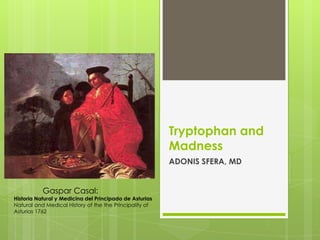
           Gaspar Casal:
Historia Natural y Medicina del Principado de Asturias
Natural and Medical History of the the Principality of
Asturias 1762
Tryptophan
 Tryptophan
           is an essential amino acid,
 which means that we must obtain it from
 the diet.
Absorbtion
Two Pathways: Melatonin and Niacin
Tryptophan Crosses the Blood
Brain Barrier via Active Transport
Deficiency of the Niacin Pathway Leads
to Pellagra
"Asturian leprosy"
   Pellagra was first described in Spain in 1735 by Gaspar Casal in his
    Natural and Medical History of the Asturian Principality (1762).
   It came to be known as “Asturian leprosy”.

It was later named pellagra by Francesco Frapoli of Milan.
Deficiency of the
          Serotonin/Melatonin Pathway
  Serotonin is synthetized by two distinct Tryptophan hydroxylase (TPH) enzymes in the brain
  (TPH2) and in the periphery (TPH1). Thus, the indicated peripheral and central functions of
  serotonin are differentially regulated and can be targeted independently.
  In the pathogenesis of migraine, serotonin from both sources may be involved.


Diego J. Walther, Michael Bader; A unique central tryptophan hydroxylase isoform
Max Delbrück Center for Molecular Medicine (MDC), Robert-Rossle-Strasse 10, D-13092 Berlin-Buch, Germany
http://dx.doi.org/10.1016/S0006-2952(03)00556-2,
Let’s Focus on the
Kynurenine Pathway (KP)


   Inflammatory cytokines or excess cortisol can
    force the tryptophan into kynurenine
    pathway (KP).

   This is accomplished by two enzymes:
        -indoleamine 2,3-dioxygenase (IDO)
        -tryptophan 2,3-dioxygenase (TDO)
Alteration of tryptophan metabolism by
  immune stimuli or cortisol
 Inmonocytes, macrophages and microglia IDO is
  activated by cytokines (immune stimuli).

 In   the liver TDO is activated by cortisol.
KP and Depression
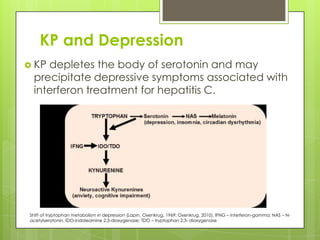
 KP depletes the body of serotonin and may
  precipitate depressive symptoms associated with
  interferon treatment for hepatitis C.


 Shift of tryptophan metabolism in depression (Lapin, Oxenkrug, 1969; Oxenkrug, 2010). IFNG – interferon-gamma; NAS – N-
 acetylserotonin, IDO-indoleamine 2,3-dioxygenase; TDO – tryptophan 2,3- dioxygenase
Once Produced Kynurenine Crosses
the Blood Brain Barrier
Kinurenine Is Processed Differently
   by Astrocytes and Microglia
Astrocytes process kynurenine to kynurenic acid (KYNA)
Microglia process kynurenine to quinolonic acid (QUIN)
Kynurenic and Quinolonic Acids Bind to
  NMDA Receptors

 KYNA  is NMDA receptor antagonist
 QUIN is NMDA receptor agonist
Kynurenine Pathway (KP) Is Controlled
  By the Immune System
 This   is where Immunology meets Psychiatry
Astrocytes and Microglia are Both
Sources and Targets of Cytokines
Cytokines Come in Two Flavors
Pro-Inflammatory Cytokines: IL-1, IL-6, TNF, interferon-alpha - activate IDO and KMO
Anti-Inflammatory Cytokines:IL-4, IL-5, IL-10 - inhibit IDO and KMO


         IDO = indoleamine 2,3-dioxygenase
         KMO = kynurenine 3-monoxygenase
KP and Psychosis
 Reduced     KMO expression and increased CSF KYNA
   levels were found in schizophrenia and bipolar
   disorder type 1 with psychotic features.

A   genetic variant of KMO (Arg452 allele) was
   associated with psychotic features during manic
   episodes.

 KMO   mRNA levels and activity in prefrontal cortex
   (PFC) are reduced in schizophrenia.

Molecular Psychiatry advance online publication, 5 March 2013; doi:10.1038/mp.2013.11.
PMID: 23459468 [PubMed - as supplied by publisher]
KP in Alzheimer’s Disease
 Kynurenine production is increased in Alzheimer's
  disease where its metabolites are associated with
  both cognitive deficits and depressive symptoms.

IDO = indoleamine 2,3-dioxygenase
KMO = kynurenine 3-monoxygenase
Autoimmune Pellagric Dementia
     (Nasu-Hakola Disease or PLOSL)
 IDO dysregulation (manifest as autoimmune
 pellagric dementia) is genetically illustrated by
 Nasu-Hakola Disease (or PLOSL).

A mutation in the IDO antagonizing genes
 TYROBP/DAP12 or TREM2 leads to PLOSL.

 Increases
          in microglial IDO expression depletes
 neurons of tryptophan causing psychotic symptoms
 and neurodegeneration.
IDO - Immune Tolerance and Acceptance of
the Fetus
   Cells at the maternal-fetal interface express IDO to consume
    all local tryptophan and prevent an immunologic attack by
    the T-cells against the fetus.
IDO creates a sort of “force field” around the
fetus by tranquilizing all T-cells that come too
close
Inhibition of IDO
 Inhibition
          of IDO using 1-methyl-tryptophan causes
  a sudden catastrophic rejection of the mammalian
  fetus.
Autoimmune Diseases- Localized
      Pellagra?
 Pharmacological        doses of NAD precursors
   sometimes provide dramatic therapeutic benefit
   for rheumatoid arthritis, type 1 diabetes, multiple
   sclerosis, colitis, other autoimmune diseases, and
   schizophrenia in either the clinic or animal models.

 Collectivelythese observations support the idea
   that autoimmune disease may in part be
   considered as localized pellagra manifesting with
   symptoms particular to the inflamed target tissues.

Penberthy WT.; Pharmacological targeting of IDO-mediated tolerance for treating autoimmune disease; Curr Drug
Metab. 2007 Apr;8(3):245-66; PMID: 17430113 [PubMed - indexed for MEDLINE]
Immunologic Tolerance - Good News
For the Baby, Bad News for Cancer
Visualizing IDO in Cancer
     (HRPimmunoperoxidase)

   Expression of the tryptophan-catabolizing enzyme IDO by
   endothelial cells of infantile hemangioma
                     A. proliferative phase in proliferative phase
                     B. involutive phase


Sheila Fallon Friedlander, Matthew R. Ritter, and Martin Friedlander; Recent Progress in Our Understanding of the
Pathogenesis of Infantile Hemangiomas ;Lymphatic Research and Biology. 2005, 3(4): 219-225. doi:10.1089/lrb.2005.3.219   .
IDO and Autoimmunity - Loss of
     Tolerance to “self”

 In   autoimmune diseases the individual loses normal
    tolerance to “self” proteins.

A    newly described role for IDO is in the regulation
    of tolerance towards own proteins and DNA.

    Increasing IDO production or its downstream
    effects might be a way to regain lost tolerance for
    “self”.
The Hope is to Create a Molecule with
            Maximum IDO Inhibiting Abilities and
            Minimum Side Effects

     Manipulations of the kynurenine pathway might help rectify
      neurodegenerative and psychiatric diseases alike.

     Inhibiting the enzyme kynurenine 3-monooxygenase (KMO)
      prevents synapse loss and ameliorates symptoms in models of
      Alzheimer's and Huntington's diseases.


B.S. Rawdin, S.H. Mellon, F.S. Dhabhar E.S. Epel , E. Puterman et al; Dysregulated relationship of inflammation and oxidative stress in major depression; Brain, Behavior, and Immunity xxx
(2012) xxx–xxx
M. tuberculosis infection increases IDO-1
        expression in human and murine
        macrophages.
       M. tuberculosis Induces Potent Activation of IDO-1


Blumenthal A, Nagalingam G, Huch JH, Walker L, et al. (2012) M. tuberculosis Induces Potent Activation of IDO-1, but This Is Not
Essential for the Immunological Control of Infection. PLoS ONE 7(5): e37314. doi:10.1371/journal.pone.0037314
http://www.plosone.org/article/info:doi/10.1371/journal.pone.0037314
High IDO activity - persistent and
       progressive granuloma


                                                                         High IDO activity induces
                                                                         apoptosis of immune and
                                                                         inflammatory cells that
                                                                         may prevent the
                                                                         clearance of the micro-
                                                                         organisms/antigen and
                                                                         leading to persistent and
                                                                         progressive granuloma.


Principal Investigator
René Lutter, PhD; http://www.amc.nl/web/Research/Departments/Overview/Experimental-Immunology-1/Experimental-
Immunology/Current-research/Lung-Immunology.htm
Tryptophan and madness

Tryptophan and madness

  • 1.
    Tryptophan and Madness ADONIS SFERA, MD Gaspar Casal: Historia Natural y Medicina del Principado de Asturias Natural and Medical History of the the Principality of Asturias 1762
  • 2.
    Tryptophan  Tryptophan is an essential amino acid, which means that we must obtain it from the diet.
  • 3.
  • 4.
  • 5.
    Tryptophan Crosses theBlood Brain Barrier via Active Transport
  • 6.
    Deficiency of theNiacin Pathway Leads to Pellagra
  • 7.
    "Asturian leprosy"  Pellagra was first described in Spain in 1735 by Gaspar Casal in his Natural and Medical History of the Asturian Principality (1762).  It came to be known as “Asturian leprosy”. It was later named pellagra by Francesco Frapoli of Milan.
  • 8.
    Deficiency of the Serotonin/Melatonin Pathway Serotonin is synthetized by two distinct Tryptophan hydroxylase (TPH) enzymes in the brain (TPH2) and in the periphery (TPH1). Thus, the indicated peripheral and central functions of serotonin are differentially regulated and can be targeted independently. In the pathogenesis of migraine, serotonin from both sources may be involved. Diego J. Walther, Michael Bader; A unique central tryptophan hydroxylase isoform Max Delbrück Center for Molecular Medicine (MDC), Robert-Rossle-Strasse 10, D-13092 Berlin-Buch, Germany http://dx.doi.org/10.1016/S0006-2952(03)00556-2,
  • 9.
    Let’s Focus onthe Kynurenine Pathway (KP)  Inflammatory cytokines or excess cortisol can force the tryptophan into kynurenine pathway (KP).  This is accomplished by two enzymes: -indoleamine 2,3-dioxygenase (IDO) -tryptophan 2,3-dioxygenase (TDO)
  • 10.
    Alteration of tryptophanmetabolism by immune stimuli or cortisol  Inmonocytes, macrophages and microglia IDO is activated by cytokines (immune stimuli).  In the liver TDO is activated by cortisol.
  • 11.
    KP and Depression KP depletes the body of serotonin and may precipitate depressive symptoms associated with interferon treatment for hepatitis C. Shift of tryptophan metabolism in depression (Lapin, Oxenkrug, 1969; Oxenkrug, 2010). IFNG – interferon-gamma; NAS – N- acetylserotonin, IDO-indoleamine 2,3-dioxygenase; TDO – tryptophan 2,3- dioxygenase
  • 12.
    Once Produced KynurenineCrosses the Blood Brain Barrier
  • 13.
    Kinurenine Is ProcessedDifferently by Astrocytes and Microglia Astrocytes process kynurenine to kynurenic acid (KYNA) Microglia process kynurenine to quinolonic acid (QUIN)
  • 14.
    Kynurenic and QuinolonicAcids Bind to NMDA Receptors  KYNA is NMDA receptor antagonist  QUIN is NMDA receptor agonist
  • 15.
    Kynurenine Pathway (KP)Is Controlled By the Immune System  This is where Immunology meets Psychiatry
  • 16.
    Astrocytes and Microgliaare Both Sources and Targets of Cytokines
  • 17.
    Cytokines Come inTwo Flavors Pro-Inflammatory Cytokines: IL-1, IL-6, TNF, interferon-alpha - activate IDO and KMO Anti-Inflammatory Cytokines:IL-4, IL-5, IL-10 - inhibit IDO and KMO IDO = indoleamine 2,3-dioxygenase KMO = kynurenine 3-monoxygenase
  • 18.
    KP and Psychosis Reduced KMO expression and increased CSF KYNA levels were found in schizophrenia and bipolar disorder type 1 with psychotic features. A genetic variant of KMO (Arg452 allele) was associated with psychotic features during manic episodes.  KMO mRNA levels and activity in prefrontal cortex (PFC) are reduced in schizophrenia. Molecular Psychiatry advance online publication, 5 March 2013; doi:10.1038/mp.2013.11. PMID: 23459468 [PubMed - as supplied by publisher]
  • 19.
    KP in Alzheimer’sDisease  Kynurenine production is increased in Alzheimer's disease where its metabolites are associated with both cognitive deficits and depressive symptoms. IDO = indoleamine 2,3-dioxygenase KMO = kynurenine 3-monoxygenase
  • 20.
    Autoimmune Pellagric Dementia (Nasu-Hakola Disease or PLOSL)  IDO dysregulation (manifest as autoimmune pellagric dementia) is genetically illustrated by Nasu-Hakola Disease (or PLOSL). A mutation in the IDO antagonizing genes TYROBP/DAP12 or TREM2 leads to PLOSL.  Increases in microglial IDO expression depletes neurons of tryptophan causing psychotic symptoms and neurodegeneration.
  • 21.
    IDO - ImmuneTolerance and Acceptance of the Fetus  Cells at the maternal-fetal interface express IDO to consume all local tryptophan and prevent an immunologic attack by the T-cells against the fetus.
  • 22.
    IDO creates asort of “force field” around the fetus by tranquilizing all T-cells that come too close
  • 23.
    Inhibition of IDO Inhibition of IDO using 1-methyl-tryptophan causes a sudden catastrophic rejection of the mammalian fetus.
  • 24.
    Autoimmune Diseases- Localized Pellagra?  Pharmacological doses of NAD precursors sometimes provide dramatic therapeutic benefit for rheumatoid arthritis, type 1 diabetes, multiple sclerosis, colitis, other autoimmune diseases, and schizophrenia in either the clinic or animal models.  Collectivelythese observations support the idea that autoimmune disease may in part be considered as localized pellagra manifesting with symptoms particular to the inflamed target tissues. Penberthy WT.; Pharmacological targeting of IDO-mediated tolerance for treating autoimmune disease; Curr Drug Metab. 2007 Apr;8(3):245-66; PMID: 17430113 [PubMed - indexed for MEDLINE]
  • 25.
    Immunologic Tolerance -Good News For the Baby, Bad News for Cancer
  • 26.
    Visualizing IDO inCancer (HRPimmunoperoxidase) Expression of the tryptophan-catabolizing enzyme IDO by endothelial cells of infantile hemangioma A. proliferative phase in proliferative phase B. involutive phase Sheila Fallon Friedlander, Matthew R. Ritter, and Martin Friedlander; Recent Progress in Our Understanding of the Pathogenesis of Infantile Hemangiomas ;Lymphatic Research and Biology. 2005, 3(4): 219-225. doi:10.1089/lrb.2005.3.219 .
  • 27.
    IDO and Autoimmunity- Loss of Tolerance to “self”  In autoimmune diseases the individual loses normal tolerance to “self” proteins. A newly described role for IDO is in the regulation of tolerance towards own proteins and DNA.  Increasing IDO production or its downstream effects might be a way to regain lost tolerance for “self”.
  • 28.
    The Hope isto Create a Molecule with Maximum IDO Inhibiting Abilities and Minimum Side Effects  Manipulations of the kynurenine pathway might help rectify neurodegenerative and psychiatric diseases alike.  Inhibiting the enzyme kynurenine 3-monooxygenase (KMO) prevents synapse loss and ameliorates symptoms in models of Alzheimer's and Huntington's diseases. B.S. Rawdin, S.H. Mellon, F.S. Dhabhar E.S. Epel , E. Puterman et al; Dysregulated relationship of inflammation and oxidative stress in major depression; Brain, Behavior, and Immunity xxx (2012) xxx–xxx
  • 29.
    M. tuberculosis infectionincreases IDO-1 expression in human and murine macrophages. M. tuberculosis Induces Potent Activation of IDO-1 Blumenthal A, Nagalingam G, Huch JH, Walker L, et al. (2012) M. tuberculosis Induces Potent Activation of IDO-1, but This Is Not Essential for the Immunological Control of Infection. PLoS ONE 7(5): e37314. doi:10.1371/journal.pone.0037314 http://www.plosone.org/article/info:doi/10.1371/journal.pone.0037314
  • 30.
    High IDO activity- persistent and progressive granuloma High IDO activity induces apoptosis of immune and inflammatory cells that may prevent the clearance of the micro- organisms/antigen and leading to persistent and progressive granuloma. Principal Investigator René Lutter, PhD; http://www.amc.nl/web/Research/Departments/Overview/Experimental-Immunology-1/Experimental- Immunology/Current-research/Lung-Immunology.htm