Mechanisms of humoral immune response:
indution $ effector mechanisms
 By Dr Oyaro
By Dr Oyaro
Objectives
Objectives
 Structures of immunoglobulins and their
Structures of immunoglobulins and their
proteolytic digestion
 Difference in biologic properties among antibody
Difference in biologic properties among antibody
classes
classes
 VDJ recombination and class switching of
VDJ recombination and class switching of
immunoglobulin
immunoglobulin
 Transfer of IgG from mother to fetus (via FcRn)
Transfer of IgG from mother to fetus (via FcRn)
 Mucosal secretion of IgA (via poly-Ig receptor)
Mucosal secretion of IgA (via poly-Ig receptor)
 Primary and secondary immunoglobulin responses
Primary and secondary immunoglobulin responses
 Effector functions of antibody
Effector functions of antibody
To understand;
Humoral immune responses
 “
“Antibody” = immunoglobulin is the primary
Antibody” = immunoglobulin is the primary
component of the humoral immunity
 “
“Antigen” = a molecule recognized by
Antigen” = a molecule recognized by
antibody or T cell
antibody or T cell
 “
“Epitope” is the molecular structure in an
Epitope” is the molecular structure in an
antigen that interacts with antibody or T cell
 Proteins (best antigen) >> carbohydrates
Proteins (best antigen) >> carbohydrates
(weak) >> lipids, nucleic acids (poor antigen)
Antibodies are composed of polypeptides with both
variable and constant regions
The immunoglobulin G (IgG) molecule
Hinge
Note: 2 identical heavy chains (green)
2 identical light chains (yellow)
Note: Location of the variable (red)
and constant (blue) regions in
the antibody molecule.
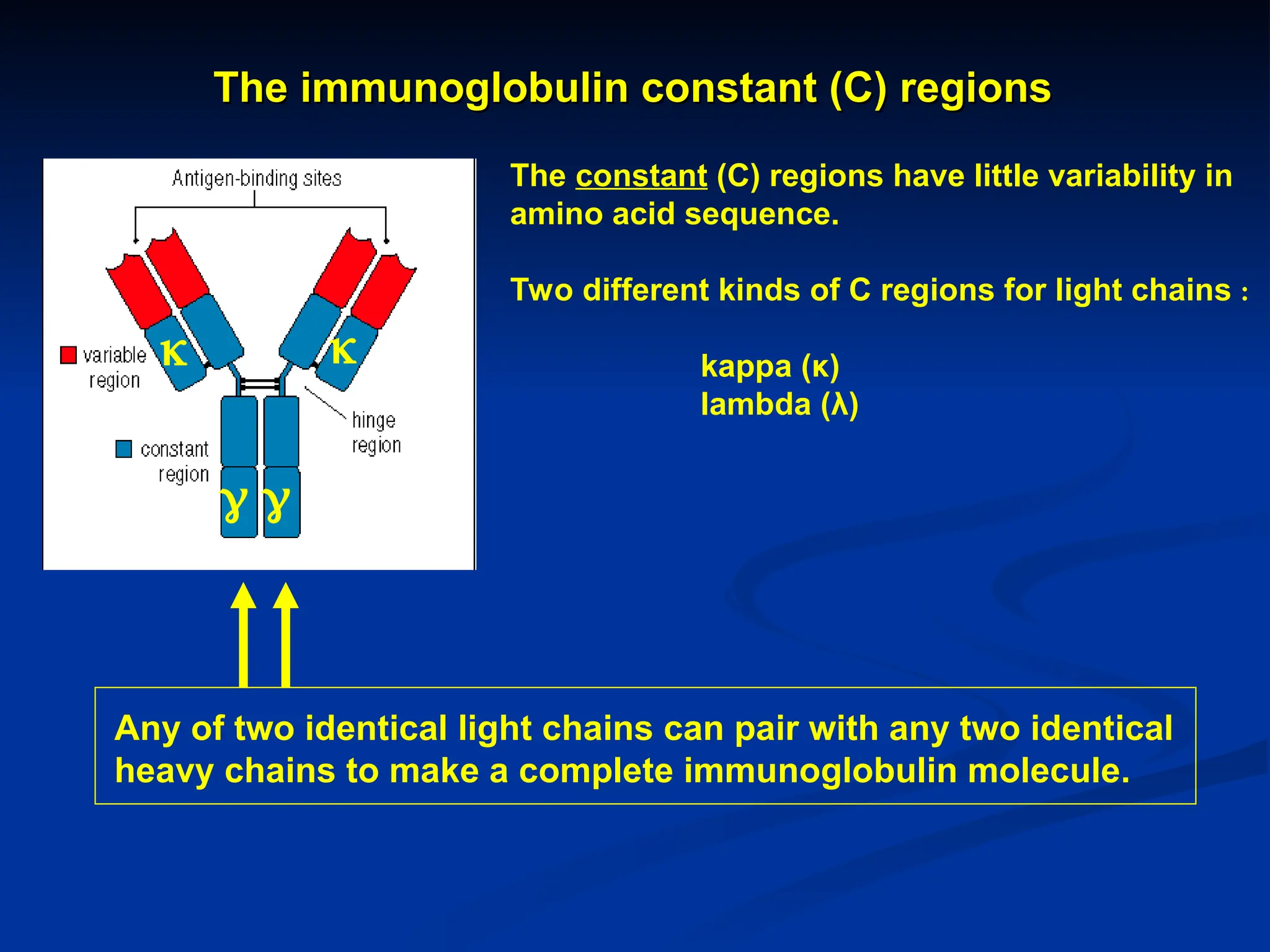
The immunoglobulin constant (C) regions
 
 
Any of two identical light chains can pair with any two identical
heavy chains to make a complete immunoglobulin molecule.
The constant (C) regions have little variability in
amino acid sequence.
Two different kinds of C regions for light chains :
kappa (κ)
lambda (λ)
Five antibody classes (
Five antibody classes (isotypes
isotypes), determined by the
), determined by the
constant region of the heavy chain
The Structural Organization of the Human Immunoglobulin Classes
Five different kinds of C regions for H chains :
gamma (γ) chains, IgG
mu (µ) chains, IgM
delta (δ) chains, IgD
alpha (α) chains, IgA
epsilon (ε) chains, IgE
Each chain is folded into multiple ‘Ig’ domains
The heavy chain constant domains (CH) :
The “biological activity” region
Responsible for interactions with other
proteins (eg, complement), cells (eg, mast
cells), and tissues that result in the effector
functions of immunoglobulins
Both H and L chains contain multiple loops of around 110 amino acids each.
Each chain is folded into multiple ‘Ig’ domains
The variable domains (VH, VL) :
The “antigen-binding” region
Together, these domains compose the
sole antigen-binding region of the
immunoglobulin molecule.
Both H and L chains contain multiple loops of around 110 amino acids each.
The V regions are the first 110 amino acids at the N-terminus of both H and L
chains. This is the region that gives antibody specificity for a given antigen.
Proteolytic digestion of IgG
•Papain treatment produces Fab fragments and Fc fragment
•Fab, antigen-binding; Fc, crystalizable or constant region
•Fc portion interacts with host systems
•Complement activation
•Binding to Fc receptor (FcR) on macrophages and other
cells
Immunoglobulins
Immunoglobulins
 Basic structure
Basic structure
 2 identical heavy chains
 2 identical light chains
 Heavy and Light chains
Heavy and Light chains
 variable (V) and constant (C) regions
 disulfide bonds link the chains together
 light chains have 2 domains, 1V and 1C
 heavy chains have 4-5 domains, 1V and 3-4 C
 heavy chains: 5 classes, μ, γ, α, δ, ε
 light chains: 2 classes, κ and λ
 Membrane bound (mIg) or secreted (sIg)
Membrane bound (mIg) or secreted (sIg)
•Antibody recognizes only a small region (epitope) on
Antibody recognizes only a small region (epitope) on
the surface of a large molecule
•Antibody binds an epitope formed by a specific
Antibody binds an epitope formed by a specific
sequence (linear epitope) or a three-dimensional
structure (conformational epitope)
Antigens can bind in pockets, grooves, extended surface, or
protruding surfaces in the binding sites of antibodies
The process of
rearrangement of
the Ig locus – called
VDJ recombination.
During B cell development, V, D, and J gene segments
rearrange, creating functional genes that encode
immunoglobulin transcripts.
Genetic recombination at the DNA level and processing at the RNA level to
produce functional mRNA
51 27 6
variable genes constant gene
For example, a rearranged heavy chain locus is composed of :
• one V gene segment (from 51)
• one D gene segment (from 27)
• one J gene segment (from 6)
• one C gene segment
During B cell maturation, V, D, and J gene segments
rearrange, creating functional genes that encode
immunoglobulin transcripts.
*After maturation, the variable gene segment rearrangment
(and therefore the epitope specificity) does not change.
V23 D14 J3
Thus, 2.64 x 10
Thus, 2.64 x 10⁶
6
DIFFERENT specificities are possible from the process of
VDJ recombination alone
8262 x (200 + 120) = 2643840 = 2.64 x 10
8262 x (200 + 120) = 2643840 = 2.64 x 10⁶
6
8262 x (200 + 120) = 2.64 x 10
8262 x (200 + 120) = 2.64 x 10⁶
6
A given immunoglobulin has either
A given immunoglobulin has either κ
κ chains or
chains or λ
λ chains, never one of
chains, never one of
each
each
No two B cells are likely to secrete the same Ig (unless
they are clonal progeny), due to the number of different
rearrangements that are possible within the variable
region of the immunoglobulin locus
Note
Note – There are several other forms of antibody
– There are several other forms of antibody
diversification (eg, somatic hypermutation) that
greatly increase the number of distinct antibodies
that the immune system can generate.
Thus, 2.64 x 10
Thus, 2.64 x 10⁶
6
DIFFERENT specificities are possible from the process of
VDJ recombination alone (more than 10
VDJ recombination alone (more than 1011
11
different specificities in total)
Murray
textbook, p75
Number of gene
segment, wrong
information:
κ chain: 300 V,
5J
H chain: 300-
1000 V, 12D, 9J
Naïve B cells die if they do not
see antigen (Ag)
see antigen (Ag)
Naïve B cells that encounter
antigen (plus T cell help) :
1. become activated
1. become activated
2. undergo class switching
3. differentiate into either :
plasma cells [antibody (Ab)
secreting]
secreting]
or
or
memory cells (non-secreting)
The Life of a B cell
When membrane-
bound Ig (mIg) on the
B cell surface binds
to it’s specific
antigen, the B cell
becomes activated.
Proper activation of the B cell
typically requires contact
with CD4 helper T (TH) cells.
Activated B cells differentiate into
Activated B cells differentiate into :
:
plasma cells (Ab secreting)
or
or
memory cells (non-secreting)
Class switching (IgM to IgG, IgE, or
IgA) occurs in response to different
cytokines produced by CD4 helper
T cells
T cells
Class switching does not change
the variable region
the variable region
The usage of heavy chain
The usage of heavy chain constant
constant gene segments changes with B
gene segments changes with B
cell activation in a process termed
cell activation in a process termed class switching
class switching
2
3 4 5
1
but ...... epitope specificity does
but ...... epitope specificity does not
not change !
change !
Structures of the five major classes of secreted antibody
Important because antibody classes differ with regard to biological properties
IgG and IgA are divided into
IgG and IgA are divided into subclasses
subclasses
Subclasses differ in the number
and arrangement of the interchain
disulfide bonds.
13.5 mg/ml 0.0003 mg/ml
vs.
The principal immunoglobulins in plasma are IgG >> IgA > IgM
Function IgG IgM IgA IgD IgE
Complement
Activation
+ +++ - - -
Opsonization + - - - -
ADCC + - - - -
Placental transport + - - - -
B cell antigen
receptor
Naïve - + - + -
Memory + - + - +
Mucosal secretions - - + - -
Mast cell degranulation - - - - +
Antigen binding + + + + +
Biological properties of antibody classes differ
 IgG is the only isotype to cross the placenta
 The transfer of IgG from mother to fetus (placental transfer) is
mediated by an IgG transport protein in the placenta, FcRn,
which binds to the Fc portion of IgG
 Infant produces its own IgG at 6 months
IgG levels are low from the age of 3 months to 1 year
to the fetal
circulation
Maternal
blood
Syncytio-
trophoblast
Endothelial
cells of fetal
capillary
Villi
FcRn: neonatal Fc receptor for IgG
Syncytiotrophoblasts are bathed in maternal blood and internalize serum
containing maternal IgG. FcRn is expressed in the internal vesicles of the
syncytiotrophoblast. On acidification in the endosome, FcRn binds to
maternal IgG and transcytoses it to the fetal circulation where it is released
at physiological pH.
Dimeric IgA is the predominant in mucosal secretions
The delivery of antibody
to mucosal surfaces
requires their
movement across
epithelial cell layers
Transport is mediated
by the polymeric
immunoglobulin
receptor (pIgR)
IgA in colostrum,
intestinal and
respiratory tracts,
saliva, tears
Some pathogens
produce proteolytic
enzymes that can
cleave IgA
Haemophilus influenzae
(respiratory), Neisseria
gonorrhoeae (genital mucosa)
Secretory
component:
part of the
cleaved pIgR
associated
with the IgA
 IgE is found associated with mast cells
beneath epithelial surface, including
respiratroy tract, gastrointesitnal tract,
and skin
 IgD exists as membrane IgD, which
serves with IgM as an antigen receptor
on B cells, and activate B cell growth
 In healthy individuals the Ig
concentration in the central nervous
system (CNS) is low.
Immunoglobulin isotypes
are selectively distributed
The humoral immune response
to infectious pathogens
The
The primary response
primary response to an initial antigen exposure
to an initial antigen exposure
• long lag phase
long lag phase
• IgM is the first reponder
IgM is the first reponder
• gradual switch to IgG
gradual switch to IgG
• low affinity antibodies
low affinity antibodies
The
The secondary response
secondary response to antigen exposure reflects
to antigen exposure reflects
immunological
immunological memory
memory.
.
• short lag phase
short lag phase
• very rapid rise in titer
very rapid rise in titer
• IgG predominates
IgG predominates
• high affinity antibodies
high affinity antibodies
EFFECTOR FUNCTIONS OF ANTIBODIES
 Opsonization – the promotion of phagocytosis of antigens by macrophages
and neutrophils. Protein molecules called Fc receptors (FcR), which bind the
constant region of antibody, are present on the surfaces of phagocytes.
 Activation of complement – IgM (most effective) and most subclasses of IgG
can activate the classical complement pathway
 Antibody-dependent cell-mediated cytotoxicity (ADCC) – The linking of
antibody bound to target cells (virus infected cells, or some tumor cells) with
FcR of natural killer cells (NK cells), neutrophils, macrophages, or eosinophils
can result in killing of the target cell.
 Neutralization of viruses and bacteria – Prevent attachment to cell
receptors.
 Neutralization of toxins
Antibody-dependent
Antibody-dependent opsonization
opsonization of bacteria
of bacteria
facilitates phagocytosis of the pathogen
opsonization (op´sŏn-ī-zā´shŭn) The process by which bacteria and other cells are altered in such a
manner that they are more readily and more efficiently engulfed by phagocytes.
opsonin (op´sŏ-nin) Any blood serum protein that binds to antigens, enhancing phagocytosis (e.g., C3b
of the complement system, specific antibodies). [G. opson, boiled meat, opsonin: to prepare for a meal]
IgG
FcγR
Antibody-dependent activation of the complement pathway
Potential outcomes : - lysis of bacteria via MAC
- induction of inflammatory response
- phagocytosis of bacteria
IgM is the most efficient immunoglobulin for fixing
(binding) complement (Murray p 102)
“Complement fixation” = “Complement activation”
Antibody-dependent cellular (cell-mediated)
cytotoxicity (ADCC) kills the infected target cell
=FcγR
Infection of cells can be blocked by
neutralizing antibodies
Infection of cells can be blocked by neutralizing
antibodies
antibodies
Antibody can prevent
the attachment of
the attachment of
bacteria to cell surface
Many common
Many common
diseases are
diseases are
caused by
caused by
bacterial toxins
bacterial toxins
Neutralization by IgG antibodies can protect cells from toxins
Function IgG IgM IgA IgD IgE
Complement
Activation
+ +++ - - -
Opsonization + - - - -
ADCC + - - - -+
Placental transport + - - - -
B cell antigen
receptor
Naïve - + - + -
Memory + - + - +
Mucosal secretions - - + - -
Mast cell degranulation - - - - +
Antigen binding + + + + +
Biological properties of antibody classes differ
Murray p73, Table 9-4 is inaccurate
helminth
killing
Naïve B cells die if they do not
see antigen (Ag)
see antigen (Ag)
Naïve B cells that encounter
antigen (plus T cell help) :
1. become activated
1. become activated
2. undergo class switching
3. differentiate into either :
plasma cells [antibody (Ab)
secreting]
secreting]
or
or
memory cells (non-secreting)
The Life of a B cell
IgM, IgD
The usage of heavy chain
The usage of heavy chain constant
constant gene segments changes with B
gene segments changes with B
cell activation in a process termed
cell activation in a process termed class switching
class switching
2
3 4 5
1
but ...... epitope specificity does
but ...... epitope specificity does not
not change !
change !
Every B cell expresses a single type of immunoglobulin.
The specificity of that immunoglobulin is determined by
the process of VDJ recombination – rearrangement of
the DNA that encodes the variable region.
THANK YOU
THANK YOU

HUMORAL IMMUNITY PRESENTATION IN IMMUNOLOGY

  • 1.
    Mechanisms of humoralimmune response: Mechanisms of humoral immune response: indution $ effector mechanisms indution $ effector mechanisms  By Dr Oyaro By Dr Oyaro
  • 2.
    Objectives Objectives  Structures ofimmunoglobulins and their Structures of immunoglobulins and their proteolytic digestion proteolytic digestion  Difference in biologic properties among antibody Difference in biologic properties among antibody classes classes  VDJ recombination and class switching of VDJ recombination and class switching of immunoglobulin immunoglobulin  Transfer of IgG from mother to fetus (via FcRn) Transfer of IgG from mother to fetus (via FcRn)  Mucosal secretion of IgA (via poly-Ig receptor) Mucosal secretion of IgA (via poly-Ig receptor)  Primary and secondary immunoglobulin responses Primary and secondary immunoglobulin responses  Effector functions of antibody Effector functions of antibody To understand;
  • 3.
    Humoral immune responses Humoralimmune responses  “ “Antibody” = immunoglobulin is the primary Antibody” = immunoglobulin is the primary component of the humoral immunity component of the humoral immunity  “ “Antigen” = a molecule recognized by Antigen” = a molecule recognized by antibody or T cell antibody or T cell  “ “Epitope” is the molecular structure in an Epitope” is the molecular structure in an antigen that interacts with antibody or T cell antigen that interacts with antibody or T cell  Proteins (best antigen) >> carbohydrates Proteins (best antigen) >> carbohydrates (weak) >> lipids, nucleic acids (poor antigen) (weak) >> lipids, nucleic acids (poor antigen)
  • 4.
    Antibodies are composedof polypeptides with both Antibodies are composed of polypeptides with both variable and constant regions variable and constant regions The immunoglobulin G (IgG) molecule Hinge Note: 2 identical heavy chains (green) 2 identical light chains (yellow) Note: Location of the variable (red) and constant (blue) regions in the antibody molecule.
  • 5.
    The immunoglobulin constant(C) regions The immunoglobulin constant (C) regions     Any of two identical light chains can pair with any two identical heavy chains to make a complete immunoglobulin molecule. The constant (C) regions have little variability in amino acid sequence. Two different kinds of C regions for light chains : kappa (κ) lambda (λ)
  • 6.
    Five antibody classes( Five antibody classes (isotypes isotypes), determined by the ), determined by the constant region of the heavy chain constant region of the heavy chain The Structural Organization of the Human Immunoglobulin Classes Five different kinds of C regions for H chains : gamma (γ) chains, IgG mu (µ) chains, IgM delta (δ) chains, IgD alpha (α) chains, IgA epsilon (ε) chains, IgE
  • 7.
    Each chain isfolded into multiple ‘Ig’ domains Each chain is folded into multiple ‘Ig’ domains The heavy chain constant domains (CH) : The “biological activity” region Responsible for interactions with other proteins (eg, complement), cells (eg, mast cells), and tissues that result in the effector functions of immunoglobulins Both H and L chains contain multiple loops of around 110 amino acids each.
  • 8.
    Each chain isfolded into multiple ‘Ig’ domains Each chain is folded into multiple ‘Ig’ domains The variable domains (VH, VL) : The “antigen-binding” region Together, these domains compose the sole antigen-binding region of the immunoglobulin molecule. Both H and L chains contain multiple loops of around 110 amino acids each. The V regions are the first 110 amino acids at the N-terminus of both H and L chains. This is the region that gives antibody specificity for a given antigen.
  • 9.
    Proteolytic digestion ofIgG •Papain treatment produces Fab fragments and Fc fragment •Fab, antigen-binding; Fc, crystalizable or constant region •Fc portion interacts with host systems •Complement activation •Binding to Fc receptor (FcR) on macrophages and other cells
  • 10.
    Immunoglobulins Immunoglobulins  Basic structure Basicstructure  2 identical heavy chains  2 identical light chains  Heavy and Light chains Heavy and Light chains  variable (V) and constant (C) regions  disulfide bonds link the chains together  light chains have 2 domains, 1V and 1C  heavy chains have 4-5 domains, 1V and 3-4 C  heavy chains: 5 classes, μ, γ, α, δ, ε  light chains: 2 classes, κ and λ  Membrane bound (mIg) or secreted (sIg) Membrane bound (mIg) or secreted (sIg)
  • 11.
    •Antibody recognizes onlya small region (epitope) on Antibody recognizes only a small region (epitope) on the surface of a large molecule the surface of a large molecule •Antibody binds an epitope formed by a specific Antibody binds an epitope formed by a specific sequence (linear epitope) or a three-dimensional sequence (linear epitope) or a three-dimensional structure (conformational epitope) structure (conformational epitope)
  • 12.
    Antigens can bindin pockets, grooves, extended surface, or Antigens can bind in pockets, grooves, extended surface, or protruding surfaces in the binding sites of antibodies protruding surfaces in the binding sites of antibodies
  • 13.
    The process of rearrangementof the Ig locus – called VDJ recombination. During B cell development, V, D, and J gene segments During B cell development, V, D, and J gene segments rearrange, creating functional genes that encode rearrange, creating functional genes that encode immunoglobulin transcripts. immunoglobulin transcripts. Genetic recombination at the DNA level and processing at the RNA level to produce functional mRNA
  • 14.
    51 27 6 variablegenes constant gene For example, a rearranged heavy chain locus is composed of : • one V gene segment (from 51) • one D gene segment (from 27) • one J gene segment (from 6) • one C gene segment During B cell maturation, V, D, and J gene segments During B cell maturation, V, D, and J gene segments rearrange, creating functional genes that encode rearrange, creating functional genes that encode immunoglobulin transcripts. immunoglobulin transcripts. *After maturation, the variable gene segment rearrangment (and therefore the epitope specificity) does not change. V23 D14 J3
  • 15.
    Thus, 2.64 x10 Thus, 2.64 x 10⁶ 6 DIFFERENT specificities are possible from the process of DIFFERENT specificities are possible from the process of VDJ recombination alone VDJ recombination alone 8262 x (200 + 120) = 2643840 = 2.64 x 10 8262 x (200 + 120) = 2643840 = 2.64 x 10⁶ 6 8262 x (200 + 120) = 2.64 x 10 8262 x (200 + 120) = 2.64 x 10⁶ 6 A given immunoglobulin has either A given immunoglobulin has either κ κ chains or chains or λ λ chains, never one of chains, never one of each each
  • 16.
    No two Bcells are likely to secrete the same Ig (unless No two B cells are likely to secrete the same Ig (unless they are clonal progeny), due to the number of different they are clonal progeny), due to the number of different rearrangements that are possible within the variable rearrangements that are possible within the variable region of the immunoglobulin locus region of the immunoglobulin locus Note Note – There are several other forms of antibody – There are several other forms of antibody diversification (eg, somatic hypermutation) that diversification (eg, somatic hypermutation) that greatly increase the number of distinct antibodies greatly increase the number of distinct antibodies that the immune system can generate. that the immune system can generate. Thus, 2.64 x 10 Thus, 2.64 x 10⁶ 6 DIFFERENT specificities are possible from the process of DIFFERENT specificities are possible from the process of VDJ recombination alone (more than 10 VDJ recombination alone (more than 1011 11 different specificities in total) different specificities in total)
  • 17.
    Murray textbook, p75 Number ofgene segment, wrong information: κ chain: 300 V, 5J H chain: 300- 1000 V, 12D, 9J
  • 18.
    Naïve B cellsdie if they do not Naïve B cells die if they do not see antigen (Ag) see antigen (Ag) Naïve B cells that encounter Naïve B cells that encounter antigen (plus T cell help) : antigen (plus T cell help) : 1. become activated 1. become activated 2. undergo class switching 2. undergo class switching 3. differentiate into either : 3. differentiate into either : plasma cells [antibody (Ab) plasma cells [antibody (Ab) secreting] secreting] or or memory cells (non-secreting) memory cells (non-secreting) The Life of a B cell The Life of a B cell
  • 19.
    When membrane- bound Ig(mIg) on the B cell surface binds to it’s specific antigen, the B cell becomes activated.
  • 20.
    Proper activation ofthe B cell typically requires contact with CD4 helper T (TH) cells.
  • 21.
    Activated B cellsdifferentiate into Activated B cells differentiate into : : plasma cells (Ab secreting) plasma cells (Ab secreting) or or memory cells (non-secreting) memory cells (non-secreting)
  • 22.
    Class switching (IgMto IgG, IgE, or Class switching (IgM to IgG, IgE, or IgA) occurs in response to different IgA) occurs in response to different cytokines produced by CD4 helper cytokines produced by CD4 helper T cells T cells Class switching does not change Class switching does not change the variable region the variable region
  • 23.
    The usage ofheavy chain The usage of heavy chain constant constant gene segments changes with B gene segments changes with B cell activation in a process termed cell activation in a process termed class switching class switching 2 3 4 5 1 but ...... epitope specificity does but ...... epitope specificity does not not change ! change !
  • 24.
    Structures of thefive major classes of secreted antibody Structures of the five major classes of secreted antibody Important because antibody classes differ with regard to biological properties Important because antibody classes differ with regard to biological properties
  • 25.
    IgG and IgAare divided into IgG and IgA are divided into subclasses subclasses Subclasses differ in the number and arrangement of the interchain disulfide bonds.
  • 26.
    13.5 mg/ml 0.0003mg/ml vs. The principal immunoglobulins in plasma are IgG >> IgA > IgM
  • 27.
    Function IgG IgMIgA IgD IgE Complement Activation + +++ - - - Opsonization + - - - - ADCC + - - - - Placental transport + - - - - B cell antigen receptor Naïve - + - + - Memory + - + - + Mucosal secretions - - + - - Mast cell degranulation - - - - + Antigen binding + + + + + Biological properties of antibody classes differ Biological properties of antibody classes differ
  • 28.
     IgG isthe only isotype to cross the placenta  The transfer of IgG from mother to fetus (placental transfer) is mediated by an IgG transport protein in the placenta, FcRn, which binds to the Fc portion of IgG  Infant produces its own IgG at 6 months IgG levels are low from the age of 3 months to 1 year IgG levels are low from the age of 3 months to 1 year
  • 29.
  • 30.
    FcRn: neonatal Fcreceptor for IgG
  • 31.
    Syncytiotrophoblasts are bathedin maternal blood and internalize serum containing maternal IgG. FcRn is expressed in the internal vesicles of the syncytiotrophoblast. On acidification in the endosome, FcRn binds to maternal IgG and transcytoses it to the fetal circulation where it is released at physiological pH.
  • 32.
    Dimeric IgA isthe predominant in mucosal secretions The delivery of antibody to mucosal surfaces requires their movement across epithelial cell layers Transport is mediated by the polymeric immunoglobulin receptor (pIgR) IgA in colostrum, intestinal and respiratory tracts, saliva, tears Some pathogens produce proteolytic enzymes that can cleave IgA Haemophilus influenzae (respiratory), Neisseria gonorrhoeae (genital mucosa) Secretory component: part of the cleaved pIgR associated with the IgA
  • 33.
     IgE isfound associated with mast cells beneath epithelial surface, including respiratroy tract, gastrointesitnal tract, and skin  IgD exists as membrane IgD, which serves with IgM as an antigen receptor on B cells, and activate B cell growth  In healthy individuals the Ig concentration in the central nervous system (CNS) is low. Immunoglobulin isotypes Immunoglobulin isotypes are selectively distributed are selectively distributed
  • 34.
    The humoral immuneresponse The humoral immune response to infectious pathogens to infectious pathogens
  • 35.
    The The primary response primaryresponse to an initial antigen exposure to an initial antigen exposure • long lag phase long lag phase • IgM is the first reponder IgM is the first reponder • gradual switch to IgG gradual switch to IgG • low affinity antibodies low affinity antibodies
  • 36.
    The The secondary response secondaryresponse to antigen exposure reflects to antigen exposure reflects immunological immunological memory memory. . • short lag phase short lag phase • very rapid rise in titer very rapid rise in titer • IgG predominates IgG predominates • high affinity antibodies high affinity antibodies
  • 37.
    EFFECTOR FUNCTIONS OFANTIBODIES EFFECTOR FUNCTIONS OF ANTIBODIES  Opsonization – the promotion of phagocytosis of antigens by macrophages and neutrophils. Protein molecules called Fc receptors (FcR), which bind the constant region of antibody, are present on the surfaces of phagocytes.  Activation of complement – IgM (most effective) and most subclasses of IgG can activate the classical complement pathway  Antibody-dependent cell-mediated cytotoxicity (ADCC) – The linking of antibody bound to target cells (virus infected cells, or some tumor cells) with FcR of natural killer cells (NK cells), neutrophils, macrophages, or eosinophils can result in killing of the target cell.  Neutralization of viruses and bacteria – Prevent attachment to cell receptors.  Neutralization of toxins
  • 38.
    Antibody-dependent Antibody-dependent opsonization opsonization ofbacteria of bacteria facilitates phagocytosis of the pathogen facilitates phagocytosis of the pathogen opsonization (op´sŏn-ī-zā´shŭn) The process by which bacteria and other cells are altered in such a manner that they are more readily and more efficiently engulfed by phagocytes. opsonin (op´sŏ-nin) Any blood serum protein that binds to antigens, enhancing phagocytosis (e.g., C3b of the complement system, specific antibodies). [G. opson, boiled meat, opsonin: to prepare for a meal] IgG FcγR
  • 39.
    Antibody-dependent activation ofthe complement pathway Antibody-dependent activation of the complement pathway Potential outcomes : - lysis of bacteria via MAC - induction of inflammatory response - phagocytosis of bacteria IgM is the most efficient immunoglobulin for fixing (binding) complement (Murray p 102) “Complement fixation” = “Complement activation”
  • 40.
    Antibody-dependent cellular (cell-mediated) Antibody-dependentcellular (cell-mediated) cytotoxicity (ADCC) kills the infected target cell cytotoxicity (ADCC) kills the infected target cell =FcγR
  • 41.
    Infection of cellscan be blocked by Infection of cells can be blocked by neutralizing antibodies neutralizing antibodies
  • 42.
    Infection of cellscan be blocked by neutralizing Infection of cells can be blocked by neutralizing antibodies antibodies
  • 43.
    Antibody can prevent Antibodycan prevent the attachment of the attachment of bacteria to cell surface bacteria to cell surface
  • 44.
    Many common Many common diseasesare diseases are caused by caused by bacterial toxins bacterial toxins
  • 45.
    Neutralization by IgGantibodies can protect cells from toxins Neutralization by IgG antibodies can protect cells from toxins
  • 46.
    Neutralization by IgGantibodies can protect cells from toxins Neutralization by IgG antibodies can protect cells from toxins
  • 47.
    Function IgG IgMIgA IgD IgE Complement Activation + +++ - - - Opsonization + - - - - ADCC + - - - -+ Placental transport + - - - - B cell antigen receptor Naïve - + - + - Memory + - + - + Mucosal secretions - - + - - Mast cell degranulation - - - - + Antigen binding + + + + + Biological properties of antibody classes differ Biological properties of antibody classes differ Murray p73, Table 9-4 is inaccurate helminth killing
  • 48.
    Naïve B cellsdie if they do not Naïve B cells die if they do not see antigen (Ag) see antigen (Ag) Naïve B cells that encounter Naïve B cells that encounter antigen (plus T cell help) : antigen (plus T cell help) : 1. become activated 1. become activated 2. undergo class switching 2. undergo class switching 3. differentiate into either : 3. differentiate into either : plasma cells [antibody (Ab) plasma cells [antibody (Ab) secreting] secreting] or or memory cells (non-secreting) memory cells (non-secreting) The Life of a B cell The Life of a B cell IgM, IgD
  • 49.
    The usage ofheavy chain The usage of heavy chain constant constant gene segments changes with B gene segments changes with B cell activation in a process termed cell activation in a process termed class switching class switching 2 3 4 5 1 but ...... epitope specificity does but ...... epitope specificity does not not change ! change !
  • 50.
    Every B cellexpresses a single type of immunoglobulin. Every B cell expresses a single type of immunoglobulin. The specificity of that immunoglobulin is determined by The specificity of that immunoglobulin is determined by the process of VDJ recombination – rearrangement of the process of VDJ recombination – rearrangement of the DNA that encodes the variable region. the DNA that encodes the variable region.
  • 51.

Editor's Notes

  • #6 epsilon   Use Epsilon in a sentence gam·ma /‘gæmə/ al·pha /‘ælfə/ ep·si·lon /‘ɛpsəlɒn, -lən or, esp. British, ɛpsaɪlən/
  • #7 do·main /doʊ’meɪn/
  • #32 co·los·trum /kə’lɒstrəm/ noun a yellowish liquid, especially rich in immune factors, secreted by the mammary gland of female mammals a few days before and after the birth of their young. se·cre·to·ry /sɪ’kritəri/ adjective 1. pertaining to secretion. 2. performing the process of secretion.