Antibody-Mediated Encephalitis
Josep Dalmau, M.D., Ph.D., and
Francesc Graus, M.D., Ph.D.
March 1, 2018
Dr Amruta Rajamanya
DNB Neurology
KMC MANGALORE
• Antibody-mediated encephalitides
constitute a group of inflammatory brain
diseases that are characterized by
prominent neuropsychiatric symptoms
and are associated with antibodies
against neuronal cell-surface proteins,
ion channels, or receptors.
• Estimated annual incidence of all types of
encephalitis is approximately 5 to 8 cases per
100,000 persons,
• 40 to 50% of the cases, the cause cannot be
established.
• Autoimmune disorders are the third most
common cause of encephalitis
• A study from a center that is specifically
concerned with the epidemiology of encephalitis
showed that the frequency of the most common
form of autoimmune encephalitis, the type with
antibodies against the N-methyl-daspartate
receptor (NMDAR)
• Anti-NMDAR encephalitis accounted for 1% of
all admissions of young adults to an intensive
care unit
• A retrospective Dutch study showed that
encephalitis characterized by antibodies
against leucine-rich, glioma-inactivated 1
(LGI1) was the second most frequent
autoimmune encephalitis, with an incidence
of 0.83 cases per 1 million persons
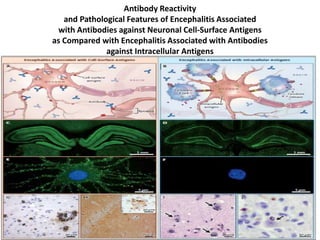
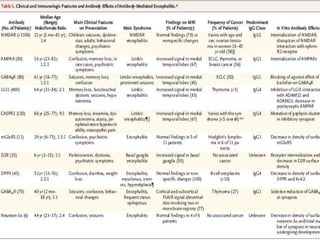
Antibody Reactivity
and Pathological Features of Encephalitis Associated
with Antibodies against Neuronal Cell-Surface Antigens
as Compared with Encephalitis Associated with Antibodies
against Intracellular Antigens
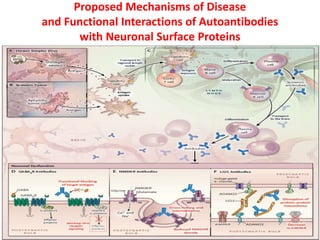
Proposed Mechanisms of Disease
and Functional Interactions of Autoantibodies
with Neuronal Surface Proteins
• These mechanisms are influenced by the type
of antibodies;
• IgG1 antibodies frequently crosslink and
internalize the target antigen,
• but IgG4 antibodies more often alter protein–
protein interactions.
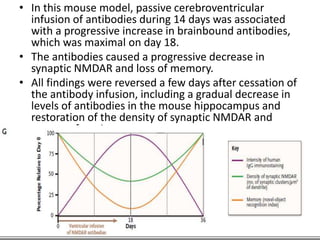
• In this mouse model, passive cerebroventricular
infusion of antibodies during 14 days was associated
with a progressive increase in brainbound antibodies,
which was maximal on day 18.
• The antibodies caused a progressive decrease in
synaptic NMDAR and loss of memory.
• All findings were reversed a few days after cessation of
the antibody infusion, including a gradual decrease in
levels of antibodies in the mouse hippocampus and
restoration of the density of synaptic NMDAR and
memory function
Clinical Syndromes
• Symptoms progress over a period of days or weeks.
• Approximately 60% of patients with autoimmune
encephalitis have prodromal low-grade fever,
malaise, or headache.
• Some prodormal symptoms are characteristic of
particular types of autoimmune encephalitides —
for example,
• faciobrachial dystonic seizures and paroxysmal dizzy spells
occur with anti-LGI1 encephalitis,
• severe diarrhea and weight loss occur in the prodromal
phase of anti-DPPX encephalitis
Anti-NMDAR encephalitis
• affects predominantly children and young
• adults (median age, 21 years),
• with a predominance of cases in females (4:1)
that becomes less evident after the age of 45
years.
• 58% of affected young female patients have
an ovarian teratoma (extragonadal teratomas
are a rare cause)
• Young children typically present with
insomnia, seizures, abnormal movements, or a change in behavior
such as irritability, temper tantrums, agitation, and reduction of verbal
output.
• Teenagers and adults
more often present with psychiatric symptoms, including agitation,
hallucinations, delusions, and catatonia, which may lead to hospital
admission for psychosis
• The disease progresses in a period of days or
weeks to include
reduction of speech, memory deficit, orofacial and limb dyskinesias,
seizures, decreased level of consciousness, and autonomic instability
manifested as excess salivation, hyperthermia, fluctuations of blood
pressure, tachycardia, or central hypoventilation.
One month after disease onset
have a syndrome that combines several of the above-mentioned
symptoms; in approximately 5% of patients, the disease may remain
monosymptomatic
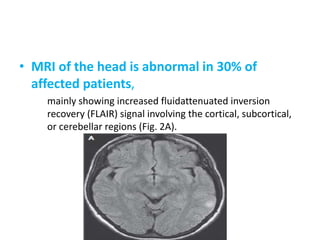
• MRI of the head is abnormal in 30% of
affected patients,
mainly showing increased fluidattenuated inversion
recovery (FLAIR) signal involving the cortical, subcortical,
or cerebellar regions (Fig. 2A).
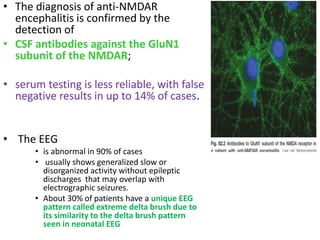
• The diagnosis of anti-NMDAR
encephalitis is confirmed by the
detection of
• CSF antibodies against the GluN1
subunit of the NMDAR;
• serum testing is less reliable, with false
negative results in up to 14% of cases.
• The EEG
• is abnormal in 90% of cases
• usually shows generalized slow or
disorganized activity without epileptic
discharges that may overlap with
electrographic seizures.
• About 30% of patients have a unique EEG
pattern called extreme delta brush due to
its similarity to the delta brush pattern
seen in neonatal EEG
Limbic
encephalitis
• usually older than 45 years,
• With a sex predominance that varies with the type
of antibody.
• Symptoms include
confusion,
behavioral changes, seizures,
 and inability to form new memories, with relative
preservation of the old ones
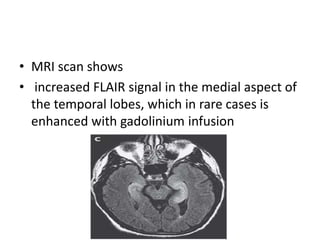
• MRI scan shows
• increased FLAIR signal in the medial aspect of
the temporal lobes, which in rare cases is
enhanced with gadolinium infusion
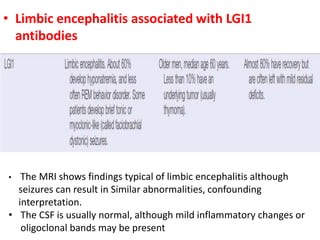
• Limbic encephalitis associated with LGI1
antibodies
• The MRI shows findings typical of limbic encephalitis although
seizures can result in Similar abnormalities, confounding
interpretation.
• The CSF is usually normal, although mild inflammatory changes or
oligoclonal bands may be present
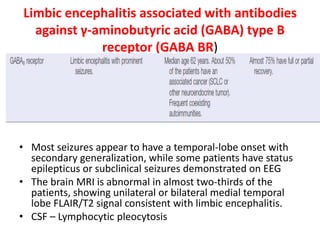
Limbic encephalitis associated with antibodies
against γ-aminobutyric acid (GABA) type B
receptor (GABA BR)
• Most seizures appear to have a temporal-lobe onset with
secondary generalization, while some patients have status
epilepticus or subclinical seizures demonstrated on EEG
• The brain MRI is abnormal in almost two-thirds of the
patients, showing unilateral or bilateral medial temporal
lobe FLAIR/T2 signal consistent with limbic encephalitis.
• CSF – Lymphocytic pleocytosis
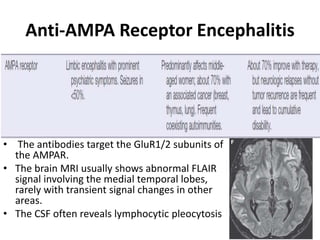
Anti-AMPA Receptor Encephalitis
• The antibodies target the GluR1/2 subunits of
the AMPAR.
• The brain MRI usually shows abnormal FLAIR
signal involving the medial temporal lobes,
rarely with transient signal changes in other
areas.
• The CSF often reveals lymphocytic pleocytosis
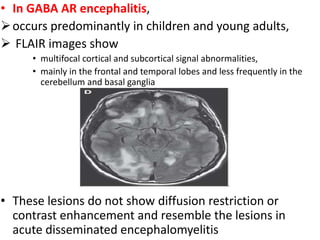
• In GABA AR encephalitis,
occurs predominantly in children and young adults,
 FLAIR images show
• multifocal cortical and subcortical signal abnormalities,
• mainly in the frontal and temporal lobes and less frequently in the
cerebellum and basal ganglia
• These lesions do not show diffusion restriction or
contrast enhancement and resemble the lesions in
acute disseminated encephalomyelitis
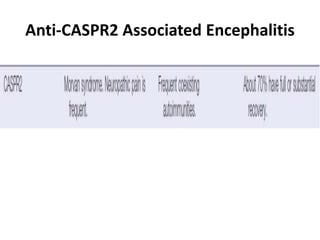
Anti-CASPR2 Associated Encephalitis
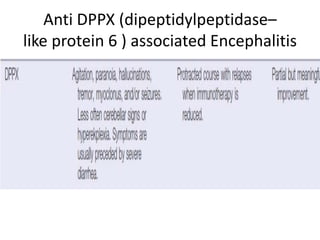
Anti DPPX (dipeptidylpeptidase–
like protein 6 ) associated Encephalitis
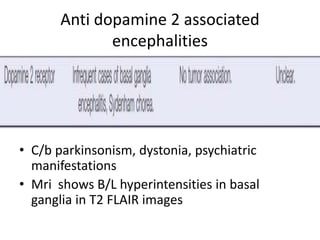
Anti dopamine 2 associated
encephalities
• C/b parkinsonism, dystonia, psychiatric
manifestations
• Mri shows B/L hyperintensities in basal
ganglia in T2 FLAIR images
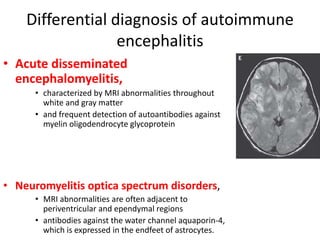
Differential diagnosis of autoimmune
encephalitis
• Acute disseminated
encephalomyelitis,
• characterized by MRI abnormalities throughout
white and gray matter
• and frequent detection of autoantibodies against
myelin oligodendrocyte glycoprotein
• Neuromyelitis optica spectrum disorders,
• MRI abnormalities are often adjacent to
periventricular and ependymal regions
• antibodies against the water channel aquaporin-4,
which is expressed in the endfeet of astrocytes.
Treatments and Outcome
• The current approach includes immunotherapy and
removal of the immunologic trigger, such as teratoma
or another tumor, when applicable.
• Most patients are treated with glucocorticoids,
intravenous immune globulin, or plasma exchange,
and if there is no clinical response, rituximab and
cyclophosphamide are used.
• Favorable outcome
• The frequency of clinical relapse in the encephalitides
associated with antibodies against NMDAR, AMPAR,
LGI1, CASPR2, or DPPX ranges from 12 to 35%.
Antibody mediated encephalitis  ppt

Antibody mediated encephalitis ppt

  • 1.
    Antibody-Mediated Encephalitis Josep Dalmau,M.D., Ph.D., and Francesc Graus, M.D., Ph.D. March 1, 2018 Dr Amruta Rajamanya DNB Neurology KMC MANGALORE
  • 2.
    • Antibody-mediated encephalitides constitutea group of inflammatory brain diseases that are characterized by prominent neuropsychiatric symptoms and are associated with antibodies against neuronal cell-surface proteins, ion channels, or receptors.
  • 3.
    • Estimated annualincidence of all types of encephalitis is approximately 5 to 8 cases per 100,000 persons, • 40 to 50% of the cases, the cause cannot be established. • Autoimmune disorders are the third most common cause of encephalitis
  • 4.
    • A studyfrom a center that is specifically concerned with the epidemiology of encephalitis showed that the frequency of the most common form of autoimmune encephalitis, the type with antibodies against the N-methyl-daspartate receptor (NMDAR) • Anti-NMDAR encephalitis accounted for 1% of all admissions of young adults to an intensive care unit
  • 5.
    • A retrospectiveDutch study showed that encephalitis characterized by antibodies against leucine-rich, glioma-inactivated 1 (LGI1) was the second most frequent autoimmune encephalitis, with an incidence of 0.83 cases per 1 million persons
  • 6.
    Antibody Reactivity and PathologicalFeatures of Encephalitis Associated with Antibodies against Neuronal Cell-Surface Antigens as Compared with Encephalitis Associated with Antibodies against Intracellular Antigens
  • 7.
    Proposed Mechanisms ofDisease and Functional Interactions of Autoantibodies with Neuronal Surface Proteins
  • 8.
    • These mechanismsare influenced by the type of antibodies; • IgG1 antibodies frequently crosslink and internalize the target antigen, • but IgG4 antibodies more often alter protein– protein interactions.
  • 9.
    • In thismouse model, passive cerebroventricular infusion of antibodies during 14 days was associated with a progressive increase in brainbound antibodies, which was maximal on day 18. • The antibodies caused a progressive decrease in synaptic NMDAR and loss of memory. • All findings were reversed a few days after cessation of the antibody infusion, including a gradual decrease in levels of antibodies in the mouse hippocampus and restoration of the density of synaptic NMDAR and memory function
  • 11.
    Clinical Syndromes • Symptomsprogress over a period of days or weeks. • Approximately 60% of patients with autoimmune encephalitis have prodromal low-grade fever, malaise, or headache. • Some prodormal symptoms are characteristic of particular types of autoimmune encephalitides — for example, • faciobrachial dystonic seizures and paroxysmal dizzy spells occur with anti-LGI1 encephalitis, • severe diarrhea and weight loss occur in the prodromal phase of anti-DPPX encephalitis
  • 12.
    Anti-NMDAR encephalitis • affectspredominantly children and young • adults (median age, 21 years), • with a predominance of cases in females (4:1) that becomes less evident after the age of 45 years. • 58% of affected young female patients have an ovarian teratoma (extragonadal teratomas are a rare cause)
  • 13.
    • Young childrentypically present with insomnia, seizures, abnormal movements, or a change in behavior such as irritability, temper tantrums, agitation, and reduction of verbal output. • Teenagers and adults more often present with psychiatric symptoms, including agitation, hallucinations, delusions, and catatonia, which may lead to hospital admission for psychosis
  • 14.
    • The diseaseprogresses in a period of days or weeks to include reduction of speech, memory deficit, orofacial and limb dyskinesias, seizures, decreased level of consciousness, and autonomic instability manifested as excess salivation, hyperthermia, fluctuations of blood pressure, tachycardia, or central hypoventilation. One month after disease onset have a syndrome that combines several of the above-mentioned symptoms; in approximately 5% of patients, the disease may remain monosymptomatic
  • 15.
    • MRI ofthe head is abnormal in 30% of affected patients, mainly showing increased fluidattenuated inversion recovery (FLAIR) signal involving the cortical, subcortical, or cerebellar regions (Fig. 2A).
  • 16.
    • The diagnosisof anti-NMDAR encephalitis is confirmed by the detection of • CSF antibodies against the GluN1 subunit of the NMDAR; • serum testing is less reliable, with false negative results in up to 14% of cases. • The EEG • is abnormal in 90% of cases • usually shows generalized slow or disorganized activity without epileptic discharges that may overlap with electrographic seizures. • About 30% of patients have a unique EEG pattern called extreme delta brush due to its similarity to the delta brush pattern seen in neonatal EEG
  • 17.
    Limbic encephalitis • usually olderthan 45 years, • With a sex predominance that varies with the type of antibody. • Symptoms include confusion, behavioral changes, seizures,  and inability to form new memories, with relative preservation of the old ones
  • 18.
    • MRI scanshows • increased FLAIR signal in the medial aspect of the temporal lobes, which in rare cases is enhanced with gadolinium infusion
  • 19.
    • Limbic encephalitisassociated with LGI1 antibodies • The MRI shows findings typical of limbic encephalitis although seizures can result in Similar abnormalities, confounding interpretation. • The CSF is usually normal, although mild inflammatory changes or oligoclonal bands may be present
  • 20.
    Limbic encephalitis associatedwith antibodies against γ-aminobutyric acid (GABA) type B receptor (GABA BR) • Most seizures appear to have a temporal-lobe onset with secondary generalization, while some patients have status epilepticus or subclinical seizures demonstrated on EEG • The brain MRI is abnormal in almost two-thirds of the patients, showing unilateral or bilateral medial temporal lobe FLAIR/T2 signal consistent with limbic encephalitis. • CSF – Lymphocytic pleocytosis
  • 21.
    Anti-AMPA Receptor Encephalitis •The antibodies target the GluR1/2 subunits of the AMPAR. • The brain MRI usually shows abnormal FLAIR signal involving the medial temporal lobes, rarely with transient signal changes in other areas. • The CSF often reveals lymphocytic pleocytosis
  • 22.
    • In GABAAR encephalitis, occurs predominantly in children and young adults,  FLAIR images show • multifocal cortical and subcortical signal abnormalities, • mainly in the frontal and temporal lobes and less frequently in the cerebellum and basal ganglia • These lesions do not show diffusion restriction or contrast enhancement and resemble the lesions in acute disseminated encephalomyelitis
  • 23.
  • 24.
    Anti DPPX (dipeptidylpeptidase– likeprotein 6 ) associated Encephalitis
  • 25.
    Anti dopamine 2associated encephalities • C/b parkinsonism, dystonia, psychiatric manifestations • Mri shows B/L hyperintensities in basal ganglia in T2 FLAIR images
  • 26.
    Differential diagnosis ofautoimmune encephalitis • Acute disseminated encephalomyelitis, • characterized by MRI abnormalities throughout white and gray matter • and frequent detection of autoantibodies against myelin oligodendrocyte glycoprotein • Neuromyelitis optica spectrum disorders, • MRI abnormalities are often adjacent to periventricular and ependymal regions • antibodies against the water channel aquaporin-4, which is expressed in the endfeet of astrocytes.
  • 27.
    Treatments and Outcome •The current approach includes immunotherapy and removal of the immunologic trigger, such as teratoma or another tumor, when applicable. • Most patients are treated with glucocorticoids, intravenous immune globulin, or plasma exchange, and if there is no clinical response, rituximab and cyclophosphamide are used. • Favorable outcome • The frequency of clinical relapse in the encephalitides associated with antibodies against NMDAR, AMPAR, LGI1, CASPR2, or DPPX ranges from 12 to 35%.