Download to read offline











![Ocrelizumab
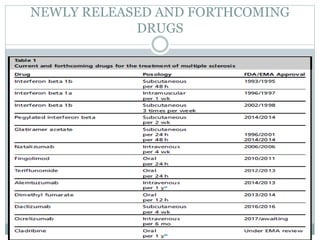
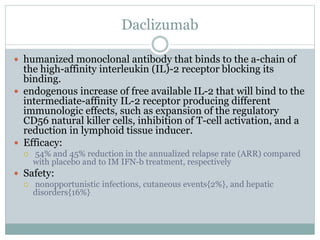
Ocrelizumab is a humanized monoclonal antibody that selectively
binds to the B-cellsurface CD20 antigen.
The adhesion of ocrelizumab to its target produces a selective
depletion of B cells presenting with the antigen: pre-B cells, mature
B cells, and memory B cells, but it will not affect lymphoid stem
cells and plasma cells
Efficacy:
The results of the 2 phase 3 clinical trials demonstrated that, compared with
subcutaneous IFN-b, ocrelizumab significantly reduced by 46% to 47% the ARR
after 2 years of treatment.
reduced by 77% to 83% the mean number of new T2 lesions and by 94% to 95%
the mean number of Gd-enhancing lesions
Safety:
infusion-related reactions[35% to 40%.]
nasopharyngitis, upper respiratory tract infection, and urinary tract
infections](https://image.slidesharecdn.com/updatesinms-171226092459/85/Updates-in-ms-32-320.jpg)





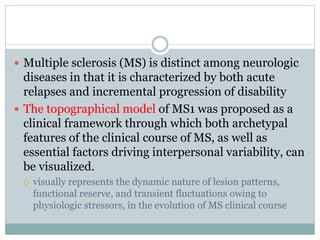
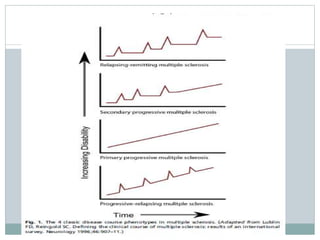
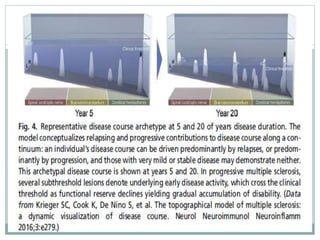
This document provides an overview of multiple sclerosis (MS), including its characteristics, pathogenesis, clinical course, diagnosis using MRI, and current and emerging treatments. Key points: - MS is a chronic autoimmune disease affecting the central nervous system, characterized by inflammation, demyelination and axonal loss from early stages. It mainly affects young adults aged 20-40, with higher prevalence in women. - The clinical course involves both acute relapses and progressive disability. A "topographical model" represents the CNS in layers of increasing vulnerability and shows how disability evolves based on lesion location and the brain's residual reserve. - MRI plays a critical role in diagnosis by demonstrating dissemination of lesions in


![CTEV [ clubfoot] DR ARUN LAL ,DR MOHAMED ASHRAF travancore medical college k...](https://cdn.slidesharecdn.com/ss_thumbnails/ctevclubfootdrarunlaldrmohamedashraftravancoremedicalcollegekollamkeralaindia-260208063247-18fc466c-thumbnail.jpg?width=640&height=640&fit=bounds)


