DR. DHANANJAYSINGH
ANTIBODIES IMMUNOGLOBULIN
ANTIBODIES-IMMUNOGLOBULINS
I. ANTIBODIES
Antibodies are substances which are formed in the serum and tissue fluids in response to an antigen and react
with that antigen specifically and in some observable manner.
A. Properties of Antibodies
1. Chemical nature of antibodies is globulin and they are named as immunoglobulins.
 Serum globulins could be separated into-
pseudoglobulins (water soluble)
euglobulins (water insoluble).
 Most antibodies are found to be euglobulins.
 Immunoglobulins constitute about 20 to 25 per cent of the total serum proteins.
2. Based on sedimentation studies, most antibodies are sedimented at 7S (M.W 150 ,000- 180,000).
3. Tiselius and Kabat (1938) showed that most serum antibodies on electrophoretic mobility.
 The term ' Immunoglobulin' was proposed by expert committee of WHO in 1964.
 Immunoglobulins are mainly synthesised by plasma cells .
 all immunoglobulins may not be antibodies but all antibodies are immunoglobulins.
B. Structure of Immunoglobulin
Porter, Edelman and Nisonoff (1959-64) developed a technique for cleavage of immunoglobulin molecule
which has led to detailed structure of immunoglobulin.
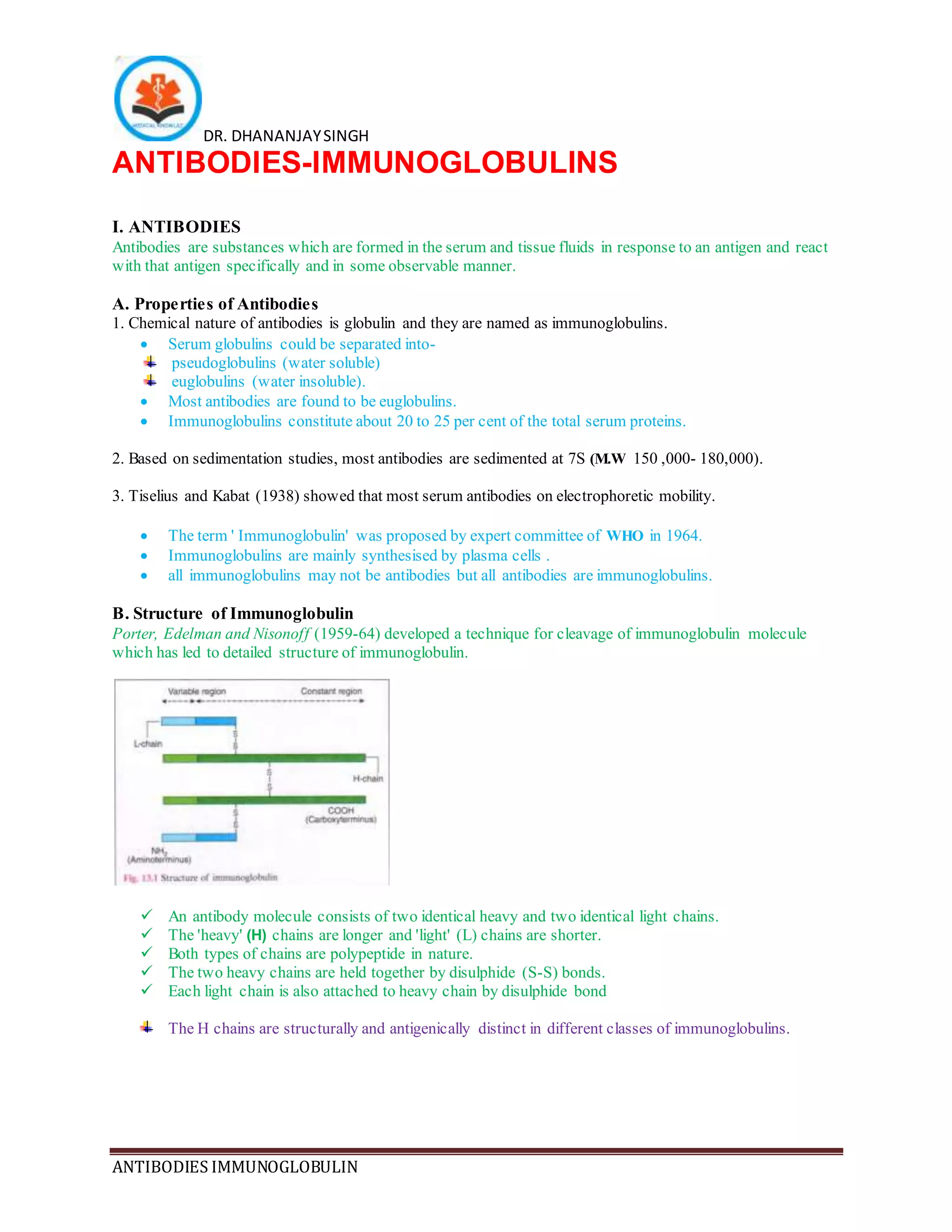
 An antibody molecule consists of two identical heavy and two identical light chains.
 The 'heavy' (H) chains are longer and 'light' (L) chains are shorter.
 Both types of chains are polypeptide in nature.
 The two heavy chains are held together by disulphide (S-S) bonds.
 Each light chain is also attached to heavy chain by disulphide bond
The H chains are structurally and antigenically distinct in different classes of immunoglobulins.
DR. DHANANJAYSINGH
ANTIBODIES IMMUNOGLOBULIN
The L chains are similar in all classes of immunoglobulins.
The light chains are named kappa and lambda after the investigators Komgold and Lapari.
Kappa and Lambda chains are present in a ratio of 2: 1 in human sera.
1. Effect of Enzymes
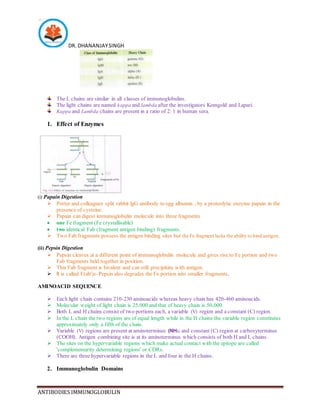
(i) Papain Digestion
 Porter and colleagues split rabbit lgG antibody to egg albumin , by a proteolytic enzyme papain in the
presence of cysteine.
 Papain can digest immunoglobulin molecule into three fragments
 one Fe fragment (Fe crystallisable)
 two identical Fab (fragment antigen binding) fragments.
 Two Fab fragments possess the antigen binding sites but the Fe fragment lacks the ability to bind antigen.
(ii) Pepsin Digestion
 Pepsin cleaves at a different point of immunoglobulin molecule and gives rise to Fe portion and two
Fab fragments held together in position.
 This Fab fragment is bivalent and can still precipitate with antigen.
 It is called F(ab')2 • Pepsin also degrades the Fe portion into smaller fragments.
AMINOACID SEQUENCE
 Each light chain contains 210-230 aminoacids whereas heavy chain has 420-460 aminoacids.
 Molecular weight of light chain is 25,000 and that of heavy chain is 50,000.
 Both L and H chains consist of two portions each, a variable (V) region and a constant (C) region.
 In the L chain the two regions are of equal length while in the H chains the variable region constitutes
approximately only a fifth of the chain.
 Variable (V) regions are present at aminoterminus (NH2) and constant (C) region at carboxyterminus
(COOH). Antigen combining site is at its aminoterminus which consists of both H and L chains.
 The sites on the hypervariable regions which make actual contact with the epitope are called
'complementarity determining regions' or CDRs.
 There are three hypervariable regions in the L and four in the H chains.
2. Immunoglobulin Domains
DR. DHANANJAYSINGH
ANTIBODIES IMMUNOGLOBULIN
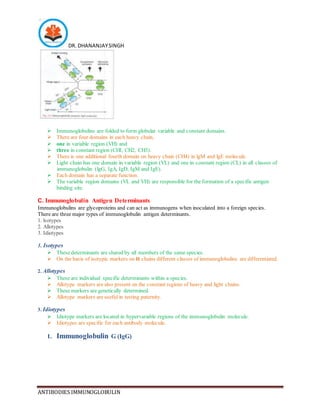
 Immunoglobulins are folded to form globular variable and constant domains.
 There are four domains in each heavy chain,
 one in variable region (VH) and
 three in constant region (CHI, CH2, CH3).
 There is one additional fourth domain on heavy chain (CH4) in lgM and lgE molecule.
 Light chain has one domain in variable region (VL) and one in constant region (CL) in all classes of
immunoglobulin (lgG, IgA, IgD, IgM and IgE).
 Each domain has a separate function.
 The variable region domains (VL and VH) are responsible for the formation of a specific antigen
binding site.
C. Immunoglobulin Antigen Determinants
Immunoglobulins are glycoproteins and can act as immunogens when inoculated into a foreign species.
There are three major types of immunoglobulin antigen determinants.
1. lsotypes
2. Allotypes
3. Idiotypes
1. Isotypes
 These determinants are shared by all members of the same species.
 On the basis of isotypic markers on H chains different classes of immunoglobulins are differentiated.
2. Allotypes
 These are individual specific determinants within a species.
 Allotype markers are also present on the constant regions of heavy and light chains.
 These markers are genetically determined.
 Allotype markers are useful in testing paternity.
3. Idiotypes
 Idiotype markers are located in hypervariable regions of the immunoglobulin molecule.
 Idiotypes are specific for each antibody molecule.
1. Immunoglobulin G (IgG)
DR. DHANANJAYSINGH
ANTIBODIES IMMUNOGLOBULIN
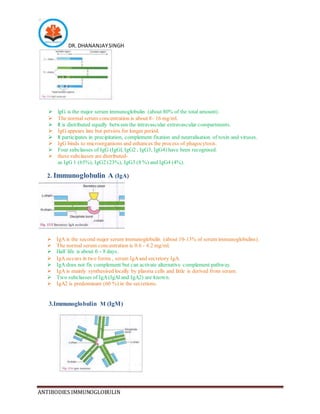
 lgG is the major serum immunoglobulin (about 80% of the total amount).
 The normal serum concentration is about 8- 16 mg/ml.
 It is distributed equally between the intravascular extravascular compartments.
 IgG appears late but persists for longer period.
 It participates in precipitation, complement fixation and neutralisation of toxin and viruses.
 IgG binds to microorganisms and enhances the process of phagocytosis.
 Four subclasses of IgG (IgGl, IgG2 , IgG3, IgG4) have been recognised.
 these subclasses are distributed-
as IgG 1 (65%), IgG2 (23%), IgG3 (8 %) and IgG4 (4%).
2. Immunoglobulin A (IgA)
 IgA is the second major serum immunoglobulin (about 10-13% of serum immunoglobulins).
 The normal serum concentration is 0.6 - 4.2 mg/ml.
 Half life is about 6 - 8 days.
 IgA occurs in two forms , serum IgAand secretory IgA.
 IgA does not fix complement but can activate alternative complement pathway.
 IgA is mainly synthesised locally by plasma cells and little is derived from serum.
 Two subclasses of IgA(IgAl and IgA2) are known.
 IgA2 is predominant (60 %) in the secretions.
3.Immunoglobulin M (IgM)
DR. DHANANJAYSINGH
ANTIBODIES IMMUNOGLOBULIN
 IgM is a pentamer consisting of 5 immunoglobulin subunits and one molecule of J chain, which joins
the Fe region of the basic subunits.
 Each H chain of IgM has four CH domains rather than three as seen in H chain of IgG molecule.
 It constitutes about 5- 8 percent of total serum immunoglobulins.
 The normal level in serum is 0.5- 2 mg/ml.
 Half life is about five days.
 IgM is mainly distributed intravascularly (80 %).
 It is the earliest synthesised immunoglobulin by foetus in about 20 weeks of age
 Two subclasses (IgMl and IgM2) of IgM are described.
 These are differentiated by characteristic H chains i.e. μ1 and μ2 H chains.
4. Immunoglobulin D (IgD)
 IgD resembles IgG structurally.
 IgD is present in a concentration of 3 mg per 100 ml in serum. It is mostly intravascular in
distribution.
 Molecular weight is 1,80,000 (7 S monomer) .
 Half life is about three days.
 Two subclasses (IgDl and IgD2) of IgD are known.
5. Immunoglobulin E (IgE)
 IgE is mainly produced in the linings of respiratory and intestinal tracts.
 Molecular weight is 1,90,000 (8S molecule).
 Half life is 2-3 days.It resembles IgG in structure.
 It is heat labile (inactivated at 56°C in one hour) whereas other immunoglobulins are heat stable.
 IgE mediates type I hypersensitivity (atopic) reaction.
 This is responsible for asthma, hay fever, eczema and Prausnitz-Kustner (PK) reaction.
 It cannot cross the placental barrier or fix the complement.
 IgE is responsible for anaphylactic type of reaction.
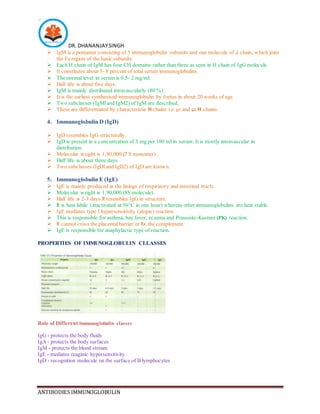
PROPERTIES OF IMMUNOGLOBULIN CLLASSES
Role of Different lmmunoglobulin classes
IgG - protects the body fluids
IgA - protects the body surfaces
IgM - protects the blood stream
IgE - mediates reaginic hypersensitivity
IgD - recognition molecule on the surface of B lymphocytes
DR. DHANANJAYSINGH
ANTIBODIES IMMUNOGLOBULIN
II. ABNORMAL IMMUNOGLOBULINS
 Apart from antibodies, other structurally similar proteins may be found in serum in following pathological
conditions
A. Multiple myeloma
B. Heavy chain disease
C. Cryoglobulinaemia
A. Multiple Myeloma
 It is a plasma cell dyscrasia in which unchecked proliferation of one clone of plasma cells occur, resulting
in the excessive production of the particular immunoglobulin synthesized by the clone.
 Myeloma involving IgM producing plasma cells is named as Waldenstrom's macroglobulinaemia.
B. Heavy Chain Disease
 Abnormal heavy chains are produced in excess.
 This is due to lymphoid neoplasia.
C. Cryoglobulinaemia
It is a condition in which there is a formation of precipitate on cooling the serum, the precipitate redissolves on
warming.
This is due to presence of cryoglobulins in blood.
Cryoglobulinaemia is often found in macroglobulinaemia, systemic lupus erythematosus (SLE) and myelomas.
THANK YOU
DR. DHANANJAY SINGH

Antibodies immunoglobulin

  • 1.
    DR. DHANANJAYSINGH ANTIBODIES IMMUNOGLOBULIN ANTIBODIES-IMMUNOGLOBULINS I.ANTIBODIES Antibodies are substances which are formed in the serum and tissue fluids in response to an antigen and react with that antigen specifically and in some observable manner. A. Properties of Antibodies 1. Chemical nature of antibodies is globulin and they are named as immunoglobulins.  Serum globulins could be separated into- pseudoglobulins (water soluble) euglobulins (water insoluble).  Most antibodies are found to be euglobulins.  Immunoglobulins constitute about 20 to 25 per cent of the total serum proteins. 2. Based on sedimentation studies, most antibodies are sedimented at 7S (M.W 150 ,000- 180,000). 3. Tiselius and Kabat (1938) showed that most serum antibodies on electrophoretic mobility.  The term ' Immunoglobulin' was proposed by expert committee of WHO in 1964.  Immunoglobulins are mainly synthesised by plasma cells .  all immunoglobulins may not be antibodies but all antibodies are immunoglobulins. B. Structure of Immunoglobulin Porter, Edelman and Nisonoff (1959-64) developed a technique for cleavage of immunoglobulin molecule which has led to detailed structure of immunoglobulin.  An antibody molecule consists of two identical heavy and two identical light chains.  The 'heavy' (H) chains are longer and 'light' (L) chains are shorter.  Both types of chains are polypeptide in nature.  The two heavy chains are held together by disulphide (S-S) bonds.  Each light chain is also attached to heavy chain by disulphide bond The H chains are structurally and antigenically distinct in different classes of immunoglobulins.
  • 2.
    DR. DHANANJAYSINGH ANTIBODIES IMMUNOGLOBULIN TheL chains are similar in all classes of immunoglobulins. The light chains are named kappa and lambda after the investigators Komgold and Lapari. Kappa and Lambda chains are present in a ratio of 2: 1 in human sera. 1. Effect of Enzymes (i) Papain Digestion  Porter and colleagues split rabbit lgG antibody to egg albumin , by a proteolytic enzyme papain in the presence of cysteine.  Papain can digest immunoglobulin molecule into three fragments  one Fe fragment (Fe crystallisable)  two identical Fab (fragment antigen binding) fragments.  Two Fab fragments possess the antigen binding sites but the Fe fragment lacks the ability to bind antigen. (ii) Pepsin Digestion  Pepsin cleaves at a different point of immunoglobulin molecule and gives rise to Fe portion and two Fab fragments held together in position.  This Fab fragment is bivalent and can still precipitate with antigen.  It is called F(ab')2 • Pepsin also degrades the Fe portion into smaller fragments. AMINOACID SEQUENCE  Each light chain contains 210-230 aminoacids whereas heavy chain has 420-460 aminoacids.  Molecular weight of light chain is 25,000 and that of heavy chain is 50,000.  Both L and H chains consist of two portions each, a variable (V) region and a constant (C) region.  In the L chain the two regions are of equal length while in the H chains the variable region constitutes approximately only a fifth of the chain.  Variable (V) regions are present at aminoterminus (NH2) and constant (C) region at carboxyterminus (COOH). Antigen combining site is at its aminoterminus which consists of both H and L chains.  The sites on the hypervariable regions which make actual contact with the epitope are called 'complementarity determining regions' or CDRs.  There are three hypervariable regions in the L and four in the H chains. 2. Immunoglobulin Domains
  • 3.
    DR. DHANANJAYSINGH ANTIBODIES IMMUNOGLOBULIN Immunoglobulins are folded to form globular variable and constant domains.  There are four domains in each heavy chain,  one in variable region (VH) and  three in constant region (CHI, CH2, CH3).  There is one additional fourth domain on heavy chain (CH4) in lgM and lgE molecule.  Light chain has one domain in variable region (VL) and one in constant region (CL) in all classes of immunoglobulin (lgG, IgA, IgD, IgM and IgE).  Each domain has a separate function.  The variable region domains (VL and VH) are responsible for the formation of a specific antigen binding site. C. Immunoglobulin Antigen Determinants Immunoglobulins are glycoproteins and can act as immunogens when inoculated into a foreign species. There are three major types of immunoglobulin antigen determinants. 1. lsotypes 2. Allotypes 3. Idiotypes 1. Isotypes  These determinants are shared by all members of the same species.  On the basis of isotypic markers on H chains different classes of immunoglobulins are differentiated. 2. Allotypes  These are individual specific determinants within a species.  Allotype markers are also present on the constant regions of heavy and light chains.  These markers are genetically determined.  Allotype markers are useful in testing paternity. 3. Idiotypes  Idiotype markers are located in hypervariable regions of the immunoglobulin molecule.  Idiotypes are specific for each antibody molecule. 1. Immunoglobulin G (IgG)
  • 4.
    DR. DHANANJAYSINGH ANTIBODIES IMMUNOGLOBULIN lgG is the major serum immunoglobulin (about 80% of the total amount).  The normal serum concentration is about 8- 16 mg/ml.  It is distributed equally between the intravascular extravascular compartments.  IgG appears late but persists for longer period.  It participates in precipitation, complement fixation and neutralisation of toxin and viruses.  IgG binds to microorganisms and enhances the process of phagocytosis.  Four subclasses of IgG (IgGl, IgG2 , IgG3, IgG4) have been recognised.  these subclasses are distributed- as IgG 1 (65%), IgG2 (23%), IgG3 (8 %) and IgG4 (4%). 2. Immunoglobulin A (IgA)  IgA is the second major serum immunoglobulin (about 10-13% of serum immunoglobulins).  The normal serum concentration is 0.6 - 4.2 mg/ml.  Half life is about 6 - 8 days.  IgA occurs in two forms , serum IgAand secretory IgA.  IgA does not fix complement but can activate alternative complement pathway.  IgA is mainly synthesised locally by plasma cells and little is derived from serum.  Two subclasses of IgA(IgAl and IgA2) are known.  IgA2 is predominant (60 %) in the secretions. 3.Immunoglobulin M (IgM)
  • 5.
    DR. DHANANJAYSINGH ANTIBODIES IMMUNOGLOBULIN IgM is a pentamer consisting of 5 immunoglobulin subunits and one molecule of J chain, which joins the Fe region of the basic subunits.  Each H chain of IgM has four CH domains rather than three as seen in H chain of IgG molecule.  It constitutes about 5- 8 percent of total serum immunoglobulins.  The normal level in serum is 0.5- 2 mg/ml.  Half life is about five days.  IgM is mainly distributed intravascularly (80 %).  It is the earliest synthesised immunoglobulin by foetus in about 20 weeks of age  Two subclasses (IgMl and IgM2) of IgM are described.  These are differentiated by characteristic H chains i.e. μ1 and μ2 H chains. 4. Immunoglobulin D (IgD)  IgD resembles IgG structurally.  IgD is present in a concentration of 3 mg per 100 ml in serum. It is mostly intravascular in distribution.  Molecular weight is 1,80,000 (7 S monomer) .  Half life is about three days.  Two subclasses (IgDl and IgD2) of IgD are known. 5. Immunoglobulin E (IgE)  IgE is mainly produced in the linings of respiratory and intestinal tracts.  Molecular weight is 1,90,000 (8S molecule).  Half life is 2-3 days.It resembles IgG in structure.  It is heat labile (inactivated at 56°C in one hour) whereas other immunoglobulins are heat stable.  IgE mediates type I hypersensitivity (atopic) reaction.  This is responsible for asthma, hay fever, eczema and Prausnitz-Kustner (PK) reaction.  It cannot cross the placental barrier or fix the complement.  IgE is responsible for anaphylactic type of reaction. PROPERTIES OF IMMUNOGLOBULIN CLLASSES Role of Different lmmunoglobulin classes IgG - protects the body fluids IgA - protects the body surfaces IgM - protects the blood stream IgE - mediates reaginic hypersensitivity IgD - recognition molecule on the surface of B lymphocytes
  • 6.
    DR. DHANANJAYSINGH ANTIBODIES IMMUNOGLOBULIN II.ABNORMAL IMMUNOGLOBULINS  Apart from antibodies, other structurally similar proteins may be found in serum in following pathological conditions A. Multiple myeloma B. Heavy chain disease C. Cryoglobulinaemia A. Multiple Myeloma  It is a plasma cell dyscrasia in which unchecked proliferation of one clone of plasma cells occur, resulting in the excessive production of the particular immunoglobulin synthesized by the clone.  Myeloma involving IgM producing plasma cells is named as Waldenstrom's macroglobulinaemia. B. Heavy Chain Disease  Abnormal heavy chains are produced in excess.  This is due to lymphoid neoplasia. C. Cryoglobulinaemia It is a condition in which there is a formation of precipitate on cooling the serum, the precipitate redissolves on warming. This is due to presence of cryoglobulins in blood. Cryoglobulinaemia is often found in macroglobulinaemia, systemic lupus erythematosus (SLE) and myelomas. THANK YOU DR. DHANANJAY SINGH