
Annotated Bibliographies History 12 Senior Seminar, Ryan Staude, December 9, 2011
Why Annotated Bibliographies? What does it mean to annotate?  Why is Ryan asking you to create an annotated bibliography?  What should a source annotation include?
Annotation Defined Annotate : (v.) to add notes to (a text or diagram) giving explanation or comment. -- Source:  The Oxford American Dictionary
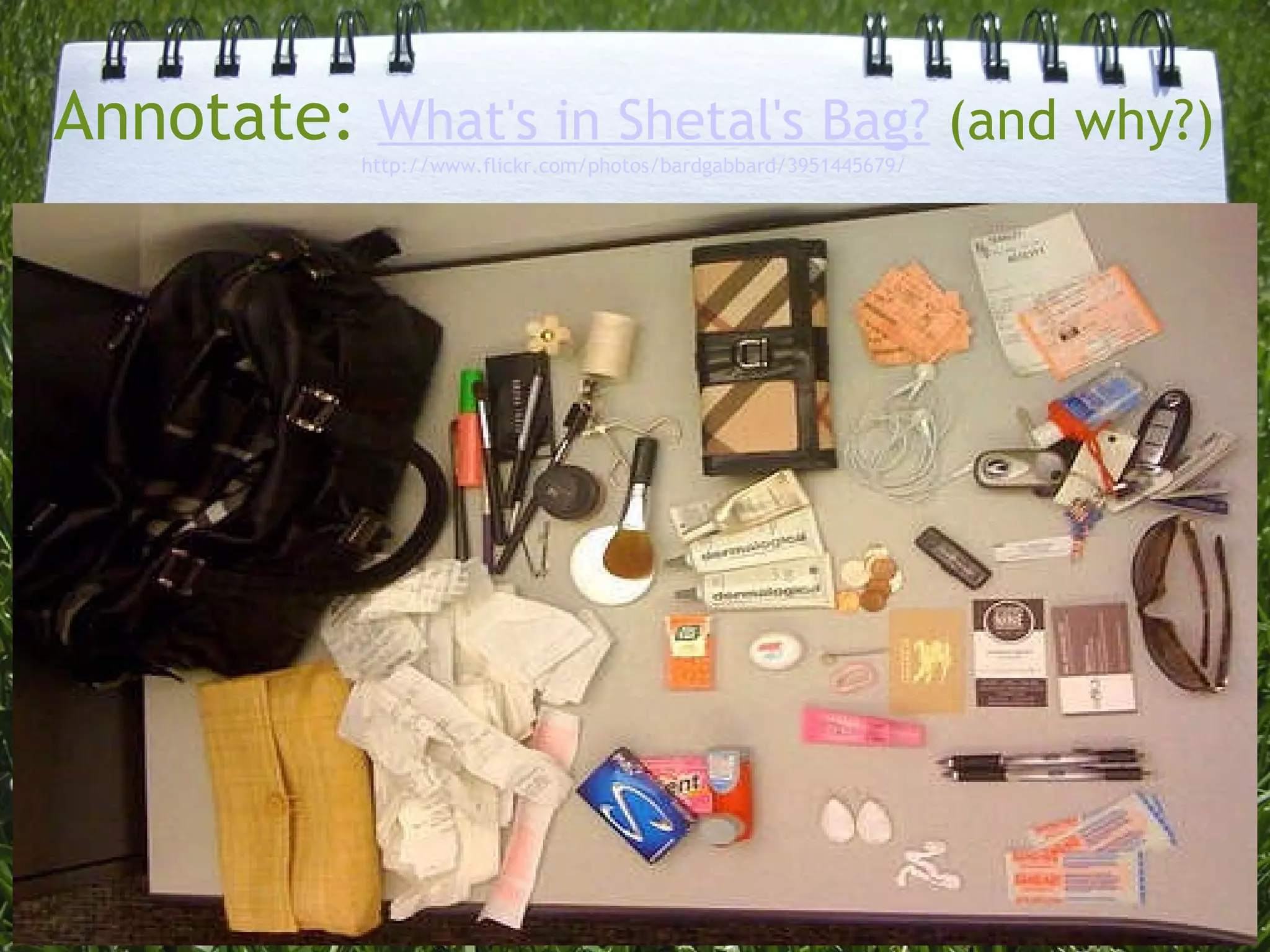
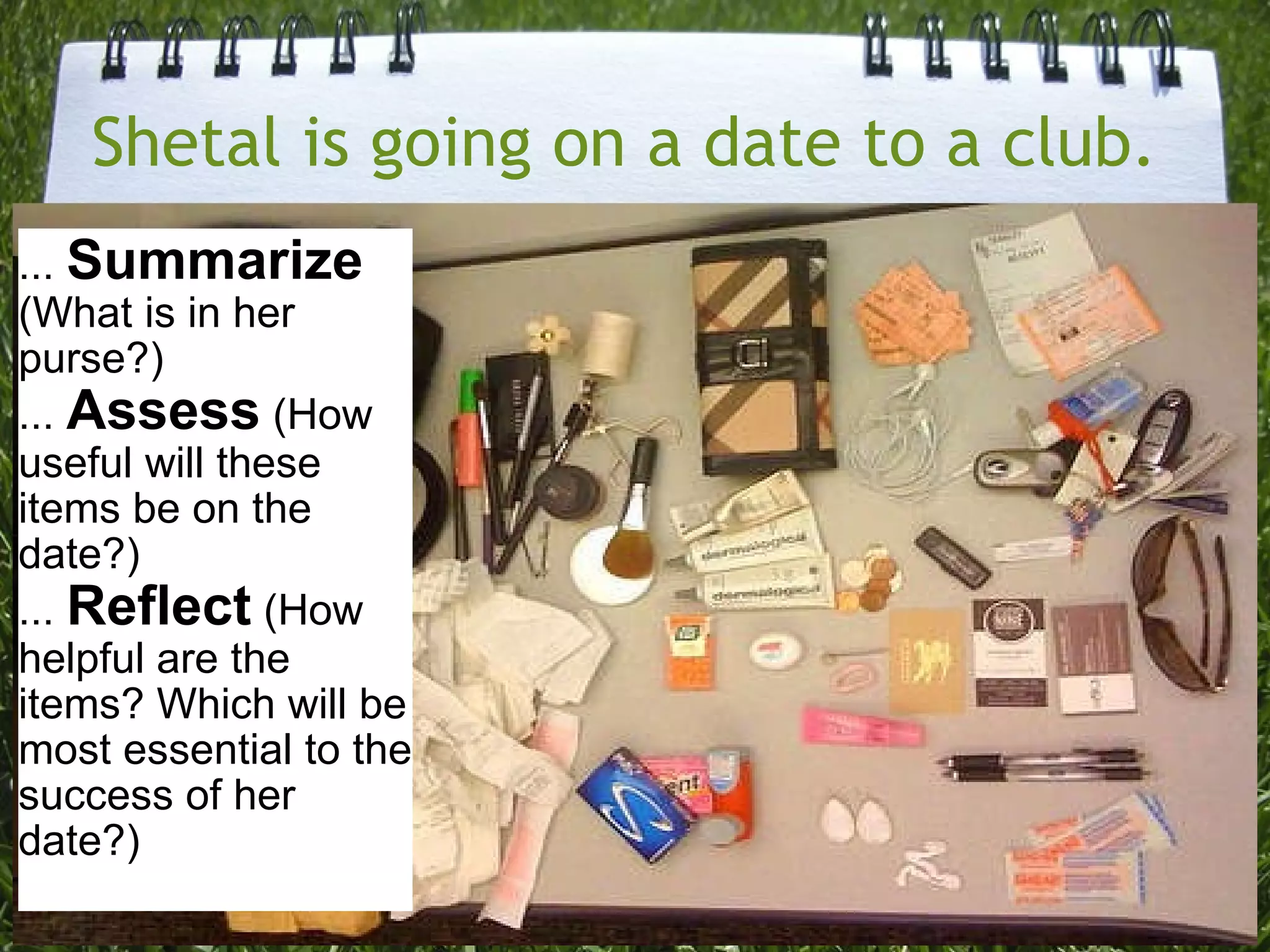
Annotate:  What's in Shetal's Bag?  (and why?) http://www.flickr.com/photos/bardgabbard/3951445679 /
Annotated Bibliography Overview:  a list of sources with a short explanation of the source and how it will be useful to you. Length of annotation:  About 150 words Purpose:  Inform the reader of the relevance, accuracy and quality of the sources -- source: Olin and Uris Libraries, "How to Prepare an Annotated Bibliography, http://olinuris.library.cornell.edu/ref/research/skill28.htm
Potential Elements of an Annotation Once sentence  description  of source and, if applicable, author’s thesis. Brief description of who  author  is and his/her credentials as an authority on the subject. Brief description of the  evidence  the author uses to support his/her theses. A brief description of the  value  of the book for your project Adapted from  A Pocket Guide to Writing in History , 5th ed., buy Mary Lynn Rampolla, (New York: Bedford/St. Martin’s), 2007.
Annotations Should... ...  Summarize  (topics, main arguments) ...  Assess  (usefulness, authority) ...  Reflect  (How helpful is this source for you? How will you use it to shape your argument?)
...  Summarize  (What is in her purse?) ...  Assess  (How useful will these items be on the date?) ...  Reflect  (How helpful are the items? Which will be most essential to the success of her date?) Shetal is going on a date to a club.
Why Bother? Creating an annotated bibliography...      ... forces you to examine your sources critically.      ... will allow you to begin thinking of how to structure your argument
Effective Note Taking
How Do You Take Notes? What are your strategies for “pre-reading” a text before taking notes on it? What does it mean to read a source actively (vs. passively)?
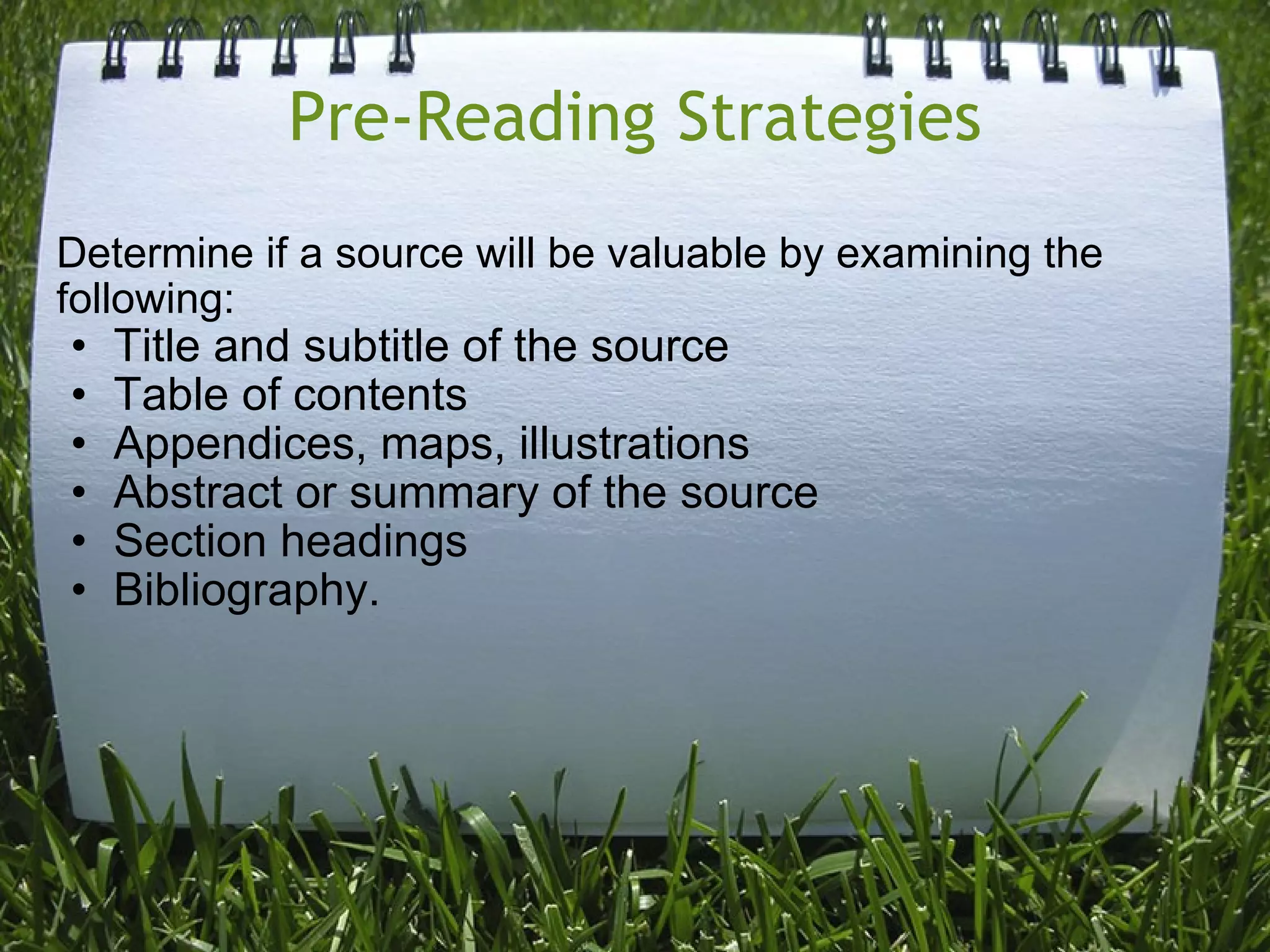
Pre-Reading Strategies Determine if a source will be valuable by examining the following: Title and subtitle of the source Table of contents Appendices, maps, illustrations Abstract or summary of the source Section headings Bibliography.
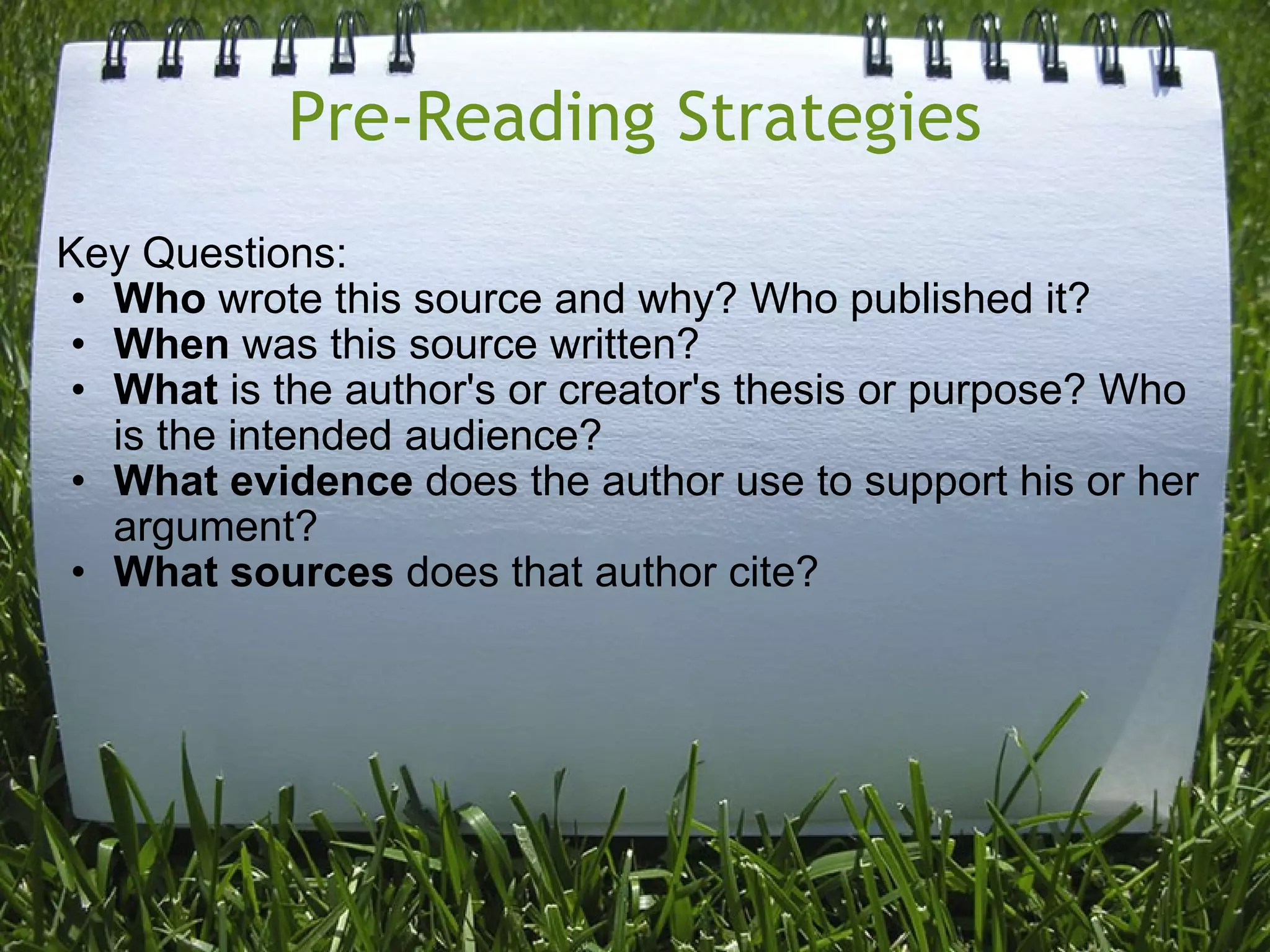
Pre-Reading Strategies Key Questions: Who  wrote this source and why? Who published it? When  was this source written? What  is the author's or creator's thesis or purpose? Who is the intended audience? What evidence  does the author use to support his or her argument? What sources  does that author cite?
Pre-Reading Strategies Final Considerations: How trustworthy  is this source? How relevant  is this source to your topic?
Reading Actively Consider the  author's thesis  as you read and understand the facts presented. Read the  introduction  and  conclusion  first. Collect facts -->  Organize and interpret  information. Ask questions:  What is the author's point? Do you agree? Why or why not?
Have a Conversation with the Source Write as you read:   Summarize  main points of a source. Be selective and concise! Look up unfamiliar words  and write definitions in your notes or on photocopies of your sources. Respond in the margins:  ask questions, disagree, and make connections to other texts. Tag/add keywords  to your notes to help you organize them later. Write reflections  and reactions to what you read. Review what you have written  regularly. 
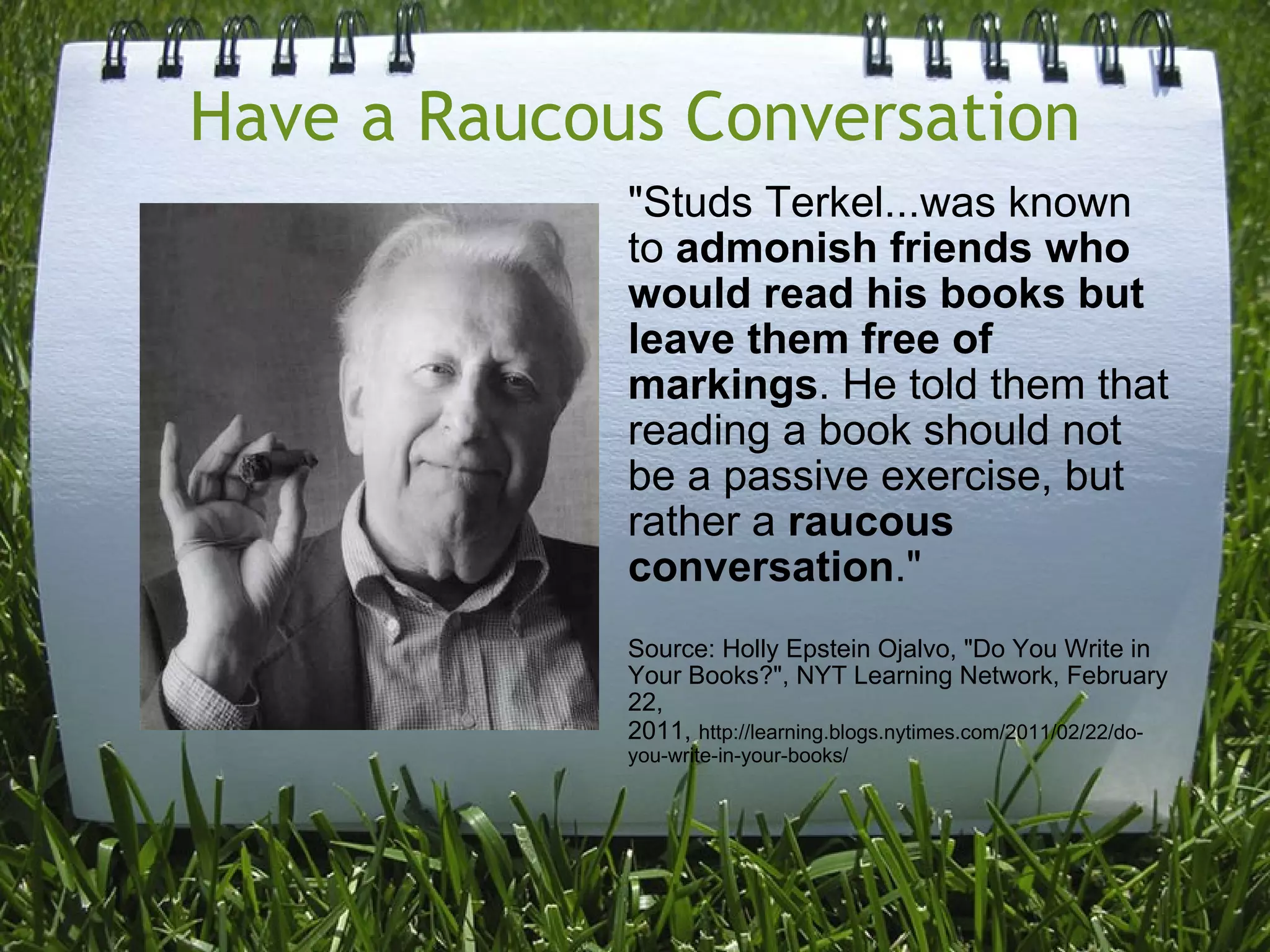
Have a Raucous Conversation "Studs Terkel...was known to  admonish friends who would read his books but leave them free of markings . He told them that reading a book should not be a passive exercise, but rather a  raucous conversation ." Source: Holly Epstein Ojalvo, "Do You Write in Your Books?", NYT Learning Network, February 22, 2011,   http://learning.blogs.nytimes.com/2011/02/22/do-you-write-in-your-books/
Questions? Thoughts?

Annotated Bibliographies and Notetaking

  • 1.
    Annotated Bibliographies History12 Senior Seminar, Ryan Staude, December 9, 2011
  • 2.
    Why Annotated Bibliographies?What does it mean to annotate? Why is Ryan asking you to create an annotated bibliography? What should a source annotation include?
  • 3.
    Annotation Defined Annotate: (v.) to add notes to (a text or diagram) giving explanation or comment. -- Source: The Oxford American Dictionary
  • 4.
    Annotate:  What's inShetal's Bag?  (and why?) http://www.flickr.com/photos/bardgabbard/3951445679 /
  • 5.
    Annotated Bibliography Overview: a list of sources with a short explanation of the source and how it will be useful to you. Length of annotation: About 150 words Purpose: Inform the reader of the relevance, accuracy and quality of the sources -- source: Olin and Uris Libraries, "How to Prepare an Annotated Bibliography, http://olinuris.library.cornell.edu/ref/research/skill28.htm
  • 6.
    Potential Elements ofan Annotation Once sentence description of source and, if applicable, author’s thesis. Brief description of who author is and his/her credentials as an authority on the subject. Brief description of the evidence the author uses to support his/her theses. A brief description of the value of the book for your project Adapted from A Pocket Guide to Writing in History , 5th ed., buy Mary Lynn Rampolla, (New York: Bedford/St. Martin’s), 2007.
  • 7.
    Annotations Should... ... Summarize (topics, main arguments) ... Assess (usefulness, authority) ... Reflect (How helpful is this source for you? How will you use it to shape your argument?)
  • 8.
    ... Summarize (What is in her purse?) ... Assess (How useful will these items be on the date?) ... Reflect (How helpful are the items? Which will be most essential to the success of her date?) Shetal is going on a date to a club.
  • 9.
    Why Bother? Creatingan annotated bibliography...     ... forces you to examine your sources critically.     ... will allow you to begin thinking of how to structure your argument
  • 10.
  • 11.
    How Do YouTake Notes? What are your strategies for “pre-reading” a text before taking notes on it? What does it mean to read a source actively (vs. passively)?
  • 12.
    Pre-Reading Strategies Determineif a source will be valuable by examining the following: Title and subtitle of the source Table of contents Appendices, maps, illustrations Abstract or summary of the source Section headings Bibliography.
  • 13.
    Pre-Reading Strategies KeyQuestions: Who wrote this source and why? Who published it? When was this source written? What is the author's or creator's thesis or purpose? Who is the intended audience? What evidence does the author use to support his or her argument? What sources does that author cite?
  • 14.
    Pre-Reading Strategies FinalConsiderations: How trustworthy is this source? How relevant is this source to your topic?
  • 15.
    Reading Actively Considerthe author's thesis as you read and understand the facts presented. Read the introduction and conclusion first. Collect facts -->  Organize and interpret information. Ask questions: What is the author's point? Do you agree? Why or why not?
  • 16.
    Have a Conversationwith the Source Write as you read:   Summarize main points of a source. Be selective and concise! Look up unfamiliar words and write definitions in your notes or on photocopies of your sources. Respond in the margins: ask questions, disagree, and make connections to other texts. Tag/add keywords to your notes to help you organize them later. Write reflections and reactions to what you read. Review what you have written regularly. 
  • 17.
    Have a RaucousConversation "Studs Terkel...was known to admonish friends who would read his books but leave them free of markings . He told them that reading a book should not be a passive exercise, but rather a raucous conversation ." Source: Holly Epstein Ojalvo, "Do You Write in Your Books?", NYT Learning Network, February 22, 2011,   http://learning.blogs.nytimes.com/2011/02/22/do-you-write-in-your-books/
  • 18.