Accountability and
Measuring Success
IS 430 (UCLA)
Sarah Clark
Monday, November 25, 2013
Overview of Today
1. Measuring Success and Communicating
Benefits (60 min)
2. Group-led discussion of readings (30 min)
3. Field Trip and Guest Speaker:
Julia Glassman, UCLA College Library (70-90
min)
Next Week
● Bring the following:
○ Your library’s mission + Your community profile
and needs assessment
○ Your collection policy
○ Your website/flyer/artifact to connect your users to
your resources
Final Project
● Due: Friday,
December 13th
(sorry!)
● Submit via email:
sarahclark@ucla.edu

● You can pick it up
from the GSEIS
office after break.
Credit: Clear Guitar
Measuring
Success...

Flickr CC @martapiqs

… and demonstrating your success to your
stakeholders and community.
Evaluation and Measuring Success
● How do you determine
what “success” means in
terms of a library
collection?
● What are ways to
measure success of our
collections?
● What are the benefits
and drawbacks to those
methods?

Flickr CC @SalFalko
The Logic Model
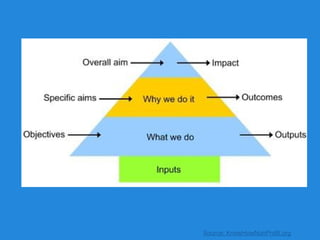
Source: KnowHowNonProfit.org
Outcomes
Outcome = the impact your collections and
services have on your user community.
Ask yourself: What is the big purpose? What
impact do I want my collections to have on my
user community? How will I measure that
impact?
Outputs
Outputs = Activities and what

is
produced through activities.
Libraries tend to be good at measuring
outputs: #of participants, #circulations, etc.
Source: QuantumLeap.com
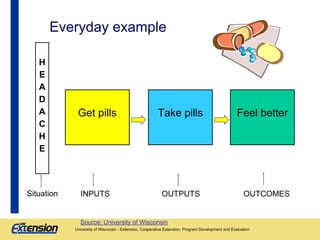
Everyday example
H
E
A
D
A
C
H
E

Situation

Get pills

Take pills

INPUTS

OUTPUTS

Source: University of Wisconsin

Feel better

OUTCOMES

University of Wisconsin - Extension, Cooperative Extension, Program Development and Evaluation
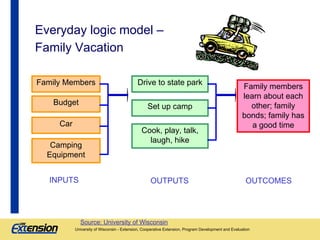
Everyday logic model –
Family Vacation
Family Members
Budget

Set up camp

Car
Camping
Equipment
INPUTS

Drive to state park

Cook, play, talk,
laugh, hike

OUTPUTS

Source: University of Wisconsin

Family members
learn about each
other; family
bonds; family has
a good time

OUTCOMES

University of Wisconsin - Extension, Cooperative Extension, Program Development and Evaluation
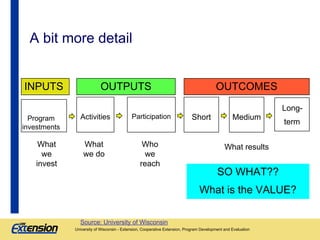
A bit more detail

INPUTS

OUTPUTS

OUTCOMES
Long-

Program
investments

What
we
invest

Activities

Participation

What
we do

Who
we
reach

Short

Medium

term

What results

SO WHAT??
What is the VALUE?

Source: University of Wisconsin

University of Wisconsin - Extension, Cooperative Extension, Program Development and Evaluation
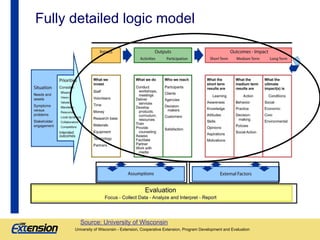
Fully detailed logic model

Source: University of Wisconsin

University of Wisconsin - Extension, Cooperative Extension, Program Development and Evaluation
Source: University of Wisconsin

University of Wisconsin - Extension, Cooperative Extension, Program Development and Evaluation
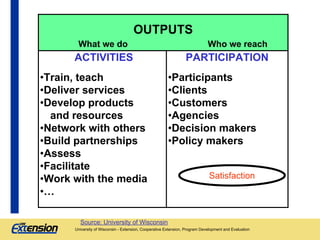
OUTPUTS
What we do

ACTIVITIES
•Train, teach
•Deliver services
•Develop products
and resources
•Network with others
•Build partnerships
•Assess
•Facilitate
•Work with the media
•…
Source: University of Wisconsin

Who we reach

PARTICIPATION
•Participants
•Clients
•Customers
•Agencies
•Decision makers
•Policy makers
Satisfaction

University of Wisconsin - Extension, Cooperative Extension, Program Development and Evaluation
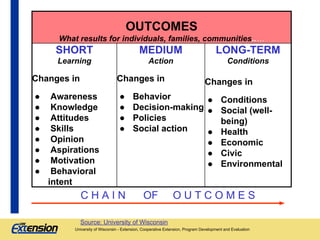
OUTCOMES
What results for individuals, families, communities..…

SHORT

MEDIUM

LONG-TERM

Learning

Action

Conditions

Changes in

Changes in

●
●
●
●
●
●
●
●

●
●
●
●

Awareness
Knowledge
Attitudes
Skills
Opinion
Aspirations
Motivation
Behavioral
intent

CHAIN

Changes in

Behavior
● Conditions
Decision-making ● Social (wellPolicies
being)
Social action
● Health
● Economic
● Civic
● Environmental

OF

Source: University of Wisconsin

OUTCOMES

University of Wisconsin - Extension, Cooperative Extension, Program Development and Evaluation
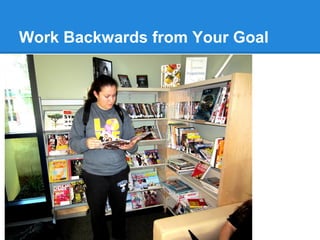
Work Backwards from Your Goal
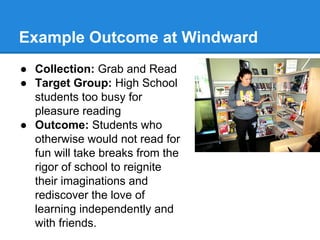
Example Outcome at Windward
● Collection: Grab and Read
● Target Group: High School
students too busy for
pleasure reading
● Outcome: Students who
otherwise would not read for
fun will take breaks from the
rigor of school to reignite
their imaginations and
rediscover the love of
learning independently and
with friends.
What Are Your Outcomes?
● Identify a target community.
● Create a specific outcome connected to
your collection.
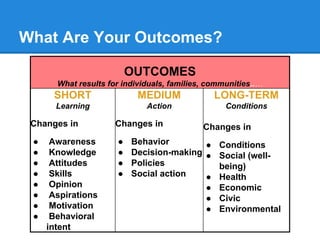
What Are Your Outcomes?
OUTCOMES
What results for individuals, families, communities..…

SHORT

MEDIUM

LONG-TERM

Learning

Action

Conditions

Changes in

Changes in

●
●
●
●
●
●
●
●

●
●
●
●

Awareness
Knowledge
Attitudes
Skills
Opinion
Aspirations
Motivation
Behavioral
intent

Changes in

Behavior
● Conditions
Decision-making ● Social (wellPolicies
being)
Social action
● Health
● Economic
● Civic
● Environmental
Demonstrating
Success
communicating your successes with your
community and with stakeholders
Flickr CC @Enokson
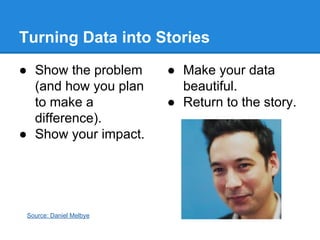
Turning Data into Stories
● Show the problem
(and how you plan
to make a
difference).
● Show your impact.

Source: Daniel Melbye

● Make your data
beautiful.
● Return to the story.
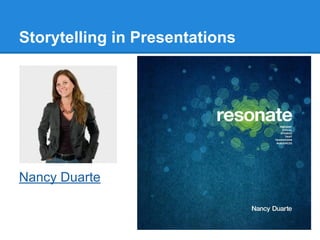
Storytelling in Presentations

Nancy Duarte
Elevator Speech

Flickr CC @daryl_mitchell
So, what is it that
you are doing here?

Flickr CC @daryl_mitchell
Elevator Speech should ...
● … be simple and memorable.
● … be ready at any time for a chance
encounter.
● … show what your collection contributes to
the community and why it matters.
● … create curiosity.

Flickr CC @daryl_mitchell
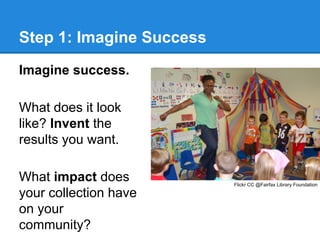
Step 1: Imagine Success
Imagine success.
What does it look
like? Invent the
results you want.
What impact does
your collection have
on your
community?

Flickr CC @Fairfax Library Foundation
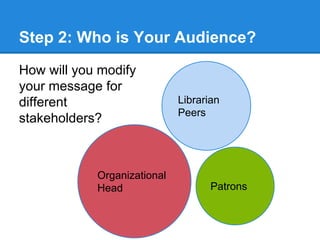
Step 2: Who is Your Audience?
How will you modify
your message for
different
stakeholders?

Organizational
Head

Librarian
Peers

Patrons
Speed Elevator Speeches -- Round 1
1. Find a partner.
2. One person gives his/her elevator speech as
if the partner is a key stakeholder. (30 sec)
3. Partners switch roles. (30 sec)
4. Rotate to a new partner.
5. Repeat.
Speed Elevator Speeches -- Round 2
1. Find a partner.
2. One person gives his/her elevator speech as
if the partner is a library patron curious
about the collection and its purpose. (30 sec)
3. Partners switch roles. (30 sec)
4. Rotate to a new partner.
5. Repeat.
Parting Words
● Begin with your
purpose. Know
what outcomes
you want.
● Consider how
you will
measure your
success from
the beginning.

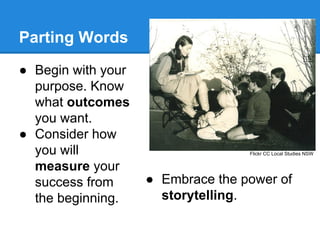
Flickr CC Local Studies NSW

● Embrace the power of
storytelling.

Class 8 - accountability and measuring success

  • 1.
    Accountability and Measuring Success IS430 (UCLA) Sarah Clark Monday, November 25, 2013
  • 2.
    Overview of Today 1.Measuring Success and Communicating Benefits (60 min) 2. Group-led discussion of readings (30 min) 3. Field Trip and Guest Speaker: Julia Glassman, UCLA College Library (70-90 min)
  • 3.
    Next Week ● Bringthe following: ○ Your library’s mission + Your community profile and needs assessment ○ Your collection policy ○ Your website/flyer/artifact to connect your users to your resources
  • 4.
    Final Project ● Due:Friday, December 13th (sorry!) ● Submit via email: sarahclark@ucla.edu ● You can pick it up from the GSEIS office after break. Credit: Clear Guitar
  • 5.
    Measuring Success... Flickr CC @martapiqs …and demonstrating your success to your stakeholders and community.
  • 6.
    Evaluation and MeasuringSuccess ● How do you determine what “success” means in terms of a library collection? ● What are ways to measure success of our collections? ● What are the benefits and drawbacks to those methods? Flickr CC @SalFalko
  • 7.
  • 8.
  • 9.
    Outcomes Outcome = theimpact your collections and services have on your user community. Ask yourself: What is the big purpose? What impact do I want my collections to have on my user community? How will I measure that impact?
  • 10.
    Outputs Outputs = Activitiesand what is produced through activities. Libraries tend to be good at measuring outputs: #of participants, #circulations, etc.
  • 11.
  • 12.
    Everyday example H E A D A C H E Situation Get pills Takepills INPUTS OUTPUTS Source: University of Wisconsin Feel better OUTCOMES University of Wisconsin - Extension, Cooperative Extension, Program Development and Evaluation University of Wisconsin - Extension, Cooperative Extension, Program Development and Evaluation
  • 13.
    Everyday logic model– Family Vacation Family Members Budget Set up camp Car Camping Equipment INPUTS Drive to state park Cook, play, talk, laugh, hike OUTPUTS Source: University of Wisconsin Family members learn about each other; family bonds; family has a good time OUTCOMES University of Wisconsin - Extension, Cooperative Extension, Program Development and Evaluation University of Wisconsin - Extension, Cooperative Extension, Program Development and Evaluation
  • 14.
    A bit moredetail INPUTS OUTPUTS OUTCOMES Long- Program investments What we invest Activities Participation What we do Who we reach Short Medium term What results SO WHAT?? What is the VALUE? Source: University of Wisconsin University of Wisconsin - Extension, Cooperative Extension, Program Development and Evaluation University of Wisconsin - Extension, Cooperative Extension, Program Development and Evaluation
  • 15.
    Fully detailed logicmodel Source: University of Wisconsin University of Wisconsin - Extension, Cooperative Extension, Program Development and Evaluation University of Wisconsin - Extension, Cooperative Extension, Program Development and Evaluation
  • 16.
    Source: University ofWisconsin University of Wisconsin - Extension, Cooperative Extension, Program Development and Evaluation University of Wisconsin - Extension, Cooperative Extension, Program Development and Evaluation
  • 17.
    OUTPUTS What we do ACTIVITIES •Train,teach •Deliver services •Develop products and resources •Network with others •Build partnerships •Assess •Facilitate •Work with the media •… Source: University of Wisconsin Who we reach PARTICIPATION •Participants •Clients •Customers •Agencies •Decision makers •Policy makers Satisfaction University of Wisconsin - Extension, Cooperative Extension, Program Development and Evaluation University of Wisconsin - Extension, Cooperative Extension, Program Development and Evaluation
  • 18.
    OUTCOMES What results forindividuals, families, communities..… SHORT MEDIUM LONG-TERM Learning Action Conditions Changes in Changes in ● ● ● ● ● ● ● ● ● ● ● ● Awareness Knowledge Attitudes Skills Opinion Aspirations Motivation Behavioral intent CHAIN Changes in Behavior ● Conditions Decision-making ● Social (wellPolicies being) Social action ● Health ● Economic ● Civic ● Environmental OF Source: University of Wisconsin OUTCOMES University of Wisconsin - Extension, Cooperative Extension, Program Development and Evaluation University of Wisconsin - Extension, Cooperative Extension, Program Development and Evaluation
  • 19.
  • 20.
    Example Outcome atWindward ● Collection: Grab and Read ● Target Group: High School students too busy for pleasure reading ● Outcome: Students who otherwise would not read for fun will take breaks from the rigor of school to reignite their imaginations and rediscover the love of learning independently and with friends.
  • 21.
    What Are YourOutcomes? ● Identify a target community. ● Create a specific outcome connected to your collection.
  • 22.
    What Are YourOutcomes? OUTCOMES What results for individuals, families, communities..… SHORT MEDIUM LONG-TERM Learning Action Conditions Changes in Changes in ● ● ● ● ● ● ● ● ● ● ● ● Awareness Knowledge Attitudes Skills Opinion Aspirations Motivation Behavioral intent Changes in Behavior ● Conditions Decision-making ● Social (wellPolicies being) Social action ● Health ● Economic ● Civic ● Environmental
  • 23.
    Demonstrating Success communicating your successeswith your community and with stakeholders
  • 24.
  • 25.
    Turning Data intoStories ● Show the problem (and how you plan to make a difference). ● Show your impact. Source: Daniel Melbye ● Make your data beautiful. ● Return to the story.
  • 26.
  • 27.
  • 28.
    So, what isit that you are doing here? Flickr CC @daryl_mitchell
  • 29.
    Elevator Speech should... ● … be simple and memorable. ● … be ready at any time for a chance encounter. ● … show what your collection contributes to the community and why it matters. ● … create curiosity. Flickr CC @daryl_mitchell
  • 30.
    Step 1: ImagineSuccess Imagine success. What does it look like? Invent the results you want. What impact does your collection have on your community? Flickr CC @Fairfax Library Foundation
  • 31.
    Step 2: Whois Your Audience? How will you modify your message for different stakeholders? Organizational Head Librarian Peers Patrons
  • 32.
    Speed Elevator Speeches-- Round 1 1. Find a partner. 2. One person gives his/her elevator speech as if the partner is a key stakeholder. (30 sec) 3. Partners switch roles. (30 sec) 4. Rotate to a new partner. 5. Repeat.
  • 33.
    Speed Elevator Speeches-- Round 2 1. Find a partner. 2. One person gives his/her elevator speech as if the partner is a library patron curious about the collection and its purpose. (30 sec) 3. Partners switch roles. (30 sec) 4. Rotate to a new partner. 5. Repeat.
  • 34.
    Parting Words ● Beginwith your purpose. Know what outcomes you want. ● Consider how you will measure your success from the beginning. Flickr CC Local Studies NSW ● Embrace the power of storytelling.