IFY Social Sciences – Semester 2 Week 2
Workshop II: Annotating and grouping
information
Effective from September 2015 | Name of PPT or Course here
Today’s lecture: Context
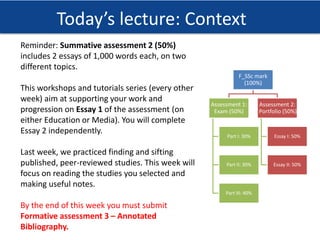
Reminder: Summative assessment 2 (50%)
includes 2 essays of 1,000 words each, on two
different topics.
This workshops and tutorials series (every other
week) aim at supporting your work and
progression on Essay 1 of the assessment (on
either Education or Media). You will complete
Essay 2 independently.
Last week, we practiced finding and sifting
published, peer-reviewed studies. This week will
focus on reading the studies you selected and
making useful notes.
By the end of this week you must submit
Formative assessment 3 – Annotated
Bibliography.
F_SSc mark
(100%)
Assessment 1:
Exam (50%)
Part I: 30%
Part II: 30%
Part III: 40%
Assessment 2:
Portfolio (50%)
Essay I: 50%
Essay II: 50%
Effective from September 2015 | Name of PPT or Course here
Today’s lecture: Objectives
What is this lecture aiming to achieve?
• Familiarity with different types of comments;
• An increase confidence and ability to make and
organise comments on academic texts;
• Support your development and timely progression
on Essay 1 (assessed in Formative Assessment 3)
Effective from September 2015 | Name of PPT or Course here
Today’s lecture: Content
Structure: What we will cover
• Annotating texts while reading them
• Annotating texts after reading them
• Annotated bibliography: What is it, why write it and how
• Formative Assessment 3: Annotated Bibliography
Effective from September 2015 | Name of PPT or Course here
Making notes when reading
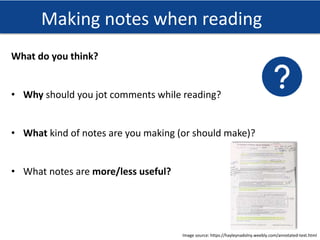
What do you think?
• Why should you jot comments while reading?
• What kind of notes are you making (or should make)?
• What notes are more/less useful?
Image source: https://hayleynadolny.weebly.com/annotated-text.html
Effective from September 2015 | Name of PPT or Course here
Making notes when reading
Why annotate?
Short term:
• Highlighting, underlining, jotting and drawing on a text can help
you prepare for more organised notes later.
• Your notes can be seen as time travellers, time capsules,
or ‘reverse archaeology’: They will help future-you
find what they need later, without having to read the
whole text all over again. You are now leaving
breadcrumbs for your future-self to find.
Long term:
• Deep engagement with a text is one of the best ways to improve
reading, comprehension and writing!
• Develops your ability to interpret academic text.
• Active reading also develops your critical thinking.
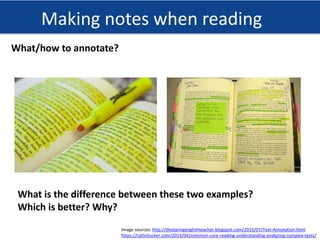
What/how to annotate?
Making notes when reading
What is the difference between these two examples?
Which is better? Why?
Image sources: http://thedaringenglishteacher.blogspot.com/2015/07/Text-Annotation.html
https://catlintucker.com/2013/04/common-core-reading-understanding-analyzing-complex-texts/
Effective from September 2015 | Name of PPT or Course here
Making notes when reading
What/how to annotate?
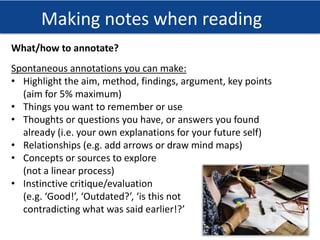
Spontaneous annotations you can make:
• Highlight the aim, method, findings, argument, key points
(aim for 5% maximum)
• Things you want to remember or use
• Thoughts or questions you have, or answers you found
already (i.e. your own explanations for your future self)
• Relationships (e.g. add arrows or draw mind maps)
• Concepts or sources to explore
(not a linear process)
• Instinctive critique/evaluation
(e.g. ‘Good!’, ‘Outdated?’, ‘is this not
contradicting what was said earlier!?’
What else can you include?
• Definitions and new
vocabulary
• Summaries
• Translate ideas into
your own words
• Make connections
with other books,
classes, life
experiences…
• Ask questions
• Comment on ideas
• Develop your own
shorthand codes. For
example:
? = Unclear/disagree
! = Important
🗸 = Agree
[ ] = Quotable
# = Facts
_ = Vocabulary
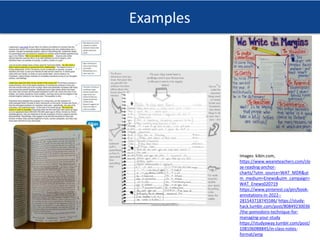
Examples
Images: kibin.com,
https://www.weareteachers.com/clo
se-reading-anchor-
charts/?utm_source=WAT_MDR&ut
m_medium=Enews&utm_campaign=
WAT_Enews020719
https://www.pinterest.ca/pin/book-
annotations-in-2022--
281543718745586/ https://study-
hack.tumblr.com/post/80849230036
/the-pomodoro-technique-for-
managing-your-study
https://studyaway.tumblr.com/post/
108106088845/in-class-notes-
format/amp
Do’s and Don’t’s
Use your own words, in ways
that are short and clear for
yourself.
Add your own thoughts, ideas
and questions
Draw mind maps
Identify and explain main
concepts (even if online)
Go back to other texts, or
search for new ones
Do not copy sections or quote
Highlight large sections
Use theoretical essays
(concepts and discussions, but
no empirical research),
methodological (incl. new
tool/index for
measuring/modelling),
reviews/critiques/syntheses of
prior research, brief essays or
commentary
After reading
sheffield.ac.uk/international-college
12
• When you finished, spend a few minutes concluding the text, and
organising your notes, so that you have overall clarity and won’t
need to ‘decipher; your own notes later – before you forget what
they meant.
• You can include:
• What was the study about?
• How was it conducted & what did it find?
• What was particularly new/interesting?
• What might be useful here?
• Your own insights, ideas, comments or questions
• Things to look up or explore more
We suggest you aim for 50-150 words per item.
Annotated bibliography
sheffield.ac.uk/international-college
13
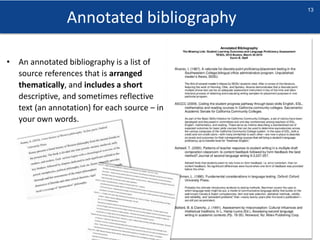
• An annotated bibliography is a list of
source references that is arranged
thematically, and includes a short
descriptive, and sometimes reflective
text (an annotation) for each source – in
your own words.
Annotated bibliography
sheffield.ac.uk/international-college
14
Why write an annotated bibliography?
• To show that you can identify and evaluate the literature
underpinning a research problem;
• To develop skills in discerning the most relevant research studies
from those which have only superficial relevance to your topic;
• To be thoroughly engaged with individual sources in order to
strengthen your analytical skills;
• To practice paraphrasing (not re-phrasing!) and finding your own
ideas and articulations;
• To organise your thoughts and lay the foundations for your work.
Annotated bibliography
sheffield.ac.uk/international-college
15
How to write it
For each source, put the full APA reference,
followed by 50-150 words, typically
formatted as a single paragraph.
Notes can be:
• Descriptive = Summarising key information arguments,
methods and findings;
• Evaluative = assessing how good the arguments and
methods are;
• Reflective (considering the relevance of the sources to
your project);
or a combination of them.
Formative Assessment this weekend
sheffield.ac.uk/international-college
16
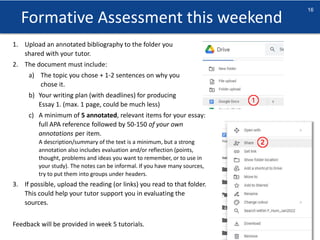
1. Upload an annotated bibliography to the folder you
shared with your tutor.
2. The document must include:
a) The topic you chose + 1-2 sentences on why you
chose it.
b) Your writing plan (with deadlines) for producing
Essay 1. (max. 1 page, could be much less)
c) A minimum of 5 annotated, relevant items for your essay:
full APA reference followed by 50-150 of your own
annotations per item.
A description/summary of the text is a minimum, but a strong
annotation also includes evaluation and/or reflection (points,
thought, problems and ideas you want to remember, or to use in
your study). The notes can be informal. If you have many sources,
try to put them into groups under headers.
3. If possible, upload the reading (or links) you read to that folder.
This could help your tutor support you in evaluating the
sources.
Feedback will be provided in week 5 tutorials.
References
sheffield.ac.uk/international-college
17
Caulfield, J. (2022, August 23). What Is
an Annotated Bibliography? | Examples
& Format. Scribbr. Retrieved January
24, 2023, from
USC research libraries (2023), Research
guides. Organizing Your Social Sciences
Research Assignments. University of
South Carolina.

L4 Workshop II - Annotating and grouping info.pptx

  • 1.
    IFY Social Sciences– Semester 2 Week 2 Workshop II: Annotating and grouping information
  • 2.
    Effective from September2015 | Name of PPT or Course here Today’s lecture: Context Reminder: Summative assessment 2 (50%) includes 2 essays of 1,000 words each, on two different topics. This workshops and tutorials series (every other week) aim at supporting your work and progression on Essay 1 of the assessment (on either Education or Media). You will complete Essay 2 independently. Last week, we practiced finding and sifting published, peer-reviewed studies. This week will focus on reading the studies you selected and making useful notes. By the end of this week you must submit Formative assessment 3 – Annotated Bibliography. F_SSc mark (100%) Assessment 1: Exam (50%) Part I: 30% Part II: 30% Part III: 40% Assessment 2: Portfolio (50%) Essay I: 50% Essay II: 50%
  • 3.
    Effective from September2015 | Name of PPT or Course here Today’s lecture: Objectives What is this lecture aiming to achieve? • Familiarity with different types of comments; • An increase confidence and ability to make and organise comments on academic texts; • Support your development and timely progression on Essay 1 (assessed in Formative Assessment 3)
  • 4.
    Effective from September2015 | Name of PPT or Course here Today’s lecture: Content Structure: What we will cover • Annotating texts while reading them • Annotating texts after reading them • Annotated bibliography: What is it, why write it and how • Formative Assessment 3: Annotated Bibliography
  • 5.
    Effective from September2015 | Name of PPT or Course here Making notes when reading What do you think? • Why should you jot comments while reading? • What kind of notes are you making (or should make)? • What notes are more/less useful? Image source: https://hayleynadolny.weebly.com/annotated-text.html
  • 6.
    Effective from September2015 | Name of PPT or Course here Making notes when reading Why annotate? Short term: • Highlighting, underlining, jotting and drawing on a text can help you prepare for more organised notes later. • Your notes can be seen as time travellers, time capsules, or ‘reverse archaeology’: They will help future-you find what they need later, without having to read the whole text all over again. You are now leaving breadcrumbs for your future-self to find. Long term: • Deep engagement with a text is one of the best ways to improve reading, comprehension and writing! • Develops your ability to interpret academic text. • Active reading also develops your critical thinking.
  • 7.
    What/how to annotate? Makingnotes when reading What is the difference between these two examples? Which is better? Why? Image sources: http://thedaringenglishteacher.blogspot.com/2015/07/Text-Annotation.html https://catlintucker.com/2013/04/common-core-reading-understanding-analyzing-complex-texts/
  • 8.
    Effective from September2015 | Name of PPT or Course here Making notes when reading What/how to annotate? Spontaneous annotations you can make: • Highlight the aim, method, findings, argument, key points (aim for 5% maximum) • Things you want to remember or use • Thoughts or questions you have, or answers you found already (i.e. your own explanations for your future self) • Relationships (e.g. add arrows or draw mind maps) • Concepts or sources to explore (not a linear process) • Instinctive critique/evaluation (e.g. ‘Good!’, ‘Outdated?’, ‘is this not contradicting what was said earlier!?’
  • 9.
    What else canyou include? • Definitions and new vocabulary • Summaries • Translate ideas into your own words • Make connections with other books, classes, life experiences… • Ask questions • Comment on ideas • Develop your own shorthand codes. For example: ? = Unclear/disagree ! = Important 🗸 = Agree [ ] = Quotable # = Facts _ = Vocabulary
  • 10.
  • 11.
    Do’s and Don’t’s Useyour own words, in ways that are short and clear for yourself. Add your own thoughts, ideas and questions Draw mind maps Identify and explain main concepts (even if online) Go back to other texts, or search for new ones Do not copy sections or quote Highlight large sections Use theoretical essays (concepts and discussions, but no empirical research), methodological (incl. new tool/index for measuring/modelling), reviews/critiques/syntheses of prior research, brief essays or commentary
  • 12.
    After reading sheffield.ac.uk/international-college 12 • Whenyou finished, spend a few minutes concluding the text, and organising your notes, so that you have overall clarity and won’t need to ‘decipher; your own notes later – before you forget what they meant. • You can include: • What was the study about? • How was it conducted & what did it find? • What was particularly new/interesting? • What might be useful here? • Your own insights, ideas, comments or questions • Things to look up or explore more We suggest you aim for 50-150 words per item.
  • 13.
    Annotated bibliography sheffield.ac.uk/international-college 13 • Anannotated bibliography is a list of source references that is arranged thematically, and includes a short descriptive, and sometimes reflective text (an annotation) for each source – in your own words.
  • 14.
    Annotated bibliography sheffield.ac.uk/international-college 14 Why writean annotated bibliography? • To show that you can identify and evaluate the literature underpinning a research problem; • To develop skills in discerning the most relevant research studies from those which have only superficial relevance to your topic; • To be thoroughly engaged with individual sources in order to strengthen your analytical skills; • To practice paraphrasing (not re-phrasing!) and finding your own ideas and articulations; • To organise your thoughts and lay the foundations for your work.
  • 15.
    Annotated bibliography sheffield.ac.uk/international-college 15 How towrite it For each source, put the full APA reference, followed by 50-150 words, typically formatted as a single paragraph. Notes can be: • Descriptive = Summarising key information arguments, methods and findings; • Evaluative = assessing how good the arguments and methods are; • Reflective (considering the relevance of the sources to your project); or a combination of them.
  • 16.
    Formative Assessment thisweekend sheffield.ac.uk/international-college 16 1. Upload an annotated bibliography to the folder you shared with your tutor. 2. The document must include: a) The topic you chose + 1-2 sentences on why you chose it. b) Your writing plan (with deadlines) for producing Essay 1. (max. 1 page, could be much less) c) A minimum of 5 annotated, relevant items for your essay: full APA reference followed by 50-150 of your own annotations per item. A description/summary of the text is a minimum, but a strong annotation also includes evaluation and/or reflection (points, thought, problems and ideas you want to remember, or to use in your study). The notes can be informal. If you have many sources, try to put them into groups under headers. 3. If possible, upload the reading (or links) you read to that folder. This could help your tutor support you in evaluating the sources. Feedback will be provided in week 5 tutorials.
  • 17.
    References sheffield.ac.uk/international-college 17 Caulfield, J. (2022,August 23). What Is an Annotated Bibliography? | Examples & Format. Scribbr. Retrieved January 24, 2023, from USC research libraries (2023), Research guides. Organizing Your Social Sciences Research Assignments. University of South Carolina.