CITATION
REFRESHER
L I B R A R Y T E C H T A L K
M O N D A Y , N O V . 3 0 , 2 0 1 5
REMIND ME: WHAT IS A CITATION?
• “In the literary sense, any written or spoken reference to an
authority or precedent or to the verbatim words of another
speaker or writer. “
– Online Dictionary of Library and Information Science
• Citations let the reader of your paper know that you used
others’ idea(s) to support your research and/or conclusions.
BUT SERIOUSLY, WHY?
• Because you need to specify which ideas are not your own.
• Because you need to give credit to the original source.
• Because your readers may want to know more. A citation
gives them directions for how to find a source. Like an
address!
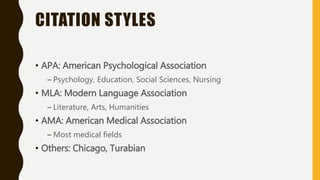
CITATION STYLES
• APA: American Psychological Association
– Psychology, Education, Social Sciences, Nursing
• MLA: Modern Language Association
– Literature, Arts, Humanities
• AMA: American Medical Association
– Most medical fields
• Others: Chicago, Turabian
TWO TYPES OF CITATION
• IN TEXT CITATION
– Giving credit in your paper, right when you use an idea
• BIBLIOGRAPHIC
– Listing all of the sources you used on one page
IN-TEXT CITATION:
T H E B A S I C S
QUOTING VS. PARAPHRASING
• QUOTING
– Using the author’s exact words
• PARAPHRASING
– Using the author’s idea, but putting it in your own words
– STILL NEEDS A CITATION
QUOTING VS. PARAPHRASING
This prospect scared industrial-scale meat producers into organizing a coordinated
pushback. Recognizing that, in the era of smartphones and social media, any worker could
easily shoot and distribute damning video, meat producers began pressing for legislation
that would outlaw this kind of whistleblowing.
Genoways, Ted. "Animals Suffer Needlessly for Food Production." Vegetarianism. Ed. Amy Francis. Farmington Hills, MI: Greenhaven Press, 2015. Current Controversies. Rpt. from
"Gagged by Big
Ag." Mother Jones (2013). Opposing Viewpoints in Context. Web. 30 Nov. 2015.
The author writes, “Recognizing that, in the era of smartphones and social media, any worker could easily shoot
and distribute damning video, meat producers began pressing for legislation that would outlaw this kind of
whistleblowing” (Genoways para. 7).
The author points out that due to the popularity of social media and smartphones, video evidence could be
captured easily by anyone, including workers in the meat industry. This posed a threat to meat producers, so they
fought to make it illegal for their workers to leak this type of evidence (Genoways para. 7).
QUOTE
PARAPHRASE
FORMATTING THE IN-TEXT CITATION
• Introduce the thought or idea you are using
– The author writes
– According to one study
– Smith states that
• Drop Quotes=using a quote or idea without introducing it
IN-TEXT CITATION: MLA
• In-text citation comes at the end of a quote or paraphrase
• Include author(s)’s last name and page number
END QUOTE OPEN PARENTHESIS CITATION CLOSE PARENTHESIS PERIOD
EXAMPLES:
According to the author, “Social media is harmful to teens” (Delnero 135).
According to the authors, “Video games cause dyslexia” (Delnero, Smith 197).
Delnero writes, “Social media is harmful to teens” (135).
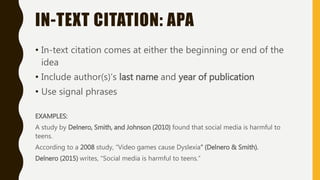
IN-TEXT CITATION: APA
• In-text citation comes at either the beginning or end of the
idea
• Include author(s)’s last name and year of publication
• Use signal phrases
EXAMPLES:
A study by Delnero, Smith, and Johnson (2010) found that social media is harmful to
teens.
According to a 2008 study, “Video games cause Dyslexia” (Delnero & Smith).
Delnero (2015) writes, “Social media is harmful to teens.”
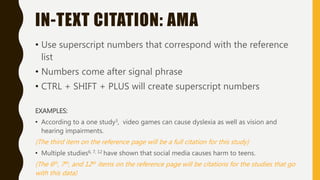
IN-TEXT CITATION: AMA
• Use superscript numbers that correspond with the reference
list
• Numbers come after signal phrase
• CTRL + SHIFT + PLUS will create superscript numbers
EXAMPLES:
• According to a one study3, video games can cause dyslexia as well as vision and
hearing impairments.
(The third item on the reference page will be a full citation for this study)
• Multiple studies6, 7, 12 have shown that social media causes harm to teens.
(The 6th, 7th, and 12th items on the reference page will be citations for the studies that go
with this data)
BIBLIOGRAPHIES:
T H E B A S I C S
GENERAL FORMATTING
• One inch margins
• 12 pt. font (Times New Roman)
• DOUBLE SPACED
MLA WORKS CITED
• MLA bibliography is called “Works Cited”
– This should be at the top of your page and centered
• Hanging indent
– All lines EXCEPT THE FIRST are indented
– Highlight all the citations you would like to format. Right click and choose Paragraph. Under
Indentation go to the drop-down box that says Special and choose Hanging. Done!
• You will always start with the author. For MLA, we list the authors LAST NAME and then
the FIRST NAME with a comma between
– Ex: Delnero, Chelsea
MLA CITATION: BASIC RULES
• All citations, no matter the format, require basically the same information
– You must include as much information as you can! Remember: a citation is an address!
• Start with the author. Last name, First name
• Books and Journal titles (Thing “BIG” titles) are italicized
• Article or chapter titles are in quotation marks
• Other required info: Publication date, Date accessed, Medium (Print, Web, etc.), Page
numbers
APA REFERENCES
• APA bibliography is called “References”
– This should be at the top of your page and centered
• Hanging indent
– All lines EXCEPT THE FIRST are indented
– Highlight all the citations you would like to format. Right click and choose Paragraph. Under
Indentation go to the drop-down box that says Special and choose Hanging. Done!
• You will always start with the author. For APA, we list the authors LAST NAME and then
the FIRST AND MIDDLE (if applicable) initials with periods between them.
– Ex: Delnero, C.A.
APA CITATION: THE BASICS
• For more than one author separate with commas. Use the AMPERSAND (&) for the last
author.
– Ex: Delnero, C.A., Smith, J.R., & Doe, R.R.
• Italicize the titles of books and journals. Do not italicize or use quotations for the title
of a chapter or article.
• Use the same punctuation as the titles for books and journals
• Other information required: Publication date, Date accessed, Page numbers
AMA REFERENCES
• AMA bibliography is called “References”
– This should be at the top of your page and centered
• References are listed by the order in which they appear in your paper
• You will always start with the author. For AMA, we list the authors LAST NAME and
then the FIRST AND MIDDLE (if applicable) initials WITHOUT commas or periods
between them. Separate each new author with a comma.
– Ex: Delnero CA
– Ex: Delnero CA, Smith JR, Doe RR.
AMA CITATION: THE BASICS
• Titles of journals are abbreviated according to the National Library of Medicine
– Ex: Journal of the American College of Surgeons will become J Am Coll Surg
• Article titles only have the first word capitalized and the first word after a colon.
– Ex: Distinguishing diabetes: Differentiate between type 1 & type 2 DM.
• Other information required: Year published, Page numbers
CITATION TOOLS
DATABASES BY SUBJECT CITATIONS
• EasyBib
• Tweet 2 Cite
• bibme

Citation refresher

  • 1.
    CITATION REFRESHER L I BR A R Y T E C H T A L K M O N D A Y , N O V . 3 0 , 2 0 1 5
  • 2.
    REMIND ME: WHATIS A CITATION? • “In the literary sense, any written or spoken reference to an authority or precedent or to the verbatim words of another speaker or writer. “ – Online Dictionary of Library and Information Science • Citations let the reader of your paper know that you used others’ idea(s) to support your research and/or conclusions.
  • 3.
    BUT SERIOUSLY, WHY? •Because you need to specify which ideas are not your own. • Because you need to give credit to the original source. • Because your readers may want to know more. A citation gives them directions for how to find a source. Like an address!
  • 4.
    CITATION STYLES • APA:American Psychological Association – Psychology, Education, Social Sciences, Nursing • MLA: Modern Language Association – Literature, Arts, Humanities • AMA: American Medical Association – Most medical fields • Others: Chicago, Turabian
  • 5.
    TWO TYPES OFCITATION • IN TEXT CITATION – Giving credit in your paper, right when you use an idea • BIBLIOGRAPHIC – Listing all of the sources you used on one page
  • 6.
    IN-TEXT CITATION: T HE B A S I C S
  • 7.
    QUOTING VS. PARAPHRASING •QUOTING – Using the author’s exact words • PARAPHRASING – Using the author’s idea, but putting it in your own words – STILL NEEDS A CITATION
  • 8.
    QUOTING VS. PARAPHRASING Thisprospect scared industrial-scale meat producers into organizing a coordinated pushback. Recognizing that, in the era of smartphones and social media, any worker could easily shoot and distribute damning video, meat producers began pressing for legislation that would outlaw this kind of whistleblowing. Genoways, Ted. "Animals Suffer Needlessly for Food Production." Vegetarianism. Ed. Amy Francis. Farmington Hills, MI: Greenhaven Press, 2015. Current Controversies. Rpt. from "Gagged by Big Ag." Mother Jones (2013). Opposing Viewpoints in Context. Web. 30 Nov. 2015. The author writes, “Recognizing that, in the era of smartphones and social media, any worker could easily shoot and distribute damning video, meat producers began pressing for legislation that would outlaw this kind of whistleblowing” (Genoways para. 7). The author points out that due to the popularity of social media and smartphones, video evidence could be captured easily by anyone, including workers in the meat industry. This posed a threat to meat producers, so they fought to make it illegal for their workers to leak this type of evidence (Genoways para. 7). QUOTE PARAPHRASE
  • 9.
    FORMATTING THE IN-TEXTCITATION • Introduce the thought or idea you are using – The author writes – According to one study – Smith states that • Drop Quotes=using a quote or idea without introducing it
  • 10.
    IN-TEXT CITATION: MLA •In-text citation comes at the end of a quote or paraphrase • Include author(s)’s last name and page number END QUOTE OPEN PARENTHESIS CITATION CLOSE PARENTHESIS PERIOD EXAMPLES: According to the author, “Social media is harmful to teens” (Delnero 135). According to the authors, “Video games cause dyslexia” (Delnero, Smith 197). Delnero writes, “Social media is harmful to teens” (135).
  • 11.
    IN-TEXT CITATION: APA •In-text citation comes at either the beginning or end of the idea • Include author(s)’s last name and year of publication • Use signal phrases EXAMPLES: A study by Delnero, Smith, and Johnson (2010) found that social media is harmful to teens. According to a 2008 study, “Video games cause Dyslexia” (Delnero & Smith). Delnero (2015) writes, “Social media is harmful to teens.”
  • 12.
    IN-TEXT CITATION: AMA •Use superscript numbers that correspond with the reference list • Numbers come after signal phrase • CTRL + SHIFT + PLUS will create superscript numbers EXAMPLES: • According to a one study3, video games can cause dyslexia as well as vision and hearing impairments. (The third item on the reference page will be a full citation for this study) • Multiple studies6, 7, 12 have shown that social media causes harm to teens. (The 6th, 7th, and 12th items on the reference page will be citations for the studies that go with this data)
  • 13.
  • 14.
    GENERAL FORMATTING • Oneinch margins • 12 pt. font (Times New Roman) • DOUBLE SPACED
  • 15.
    MLA WORKS CITED •MLA bibliography is called “Works Cited” – This should be at the top of your page and centered • Hanging indent – All lines EXCEPT THE FIRST are indented – Highlight all the citations you would like to format. Right click and choose Paragraph. Under Indentation go to the drop-down box that says Special and choose Hanging. Done! • You will always start with the author. For MLA, we list the authors LAST NAME and then the FIRST NAME with a comma between – Ex: Delnero, Chelsea
  • 16.
    MLA CITATION: BASICRULES • All citations, no matter the format, require basically the same information – You must include as much information as you can! Remember: a citation is an address! • Start with the author. Last name, First name • Books and Journal titles (Thing “BIG” titles) are italicized • Article or chapter titles are in quotation marks • Other required info: Publication date, Date accessed, Medium (Print, Web, etc.), Page numbers
  • 17.
    APA REFERENCES • APAbibliography is called “References” – This should be at the top of your page and centered • Hanging indent – All lines EXCEPT THE FIRST are indented – Highlight all the citations you would like to format. Right click and choose Paragraph. Under Indentation go to the drop-down box that says Special and choose Hanging. Done! • You will always start with the author. For APA, we list the authors LAST NAME and then the FIRST AND MIDDLE (if applicable) initials with periods between them. – Ex: Delnero, C.A.
  • 18.
    APA CITATION: THEBASICS • For more than one author separate with commas. Use the AMPERSAND (&) for the last author. – Ex: Delnero, C.A., Smith, J.R., & Doe, R.R. • Italicize the titles of books and journals. Do not italicize or use quotations for the title of a chapter or article. • Use the same punctuation as the titles for books and journals • Other information required: Publication date, Date accessed, Page numbers
  • 19.
    AMA REFERENCES • AMAbibliography is called “References” – This should be at the top of your page and centered • References are listed by the order in which they appear in your paper • You will always start with the author. For AMA, we list the authors LAST NAME and then the FIRST AND MIDDLE (if applicable) initials WITHOUT commas or periods between them. Separate each new author with a comma. – Ex: Delnero CA – Ex: Delnero CA, Smith JR, Doe RR.
  • 20.
    AMA CITATION: THEBASICS • Titles of journals are abbreviated according to the National Library of Medicine – Ex: Journal of the American College of Surgeons will become J Am Coll Surg • Article titles only have the first word capitalized and the first word after a colon. – Ex: Distinguishing diabetes: Differentiate between type 1 & type 2 DM. • Other information required: Year published, Page numbers
  • 21.
  • 22.
    DATABASES BY SUBJECTCITATIONS • EasyBib • Tweet 2 Cite • bibme