Doing Research on Language & Linguistics: An Introduction
Outline New to research on English Language materials? Here are the topics that will be covered: Interpreting references Research process Boolean operators & search statements Using databases Plagiarism & citation Library services
Interpreting References
Interpreting References First things first. Can you interpret your reading list or the references at the end of a book or journal article? Perhaps you can interpret a book reference. But what about references to other materials? Note: if  appears, check out the note at the bottom of the same page. see powerpoint notes
Interpreting References: Journal Article authors article title Herring, S. C., & Paolillo, J. C. (2006). Gender and genre variation in weblogs.  Journal of Sociolinguistics, 10 (4), 439-459. year journal title volume (issue) pages see powerpoint notes
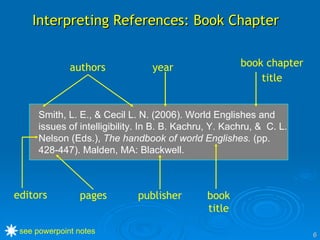
Interpreting References: Book Chapter  authors book chapter title Smith, L. E., & Cecil L. N. (2006). World Englishes and issues of intelligibility. In B. B. Kachru, Y. Kachru, &  C. L. Nelson (Eds.),  The handbook of world Englishes.  (pp. 428-447). Malden, MA: Blackwell. year publisher book title pages editors see powerpoint notes
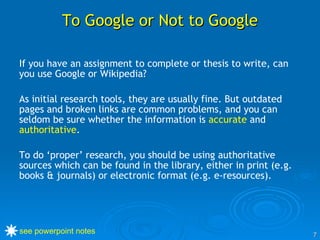
To Google or Not to Google If you have an assignment to complete or thesis to write, can you use Google or Wikipedia? As initial research tools, they are usually fine. But outdated pages and broken links are common problems, and you can seldom be sure whether the information is  accurate  and  authoritative . To do ‘proper’ research, you should be using authoritative sources which can be found in the library, either in print (e.g. books & journals) or electronic format (e.g. e-resources). see powerpoint notes
Research Process
The Research Process The typical research process looks like this: Your topic Break down your topic into concepts List keywords from concepts Construct search statement from your keywords Search for materials such as books & articles. Use LINC & databases. Check if they are relevant Locate the materials in the library Find more sources by using references in the sources you have located Do you have sufficient sources for your assignment? Complete your assignment START HERE YES NO see powerpoint notes
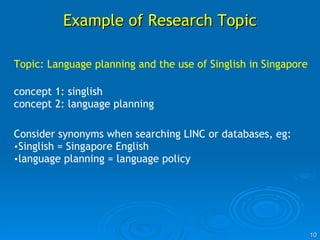
Example of Research Topic Topic: Language planning and the use of Singlish in Singapore concept 1: singlish concept 2: language planning  Consider synonyms when searching LINC or databases, eg: Singlish = Singapore English language planning = language policy
Boolean Operators &  Search Statements
Boolean Operators: AND, OR AND OR Singapore  AND  language planning Singlish  OR  Singapore English language planning  OR  language policy AND  narrows your search & is usually used for unrelated terms OR  broadens your search & is usually used for synonyms see powerpoint notes
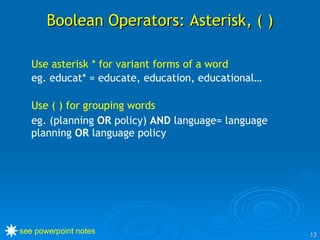
Boolean Operators: Asterisk, ( ) Use asterisk * for variant forms of a word eg. educat* = educate, education, educational… Use ( ) for grouping words  eg. (planning  OR  policy)  AND  language= language planning  OR  language policy see powerpoint notes
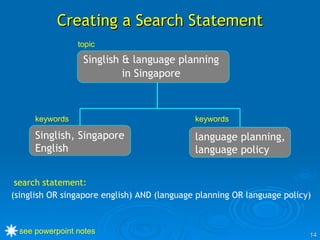
Creating a Search Statement Singlish & language planning in Singapore Singlish, Singapore English search statement: (singlish OR singapore english) AND (language planning OR language policy)  topic keywords keywords language planning, language policy see powerpoint notes
Using Databases
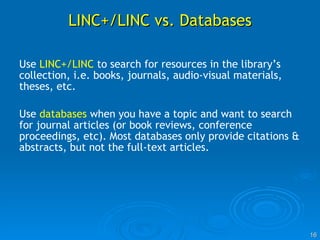
LINC+/LINC vs. Databases Use  LINC+/LINC  to search for resources in the library’s collection, i.e. books, journals, audio-visual materials, theses, etc. Use  databases  when you have a topic and want to search for journal articles (or book reviews, conference proceedings, etc). Most databases only provide citations & abstracts, but not the full-text articles.
Accessing Databases or, select from this list of major databases e.g. MLA click here to browse by title, subject, type and location
Databases for English Language Specialised databases CSA Linguistics & Language Behavior Abstracts (LLBA) MLA International Bibliography General databases Humanities Abstracts Arts & Humanities Citation Index (via Web of Science) Expanded Academic ASAP  Jstor (full-text articles but back issues only) Factiva (full-text newspaper articles from 1980s) PERIND (articles on Singapore, Malaysia, Brunei & ASEAN)
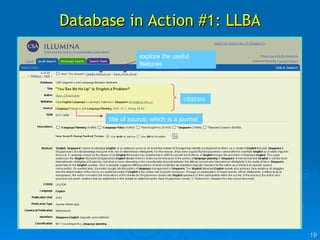
Database in Action #1: LLBA type llba in this box type your search statement here click on title of article or ‘View record’ for more information citation title of source, which is a journal explore the useful features
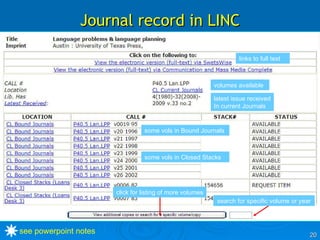
Journal record in LINC Now that you have a citation to an article which you are interested in, check LINC to find out whether NUS Libraries has the journal. see powerpoint notes some vols in Bound Journals some vols in Closed Stacks volumes available links to full text latest issue received In current Journals search for specific volume or year click for listing of more volumes
Database in Action #2: Factiva You may need to look for newspaper articles. You can use either  Factiva  or  LexisNexis Academic . When searching Factiva or LexisNexis Academic, remember to use keywords which are likely to be found in the newspaper of your choice. It is rare to find jargon such as ‘language planning’ and ‘sociolinguistics’ in the newspapers! For a guide on Factiva, check out http://www.brainshark.com/brainshark/vu/view.asp?pi=44319
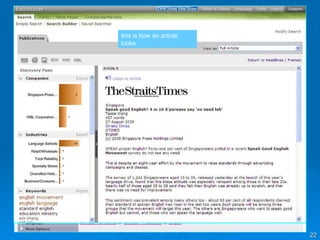
Database in Action #2: Factiva click on Factiva click on search builder 1. type your keywords here  2. select date or choose all dates 3. search for Straits Times and select the correct newspaper by clicking on it 4. click on run search click on title to view full article click within the boxes, then select an icon to view selected articles, email,  print or save this is how an article looks
Troubleshooting Your Search Results When searching databases, you may encounter: too many  results    use more keywords too few  results    add synonyms too many irrelevant  results    exclude keywords that are too general no results     use more general keywords, reduce number of keywords or redefine your research topic Quite often, you’ll need to refine your keywords through some trial and error.  If you need help, check with your professor or  ask a librarian !   
Plagiarism & Citation
Plagiarism Passing off someone else’s ideas as your own To avoid plagiarism: Jot down your sources Put all direct quotes in quotation marks, e.g. “ Both words and images can be evocative in their own ways and independent of each other” (Nikolajeva & Scott, 2006, p. 2) Acknowledge the source even when you paraphrase, e.g. Vietnam is one of the region’s fastest growing economies (Rogers, 2008) Create a reference section, e.g.  Nikolajeva, M., & Scott, C. (2006). How picturebooks work. New York: Routledge.
Citation Why cite? back-up your arguments  acknowledge intellectual debt show the research done help readers verify your claims
Citation Styles Style sheet for American Psychological Association (APA) http://owl.english.purdue.edu/owl/resource/560/01/ http://www.lib.berkeley.edu/instruct/guides/apastyle.pdf Style sheet for Linguistic Society of America (LSA) http://www.lsadc.org/info/pubs-lang-style.cfm Style sheet for Modern Language Association (MLA) http://owl.english.purdue.edu/owl/resource/557/01/ Using EndNote to import references http://libpweb1.nus.edu.sg/lion/e/endnoteGuide.html see powerpoint notes
Library Services
Materials Not Found in Library Request the library to  purchase new books : subject to relevance to NUS’ teaching & research needs and availability of funds Request for  Document Delivery Service  (DDS): honours and graduate students only For both services, go to the library portal at  www.lib.nus.edu.sg , click on login at the top left corner and click on e-forms.
Need Help? Phone: 6516-2028 Email: [email_address] -for queries on English Language  [email_address] -for general queries Walk in: Information desk @ Central Library Level 5

Doing Research on Language and Linguistics (2009)

  • 1.
    Doing Research onLanguage & Linguistics: An Introduction
  • 2.
    Outline New toresearch on English Language materials? Here are the topics that will be covered: Interpreting references Research process Boolean operators & search statements Using databases Plagiarism & citation Library services
  • 3.
  • 4.
    Interpreting References Firstthings first. Can you interpret your reading list or the references at the end of a book or journal article? Perhaps you can interpret a book reference. But what about references to other materials? Note: if appears, check out the note at the bottom of the same page. see powerpoint notes
  • 5.
    Interpreting References: JournalArticle authors article title Herring, S. C., & Paolillo, J. C. (2006). Gender and genre variation in weblogs. Journal of Sociolinguistics, 10 (4), 439-459. year journal title volume (issue) pages see powerpoint notes
  • 6.
    Interpreting References: BookChapter authors book chapter title Smith, L. E., & Cecil L. N. (2006). World Englishes and issues of intelligibility. In B. B. Kachru, Y. Kachru, & C. L. Nelson (Eds.), The handbook of world Englishes. (pp. 428-447). Malden, MA: Blackwell. year publisher book title pages editors see powerpoint notes
  • 7.
    To Google orNot to Google If you have an assignment to complete or thesis to write, can you use Google or Wikipedia? As initial research tools, they are usually fine. But outdated pages and broken links are common problems, and you can seldom be sure whether the information is accurate and authoritative . To do ‘proper’ research, you should be using authoritative sources which can be found in the library, either in print (e.g. books & journals) or electronic format (e.g. e-resources). see powerpoint notes
  • 8.
  • 9.
    The Research ProcessThe typical research process looks like this: Your topic Break down your topic into concepts List keywords from concepts Construct search statement from your keywords Search for materials such as books & articles. Use LINC & databases. Check if they are relevant Locate the materials in the library Find more sources by using references in the sources you have located Do you have sufficient sources for your assignment? Complete your assignment START HERE YES NO see powerpoint notes
  • 10.
    Example of ResearchTopic Topic: Language planning and the use of Singlish in Singapore concept 1: singlish concept 2: language planning Consider synonyms when searching LINC or databases, eg: Singlish = Singapore English language planning = language policy
  • 11.
    Boolean Operators & Search Statements
  • 12.
    Boolean Operators: AND,OR AND OR Singapore AND language planning Singlish OR Singapore English language planning OR language policy AND narrows your search & is usually used for unrelated terms OR broadens your search & is usually used for synonyms see powerpoint notes
  • 13.
    Boolean Operators: Asterisk,( ) Use asterisk * for variant forms of a word eg. educat* = educate, education, educational… Use ( ) for grouping words eg. (planning OR policy) AND language= language planning OR language policy see powerpoint notes
  • 14.
    Creating a SearchStatement Singlish & language planning in Singapore Singlish, Singapore English search statement: (singlish OR singapore english) AND (language planning OR language policy) topic keywords keywords language planning, language policy see powerpoint notes
  • 15.
  • 16.
    LINC+/LINC vs. DatabasesUse LINC+/LINC to search for resources in the library’s collection, i.e. books, journals, audio-visual materials, theses, etc. Use databases when you have a topic and want to search for journal articles (or book reviews, conference proceedings, etc). Most databases only provide citations & abstracts, but not the full-text articles.
  • 17.
    Accessing Databases or,select from this list of major databases e.g. MLA click here to browse by title, subject, type and location
  • 18.
    Databases for EnglishLanguage Specialised databases CSA Linguistics & Language Behavior Abstracts (LLBA) MLA International Bibliography General databases Humanities Abstracts Arts & Humanities Citation Index (via Web of Science) Expanded Academic ASAP Jstor (full-text articles but back issues only) Factiva (full-text newspaper articles from 1980s) PERIND (articles on Singapore, Malaysia, Brunei & ASEAN)
  • 19.
    Database in Action#1: LLBA type llba in this box type your search statement here click on title of article or ‘View record’ for more information citation title of source, which is a journal explore the useful features
  • 20.
    Journal record inLINC Now that you have a citation to an article which you are interested in, check LINC to find out whether NUS Libraries has the journal. see powerpoint notes some vols in Bound Journals some vols in Closed Stacks volumes available links to full text latest issue received In current Journals search for specific volume or year click for listing of more volumes
  • 21.
    Database in Action#2: Factiva You may need to look for newspaper articles. You can use either Factiva or LexisNexis Academic . When searching Factiva or LexisNexis Academic, remember to use keywords which are likely to be found in the newspaper of your choice. It is rare to find jargon such as ‘language planning’ and ‘sociolinguistics’ in the newspapers! For a guide on Factiva, check out http://www.brainshark.com/brainshark/vu/view.asp?pi=44319
  • 22.
    Database in Action#2: Factiva click on Factiva click on search builder 1. type your keywords here 2. select date or choose all dates 3. search for Straits Times and select the correct newspaper by clicking on it 4. click on run search click on title to view full article click within the boxes, then select an icon to view selected articles, email, print or save this is how an article looks
  • 23.
    Troubleshooting Your SearchResults When searching databases, you may encounter: too many results  use more keywords too few results  add synonyms too many irrelevant results  exclude keywords that are too general no results  use more general keywords, reduce number of keywords or redefine your research topic Quite often, you’ll need to refine your keywords through some trial and error. If you need help, check with your professor or ask a librarian ! 
  • 24.
  • 25.
    Plagiarism Passing offsomeone else’s ideas as your own To avoid plagiarism: Jot down your sources Put all direct quotes in quotation marks, e.g. “ Both words and images can be evocative in their own ways and independent of each other” (Nikolajeva & Scott, 2006, p. 2) Acknowledge the source even when you paraphrase, e.g. Vietnam is one of the region’s fastest growing economies (Rogers, 2008) Create a reference section, e.g. Nikolajeva, M., & Scott, C. (2006). How picturebooks work. New York: Routledge.
  • 26.
    Citation Why cite?back-up your arguments acknowledge intellectual debt show the research done help readers verify your claims
  • 27.
    Citation Styles Stylesheet for American Psychological Association (APA) http://owl.english.purdue.edu/owl/resource/560/01/ http://www.lib.berkeley.edu/instruct/guides/apastyle.pdf Style sheet for Linguistic Society of America (LSA) http://www.lsadc.org/info/pubs-lang-style.cfm Style sheet for Modern Language Association (MLA) http://owl.english.purdue.edu/owl/resource/557/01/ Using EndNote to import references http://libpweb1.nus.edu.sg/lion/e/endnoteGuide.html see powerpoint notes
  • 28.
  • 29.
    Materials Not Foundin Library Request the library to purchase new books : subject to relevance to NUS’ teaching & research needs and availability of funds Request for Document Delivery Service (DDS): honours and graduate students only For both services, go to the library portal at www.lib.nus.edu.sg , click on login at the top left corner and click on e-forms.
  • 30.
    Need Help? Phone:6516-2028 Email: [email_address] -for queries on English Language [email_address] -for general queries Walk in: Information desk @ Central Library Level 5

Editor's Notes

  • #6 In LINC, search the journal title. The citation style used for this slide is the American Psychological Association (APA).
  • #7 In LINC, search the book title. The citation style used for this slide is the American Psychological Association (APA).
  • #8 How can you tell if the source is more authoritative than another? Look out for the author's name and credentials (degrees, achievements, designations, etc.), the sources used by the author, and presence/absence of peer review (where one’s work is checked by equals (peers) to ensure it meets specific criteria before it is published).
  • #10 Research is an iterative process, as indicated by the dotted lines.
  • #13 Two commonly-used boolean operators are AND & OR . AND is used to indicate that both terms must be present. OR is used to indicate that either terms may be present. You can type them in lowercase in LINC or the database (most databases recognise Boolean operators, but do check if you’re not sure). In this powerpoint, they appear in uppercase for emphasis.
  • #14 ( ) are used just like in algebra: commands inside the innermost parentheses are executed first.
  • #15 If you search language planning and singapore , you’ll get results on not just Singlish/Singapore English but other languages, such as Mandarin.
  • #20 If you are interested in this article, you’ll need to check LINC+/LINC to see whether the library subscribes to the journal Language Problems and Language Planning , and if so, whether it has volume 27, issue 1.
  • #21 If the library subscribes to the electronic version of a journal, you will see the hyperlinks “View the electronic version (full-text) via…” Our full text subscriptions are usually for the current 5 years or slightly more. Click on the hyperlinked CL Current Journals to check which issues are shelved at Current Journals.
  • #28 Check with your lecturer or tutor for the citation style that you should be using. Whether you use LSA, MLA or another citation style, the key point is consistency!