Annotated
Bibliographies
Liz Johns emjohns@jhu.edu
Sara Oestreich soestre1@jhu.edu
Liz Johns| emjohns@jhu.edu
Sara Oestreich | soestre1@jhu.edu
POLL
pollev.com/emjohns
Where are you in the process of
creating your annotated bib?
Annotation Break Down
Examples
Practice
Resources
An annotated bibliography is a list of citations on a particular topic
followed by an evaluation of the source’s argument and other relevant
material including its intended audience, sources of evidence and
methodology.
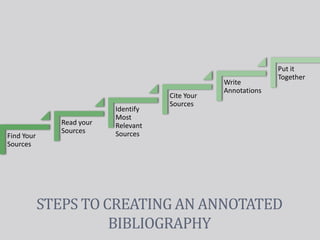
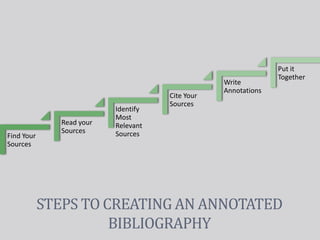
STEPS TO CREATING AN ANNOTATED
BIBLIOGRAPHY
Find Your
Sources
Read your
Sources
Identify
Most
Relevant
Sources
Cite Your
Sources
Write
Annotations
Put it
Together
STEP 1: FIND YOUR SOURCES
WHERE?
• Research Guide for Education:
guides.library.jhu.edu/education
• Databases used for other assignments
• Sources you found for other
assignments. Not sources you were
given by your professor.
STEP 2: READ YOUR SOURCES
Take notes as you are reading.
STEP 3: IDENTIFY THE 40
MOST IMPORTANT SOURCES
HOW?
• You’ll need to find more than 40, and
narrow down.
• Split them between your two courses -
about 20 for each.
• Determine which are most relevant to
your research.
POLL
pollev.com/emjohns
How do you know that a source is
“important”?
WHAT TO INCLUDE?
• Peer reviewed, empirical research studies
ONLY.
• A variety of perspectives.
• Articles that focus on the underlying causes
and factors associated with your POP
• Sources that are affiliated with the
perspectives covered in your two courses.
WHAT NOT TO INCLUDE?
• Books and book chapters
• Reports
• Non-peer reviewed sources
• Anything not related to your POP
• Anything that was listed in your course reserves or
syllabus
• Anything that does not add to the dialog of your POP
EXCEPTIONS? QUESTIONS?
Ask your professor.
STEP 4: CITE YOUR SOURCES
APA Resources
APA Manual
Patience you must
have.
STEP 4: CITE YOUR SOURCES
Other APA Resources
APA Style Guide
apastyle.org
APA Blog
blog.apastyle.org/apastyle
Refworks
guides.library.jhu.edu/refworks
Purdue Owl
(Google it)
STEP 5: WRITE YOUR
ANNOTATIONS
Write an annotation for each source. These
annotations should be single-spaced and should
include an overview of the study and succinctly
evaluate the source’s argument, sources of
evidence, methodology, and conclusions specifically
focused on the underlying causes and factors
associated with your POP and their relation to the
POP. The annotation should also indicate the
primary audience of the work and the constructs
used.
POLL
pollev.com/emjohns
Based on your assignment description,
what are the major components of an
annotation?
PARTS OF AN ANNOTATION
1. Summary/Description
(1-2 paragraphs)
2. Evaluation and
Commentary/Reflection
(1 paragraph)
TACKLE YOUR ANNOTATION
1. Introduce subject of article.
2. Determine how it relates to your
POP and/or your research.
3. Critique the article.
4. Defend its use in your research.
SUMMARY
Highlight the main points or
findings.
SUMMARY
Describe the relevance,
accuracy and quality of the
resource.
SUMMARY
Comment on the intended
audience.
SUMMARY: PARAPHRASE
Use your own words, do not
copy the abstract.
Paraphrasing advice: owl.english.purdue.edu/owl/resource/563/02/
EVALUATE, COMMENT,
REFLECT
• Authority of author
• Strength of argument
• Strength of author’s evidence/sources
• Strength of author’s methodology
• Strength of author’s conclusions
EVALUATE, COMMENT,
REFLECT
• Identify connections to other studies
• Consider:
• Conclusions drawn from the data
• Methods that may inform your work on the
POP
• How does this add to or inform your POP?
TACKLE YOUR ANNOTATION
1. Introduce subject of article.
2. Determine how it relates to your
POP and/or your research.
3. Critique the article.
4. Defend its use in your research.
USE OF THE FIRST PERSON
• Allowed by APA
• Encouraged to avoid awkwardness
• Use sparingly
See APA Manual pp. 69-70
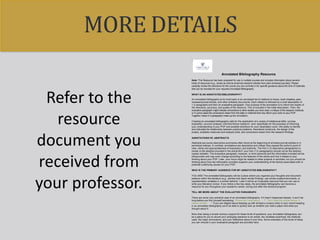
MORE DETAILS
Refer to the
resource
document you
received from
your professor.
!
Annotated Bibliography Resource
Note: This Resource has been prepared for use in multiple courses and includes information about several
kinds of resources (e.g., books as well as empirical research articles from peer-reviewed journals). Please
carefully review the directions for the course you are currently in for specific guidance about the kind of materials
that can be included for your required Annotated Bibliography.
WHAT IS AN ANNOTATED BIBLIOGRAPHY?
An annotated bibliography at its most basic is an annotated list of citations to books, book chapters, peer-
reviewed journal articles, and other scholarly documents. Each citation is followed by a brief description of
1-2 paragraphs and then an evaluative paragraph. One purpose of the annotation is to inform the reader of
the relevance, accuracy, and quality of the resource. This is included in the initial description. Then, the
evaluative paragraph might indicate connections to other studies you have read, a critique of the research methods
or in some cases the conclusions drawn from the data or methods that may inform your work on your POP.
Together, these 2-3 paragraphs make up the annotation.
Creating an annotated bibliography calls for the application of a variety of intellectual skills: concise
exposition, succinct analysis, informed library research—and, specifically for the purposes of informing
your understanding of your POP and possible directions for your dissertation work—the ability to identify
and articulate the relationship between practical problems, theoretical constructs, the design of the
project, available measures and analysis tools, and conclusions drawn from the research findings.
ANNOTATIONS VS. ABSTRACTS
Abstracts are purely descriptive summaries often found at the beginning of scholarly journal articles or in
periodical indexes. In contrast, annotations are descriptive and critical; they expose the author's point of
view, clarity and appropriateness of expression, and authority. The first (1-2) descriptive paragraph(s) is
similar to the abstract provided in the article BUT your first (1-2) paragraph(s) should not be the abstract
copied verbatim. The evaluative paragraph, however, is more personal and the information included will be
idiosyncratic and may even change according to the features of the article and how it relates to your
thinking about your POP. Later, your focus might be related to other projects or activities, but you should be
thinking about how the information provided supports your understanding of the factors associated with or
potential underlying causes for your POP.
WHO IS THE PRIMARY AUDIENCE FOR MY ANNOTATED BIBLIOGRAPHY?
YOU ARE! The annotated bibliography will be a place where you organize your thoughts and document
patterns within the literature (e.g., articles that report similar findings, use similar scales/instruments, or
operationalize variables in a similar fashion). Later it will be an invaluable resource that you can use to
write your literature review. If you follow a few key steps, the annotated bibliography can become a
resource for you throughout your academic career, during and after this doctoral program.
TELL ME MORE ABOUT THE EVALUATIVE PARAGRAPH
There are some very practical uses of an annotated bibliography. If it hasn’t happened already, it won’t be
long before you find yourself wondering: “Where did I read about. . . ?”, “Did I read this article before, it
seems familiar. . .?” If you are diligent about keeping up with at least a cursory entry in your record keeping
in an annotated bibliography you’ll be able to quickly look up whether you read a paper and what you
thought about it.
More than being a simple memory support for these kinds of questions, your annotated bibliography can
be a place for you to record your emerging reactions to an article, the variables examined, the methods
used, the major conclusions, and your reflections about it over time. Some examples of the kinds of ideas
you can include in your evaluative paragraph are provided here:
cc: Valerie Everett - https://www.flickr.com/photos/66742614@N00
QUESTIONS?
Example A
Rubin, A. (1999). Technology Meets Math Education: Envisioning
a Practical Future Forum on the Future of Technology in
Education. Journal of Math Education 3, 301-322.
This article looks at computers from the perspective of
mathematics education instead of looking at mathematics
education from the perspective of the computer. Several
categories of technology use are discussed, noting the
present situation and future possibilities.
Five powerful uses of technology in mathematics
education are listed, and factors that are necessary to fulfill
the potential of technology are considered. Some concerns
about the integration of technology into mathematics
education are also included as well as a brief closing
restatement of the dilemma.
Example A
Rubin, A. (1999). Technology Meets Math Education: Envisioning
a Practical Future Forum on the Future of Technology in
Education. Journal of Math Education 3, 301-322.
This article looks at computers from the perspective of
mathematics education instead of looking at mathematics
education from the perspective of the computer. Several
categories of technology use are discussed, noting the
present situation and future possibilities.
Five powerful uses of technology in mathematics
education are listed, and factors that are necessary to fulfill
the potential of technology are considered. Some concerns
about the integration of technology into mathematics
education are also included as well as a brief closing
restatement of the dilemma.
Example B
Cusatis, C., & Martin-Kratzer, R. (2010). Assessing the state of math
education in ACEJMC-accredited and non-accredited undergraduate
journalism programs. Journalism & Mass Communication Educator, 64,
356-372.
Through surveys, the authors assessed journalists' math education in the
United States, from both ACEJMC-accredited and non-accredited journalism.
Results indicated that few programs offered a math course specifically for the
journalism major. Instead, most relied on general education requirements and
segments of core journalism courses to provide students with math skills. The
average journalism student's mathematical skills were rated as "poor" or "fair"
by 70.2% of journalism chairs.
A lack of room in the curriculum was the most commonly cited constraint
to the implementation of math education, although others, such as conflicts
with the math department and the limiting effect of accreditation standards
on the curriculum, were also documented. The article cites other studies also
included in this bibliography. The article is interesting and accessible, but it
relies almost entirely on self-reporting in the surveys, it is subject to bias and
dishonesty in the responses.
Example B
Cusatis, C., & Martin-Kratzer, R. (2010). Assessing the state of math
education in ACEJMC-accredited and non-accredited undergraduate
journalism programs. Journalism & Mass Communication Educator, 64,
356-372.
Through surveys, the authors assessed journalists' math education in the
United States, from both ACEJMC-accredited and non-accredited journalism.
Results indicated that few programs offered a math course specifically for the
journalism major. Instead, most relied on general education requirements and
segments of core journalism courses to provide students with math skills. The
average journalism student's mathematical skills were rated as "poor" or "fair"
by 70.2% of journalism chairs.
A lack of room in the curriculum was the most commonly cited constraint
to the implementation of math education, although others, such as conflicts
with the math department and the limiting effect of accreditation standards
on the curriculum, were also documented. The article cites other studies also
included in this bibliography. The article is interesting and accessible, but it
relies almost entirely on self-reporting in the surveys, it is subject to bias and
dishonesty in the responses.
Example C
Starks, B. C., Harrison, L., & Denhardt, K. (2011). Outside the comfort zone of the
classroom. Journal of Criminal Justice Education, 2, 203-225.
doi:10.1080/10511253.2010.517773
This paper explains how service learning can be a valuable part of a student’s
academic career. Service can be tied into a course and takes students outside of the
classroom for a non-traditional, active learning experience that can impact not only
their education, but their personal and professional lives. Examples are provided for
other teachers to encourage them to explore service learning projects in their own
classrooms.
The authors are practitioners who have used service projects to enhance their
courses, and their experiences are also supported by previous research done on this
topic. Their examples demonstrate that learning can be achieved in non-traditional
ways, and service learning can have a larger impact that regular classroom study.
Their argument for active learning is supported by many of the other articles in this
bibliography, which stress that active learning is the most effective method for
retaining life-long skills. The examples and background in this article describe how
teaching and learning has changed over time, and provides important perspective
and context to inform my POP.
Example C
Starks, B. C., Harrison, L., & Denhardt, K. (2011). Outside the comfort zone of the
classroom. Journal of Criminal Justice Education, 2, 203-225.
doi:10.1080/10511253.2010.517773
This paper explains how service learning can be a valuable part of a student’s
academic career. Service can be tied into a course and takes students outside of the
classroom for a non-traditional, active learning experience that can impact not only
their education, but their personal and professional lives. Examples are provided for
other teachers to encourage them to explore service learning projects in their own
classrooms.
The authors are practitioners who have used service projects to enhance their
courses, and their experiences are also supported by previous research done on this
topic. Their examples demonstrate that learning can be achieved in non-traditional
ways, and service learning can have a larger impact that regular classroom study.
Their argument for active learning is supported by many of the other articles in this
bibliography, which stress that active learning is the most effective method for
retaining life-long skills. The examples and background in this article describe how
teaching and learning has changed over time, and provides important perspective
and context to inform my POP.
tinyurl.com/q23cpab
PRACTICE
POLL
pollev.com/emjohns
Do you feel more confident in creating
your annotated bibliography after
participating in this workshop?
cc: Valerie Everett - https://www.flickr.com/photos/66742614@N00
QUESTIONS?
STEPS TO CREATING AN ANNOTATED
BIBLIOGRAPHY
Find Your
Sources
Read your
Sources
Identify
Most
Relevant
Sources
Cite Your
Sources
Write
Annotations
Put it
Together
STEP 6: PUT IT TOGETHER
Start with a statement of your
POP.
DIVIDE SOURCES
• Split your sources between your two
courses.
• Clearly and explicitly indicate which
annotations are being submitted for
each course.
CATEGORIZE SOURCES
Within each group categorize
sources into themes.
Focus on different causes and
underlying factors of your POP.
NUMBER SOURCES
Number each source 1-40
List each source only once. You
have to choose.
STEPS TO CREATING AN ANNOTATED
BIBLIOGRAPHY
Find Your
Sources
Read your
Sources
Identify
Most
Relevant
Sources
Cite Your
Sources
Write
Annotations
Put it
Together
PURPOSE OF AN AB
POLL
pollev.com/emjohns
What’s the point?
PURPOSE OF AN AB
• Explore POP
• Appraise issues or factors associated with your
professional practice and POP.
• Help you get started with the literature review for
your dissertation.
• Think critically about your POP, and the literature.
PURPOSE OF AN AB
Identify and articulate:
• Relationships between practical problems,
• theoretical constructs,
• design of the project,
• available measures and analysis tools, and
• conclusions drawn from the research
findings.
REMEMBER…
• You need 40 peer-reviewed sources.
• You need to read, evaluate, cite, and annotate each of
these sources.
• These are the 40 most relevant sources, not the first
40 you’ve found, so…
• You will need to find and read many more than just 40
sources.
LIBRARY RESOURCES
Guide for Education
guides.library.jhu.edu/education
Library Research Modules in Blackboard
Lit Review Guide
guides.library.jhu.edu/lit-review
REFWORKS
RefWorks Guide
guides.library.jhu.edu/refworks
RefWorks Workshop
Thursday, Nov. 19, 6:30pm
http://tinyurl.com/p5dw7w7
FINAL THOUGHTS
http://bit.ly/dsplvq
What will you do differently?
cc: Valerie Everett - https://www.flickr.com/photos/66742614@N00
QUESTIONS?
Liz: emjohns@jhu.edu
Sara: soestre1@jhu.edu

Annotated Bibliographies 2, Fall 2015

  • 1.
  • 2.
  • 3.
    Sara Oestreich |soestre1@jhu.edu
  • 4.
    POLL pollev.com/emjohns Where are youin the process of creating your annotated bib?
  • 5.
  • 6.
    An annotated bibliographyis a list of citations on a particular topic followed by an evaluation of the source’s argument and other relevant material including its intended audience, sources of evidence and methodology.
  • 7.
    STEPS TO CREATINGAN ANNOTATED BIBLIOGRAPHY Find Your Sources Read your Sources Identify Most Relevant Sources Cite Your Sources Write Annotations Put it Together
  • 8.
    STEP 1: FINDYOUR SOURCES
  • 9.
    WHERE? • Research Guidefor Education: guides.library.jhu.edu/education • Databases used for other assignments • Sources you found for other assignments. Not sources you were given by your professor.
  • 10.
    STEP 2: READYOUR SOURCES
  • 11.
    STEP 2: READYOUR SOURCES Take notes as you are reading.
  • 12.
    STEP 3: IDENTIFYTHE 40 MOST IMPORTANT SOURCES
  • 13.
    HOW? • You’ll needto find more than 40, and narrow down. • Split them between your two courses - about 20 for each. • Determine which are most relevant to your research.
  • 14.
    POLL pollev.com/emjohns How do youknow that a source is “important”?
  • 15.
    WHAT TO INCLUDE? •Peer reviewed, empirical research studies ONLY. • A variety of perspectives. • Articles that focus on the underlying causes and factors associated with your POP • Sources that are affiliated with the perspectives covered in your two courses.
  • 16.
    WHAT NOT TOINCLUDE? • Books and book chapters • Reports • Non-peer reviewed sources • Anything not related to your POP • Anything that was listed in your course reserves or syllabus • Anything that does not add to the dialog of your POP
  • 17.
  • 18.
    STEP 4: CITEYOUR SOURCES APA Resources APA Manual Patience you must have.
  • 19.
    STEP 4: CITEYOUR SOURCES Other APA Resources APA Style Guide apastyle.org APA Blog blog.apastyle.org/apastyle Refworks guides.library.jhu.edu/refworks Purdue Owl (Google it)
  • 20.
    STEP 5: WRITEYOUR ANNOTATIONS Write an annotation for each source. These annotations should be single-spaced and should include an overview of the study and succinctly evaluate the source’s argument, sources of evidence, methodology, and conclusions specifically focused on the underlying causes and factors associated with your POP and their relation to the POP. The annotation should also indicate the primary audience of the work and the constructs used.
  • 21.
    POLL pollev.com/emjohns Based on yourassignment description, what are the major components of an annotation?
  • 22.
    PARTS OF ANANNOTATION 1. Summary/Description (1-2 paragraphs) 2. Evaluation and Commentary/Reflection (1 paragraph)
  • 23.
    TACKLE YOUR ANNOTATION 1.Introduce subject of article. 2. Determine how it relates to your POP and/or your research. 3. Critique the article. 4. Defend its use in your research.
  • 24.
    SUMMARY Highlight the mainpoints or findings.
  • 25.
    SUMMARY Describe the relevance, accuracyand quality of the resource.
  • 26.
    SUMMARY Comment on theintended audience.
  • 27.
    SUMMARY: PARAPHRASE Use yourown words, do not copy the abstract. Paraphrasing advice: owl.english.purdue.edu/owl/resource/563/02/
  • 28.
    EVALUATE, COMMENT, REFLECT • Authorityof author • Strength of argument • Strength of author’s evidence/sources • Strength of author’s methodology • Strength of author’s conclusions
  • 29.
    EVALUATE, COMMENT, REFLECT • Identifyconnections to other studies • Consider: • Conclusions drawn from the data • Methods that may inform your work on the POP • How does this add to or inform your POP?
  • 30.
    TACKLE YOUR ANNOTATION 1.Introduce subject of article. 2. Determine how it relates to your POP and/or your research. 3. Critique the article. 4. Defend its use in your research.
  • 31.
    USE OF THEFIRST PERSON • Allowed by APA • Encouraged to avoid awkwardness • Use sparingly See APA Manual pp. 69-70
  • 32.
    MORE DETAILS Refer tothe resource document you received from your professor. ! Annotated Bibliography Resource Note: This Resource has been prepared for use in multiple courses and includes information about several kinds of resources (e.g., books as well as empirical research articles from peer-reviewed journals). Please carefully review the directions for the course you are currently in for specific guidance about the kind of materials that can be included for your required Annotated Bibliography. WHAT IS AN ANNOTATED BIBLIOGRAPHY? An annotated bibliography at its most basic is an annotated list of citations to books, book chapters, peer- reviewed journal articles, and other scholarly documents. Each citation is followed by a brief description of 1-2 paragraphs and then an evaluative paragraph. One purpose of the annotation is to inform the reader of the relevance, accuracy, and quality of the resource. This is included in the initial description. Then, the evaluative paragraph might indicate connections to other studies you have read, a critique of the research methods or in some cases the conclusions drawn from the data or methods that may inform your work on your POP. Together, these 2-3 paragraphs make up the annotation. Creating an annotated bibliography calls for the application of a variety of intellectual skills: concise exposition, succinct analysis, informed library research—and, specifically for the purposes of informing your understanding of your POP and possible directions for your dissertation work—the ability to identify and articulate the relationship between practical problems, theoretical constructs, the design of the project, available measures and analysis tools, and conclusions drawn from the research findings. ANNOTATIONS VS. ABSTRACTS Abstracts are purely descriptive summaries often found at the beginning of scholarly journal articles or in periodical indexes. In contrast, annotations are descriptive and critical; they expose the author's point of view, clarity and appropriateness of expression, and authority. The first (1-2) descriptive paragraph(s) is similar to the abstract provided in the article BUT your first (1-2) paragraph(s) should not be the abstract copied verbatim. The evaluative paragraph, however, is more personal and the information included will be idiosyncratic and may even change according to the features of the article and how it relates to your thinking about your POP. Later, your focus might be related to other projects or activities, but you should be thinking about how the information provided supports your understanding of the factors associated with or potential underlying causes for your POP. WHO IS THE PRIMARY AUDIENCE FOR MY ANNOTATED BIBLIOGRAPHY? YOU ARE! The annotated bibliography will be a place where you organize your thoughts and document patterns within the literature (e.g., articles that report similar findings, use similar scales/instruments, or operationalize variables in a similar fashion). Later it will be an invaluable resource that you can use to write your literature review. If you follow a few key steps, the annotated bibliography can become a resource for you throughout your academic career, during and after this doctoral program. TELL ME MORE ABOUT THE EVALUATIVE PARAGRAPH There are some very practical uses of an annotated bibliography. If it hasn’t happened already, it won’t be long before you find yourself wondering: “Where did I read about. . . ?”, “Did I read this article before, it seems familiar. . .?” If you are diligent about keeping up with at least a cursory entry in your record keeping in an annotated bibliography you’ll be able to quickly look up whether you read a paper and what you thought about it. More than being a simple memory support for these kinds of questions, your annotated bibliography can be a place for you to record your emerging reactions to an article, the variables examined, the methods used, the major conclusions, and your reflections about it over time. Some examples of the kinds of ideas you can include in your evaluative paragraph are provided here:
  • 33.
    cc: Valerie Everett- https://www.flickr.com/photos/66742614@N00 QUESTIONS?
  • 34.
    Example A Rubin, A.(1999). Technology Meets Math Education: Envisioning a Practical Future Forum on the Future of Technology in Education. Journal of Math Education 3, 301-322. This article looks at computers from the perspective of mathematics education instead of looking at mathematics education from the perspective of the computer. Several categories of technology use are discussed, noting the present situation and future possibilities. Five powerful uses of technology in mathematics education are listed, and factors that are necessary to fulfill the potential of technology are considered. Some concerns about the integration of technology into mathematics education are also included as well as a brief closing restatement of the dilemma.
  • 35.
    Example A Rubin, A.(1999). Technology Meets Math Education: Envisioning a Practical Future Forum on the Future of Technology in Education. Journal of Math Education 3, 301-322. This article looks at computers from the perspective of mathematics education instead of looking at mathematics education from the perspective of the computer. Several categories of technology use are discussed, noting the present situation and future possibilities. Five powerful uses of technology in mathematics education are listed, and factors that are necessary to fulfill the potential of technology are considered. Some concerns about the integration of technology into mathematics education are also included as well as a brief closing restatement of the dilemma.
  • 36.
    Example B Cusatis, C.,& Martin-Kratzer, R. (2010). Assessing the state of math education in ACEJMC-accredited and non-accredited undergraduate journalism programs. Journalism & Mass Communication Educator, 64, 356-372. Through surveys, the authors assessed journalists' math education in the United States, from both ACEJMC-accredited and non-accredited journalism. Results indicated that few programs offered a math course specifically for the journalism major. Instead, most relied on general education requirements and segments of core journalism courses to provide students with math skills. The average journalism student's mathematical skills were rated as "poor" or "fair" by 70.2% of journalism chairs. A lack of room in the curriculum was the most commonly cited constraint to the implementation of math education, although others, such as conflicts with the math department and the limiting effect of accreditation standards on the curriculum, were also documented. The article cites other studies also included in this bibliography. The article is interesting and accessible, but it relies almost entirely on self-reporting in the surveys, it is subject to bias and dishonesty in the responses.
  • 37.
    Example B Cusatis, C.,& Martin-Kratzer, R. (2010). Assessing the state of math education in ACEJMC-accredited and non-accredited undergraduate journalism programs. Journalism & Mass Communication Educator, 64, 356-372. Through surveys, the authors assessed journalists' math education in the United States, from both ACEJMC-accredited and non-accredited journalism. Results indicated that few programs offered a math course specifically for the journalism major. Instead, most relied on general education requirements and segments of core journalism courses to provide students with math skills. The average journalism student's mathematical skills were rated as "poor" or "fair" by 70.2% of journalism chairs. A lack of room in the curriculum was the most commonly cited constraint to the implementation of math education, although others, such as conflicts with the math department and the limiting effect of accreditation standards on the curriculum, were also documented. The article cites other studies also included in this bibliography. The article is interesting and accessible, but it relies almost entirely on self-reporting in the surveys, it is subject to bias and dishonesty in the responses.
  • 38.
    Example C Starks, B.C., Harrison, L., & Denhardt, K. (2011). Outside the comfort zone of the classroom. Journal of Criminal Justice Education, 2, 203-225. doi:10.1080/10511253.2010.517773 This paper explains how service learning can be a valuable part of a student’s academic career. Service can be tied into a course and takes students outside of the classroom for a non-traditional, active learning experience that can impact not only their education, but their personal and professional lives. Examples are provided for other teachers to encourage them to explore service learning projects in their own classrooms. The authors are practitioners who have used service projects to enhance their courses, and their experiences are also supported by previous research done on this topic. Their examples demonstrate that learning can be achieved in non-traditional ways, and service learning can have a larger impact that regular classroom study. Their argument for active learning is supported by many of the other articles in this bibliography, which stress that active learning is the most effective method for retaining life-long skills. The examples and background in this article describe how teaching and learning has changed over time, and provides important perspective and context to inform my POP.
  • 39.
    Example C Starks, B.C., Harrison, L., & Denhardt, K. (2011). Outside the comfort zone of the classroom. Journal of Criminal Justice Education, 2, 203-225. doi:10.1080/10511253.2010.517773 This paper explains how service learning can be a valuable part of a student’s academic career. Service can be tied into a course and takes students outside of the classroom for a non-traditional, active learning experience that can impact not only their education, but their personal and professional lives. Examples are provided for other teachers to encourage them to explore service learning projects in their own classrooms. The authors are practitioners who have used service projects to enhance their courses, and their experiences are also supported by previous research done on this topic. Their examples demonstrate that learning can be achieved in non-traditional ways, and service learning can have a larger impact that regular classroom study. Their argument for active learning is supported by many of the other articles in this bibliography, which stress that active learning is the most effective method for retaining life-long skills. The examples and background in this article describe how teaching and learning has changed over time, and provides important perspective and context to inform my POP.
  • 40.
  • 41.
    POLL pollev.com/emjohns Do you feelmore confident in creating your annotated bibliography after participating in this workshop?
  • 42.
    cc: Valerie Everett- https://www.flickr.com/photos/66742614@N00 QUESTIONS?
  • 43.
    STEPS TO CREATINGAN ANNOTATED BIBLIOGRAPHY Find Your Sources Read your Sources Identify Most Relevant Sources Cite Your Sources Write Annotations Put it Together
  • 44.
    STEP 6: PUTIT TOGETHER Start with a statement of your POP.
  • 45.
    DIVIDE SOURCES • Splityour sources between your two courses. • Clearly and explicitly indicate which annotations are being submitted for each course.
  • 46.
    CATEGORIZE SOURCES Within eachgroup categorize sources into themes. Focus on different causes and underlying factors of your POP.
  • 47.
    NUMBER SOURCES Number eachsource 1-40 List each source only once. You have to choose.
  • 48.
    STEPS TO CREATINGAN ANNOTATED BIBLIOGRAPHY Find Your Sources Read your Sources Identify Most Relevant Sources Cite Your Sources Write Annotations Put it Together
  • 49.
  • 50.
  • 51.
    PURPOSE OF ANAB • Explore POP • Appraise issues or factors associated with your professional practice and POP. • Help you get started with the literature review for your dissertation. • Think critically about your POP, and the literature.
  • 52.
    PURPOSE OF ANAB Identify and articulate: • Relationships between practical problems, • theoretical constructs, • design of the project, • available measures and analysis tools, and • conclusions drawn from the research findings.
  • 53.
    REMEMBER… • You need40 peer-reviewed sources. • You need to read, evaluate, cite, and annotate each of these sources. • These are the 40 most relevant sources, not the first 40 you’ve found, so… • You will need to find and read many more than just 40 sources.
  • 54.
    LIBRARY RESOURCES Guide forEducation guides.library.jhu.edu/education Library Research Modules in Blackboard Lit Review Guide guides.library.jhu.edu/lit-review
  • 55.
  • 57.
  • 58.
    cc: Valerie Everett- https://www.flickr.com/photos/66742614@N00 QUESTIONS? Liz: emjohns@jhu.edu Sara: soestre1@jhu.edu

Editor's Notes

  • #7 From the assignment
  • #8 Focusing on Step 5 today, writing annotations.
  • #21 From the assignment: Write an annotation for each source. These annotations should be single-spaced and should include an overview of the study and succinctly evaluate the source’s argument, sources of evidence, methodology, and conclusions specifically focused on the underlying causes and factors associated with your POP and their relation to the POP. The annotation should also indicate the primary audience of the work and the constructs used.
  • #44 Focusing on Step 5 today, writing annotations.
  • #49 Focusing on Step 5 today, writing annotations.