Segmented Worms Chapter 13 Section 2
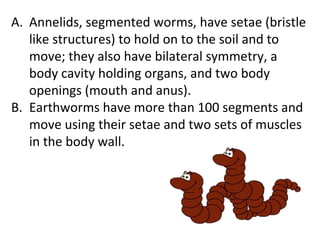
Annelids, segmented worms, have setae (bristle like structures) to hold on to the soil and to move; they also have bilateral symmetry, a body cavity holding organs, and two body openings (mouth and anus). Earthworms have more than 100 segments and move using their setae and two sets of muscles in the body wall.
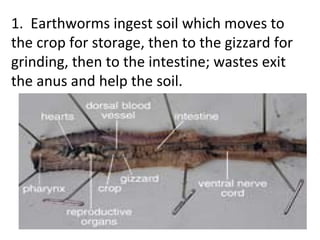
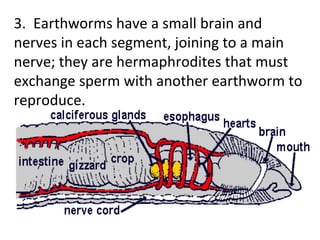
1.  Earthworms ingest soil which moves to the crop for storage, then to the gizzard for grinding, then to the intestine; wastes exit the anus and help the soil.
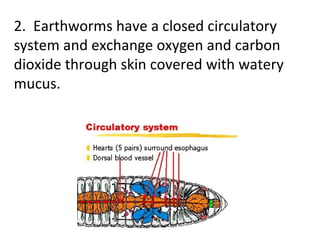
2.  Earthworms have a closed circulatory system and exchange oxygen and carbon dioxide through skin covered with watery mucus.
3.  Earthworms have a small brain and nerves in each segment, joining to a main nerve; they are hermaphrodites that must exchange sperm with another earthworm to reproduce.
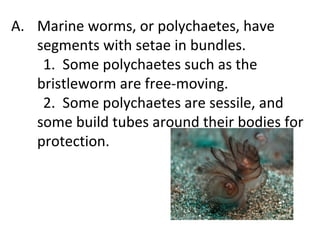
Marine worms, or polychaetes, have segments with setae in bundles.  1.  Some polychaetes such as the bristleworm are free-moving.  2.  Some polychaetes are sessile, and some build tubes around their bodies for protection.
Leeches are segmented worms without setae; they feed on blood from other animals.  1.  Leeches are used in medicine to prevent blood from coagulating and to heal surgical sites.  2.  Leeches release chemicals that are being studied as treatments for heart and circulatory diseases, strokes, arthritis, and glaucoma.
Segmented worms are valuable since they aerate the soil, produce medically useful chemicals, and provide food for many fish, invertebrates, and mammals.  http://www.ciwmb.ca.gov/vermi/game/menu.html

Segmented Worms

  • 1.
  • 2.
    Annelids, segmented worms,have setae (bristle like structures) to hold on to the soil and to move; they also have bilateral symmetry, a body cavity holding organs, and two body openings (mouth and anus). Earthworms have more than 100 segments and move using their setae and two sets of muscles in the body wall.
  • 3.
    1. Earthwormsingest soil which moves to the crop for storage, then to the gizzard for grinding, then to the intestine; wastes exit the anus and help the soil.
  • 4.
    2. Earthwormshave a closed circulatory system and exchange oxygen and carbon dioxide through skin covered with watery mucus.
  • 5.
    3. Earthwormshave a small brain and nerves in each segment, joining to a main nerve; they are hermaphrodites that must exchange sperm with another earthworm to reproduce.
  • 6.
    Marine worms, orpolychaetes, have segments with setae in bundles. 1. Some polychaetes such as the bristleworm are free-moving. 2. Some polychaetes are sessile, and some build tubes around their bodies for protection.
  • 7.
    Leeches are segmentedworms without setae; they feed on blood from other animals. 1. Leeches are used in medicine to prevent blood from coagulating and to heal surgical sites. 2. Leeches release chemicals that are being studied as treatments for heart and circulatory diseases, strokes, arthritis, and glaucoma.
  • 8.
    Segmented worms arevaluable since they aerate the soil, produce medically useful chemicals, and provide food for many fish, invertebrates, and mammals. http://www.ciwmb.ca.gov/vermi/game/menu.html