ANKYLOSING SPONDYLITIS
PRESENTER – DR SHARAN
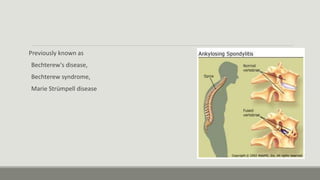
Previously known as
Bechterew's disease,
Bechterew syndrome,
Marie Strümpell disease
INTRODUCTION
It is a form of arthritis that is long-lasting (chronic) and most often affects the spine.
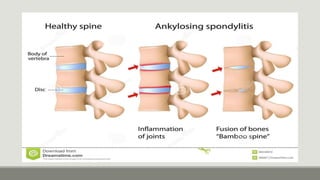
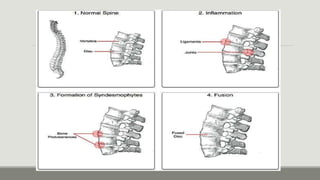
It affects joints in the spine and the sacroilium in the pelvis, causing eventual fusion of the spine.
Complete fusion results in a complete rigidity of the spine, a condition known as bamboo spine .
Ankylosing Spondylitis is a systemic rheumatic disease and is one of the seronegative
spondyloarthropathies.
The typical patient is young, aged 18-30 yrs.
Men are affected more than women by a ratio about of 3:1
The cause of ankylosing spondylitis is unknown, but a tendency to develop the condition may be
genetic.
HLA-B27 genotype. -90% of patients
Tumor necrosis factor-alpha (TNF α)
IL-1
SIGNS AND SYMPTOMS
Initial symptom
• Insidious onset dull pain in the lower lumbar or gluteal region
• Low-back morning stiffness of up to a few hours' duration that improves with activity and
returns following periods of inactivity.
• Pain usually becomes persistent and bilateral.
• Predominant complaint- Back pain or stiffness.
• Bony tenderness may present at- costosternal junctions, spinous processes, iliac crests, greater
trochanters, ischial tuberosities, tibial tubercles, and heels.
Neck pain and stiffness from involvement of the cervical spine
late manifestations
• Arthritis in the hips and shoulders (ā€œrootā€ joints) : in25 to 35% of patients.
• Arthritis of other peripheral joints: usually asymmetric.
• Pain tends to be persistent early in the disease and then becomes intermittent, with alternating
exacerbations and quiescent periods.
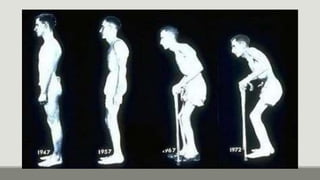
• In a typical severe untreated case- the patient's posture undergoes characteristic changes, with
obliterated lumbar lordosis, buttock atrophy, and accentuated thoracic kyphosis. There may be a
forward stoop of the neck or flexion contractures at the hips, compensated by flexion at the knees.
• Complication of the spinal disease is spinal fracture, which can occur with even minor trauma to the
rigid, osteoporotic spine; cervical spine is most commonly involved.
In 40% of cases, ankylosing spondylitis is associated with an inflammation of the white of the
eye (iridocyclitis)
-causing eye pain and photophobia.
Another common symptom is generalized fatigue. Less commonly aortitis, apical lung fibrosis
and ectasia of the sacral nerve root sheaths may occur.
Investigation
HLA B27: present in ā‰ˆ 90% of patients.
ESR and CRP – often elevated.
Mild anemia.
Elevated serum IgA levels.
ALP & CPK raised.
A blood test for the HLA-B27 gene
X-ray -which show characteristic spinal changes and sacroiliitis.
Tomography and magnetic resonance imaging of the sacroiliac joints but the reliability of these
tests is still unclear
Schober's test -a useful clinical measure of flexion of the lumbar spine performed during
examination.
TEST and MEASUREMENT
Cervical mobility
ā—¦ Occiput-to-wall distance
ā—¦ Tragus-to-wall distance
ā—¦ Cervical rotation
Thoracic mobility
ā—¦ Chest expansion
Lumber mobility
ā—¦ Modified schober index
ā—¦ Finger-to-floor distance
ā—¦ Lumber lateral flexion
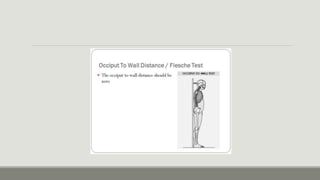
Occiput-to-wall distance
The severity of cervical flexion deformity in ankylosing spondylitis can be assessed by measuring
the occiput to wall distance (Flesche test).
With the patient standing erect, the heels and the buttocks are placed against a wall; the patient
is then instructed to extend his or her neck maximally in an attempt to touch the wall with the
occiput.
The distance between the occiput and the wall is a measure of the degree of flexion deformity
of the cervical spine.
The occiput to wall distance should be zero
Tragus-to-wall distance
Maintain starting position i.e. ensure head in neutral position (anatomical alignment), chin
drawn in as far as possible.
Measure distance between tragus of the ear and wall on both sides, using a rigid ruler.
Ensure no cervical extension, rotation, flexion or side flexion occurs.
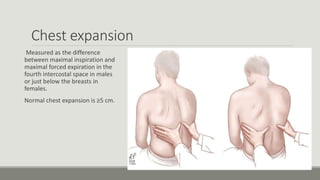
Chest expansion
Measured as the difference
between maximal inspiration and
maximal forced expiration in the
fourth intercostal space in males
or just below the breasts in
females.
Normal chest expansion is ≄5 cm.
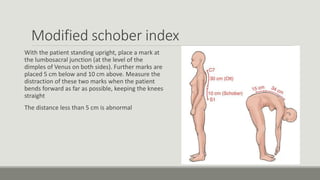
Modified schober index
With the patient standing upright, place a mark at
the lumbosacral junction (at the level of the
dimples of Venus on both sides). Further marks are
placed 5 cm below and 10 cm above. Measure the
distraction of these two marks when the patient
bends forward as far as possible, keeping the knees
straight
The distance less than 5 cm is abnormal
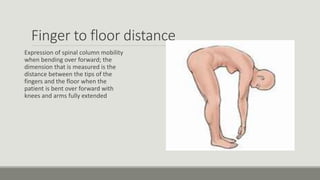
Finger to floor distance
Expression of spinal column mobility
when bending over forward; the
dimension that is measured is the
distance between the tips of the
fingers and the floor when the
patient is bent over forward with
knees and arms fully extended
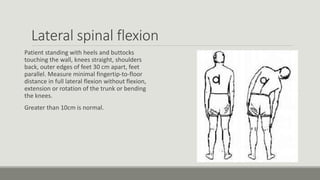
Lateral spinal flexion
Patient standing with heels and buttocks
touching the wall, knees straight, shoulders
back, outer edges of feet 30 cm apart, feet
parallel. Measure minimal fingertip-to-floor
distance in full lateral flexion without flexion,
extension or rotation of the trunk or bending
the knees.
Greater than 10cm is normal.
Range of motion
Cervical Spine
• Forward flexion: 0 to 45 degrees
• Extension: 0 to 45 degrees
• Lateral Flexion: 0 to 45
• Lateral Rotation: 0 to 80
Thoracolumbar spine
• Forward flexion: 0 to 90 degrees
• Extension: 0 to 30 degrees
• Lateral Flexion: 0 to 30
• Lateral Rotation: 0 to 30
TESTS FOR SACROILITIS
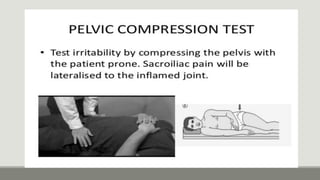
Pelvic compression test
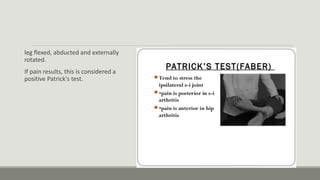
Faber test
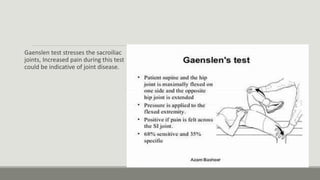
Gaenslen Test
leg flexed, abducted and externally
rotated.
If pain results, this is considered a
positive Patrick's test.
Gaenslen test stresses the sacroiliac
joints, Increased pain during this test
could be indicative of joint disease.
Modified Newyork Criteria (1984) – 4 + any of 1/2/3
1. Inflammatory low back pain > 3 months (Age of onset < 40, Insidious onset, Duration longer
than 3 months, Pain worse in the morning, Morning stiffness lasts longer than 30 minutes, Pain
decreases with Exercise, Pain provoked by prolonged inactivity or lying down, Pain accompanied
with constitutional Symptoms- Anorexia, Malaise, Low grade fever)
2. Limited motion of lumbar spine in sagittal & frontal planes
3. Limited chest expansion (<2.5cm at 4th ICS)
4. Definite radiologic sacroiliitis
TREATMENT
Anti-inflammatory drugs -includes NSAIDs such as aspirin, ibuprofen, phenylbutazone,
indomethacin, naproxen and COX-2 inhibitors, -reduce inflammation, and consequently pain
DMARDs -such as cyclosporin, methotrexate, sulfasalazine, and corticosteroids,
-used to reduce the immune system response through immunosuppression;
TNFα blockers (antagonists) -such as etanercept, infliximab and adalimumab (also known as
biologics) -indicated for the treatment of and are effective immunosuppressants in Ankylosing
Spondylitis as in other autoimmune diseases.
SURGERY MANAGEMENT
May include OSTEOTOMY for marked deformities of the hip/spine.
occasionally, hip or knee ARTHROPLASTY is used. - if there is severe arthritis of those joints.
Thank you

Ankylosing spondylitis

  • 1.
  • 2.
    Previously known as Bechterew'sdisease, Bechterew syndrome, Marie Strümpell disease
  • 3.
    INTRODUCTION It is aform of arthritis that is long-lasting (chronic) and most often affects the spine. It affects joints in the spine and the sacroilium in the pelvis, causing eventual fusion of the spine. Complete fusion results in a complete rigidity of the spine, a condition known as bamboo spine .
  • 5.
    Ankylosing Spondylitis isa systemic rheumatic disease and is one of the seronegative spondyloarthropathies. The typical patient is young, aged 18-30 yrs. Men are affected more than women by a ratio about of 3:1
  • 6.
    The cause ofankylosing spondylitis is unknown, but a tendency to develop the condition may be genetic. HLA-B27 genotype. -90% of patients Tumor necrosis factor-alpha (TNF α) IL-1
  • 7.
    SIGNS AND SYMPTOMS Initialsymptom • Insidious onset dull pain in the lower lumbar or gluteal region • Low-back morning stiffness of up to a few hours' duration that improves with activity and returns following periods of inactivity. • Pain usually becomes persistent and bilateral. • Predominant complaint- Back pain or stiffness. • Bony tenderness may present at- costosternal junctions, spinous processes, iliac crests, greater trochanters, ischial tuberosities, tibial tubercles, and heels.
  • 8.
    Neck pain andstiffness from involvement of the cervical spine late manifestations • Arthritis in the hips and shoulders (ā€œrootā€ joints) : in25 to 35% of patients. • Arthritis of other peripheral joints: usually asymmetric. • Pain tends to be persistent early in the disease and then becomes intermittent, with alternating exacerbations and quiescent periods. • In a typical severe untreated case- the patient's posture undergoes characteristic changes, with obliterated lumbar lordosis, buttock atrophy, and accentuated thoracic kyphosis. There may be a forward stoop of the neck or flexion contractures at the hips, compensated by flexion at the knees. • Complication of the spinal disease is spinal fracture, which can occur with even minor trauma to the rigid, osteoporotic spine; cervical spine is most commonly involved.
  • 11.
    In 40% ofcases, ankylosing spondylitis is associated with an inflammation of the white of the eye (iridocyclitis) -causing eye pain and photophobia. Another common symptom is generalized fatigue. Less commonly aortitis, apical lung fibrosis and ectasia of the sacral nerve root sheaths may occur.
  • 12.
    Investigation HLA B27: presentin ā‰ˆ 90% of patients. ESR and CRP – often elevated. Mild anemia. Elevated serum IgA levels. ALP & CPK raised.
  • 13.
    A blood testfor the HLA-B27 gene X-ray -which show characteristic spinal changes and sacroiliitis. Tomography and magnetic resonance imaging of the sacroiliac joints but the reliability of these tests is still unclear Schober's test -a useful clinical measure of flexion of the lumbar spine performed during examination.
  • 14.
    TEST and MEASUREMENT Cervicalmobility ā—¦ Occiput-to-wall distance ā—¦ Tragus-to-wall distance ā—¦ Cervical rotation Thoracic mobility ā—¦ Chest expansion Lumber mobility ā—¦ Modified schober index ā—¦ Finger-to-floor distance ā—¦ Lumber lateral flexion
  • 15.
    Occiput-to-wall distance The severityof cervical flexion deformity in ankylosing spondylitis can be assessed by measuring the occiput to wall distance (Flesche test). With the patient standing erect, the heels and the buttocks are placed against a wall; the patient is then instructed to extend his or her neck maximally in an attempt to touch the wall with the occiput. The distance between the occiput and the wall is a measure of the degree of flexion deformity of the cervical spine. The occiput to wall distance should be zero
  • 17.
    Tragus-to-wall distance Maintain startingposition i.e. ensure head in neutral position (anatomical alignment), chin drawn in as far as possible. Measure distance between tragus of the ear and wall on both sides, using a rigid ruler. Ensure no cervical extension, rotation, flexion or side flexion occurs.
  • 18.
    Chest expansion Measured asthe difference between maximal inspiration and maximal forced expiration in the fourth intercostal space in males or just below the breasts in females. Normal chest expansion is ≄5 cm.
  • 19.
    Modified schober index Withthe patient standing upright, place a mark at the lumbosacral junction (at the level of the dimples of Venus on both sides). Further marks are placed 5 cm below and 10 cm above. Measure the distraction of these two marks when the patient bends forward as far as possible, keeping the knees straight The distance less than 5 cm is abnormal
  • 20.
    Finger to floordistance Expression of spinal column mobility when bending over forward; the dimension that is measured is the distance between the tips of the fingers and the floor when the patient is bent over forward with knees and arms fully extended
  • 21.
    Lateral spinal flexion Patientstanding with heels and buttocks touching the wall, knees straight, shoulders back, outer edges of feet 30 cm apart, feet parallel. Measure minimal fingertip-to-floor distance in full lateral flexion without flexion, extension or rotation of the trunk or bending the knees. Greater than 10cm is normal.
  • 22.
    Range of motion CervicalSpine • Forward flexion: 0 to 45 degrees • Extension: 0 to 45 degrees • Lateral Flexion: 0 to 45 • Lateral Rotation: 0 to 80 Thoracolumbar spine • Forward flexion: 0 to 90 degrees • Extension: 0 to 30 degrees • Lateral Flexion: 0 to 30 • Lateral Rotation: 0 to 30
  • 23.
    TESTS FOR SACROILITIS Pelviccompression test Faber test Gaenslen Test
  • 25.
    leg flexed, abductedand externally rotated. If pain results, this is considered a positive Patrick's test.
  • 26.
    Gaenslen test stressesthe sacroiliac joints, Increased pain during this test could be indicative of joint disease.
  • 27.
    Modified Newyork Criteria(1984) – 4 + any of 1/2/3 1. Inflammatory low back pain > 3 months (Age of onset < 40, Insidious onset, Duration longer than 3 months, Pain worse in the morning, Morning stiffness lasts longer than 30 minutes, Pain decreases with Exercise, Pain provoked by prolonged inactivity or lying down, Pain accompanied with constitutional Symptoms- Anorexia, Malaise, Low grade fever) 2. Limited motion of lumbar spine in sagittal & frontal planes 3. Limited chest expansion (<2.5cm at 4th ICS) 4. Definite radiologic sacroiliitis
  • 28.
    TREATMENT Anti-inflammatory drugs -includesNSAIDs such as aspirin, ibuprofen, phenylbutazone, indomethacin, naproxen and COX-2 inhibitors, -reduce inflammation, and consequently pain DMARDs -such as cyclosporin, methotrexate, sulfasalazine, and corticosteroids, -used to reduce the immune system response through immunosuppression; TNFα blockers (antagonists) -such as etanercept, infliximab and adalimumab (also known as biologics) -indicated for the treatment of and are effective immunosuppressants in Ankylosing Spondylitis as in other autoimmune diseases.
  • 29.
    SURGERY MANAGEMENT May includeOSTEOTOMY for marked deformities of the hip/spine. occasionally, hip or knee ARTHROPLASTY is used. - if there is severe arthritis of those joints.
  • 30.