Animal Nutrition
and
Product Quality
Laboratory Manual
Monika Zaklouta, Muhi El-Dine Hilali, Ali Nefzaoui
and Mohammad Haylani
Edited by
Monika Zaklouta

International Center for Agricultural Research in the Dry Areas
Copyright © 2011 ICARDA (International Center for Agricultural Research in the Dry
Areas).
All rights reserved. ICARDA encourages fair use of this material for non-commercial
purposes, with proper citation.
Citation:
Zaklouta M., Hilali M., Nefzaoui A. and Haylani M. 2011. Animal nutrition and product
quality laboratory manual. ICARDA, Aleppo, Syria. viii + 92 pp.

ISBN: 92-9127-250-7

International Center for Agricultural Research in the Dry Areas (ICARDA)
P.O.Box 5466, Aleppo, Syria
Tel: +963 21 2213433, 2213477, 2225012
E-mail: icarda@cgiar.org
Website: www.icarda.org
The views expressed are those of the authors, and not necessarily those of ICARDA.
Where trade names are used, it does not imply endorsement of, or discrimination
against, any product by the Center. Maps have been used to support research
data, and are not intended to show political boundaries.
Contents
Forword ................................................................................................................................ v
Introduction ......................................................................................................................... 1
1
Feed analysis ......................................................................................................... 3
1.1
Sample receiving and preparation ................................................................... 3
1.1.1 Record incoming samples ................................................................................... 3
1.1.2 Sample preparation .............................................................................................. 3
1.1.3 Drying samples ...................................................................................................... 3
1.1.4 Grinding .................................................................................................................. 4
1.2
Determination of Dry Matter, Ash and Organic Matter ................................... 4
1.2.1 Determination of Dry Matter (DM) ..................................................................... 4
1.2.2 Determination of Ash ............................................................................................ 6
1.2.3 Determination of Organic Dry Matter (ODM) ................................................... 6
1.3
Determination of Crude Protein .......................................................................... 7
1.4
Determination of Nonprotein Nitrogen (NPN) using Trichloroacetic Acid
(TCA) ....................................................................................................................... 9
1.5
Determination of Fat ........................................................................................... 10
1.6
Detergent Fiber Analyses .................................................................................... 11
1.6.1 Determination of Neutral Detergent Fiber (NDF) ............................................. 11
1.6.2 Determination of Acid Detergent Fiber (ADF) .................................................. 13
1.6.3 Determination of Acid Detergent Lignin (ADL) ................................................ 14
1.6.4 Determination of Acid-Detergent Insoluble Nitrogen (ADIN) ......................... 15
1.7
Fiber Analysis using the Semi-automated ANKOM Filter Bag Technique ....... 17
1.7.1 Acid Detergent Fiber (ADF) in Feeds using Filter Bag Technique ................... 17
1.7.2 Acid Detergent Lignin (ADL) in Feeds using Filter Bag Technique .................. 20
1.7.3 Neutral Detergent Fiber (NDF) in Feeds using Filter Bag Technique .............. 21
1.7.4 Crude Fiber Analysis in Feeds Filter Bag Technique ......................................... 23
1.8
Determination of Macro and Micro Minerals ................................................... 25
1.8.1 Determination of Phosphorus ............................................................................. 26
1.8.2 Determination of Potassium and Sodium .......................................................... 26
1.8.3 Determination of Calcium and Magnesium ..................................................... 27
1.9
Determination of Tannins ..................................................................................... 31
1.9.1 Total Phenolics and Tannins ................................................................................ 31
1.9.2 Condensed Tannins ............................................................................................. 34
1.9.3 Bioassay using PEG ............................................................................................... 37
1.10
Digestibility Determination .................................................................................. 41
1.10.1 In vitro Digestibility ................................................................................................ 41
1.10.2 Gas Production Test (Hohenheim Method) ...................................................... 44
1.10.3 In sacco Degradability and Digestibility ........................................................... 46

iii
2
2.1
2.2
2.3
2.3.1
2.3.2
2.3.3
2.3.4
2.3.5
2.3.6
2.4

Assessment of Silage Nutritional Quality ..........................................................
Definition and advantages of silage .................................................................
Sampling ...............................................................................................................
Silage quality assessment ....................................................................................
Dry matter (DM) ....................................................................................................
Extraction of silage 'juice' ....................................................................................
pH ...........................................................................................................................
Ammonia ..............................................................................................................
Determination of Volatile Fatty Acids ................................................................
Lactic Acid ............................................................................................................
Assessment of Silage Quality Using Fermentation End Products ....................

49
49
49
50
50
51
51
52
53
55
57

3
3.1
3.2
3.3
3.4
3.5
3.6
3.7
3.8
3.9
3.10
3.11
3.12
3.12.1
3.12.2

Milk analysis ........................................................................................................
Sampling ...............................................................................................................
Sample preparation ............................................................................................
Determination of Fat (Gerber method) ............................................................
Total solids ..............................................................................................................
Fat, Protein Total Solids and Lactose Analysis ...................................................
Milk density ............................................................................................................
Milk conductivity ..................................................................................................
Milk pH ...................................................................................................................
Milk Acidity ............................................................................................................
Volatile Fatty Acids ..............................................................................................
Organic Acids .......................................................................................................
Tests for Abnormal Milk ........................................................................................
Somatic Cell Count (SCC) ..................................................................................
California Mastitis Test (CMT) ..............................................................................

58
58
59
59
60
61
62
63
63
64
65
67
69
69
71

4.
4.1.

Blood analysis ..................................................................................................... 72
Determination of Progesterone ......................................................................... 72

APPENDICES ........................................................................................................................
Appendix 1. Request form for analyses in Animal Nutrition Laboratory .....................
Appendix 2. Safety in the laboratory ..............................................................................
Appendix 3. Preparing standard solutions .....................................................................
Appendix 4. Abbreviations ..............................................................................................
Appendix 5. Units and conversion tables .......................................................................
Appendix 6. Frequently used standards of concentration ..........................................
Appendix 7. Table of elements .......................................................................................
Appendix 8. Bibliography .................................................................................................

iv

74
74
75
78
81
82
84
85
90
Foreword
Livestock production is the major source of livelihoods for millions of households
worldwide. Small ruminants (sheep and goats) are critically important in dry areas,
and a key focus of ICARDA’s research. The Center’s livestock research covers many
areas, two of which relate to this manual: development of low-cost alternative feeds
to improve animal nutrition, and value-added products such as cheese and yogurt,
to increase farmers’ income. Both aspects require field research as well as laboratory analyses.
Feed analyses are necessary to determine the nutritional value of different feed
products in terms of dry matter, crude protein, crude fiber, crude fat, crude ash, minerals, tannins and other parameters. Similarly, laboratory tests are needed to analyze
the composition and quality of milk and milk derivatives in terms of protein, fat, lactose, total solids, acidity, pH, density, conductivity and other parameters including
hygiene aspects.
ICARDA’s Animal Nutrition Laboratory is well equipped, with highly trained staff. It
provides analytical services to support livestock research by ICARDA and national
research centers in many countries; and helps develop research capacity through
training programs for researchers, farmers and extension staff, student internships
and other means.
This manual describes detailed procedures for conducting a wide range of laboratory analyses. These procedures are based on international standards, and have
been refined through many years of use and experience at ICARDA. The manual
will be freely available in printed and on-line versions. It will be a useful guide for
livestock technicians and researchers in developing countries worldwide. It will also
serve as a reference for developing-country laboratories seeking to establish their
own standards and protocols.
Mahmoud Solh
Director General, ICARDA

v
Preface
ICARDA’s livestock research aims to develop appropriate technologies to improve
small ruminant production by resource-poor households. Technologies – particularly
for nutrition, feeding and milk processing – are tested under controlled conditions at
the Animal Research Laboratory at ICARDA’s headquarters. The laboratory also runs
training programs for national researchers, extension staff and farmers; and supports
graduate students in their research.
The Animal Research Laboratory, named after the late Dr Giro Orita, holds an experimental flock of 400 Awassi sheep, a hall for indoor feeding experiments, an animal
nutrition laboratory, an animal health laboratory, and a milk processing plant that is
connected to an automatic milking parlor.
The flock is used for research on animal nutrition, husbandry, reproduction and
breeding. The milk processing plant supports research on and production of dairy
products, and helps develop practical solutions to farmers’ problems in milking
hygiene, processing and product diversification. The animal nutrition laboratory
conducts quality analysis of feeds, milk and milk products, conducting about 20,000
analyses of feed, milk and blood samples every year.
This manual was developed by scientists and technicians at ICARDA’s headquarters
in Syria, and regional offices in Tunisia. It provides a comprehensive guide to feed
and milk quality analyses that are being conducted at ICARDA. It is hoped this information will also contribute to establishing standard and protocols at animal nutrition
laboratories in national institutions.

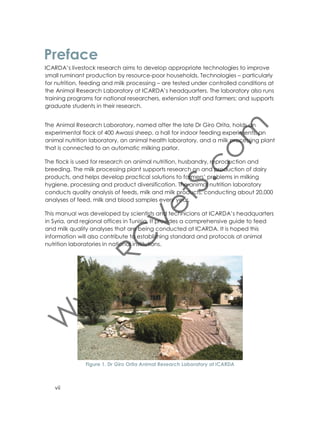
Figure 1. Dr Giro Orita Animal Research Laboratory at ICARDA

vii
Introduction
Animal nutrition is an important factor limiting livestock productivity,
and feed costs are considered as the main constraint to raising income
from small–scale ruminant production in dry areas. ICARDA’s livestock
scientists are searching for alternative feed resources to be included in
well balanced diets that can lead to improvements in flock productivity
and in meat and milk quality. The nutritional value of proposed low cost
diets and their effects on product quality need careful evaluation in the
laboratory. Therefore, ICARDA’s Animal Nutrition Laboratory analyzes
feed as well milk and dairy product quality.
This manual covers all analyses conducted in the Animal Nutrition Laboratory at ICARDA, as well as the equipment needed. Special chapters
refer to analyses conducted in the newly established laboratories in
Libya.
Feed analyses conducted in the laboratory include basic nutritional
analyses such as dry matter, crude protein, crude fiber, crude fat,
crude ash, minerals and tannins. For these analyses, the laboratory is
equipped with Kjeldahl nitrogen analyzer, Soxhlet, Atomic Absorption
Spectrophotometer, balances, and centrifuges. The unit also holds
donor animals for rumen liquid that is used for two–phase digestibility
analysis and Gas Production Tests.
In addition, this manual describes composition and quality analyses of
milk and milk derivatives. The laboratory provides analyses for protein,
fat, lactose, total solids, acidity, pH, density and conductivity. It also

Figure 2. Animal Nutrition Laboratory at ICARDA

1
facilitates advanced analyses that use gas chromatography, and HPLC
analyzer for detection of organic acids and Volatile Fatty Acids.
One chapter of this manual describes assays to determine the udder
health of animals. Mastitis can be determined by either the California
Mastitis Test or using somatic cell counter. The blood of sheep can be
evaluated for progesterone content using the ELISA assay.
The main purpose of this manual is to provide a guide for technicians
in the Animal Nutrition Laboratory, and for technicians and researchers
from NARS and other collaborators that come to ICARDA for training or
collaborative research projects. Furthermore, it informs scientists from
ICARDA and outside ICARDA on the services offered by the laboratory.

2
1. Feed Analysis
1.1. Sample Receiving and Preparation
1.1.1. Record Incoming Samples
Upon receipt at the laboratory samples are assigned batch numbers.
The requester has to fill a form (see Appendix 1) providing sample
description, source, requested analyses, costs for each analysis and
budget code for charges. This form must be approval by the project
manager for charge back payment. The Animal Nutrition Laboratory
uses this information to build up a data base on results of analyses and
source description of all samples that pass through the laboratory.
1.1.2. Sample Preparation
Sample preparation converts the samples into homogeneous material
for the various nutritional analyses. Drying and grinding are the essential
operations. Sample preparation is conducted according to sample
type and analyses requested.
Reference
• AOAC (Association of Official
Analytical Chemists). 1995.
1.1.3. Drying Samples
In case fresh forage samples are
wet when received they are dried
overnight at 60 °C in an air-circulation oven to obtain air dried
samples ready for grinding.
Feces samples are dried at 60 °C
in an air-circulation oven (Fig.3)
for at least 48 hours prior to grinding.
Milk and milk derivatives are prepared according to the analyses
requested (see chapter 3). For dry
matter see section 1.2.1.

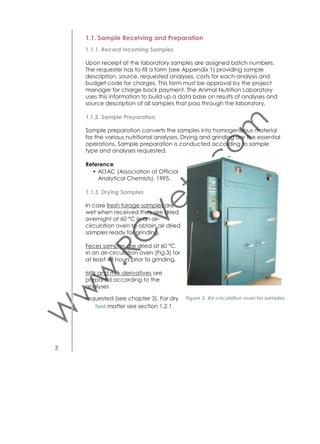
3

Figure 3. Air-circulation oven for field
samples
Equipment
• Air-circulation oven for
large field samples (Fig. 3)
1.1.4. Grinding
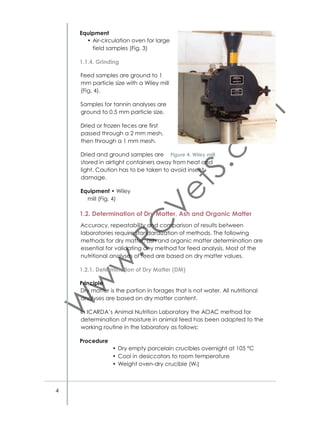
Feed samples are ground to 1
mm particle size with a Wiley mill
(Fig. 4).
Samples for tannin analyses are
ground to 0.5 mm particle size.
Dried or frozen feces are first
passed through a 2 mm mesh,
then through a 1 mm mesh.
Figure 4. Wiley mill
Dried and ground samples are
stored in airtight containers away
from heat and light. Caution has
to be taken to avoid insect damage.

Equipment
• Wiley mill (Fig. 4)

1.2. Determination of Dry Matter, Ash and Organic Matter
Accuracy, repeatability and comparison of results between laboratories require standardization of methods. The following methods for dry
matter, ash and organic matter determination are essential for validating any method for feed analysis. Most of the nutritional analyses of
feed are based on dry matter values.
1.2.1. Determination of Dry Matter (DM)
Principle
Dry matter is the portion in forages that is not water. All nutritional
analyses are based on dry matter content.
In ICARDA’s Animal Nutrition Laboratory the AOAC method for determination of moisture in animal feed has been adapted to the working
routine in the laboratory as follows:
Procedure
• Dry empty porcelain crucibles overnight at 105 °C
• Cool in desiccators to room temperature
• Weight oven-dry crucible (Wt)

4
•
•
•
•

Add approximately 2 g of ground sample; record weight (Ws)
Dry overnight at 105 °C
Cool in desiccators to room temperature
Weight oven–dry crucible+sample = (W0)

For milk and milk derivatives samples
• For dry matter based analyses, 2 ml of milk are dried in crucibles
overnight at 105 °C and its weight taken
• For cheese, a 2 g sample is dried overnight at 105 °C and then dry
weight taken.
Calculations
%DM = [(W0–Wt )/Ws ]×100
Equipment
• Precision balance (Fig. 5)
• Air-circulation oven (Fig. 6)
• Desiccator (Fig. 7)
• Porcelain crucibles (Fig. 9).
References
• AOAC. 1995.

Figure 5. Precision balance

Figure 6. Air-circulation oven

5

Figure 7. Desiccator
1.2.2. Determination of Ash
Procedure
• Ignite dry matter samples (see 1.2.1) overnight at 550 °C in muffle
furnace
• Cool in desiccators to room temperature
• Weigh ignited crucible + sample (Wa).
Calculation
%Ash = [(Wa–Wt )/(W0–Wt)]×100
Equipment
• Precision balance (Fig. 5)
• Muffle furnace (550 °C) (Fig. 8)
• Desiccator (Fig. 7)
• Porcelain crucibles (Fig. 9).

Figure 8. Muffle furnace

Figure 9. Porcelain crucible

Reference
• AOAC.1995.
1.2.3. Determination of Organic Dry Matter (ODM)
Calculations
%ODM = 100 – %Ash

6
1.3. Determination of Crude Protein
Principle
Determination of total nitrogen (crude protein) is conducted using the
Kjeldahl method. The sample is digested in sulfuric acid using K2SO4/
CuSO4/TiO4 as a catalyst. N is converted into NH3, then distilled trapped
in boric acid and titrated with H2SO4.
Procedure
• Add 1g of dry sample in digestion tubes (250 ml)
• Consider blank tube
• Consider standard sample of known nitrogen contents
• Add half a tablet of catalyst
• Add 13 ml of concentrated sulfuric acid (H2SO4)
• Insert rack with 20 tubes, including blank and standard sample in
digestion block heater under fume hood, and install exhaust manifold connected to water aspirator (Fig.11)
• Keep in digester at 420 °C until liquid becomes transparent
• Remove rack with exhaust manifold from digester and allow to
cool to room temperature under fume hood
• Remove exhaust manifold and transfer tubes separately to distillation unit
• Automatic distillation: 65 ml dist. water + 35 ml of 40% sodium hydroxide solution
• Collect condensed liquid in Erlenmeyer flask with 10 ml indicator
solution
• Titrate liquid with 0.1142 N sulfuric acid until color turns purple.
Calculations
%N = [1.4007×(Va–Vb)×N]/W
Va: volume of acid used for sample titration
Vb: volume of acid used for the blank
N: Normality of acid
W: sample weight in grams
1.4007: conversion factor milliequivalent weight of nitrogen and N
percent
Calculation: Percent Crude Protein (CP)
%CP = %N × F
F = 6.25 for all forages
F = 5.70 for wheat grains
F = 6.38 for milk
Using acid normality of 0.1142 one can consider that each ml of above
sulfuric acid added at titration corresponds to 1% of crude protein (CP)
if the above conversion factor (F) is equal to 6.25.

7
Reagents / Solutions
Digestion reagents
• Catalyst tablet composition: 5 g K2SO4 , 0.15 g TiO2 , 0.15 g
CuSO4.5H2O, Foss, cat. No. A15270010
• Concentrated sulfuric acid H2SO4 (96-98%).
Distillation solution
40% sodium hydroxide solution:
• 400 g of NaOH (99%)
• 1 l distilled water.
Indicator solution
• Boil 4 l distilled water
• Add 160 g boric acid (H3BO3)
• Cool to next day
• Add 2.8 ml methy l red
• Add 4 ml bromocresol green.
Titration solution
• 0.1142 N sulfuric acid H2SO4 (Merck 1.9981: Titrisol for 1 l, H2SO4, 0.5
mol/l)
• Empty Titrisol ampoule into 1 l volumetric flask
• Make up with distilled water to 1 l
• Transfer total contents of volumetric flask into 10 l Nalgene container
• Add 7757 ml of distilled water.
Equipment
• Precision balance (Fig. 5)
• Fume hood (Fig. 12)
• Digestion block heater (Tecator 2020, Foss, Denmark) with exhaust
manifold connected to water aspirator for 20 digestion tubes (Fig.11)
• Distillation unit (Vapodest 30,Gerhardt, Germany) (Fig.10)

Figure 10. Automatic distillation unit (Kjeldahl) and automatic burette for titration

8
Figure 11. Digestion block heater with
exhaust manifold

•
•
•
•

Figure 12. Fume hood

Automatic burette (Eppendorf, Germany) for titration
Kjeldahl digestion tubes 6100, 250 ml
Erlenmeyer flask, 250 ml
Volumetric flasks,1 l.

References
• AOAC. 1995.
• ISO 2004

1.4. Determination of Nonprotein Nitrogen (NPN) using
Trichloro-acetic Acid (TCA)
Principle
Nonprotein nitrogen is the nitrogen remaining after precipitation of true
protein. After filtration the insoluble nitrogen can be determined.
Procedure
• Weigh 0.5 g dry sample into a 125 ml Erlenmeyer flask
• Add 50 ml distilled water; allow standing for 30 min
• Add 10 ml 10% trichloroacetic acid; stand for 20-30 min
• Filter by gravity through Whatman #54 or 541 paper
• Rinse twice with TCA solution
• Transfer paper to Kjeldahl flask and determine residual nitrogen.
Calculation
NPN = Total nitrogen – Residual nitrogen
Express NPN as Crude Protein or as % of total nitrogen in feed

9
Reagents / Solutions
TCA Solution
• Trichloroacetic acid (CCl3COOH) 10% w/v in water
Reference
• Licitra G, Hernandez TM and VanSoest PJ. 1996.

1.5. Determination of Fat
Principle
The dried feed sample is dissolved with petrol ether and then the ether
is evaporated in the Soxhlet apparatus. The residues are crude fat.
In the Animal Nutrition Laboratory at ICARDA a Soxtherm apparatus
from Gerhardt GmbH is used. The procedure described below follows
the instruction for this specific Soxhlet apparatus. In the laboratory the
modified method for determination of fat in meat has been adapted.
Procedure
• Fill extraction beakers with boiling stones dried at 103 °C (Fig. 14)
• Cool beakers down to room temperature in desiccator
• Weigh beakers on precision balance (W0)
• Weigh 5 g of dried samples in extraction thimbles (Ws)
• Cover with fat free cotton
• Insert extraction thimble into extraction beaker
• Add 140 ml of petrol ether and insert beaker in Soxhlet apparatus
(Fig. 13)
• Start program
• Program:
1. Boiling time
30 min
2. Solvent reduction
5×15 min
3. Extraction time
80 min
4. Extraction temperature
150 °C
5. Solvent reduction
8 min
6. Solvent reduction
5 min
7. Solvent reduction interval
3 min
8. Solvent reduction phase
3 sec
• After termination of program, dry beakers at 105 °C overnight
• Cool beakers down to room temperature in desiccator and weigh
(We).
Calculations
%Crude fat = [(We–W0 )/(Ws×%DM)]×100
Reagents / Solutions
Petrol ether (40–60 °C)

10
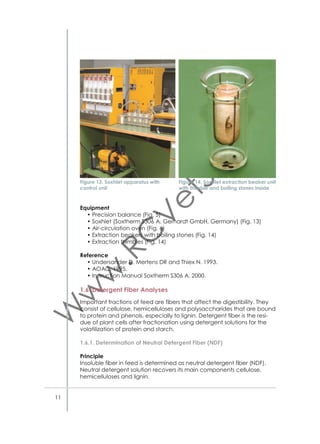
Figure 13. Soxhlet apparatus with
control unit

Figure 14. Soxhlet extraction beaker unit
with thimble and boiling stones inside

Equipment
• Precision balance (Fig. 5)
• Soxhlet (Soxtherm S306 A, Gerhardt GmbH, Germany) (Fig. 13)
• Air-circulation oven (Fig. 6)
• Extraction beakers with boiling stones (Fig. 14)
• Extraction thimbles (Fig. 14)
Reference
• Undersander D, Mertens DR and Thiex N. 1993.
• AOAC. 1995.
• Instruction Manual Soxtherm S306 A. 2000.

1.6. Detergent Fiber Analyses
Important fractions of feed are fibers that affect the digestibility. They
consist of cellulose, hemicelluloses and polysaccharides that are bound
to protein and phenols, especially to lignin. Detergent fiber is the residue of plant cells after fractionation using detergent solutions for the
volatilization of protein and starch.
1.6.1. Determination of Neutral Detergent Fiber (NDF)
Principle
Insoluble fiber in feed is determined as neutral detergent fiber (NDF).
Neutral detergent solution recovers its main components cellulose,
hemicelluloses and lignin.
11
Procedure
• Weigh oven-dry glass crucible (Wt)
• Add 0.5–1 g sample (Ws) in 600 ml Berzelius beaker
• Add 100 ml of neutral detergent solution and 0.5 g sodium sulfite
(Na2SO3)
• Boil for one hour in refluxing apparatus (Fig. 15)
• Pour through glass crucibles (Fig. 17)
• Admit vacuum (Fig. 16)
• Rinse crucibles with approximately 50 ml hot water four times until
all traces are removed
• Rinse with acetone repeatedly until drained liquid is cleared.
• Dry at 105 °C overnight
• Cool to room temperature in desiccator
• Weigh sample and crucible (W0)
• Ash residues for three hours at 550 °C
• Cool to room temperature in desiccators
• Weight crucibles and residues (Wa).

Figure 15. Refluxing apparatus

Calculations
%NDF = [(W0–Wt)/Ws]×100
Cell soluble material = 100 – %NDF
NDF expressed as organic matter:
Ash insoluble in neutral detergent
%NDFash = [(Ws–Wt )/(W0–Wt)]×100
Neutral detergent solution
• 2 l distilled water.
• 60 g sodium lauryl sulfate (C12H25O4S)
• 37.22 g disodium dihydrogen EDTA (C10H14N2Na2O8)
• 13.62 g sodium borate (decahydrate) (Na2B4O7.10H2O)

12
• 9.12 g disodium hydrogen phosphate (Na2HPO4)
• 20 ml 2–ethoxy–ethanol (C4H10O2)
• Adjust pH 6.9–7.1.
Equipment
• Precision balance (Fig. 5)
• Refluxing apparatus (Fig. 15)
• Vacuum filtering system with
trap in line (Fig. 16)
• Desiccator (Fig. 7)
• Berzelius beakers (600 ml)
• Sintered glass crucibles
(coarse porosity 1) (Fig. 17).
References
• Goering HK and VanSoest
PJ. 1970.
• Van Soest PJ, Robertson JB
and Lewis BA.1991.
1.6.2. Determination of Acid
Detergent Fiber (ADF)
Principle
Acid detergent fiber is determined as the residue remaining after adding an acidified
solution. It is the NDF without
the hemicelluloses. Cell soluble,
hemicelluloses and soluble minerals dissolve. Cetyl trimethyl-ammonium bromide (CTAB) separates proteins from the remaining
cellulose and lignin, and minerals
(ash). The acid detergents solution recovers cellulose and lignin.

Figure 16. Vacuum filtering system with
trap in line

ADF determination is a preparation step for lignin determination.
Procedure
• Add 0.5–1 g sample (Ws) in
600 ml Berzelius beaker
• Add 100 ml of acid detergent solution
• Boil for one hour on refluxing
apparatus

13

Figure 17. Glass crucible, porosity 1
•
•
•
•
•
•
•
•
•
•
•

Weigh oven–dry glass crucible (Wt)
Pour through glass crucibles
Admit vacuum
Rinse crucibles with approximately 50 ml hot water four times until
all traces are removed
Rinse with acetone repeatedly until drained liquid is cleared
Dry at 105 °C overnight
Cool to room temperature in desiccator
Weight sample and crucible (W0)
Ash residues for three hours at 550 °C
Cool to room temperature in desiccator
Weight crucibles and residues (Wa).

Calculations
%ADF = [(W0–Wt)/Ws]×100
ADF expressed as organic matter:
%ADFash = [(Wa–Wt)/(W0–Wt)]×100
Acid detergent solution
• 20 g cetyl trimethylammonium bromide (CTAB)
• 1l of 1.0 N sulfuric acid (H2SO4).
Equipment
• Precision balance (Fig. 5)
• Refluxing apparatus (Fig. 15)
• Vacuum filtering system with trap in line (Fig. 16)
• Desiccator (Fig. 7)
• Berzelius beakers (600 ml)
• Sintered glass crucibles (coarse porosity 1) (Fig. 17).
References
• Goering HK and VanSoest PJ. 1970.
• AOAC. 1995.
• Undersander D, Mertens DR and Thiex N. 1993.
1.6.3. Determination of Acid Detergent Lignin (ADL)
Principle
Lignin is the indigestible non-carbohydrate component of forages.
Residues from ADF determination are treated with sulfuric acid. Lignin
represents the indigestible NDF fraction.
Procedure
• Transfer crucibles with residues from ADF to a flat container or tray
• Cover the contents of the crucible with cooled 72% sulfuric acid
(H2SO4)
• Stir with glass rod, breaking all lumps

14
•
•
•
•
•
•
•
•
•

Fill crucible about half full with sulfuric acid and stir
Refill three times at room temperature
Leave for three hours stirring every 15 min with glass rod
Filter under vacuum
Rinse twice with 400 ml hot water
Dry overnight at 105 °C
Cool in desiccator and weigh (W0)
Ash at 550 °C for three hours
Cool in desiccator and weigh (Wa).

Calculations
%ADL = [(Wa–W0)/Ws]×100
Reagents / Solutions
72% sulfuric acid solution
• 735 ml concentrated sulfuric acid (98%)
• Add 265 ml water.
Equipment
• Precision balance (Fig. 5)
• Muffle furnace (550 °C) (Fig. 8)
• Sintered glass crucibles (coarse porosity 1) (Fig.17)
• Desiccator (Fig. 7).
References
• Goering HK and VanSoest PJ. 1970.
• AOAC. 1995.
1.6.4. Determination of Acid–Detergent Insoluble Nitrogen (ADIN)
Principle
ADIN is determined as the nitrogen remaining in ADF residue. In this
manual the percentage of Acid Detergent Insoluble Nitrogen (ADIN)
on DM basis is determined from the total ADF residue that is trapped in
filter paper.
Procedure
• Dry filter paper overnight at 100 °C and weigh (W0)
• Weigh 1 g air dry sample in 600 ml Berzelius beaker (Ws)
• Add 100 ml acid detergent solution
• Boil for 1 h on refluxing apparatus
• Filter onto filter paper using funnel with vacuum suction
• Wash beaker with hot distilled water to remove all fiber particles
into filter paper
• Use blanks (filter paper washed with ADF solution) to estimate nitrogen in paper and reagents
• Soak twice with boiling water after filling funnel with vacuum off for 2 minutes

15
• Rinse twice with acetone by filling funnel with vacuum off for 2
minutes before vacuuming dry
• Leave folded filter paper with residues in oven at 105 °C for 8 h or
overnight
• Weigh hot filter paper with residues (Wr)
• Transfer paper residue into Kjeldahl digestion tube
• Add additional 5 ml sulfuric acid to digest filter paper
• Determine nitrogen in residue by standard Kjeldahl
• Titrate with 0.01 N standard acid.
Calculation
%ADIN = [(%N in Wt – %N in W0)/(Ws×%DM)]×100
Reagents / Solutions
• Standard ADF solution (see 1.6.2.)
• For titration 0.01 N sulfuric acid (H2SO4) (see 1.6.2.).
Equipment
• Precision balance (Fig. 5)
• Refluxing apparatus (see Fig. 15)
• Vacuum filtering system with trap in line (Fig. 16)
• Air-circulation oven (Fig. 6)
• Berzelius beakers (600 ml)
• Sintered glass crucibles (course porosity 1) (Fig. 17)
• Büchner funnel
• Whatman filter paper number 54 or 541.
Crucible cleaning
The sintered glass crucibles (coarse porosity1) that are used for detergent fiber analyses (1.6.) need to be cleaned regularly as follows:
• Place crucibles on a metal tray and pull washing solution to cover
the bottom of the crucibles
• Keep overnight for 18 hours
• Rinse with distilled water until clear
• Dry crucibles in oven at 105 °C.
Washing solution
Dissolve 6 g of either Sodium dichromate or Potassium dichromate in
100 ml distilled water and then add 100 ml of concentrated sulfuric acid
References
• Licitra G, Hernandez TM and VanSoest PJ. 1996.

16
1.7. Fiber Analysis using the Semi–automated ANKOM Filter Bag
Technique
Conventional methods (Goering and VanSoest, 1970; AOAC, 1990)
require a great deal of preparatory and analytical technician time.
Semi–automated equipment for fiber analysis (ANKOM Technology
Corp., Fairport, NY) requires less technician time and increases sample
handling capacity. Furthermore, the semi–automated method helps
reduce technician interaction with harmful chemicals and alleviate errors that can occur due to variation in crucible filtration. This technique
is used in the Animal Nutrition Laboratories in Libya.
1.7.1. Acid Detergent Fiber (ADF) in Feeds using Filter Bag Technique
Principle
This method determines Acid Detergent Fiber, which is the residue
remaining after digesting with H2SO4 and CTAB. The fiber residues are
predominantly cellulose and lignin.
Scope
This method is applicable to grains, feeds, forages and all fiber–bearing
material.
Acid detergent solution
Add 20 g cetyl trimethylammonium bromide (CTAB) to 1 l of 1 N H2SO4
previously standardized. Agitate and heat to aid solution.
Preparation of sample
Grind samples in a centrifugal mill with a 2 mm screen, or cutter type
(Wiley) mill with a 1 mm screen. Samples ground finer may have particle loss from the filter bags and result in low values.
Procedure
• Use a solvent resistant marker to label the filter bags. Weigh filter
bag (W1) and zero balance. Do not pre–dry filter bags; any moisture will be accounted for by the blank bag correction
• Weigh 0.45–0.55 g of prepared sample (W2) directly in filter bag
Avoid placing the sample on the upper 4 mm of the bag
• Completely seal the upper edge of the filter bag within 4 mm of
the top with the heat sealer encapsulating the sample. Use sufficient heat to completely seal the filter bag and allow enough
cooling time (2 sec) before removing the bag from the heat sealer
• Weigh one blank bag and include in run to determine blank bag
correction (C1)
• Pre-extraction of fat–rich products (>5 % fat). Extract samples by
placing 24 bags with samples into a container with a top Pour
enough acetone into container to cover bags and secure top.

17
•

•

•

•
•

•

•
•

•

18

Shake the container 10 times and allow bags to soak for 10 minutes. Repeat with fresh acetone. Pour out acetone and place
bags on a wire screen to air–dry
Exception – Roasted soybean: Due to the processing of roasted
soya, a modification is required at the extraction stage. Place
roasted soy samples into a container with a top. Pour enough
acetone into container to cover bags and secure top. Shake the
container 10 times and pour off acetone. Add fresh acetone and
allow samples to soak for twelve hours. After soaking time, pour out
acetone and place bags on a wire screen to air–dry
Place a maximum of 24 bags into the Bag Suspender. All nine trays
should be used regardless of the number of bags being processed.
Place three bags per tray and then stack trays on center post with
each level rotated to 120 degrees. Insert the Bag Suspender with
bags into the fiber analyzer vessel and place the Bag Suspender
weight on top to keep it submerged. Prior to inserting the Bag Suspender, if the vessel temperature is warm from a previous run, add
cold water and exhaust
When processing 24 sample bags, add 1900–2000 ml of ambient
temperature AD solution to the fiber analyzer vessel. If processing
less than 20 bags, add 100 ml/bag of AD solution (use a minimum
of 1500 ml to ensure Bag Suspender is covered).
Turn Agitate and Heat ON and confirm agitation. Set timer for 60
min and close lid
At end of extraction, turn Heat and Agitate off. Open the drain
valve (slowly at first) and exhaust hot solution before opening lid.
The solution in the vessel is under pressure. The exhaust valve needs
to be opened to release the pressure and solution prior to opening
the lid
After the solution has been exhausted, close the exhaust valve
and open the lid. Add 1900–2000 ml of (70–90 °C) rinse water. Turn
Agitate on and rinse for 5 min. The lid may be sealed with the Heat
On or left open with the Heat Off. Repeat hot water rinses a total
of four times or until water is of neutral pH
When the rinsing process is complete remove the samples. Gently
press out excess water from bags. Place bags in a 250 ml beaker,
add enough acetone to cover bags and soak for 3–5 min
Remove bags from acetone and place on a wire screen to air–dry
Completely dry in oven at 105±2 °C (most ovens will complete
drying within 2–4 hours). Do not place bags in the oven until the
acetone has completely evaporated
Remove bags from oven, place directly into a collapsible desiccant
pouch and flatten to remove air. Cool to ambient temperature and
weigh bags (W3). Do not use conventional desiccator container.
Caution
• Sulfuric acid is a strong acid and will cause severe burns. Protective
clothing should be worn when working with this acid. Always add
acid to water and not the reverse
• CTAB will irritate the mucous membranes. A dust mask and gloves
should be worn when handling this chemical
• Acetone is extremely flammable. Avoid static electricity and use a
fume hood when handling.
Calculations
%ADF (as-received basis) = [W3 – (W1×C1)/W2]×100
Where:
W1 = Bag tare weight
W2 = Sample weight
W3 = Dried weight of bag with fiber after extraction process
C1 = Blank bag correction (final oven-dried weight divided by original
blank bag weight)
Equipment
• Analytical balance, capable of weighing down to 0.1 mg
• Oven capable of maintaining a temperature of 105±2 °C
• ANKOM200, 65 rpm agitation, digestion instrument capable of
performing digestion at 100 ± 0.5 °C, and maintaining a pressure of
10–25 psi. The instrument must also be capable of creating a similar
flow around each sample to ensure uniformity of extraction (Fig. 18)
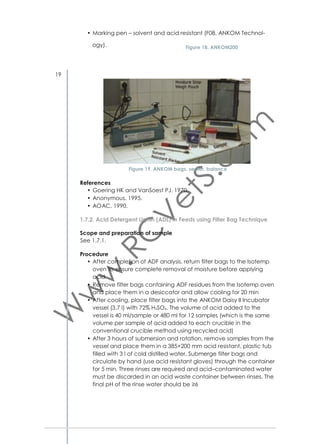
• Filter bags, constructed from chemically inert and heat resistant
filter media, capable of being
heat sealed closed and able
to retain 25 micron particles
while permitting rapid solution
penetration (F57, ANKOM Technology) (Fig. 19)
• Heat sealer – sufficient for sealing the filter bags to complete
closure (1915, ANKOM Technology) (Fig. 19)
• Desiccator pouch, collapsible
sealable pouch with desiccant inside that enables the
removal of air from around the
filter bags (Moisture Stop Weigh
Pouch, ANKOM Technology)
• Marking pen – solvent and acid
resistant (F08, ANKOM Technology).
Figure 18. ANKOM200

19
Figure 19. ANKOM bags, sealer, balance

References
• Goering HK and VanSoest PJ. 1970.
• Anonymous. 1995.
• AOAC. 1990.
1.7.2. Acid Detergent Lignin (ADL) in Feeds using Filter Bag Technique
Scope and preparation of sample
See 1.7.1.
Procedure
• After completion of ADF analysis, return filter bags to the Isotemp
oven to ensure complete removal of moisture before applying acid
• Remove filter bags containing ADF residues from the Isotemp oven
and place them in a desiccator and allow cooling for 20 min
• After cooling, place filter bags into the ANKOM Daisy II Incubator vessel (3.7 l) with 72% H2SO4. The volume of acid added to the
vessel is 40 ml/sample or 480 ml for 12 samples (which is the same
volume per sample of acid added to each crucible in the conventional crucible method using recycled acid)
• After 3 hours of submersion and rotation, remove samples from the
vessel and place them in a 385×200 mm acid resistant, plastic tub
filled with 3 l of cold distilled water. Submerge filter bags and circulate by hand (use acid resistant gloves) through the container for 5
min. Three rinses are required and acid–contaminated water must
be discarded in an acid waste container between rinses. The final
pH of the rinse water should be ≥6
• When the rinsing process is complete remove the samples. Gently
press out excess water from bags. Place bags in a 250 ml beaker
and add enough acetone to cover bags. Soak for 3–5 min
• Remove bags from acetone and place on a wire screen to air–
dry.Completely dry in oven at 105±2 °C (most ovens will complete

20
drying within 2–4 h). Do not place bags in the oven until acetone
has completely evaporated
• Remove bags from oven, place directly into a collapsible desiccant pouch and flatten to remove air. Cool to ambient temperature and weigh bags (W3). Do not use conventional desiccator
container.
Calculations
%ADL (as-received basis) = [W3 – (W1×C1)/W2]×100
Where:
W1 = Bag tare weight
W2 = Sample weight
W3 = Dried weight of bag with fiber after extraction process
C1 = Blank bag correction (final oven–dried weight divided by original
blank bag weight)
Equipment
• See Acid detergent fiber (1.7.1)
References
• Goering HK and VanSoest PJ.1970.
• Anonymous. 1995.
• AOAC. 1990.
1.7.3. Neutral Detergent Fiber (NDF) in Feeds using Filter Bag Technique
Principle
This method determines Neutral Detergent Fiber, which is the residue
remaining after digesting in a detergent solution. The fiber residues are
predominantly hemicelluloses, cellulose, and lignin.
Scope
This method is applicable to grains, feeds, forages and all fiber–bearing
material.
Reagents / Solutions
• Neutral Detergent Solution: Add 30 g sodium lauryl sulfate, USP;
18.61 g Ethylenediamine-tetraacetic disodium salt, dihydrate; 6.81
g sodium tetraborate decahydrate; 4.56 g sodium phosphate
dibasic, anhydrous; and 10 ml triethylene glycol, in 1 l distilled H2O
Check pH range to 6.9 to 7.1. Agitate and heat to aid solution
• Alpha-amylase: Heat-stable bacterial alpha-amylase: activity =
17,400 Liquefon Units/ml (FAA, ANKOM Technology)
• Sodium sulfite: Na2SO3, anhydrous.

21
Preparation of sample
Grind samples in a centrifugal mill with a 2 mm screen, or cutter type
(Wiley) mill with a 1 mm screen. Samples ground finer may have particle loss from the filter bags and result in low values.
Procedure
• Use a solvent resistant marker to label the filter bags. Weigh filter
bag (W1) and zero balance. Do not pre-dry filter bags; any moisture will be accounted for by the blank bag correction
• Weigh 0.45–0.55 g of prepared sample (W2) directly in filter bag.
Avoid placing the sample on the upper 4 mm of the bag
• Completely seal the upper edge of the filter bag within 4 mm of
the top, with the heat sealer encapsulating the sample. Heat sufficiently to completely seal the filter bag and allow enough cooling
time (2 sec) before removing the bag from the heat sealer
• Weigh one blank bag and include in run to determine blank bag
correction (C1)
• Pre-extraction of fat-rich products (>5% fat) (as for Acid detergent
fiber)
• Place a maximum of 24 bags into the Bag Suspender. All nine trays
should be used regardless of the number of bags being processed
Place three bags per tray and then stack trays on center post with
each level rotated to120 degrees. Insert the Bag Suspender with
bags into the fiber analyzer vessel and place the weight on top to
keep it submerged. Prior to inserting the Bag Suspender, if the vessel temperature is warm from a previous run, add cold water and
exhaust
• When processing 24 sample bags, add 1900–2000 ml of ambient
ND solution to the fiber analyzer vessel. If processing less than 20
bags, add 100 ml/bag of ND solution (use a minimum of 1500 ml
to ensure Bag Suspender is covered). Add 20 g (0.5 g/50 ml of ND
solution) of sodium sulfite to the solution in the vessel
• Turn Agitate and Heat on, and confirm agitation. Set timer for 75
min and close lid
• At end of extraction, turn Heat and Agitate off. Open the drain
valve (slowly at first) and exhaust hot solution before opening lid.
The solution in the vessel is under pressure. The exhaust valve needs
to be opened to release the pressure and solution prior to opening
the lid
• After the solution has been exhausted, close the exhaust valve and
open the lid. Add 1900 ml of (70–90 °C) rinse water, and 4 ml of
alpha–amylase to the first and second rinses. Turn Agitate on and
rinse for 5 min. The lid may be sealed with the Heat on or left open
with the Heat off. Repeat hot water rinses a total of three times
• When the rinsing process is complete remove the samples. Gently
press out excess water from bags. Place bags in a 250 ml beaker,
add enough acetone to cover bags and soak for 3–5 min.

22
• Remove bags from acetone and place on a wire screen to air-dry.
Completely dry in oven at 105±2 °C (most ovens will complete drying within 2–4 h). Do not place bags in the oven until acetone has
completely evaporated
• Remove bags from oven, place directly into a collapsible desiccant pouch and flatten to remove air. Cool to ambient temperature and weigh bags (W3). Do not use conventional desiccator
container.
Calculations
%NDF (as–received basis) = [W3 – (W1×C1)/W2]×100
Where:
W1 = Bag tare weight
W2 = Sample weight
W3 = Dried weight of bag with fiber after extraction process
C1 = Blank bag correction (final oven-dried weight divided by the original blank bag weight)
Caution
• Powdered chemicals will irritate the mucous membranes. A dust
mask and gloves should be worn when handling this chemical
• Acetone is extremely flammable. Avoid static electricity and use a
fume hood when handling.
Equipment
• As for Acid detergent fiber.
References
• Goering HK and VanSoest PJ. 1970.
• Anonymous. 1995.
• AOAC. 1990.
1.7.4. Crude Fiber Analysis in Feeds by Filter Bag Technique
Principle
This method determines crude fiber which is the organic residue
remaining after digesting with 0.255 N H2SO4 and 0.313 N NaOH. The
compounds removed are predominantly protein, sugar, starch, lipids
and portions of both the structural carbohydrates and lignin.
Scope
This method is applicable for all feed materials such as grains, meals, pet
foods, mixed feeds, forages and the following oilseeds: corn and soybeans.
Reagents / Solutions
• Sulfuric acid solution: Density 0.255±0.005, 1.25 g H2SO4/100 ml.

23
Concentration must be checked by titration. Sulfuric acid is a
strong acid and will cause severe burns. Protective clothing should
be worn when working with this acid. Always add acid to water
and not the reverse
• Sodium hydroxide solution: 0.313±0.005 N, 1.25 g NaOH/100 ml.
Concentration must be checked by titration. Sodium hydroxide
can severely burn skin, eyes and respiratory tract. Protective clothing should be worn. Always add caustic material to water and not
the reverse.
Preparation of sample
As for Acid detergent fiber.
Procedure
• Use a solvent and acid resistant marker to label the filter bags.
Weigh filter bag (WI) and zero balance. Do not pre-dry filter bags;
any moisture will be accounted for by the blank bag correction
• Weigh 0.95–1.0 g of prepared sample (W2) directly in filter bag
Avoid placing the sample on the upper 4 mm of the bag
• Completely seal the upper edge of the filter bag within 4 mm of
the top with the heat sealer encapsulating the sample. Use sufficient heat to seal the filter bag and allow enough cool time (2
sec) before removing the bag from the heat sealer
• Weigh one blank bag and include in run to determine blank bag
correction (C1)
• Extract fat from samples by placing all bags into a 350 ml container. Add enough petroleum ether to cover bags and soak for
10 min. Pour off solvent and allow bags to air–dry. Spread sample
uniformly inside the filter bag by shaking and flicking the bag to
eliminate clumping
• Place a maximum of 24 bags into the Bag Suspender. All nine trays
must be used regardless of the number of bags being processed.
Place three bags per tray and then stack trays on center post with
each level rotated to 120 degrees. Insert the Bag Suspender with
bags into the fiber analyzer vessel and place the Bag Suspender
weight on top of the empty 9th tray to keep it submerged. Prior to
inserting the Bag Suspender, if the vessel temperature is warm from
a previous run, add cool water and exhaust
• When processing 24 sample bags, pour 1900–2000 ml of ambient
temperature acid (0.255 N H2SO4) solution to the fiber analyzer vessel. If processing less than 20 bags, add 100 ml/bag of acid solution
(use minimum of 1500 ml to ensure Bag Suspender is covered)
• Turn Agitate and Heat on and confirm that Bag Suspender is agitating properly. Close and completely seal the lid of vessel. Extract
samples for a total of 40 min
• At end of extraction, turn Heat and Agitate off. Open the drain
valve (slowly at first) and exhaust hot solution before opening lid

24
• Note: The solution in the vessel is under pressure. The exhaust valve
needs to be opened to release the pressure and solution prior to
opening the lid
• After the solution has been exhausted, close the exhaust valve
and open the lid. Add 1900 ml of (50–85 °C) rinse water and agitate for 5 min. The lid may be sealed with the Heat on or left open
with the Heat off. Repeat hot water rinse (total of two rinses)
• When the rinsing process is complete remove the samples. Gently
press out excess water from bags. Place bags in a 250 ml beaker,
add enough acetone to cover bags and soak for 3–5 min.
• Remove bags from acetone and place on a wire screen to air–dry.
Completely dry in oven at 105±2 °C (most ovens will complete drying within 2–4 h). Do not place bags in the oven until acetone has
completely evaporated
• Remove bags from oven, place directly into a collapsible desiccant pouch and flatten to remove air. Cool to ambient temperature and weigh bags
• Ash the entire bag/sample in pre-weighed crucible for 2 h at
600±15 °C, cool in desiccator and weigh to calculate loss of
weight of organic matter (W3).
Calculations
% Crude Fiber = [W3–(W1×C1)/W2]×100
Where:
W1 = Bag tare weight,
W2 = Sample weight
W3 = Weight of Organic Matter (Loss of weight on ignition of bag and
fiber)
C1 = Ash corrected blank bag factor (Loss of weight on ignition of
blank bag/original blank bag)
Equipment
As for Acid detergent fiber.
References
• Goering HK and VanSoest PJ. 1970.
• Anonymous. 1995.
• AOAC. 1990.

1.8. Determination of Macro and Micro Minerals
Principle
Samples are dried and ashed. The ash is dissolved in acid and diluted
with water. The minerals in the diluted ash are determined.

25
Procedure
Sample preparation
• Mix and homogenize the samples
• Weigh about 1 g of the sample to nearest mg in crucible (Vycor® dish)
• Dry at least for 1 h in 105 °C air forced oven
• Ash in furnace overnight (16 h) at 550 °C
• Cool in desiccator
• Add 1 ml HNO3 to dissolve the ash
• Transfer to 250 ml volumetric flask and make up volume with H2O.
Equipment
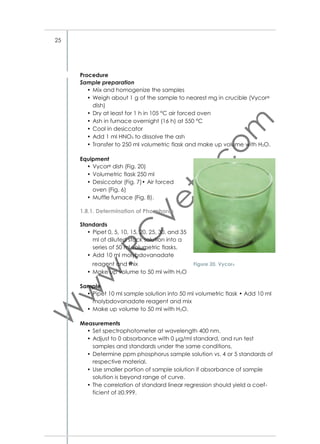
• Vycor® dish (Fig. 20)
• Volumetric flask 250 ml
• Desiccator (Fig. 7)
• Air forced oven (Fig. 6)
• Muffle furnace (Fig. 8).
1.8.1. Determination of Phosphorus
Standards
• Pipet 0, 5, 10, 15, 20, 25, 30, and 35
ml of diluted stock solution into a
series of 50 ml volumetric flasks.
• Add 10 ml molybdovanadate
reagent and mix
• Make up volume to 50 ml with H2O

Figure 20. Vycor®

Sample
• Pipet 10 ml sample solution into 50 ml volumetric flask
• Add 10 ml molybdovanadate reagent and mix
• Make up volume to 50 ml with H2O.
Measurements
• Set spectrophotometer at wavelength 400 nm.
• Adjust to 0 absorbance with 0 μg/ml standard, and run test
samples and standards under the same conditions.
• Determine ppm phosphorus sample solution vs. 4 or 5 standards of
respective material.
• Use smaller portion of sample solution if absorbance of sample
solution is beyond range of curve.
• The correlation of standard linear regression should yield a coefficient of ≥0.999.
1.8.2. Determination of Potassium and Sodium
Standards
Use 0, 1, 2, 3, 4, 6, 8 and 10 ppm standards.

26
Sample
Pipet 5 ml sample solution into 50 ml volumetric flask.
Make up to volume.
Measurements
• Adjust flame photometer to 0 absorbance with 0 ppm standard and
run test portions along with standards under the same conditions
• Determine ppm minerals sample solution vs 4 or 5 standards of
respective material
• Use smaller portion of sample solution if absorbance of sample
solution is beyond range of curve
• The correlation of standard linear regression should yield a coefficient of ≥0.999
• Linearity is harvested using standards from 0 to 10 ppm; beyond 10
ppm the standard curve is not linear.
1.8.3. Determination of Calcium and Magnesium
Standards
• Pipet 0, 2.5, 5, 7.5, 10, 12.5 and 15 ml of diluted stock solution into a
series of 50 ml volumetric flasks
• Add 5 ml La stock solution, and dilute to volume. You will obtain
0–6 μg/ml of Ca and 0–0.3 μg/ml of Mg in 0.1% La.
Samples
• Pipet 5 ml sample solution into 50 ml volumetric flask
• Add 5 ml La stock solution and dilute to volume.
Measurements
• Set the optimum response of AAS system (Table 1)
• Adjust to 0 absorbance with 0 μg/ml standard, and run test
samples and standards under the same conditions
• Determine ppm minerals sample solution vs. 4 or 5 standards of
respective material
• Use smaller portion of sample solution if absorbance of sample
solution is beyond range of curve
• The correlation of standard linear regression should yield a coefficient of ≥0.999.
Note: All glassware should be rinsed in 1:1 HCl and then rinsed with
distilled water.
Reagents / Solutions
Preparation of chemicals for concentrated stock solution
• Calcium carbonate CaCO3, dry overnight at 200 °C
• Ammonium dihydrogen phosphate (NH4)H2PO4, dry overnight at
110 °C

27
• Sodium chloride NaCl. Dry overnight at 110 °C
• Potassium chloride KCl. Dry overnight at 120 °C
• Magnesium stock solution (1000 mg Mg/l)
– Magnesium metal. Mg 9.95%
– 1000 mg pure Mg metal in 50 ml H2O
– Add slowly 10 ml HCl
– Make up to 1000 ml
• HCl stock solution(1:3).
– 75 ml distilled water
– Add slowly 25 ml HCl
Concentrated standard stock solution
• 500 mg Ca/l
• 300 mg P/l
• 25 mg Mg/l
• 1000 ml volumetric flask
• Add 1.249 g CaCO3
• 1.114 g (NH4)H2PO4
• 25 ml Mg stock solution
• Add 30 ml HCl stock solution
• Mix until dissolved and then make up to volume.
Diluted standard stock solution (20 mg Ca/l, 12 mg P/l, and 1 mg Mg/l)
• Add 40 ml concentrated stock solution in 1000 ml volumetric flask
• Make up to 1000 ml with distilled water.
Molybdovanadate solution
While stirring gradually add molybdate solution to vanadate solution.
Molybdate solution
• Weigh 1.5 g ammonium metavanadate
• Add 690 ml hot H2O
• Add 300 ml HNO3
• Cool to 20 °C
• Make up to 1000 ml with distilled water.
Vanadate solution
• Weigh 60 g ammonium molybdate tetrahydrate
• Add 900 ml hot H2O
• Cool to 20 °C
• Make up to 1000 ml with distilled water.
Note: Store at room temperature in polyethylene or glass–stopper Pyrex
bottle. Reagent is stable in Pyrex bottle. Discard reagent if precipitate
forms.

28
Lanthanum stock solution (1% La)
• Weigh 11.73 g La2O3 or 26.74 g LaCl3.7H2O
• Add slowly 25 ml HNO3
• Make up solution to 1 l.
Note: Reagents for mineral standards must be ultra–pure (99.95%).
Opened reagents should be resealed and stored in desiccator.
Calculations
Plot absorbance vs. μg/ml minerals using Microsoft Excel. Use the Forecast function of Microsoft Excel to calculate mineral concentration (C)
based on standard data.
Calculate the content of minerals in mg /100 g as follows:
Minerals,mg/100 g = (C×D)/W
Where:
C = μg/ml Ca or Mg in the assay solution
W = g weight of sample
D = dilution factor×factor for transforming to mg/100 g
D = [(250×50)/10]×(100/1000) = 125
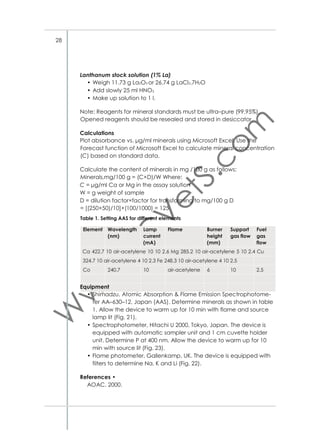
Table 1. Setting AAS for different elements
Element

Wavelength
(nm)

Lamp
current
(mA)

Flame

Burner
height
(mm)

Support
gas flow

Fuel
gas
flow

Ca

422.7

10

air-acetylene

10

10

2.6

Mg

285.2

10

air-acetylene

5

10

2.4

Cu

324.7

10

air-acetylene

4

10

2.3

Fe

248.3

10

air-acetylene

4

10

2.5

Co

240.7

10

air-acetylene

6

10

2.5

Equipment
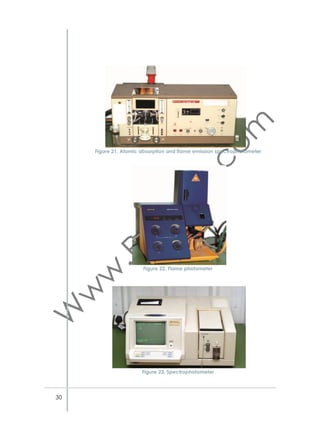
• Shimadzu, Atomic Absorption & Flame Emission Spectrophotometer AA–630–12, Japan (AAS). Determine minerals as shown in table
1. Allow the device to warm up for 10 min with flame and source
lamp lit (Fig. 21).
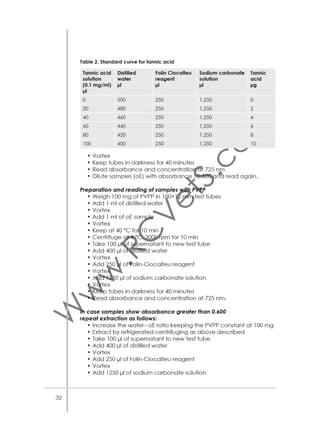
• Spectrophotometer, Hitachi U 2000, Tokyo, Japan. The device is
equipped with automatic sampler unit and 1 cm cuvette holder
unit. Determine P at 400 nm. Allow the device to warm up for 10
min with source lit (Fig. 23).
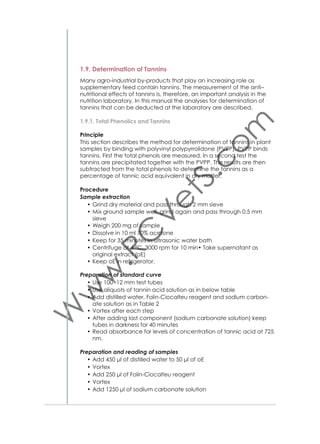
• Flame photometer, Gallenkamp, UK. The device is equipped with
filters to determine Na, K and Li (Fig. 22).
References
• AOAC. 2000.

29
Figure 21. Atomic absorption and flame emission spectrophotometer

Figure 22. Flame photometer

Figure 23. Spectrophotometer

30
1.9. Determination of Tannins
Many agro-industrial by-products that play an increasing role as
supplementary feed contain tannins. The measurement of the anti–nutritional effects of tannins is, therefore, an important analysis in the nutrition laboratory. In this manual the analyses for determination of tannins
that can be deducted at the laboratory are described.
1.9.1. Total Phenolics and Tannins
Principle
This section describes the method for determination of tannins in plant
samples by binding with polyvinyl polypyrrolidone (PVPP). PVPP binds
tannins. First the total phenols are measured. In a second test the tannins are precipitated together with the PVPP. The results are then subtracted from the total phenols to determine the tannins as a percentage of tannic acid equivalent in dry matter.
Procedure
Sample extraction
• Grind dry material and pass through 2 mm sieve
• Mix ground sample well, grind again and pass through 0.5 mm
sieve
• Weigh 200 mg of sample
• Dissolve in 10 ml 70% acetone
• Keep for 35 minutes in ultrasonic water bath
• Centrifuge at 4 °C, 3000 rpm for 10 min
• Take supernatant as original extract (oE)
• Keep oE in refrigerator.
Preparation of standard curve
• Use 100×12 mm test tubes
• Use aliquots of tannin acid solution as in below table
• Add distilled water, Folin-Ciocalteu reagent and sodium carbonate solution as in Table 2
• Vortex after each step
• After adding last component (sodium carbonate solution) keep
tubes in darkness for 40 minutes
• Read absorbance for levels of concentration of tannic acid at 725
nm.
Preparation and reading of samples
• Add 450 μl of distilled water to 50 μl of oE
• Vortex
• Add 250 μl of Folin-Ciocalteu reagent
• Vortex
• Add 1250 μl of sodium carbonate solution

31
Table 2. Standard curve for tannic acid
Tannic acid
solution
(0.1 mg/ml)
μl

Distilled
water
μl

Folin Ciocalteu
reagent
μl

Sodium carbonate
solution
μl

Tannic
acid
μg

0

500

250

1,250

0

20

480

250

1,250

2

40

460

250

1,250

4

60

440

250

1,250

6

80

420

250

1,250

8

100

400

250

1,250

10

•
•
•
•

Vortex
Keep tubes in darkness for 40 minutes
Read absorbance and concentration at 725 nm
Dilute samples (oE) with absorbance >0.600 and read again.

Preparation and reading of samples with PVPP
• Weigh 100 mg of PVPP in 100×12 mm test tubes
• Add 1 ml of distilled water
• Vortex
• Add 1 ml of oE sample
• Vortex
• Keep at 40 °C for 10 min
• Centrifuge at 4 °C, 3000 rpm for 10 min
• Take 100 μl of supernatant to new test tube
• Add 400 μl of distilled water
• Vortex
• Add 250 μl of Folin-Ciocalteu reagent
• Vortex
• Add 1250 μl of sodium carbonate solution
• Vortex
• Keep tubes in darkness for 40 minutes
• Read absorbance and concentration at 725 nm.
In case samples show absorbance greater than 0.600
repeat extraction as follows:
• Increase the water– oE ratio keeping the PVPP constant at 100 mg
• Extract by refrigerated centrifuging as above described
• Take 100 μl of supernatant to new test tube
• Add 400 μl of distilled water
• Vortex
• Add 250 μl of Folin-Ciocalteu reagent
• Vortex
• Add 1250 μl of sodium carbonate solution

32
• Vortex
• Keep tubes in darkness for 40 minutes
• Read absorbance and concentration at 725 nm.
Calculations
Calculation of total phenols
1. Reading of samples as per the procedure described above gives
a concentration (conc.) of tannic acid in μg/μl for 50 μl of the original extracted sample (oE)
2. Concentration for 1 ml of oE in μg can be calculated dividing by 0.05
3. Transfer result into mg tannic acid
4. 200 mg of sample were extracted in 10 ml solvent (20 mg/ml).
Therefore 100 mg content 5 times mg of tannic acid
5. Transfer result into g of tannic acid per 100 g of sample.
Step 1–5 can be therefore calculated as:
x = [(conc/0.05)/1000]×5
Express as percentage of tannic acid in dry matter.
Calculation of non–tannin phenols
1. Reading of samples as per above described procedure gives concentration (conc.) of tannic acid in μg/ μl for 100 μl of the supernatant.
2. Concentration for 1 ml of supernatant in μg can be calculated
dividing by 0.1.
3. Transfer result into mg tannin acid to get per 10 mg sample since
extract is diluted 2–fold.
4. Multiply by 10 to get concentration of tannic acid in 100 mg of
sample.
5. Step 1– 4 can be therefore calculated as:
y = [(conc/0.01)/1000]×10
Express as percentage of tannic acid in dry matter.
6. Calculate tannin in sample as tannic acid equivalent subtracting
the non–tannin phenols from total phenols: x–y % in dry matter
Reagents / Solutions
70% acetone
• Prepare 70% aqueous acetone (v/v).
Folin–Ciocalteu reagent (1N)
• Dilute commercial Folin–Ciocalteu reagent (2N) with equal volume
of distilled water
• Keep in brown bottle at 4 °C; watch golden color. If color changes
to green, discard.
Sodium carbonate (20%)
• Weigh 40 g sodium carbonate (Na2CO3.10H2O) in 200 ml distilled
water

33
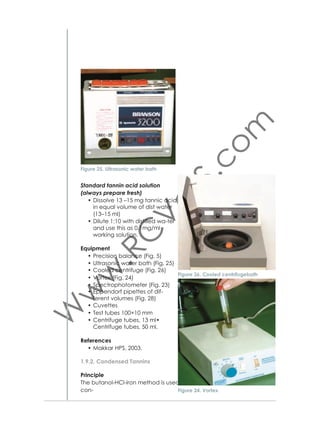
Figure 25. Ultrasonic water bath

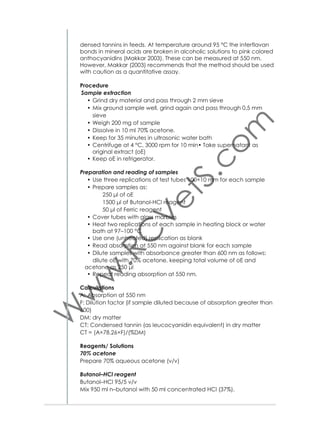
Figure 26. Cooled centrifugebath

Standard tannin acid solution
(always prepare fresh)
• Dissolve 13 –15 mg tannic acid
in equal volume of dist water
(13–15 ml)
• Dilute 1:10 with distilled water and use this as 0.1mg/ml
working solution.
Equipment
• Precision balance (Fig. 5)
• Ultrasonic water bath (Fig.
25)
• Cooled centrifuge (Fig. 26)
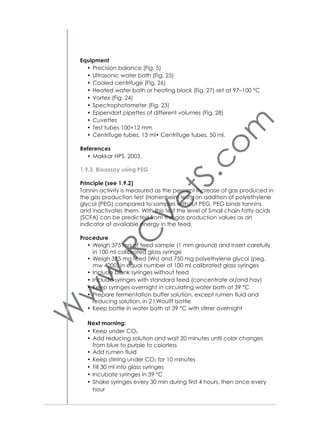
• Vortex (Fig. 24)
• Spectrophotometer (Fig.
23)
• Eppendorf pipettes of different volumes (Fig. 28)
• Cuvettes
• Test tubes 100×10 mm
• Centrifuge tubes, 13 ml
• Centrifuge tubes, 50 ml.

Figure 24. Vortex

References
• Makkar HPS. 2003.
1.9.2. Condensed Tannins
Principle
The butanol-HCl-iron method is used to ascertain the presence of con34
densed tannins in feeds. At temperature around 95 °C the interflavan
bonds in mineral acids are broken in alcoholic solutions to pink colored
anthocyanidins (Makkar 2003). These can be measured at 550 nm.
However, Makkar (2003) recommends that the method should be used
with caution as a quantitative assay.
Procedure
Sample extraction
• Grind dry material and pass through 2 mm sieve
• Mix ground sample well, grind again and pass through 0.5 mm sieve
• Weigh 200 mg of sample
• Dissolve in 10 ml 70% acetone.
• Keep for 35 minutes in ultrasonic water bath
• Centrifuge at 4 °C, 3000 rpm for 10 min
• Take supernatant as original extract (oE)
• Keep oE in refrigerator.
Preparation and reading of samples
• Use three replications of test tubes 100×10 mm for each sample
• Prepare samples as:
250 μl of oE
1500 μl of Butanol-HCl reagent
50 μl of Ferric reagent
• Cover tubes with glass marbles
• Heat two replications of each sample in heating block or water
bath at 97–100 °C
• Use one (unheated) replication as blank
• Read absorption at 550 nm against blank for each sample
• Dilute samples with absorbance greater than 600 nm as follows:
dilute oE with 70% acetone, keeping total volume of oE and
acetone as 250 μl
• Repeat reading absorption at 550 nm.
Calculations
A: Absorption at 550 nm
F: Dilution factor (if sample diluted because of absorption greater than 600)
DM: dry matter
CT: Condensed tannin (as leucocyanidin equivalent) in dry matter
CT = (A×78.26×F)/(%DM)
Reagents/ Solutions
70% acetone
Prepare 70% aqueous acetone (v/v)
Butanol–HCl reagent
Butanol–HCl 95/5 v/v
Mix 950 ml n–butanol with 50 ml concentrated HCl (37%).

35
Figure 27. Heating block

Figure 28. Eppendorf pipettes (different volumes)

Figure 29: Sample extraction

Ferric reagent
• Make 2N HCl: make 16.6 ml concentrated HCl up to 100 ml with
distilled water
• Add 2 g ferric ammonium sulfate to 100 ml of 2N HCl solution
• Store in dark bottle.

36
Equipment
• Precision balance (Fig. 5)
• Ultrasonic water bath (Fig. 25)
• Cooled centrifuge (Fig. 26)
• Heated water bath or heating block (Fig. 27) set at 97–100 °C
• Vortex (Fig. 24)
• Spectrophotometer (Fig. 23)
• Eppendorf pipettes of different volumes (Fig. 28)
• Cuvettes
• Test tubes 100×12 mm
• Centrifuge tubes, 13 ml
• Centrifuge tubes, 50 ml.
References
• Makkar HPS. 2003.
1.9.3. Bioassay using PEG
Principle (see 1.9.2)
Tannin activity is measured as the percent increase of gas produced in
the gas production test (Hohenheim test), on addition of polyethylene
glycol (PEG) compared to samples without PEG. PEG binds tannins
and inactivates them. With this test the level of Small chain fatty acids
(SCFA) can be predicted from the gas production values as an indicator of available energy in the feed.
Procedure
• Weigh 375 mg of feed sample (1 mm ground) and insert carefully
in 100 ml calibrated glass syringe
• Weigh 375 mg feed (Ws) and 750 mg polyethylene glycol (peg,
mw 4000) in equal number of 100 ml calibrated glass syringes
• Include blank syringes without feed
• Include syringes with standard feed (concentrate or/and hay)
• Keep syringes overnight in circulating water bath at 39 °C
• Prepare fermentation buffer solution, except rumen fluid and reducing solution, in 2 l.Woulff bottle
• Keep bottle in water bath at 39 °C with stirrer overnight
Next morning:
• Keep under CO2
• Add reducing solution and wait 20 minutes until color changes
from blue to purple to colorless
• Add rumen fluid
• Keep stirring under CO2 for 10 minutes
• Fill 30 ml into glass syringes
• Incubate syringes in 39 °C
• Shake syringes every 30 min during first 4 hours, then once every hour

37
• Record gas production at 8 hours and push back piston to 30 ml if
gas production exceeds 70 ml
• Record gas production at 24 hours and terminate experiment.
Calculations for tannin activity
Gn = [(V24–V0–G0)×FSt×0.375]/Ws
if piston pushed back to 30 ml after 8 hours use:
Gn = [(V24–V0+V8–30–G0)×FSt×0.375]/Ws
FSt = GSt/GSt measured
Reference value (FSt) is gas production GSt of the standard sample (e.g. hay
and/or concentrate) as per supplier (e.g. Landesarbeitskreis. Fütterung,
Baden Württemberg e.V. (LAF), Hohenheim, 70578 Stuttgart, PF 7200220)
compared to the measured gas production in the test (GSt measured).
Gn = gas production value in ml
G0 = gas production of blank syringes (ml)
V0 = volume in ml at begin
V8 = volume in ml at 8 hours
V24 = volume in ml at 24 hours
Ws = weight of dried sample in mg
%Tannin activity = GPEG– GnoPEG
GPEG= Gas production with PEG
GnoPEG = gas production without PEG
Prediction of Small Chain Fatty Acids (SCFA)
Relationship between SCFA production (nmol) and gas volume (ml)
after 24 hours incubation (example of tannin containing browses)
(Makkar, 2003):
SCFAnoPEG = –0.0601+0.0239×G24
R2 = 0.953; N = 39; P <0.001
SCFAPEG = 0.0521+0.0207×G24
R2 = 0.925; N = 37; P <0.001
overall SCFA = –0.00425+0.0222×G24
R2 = 0.935; N = 76; P <0.001
Reagents/ Solutions
Rumen fluid
• Collect rumen fluid before morning feeding from 2 rams
• Filter through two–layer cheese cloth into thermos container
• Keep at 39 °C and under carbon dioxide (CO2).

38
Fermentation buffer solution
• 630 ml of bicarbonate buffer
• 315 ml of macromineral solution
• 0.16 ml of micromineral solution
• 1.6 ml of resazurine solution
• 945 ml distilled water
• 60 ml of fresh prepared reducing solution
• 660 ml rumen fluid.
Bicarbonate buffer
• 35 g sodium bicarbonate (NaHCO3)
• 4 g ammonium carbonate
• Dissolve in 500 ml distilled water and then make up to 1 l.
Macromineral solution
• 6.2 g potassium dihydrogen phosphate (KH2PO4)
• 5.7 g disodium hydrogen phosphate (Na2HPO4)
• 0.6 g magnesium sulphate (MgSO4.7H2O)
• Dissolve in 500 ml distilled water and then make up to 1 liter.
Micromineral solution
• 10 g manganese chloride (MnCl2.4H2O)
• 13.2 g calcium chloride (CaCl2.2H2O)
• 1 g cobalt chloride (CoCl2.6H2O)
• Dissolve in 50 ml distilled water and then make up to 100 ml.
Resazurine
• 0.1 g resazurine in 100 ml distilled water
Reducing solution
• 996 mg sodium sulphide (Na2S.9H2O)
• Dissolve in 94 ml distilled water
• 6 ml 1 N sodium hydroxide solution (NaOH)
• 1 N NaOH = 4 g NaOH in 100 ml distilled water.
Equipment
• Precision balance (Fig. 5)
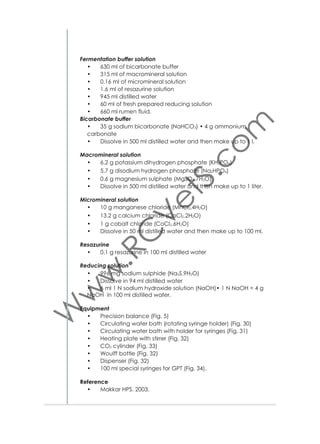
• Circulating water bath (rotating syringe holder) (Fig. 30)
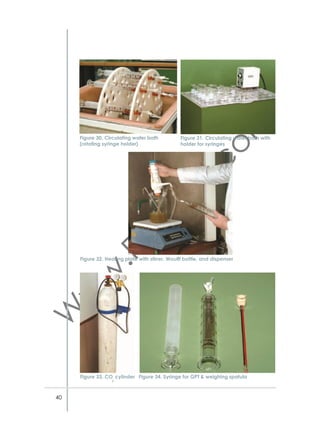
• Circulating water bath with holder for syringes (Fig. 31)
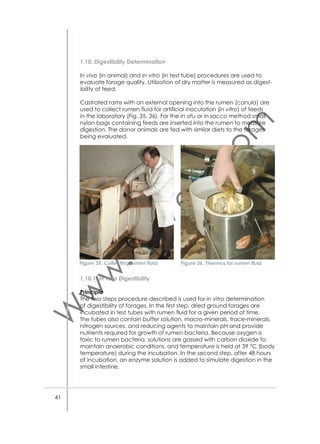
• Heating plate with stirrer (Fig. 32)
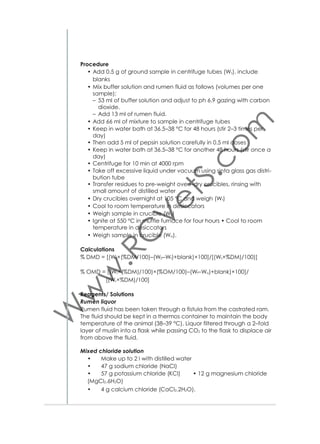
• CO2 cylinder (Fig. 33)
• Woulff bottle (Fig. 32)
• Dispenser (Fig. 32)
• 100 ml special syringes for GPT (Fig. 34).
Reference
• Makkar HPS. 2003.

39
Figure 30. Circulating water bath
(rotating syringe holder)

Figure 31. Circulating water bath with
holder for syringes

Figure 32. Heating plate with stirrer, Woulff bottle, and dispenser

Figure 33. CO2 cylinder Figure 34. Syringe for GPT & weighing spatula

40
1.10. Digestibility Determination
In vivo (in animal) and in vitro (in test tube) procedures are used to
evaluate forage quality. Utilization of dry matter is measured as digestibility of feed.
Castrated rams with an external opening into the rumen (canula) are
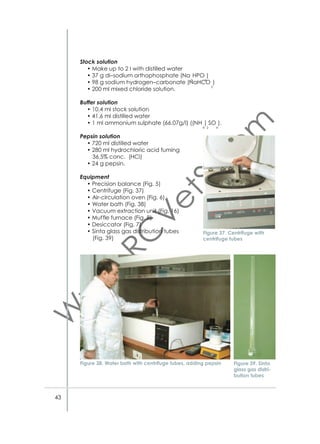
used to collect rumen fluid for artificial inoculation (in vitro) of feeds
in the laboratory (Fig. 35, 36). For the in situ or in sacco method small
nylon bags containing feeds are inserted into the rumen to measure
digestion. The donor animals are fed with similar diets to the forages
being evaluated.

Figure 35. Collecting rumen fluid

Figure 36. Thermos for rumen fluid

1.10.1. In vitro Digestibility
Principle
The two steps procedure described is used for in vitro determination
of digestibility of forages. In the first step, dried ground forages are
incubated in test tubes with rumen fluid for a given period of time.
The tubes also contain buffer solution, macro-minerals, trace-minerals,
nitrogen sources, and reducing agents to maintain pH and provide
nutrients required for growth of rumen bacteria. Because oxygen is
toxic to rumen bacteria, solutions are gassed with carbon dioxide to
maintain anaerobic conditions, and temperature is held at 39 °C (body
temperature) during the incubation. In the second step, after 48 hours
of incubation, an enzyme solution is added to simulate digestion in the
small intestine.

41
Procedure
• Add 0.5 g of ground sample in centrifuge tubes (Ws), include
blanks
• Mix buffer solution and rumen fluid as follows (volumes per one
sample):
– 53 ml of buffer solution and adjust to ph 6.9 gazing with carbon
dioxide.
– Add 13 ml of rumen fluid.
• Add 66 ml of mixture to sample in centrifuge tubes
• Keep in water bath at 36.5–38 °C for 48 hours (stir 2–3 times per
day)
• Then add 5 ml of pepsin solution carefully in 0.5 ml doses
• Keep in water bath at 36.5–38 °C for another 48 hours (stir once a
day)
• Centrifuge for 10 min at 4000 rpm
• Take off excessive liquid under vacuum using sinta glass gas distribution tube
• Transfer residues to pre-weight oven–dry crucibles, rinsing with
small amount of distilled water
• Dry crucibles overnight at 105 °C and weigh (Wt)
• Cool to room temperature in desiccators
• Weigh sample in crucible (W0)
• Ignite at 550 °C in muffle furnace for four hours
• Cool to room temperature in desiccators
• Weigh sample in crucible (Wa).
Calculations
% DMD = [(Ws×(%DM/100)–(W0–Wt)+blank)×100]/[(Ws×%DM)/100)]
% OMD = [(Ws×(%DM)/100)×(%OM/100)–(Wt–Wa)+blank)×100]/
[(Ws×%DM)/100]
Reagents/ Solutions
Rumen liquor
Rumen fluid has been taken through a fistula from the castrated ram.
The fluid should be kept in a thermos container to maintain the body
temperature of the animal (38–39 °C). Liquor filtered through a 2–fold
layer of muslin into a flask while passing CO2 to the flask to displace air
from above the fluid.
Mixed chloride solution
• Make up to 2 l with distilled water
• 47 g sodium chloride (NaCl)
• 57 g potassium chloride (KCl)
• 12 g magnesium chloride (MgCl2.6H2O)
• 4 g calcium chloride (CaCl2.2H2O).

42
Stock solution
• Make up to 2 l with distilled water
• 37 g di–sodium orthophosphate (Na2HPO4)
• 98 g sodium hydrogen–carbonate (NaHCO3)
• 200 ml mixed chloride solution.
Buffer solution
• 10.4 ml stock solution
• 41.6 ml distilled water
• 1 ml ammonium sulphate (66.07g/l) ((NH4)2SO4).
Pepsin solution
• 720 ml distilled water
• 280 ml hydrochloric acid fuming
36.5% conc. (HCl)
• 24 g pepsin.
Equipment
• Precision balance (Fig. 5)
• Centrifuge (Fig. 37)
• Air-circulation oven (Fig. 6)
• Water bath (Fig. 38)
• Vacuum extraction unit (Fig. 16)
• Muffle furnace (Fig. 8)
• Desiccator (Fig. 7)
• Sinta glass gas distribution tubes
(Fig. 39)

Figure 37. Centrifuge with
centrifuge tubes

Figure 38. Water bath with centrifuge tubes, adding pepsin

43

Figure 39. Sinta
glass gas distribution tubes
• Nalgene centrifuge tubes 28 mm×160 mm (Fig. 37)
• Crucibles (Fig. 9).
References
• Tilley JMA and Terry RA. 1963.
1.10.2. Gas Production Test (Hohenheim Method)
Principle
The gas production test is based on the association between rumen
fermentation and gas production.
The in vitro gas production method can be used to measure the metabolizable energy of feeds and to quantify utilization of nutrients.
Procedure
• Weigh 200 mg of feed sample (1 mm ground) and insert carefully
in 100 ml calibrated glass syringe
• Include blank syringes without feed
• Include syringes with standard feed (concentrate or/and hay)
• Keep syringes overnight in circulating water bath at 39 °C
• Prepare fermentation buffer solution except rumen fluid and reducing solution in 2 l Woulff bottle
• Keep bottle in water bath at 39 °C with stirrer overnight.
Next morning
• Keep under CO2
• Add reducing solution and wait 20 minutes until color changes
from blue to purple to colorless
• Add rumen fluid
• Keep stirring under CO2 for 10 minutes
• Fill 30 ml into glass syringes
• Incubate syringes in 39 °C
• Shake syringes every hour during first four hours, then twice every
hour
• Record gas production at 8 hours and push back piston to 30 ml if
gas production exceeds 70 ml
• Record gas production at 24 hours (V24) and terminate experiment.
Reagents / Solutions
Rumen fluid
• Collect rumen fluid before morning feeding from 2 rams
• Filter through two-layer cheese cloth into thermos container
• Keep at 39 °C and under carbon dioxide (CO2).
Fermentation buffer solution
• 630 ml of bicarbonate buffer
• 315 ml of macromineral solution

44
•
•
•
•
•

0.16 ml of micromineral solution
1.6 ml of resazurine solution
945 ml distilled water
60 ml of fresh prepared reducing solution
660 ml rumen fluid.

Bicarbonate buffer
• 35 g sodium bicarbonate (NaHCO3)
• 4 g ammonium carbonate
• Dissolve in 500 ml distilled water and then make up to 1litre.
Macromineral solution
• 6.2 g potassium dihydrogen phosphate (KH2PO4)
• 5.7 g disodium hydrogen phosphate (Na2HPO4)
• 0.6 g magnesium sulphate (MgSO4.7H2O)
• Dissolve in 500 ml distilled water and then make up to 1 l.
Micromineral solution
• 10 g manganese chloride (MnCl2.4H2O)
• 13.2 g calcium chloride (CaCl2.2H2O)
• 1 g cobalt chloride (CoCl2.6H2O)
• Dissolve in 50 ml distilled water and then make up to 100 ml.
Resazurine
• 0.1 g resazurine in 100 ml distilled water.
Reducing solution
• 996 mg sodium sulphide (Na2S.9H2O)
• Dissolve in 94 ml distilled water
• 6 ml 1 N sodium hydroxide solution (NaOH)
• 1 N NaOH = 4 g NaOH in 100 ml distilled water.
Calculations
Calculation for gas production
G24 = [(V24–V0–G0)×FSt×200]/Ws
If pushed back after 8 hours:
G24 = [(V24–V0+V8–G0)×FSt×200]/Ws
G24 = gas production value (ml/200 mg) at 24 hours
G0 = gas production of blank syringes (ml)
V0 = volume in ml at begin
V8 = volume in ml at 8 hours
V24 = volume in ml at 24 hours
Ws = weight of dried sample in mg
FSt = GSt/GSt measured

45
Reference value (FSt) is gas production GSt of the standard sample (e.g. hay
and/or concentrate) as per supplier (e.g. Landesarbeitskreis. Fütterung,
Baden Württemberg e.V. (LAF), Hohenheim, 70578 Stuttgart, PF 7200220)
compared to the measured gas production in the test (GStmeasured).
Calculation for organic matter digestibility (OMD)
%OMD = 14.88+0.889 G24+0.45 CP
CP = Crude Protein
Calculation for metabolizable energy (ME)
ME(MJ/kg DM) = 2.2+0.136 G24+0.057 CP
Calculation for net lactation energy (NEL)
NEL(MJ/kg Ws) = 0.0663 G24+0.095 CP+0.228 CF+0.079 Nfree– 3.49
Nfree = N-free extract in % dry weight
CF = Crude Fat
Equipment
• Precision balance (Fig. 5)
• Circulating water bath with holder for syringes (Fig. 31)
• Heating plate with stirrer (Fig. 32)
• CO2 cylinder (Fig. 33)
• Woulff bottle (Fig. 32)
• Dispenser (Fig. 32)
• 100 ml glass syringes for GPT (Fig. 34).
References
• Makkar HPS. 2002.
• Menke KH, Raab L, Salewski A, Steingass H, Fritz D and Schneider W.
1979.
• Methodenbuch Bd.1988.
1.10.3. In sacco Degradability and Digestibility
Principle
The incubation of feeds in nylon bags inside the rumen is used to measure the degradation of the feedstuff. Degradability is expressed as loss
of weight during incubation. Digestibility can be measured by analyzing the residues for NDF.
Procedure for degradability
• Weigh 3 g of dried and ground feed (3 mm mesh size) in each
nylon bag (Ws)
• Attach 3–5 bags to each plastic tube and insert in rumen
• Up to 12 bags can be inserted in rumen
• Use at least three animals
• Diet of animals same as feed in nylon bags

46
• Incubation time: 4, 8, 16, 24, 36, 48, 72 and 96 hours
• Insert bags at different time intervals to take them out at the same
time
• Take out bags and put immediately in cold water to stop fermentation
• Wash in washing machine for 20 minutes at 22–25 °C (record revolutions per minutes, rpm)
• Dry bags at 65 °C for 30 hours
• Weigh residues (Wr).
Calculations for dry matter degradability (DMdeg)
Calculate dry matter as under 1.2.1. for feed sample (DMs) and residue
(DMr)
DMdeg = [(DMs–DMr)/DMs ]×100
Procedure for digestibility
• Transfer contents of nylon bag to Berzelius beaker
• Proceed with NDF determination for residue (NDFr) as under 1.6.1.
Calculation of digestibility (D)
D = (NDFr/DMr )×100
Equipment
• Precision balance (Fig. 5)
• Air circulating oven (Fig. 6)
• Muffle furnace (Fig. 8)
• Nylon bags of 9x16 cm made from indigestible material; 40–60
micron mesh size, (Fig. 40)
• Plastic tubes with attachments for nylon bags (Fig. 41).
References
• Ørskov ER, Hovell FD DeB and Mould F. 1980.

Figure 40. Nylon bags

47
Figure 41. Plastic tubes with attachments for nylon bags

48
2. Assessment of Silage
Nutritional Quality
2.1. Definition and Advantages of Silage
Ensiling is a forage preservation method based on spontaneous acid
lactic fermentation under anaerobic conditions. Silage techniques
minimize the loss of nutrients right from harvest, to storage. Moreover,
they also improve the quality of feed. The epiphytic (existing on plants)
lactic acid bacteria that are present on forage crops are involved in
the fermentation water-soluble carbohydrates to lactic acid and, to a
lesser extent, to acetic acid. As a result the pH level of the ensiled material is reduced so the activity of spoilage microorganisms is inhibited.
The advantage of using silage includes the following (Cowan 2001,
Schroeder 2004, Romero et al. 2006):
• As a reserve during times of extreme feed shortage periods, which
entails ensiling pasture, crops or high-moisture by-products under
optimal conditions and storing them for a long period
• To profit from excess growth. Generally, this excess is considered
to be a waste. Ensiling allows excess growth to be stored so that
losses due to maturation or decay in situ are avoided
• To enable storage of perishable materials since the ensiling process
ensures the feed can be used over an extended period of time, for
instance, the ensiling of wet by-products
• To preserve the dry matter content and maintain income potential
(palatability, consistency and composition) of the fermented feed
• To balance the nutrient content of the diet. The silage is used to
provide nutrients whenever the feeds available are deficient (example, the use of legume silage to complement maize silage).
References
• Cowen T. 2001.
• Romero LA, Mattero J, Comeron EA, Gaggiotti MC and Cuatrin A.
2006.
• Schroeder JW. 2004.

2.2. Sampling
Collecting a representative sample on farm is vital if the laboratory
analysis is to reflect what is actually being fed. To help ensure representative samples are taken, the following key procedures are recommended:

49
Wait at least six weeks after harvesting before sampling silage, to ensure fermentation has completed.
Representative samples should be made by taking 1 to 5 kg of silage
from different locations of the freshly open front silo. Avoid taking samples from the periphery of the silo and from moldy or damaged parts.
The face of the silo gives a better sample of the silage the animals are
actually eating.
Samples should be thoroughly mixed and if the final sample has to be
reduced before being sent to the laboratory, it should be prepared by
the quartering method outlined below:
• Tip the sample onto a clean surface such as a clean board or
worktop. Rough concrete is not suitable
• Thoroughly mix the sample ensuring an even distribution of material
• Using a clean board or card, halve the sample by dividing across
the pile and separating into 2 piles. If one pile is approximately 1
kg, carefully place this into a clean plastic bag ensuring all the
material in the pile is included
• After placing in the plastic bag, remove as much of the air as possible by squeezing the bag, and seal. This will help reduce silage
changes during transport and make your analysis more accurate
• Label the bag clearly with sample number, forage mixture, stage
of maturity and date harvested, and store immediately in a cold
place, preferably in a freezer to prevent bacterial decay, until
analyzed.

2.3. Silage Quality Assessment
Fig. 42 presents the different steps of silage nutritional quality assessment. There are two major procedures: (i) Assessment of fermentation
quality and (ii) Conventional feed analysis. The latter has similarities
to the general methodology of feed analysis procedures already
described. Focus will be made on fermentation quality assessment.
Special mention is made for dry matter that needs to be corrected for
volatile components including ammonia and volatile organic acids
(acetic, propionic, butyric, isobutyric).
2.3.1. Dry Matter (DM)
This is the material left after all water has been removed by drying.
Values given are ‘corrected values’ to allow for volatile fatty acids and
other components lost during oven drying.
DM = 100–MC

50
Where
MC: sample moisture content in %
%MC = W1–W2
Wsi: weight of the sample in gram
Wsf: weight of the sample after drying at 105 °C in air-circulation oven
and up to constant weight in gram
W1 = (100×Wsf)/Wsi
W2: Weight of volatile acids in %
2.3.2. Extraction of Silage “Juice”
Silage “juice” extraction is made on fresh or frozen samples. Frozen
samples should be kept in tight bags and left in room temperature (15
to 20 °C) overnight. Juice may be extract by pressing or maceration.
Maceration is recommended because pressing is not applicable for
silages with high dry matter contents. The following procedure is recommended:
• 200 g of wet silage sample are weighed in a 1 l beaker to which 1 l
of de–ionized water is added. Mix carefully and leave overnight at
4 °C
• Blend the sample for 2 min and filter through coarse (20–25 μm
particle retention) filter paper.
The extract will be used to determine pH, ammonia, volatile fatty acids
(Acetic, Proprionic, Butyric, & Iso–butyric acids) and lactic acid.
2.3.3. pH
pH is a key criteria to evaluate silage fermentation. Generally, the lower
the pH, the better preserved and more stable is the silage. Haylage
Silage sample
100 g sample mac
erated in 1000 ml
distilled water
Filtration

DM
determination
(drying at 105 °C
in air circulated
even)

Sample grinding

Solution
Measurement of pH
ammonia soluble N
acetic propionic
and butyric acids

Drying at 50 °C
air-circulated
oven

Correction
of DM

Conventional
feed analysis

Assessment of
fermentation quality
Figure 42. Major steps in silage nutritional quality assessment

51
should reach a final pH of around 4.5 and corn silage near 4.0. The pH
of the forage alone is not a good indicator of the quality of the silage,
or the type of fermentation that occurred. Forages ensiled at moisture
levels greater than 70% may develop large populations of clostridia
bacteria, which produce butyric acid rather than lactic acid. This may
result in sour silage with a pH of 5.0 or above.
pH is measured directly using a conventional digital pH meter.
2.3.4. Ammonia
Ammonia Nitrogen (NH3) N shows the proportion of N (including protein) that has been broken down during ensilage and is the best indicator of silage fermentation. A value <50 g/kg N indicates an excellent
fermentation, a stable silage and minimal nutrient loss. Values >150g/kg
indicate a poor fermentation.
The methodology used is adapted from Weatherburn (1967).
Reagents/ Solutions
Solution A
• Phenol (6 B4): 10 g/l
• Sodium nitroprusside with FeIII (4A1): 0,05 g/l (0.05687 if it’s dehydrated)
Solution B
• NaOH: 5 g/l
• NaClO: 8.4 ml/l
• If using NaClO (commercial containing 40 g of active Chlorine per
liter): 10.5 ml are needed, equivalent to 0.42 g of NaClO)
Preparation of ammonia solution (100 μg N–NH4/ml)
• Dry the (NH4)2SO4 at 105 °C in an oven for one hour
• Dissolve 4,714 g of the previous dry reagent in 1000 ml of distilled
water
• Using the basic solution of ammonia, prepare a solution containing
10 μg of N–NH4/ml (add 99 ml of water to 1 ml of the basic solution
of ammonia)
• Prepare a standard curve using the previous solution (10 μg
(NH4)2SO4 /ml), as follows : put 0, 1, 2, 4, 6, 8 and 10 ml of the solution in 7 test tubes, adjusting the volume to 10 ml with distilled
water. Stir the tubes.
Silage extract conditioning
• Pipette 5 ml of the silage extract in a centrifugation tube, keeping
it cold on ice
• Centrifuge at 4000 rpm for 20 min at 4 °C

52
• Take 0.1 ml from the supernatant and add 4.9 ml of distilled water.
Stir and keep cold on ice.
Procedure
• Take 1 ml of each tube from the standard curve and the unknowns
• Add 5 ml of solution A and stir
• Add 5 ml of solution B and stir
• (Up to this step, keep the samples on ice)
• Prepare a blank containing 1 ml water, 5 ml of solution A and 5 ml
of solution B
• Incubate at 37 °C for 20 minutes. Optionally, keep at 20 °C or
more, for at least 30 minutes
• Read with the spectrophotometer at 625 nm
• Make a standard curve using the concentrations of N–NH4 in μg /
ml as abscissas and the optical density as the ordinates
• From the calibration curve, calculate the concentration of the
unknown samples, by interpolation.
The ratio ammonia nitrogen/total nitrogen is used as indicator of the
fermentation quality. The following scale is recommended:
Table 3. Scale for fermentation quality
Ratio ammonia nitrogen/total nitrogen %

Conservation

0-5

Very good

5-10

Good

10-15

Standard

15-20

Satisfactory

20-30

Poor

>30

Bad

References
• Weatherburn MW. 1967.
2.3.5. Determination of Volatile Fatty Acids
Total fermentation acids (TFA) – the total amount of acid produced during fermentation. It includes lactic, butyric and acetic acids, and may
also extend to propionic acid and ethanol.
Volatile fatty acids (VFA) – will be high when fermentation is poor. The
undesirable VFAs are butyric and, to a lesser extent, acetic acid. These
are associated with high total VFA and give a distinctive and persisting
smell to badly made silages.
Acetic acid – is looked upon as a normal constituent of silage, but less
desirable than lactic acid. High levels can restrict intake.

53
Butyric acid – production indicates poorly fermented silage. This can
be produced under anaerobic conditions due to a variety of factors
including high soil contamination, slow rate of fermentation, low DM
content and secondary fermentation. The butyric acid content will
often be added to the acetic acid content, termed total volatile fatty
acids VFA s, and expressed as a percentage of total fermentation
acids (TFA).
Better quality silages with low acetic, ammonia–N, butyric and high
lactic and sugars are more prone to aerobic spoilage.
Procedure
The methodology used is based on the one developed by Jouany
(1981).
Sample preparation
The silage juice should be stabilized immediately. For this purpose the
following steps are recommended:
• Preparation of a conservation reagent: a solution is prepared by
adding ortho H3PO4 (5 % v/v) and HgCl2 (1 % w/v)
• To 10 ml of silage juice add 1 ml of the conservation reagent.
• Store at –15 °C in a deep freezer
• Prior to analysis, fresh or frozen samples are centrifuged at 2000
rpm for 5 minutes at 4 °C.
Chromatography
• Equipment: Gas chromatograph equipped with flame ionization
detector. The column is made of glass, 1.5 m long and with an
internal diameter of 2.17 mm. The column is filled with chromosorb
W–AW–60–80 mesh, and impregnated with 10 % (w/w) SP 1200
(Supelco) and 1% (w/w) ortho H3PO4. It is conditioned at 160 °C
overnight with a nitrogen flux of 30 ml/mn
• The analysis is conducted by injecting 1 ml sample (including the
conservation reagent) to which is added 0.1 ml of internal standard composed of 1% (w/v) 4–methyl valeric acid
• Working conditions:
– N2 (vector gas) : 30 ml/mn.
– H2 (detector): 40 ml/mn.
– Air (detector): 400 ml/mn.
– Temperature: 125 °C (oven), 155 °C (detector), 165 °C (injector).
– Volume of the sample to inject: 5 μl.
Calculations
VFA analysis is based on (i) A standard solution (solution A) and an
internal standard, which help determine the “response factor” used for
calculation.

54
Determination of the response factor
The following formula is used to calculate
the response factor (Ka)
Ka = (Sa/S)/(1/Ca)
Where:
Ka: response factor of component “a”.
Sa: pic surface of component “a”.
S: pic surface of the internal standard.
Ca: concentration of component “a” in
the standard solution “A”.
The composition of the standard solution
“A” is as follows:
• Acetic acid (C2)
6.00 g
• Propionic acid (C3)
1.00 g
• Isobutyric acid (IC4)
0.125 g
• Butyric acid (C4)
1.75 g
0.25 g
• Isovaleric acid (IC5)
• Valeric acid (C5)
0.25 g
After injecting the silage sample, VFA
contents are determined according to
the formula:
Ca = (Sa/S)/(1/Ka)

Figure 43. Typical chromatogram of silage juice (C2:
acetic acid; C3: propionic
acid; IC4: Iso-butyric acid;
C4: butyric acid; IC5: Isovaleric acid; C5: Valeric
acid; IS: Internal standard

Where
Ca: concentration of component “a” in the silage sample
Sa: Pic surface of component “a” of the silage sample
S: Pic surface of the internal standard injected concomitantly with the
silage sample
Ka: Response factor of component “a”
References
• Jouany JP. 1981.
2.3.6. Lactic Acid
Lactic acid gives an indication of the quality of forage fermentation,
being produced almost exclusively by the lactobacilli responsible for
good silage fermentation and effective preservation. Grass silages
typically have lactic acid contents of 60–150 g/kg, higher values suggesting more rapid fermentation, better protein preservation and less
likelihood of fermentation of by-products that reduces intake. Like butyric acid, lactic acid contents maybe expressed as a proportion of the

55
total fermentation acids; higher levels indicating better fermentations,
and values over 70% TFA being ideal.
Lactic acid should be the primary acid in good silage. This acid is stronger than other acids in silage (acetic, propionic and butyric) and thus
usually responsible for most of the drop in silage pH. Secondly, fermentation that produces lactic acid results in the smallest loss of dry matter
and energy from the crop during storage.
Some common reasons for low lactic acid content are as follows:
• Restricted fermentation due to high DM content (especially legumes and grasses with >50% DM)
• Restricted fermentation due to cold weather
• Sample taken after considerable aerobic exposure that has degraded lactic acid
• Silages high in butyric acid (Clostridial silages) are usually low in
lactic acid.
Determination of lactic acid in silage juice
The method suggested uses a simple colorimetric assay based on the
method developed by Barker and Summerson (1941), and modified by
Kimberley and Taylor in 1996.
In this method, acetaldehyde is released from lactic acid by hot sulfuric acid. The acetaldehyde is reacted with copper and p–phenylphenol (pPP) to yield a chromagen, which absorbs at 570 nm.
Reagents/Solutions
• Concentrated H2SO4 (96%)
• 4% CuSO4.5H2O in dd H2O
• 1.5% p–phenylphenol in 95% ethanol.
Development of the standard curve
To develop a lactic acid standard curve:
• Add 0 to 30 micrograms of lactic acid to 16×150 mm borosilicate
tubes. The curve should be in 5–micrograms increments or less
• Add 3 ml of concentrated H2SO4 and mix with a vortex mixer. This
quantity of acid is defined here as 82% acid
• Incubate at 95–100 °C for 10 minutes in a steam water bath
• Cool at room temperature using a water bath.
• Add 50 μl CuSO4 reagent and then 100 μl of pPP reagent; mix well
on vortex mixer keeping the tube at room temperature
• Leave the tubes at room temperature for at least 30 min and then
read absorbance at 570 nm
• Blanks will show values of 0.2–0.5 compared to water.

56
The typical assay involved 1 ml of silage juice sample to which reagents
and procedures described above for the standard curve are applied.
Absorbance obtained is plotted against the standard curve to calculate the amount of lactic acid.
References
• Jouany JP. 1981.
• Kimberly Taylor. 1996.

2.4. Assessment of Silage Quality Using Fermentation End
Products
The following table summarizes normal values for pH, ammonia, volatile
fatty acids and lactic acid in different silage types. These values will
help assessing silage quality.
Table 4. Recommended values for quality assessing for ensiled forage sample
fermentation
Item

Corn
silage

Alfalfa
silage

Grass
silage

(+) or (-)
effect

Action(s)

pH

3.7-4.2

4.3-4.5

4.3-4.7

+

Low pH inhibits bacterial
activity

Ammonia
N% total N

5-7

10-15

8-12

Lactic
acid

4-7

7-8

6-10

+

Inhibits bacterial activity
by lowering pH

Acetic
acid

1-3

2-3

1-3

+/

Associated with undesirable fermentations.

High levels indicate excessive protein breakdown

Inhibits yeasts responsible
for aerobic spoilage
Butyric
acid

0

<0.5

References
• Weatherburn MW. 1967.
• Jouany JP. 1981.
• Kimberly. Taylor. 1996.

57

<0.5

Associated with protein
degradation, toxin formation, and large losses of dry
matter and energy
3. Milk Analysis
Regular quality control of milk is essential. Routine chemical analyses
are carried out in the laboratory to check milk composition for fat and
total solids (TS). The laboratory analyzes milk samples from ICARDA’s
sheep flock, as well as samples from various experiments conducted by
ICARDA’s scientists and collaborators in the region.

3.1. Sampling
Laboratory samples should kept in closed containers, sealed and
labeled indicating the nature of the product, identification number,
batch number of the sample and date of sampling. The method of
sampling depends on the nature of the product (liquid or solid) and
whether chemical or bacteriological analyses are required. The size of
the samples is regulated by the size of the product to evaluate.
Technical instructions
Clean and dry all equipment for chemical purposes. Equipment used in
sampling for bacteriological purposes should be clean and treated by
one of following methods:
• Expose to hot air at 170 °C for 2 h
• Autoclave 15–20 min at 121 °C
• Expose to steam for 1 hour at 100 °C for immediate use
• Immerse in 70% alcohol and flame for immediate use.
Liquid sample
Use clean and dry containers: glass, stainless metal or plastic with a suitable shape and capacity for material to be sampled.
Containers should be closed with a suitable plastic stopper or screw cap.
Note: Containers should be filled well to prevent churning during transportation
Solid and semi-solid samples
Use clean and dry containers of suitable waterproof material like glass,
stainless metal or plastic material. Avoid narrow neck containers and
close well. Air-tight plastic bags can be used too.
Preservation of laboratory samples
Preservatives have to be added to liquid samples or cheese intended
for chemical analysis. The preservative should not affect analysis. Sodium azide or potassium dichromate are the preferred preservatives.
58
Transport of laboratory samples
Transport samples to the laboratory as fast as possible. Take precautions to prevent exposure to direct sunlight, or to temperatures
above10 °C in case of perishable products. For laboratory samples
intended for bacteriological examination, maintain temperature at 0–5
°C. Maintain samples of cheese under the same conditions to avoid
separation of fat and moisture.
References
• AOAC. 2000.

3.2. Sample Preparation
Principle
Homogenizing of the milk before analysis is essential. Milk fat tends to
separate and to flow on the surface.
Procedure
• Put the milk sample in a water bath, at 38 °C
• Mix until homogenization
• Cool samples to approx. 20 °C before analysis.
References
• AOAC. 2000.

3.3. Determination of Fat (Gerber Method)
Principle
Milk is mixed with sulphuric acid in a special glass tube called a Gerber
tube. The temperature of the mixture becomes hot due to the dilution
of a strong acid. As a consequence milk proteins are digested and fat
is set free from the fat globules. It can be measured in the glass scale
(Figure 43).
Procedure
• Pipette 10 ml of sulphuric acid into the butyrometer
• Slowly Pipette 10.75 ml milk. Milk should not be mixed with the sulphuric acid, it should appear as a separated layer
• Add 1 ml of Amyl alcohol
• Close with Gerber tube stopper
Caution: Dry neck of butyrometer before
• Shake the butyrometer until all the milk is digested
Caution: Glass becomes very hot
• Centrifuge in Gerber centrifuge for 5 min on 1100±100rpm
• Place the butyrometer for 5 min in water bath, at 65 °C
• Read the percentage of fat.

59
Calculations
The reading represents the percentage of fat content in milk
Reagents / Solutions
• Sulphuric acid density 1.81
• Amyl alcohol
Equipment
• Water bath (Fig. 44)
• Gerber milk butyrometer (Fig. 46)
• Standard rubber stopper
• Volumetric pipette (H2SO4) with safety bulb, 10 ml (Fig. 47)
• Volumetric pipette (milk), 10.75 ml (Fig. 47)
• Volumetric pipette (Amyl alcohol), 1 ml (Fig. 47)
• Gerber centrifuge (1100±100 rpm, diameter 45–50 cm), (Funke
Gerber, Germany) (Fig. 45).
References
• Marth EH. 1978.

3.4. Total Solids
Principle
Milk is dried under constant temperature in the oven until weight is
stabilized.
Procedure
• Weigh a clean pre-heated crucible
• Add 3–4 g of milk and record weight
• Dry the sample in an air forced oven at 105 °C overnight to stabilize weight
• Weigh the crucible with the dried sample.
Calculations
%TS = [(Weight of dried milk)/(weight of milk)]×100
Equipment
• Air forced oven (Fig. 6)
• Crucibles (Fig. 9)
• Desiccator (Fig. 7)
• Pipette (Fig. 28).
References
• Hui YH 1992.

60
Figure 44. Water bath

Figure 46. Gerber milk butyrometer

Figure 45. Gerber centrifuge

Figure 47. Volumetric pipettes

3.5. Fat, Protein Total Solids and Lactose Analysis
Principle
The analysis of milk with the Milkoscan device is based on absorption of
Near Infrared energy at specific wavelength:
• by CH groups (3.48 μm) and carbonyl groups of fat (5.723 μm)
• by peptide bonds of protein molecules (6.465 μm), and
• by OH groups in lactose molecules (9.610 μm).

61
The Total Solids (TS) are set by the factory based on other solid milk
components (e.g. protein, fat, lactose).
Procedure
Cleaning and calibration of the Milkoscan
• Warm Triton 1% solution and Stella 5% solution to 40 °C
• Purge the device with Stella
• Purge the device with Triton
• Calibrate the device with Triton 1%.
Measurement
• Warm milk samples to 40 °C in water bath
• Insert sample in aspirator device of Milkoscan.
Equipment
• Milkoscan 133B device (Foss Electric, Hillerød, Denmark)(Fig. 48)
• Water bath (Fig. 48).
References
• Manual for Milkoscan 133B, 1993.
• AOAC. 2000.

Figure 48. Milkoscan with water bath

3.6. Milk Density
Principle
Based on specific gravity a special device is used to determine the milk
density.
Procedure
• Inject approximately 5 ml of milk to ensure that the milk line is well
flushed with the sample
• Read the density on the device.
Note: Ensure that there are no bubbles in the milk line, bubbles cause
an error.

62
Equipment
• Density meter DMA 35, PAAR, Austria
(Fig. 49).
References
• Milchanalytik 755.302. 2008

3.7. Milk Conductivity
Principle
Mastitis causes an increase of salt concentration. Conductivity is measured
with an electronic conductivity meter by
immersing a probe directly into the milk
sample.

Figure 49. Density meter

Procedure
• Immerse the conductivity probe into
the milk sample
• Read the result on the device.
Equipment
• Electric conductivity meter Hanna HI
98360 Microprocessor, Hanna Instruments, Italy (Fig. 50).
References
• Hui YH. 1992.

3.8. Milk pH
Principle
pH is the negative logarithm of the hydrogen ion concentration. Measurement
of pH is particularly important in the dairy
industry since it provides, in many cases,
a more meaningful measurement than
titratable acidity. pH values from 0–7 are
acidic, while those from 7–14 are alkaline.
pH measures the level of the acidity.
Procedure
• Pour the sample into a clean, dry
beaker
• Carefully press electrodes into the
milk-containing beaker and determine the pH.

63

Figure 50. Electric conductivity meter

Figure 51. pH meter
Equipment
• pH meter HANNA HI 113, Hanna Instruments, Italy (Fig. 51)
References
• FAO. 1986.
• Nielsen EW and Ullum JA. 1989.

3.9. Milk Acidity
Principle
The pH value of fresh milk is normally about 6.6 at 25 °C, which indicates a natural acidity. The acidity is determined by titration with alkali
NaOH, in the presence of phenolphthalein as indicator.
Procedure
• Pipette 10 ml of milk
• Add 5 drops of 1% phenolphthalein
• Titrate with 0.1 N NaOH until a
slight pink color appears.
Solids non-fat (SNF) define the
natural acidity of fresh milk. The
higher the solids, that are not fat
content, in milk, the higher the
natural acidity and vice versa.
Developed or real acidity is
Figure 52. Round bottomed white porcelain dish, 100 ml
due to lactic acid, formed as
a result of bacterial action on
lactose in milk. Hence the titratable acidity of stored milk is equal to the
sum of natural acidity and developed acidity. The titratable acidity is
expressed as percentage of lactic acid. Colostrum has a high "natural
acidity" in part because of its very high protein content.
Reagents / Solutions
Sodium hydroxide 0.1 N solution
• Dissolve equal parts of sodium hydroxide (sticks or pellets) in equal
parts of water in a flask
• Tightly close the flask with a rubber bung and allow insoluble sodium carbonate to settle down for 3 to 4 days
• Use the clear supernatant liquid for preparing the standard 0.1 N
solution
• Use 8 ml of stock solution per liter of distilled water
• Standardize solution accurately against acid potassium phthalate
or oxalic acid.

64
Phenolphthalein indicator 1%
• Weigh 1g of phenolphthalein in volumetric flask 100 ml
• Dissolve in ethanol and make up to volume.
Calculations
%acidity of milk = [(Va×0.009)/Vm ]×100
where:
Va : volume of 0.1N NaOH
Vm : volume of milk sample
0.009 : conversion factor from milliliter of 0.1N NaOH to gram of lactic acid
Equipment
• Glass burette 50 ml capacity with 0.1 ml graduation (Fig.10)
• Round bottomed white porcelain dish, 100 ml (Fig. 52)
• Pipette 10 ml
• Pipette 1 ml
• Stirrer
• Stirring rods.
References
• AOAC. 2000.

3.10. Volatile Fatty Acids
Principle
Fat samples are esterified and evaporated in the GC system; fatty
acids are separated in a stationary phase of the installed column depending on the chemical characteristics.
Sample preparation
Extraction (Folch et al. 1957)
• 1 ml milk
• 2 ml MeOH
• 1 ml CHCl3
• Vortex 1min
• 1 ml CHCl3
• 1 ml H2O
• Extract the lower part
• Evaporate with N2.
Methylation (Joachim Molkentin, Dietz Precht 2000)
• 100±20 mg of fat
• 5 ml methyl valerate standard (n–heptane, containing 0.4 mg/ml
methyl valerate).
1 ml of this solution was mixed with
• 20 μl sodium methylate solution (2 N in methanol) in a sample vial

65
•
•
•
•
•
•
•

Vortex for 3 min
Centrifuge for 1min at 2000 rpm
100 mg sodium hydrogen sulphatemonohydrate
Cover vial with new cap
Vortex for 2 min mix
Centrifuge for 1 min at 2000 rpm
Use supernatant for GC analysis.

Procedure
Switch on procedures
• Switch on device
• Switch on attached PC
• Run GC solution program
• Click on the GC–Device
• Load the cool–heat method and click on ‘Download’
• Click on ‘System on’ and let the method work for 5 min
• Load the heat method and click on ‘Download’
• Run method for 20 min while observing GC parameters on monitor
When FID temperature is above 100 °C, switch on the detector and
ignite the flame clicking the left button on system monitor screen
• Load the analytical method
• Click on ‘Download’.
Injection procedure
Before injecting a sample there are some steps to follow:
• Click on ‘Sample log on’. Fill in the requested data. This is important
for post–acquisition data work
• Fill the GC analysis lab–book with the requested data
• Do not inject the sample before ‘Ready’ appears on the PC monitor in blue; LED’s on the GC should appear in green
• Inject the sample and press the ‘Start’ buttom on the GC simultaneously.
Thermal program
• 50 °C for 3 min
• 5 °C/min to 140 °C for 2 min
• 2 °C/min to 170 °C for 5 min
• 10 °C/min to 220 °C for 2 min
• 5 °C/min to 225 °C for 21 min.
Injection
Thermal method:
• 1 μl solvent
• 1 μl air
• 1 μl sample
• Inject sample manually after a dwell–time of 5 seconds
• Remove the syringe after 5 seconds.

66
Switch off procedure
• Load the cool–heat method and click on ‘Download’
• Switch off the flame and then switch off the detector by clicking
the left buttons on system monitor screen
• Wait till the FID and injector temperature are less than 100 °C, then
press the ‘System off’ button
• Close the program
• Switch off the GC
• Close running programs and shut down the PC.
Note: Do not open the oven at any time. This may damage the installed column.
If any error message appears, inform the person responsible immediately. Any delay in conveying this information could damage the
whole system.
Do not inject wet samples.
Do not inject more than 1 μl of air.
Calculations
The qualitative and quantitative
assessment of fatty acids is calculated by the GC solution software.
Reagents / Solutions
• He gas (99.999%)
• H2 gas (99.999%)
• N2 gas (99.999%)
• Sodium methylate 2N
• Methanol
• Chloroform.
Equipment
• Gas chromatograph (Shimadzu 2010) with FID system, Japan (Fig. 53)
• Vortex mixer
• Syringe 1 μl
• Pasteur pipettes.
References
• Folch J, Lees M, and Stanley GHS. 1957.
• Molkentin J and Precht D. 2000.

3.11. Organic Acids
Principle
A filtered sample is carried by the mobile phase through the stationary

67
Figure 53. Gas chromatograph

phase. The separated organic acid is detected by an electric conductivity detector after mixing with the post-column pH buffered electrolyte to enhance detection (Fig. 54).
Sample preparation
• Dilute 5 g yogurt with H2O to 25 ml
• Shake, 5 min
• Centrifuge at 2000 rpm, 10 min
• Filter through 45 μm disc filter
• Inject 20 μl into injector.

Pump

Injector

Analytical column

Mixer

Electrolytic Conductivity
Detector

Mobile Phase

Reagent

Figure 54. Flow diagram of organic acids analysis system

Procedure
Separation
• Column: Shim–pack SCR–102H (300 mm×8.0 mm i.d.) two columns
in series
• Mobile Phase: 5 mM p–toluenesulfonic acid
68
• Flow Rate: 0.8 ml/min
• Temperature: 45 °C.
Detection
• Flow Rate: 0.8 ml/min
• Temperature: 48 °C
• Detector: Electrolytic conductivity.
Calculations
The qualitative and quantitative assessment of organic acids are calculated by the CLASS–VP software.
Reagents / Solutions
Mobile and buffer solution
• 5 mM p–toluenesulfonic acid
• 20 mM Bis–Tris
• 100 μM EDTA.2Na .
Standard
• Acetic acid
• Formic acid
• Citric acid
• Ortho phosphoric acid
• Succinic acid
• Lithium lactate
Equipment
• HPLC assembly (Fig. 55):
• Conductivity detector (Shimadzu CDD10A vp)
• Oven (Shimadzu CTO 10 AC
vp)
• Control Unit (Shimadzu SCC
10Asp)
• Pump (Shimadzu LC10 ADvp)
• Degasser (Shimadzu DGU 14A).
References
• Zhang H, Zhou F, Ji B, Nout R,
Fang Q, and Yang Z. 2008.

3.12. Tests for Abnormal Milk
3.12.1. Somatic Cell Count (SCC)
Figure 55. HPLC

Principle
Cell counts are used to determine levels of mastitis infection in indi-

69
vidual ruminants, or in bulk milk samples. SCC over 500,000 indicates
subclinical mastitis (Al–Majali and Jawabreh, 2003; Kiossis et al, 2007).
Procedure
• Immerse the cassette nipple in the milk sample
• Press the white knob on the cassette to load the milk sample
• Put the cassette in the cell counter device and press run
• Read the results.
Equipment
• Cell counter DCC (DeLaval, Sweden) (Fig. 56)
• Cell counter cassettes (DeLaval) (Fig. 57).

Figure 56. Somatic cell counter

Figure 57. Somatic cell counter cassettes

References
• Al–Majali AM and Jawabreh S. 2003.
• Kiossis E, Brozos CN, Petridou E and Boscos C. 2007.

70
3.12.2. California Mastitis Test (CMT)
Principle
CMT reagent consists of a detergent and acid base indicator. Somatic
cells are ruptured by the detergent, releasing the DNA. Reagent will
precipitate the DNA resulting in a gel formation that is proportional to
the quantity of DNA present.
Procedure
• Take 1 teaspoon (2 ml) milk from each part of the udder. Hold
paddle in vertical position
• Add an equal amount of CMT solution to each cup of the paddle
• Rotate the CMT paddle in a circular motion to mix the contents
not longer than 10 seconds.
• Read the test quickly. Visible reaction disintegrates after about 20
seconds. The reaction is visually scored according to Table 5.
Note: CMT paddle should be rinsed after each test.
Table 5. Score for CMT reading
Score

Description

0 = Negative(Not Infected)

No thickening of the mixture

1 = Trace (Possible Infection)

Slight thickening of the mixture

2 = Weak Positive (Infected)

Distinct thickening of the mixture

3 = Distinct Positive (Infected)

Immediate thickening of the mixture with a
slight gel formation

4 = Strong Positive (Infected)

Gel is formed and surface of the mixture
becomes elevated

Equipment
• CMT paddle (Fig. 58)
Reagents/ Solution
• CMT Solution reconstituted according to package instructions.
References
• González–Rodríguez MC and
Cármenes P. 1996.
• Hui YH. 1992.
Figure 58. CMT paddle

71
4. Blood Analysis
4.1. Determination of Progesterone
Principle
Blood samples are collected in vacutainer tubes. Blood serum or
EDTA plasma is used for progesterone determination. Progesterone is
bounded with a constant amount of rabbit anti–progesterone.
The determination is carried out using progesterone enzyme immunoassay test kit.
Procedure
Sample preparation
• Centrifuge blood samples at 6000 rpm for 20 minutes
• Collect 2 ml of serum/ plasma
• Freeze samples till analysis.
Assessing the test
• Melt the frozen sample to room temperature
• Pipette 25 μl of the sample and standard
• Pipette 100 μl of progesterone–HRP conjugate reagent
• Pipette 50 μl of rabbit anti–progesterone reagent
• Shake for 30 sec on plate shaker
• Incubate for 90 min at room temperature
• Wash wells 5 times with distilled water
• Pipette 100 μl of TMB reagents
• Shake for 5 sec on plate shaker
• Incubate for 20 min at room temperature
• Pipette 100 μl of stop solution
• Shake for 30 sec on plate shaker
• Read absorbance at 450 nm within 15 minutes.
Calculations
Plot the standard curve and calculate concentration based on absorbance using Microsoft excel equations.

72
Figure 59. ELISA reader and plate shaker

Equipment
• ELISA reader (Multiskan Ascent, Thermo Labsystems, Finland)
(Fig. 59)
• ELISA plate shaker (Cole Parmer 51400.05, USA) (Fig. 59)
References
• Linear Chemicals.1994.

73
APPENDICES
Appendix 1. Request form for Analyses in Animal
Nutrition Laboratory
ICARDA Animal Nutrition Laboratory: Request for Analysis
BATCH NUMBER :
Date received:
Date dispatched:
Approval lab manager:
Requisitioner:
Program/Department:
Budget Code:
Total costs:
Approval project manager:
Type of Analysis
sample

Number
of samples

Description
of samples

Cost per
sample US$

N/CP
DM & Ash
ADF
NDF
ADL
IVDMD
IVOMD
Fat
Milk analysis
Minerals
Gas Production Test
Tannins
TP& Tannins
Condensed tannins
Total

74

Total costs
US$
Appendix 2. Safety in the Laboratory
Hazards in laboratory
• Flammable liquids
– Do not let vapors concentrate to flammable levels in work area.
– Try to eliminate all chance of sparks from static electricity even if
electric equipment is grounded.
– Use fume hood.
– Use minimum quantity.
– Store in special storage cabinet.
• Toxic liquids
– Avoid contact with skin.
– Do not inhale.
– Use fume hood.
– Do not pipette any liquids by mouth. Use pipette fillers or rubber
balls.
• Breakage of glassware
– Use correct techniques for the insertion of tubing onto glassware.
– Never use glassware under pressure or vacuum unless it is designed for the job and suitably shielded.
– Dispose broken glassware.
• Spillages
– In case of chemical spills on skin or clothes rinse with plenty of
water. If eyes are affected rinse immediately with water for at
least 10 minutes.
– Clear up spillage promptly.
• Pressure equipment and gas cylinders
– Never use without prior training.
– Minimise the number of gas cylinders in a laboratory and store
externally whenever possible.
– Chain cylinders when in use.
– Use regulators, tubing and control equipment suitable for the gas
concerned.
For Atomic Absorption Spectrophotometer use effective fume hood to
remove gaseous effluents from burner. Use only C2H2 that is dissolved in
solvent recommended by manufacturer. Open C2H2 tank stem valve
only a quarter turn. Change tank when C2H2 pressure shows 75–100 lb.
For compressed gas cylinders let contents of C2H2 cylinders settle, and
let all cylinders come to room temperature prior to opening. Use only
correct pressure gauges, pressure regulator, flow regulator, and tubing
for each size of gas cylinder and type of gas as specified by supplier.
Close gas tank valve and diaphragm on regulator when gas is not in
use. Service regulator yearly.
Note: Check for gas leakage.

75
Safe handling of concentrated corrosive acids
– Use acid–resistant fume hood when heating acids or performing
reactions that emit acid fumes. In diluting, always add acid to
H2O unless otherwise directed in method. Keep acids off skin and
protect eyes from spattering. If acids are spilled on skin, wash immediately with large amounts of H2O.
Sulfuric acid. Always add H2SO4 to H2O. Wear face shield and heavy
rubber gloves to protect against splashes. Do not mix with HCl.
Nitric acid. Nitric acid reacts vigorously or explosively with aniline, H2S,
flammable solvents, hydrazine and metal powders. Gaseous nitrogen
oxides from HNO3 can cause severe lung damage. Use fume hood.
Handle with disposable polyvinylchloride, not rubber, gloves.
Safe handling of alkalis
Alkalis can burn skin, eyes, and respiratory tract severely. Wear heavy
rubber gloves and face–shield to protect against concentrated alkali
liquids. Use fume hood or gas mask.
Sodium and Potassium hydroxides are extremely caustic and can
cause severe burns. Protect skin and eyes when working with these
alkalis, whether as solids or concentrated solutions. Add pellets to H2O,
not vice versa.
Safe handling of special chemical hazards
Acetone. Highly flammable, forms explosive peroxides with oxidizing
agents. Use fume hood.
Chloroform. Do not inhale. Use fume hood. Can react explosively with
Al, Li, Mg, Na, K, N2O4, and NaOH plus methanol. Tumor producing
agent.
Di– and Trichloroacetic and Trifluoroacetic Acids.
Can cause severe burns to skin and respiratory tract. Use rubber gloves,
eye protection and fume hood.
Ethanol. Flammable. Use fume hood when heating or evaporating.
Methanol. Flammable, toxic. Avoid contact with eyes. Avoid inhaling
vapors. Use fume hood. Can react vigorously with NaOH plus CHCl3,
and KOH plus CHCl3 or KOH plus HClO4.
Petroleum ether. Extremely flammable. Use fume hood. Avoid static
electricity.
Hexane. Highly flammable. Use fume hood.

76
General precautions in laboratory
• Wear laboratory coats when working in the laboratory. Wear protective clothes and face shield or goggle when handling hazardous chemicals
• All laboratory workers should undergo simple first aid training
• First aid kits should be available in the laboratory
• Class B and C dry chemical fire extinguishers (for flammable, liquid
and electric fires) should be placed in the laboratory. Carbon dioxide fire extinguishers should be used on fires in electronic equipment. Staff need to be instructed on use of fire extinguishers.
References
• AOAC.1995.

77
Appendix 3. Preparing Standard Solutions
A. Molar (M) solutions
1 Molar solution (1M) contains 1 mole of solute dissolved in a solution
totaling 1 l. Molecular weight is MW.
1 M = 1 g MW of solute per liter of solution
Example: NaCl
• MW of sodium chloride (NaCl) is:
Na (23)+Cl (35.5) = 58.5 grams/mole
• 1 M aqueous solution of NaCl, dissolve 58.5 grams of NaCl in 1 l. of
distilled water.
• 0.1 M solution of sodium chloride contains 5.85 grams per 1 l.
Example: H2SO4
• Molar (1 M) aqueous solution of H2SO4
• Check on bottle label for Molar concentration (e.g. 18.0)
x ml = 1 ml×1 mole/ 0.018 moles
x ml = 55.6 ml of H2SO4
Note: Add H2SO4 slowly to 500 ml of distilled water and then complete
to 1 l. Never add water to sulfuric acid.
Typical concentrations of concentrated acids and bases
Acid/Base Name

Wt%

Density (g/ml)

Molarity (M)

Acetic acid

99.7

1.05

17.4

Ammonium hydroxide

28

0.89

14.6

Hydrochloric acid

37

1.18

12.0

Nitric acid (HNO3)

37

1.40

15.6

Phosphoric acid

85

1.69

14.7

Sulfuric acid

96

1.84

18.0

B. Normal (N) solutions
Equivalent weight (EW) = molecular weight g/n
mEW = millieauivqlent weight
n = valence of solute
N = Weight of solute/ mEW of solute×Volume (ml) of dilution
Example: Normal solution with salt
2.9216 grams of NaCl in 500 ml distilled water
MW of NaCl = 58.44
EW = 58.44/1
mEW = 0.05844
N = 2.9216 g/ (0.05844×500 ml)
N = 0.099
78
Example: Normal solution with acids
EW = MW/n
n = number of replaceable hydrogen atoms in the reaction
HCl
n=1
HNO3
n=1
H2SO4
n=2
HF
n=1
For HCl
MW = 36.46, EW = 36.46
1 N = 36.46 g/l
MW = 98.08, EW = 98.08/ 2 = 49.04 g/l
For H2SO4
N = 49.04
Example: Normal solution with alkalis
EW = MW/n
n = number of hydrogen ions that are required to neutralize the base
NaOH
n=1
Ca(OH)2
n=2
For NaOH
For Ca(OH)2

MW = 40, EW = 40
1 N = 40 g/l
MW = 74, EW = 74/2 = 37
1 N = 37 g/l

C. Preparation of normal solutions from concentrated reagents
Example: H2SO4
Prepare 2 l. of 0.2N 96% H2SO4
Density = 1.84 g/ml
MW = 98.08
EW = MW/2 = 49.04 g/l
V (ml) = Volume of H2SO4 needed
V = N needed × Volume of solution×EW/density x concentration reagent
= 0.2×2.0 l × 49.04/1.84 × 0.96
= 11.105 ml
Therefore, slowly add 11.105 ml of 96% H2SO4 to 1 l of distilled water and
then add up to 2 l to get a 0.2 N solution.
Example: HCl
Prepare 2 l. of a 0.2 N 38% HCl
Density = 1.188 g/ml
MW = 36.461
EW = MW/1 = 36.461
V (ml) = Volume of HCl needed

79
V = N needed × Volume of solution × EW/density x concentration
reagent
= 0.2 × 2 × 36.461/(1×1.188 × 0.38)
= 32.604 ml
Therefore, slowly add 32.604 ml of 38% HCl to 500 ml of distilled water
and then add up to 2 l to get a 0.2 N solution.

80
Appendix 4. Abbreviations
°C
ADF
ADIN
ADL
AOAC
cm
CMT
CP
CT
CTAB
DM
FID
g
GC
GPT
IVDMD
IVOMD
l
m
M
ME
MeOH
EtOH
mg
ml
mm
μg
μl
μm
N
N
NDF
NEL
NPN
ODM
PEG
PVPP
SCC
SCFA
TCA
TP

81

Degree Celsius
Acid Detergent Fiber
Acid Detergent Insoluble Nitrogen
Acid Detergent Lignin
Association of Official Analytical Chemists
centimeter
California Mastitis Test
Crude Protein
Condensed Tannins
Cetyl Trimethyl Ammonium Bromide
Dry Matter
Flame Ionization Detector
gram
Gas Chromatograph
Gas Production Test
In vitro Dry Matter Digestibility
In vitro Organic Matter Digestibility
liter
meter
Molarity
Metabolizable energy
Methanol
Ethanol
milligram
milliliter
millimeter
microgram
microliter
micrometer
Nitrogen
Normality
Neutral Detergent Fiber
Net Lactation Energy
Non protein nitrogen
Organic Dry Matter
polyethylene glycol
Polyvinylpolypyrrolidone
Somatic Cell Count
Small Chain Fatty Acids
Trichloroacetic Acid
Total Phenolics
Appendix 5. Units and Conversion Tables
Unit

Description

Conversion

Remarks

Pa

Pascal

Standard unit

Pascal = Newton/m²

atm

Atmosphere (physical)

101,325 Pa

Pressure in gases

atm

Atmosphere
(technical)

98,066.5 Pa

One atmosphere =1
kp/cm²

bar

Bar

100,000 Pa

Pressure in gas and
liquid

psi

Pounds per Square
Inch

6,894.757293168
Pa

1 psi equivalent 14.5
bar

mbar

Millibar

100 Pa

Equivalent one hectopascal (hPa)

mmHg

Millimeter-mercury
column

133.32 Pa

Joule

Standard unit

Pressure

Energy
J
BTU

British Thermal Unit

1055.058138 J

cal

calorie

4.186794846 J

HPh

Horsepower*hour

2684517.413 J

Wh

Watt*hour

3599.9982 J

m²

Square meter

Standard unit

ha

Hectare

10,000 m²

ft²

Square foot

0.0929 m²

Area

km²

Square kilometer

1,000,000 m²

mi²

Square mile

2,589,988.11 m²

l

Liter

Standard unit

bl, bbl

Barrel

ca. 159 l

gal

Gallon (UK)

4.55 l

gal

Gallon (US)

3.7862 l

pt

Pint

0.4733 l

qt

Quart

0.9466 l

Volume

82
Appendix 5. Continued
Unit

Description

Conversion

m/s

meters per second

Standard unit

km/h

kilometers per hour

0.278 m/s

mi/h

miles per hour

0.447 m/s

N

Newton

Standard unit

p

Pond

approx. 9.81 N

W

Watt

Standard unit

hp

horsepower

745.701 W

m

meter

Standard unit

ft

foot

0.3048 m

Speed

Power

Length

in

inch

0.0254 m

mi

mile

1609.344 m

yd

yard

0.9144 m

Mass
kg

kilogram

Standard unit

lbm

pound

0.4536 kg

t

ton

1000 kg

oz

ounce

0.02834 kg

K

Kelvin

Standard unit

°C

Degree Celsius

T/°C+273.15 K

°F

Degree Fahrenheit

(T/°F+459.67 K)×1.8

Temperature

T/°C = (T/°F 32)/1.8
T/°F = T/°C×1.8+32
Time
s

Standard unit

m, min

minute

60 s

h

hour

3600 s

d

83

second

day

86400 s
Appendix 6. Frequently used Standards of Concentration
Measurement

Generic formula

Typical units

Mass percentage

wt% or w/w%

g solute x 100/ g
solution

%

Mass-volume
percentage

m/v%

g solute x100/ml
solution

% though strictly %
g/ml

Volume-volume
percentage

vol% or v/v%

ml solute x 100/ ml
solution

%

Molarity

M

moles solute/ liter
solution

mol/l (or M or mol/
dm3)

Molinity

-

moles solute/kg
solution

mol/kg

Molality

m

moles solute/kg
solvent

mol/kg (or m)

Molar fraction

Χ (chi)

moles solute/
moles solution

(decimal)

Formal

F

moles undissolved
solute/liter solution

mol/l (or F)

Normality

N

gram equivalents/
liters solution

N

Parts per hundred

%(or pph)

dekagrams
solute/kilograms
solution

dg/kg

Parts per thousand

%(or ppt)

grams solute/kilograms solution

g/kg

Parts per million

ppm

mg solute/kg
solution

mg/kg

Parts per billion

ppb

μg solute/kg solution

μg/kg

Parts per trillion

84

Notation

ppt

ng solute/kg solution

ng/kg
Appendix 7. Table of Elements
Symbol

Atomic
Number

Mass

Electronegativity

Density
g/m3

Melting
Point °C

Boiling
Point
°C

Ac

Actinium

89

227

1.10

10.07

1050

3200

Ag

Silver

47

108

1.93

10.50

962

2212

Al

Aluminum

13

27

1.61

2.70

660

2467

Am

Americium

95

243

1.28

13.67

640

2607

Ar

Argon

18

40

0.82

1.74

64

-186

As

Arsenic

33

75

2.18

5.72

81

613

At

Astatine

85

210

2.20

302

337

Au

Gold

79

197

2.54

19.32

1064

2807

B

Boron

5

11

2.04

2.34

2300

2550

Ba

Barium

56

137

0.89

3.59

725

1140

Be

Beryllium

4

9

1.57

1.85

1278

2970

Bh

Bohrium

107

264

Bi

Bismuth

83

209

2.02

9.75

271

1560

Bk

Berkelion

97

247

1.30

14.78

986

Br

Bromine

35

80

2.96

3.12

-7

59

C

Carbon

6

12

2.55

2.26

3500

4827

Ca

Calcium

20

40

1.00

1.70

839

1484

Cd

Cadmium

48

112

1.69

8.65

321

765

Ce

Cerium

58

140

1.12

6.77

795

3257

Cf

Californium

98

251

1.30

15.10

900

Cl

Chlorine

17

35

3.16

3.21

-101

Cm

Curium

96

247

1.30

13.50

1340

Co

Cobalt

27

59

1.91

8.90

1453

2870

Cr

Chromium

24

52

1.66

7.19

1857

2672

Cs

Caesium

55

133

0.79

1.87

29

678

Cu

85

Name

Copper

29

64

1.90

8.96

1083

2567

-35
Appendix 7. Continued
Symbol

Name

Atomic
Number

Mass

Electronegativity

Density
g/m3

Melting
Point °C

Boiling
Point
°C

Db

Dubnium

105

262

Ds

Darmstadtium

110

Dy

Dysprosium

66

162

1.22

8.55

1412

2562

Er

Erbium

68

167

1.24

9.07

1522

2510

Es

Einsteinium

99

252

1.30

Eu

Europium

63

152

F

Fluorine

9

19

Fe

Iron

26

Fm

Fermium

Fr

860
822

1597

3.98

0.09

-220

-188

56

1.83

7.87

1535

2750

100

257

1.30

1527

Francium

87

223

0.70

27

677

Ga

Gallium

31

70

1.81

5.91

30

2403

Gd

Gadolinium

64

157

1.20

7.90

1311

3233

Ge

Germanium

32

73

2.01

5.32

937

2830

H

Hydrogen

1

1

2.20

1.55

-259

-253

He

Helium

2

4

0.18

-272

-269

Hf

Hafnium

72

178

1.30

13.31

2150

5400

Hg

Mercury

80

201

2.00

13.55

-39

357

Ho

Holmium

67

165

1.23

8.80

1470

2720

Hs

Hassium

108

277

I

Iodine

53

127

2.10

4.93

114

184

In

Indium

49

115

1.78

7.31

157

2000

Ir

86

5.24

Iridium

77

192

2.20

22.40

2410

4527
Appendix 7. Continued
Symbol

Atomic
Number

Mass

Electronegativity

Density
g/m3

Melting
Point
°C

Boiling
Point
°C

K

Potassium

19

39

0.82

0.86

-189

774

Kr

Krypton

36

84

3.75

-157

-153

La

Lanthanum

57

139

1.10

6.15

920

3469

Li

Lithium

3

7

0.98

0.53

180

1347

Lr

Lawrencium

103

262

Lu

Lutetium

71

175

1.27

9.84

1656

3315

Md

Mendelevium

101

258

1.30

Mg

Magnesium

12

24

1.31

1.78

639

1090

Mn

Manganese

25

55

1.55

7.43

1245

1962

Mo

Molybdenum

42

96

2.16

10.22

2617

4612

Mt

Meitnerium

109

268

N

Nitrogen

7

14

3.04

1.25

-210

-196

Na

Sodium

11

23

0.93

0.97

98

883

Nb

Nobium

41

93

1.60

8.57

2468

4927

Nd

Neodym

60

144

1.14

7.01

1010

3127

Ne

Neon

10

20

0.90

-249

-246

Ni

Nickel

28

59

1.88

8.90

1495

2732

No

Nobelium

102

259

1.30

Np

Neptunium

93

237

1.38

20.20

1132

3902

O

Oxygen

8

16

3.44

1.43

-218

-183

Os

Osmium

76

190

2.20

22.60

3045

5027

P

Phosphorus

15

31

2.19

1.82

44

280

Pa

87

Name

Protactinium

91

231

1.30

15.40

1750

827
Appendix 7. Continued
Symbol

Name

Atomic
Number

Mass

Electronegativity

Density
g/m3

Melting
Point °C

Boiling
Point
°C

Pb

Lead

82

207

2.33

11.35

327

1740

Pd

Palladium

46

106

2.20

12.02

1552

2927

Pm

Promethium

61

145

7.30

1100

3000

Po

Polonium

84

209

2.00

9.30

254

962

Pr

Praseodymium

59

141

1.13

6.77

935

3127

Pt

Platinum

78

195

2.28

21.45

1772

3827

Pu

Plutonium 94

244

1.30

19.84

994

3235

Ra

Radium

88

226

0.89

5.50

700

1737

Rb

Rubidium

37

85

0.82

1.63

39

688

Re

Rhenium

75

186

1.90

21.04

3180

5627

Rf

Rutherfordium

104

261

1.30

Rg

Roentgenium

111

272

Rh

Rhodium

45

103

Rn

Radon

86

222

Ru

Ruthenium

44

101

S

Sulphur

16

Sb

Antimony

Sc

12.41

1966

3727

9.73

-71

-62

2.20

12.37

2250

3900

32

2.58

2.07

113

445

51

122

2.05

6.68

630

1750

Scandium

21

45

1.36

2.99

1539

2832

Se

Selenium

34

79

2.55

4.79

217

685

Sg

Seaborgium

106

266

Si

Silicium

14

28

1.90

2.33

1410

2355

Sm

88

2.28

1627

Samarium

62

150

1.17

7.52

1072

1900
Appendix 7. Continued
Symbol

Atomic
Number

Mass

Electronegativity

Density
g/m3

Melting
Point °C

Boiling
Point
°C

Sn

Tin

50

119

1.96

7.31

232

2270

Sr

Strontium

38

88

0.95

2.54

769

1384

Ta

Tantalum

73

181

1.50

16.65

2996

5425

Tb

Terbium

65

159

8.23

1360

3041

Tc

Technetium

43

98

1.90

11.50

2200

4877

Te

Tellurium

52

128

2.66

6.24

449

990

Th

Thorium

90

232

1.50

11.72

1568

4790

Ti

Titanium

22

48

1.54

4.54

1660

3287

Tl

Thallium

81

204

1.62

11.85

303

1457

Tm

Thulium

69

169

1.25

9.32

1545

1727

U

Uranium

92

238

1.36

18.95

640

3818

V

Vanadium

23

51

1.63

6.11

1890

3380

W

Wolfram

74

184

2.36

19.35

3410

5660

Xe

Xenon

54

131

2.60

5.90

-112

-108

Y

Yttrium

39

89

1.22

4.47

1523

3337

Yb

Ytterbium

70

173

6.90

824

1466

Zn

Zinc

30

65

1.65

7.13

420

907

Zr

89

Name

Zirconium

40

91

1.33

6.51

1852

4377
Appendix 8. Bibliography
Al-Majali AM and Jawabreh S. 2003. Period prevalence and etiology of
subclinical mastitis in Awassi sheep in southern Jordan.
Small Ruminant Research 47(3):243-248.
Anonymous. 1995. Acid detergent and neutral detergent fiber using
ANKOM’s fiber analyser F200. Ankom Technology Corporation,
Fairport, NY.
AOAC (Association of Official Analytical Chemists). 1995. Animal Feed:
Sample preparation (950.02). Official methods of analysis, 16th
edition .
AOAC. 1995. Ash of Animal Feed (942.05). Official methods of analysis,
16th edition .
AOAC. 1995. Fat (Crude) or Ether Extract in Animal Feed (920.39).
Official methods of analysis, 16th Edition .
AOAC. 1995. Fiber (Acid Detergent) and Lignin in Animal Feed (973.18).
Official methods of analysis, 16th edition .
AOAC. 1995. Moisture in Animal Feed (930.15). Official methods of
analysis, 16th edition .
AOAC. 1995. Laboratory Safety. Appendix B. Official methods of
analysis, 18th edition.
AOAC. 1990. Official methods of analysis, 15th edition. Arlington, VA.
AOAC. 2000. AOAC Official Method 970.26. Official methods of
analysis, 17th edition. AOAC International, Gaithersburg, MD,
USA.
AOAC. 2000. AOAC Official Method 972.16. Official methods of
analysis, 17th edition. Gaithersburg, MD, USA.
AOAC. 2000. Official Method 947.05. Official methods of analysis, 17th
edition. Gaithersburg, MD, USA.
Cowen T. 2001. Uso de forrajes ensilados en sistemas de produccion
animla en gran escala. http://www.fao.org/docrep/005/
X8486S/x8486s05.htm. Accessed July 15, 2010.
FAO. 1986. Food Analysis: Quality, adulteration, and tests of identity No
14/8. FAO food and nutrition paper series No 14 .
Folch J, Lees M, and Stanley GHS. 1957. A simple method for the
isolation and purification of total lipides from animal tissues.
Journal of Biological Chemistry 226:497-509.
Goering HK and VanSoest PJ. 1970. Forage Fiber Analyses (Apparatus,
Reagents, Procedures, and Some Applications). USDA
Agricultural Research Service. Agricultural Handbook No. 379 .
González-Rodríguez MC, Cármenes P . 1996. Evaluation of the
California mastitis test as a discriminant method to detect
subclinical mastitis in ewes. Small Ruminant Research
21:245-250.
Hui YH 1992. Dairy science and technology handbook. VCH Publishers,
Inc. USA .

90
Instruction Manual Soxtherm S306 A (Gerhardt GmbH). No. D 34191. 2000.
International Standards organization (ISO). 2004. Determination of
nitrogen content, block digestion methods (semi-micro rapid
routine method). ISO 8968-3. ISO, Geneva, Switzerland.
Jouany JP. 1981. Dosage des acides gras volatils et des alcohols dans
les ensilage par chromatographie en phase gazeuse. Bull.
techn. C.R.Z.V, Theix, INRA 46: 63-66 .
Kimberly A.C.C. Taylor. 1996. A simple colorimetric assay for muramic
acid and lactic acid. Applied Biochemistry and Biotechnology
56: 49-58.
Kiossis E, Brozos CN, Petridou E, and Boscos C. 2007. Program for the
control of subclinical mastitis in dairy Chios breed ewes during
lactation. Small Ruminant Research 73(1-3):194-199.
Licitra G, Hernandez TM and VanSoest PJ. 1996. Standardization of
procedure for nitrogen fractionation of ruminant feeds. Animal
Feed Science Technology 57: 347-358.
Linear chemicals,1994. Progesteron enzyme immunoasssay test kit, Cat
No LI7604. Linear Chemicals, S. L., Spain.
Makkar HPS. 2002. Application of the in vitro gas method in the
evaluation of feed resources, and enhancement of
nutritional value of tannin-rich tree/browse leaves and
agro-industrial by-products. Development and Field
Evaluation of Animal Feed: 23–39. Supplementation Packages,
IAEA-TECDOC-1294, IAEA, Vienna.
Makkar HPS. 2003. Quantification of Tannins in Tree and Shrubs Foliage.
IAEA. Kluwer. Academic Publisher. Dordrect, The Netherlands.
Manual for Milkoscan 133B,1993. Foss Electric, Hillerød, Denmark.
Marth EH. 1978. Standard methods for the examination of dairy
products, American Public Health Association. Washington DC,
USA.
Menke KH, Raab L, Salewski A, Steingass H, Fritz D, Schneider W. 1979.
The estimation of the digestibility and metabolizable energy
content of ruminant feedstuffs from the gas production when
they are incubated with rumen liquor in vitro. Journal of
Agricultural Science Cambridge 92:217-222
Methodenbuch Bd. 3, 2. Ergänz., VOLUFA-Verlag, Darmstadt, 1988.
Milchanalytik 755.302, 2008 Übungsskriptum. Department of food
science, University of Natural Resources and Applied Life
Sciences, Vienna.
Molkentin J and Precht D. 2000. Validation of a gas-chromatographic
method for the determination of milk fat contents in mixed fats
by butyric acid analysis. European Journal of Lipid Science and
Technology194-201.
Nielsen EW , Ullum JA. 1989. Dairy technology 1. Danish Turnkey dairies
LTD. Denmark.
Ørskov ER, Hovell FD DeB and Mould F. 1980. The use of nylon bag
technique for the evaluation of feedstuffs. Tropical Animal

91
Productivity 195-213.
Romero LA, Mattero J, Comeron EA, Gaggiotti MC and Cuatrin A. 2006.
Evaluacion de silajes de planta entera de sorgo granifero con
distintos contenidos de tanino. Revista Argentina de
Produccion Animal, 26 (suppl. 1):169-170.
Schroeder JW. 2004. Silage fermentation and preservation AS-1254.
http://www.ag.ndsu.edu/pubs/ansci/dairy/as1254w.htm. Ac
cessed July 15, 2010.
Tilley JMA and Terry RA. 1963. A two-stage technique for the in vitro
digestion of forage crops. Journal of the British Grassland
Society 18 :104-11.
Undersander D, Mertens DR and Thiex N. 1993. Forage Analyses.
National Forage Testing Association. USA.
Van Soest PJ, Robertson JB and Lewis BA. 1991. Methods for dietary
fiber, neutral detergent fiber and non-starch carbohydrates in
relation to animal nutrition. Journal of Dairy Science
74: 3583-3597.
Weatherburn MW. 1967 . Analytical Chemistry: 39:971-074.
Zhang H, Zhou F, Ji B, Nout R, Fang Q, and Yang Z. 2008. Determination
of organic acids evolution during apple cider fermentation
using an improved HPLC analysis method. European Food
Research and Technology 227(4):1183-1190.

92
Animal Nutrition Lab Manual 2

Animal Nutrition Lab Manual 2

  • 2.
    Animal Nutrition and Product Quality LaboratoryManual Monika Zaklouta, Muhi El-Dine Hilali, Ali Nefzaoui and Mohammad Haylani Edited by Monika Zaklouta International Center for Agricultural Research in the Dry Areas
  • 3.
    Copyright © 2011ICARDA (International Center for Agricultural Research in the Dry Areas). All rights reserved. ICARDA encourages fair use of this material for non-commercial purposes, with proper citation. Citation: Zaklouta M., Hilali M., Nefzaoui A. and Haylani M. 2011. Animal nutrition and product quality laboratory manual. ICARDA, Aleppo, Syria. viii + 92 pp. ISBN: 92-9127-250-7 International Center for Agricultural Research in the Dry Areas (ICARDA) P.O.Box 5466, Aleppo, Syria Tel: +963 21 2213433, 2213477, 2225012 E-mail: icarda@cgiar.org Website: www.icarda.org The views expressed are those of the authors, and not necessarily those of ICARDA. Where trade names are used, it does not imply endorsement of, or discrimination against, any product by the Center. Maps have been used to support research data, and are not intended to show political boundaries.
  • 4.
    Contents Forword ................................................................................................................................ v Introduction......................................................................................................................... 1 1 Feed analysis ......................................................................................................... 3 1.1 Sample receiving and preparation ................................................................... 3 1.1.1 Record incoming samples ................................................................................... 3 1.1.2 Sample preparation .............................................................................................. 3 1.1.3 Drying samples ...................................................................................................... 3 1.1.4 Grinding .................................................................................................................. 4 1.2 Determination of Dry Matter, Ash and Organic Matter ................................... 4 1.2.1 Determination of Dry Matter (DM) ..................................................................... 4 1.2.2 Determination of Ash ............................................................................................ 6 1.2.3 Determination of Organic Dry Matter (ODM) ................................................... 6 1.3 Determination of Crude Protein .......................................................................... 7 1.4 Determination of Nonprotein Nitrogen (NPN) using Trichloroacetic Acid (TCA) ....................................................................................................................... 9 1.5 Determination of Fat ........................................................................................... 10 1.6 Detergent Fiber Analyses .................................................................................... 11 1.6.1 Determination of Neutral Detergent Fiber (NDF) ............................................. 11 1.6.2 Determination of Acid Detergent Fiber (ADF) .................................................. 13 1.6.3 Determination of Acid Detergent Lignin (ADL) ................................................ 14 1.6.4 Determination of Acid-Detergent Insoluble Nitrogen (ADIN) ......................... 15 1.7 Fiber Analysis using the Semi-automated ANKOM Filter Bag Technique ....... 17 1.7.1 Acid Detergent Fiber (ADF) in Feeds using Filter Bag Technique ................... 17 1.7.2 Acid Detergent Lignin (ADL) in Feeds using Filter Bag Technique .................. 20 1.7.3 Neutral Detergent Fiber (NDF) in Feeds using Filter Bag Technique .............. 21 1.7.4 Crude Fiber Analysis in Feeds Filter Bag Technique ......................................... 23 1.8 Determination of Macro and Micro Minerals ................................................... 25 1.8.1 Determination of Phosphorus ............................................................................. 26 1.8.2 Determination of Potassium and Sodium .......................................................... 26 1.8.3 Determination of Calcium and Magnesium ..................................................... 27 1.9 Determination of Tannins ..................................................................................... 31 1.9.1 Total Phenolics and Tannins ................................................................................ 31 1.9.2 Condensed Tannins ............................................................................................. 34 1.9.3 Bioassay using PEG ............................................................................................... 37 1.10 Digestibility Determination .................................................................................. 41 1.10.1 In vitro Digestibility ................................................................................................ 41 1.10.2 Gas Production Test (Hohenheim Method) ...................................................... 44 1.10.3 In sacco Degradability and Digestibility ........................................................... 46 iii
  • 5.
    2 2.1 2.2 2.3 2.3.1 2.3.2 2.3.3 2.3.4 2.3.5 2.3.6 2.4 Assessment of SilageNutritional Quality .......................................................... Definition and advantages of silage ................................................................. Sampling ............................................................................................................... Silage quality assessment .................................................................................... Dry matter (DM) .................................................................................................... Extraction of silage 'juice' .................................................................................... pH ........................................................................................................................... Ammonia .............................................................................................................. Determination of Volatile Fatty Acids ................................................................ Lactic Acid ............................................................................................................ Assessment of Silage Quality Using Fermentation End Products .................... 49 49 49 50 50 51 51 52 53 55 57 3 3.1 3.2 3.3 3.4 3.5 3.6 3.7 3.8 3.9 3.10 3.11 3.12 3.12.1 3.12.2 Milk analysis ........................................................................................................ Sampling ............................................................................................................... Sample preparation ............................................................................................ Determination of Fat (Gerber method) ............................................................ Total solids .............................................................................................................. Fat, Protein Total Solids and Lactose Analysis ................................................... Milk density ............................................................................................................ Milk conductivity .................................................................................................. Milk pH ................................................................................................................... Milk Acidity ............................................................................................................ Volatile Fatty Acids .............................................................................................. Organic Acids ....................................................................................................... Tests for Abnormal Milk ........................................................................................ Somatic Cell Count (SCC) .................................................................................. California Mastitis Test (CMT) .............................................................................. 58 58 59 59 60 61 62 63 63 64 65 67 69 69 71 4. 4.1. Blood analysis ..................................................................................................... 72 Determination of Progesterone ......................................................................... 72 APPENDICES ........................................................................................................................ Appendix 1. Request form for analyses in Animal Nutrition Laboratory ..................... Appendix 2. Safety in the laboratory .............................................................................. Appendix 3. Preparing standard solutions ..................................................................... Appendix 4. Abbreviations .............................................................................................. Appendix 5. Units and conversion tables ....................................................................... Appendix 6. Frequently used standards of concentration .......................................... Appendix 7. Table of elements ....................................................................................... Appendix 8. Bibliography ................................................................................................. iv 74 74 75 78 81 82 84 85 90
  • 6.
    Foreword Livestock production isthe major source of livelihoods for millions of households worldwide. Small ruminants (sheep and goats) are critically important in dry areas, and a key focus of ICARDA’s research. The Center’s livestock research covers many areas, two of which relate to this manual: development of low-cost alternative feeds to improve animal nutrition, and value-added products such as cheese and yogurt, to increase farmers’ income. Both aspects require field research as well as laboratory analyses. Feed analyses are necessary to determine the nutritional value of different feed products in terms of dry matter, crude protein, crude fiber, crude fat, crude ash, minerals, tannins and other parameters. Similarly, laboratory tests are needed to analyze the composition and quality of milk and milk derivatives in terms of protein, fat, lactose, total solids, acidity, pH, density, conductivity and other parameters including hygiene aspects. ICARDA’s Animal Nutrition Laboratory is well equipped, with highly trained staff. It provides analytical services to support livestock research by ICARDA and national research centers in many countries; and helps develop research capacity through training programs for researchers, farmers and extension staff, student internships and other means. This manual describes detailed procedures for conducting a wide range of laboratory analyses. These procedures are based on international standards, and have been refined through many years of use and experience at ICARDA. The manual will be freely available in printed and on-line versions. It will be a useful guide for livestock technicians and researchers in developing countries worldwide. It will also serve as a reference for developing-country laboratories seeking to establish their own standards and protocols. Mahmoud Solh Director General, ICARDA v
  • 8.
    Preface ICARDA’s livestock researchaims to develop appropriate technologies to improve small ruminant production by resource-poor households. Technologies – particularly for nutrition, feeding and milk processing – are tested under controlled conditions at the Animal Research Laboratory at ICARDA’s headquarters. The laboratory also runs training programs for national researchers, extension staff and farmers; and supports graduate students in their research. The Animal Research Laboratory, named after the late Dr Giro Orita, holds an experimental flock of 400 Awassi sheep, a hall for indoor feeding experiments, an animal nutrition laboratory, an animal health laboratory, and a milk processing plant that is connected to an automatic milking parlor. The flock is used for research on animal nutrition, husbandry, reproduction and breeding. The milk processing plant supports research on and production of dairy products, and helps develop practical solutions to farmers’ problems in milking hygiene, processing and product diversification. The animal nutrition laboratory conducts quality analysis of feeds, milk and milk products, conducting about 20,000 analyses of feed, milk and blood samples every year. This manual was developed by scientists and technicians at ICARDA’s headquarters in Syria, and regional offices in Tunisia. It provides a comprehensive guide to feed and milk quality analyses that are being conducted at ICARDA. It is hoped this information will also contribute to establishing standard and protocols at animal nutrition laboratories in national institutions. Figure 1. Dr Giro Orita Animal Research Laboratory at ICARDA vii
  • 10.
    Introduction Animal nutrition isan important factor limiting livestock productivity, and feed costs are considered as the main constraint to raising income from small–scale ruminant production in dry areas. ICARDA’s livestock scientists are searching for alternative feed resources to be included in well balanced diets that can lead to improvements in flock productivity and in meat and milk quality. The nutritional value of proposed low cost diets and their effects on product quality need careful evaluation in the laboratory. Therefore, ICARDA’s Animal Nutrition Laboratory analyzes feed as well milk and dairy product quality. This manual covers all analyses conducted in the Animal Nutrition Laboratory at ICARDA, as well as the equipment needed. Special chapters refer to analyses conducted in the newly established laboratories in Libya. Feed analyses conducted in the laboratory include basic nutritional analyses such as dry matter, crude protein, crude fiber, crude fat, crude ash, minerals and tannins. For these analyses, the laboratory is equipped with Kjeldahl nitrogen analyzer, Soxhlet, Atomic Absorption Spectrophotometer, balances, and centrifuges. The unit also holds donor animals for rumen liquid that is used for two–phase digestibility analysis and Gas Production Tests. In addition, this manual describes composition and quality analyses of milk and milk derivatives. The laboratory provides analyses for protein, fat, lactose, total solids, acidity, pH, density and conductivity. It also Figure 2. Animal Nutrition Laboratory at ICARDA 1
  • 11.
    facilitates advanced analysesthat use gas chromatography, and HPLC analyzer for detection of organic acids and Volatile Fatty Acids. One chapter of this manual describes assays to determine the udder health of animals. Mastitis can be determined by either the California Mastitis Test or using somatic cell counter. The blood of sheep can be evaluated for progesterone content using the ELISA assay. The main purpose of this manual is to provide a guide for technicians in the Animal Nutrition Laboratory, and for technicians and researchers from NARS and other collaborators that come to ICARDA for training or collaborative research projects. Furthermore, it informs scientists from ICARDA and outside ICARDA on the services offered by the laboratory. 2
  • 12.
    1. Feed Analysis 1.1.Sample Receiving and Preparation 1.1.1. Record Incoming Samples Upon receipt at the laboratory samples are assigned batch numbers. The requester has to fill a form (see Appendix 1) providing sample description, source, requested analyses, costs for each analysis and budget code for charges. This form must be approval by the project manager for charge back payment. The Animal Nutrition Laboratory uses this information to build up a data base on results of analyses and source description of all samples that pass through the laboratory. 1.1.2. Sample Preparation Sample preparation converts the samples into homogeneous material for the various nutritional analyses. Drying and grinding are the essential operations. Sample preparation is conducted according to sample type and analyses requested. Reference • AOAC (Association of Official Analytical Chemists). 1995. 1.1.3. Drying Samples In case fresh forage samples are wet when received they are dried overnight at 60 °C in an air-circulation oven to obtain air dried samples ready for grinding. Feces samples are dried at 60 °C in an air-circulation oven (Fig.3) for at least 48 hours prior to grinding. Milk and milk derivatives are prepared according to the analyses requested (see chapter 3). For dry matter see section 1.2.1. 3 Figure 3. Air-circulation oven for field samples
  • 13.
    Equipment • Air-circulation ovenfor large field samples (Fig. 3) 1.1.4. Grinding Feed samples are ground to 1 mm particle size with a Wiley mill (Fig. 4). Samples for tannin analyses are ground to 0.5 mm particle size. Dried or frozen feces are first passed through a 2 mm mesh, then through a 1 mm mesh. Figure 4. Wiley mill Dried and ground samples are stored in airtight containers away from heat and light. Caution has to be taken to avoid insect damage. Equipment • Wiley mill (Fig. 4) 1.2. Determination of Dry Matter, Ash and Organic Matter Accuracy, repeatability and comparison of results between laboratories require standardization of methods. The following methods for dry matter, ash and organic matter determination are essential for validating any method for feed analysis. Most of the nutritional analyses of feed are based on dry matter values. 1.2.1. Determination of Dry Matter (DM) Principle Dry matter is the portion in forages that is not water. All nutritional analyses are based on dry matter content. In ICARDA’s Animal Nutrition Laboratory the AOAC method for determination of moisture in animal feed has been adapted to the working routine in the laboratory as follows: Procedure • Dry empty porcelain crucibles overnight at 105 °C • Cool in desiccators to room temperature • Weight oven-dry crucible (Wt) 4
  • 14.
    • • • • Add approximately 2g of ground sample; record weight (Ws) Dry overnight at 105 °C Cool in desiccators to room temperature Weight oven–dry crucible+sample = (W0) For milk and milk derivatives samples • For dry matter based analyses, 2 ml of milk are dried in crucibles overnight at 105 °C and its weight taken • For cheese, a 2 g sample is dried overnight at 105 °C and then dry weight taken. Calculations %DM = [(W0–Wt )/Ws ]×100 Equipment • Precision balance (Fig. 5) • Air-circulation oven (Fig. 6) • Desiccator (Fig. 7) • Porcelain crucibles (Fig. 9). References • AOAC. 1995. Figure 5. Precision balance Figure 6. Air-circulation oven 5 Figure 7. Desiccator
  • 15.
    1.2.2. Determination ofAsh Procedure • Ignite dry matter samples (see 1.2.1) overnight at 550 °C in muffle furnace • Cool in desiccators to room temperature • Weigh ignited crucible + sample (Wa). Calculation %Ash = [(Wa–Wt )/(W0–Wt)]×100 Equipment • Precision balance (Fig. 5) • Muffle furnace (550 °C) (Fig. 8) • Desiccator (Fig. 7) • Porcelain crucibles (Fig. 9). Figure 8. Muffle furnace Figure 9. Porcelain crucible Reference • AOAC.1995. 1.2.3. Determination of Organic Dry Matter (ODM) Calculations %ODM = 100 – %Ash 6
  • 16.
    1.3. Determination ofCrude Protein Principle Determination of total nitrogen (crude protein) is conducted using the Kjeldahl method. The sample is digested in sulfuric acid using K2SO4/ CuSO4/TiO4 as a catalyst. N is converted into NH3, then distilled trapped in boric acid and titrated with H2SO4. Procedure • Add 1g of dry sample in digestion tubes (250 ml) • Consider blank tube • Consider standard sample of known nitrogen contents • Add half a tablet of catalyst • Add 13 ml of concentrated sulfuric acid (H2SO4) • Insert rack with 20 tubes, including blank and standard sample in digestion block heater under fume hood, and install exhaust manifold connected to water aspirator (Fig.11) • Keep in digester at 420 °C until liquid becomes transparent • Remove rack with exhaust manifold from digester and allow to cool to room temperature under fume hood • Remove exhaust manifold and transfer tubes separately to distillation unit • Automatic distillation: 65 ml dist. water + 35 ml of 40% sodium hydroxide solution • Collect condensed liquid in Erlenmeyer flask with 10 ml indicator solution • Titrate liquid with 0.1142 N sulfuric acid until color turns purple. Calculations %N = [1.4007×(Va–Vb)×N]/W Va: volume of acid used for sample titration Vb: volume of acid used for the blank N: Normality of acid W: sample weight in grams 1.4007: conversion factor milliequivalent weight of nitrogen and N percent Calculation: Percent Crude Protein (CP) %CP = %N × F F = 6.25 for all forages F = 5.70 for wheat grains F = 6.38 for milk Using acid normality of 0.1142 one can consider that each ml of above sulfuric acid added at titration corresponds to 1% of crude protein (CP) if the above conversion factor (F) is equal to 6.25. 7
  • 17.
    Reagents / Solutions Digestionreagents • Catalyst tablet composition: 5 g K2SO4 , 0.15 g TiO2 , 0.15 g CuSO4.5H2O, Foss, cat. No. A15270010 • Concentrated sulfuric acid H2SO4 (96-98%). Distillation solution 40% sodium hydroxide solution: • 400 g of NaOH (99%) • 1 l distilled water. Indicator solution • Boil 4 l distilled water • Add 160 g boric acid (H3BO3) • Cool to next day • Add 2.8 ml methy l red • Add 4 ml bromocresol green. Titration solution • 0.1142 N sulfuric acid H2SO4 (Merck 1.9981: Titrisol for 1 l, H2SO4, 0.5 mol/l) • Empty Titrisol ampoule into 1 l volumetric flask • Make up with distilled water to 1 l • Transfer total contents of volumetric flask into 10 l Nalgene container • Add 7757 ml of distilled water. Equipment • Precision balance (Fig. 5) • Fume hood (Fig. 12) • Digestion block heater (Tecator 2020, Foss, Denmark) with exhaust manifold connected to water aspirator for 20 digestion tubes (Fig.11) • Distillation unit (Vapodest 30,Gerhardt, Germany) (Fig.10) Figure 10. Automatic distillation unit (Kjeldahl) and automatic burette for titration 8
  • 18.
    Figure 11. Digestionblock heater with exhaust manifold • • • • Figure 12. Fume hood Automatic burette (Eppendorf, Germany) for titration Kjeldahl digestion tubes 6100, 250 ml Erlenmeyer flask, 250 ml Volumetric flasks,1 l. References • AOAC. 1995. • ISO 2004 1.4. Determination of Nonprotein Nitrogen (NPN) using Trichloro-acetic Acid (TCA) Principle Nonprotein nitrogen is the nitrogen remaining after precipitation of true protein. After filtration the insoluble nitrogen can be determined. Procedure • Weigh 0.5 g dry sample into a 125 ml Erlenmeyer flask • Add 50 ml distilled water; allow standing for 30 min • Add 10 ml 10% trichloroacetic acid; stand for 20-30 min • Filter by gravity through Whatman #54 or 541 paper • Rinse twice with TCA solution • Transfer paper to Kjeldahl flask and determine residual nitrogen. Calculation NPN = Total nitrogen – Residual nitrogen Express NPN as Crude Protein or as % of total nitrogen in feed 9
  • 19.
    Reagents / Solutions TCASolution • Trichloroacetic acid (CCl3COOH) 10% w/v in water Reference • Licitra G, Hernandez TM and VanSoest PJ. 1996. 1.5. Determination of Fat Principle The dried feed sample is dissolved with petrol ether and then the ether is evaporated in the Soxhlet apparatus. The residues are crude fat. In the Animal Nutrition Laboratory at ICARDA a Soxtherm apparatus from Gerhardt GmbH is used. The procedure described below follows the instruction for this specific Soxhlet apparatus. In the laboratory the modified method for determination of fat in meat has been adapted. Procedure • Fill extraction beakers with boiling stones dried at 103 °C (Fig. 14) • Cool beakers down to room temperature in desiccator • Weigh beakers on precision balance (W0) • Weigh 5 g of dried samples in extraction thimbles (Ws) • Cover with fat free cotton • Insert extraction thimble into extraction beaker • Add 140 ml of petrol ether and insert beaker in Soxhlet apparatus (Fig. 13) • Start program • Program: 1. Boiling time 30 min 2. Solvent reduction 5×15 min 3. Extraction time 80 min 4. Extraction temperature 150 °C 5. Solvent reduction 8 min 6. Solvent reduction 5 min 7. Solvent reduction interval 3 min 8. Solvent reduction phase 3 sec • After termination of program, dry beakers at 105 °C overnight • Cool beakers down to room temperature in desiccator and weigh (We). Calculations %Crude fat = [(We–W0 )/(Ws×%DM)]×100 Reagents / Solutions Petrol ether (40–60 °C) 10
  • 20.
    Figure 13. Soxhletapparatus with control unit Figure 14. Soxhlet extraction beaker unit with thimble and boiling stones inside Equipment • Precision balance (Fig. 5) • Soxhlet (Soxtherm S306 A, Gerhardt GmbH, Germany) (Fig. 13) • Air-circulation oven (Fig. 6) • Extraction beakers with boiling stones (Fig. 14) • Extraction thimbles (Fig. 14) Reference • Undersander D, Mertens DR and Thiex N. 1993. • AOAC. 1995. • Instruction Manual Soxtherm S306 A. 2000. 1.6. Detergent Fiber Analyses Important fractions of feed are fibers that affect the digestibility. They consist of cellulose, hemicelluloses and polysaccharides that are bound to protein and phenols, especially to lignin. Detergent fiber is the residue of plant cells after fractionation using detergent solutions for the volatilization of protein and starch. 1.6.1. Determination of Neutral Detergent Fiber (NDF) Principle Insoluble fiber in feed is determined as neutral detergent fiber (NDF). Neutral detergent solution recovers its main components cellulose, hemicelluloses and lignin. 11
  • 21.
    Procedure • Weigh oven-dryglass crucible (Wt) • Add 0.5–1 g sample (Ws) in 600 ml Berzelius beaker • Add 100 ml of neutral detergent solution and 0.5 g sodium sulfite (Na2SO3) • Boil for one hour in refluxing apparatus (Fig. 15) • Pour through glass crucibles (Fig. 17) • Admit vacuum (Fig. 16) • Rinse crucibles with approximately 50 ml hot water four times until all traces are removed • Rinse with acetone repeatedly until drained liquid is cleared. • Dry at 105 °C overnight • Cool to room temperature in desiccator • Weigh sample and crucible (W0) • Ash residues for three hours at 550 °C • Cool to room temperature in desiccators • Weight crucibles and residues (Wa). Figure 15. Refluxing apparatus Calculations %NDF = [(W0–Wt)/Ws]×100 Cell soluble material = 100 – %NDF NDF expressed as organic matter: Ash insoluble in neutral detergent %NDFash = [(Ws–Wt )/(W0–Wt)]×100 Neutral detergent solution • 2 l distilled water. • 60 g sodium lauryl sulfate (C12H25O4S) • 37.22 g disodium dihydrogen EDTA (C10H14N2Na2O8) • 13.62 g sodium borate (decahydrate) (Na2B4O7.10H2O) 12
  • 22.
    • 9.12 gdisodium hydrogen phosphate (Na2HPO4) • 20 ml 2–ethoxy–ethanol (C4H10O2) • Adjust pH 6.9–7.1. Equipment • Precision balance (Fig. 5) • Refluxing apparatus (Fig. 15) • Vacuum filtering system with trap in line (Fig. 16) • Desiccator (Fig. 7) • Berzelius beakers (600 ml) • Sintered glass crucibles (coarse porosity 1) (Fig. 17). References • Goering HK and VanSoest PJ. 1970. • Van Soest PJ, Robertson JB and Lewis BA.1991. 1.6.2. Determination of Acid Detergent Fiber (ADF) Principle Acid detergent fiber is determined as the residue remaining after adding an acidified solution. It is the NDF without the hemicelluloses. Cell soluble, hemicelluloses and soluble minerals dissolve. Cetyl trimethyl-ammonium bromide (CTAB) separates proteins from the remaining cellulose and lignin, and minerals (ash). The acid detergents solution recovers cellulose and lignin. Figure 16. Vacuum filtering system with trap in line ADF determination is a preparation step for lignin determination. Procedure • Add 0.5–1 g sample (Ws) in 600 ml Berzelius beaker • Add 100 ml of acid detergent solution • Boil for one hour on refluxing apparatus 13 Figure 17. Glass crucible, porosity 1
  • 23.
    • • • • • • • • • • • Weigh oven–dry glasscrucible (Wt) Pour through glass crucibles Admit vacuum Rinse crucibles with approximately 50 ml hot water four times until all traces are removed Rinse with acetone repeatedly until drained liquid is cleared Dry at 105 °C overnight Cool to room temperature in desiccator Weight sample and crucible (W0) Ash residues for three hours at 550 °C Cool to room temperature in desiccator Weight crucibles and residues (Wa). Calculations %ADF = [(W0–Wt)/Ws]×100 ADF expressed as organic matter: %ADFash = [(Wa–Wt)/(W0–Wt)]×100 Acid detergent solution • 20 g cetyl trimethylammonium bromide (CTAB) • 1l of 1.0 N sulfuric acid (H2SO4). Equipment • Precision balance (Fig. 5) • Refluxing apparatus (Fig. 15) • Vacuum filtering system with trap in line (Fig. 16) • Desiccator (Fig. 7) • Berzelius beakers (600 ml) • Sintered glass crucibles (coarse porosity 1) (Fig. 17). References • Goering HK and VanSoest PJ. 1970. • AOAC. 1995. • Undersander D, Mertens DR and Thiex N. 1993. 1.6.3. Determination of Acid Detergent Lignin (ADL) Principle Lignin is the indigestible non-carbohydrate component of forages. Residues from ADF determination are treated with sulfuric acid. Lignin represents the indigestible NDF fraction. Procedure • Transfer crucibles with residues from ADF to a flat container or tray • Cover the contents of the crucible with cooled 72% sulfuric acid (H2SO4) • Stir with glass rod, breaking all lumps 14
  • 24.
    • • • • • • • • • Fill crucible abouthalf full with sulfuric acid and stir Refill three times at room temperature Leave for three hours stirring every 15 min with glass rod Filter under vacuum Rinse twice with 400 ml hot water Dry overnight at 105 °C Cool in desiccator and weigh (W0) Ash at 550 °C for three hours Cool in desiccator and weigh (Wa). Calculations %ADL = [(Wa–W0)/Ws]×100 Reagents / Solutions 72% sulfuric acid solution • 735 ml concentrated sulfuric acid (98%) • Add 265 ml water. Equipment • Precision balance (Fig. 5) • Muffle furnace (550 °C) (Fig. 8) • Sintered glass crucibles (coarse porosity 1) (Fig.17) • Desiccator (Fig. 7). References • Goering HK and VanSoest PJ. 1970. • AOAC. 1995. 1.6.4. Determination of Acid–Detergent Insoluble Nitrogen (ADIN) Principle ADIN is determined as the nitrogen remaining in ADF residue. In this manual the percentage of Acid Detergent Insoluble Nitrogen (ADIN) on DM basis is determined from the total ADF residue that is trapped in filter paper. Procedure • Dry filter paper overnight at 100 °C and weigh (W0) • Weigh 1 g air dry sample in 600 ml Berzelius beaker (Ws) • Add 100 ml acid detergent solution • Boil for 1 h on refluxing apparatus • Filter onto filter paper using funnel with vacuum suction • Wash beaker with hot distilled water to remove all fiber particles into filter paper • Use blanks (filter paper washed with ADF solution) to estimate nitrogen in paper and reagents • Soak twice with boiling water after filling funnel with vacuum off for 2 minutes 15
  • 25.
    • Rinse twicewith acetone by filling funnel with vacuum off for 2 minutes before vacuuming dry • Leave folded filter paper with residues in oven at 105 °C for 8 h or overnight • Weigh hot filter paper with residues (Wr) • Transfer paper residue into Kjeldahl digestion tube • Add additional 5 ml sulfuric acid to digest filter paper • Determine nitrogen in residue by standard Kjeldahl • Titrate with 0.01 N standard acid. Calculation %ADIN = [(%N in Wt – %N in W0)/(Ws×%DM)]×100 Reagents / Solutions • Standard ADF solution (see 1.6.2.) • For titration 0.01 N sulfuric acid (H2SO4) (see 1.6.2.). Equipment • Precision balance (Fig. 5) • Refluxing apparatus (see Fig. 15) • Vacuum filtering system with trap in line (Fig. 16) • Air-circulation oven (Fig. 6) • Berzelius beakers (600 ml) • Sintered glass crucibles (course porosity 1) (Fig. 17) • Büchner funnel • Whatman filter paper number 54 or 541. Crucible cleaning The sintered glass crucibles (coarse porosity1) that are used for detergent fiber analyses (1.6.) need to be cleaned regularly as follows: • Place crucibles on a metal tray and pull washing solution to cover the bottom of the crucibles • Keep overnight for 18 hours • Rinse with distilled water until clear • Dry crucibles in oven at 105 °C. Washing solution Dissolve 6 g of either Sodium dichromate or Potassium dichromate in 100 ml distilled water and then add 100 ml of concentrated sulfuric acid References • Licitra G, Hernandez TM and VanSoest PJ. 1996. 16
  • 26.
    1.7. Fiber Analysisusing the Semi–automated ANKOM Filter Bag Technique Conventional methods (Goering and VanSoest, 1970; AOAC, 1990) require a great deal of preparatory and analytical technician time. Semi–automated equipment for fiber analysis (ANKOM Technology Corp., Fairport, NY) requires less technician time and increases sample handling capacity. Furthermore, the semi–automated method helps reduce technician interaction with harmful chemicals and alleviate errors that can occur due to variation in crucible filtration. This technique is used in the Animal Nutrition Laboratories in Libya. 1.7.1. Acid Detergent Fiber (ADF) in Feeds using Filter Bag Technique Principle This method determines Acid Detergent Fiber, which is the residue remaining after digesting with H2SO4 and CTAB. The fiber residues are predominantly cellulose and lignin. Scope This method is applicable to grains, feeds, forages and all fiber–bearing material. Acid detergent solution Add 20 g cetyl trimethylammonium bromide (CTAB) to 1 l of 1 N H2SO4 previously standardized. Agitate and heat to aid solution. Preparation of sample Grind samples in a centrifugal mill with a 2 mm screen, or cutter type (Wiley) mill with a 1 mm screen. Samples ground finer may have particle loss from the filter bags and result in low values. Procedure • Use a solvent resistant marker to label the filter bags. Weigh filter bag (W1) and zero balance. Do not pre–dry filter bags; any moisture will be accounted for by the blank bag correction • Weigh 0.45–0.55 g of prepared sample (W2) directly in filter bag Avoid placing the sample on the upper 4 mm of the bag • Completely seal the upper edge of the filter bag within 4 mm of the top with the heat sealer encapsulating the sample. Use sufficient heat to completely seal the filter bag and allow enough cooling time (2 sec) before removing the bag from the heat sealer • Weigh one blank bag and include in run to determine blank bag correction (C1) • Pre-extraction of fat–rich products (>5 % fat). Extract samples by placing 24 bags with samples into a container with a top Pour enough acetone into container to cover bags and secure top. 17
  • 27.
    • • • • • • • • • 18 Shake the container10 times and allow bags to soak for 10 minutes. Repeat with fresh acetone. Pour out acetone and place bags on a wire screen to air–dry Exception – Roasted soybean: Due to the processing of roasted soya, a modification is required at the extraction stage. Place roasted soy samples into a container with a top. Pour enough acetone into container to cover bags and secure top. Shake the container 10 times and pour off acetone. Add fresh acetone and allow samples to soak for twelve hours. After soaking time, pour out acetone and place bags on a wire screen to air–dry Place a maximum of 24 bags into the Bag Suspender. All nine trays should be used regardless of the number of bags being processed. Place three bags per tray and then stack trays on center post with each level rotated to 120 degrees. Insert the Bag Suspender with bags into the fiber analyzer vessel and place the Bag Suspender weight on top to keep it submerged. Prior to inserting the Bag Suspender, if the vessel temperature is warm from a previous run, add cold water and exhaust When processing 24 sample bags, add 1900–2000 ml of ambient temperature AD solution to the fiber analyzer vessel. If processing less than 20 bags, add 100 ml/bag of AD solution (use a minimum of 1500 ml to ensure Bag Suspender is covered). Turn Agitate and Heat ON and confirm agitation. Set timer for 60 min and close lid At end of extraction, turn Heat and Agitate off. Open the drain valve (slowly at first) and exhaust hot solution before opening lid. The solution in the vessel is under pressure. The exhaust valve needs to be opened to release the pressure and solution prior to opening the lid After the solution has been exhausted, close the exhaust valve and open the lid. Add 1900–2000 ml of (70–90 °C) rinse water. Turn Agitate on and rinse for 5 min. The lid may be sealed with the Heat On or left open with the Heat Off. Repeat hot water rinses a total of four times or until water is of neutral pH When the rinsing process is complete remove the samples. Gently press out excess water from bags. Place bags in a 250 ml beaker, add enough acetone to cover bags and soak for 3–5 min Remove bags from acetone and place on a wire screen to air–dry Completely dry in oven at 105±2 °C (most ovens will complete drying within 2–4 hours). Do not place bags in the oven until the acetone has completely evaporated Remove bags from oven, place directly into a collapsible desiccant pouch and flatten to remove air. Cool to ambient temperature and weigh bags (W3). Do not use conventional desiccator container.
  • 28.
    Caution • Sulfuric acidis a strong acid and will cause severe burns. Protective clothing should be worn when working with this acid. Always add acid to water and not the reverse • CTAB will irritate the mucous membranes. A dust mask and gloves should be worn when handling this chemical • Acetone is extremely flammable. Avoid static electricity and use a fume hood when handling. Calculations %ADF (as-received basis) = [W3 – (W1×C1)/W2]×100 Where: W1 = Bag tare weight W2 = Sample weight W3 = Dried weight of bag with fiber after extraction process C1 = Blank bag correction (final oven-dried weight divided by original blank bag weight) Equipment • Analytical balance, capable of weighing down to 0.1 mg • Oven capable of maintaining a temperature of 105±2 °C • ANKOM200, 65 rpm agitation, digestion instrument capable of performing digestion at 100 ± 0.5 °C, and maintaining a pressure of 10–25 psi. The instrument must also be capable of creating a similar flow around each sample to ensure uniformity of extraction (Fig. 18) • Filter bags, constructed from chemically inert and heat resistant filter media, capable of being heat sealed closed and able to retain 25 micron particles while permitting rapid solution penetration (F57, ANKOM Technology) (Fig. 19) • Heat sealer – sufficient for sealing the filter bags to complete closure (1915, ANKOM Technology) (Fig. 19) • Desiccator pouch, collapsible sealable pouch with desiccant inside that enables the removal of air from around the filter bags (Moisture Stop Weigh Pouch, ANKOM Technology) • Marking pen – solvent and acid resistant (F08, ANKOM Technology). Figure 18. ANKOM200 19
  • 29.
    Figure 19. ANKOMbags, sealer, balance References • Goering HK and VanSoest PJ. 1970. • Anonymous. 1995. • AOAC. 1990. 1.7.2. Acid Detergent Lignin (ADL) in Feeds using Filter Bag Technique Scope and preparation of sample See 1.7.1. Procedure • After completion of ADF analysis, return filter bags to the Isotemp oven to ensure complete removal of moisture before applying acid • Remove filter bags containing ADF residues from the Isotemp oven and place them in a desiccator and allow cooling for 20 min • After cooling, place filter bags into the ANKOM Daisy II Incubator vessel (3.7 l) with 72% H2SO4. The volume of acid added to the vessel is 40 ml/sample or 480 ml for 12 samples (which is the same volume per sample of acid added to each crucible in the conventional crucible method using recycled acid) • After 3 hours of submersion and rotation, remove samples from the vessel and place them in a 385×200 mm acid resistant, plastic tub filled with 3 l of cold distilled water. Submerge filter bags and circulate by hand (use acid resistant gloves) through the container for 5 min. Three rinses are required and acid–contaminated water must be discarded in an acid waste container between rinses. The final pH of the rinse water should be ≥6 • When the rinsing process is complete remove the samples. Gently press out excess water from bags. Place bags in a 250 ml beaker and add enough acetone to cover bags. Soak for 3–5 min • Remove bags from acetone and place on a wire screen to air– dry.Completely dry in oven at 105±2 °C (most ovens will complete 20
  • 30.
    drying within 2–4h). Do not place bags in the oven until acetone has completely evaporated • Remove bags from oven, place directly into a collapsible desiccant pouch and flatten to remove air. Cool to ambient temperature and weigh bags (W3). Do not use conventional desiccator container. Calculations %ADL (as-received basis) = [W3 – (W1×C1)/W2]×100 Where: W1 = Bag tare weight W2 = Sample weight W3 = Dried weight of bag with fiber after extraction process C1 = Blank bag correction (final oven–dried weight divided by original blank bag weight) Equipment • See Acid detergent fiber (1.7.1) References • Goering HK and VanSoest PJ.1970. • Anonymous. 1995. • AOAC. 1990. 1.7.3. Neutral Detergent Fiber (NDF) in Feeds using Filter Bag Technique Principle This method determines Neutral Detergent Fiber, which is the residue remaining after digesting in a detergent solution. The fiber residues are predominantly hemicelluloses, cellulose, and lignin. Scope This method is applicable to grains, feeds, forages and all fiber–bearing material. Reagents / Solutions • Neutral Detergent Solution: Add 30 g sodium lauryl sulfate, USP; 18.61 g Ethylenediamine-tetraacetic disodium salt, dihydrate; 6.81 g sodium tetraborate decahydrate; 4.56 g sodium phosphate dibasic, anhydrous; and 10 ml triethylene glycol, in 1 l distilled H2O Check pH range to 6.9 to 7.1. Agitate and heat to aid solution • Alpha-amylase: Heat-stable bacterial alpha-amylase: activity = 17,400 Liquefon Units/ml (FAA, ANKOM Technology) • Sodium sulfite: Na2SO3, anhydrous. 21
  • 31.
    Preparation of sample Grindsamples in a centrifugal mill with a 2 mm screen, or cutter type (Wiley) mill with a 1 mm screen. Samples ground finer may have particle loss from the filter bags and result in low values. Procedure • Use a solvent resistant marker to label the filter bags. Weigh filter bag (W1) and zero balance. Do not pre-dry filter bags; any moisture will be accounted for by the blank bag correction • Weigh 0.45–0.55 g of prepared sample (W2) directly in filter bag. Avoid placing the sample on the upper 4 mm of the bag • Completely seal the upper edge of the filter bag within 4 mm of the top, with the heat sealer encapsulating the sample. Heat sufficiently to completely seal the filter bag and allow enough cooling time (2 sec) before removing the bag from the heat sealer • Weigh one blank bag and include in run to determine blank bag correction (C1) • Pre-extraction of fat-rich products (>5% fat) (as for Acid detergent fiber) • Place a maximum of 24 bags into the Bag Suspender. All nine trays should be used regardless of the number of bags being processed Place three bags per tray and then stack trays on center post with each level rotated to120 degrees. Insert the Bag Suspender with bags into the fiber analyzer vessel and place the weight on top to keep it submerged. Prior to inserting the Bag Suspender, if the vessel temperature is warm from a previous run, add cold water and exhaust • When processing 24 sample bags, add 1900–2000 ml of ambient ND solution to the fiber analyzer vessel. If processing less than 20 bags, add 100 ml/bag of ND solution (use a minimum of 1500 ml to ensure Bag Suspender is covered). Add 20 g (0.5 g/50 ml of ND solution) of sodium sulfite to the solution in the vessel • Turn Agitate and Heat on, and confirm agitation. Set timer for 75 min and close lid • At end of extraction, turn Heat and Agitate off. Open the drain valve (slowly at first) and exhaust hot solution before opening lid. The solution in the vessel is under pressure. The exhaust valve needs to be opened to release the pressure and solution prior to opening the lid • After the solution has been exhausted, close the exhaust valve and open the lid. Add 1900 ml of (70–90 °C) rinse water, and 4 ml of alpha–amylase to the first and second rinses. Turn Agitate on and rinse for 5 min. The lid may be sealed with the Heat on or left open with the Heat off. Repeat hot water rinses a total of three times • When the rinsing process is complete remove the samples. Gently press out excess water from bags. Place bags in a 250 ml beaker, add enough acetone to cover bags and soak for 3–5 min. 22
  • 32.
    • Remove bagsfrom acetone and place on a wire screen to air-dry. Completely dry in oven at 105±2 °C (most ovens will complete drying within 2–4 h). Do not place bags in the oven until acetone has completely evaporated • Remove bags from oven, place directly into a collapsible desiccant pouch and flatten to remove air. Cool to ambient temperature and weigh bags (W3). Do not use conventional desiccator container. Calculations %NDF (as–received basis) = [W3 – (W1×C1)/W2]×100 Where: W1 = Bag tare weight W2 = Sample weight W3 = Dried weight of bag with fiber after extraction process C1 = Blank bag correction (final oven-dried weight divided by the original blank bag weight) Caution • Powdered chemicals will irritate the mucous membranes. A dust mask and gloves should be worn when handling this chemical • Acetone is extremely flammable. Avoid static electricity and use a fume hood when handling. Equipment • As for Acid detergent fiber. References • Goering HK and VanSoest PJ. 1970. • Anonymous. 1995. • AOAC. 1990. 1.7.4. Crude Fiber Analysis in Feeds by Filter Bag Technique Principle This method determines crude fiber which is the organic residue remaining after digesting with 0.255 N H2SO4 and 0.313 N NaOH. The compounds removed are predominantly protein, sugar, starch, lipids and portions of both the structural carbohydrates and lignin. Scope This method is applicable for all feed materials such as grains, meals, pet foods, mixed feeds, forages and the following oilseeds: corn and soybeans. Reagents / Solutions • Sulfuric acid solution: Density 0.255±0.005, 1.25 g H2SO4/100 ml. 23
  • 33.
    Concentration must bechecked by titration. Sulfuric acid is a strong acid and will cause severe burns. Protective clothing should be worn when working with this acid. Always add acid to water and not the reverse • Sodium hydroxide solution: 0.313±0.005 N, 1.25 g NaOH/100 ml. Concentration must be checked by titration. Sodium hydroxide can severely burn skin, eyes and respiratory tract. Protective clothing should be worn. Always add caustic material to water and not the reverse. Preparation of sample As for Acid detergent fiber. Procedure • Use a solvent and acid resistant marker to label the filter bags. Weigh filter bag (WI) and zero balance. Do not pre-dry filter bags; any moisture will be accounted for by the blank bag correction • Weigh 0.95–1.0 g of prepared sample (W2) directly in filter bag Avoid placing the sample on the upper 4 mm of the bag • Completely seal the upper edge of the filter bag within 4 mm of the top with the heat sealer encapsulating the sample. Use sufficient heat to seal the filter bag and allow enough cool time (2 sec) before removing the bag from the heat sealer • Weigh one blank bag and include in run to determine blank bag correction (C1) • Extract fat from samples by placing all bags into a 350 ml container. Add enough petroleum ether to cover bags and soak for 10 min. Pour off solvent and allow bags to air–dry. Spread sample uniformly inside the filter bag by shaking and flicking the bag to eliminate clumping • Place a maximum of 24 bags into the Bag Suspender. All nine trays must be used regardless of the number of bags being processed. Place three bags per tray and then stack trays on center post with each level rotated to 120 degrees. Insert the Bag Suspender with bags into the fiber analyzer vessel and place the Bag Suspender weight on top of the empty 9th tray to keep it submerged. Prior to inserting the Bag Suspender, if the vessel temperature is warm from a previous run, add cool water and exhaust • When processing 24 sample bags, pour 1900–2000 ml of ambient temperature acid (0.255 N H2SO4) solution to the fiber analyzer vessel. If processing less than 20 bags, add 100 ml/bag of acid solution (use minimum of 1500 ml to ensure Bag Suspender is covered) • Turn Agitate and Heat on and confirm that Bag Suspender is agitating properly. Close and completely seal the lid of vessel. Extract samples for a total of 40 min • At end of extraction, turn Heat and Agitate off. Open the drain valve (slowly at first) and exhaust hot solution before opening lid 24
  • 34.
    • Note: Thesolution in the vessel is under pressure. The exhaust valve needs to be opened to release the pressure and solution prior to opening the lid • After the solution has been exhausted, close the exhaust valve and open the lid. Add 1900 ml of (50–85 °C) rinse water and agitate for 5 min. The lid may be sealed with the Heat on or left open with the Heat off. Repeat hot water rinse (total of two rinses) • When the rinsing process is complete remove the samples. Gently press out excess water from bags. Place bags in a 250 ml beaker, add enough acetone to cover bags and soak for 3–5 min. • Remove bags from acetone and place on a wire screen to air–dry. Completely dry in oven at 105±2 °C (most ovens will complete drying within 2–4 h). Do not place bags in the oven until acetone has completely evaporated • Remove bags from oven, place directly into a collapsible desiccant pouch and flatten to remove air. Cool to ambient temperature and weigh bags • Ash the entire bag/sample in pre-weighed crucible for 2 h at 600±15 °C, cool in desiccator and weigh to calculate loss of weight of organic matter (W3). Calculations % Crude Fiber = [W3–(W1×C1)/W2]×100 Where: W1 = Bag tare weight, W2 = Sample weight W3 = Weight of Organic Matter (Loss of weight on ignition of bag and fiber) C1 = Ash corrected blank bag factor (Loss of weight on ignition of blank bag/original blank bag) Equipment As for Acid detergent fiber. References • Goering HK and VanSoest PJ. 1970. • Anonymous. 1995. • AOAC. 1990. 1.8. Determination of Macro and Micro Minerals Principle Samples are dried and ashed. The ash is dissolved in acid and diluted with water. The minerals in the diluted ash are determined. 25
  • 35.
    Procedure Sample preparation • Mixand homogenize the samples • Weigh about 1 g of the sample to nearest mg in crucible (Vycor® dish) • Dry at least for 1 h in 105 °C air forced oven • Ash in furnace overnight (16 h) at 550 °C • Cool in desiccator • Add 1 ml HNO3 to dissolve the ash • Transfer to 250 ml volumetric flask and make up volume with H2O. Equipment • Vycor® dish (Fig. 20) • Volumetric flask 250 ml • Desiccator (Fig. 7) • Air forced oven (Fig. 6) • Muffle furnace (Fig. 8). 1.8.1. Determination of Phosphorus Standards • Pipet 0, 5, 10, 15, 20, 25, 30, and 35 ml of diluted stock solution into a series of 50 ml volumetric flasks. • Add 10 ml molybdovanadate reagent and mix • Make up volume to 50 ml with H2O Figure 20. Vycor® Sample • Pipet 10 ml sample solution into 50 ml volumetric flask • Add 10 ml molybdovanadate reagent and mix • Make up volume to 50 ml with H2O. Measurements • Set spectrophotometer at wavelength 400 nm. • Adjust to 0 absorbance with 0 μg/ml standard, and run test samples and standards under the same conditions. • Determine ppm phosphorus sample solution vs. 4 or 5 standards of respective material. • Use smaller portion of sample solution if absorbance of sample solution is beyond range of curve. • The correlation of standard linear regression should yield a coefficient of ≥0.999. 1.8.2. Determination of Potassium and Sodium Standards Use 0, 1, 2, 3, 4, 6, 8 and 10 ppm standards. 26
  • 36.
    Sample Pipet 5 mlsample solution into 50 ml volumetric flask. Make up to volume. Measurements • Adjust flame photometer to 0 absorbance with 0 ppm standard and run test portions along with standards under the same conditions • Determine ppm minerals sample solution vs 4 or 5 standards of respective material • Use smaller portion of sample solution if absorbance of sample solution is beyond range of curve • The correlation of standard linear regression should yield a coefficient of ≥0.999 • Linearity is harvested using standards from 0 to 10 ppm; beyond 10 ppm the standard curve is not linear. 1.8.3. Determination of Calcium and Magnesium Standards • Pipet 0, 2.5, 5, 7.5, 10, 12.5 and 15 ml of diluted stock solution into a series of 50 ml volumetric flasks • Add 5 ml La stock solution, and dilute to volume. You will obtain 0–6 μg/ml of Ca and 0–0.3 μg/ml of Mg in 0.1% La. Samples • Pipet 5 ml sample solution into 50 ml volumetric flask • Add 5 ml La stock solution and dilute to volume. Measurements • Set the optimum response of AAS system (Table 1) • Adjust to 0 absorbance with 0 μg/ml standard, and run test samples and standards under the same conditions • Determine ppm minerals sample solution vs. 4 or 5 standards of respective material • Use smaller portion of sample solution if absorbance of sample solution is beyond range of curve • The correlation of standard linear regression should yield a coefficient of ≥0.999. Note: All glassware should be rinsed in 1:1 HCl and then rinsed with distilled water. Reagents / Solutions Preparation of chemicals for concentrated stock solution • Calcium carbonate CaCO3, dry overnight at 200 °C • Ammonium dihydrogen phosphate (NH4)H2PO4, dry overnight at 110 °C 27
  • 37.
    • Sodium chlorideNaCl. Dry overnight at 110 °C • Potassium chloride KCl. Dry overnight at 120 °C • Magnesium stock solution (1000 mg Mg/l) – Magnesium metal. Mg 9.95% – 1000 mg pure Mg metal in 50 ml H2O – Add slowly 10 ml HCl – Make up to 1000 ml • HCl stock solution(1:3). – 75 ml distilled water – Add slowly 25 ml HCl Concentrated standard stock solution • 500 mg Ca/l • 300 mg P/l • 25 mg Mg/l • 1000 ml volumetric flask • Add 1.249 g CaCO3 • 1.114 g (NH4)H2PO4 • 25 ml Mg stock solution • Add 30 ml HCl stock solution • Mix until dissolved and then make up to volume. Diluted standard stock solution (20 mg Ca/l, 12 mg P/l, and 1 mg Mg/l) • Add 40 ml concentrated stock solution in 1000 ml volumetric flask • Make up to 1000 ml with distilled water. Molybdovanadate solution While stirring gradually add molybdate solution to vanadate solution. Molybdate solution • Weigh 1.5 g ammonium metavanadate • Add 690 ml hot H2O • Add 300 ml HNO3 • Cool to 20 °C • Make up to 1000 ml with distilled water. Vanadate solution • Weigh 60 g ammonium molybdate tetrahydrate • Add 900 ml hot H2O • Cool to 20 °C • Make up to 1000 ml with distilled water. Note: Store at room temperature in polyethylene or glass–stopper Pyrex bottle. Reagent is stable in Pyrex bottle. Discard reagent if precipitate forms. 28
  • 38.
    Lanthanum stock solution(1% La) • Weigh 11.73 g La2O3 or 26.74 g LaCl3.7H2O • Add slowly 25 ml HNO3 • Make up solution to 1 l. Note: Reagents for mineral standards must be ultra–pure (99.95%). Opened reagents should be resealed and stored in desiccator. Calculations Plot absorbance vs. μg/ml minerals using Microsoft Excel. Use the Forecast function of Microsoft Excel to calculate mineral concentration (C) based on standard data. Calculate the content of minerals in mg /100 g as follows: Minerals,mg/100 g = (C×D)/W Where: C = μg/ml Ca or Mg in the assay solution W = g weight of sample D = dilution factor×factor for transforming to mg/100 g D = [(250×50)/10]×(100/1000) = 125 Table 1. Setting AAS for different elements Element Wavelength (nm) Lamp current (mA) Flame Burner height (mm) Support gas flow Fuel gas flow Ca 422.7 10 air-acetylene 10 10 2.6 Mg 285.2 10 air-acetylene 5 10 2.4 Cu 324.7 10 air-acetylene 4 10 2.3 Fe 248.3 10 air-acetylene 4 10 2.5 Co 240.7 10 air-acetylene 6 10 2.5 Equipment • Shimadzu, Atomic Absorption & Flame Emission Spectrophotometer AA–630–12, Japan (AAS). Determine minerals as shown in table 1. Allow the device to warm up for 10 min with flame and source lamp lit (Fig. 21). • Spectrophotometer, Hitachi U 2000, Tokyo, Japan. The device is equipped with automatic sampler unit and 1 cm cuvette holder unit. Determine P at 400 nm. Allow the device to warm up for 10 min with source lit (Fig. 23). • Flame photometer, Gallenkamp, UK. The device is equipped with filters to determine Na, K and Li (Fig. 22). References • AOAC. 2000. 29
  • 39.
    Figure 21. Atomicabsorption and flame emission spectrophotometer Figure 22. Flame photometer Figure 23. Spectrophotometer 30
  • 40.
    1.9. Determination ofTannins Many agro-industrial by-products that play an increasing role as supplementary feed contain tannins. The measurement of the anti–nutritional effects of tannins is, therefore, an important analysis in the nutrition laboratory. In this manual the analyses for determination of tannins that can be deducted at the laboratory are described. 1.9.1. Total Phenolics and Tannins Principle This section describes the method for determination of tannins in plant samples by binding with polyvinyl polypyrrolidone (PVPP). PVPP binds tannins. First the total phenols are measured. In a second test the tannins are precipitated together with the PVPP. The results are then subtracted from the total phenols to determine the tannins as a percentage of tannic acid equivalent in dry matter. Procedure Sample extraction • Grind dry material and pass through 2 mm sieve • Mix ground sample well, grind again and pass through 0.5 mm sieve • Weigh 200 mg of sample • Dissolve in 10 ml 70% acetone • Keep for 35 minutes in ultrasonic water bath • Centrifuge at 4 °C, 3000 rpm for 10 min • Take supernatant as original extract (oE) • Keep oE in refrigerator. Preparation of standard curve • Use 100×12 mm test tubes • Use aliquots of tannin acid solution as in below table • Add distilled water, Folin-Ciocalteu reagent and sodium carbonate solution as in Table 2 • Vortex after each step • After adding last component (sodium carbonate solution) keep tubes in darkness for 40 minutes • Read absorbance for levels of concentration of tannic acid at 725 nm. Preparation and reading of samples • Add 450 μl of distilled water to 50 μl of oE • Vortex • Add 250 μl of Folin-Ciocalteu reagent • Vortex • Add 1250 μl of sodium carbonate solution 31
  • 41.
    Table 2. Standardcurve for tannic acid Tannic acid solution (0.1 mg/ml) μl Distilled water μl Folin Ciocalteu reagent μl Sodium carbonate solution μl Tannic acid μg 0 500 250 1,250 0 20 480 250 1,250 2 40 460 250 1,250 4 60 440 250 1,250 6 80 420 250 1,250 8 100 400 250 1,250 10 • • • • Vortex Keep tubes in darkness for 40 minutes Read absorbance and concentration at 725 nm Dilute samples (oE) with absorbance >0.600 and read again. Preparation and reading of samples with PVPP • Weigh 100 mg of PVPP in 100×12 mm test tubes • Add 1 ml of distilled water • Vortex • Add 1 ml of oE sample • Vortex • Keep at 40 °C for 10 min • Centrifuge at 4 °C, 3000 rpm for 10 min • Take 100 μl of supernatant to new test tube • Add 400 μl of distilled water • Vortex • Add 250 μl of Folin-Ciocalteu reagent • Vortex • Add 1250 μl of sodium carbonate solution • Vortex • Keep tubes in darkness for 40 minutes • Read absorbance and concentration at 725 nm. In case samples show absorbance greater than 0.600 repeat extraction as follows: • Increase the water– oE ratio keeping the PVPP constant at 100 mg • Extract by refrigerated centrifuging as above described • Take 100 μl of supernatant to new test tube • Add 400 μl of distilled water • Vortex • Add 250 μl of Folin-Ciocalteu reagent • Vortex • Add 1250 μl of sodium carbonate solution 32
  • 42.
    • Vortex • Keeptubes in darkness for 40 minutes • Read absorbance and concentration at 725 nm. Calculations Calculation of total phenols 1. Reading of samples as per the procedure described above gives a concentration (conc.) of tannic acid in μg/μl for 50 μl of the original extracted sample (oE) 2. Concentration for 1 ml of oE in μg can be calculated dividing by 0.05 3. Transfer result into mg tannic acid 4. 200 mg of sample were extracted in 10 ml solvent (20 mg/ml). Therefore 100 mg content 5 times mg of tannic acid 5. Transfer result into g of tannic acid per 100 g of sample. Step 1–5 can be therefore calculated as: x = [(conc/0.05)/1000]×5 Express as percentage of tannic acid in dry matter. Calculation of non–tannin phenols 1. Reading of samples as per above described procedure gives concentration (conc.) of tannic acid in μg/ μl for 100 μl of the supernatant. 2. Concentration for 1 ml of supernatant in μg can be calculated dividing by 0.1. 3. Transfer result into mg tannin acid to get per 10 mg sample since extract is diluted 2–fold. 4. Multiply by 10 to get concentration of tannic acid in 100 mg of sample. 5. Step 1– 4 can be therefore calculated as: y = [(conc/0.01)/1000]×10 Express as percentage of tannic acid in dry matter. 6. Calculate tannin in sample as tannic acid equivalent subtracting the non–tannin phenols from total phenols: x–y % in dry matter Reagents / Solutions 70% acetone • Prepare 70% aqueous acetone (v/v). Folin–Ciocalteu reagent (1N) • Dilute commercial Folin–Ciocalteu reagent (2N) with equal volume of distilled water • Keep in brown bottle at 4 °C; watch golden color. If color changes to green, discard. Sodium carbonate (20%) • Weigh 40 g sodium carbonate (Na2CO3.10H2O) in 200 ml distilled water 33
  • 43.
    Figure 25. Ultrasonicwater bath Figure 26. Cooled centrifugebath Standard tannin acid solution (always prepare fresh) • Dissolve 13 –15 mg tannic acid in equal volume of dist water (13–15 ml) • Dilute 1:10 with distilled water and use this as 0.1mg/ml working solution. Equipment • Precision balance (Fig. 5) • Ultrasonic water bath (Fig. 25) • Cooled centrifuge (Fig. 26) • Vortex (Fig. 24) • Spectrophotometer (Fig. 23) • Eppendorf pipettes of different volumes (Fig. 28) • Cuvettes • Test tubes 100×10 mm • Centrifuge tubes, 13 ml • Centrifuge tubes, 50 ml. Figure 24. Vortex References • Makkar HPS. 2003. 1.9.2. Condensed Tannins Principle The butanol-HCl-iron method is used to ascertain the presence of con34
  • 44.
    densed tannins infeeds. At temperature around 95 °C the interflavan bonds in mineral acids are broken in alcoholic solutions to pink colored anthocyanidins (Makkar 2003). These can be measured at 550 nm. However, Makkar (2003) recommends that the method should be used with caution as a quantitative assay. Procedure Sample extraction • Grind dry material and pass through 2 mm sieve • Mix ground sample well, grind again and pass through 0.5 mm sieve • Weigh 200 mg of sample • Dissolve in 10 ml 70% acetone. • Keep for 35 minutes in ultrasonic water bath • Centrifuge at 4 °C, 3000 rpm for 10 min • Take supernatant as original extract (oE) • Keep oE in refrigerator. Preparation and reading of samples • Use three replications of test tubes 100×10 mm for each sample • Prepare samples as: 250 μl of oE 1500 μl of Butanol-HCl reagent 50 μl of Ferric reagent • Cover tubes with glass marbles • Heat two replications of each sample in heating block or water bath at 97–100 °C • Use one (unheated) replication as blank • Read absorption at 550 nm against blank for each sample • Dilute samples with absorbance greater than 600 nm as follows: dilute oE with 70% acetone, keeping total volume of oE and acetone as 250 μl • Repeat reading absorption at 550 nm. Calculations A: Absorption at 550 nm F: Dilution factor (if sample diluted because of absorption greater than 600) DM: dry matter CT: Condensed tannin (as leucocyanidin equivalent) in dry matter CT = (A×78.26×F)/(%DM) Reagents/ Solutions 70% acetone Prepare 70% aqueous acetone (v/v) Butanol–HCl reagent Butanol–HCl 95/5 v/v Mix 950 ml n–butanol with 50 ml concentrated HCl (37%). 35
  • 45.
    Figure 27. Heatingblock Figure 28. Eppendorf pipettes (different volumes) Figure 29: Sample extraction Ferric reagent • Make 2N HCl: make 16.6 ml concentrated HCl up to 100 ml with distilled water • Add 2 g ferric ammonium sulfate to 100 ml of 2N HCl solution • Store in dark bottle. 36
  • 46.
    Equipment • Precision balance(Fig. 5) • Ultrasonic water bath (Fig. 25) • Cooled centrifuge (Fig. 26) • Heated water bath or heating block (Fig. 27) set at 97–100 °C • Vortex (Fig. 24) • Spectrophotometer (Fig. 23) • Eppendorf pipettes of different volumes (Fig. 28) • Cuvettes • Test tubes 100×12 mm • Centrifuge tubes, 13 ml • Centrifuge tubes, 50 ml. References • Makkar HPS. 2003. 1.9.3. Bioassay using PEG Principle (see 1.9.2) Tannin activity is measured as the percent increase of gas produced in the gas production test (Hohenheim test), on addition of polyethylene glycol (PEG) compared to samples without PEG. PEG binds tannins and inactivates them. With this test the level of Small chain fatty acids (SCFA) can be predicted from the gas production values as an indicator of available energy in the feed. Procedure • Weigh 375 mg of feed sample (1 mm ground) and insert carefully in 100 ml calibrated glass syringe • Weigh 375 mg feed (Ws) and 750 mg polyethylene glycol (peg, mw 4000) in equal number of 100 ml calibrated glass syringes • Include blank syringes without feed • Include syringes with standard feed (concentrate or/and hay) • Keep syringes overnight in circulating water bath at 39 °C • Prepare fermentation buffer solution, except rumen fluid and reducing solution, in 2 l.Woulff bottle • Keep bottle in water bath at 39 °C with stirrer overnight Next morning: • Keep under CO2 • Add reducing solution and wait 20 minutes until color changes from blue to purple to colorless • Add rumen fluid • Keep stirring under CO2 for 10 minutes • Fill 30 ml into glass syringes • Incubate syringes in 39 °C • Shake syringes every 30 min during first 4 hours, then once every hour 37
  • 47.
    • Record gasproduction at 8 hours and push back piston to 30 ml if gas production exceeds 70 ml • Record gas production at 24 hours and terminate experiment. Calculations for tannin activity Gn = [(V24–V0–G0)×FSt×0.375]/Ws if piston pushed back to 30 ml after 8 hours use: Gn = [(V24–V0+V8–30–G0)×FSt×0.375]/Ws FSt = GSt/GSt measured Reference value (FSt) is gas production GSt of the standard sample (e.g. hay and/or concentrate) as per supplier (e.g. Landesarbeitskreis. Fütterung, Baden Württemberg e.V. (LAF), Hohenheim, 70578 Stuttgart, PF 7200220) compared to the measured gas production in the test (GSt measured). Gn = gas production value in ml G0 = gas production of blank syringes (ml) V0 = volume in ml at begin V8 = volume in ml at 8 hours V24 = volume in ml at 24 hours Ws = weight of dried sample in mg %Tannin activity = GPEG– GnoPEG GPEG= Gas production with PEG GnoPEG = gas production without PEG Prediction of Small Chain Fatty Acids (SCFA) Relationship between SCFA production (nmol) and gas volume (ml) after 24 hours incubation (example of tannin containing browses) (Makkar, 2003): SCFAnoPEG = –0.0601+0.0239×G24 R2 = 0.953; N = 39; P <0.001 SCFAPEG = 0.0521+0.0207×G24 R2 = 0.925; N = 37; P <0.001 overall SCFA = –0.00425+0.0222×G24 R2 = 0.935; N = 76; P <0.001 Reagents/ Solutions Rumen fluid • Collect rumen fluid before morning feeding from 2 rams • Filter through two–layer cheese cloth into thermos container • Keep at 39 °C and under carbon dioxide (CO2). 38
  • 48.
    Fermentation buffer solution •630 ml of bicarbonate buffer • 315 ml of macromineral solution • 0.16 ml of micromineral solution • 1.6 ml of resazurine solution • 945 ml distilled water • 60 ml of fresh prepared reducing solution • 660 ml rumen fluid. Bicarbonate buffer • 35 g sodium bicarbonate (NaHCO3) • 4 g ammonium carbonate • Dissolve in 500 ml distilled water and then make up to 1 l. Macromineral solution • 6.2 g potassium dihydrogen phosphate (KH2PO4) • 5.7 g disodium hydrogen phosphate (Na2HPO4) • 0.6 g magnesium sulphate (MgSO4.7H2O) • Dissolve in 500 ml distilled water and then make up to 1 liter. Micromineral solution • 10 g manganese chloride (MnCl2.4H2O) • 13.2 g calcium chloride (CaCl2.2H2O) • 1 g cobalt chloride (CoCl2.6H2O) • Dissolve in 50 ml distilled water and then make up to 100 ml. Resazurine • 0.1 g resazurine in 100 ml distilled water Reducing solution • 996 mg sodium sulphide (Na2S.9H2O) • Dissolve in 94 ml distilled water • 6 ml 1 N sodium hydroxide solution (NaOH) • 1 N NaOH = 4 g NaOH in 100 ml distilled water. Equipment • Precision balance (Fig. 5) • Circulating water bath (rotating syringe holder) (Fig. 30) • Circulating water bath with holder for syringes (Fig. 31) • Heating plate with stirrer (Fig. 32) • CO2 cylinder (Fig. 33) • Woulff bottle (Fig. 32) • Dispenser (Fig. 32) • 100 ml special syringes for GPT (Fig. 34). Reference • Makkar HPS. 2003. 39
  • 49.
    Figure 30. Circulatingwater bath (rotating syringe holder) Figure 31. Circulating water bath with holder for syringes Figure 32. Heating plate with stirrer, Woulff bottle, and dispenser Figure 33. CO2 cylinder Figure 34. Syringe for GPT & weighing spatula 40
  • 50.
    1.10. Digestibility Determination Invivo (in animal) and in vitro (in test tube) procedures are used to evaluate forage quality. Utilization of dry matter is measured as digestibility of feed. Castrated rams with an external opening into the rumen (canula) are used to collect rumen fluid for artificial inoculation (in vitro) of feeds in the laboratory (Fig. 35, 36). For the in situ or in sacco method small nylon bags containing feeds are inserted into the rumen to measure digestion. The donor animals are fed with similar diets to the forages being evaluated. Figure 35. Collecting rumen fluid Figure 36. Thermos for rumen fluid 1.10.1. In vitro Digestibility Principle The two steps procedure described is used for in vitro determination of digestibility of forages. In the first step, dried ground forages are incubated in test tubes with rumen fluid for a given period of time. The tubes also contain buffer solution, macro-minerals, trace-minerals, nitrogen sources, and reducing agents to maintain pH and provide nutrients required for growth of rumen bacteria. Because oxygen is toxic to rumen bacteria, solutions are gassed with carbon dioxide to maintain anaerobic conditions, and temperature is held at 39 °C (body temperature) during the incubation. In the second step, after 48 hours of incubation, an enzyme solution is added to simulate digestion in the small intestine. 41
  • 51.
    Procedure • Add 0.5g of ground sample in centrifuge tubes (Ws), include blanks • Mix buffer solution and rumen fluid as follows (volumes per one sample): – 53 ml of buffer solution and adjust to ph 6.9 gazing with carbon dioxide. – Add 13 ml of rumen fluid. • Add 66 ml of mixture to sample in centrifuge tubes • Keep in water bath at 36.5–38 °C for 48 hours (stir 2–3 times per day) • Then add 5 ml of pepsin solution carefully in 0.5 ml doses • Keep in water bath at 36.5–38 °C for another 48 hours (stir once a day) • Centrifuge for 10 min at 4000 rpm • Take off excessive liquid under vacuum using sinta glass gas distribution tube • Transfer residues to pre-weight oven–dry crucibles, rinsing with small amount of distilled water • Dry crucibles overnight at 105 °C and weigh (Wt) • Cool to room temperature in desiccators • Weigh sample in crucible (W0) • Ignite at 550 °C in muffle furnace for four hours • Cool to room temperature in desiccators • Weigh sample in crucible (Wa). Calculations % DMD = [(Ws×(%DM/100)–(W0–Wt)+blank)×100]/[(Ws×%DM)/100)] % OMD = [(Ws×(%DM)/100)×(%OM/100)–(Wt–Wa)+blank)×100]/ [(Ws×%DM)/100] Reagents/ Solutions Rumen liquor Rumen fluid has been taken through a fistula from the castrated ram. The fluid should be kept in a thermos container to maintain the body temperature of the animal (38–39 °C). Liquor filtered through a 2–fold layer of muslin into a flask while passing CO2 to the flask to displace air from above the fluid. Mixed chloride solution • Make up to 2 l with distilled water • 47 g sodium chloride (NaCl) • 57 g potassium chloride (KCl) • 12 g magnesium chloride (MgCl2.6H2O) • 4 g calcium chloride (CaCl2.2H2O). 42
  • 52.
    Stock solution • Makeup to 2 l with distilled water • 37 g di–sodium orthophosphate (Na2HPO4) • 98 g sodium hydrogen–carbonate (NaHCO3) • 200 ml mixed chloride solution. Buffer solution • 10.4 ml stock solution • 41.6 ml distilled water • 1 ml ammonium sulphate (66.07g/l) ((NH4)2SO4). Pepsin solution • 720 ml distilled water • 280 ml hydrochloric acid fuming 36.5% conc. (HCl) • 24 g pepsin. Equipment • Precision balance (Fig. 5) • Centrifuge (Fig. 37) • Air-circulation oven (Fig. 6) • Water bath (Fig. 38) • Vacuum extraction unit (Fig. 16) • Muffle furnace (Fig. 8) • Desiccator (Fig. 7) • Sinta glass gas distribution tubes (Fig. 39) Figure 37. Centrifuge with centrifuge tubes Figure 38. Water bath with centrifuge tubes, adding pepsin 43 Figure 39. Sinta glass gas distribution tubes
  • 53.
    • Nalgene centrifugetubes 28 mm×160 mm (Fig. 37) • Crucibles (Fig. 9). References • Tilley JMA and Terry RA. 1963. 1.10.2. Gas Production Test (Hohenheim Method) Principle The gas production test is based on the association between rumen fermentation and gas production. The in vitro gas production method can be used to measure the metabolizable energy of feeds and to quantify utilization of nutrients. Procedure • Weigh 200 mg of feed sample (1 mm ground) and insert carefully in 100 ml calibrated glass syringe • Include blank syringes without feed • Include syringes with standard feed (concentrate or/and hay) • Keep syringes overnight in circulating water bath at 39 °C • Prepare fermentation buffer solution except rumen fluid and reducing solution in 2 l Woulff bottle • Keep bottle in water bath at 39 °C with stirrer overnight. Next morning • Keep under CO2 • Add reducing solution and wait 20 minutes until color changes from blue to purple to colorless • Add rumen fluid • Keep stirring under CO2 for 10 minutes • Fill 30 ml into glass syringes • Incubate syringes in 39 °C • Shake syringes every hour during first four hours, then twice every hour • Record gas production at 8 hours and push back piston to 30 ml if gas production exceeds 70 ml • Record gas production at 24 hours (V24) and terminate experiment. Reagents / Solutions Rumen fluid • Collect rumen fluid before morning feeding from 2 rams • Filter through two-layer cheese cloth into thermos container • Keep at 39 °C and under carbon dioxide (CO2). Fermentation buffer solution • 630 ml of bicarbonate buffer • 315 ml of macromineral solution 44
  • 54.
    • • • • • 0.16 ml ofmicromineral solution 1.6 ml of resazurine solution 945 ml distilled water 60 ml of fresh prepared reducing solution 660 ml rumen fluid. Bicarbonate buffer • 35 g sodium bicarbonate (NaHCO3) • 4 g ammonium carbonate • Dissolve in 500 ml distilled water and then make up to 1litre. Macromineral solution • 6.2 g potassium dihydrogen phosphate (KH2PO4) • 5.7 g disodium hydrogen phosphate (Na2HPO4) • 0.6 g magnesium sulphate (MgSO4.7H2O) • Dissolve in 500 ml distilled water and then make up to 1 l. Micromineral solution • 10 g manganese chloride (MnCl2.4H2O) • 13.2 g calcium chloride (CaCl2.2H2O) • 1 g cobalt chloride (CoCl2.6H2O) • Dissolve in 50 ml distilled water and then make up to 100 ml. Resazurine • 0.1 g resazurine in 100 ml distilled water. Reducing solution • 996 mg sodium sulphide (Na2S.9H2O) • Dissolve in 94 ml distilled water • 6 ml 1 N sodium hydroxide solution (NaOH) • 1 N NaOH = 4 g NaOH in 100 ml distilled water. Calculations Calculation for gas production G24 = [(V24–V0–G0)×FSt×200]/Ws If pushed back after 8 hours: G24 = [(V24–V0+V8–G0)×FSt×200]/Ws G24 = gas production value (ml/200 mg) at 24 hours G0 = gas production of blank syringes (ml) V0 = volume in ml at begin V8 = volume in ml at 8 hours V24 = volume in ml at 24 hours Ws = weight of dried sample in mg FSt = GSt/GSt measured 45
  • 55.
    Reference value (FSt)is gas production GSt of the standard sample (e.g. hay and/or concentrate) as per supplier (e.g. Landesarbeitskreis. Fütterung, Baden Württemberg e.V. (LAF), Hohenheim, 70578 Stuttgart, PF 7200220) compared to the measured gas production in the test (GStmeasured). Calculation for organic matter digestibility (OMD) %OMD = 14.88+0.889 G24+0.45 CP CP = Crude Protein Calculation for metabolizable energy (ME) ME(MJ/kg DM) = 2.2+0.136 G24+0.057 CP Calculation for net lactation energy (NEL) NEL(MJ/kg Ws) = 0.0663 G24+0.095 CP+0.228 CF+0.079 Nfree– 3.49 Nfree = N-free extract in % dry weight CF = Crude Fat Equipment • Precision balance (Fig. 5) • Circulating water bath with holder for syringes (Fig. 31) • Heating plate with stirrer (Fig. 32) • CO2 cylinder (Fig. 33) • Woulff bottle (Fig. 32) • Dispenser (Fig. 32) • 100 ml glass syringes for GPT (Fig. 34). References • Makkar HPS. 2002. • Menke KH, Raab L, Salewski A, Steingass H, Fritz D and Schneider W. 1979. • Methodenbuch Bd.1988. 1.10.3. In sacco Degradability and Digestibility Principle The incubation of feeds in nylon bags inside the rumen is used to measure the degradation of the feedstuff. Degradability is expressed as loss of weight during incubation. Digestibility can be measured by analyzing the residues for NDF. Procedure for degradability • Weigh 3 g of dried and ground feed (3 mm mesh size) in each nylon bag (Ws) • Attach 3–5 bags to each plastic tube and insert in rumen • Up to 12 bags can be inserted in rumen • Use at least three animals • Diet of animals same as feed in nylon bags 46
  • 56.
    • Incubation time:4, 8, 16, 24, 36, 48, 72 and 96 hours • Insert bags at different time intervals to take them out at the same time • Take out bags and put immediately in cold water to stop fermentation • Wash in washing machine for 20 minutes at 22–25 °C (record revolutions per minutes, rpm) • Dry bags at 65 °C for 30 hours • Weigh residues (Wr). Calculations for dry matter degradability (DMdeg) Calculate dry matter as under 1.2.1. for feed sample (DMs) and residue (DMr) DMdeg = [(DMs–DMr)/DMs ]×100 Procedure for digestibility • Transfer contents of nylon bag to Berzelius beaker • Proceed with NDF determination for residue (NDFr) as under 1.6.1. Calculation of digestibility (D) D = (NDFr/DMr )×100 Equipment • Precision balance (Fig. 5) • Air circulating oven (Fig. 6) • Muffle furnace (Fig. 8) • Nylon bags of 9x16 cm made from indigestible material; 40–60 micron mesh size, (Fig. 40) • Plastic tubes with attachments for nylon bags (Fig. 41). References • Ørskov ER, Hovell FD DeB and Mould F. 1980. Figure 40. Nylon bags 47
  • 57.
    Figure 41. Plastictubes with attachments for nylon bags 48
  • 58.
    2. Assessment ofSilage Nutritional Quality 2.1. Definition and Advantages of Silage Ensiling is a forage preservation method based on spontaneous acid lactic fermentation under anaerobic conditions. Silage techniques minimize the loss of nutrients right from harvest, to storage. Moreover, they also improve the quality of feed. The epiphytic (existing on plants) lactic acid bacteria that are present on forage crops are involved in the fermentation water-soluble carbohydrates to lactic acid and, to a lesser extent, to acetic acid. As a result the pH level of the ensiled material is reduced so the activity of spoilage microorganisms is inhibited. The advantage of using silage includes the following (Cowan 2001, Schroeder 2004, Romero et al. 2006): • As a reserve during times of extreme feed shortage periods, which entails ensiling pasture, crops or high-moisture by-products under optimal conditions and storing them for a long period • To profit from excess growth. Generally, this excess is considered to be a waste. Ensiling allows excess growth to be stored so that losses due to maturation or decay in situ are avoided • To enable storage of perishable materials since the ensiling process ensures the feed can be used over an extended period of time, for instance, the ensiling of wet by-products • To preserve the dry matter content and maintain income potential (palatability, consistency and composition) of the fermented feed • To balance the nutrient content of the diet. The silage is used to provide nutrients whenever the feeds available are deficient (example, the use of legume silage to complement maize silage). References • Cowen T. 2001. • Romero LA, Mattero J, Comeron EA, Gaggiotti MC and Cuatrin A. 2006. • Schroeder JW. 2004. 2.2. Sampling Collecting a representative sample on farm is vital if the laboratory analysis is to reflect what is actually being fed. To help ensure representative samples are taken, the following key procedures are recommended: 49
  • 59.
    Wait at leastsix weeks after harvesting before sampling silage, to ensure fermentation has completed. Representative samples should be made by taking 1 to 5 kg of silage from different locations of the freshly open front silo. Avoid taking samples from the periphery of the silo and from moldy or damaged parts. The face of the silo gives a better sample of the silage the animals are actually eating. Samples should be thoroughly mixed and if the final sample has to be reduced before being sent to the laboratory, it should be prepared by the quartering method outlined below: • Tip the sample onto a clean surface such as a clean board or worktop. Rough concrete is not suitable • Thoroughly mix the sample ensuring an even distribution of material • Using a clean board or card, halve the sample by dividing across the pile and separating into 2 piles. If one pile is approximately 1 kg, carefully place this into a clean plastic bag ensuring all the material in the pile is included • After placing in the plastic bag, remove as much of the air as possible by squeezing the bag, and seal. This will help reduce silage changes during transport and make your analysis more accurate • Label the bag clearly with sample number, forage mixture, stage of maturity and date harvested, and store immediately in a cold place, preferably in a freezer to prevent bacterial decay, until analyzed. 2.3. Silage Quality Assessment Fig. 42 presents the different steps of silage nutritional quality assessment. There are two major procedures: (i) Assessment of fermentation quality and (ii) Conventional feed analysis. The latter has similarities to the general methodology of feed analysis procedures already described. Focus will be made on fermentation quality assessment. Special mention is made for dry matter that needs to be corrected for volatile components including ammonia and volatile organic acids (acetic, propionic, butyric, isobutyric). 2.3.1. Dry Matter (DM) This is the material left after all water has been removed by drying. Values given are ‘corrected values’ to allow for volatile fatty acids and other components lost during oven drying. DM = 100–MC 50
  • 60.
    Where MC: sample moisturecontent in % %MC = W1–W2 Wsi: weight of the sample in gram Wsf: weight of the sample after drying at 105 °C in air-circulation oven and up to constant weight in gram W1 = (100×Wsf)/Wsi W2: Weight of volatile acids in % 2.3.2. Extraction of Silage “Juice” Silage “juice” extraction is made on fresh or frozen samples. Frozen samples should be kept in tight bags and left in room temperature (15 to 20 °C) overnight. Juice may be extract by pressing or maceration. Maceration is recommended because pressing is not applicable for silages with high dry matter contents. The following procedure is recommended: • 200 g of wet silage sample are weighed in a 1 l beaker to which 1 l of de–ionized water is added. Mix carefully and leave overnight at 4 °C • Blend the sample for 2 min and filter through coarse (20–25 μm particle retention) filter paper. The extract will be used to determine pH, ammonia, volatile fatty acids (Acetic, Proprionic, Butyric, & Iso–butyric acids) and lactic acid. 2.3.3. pH pH is a key criteria to evaluate silage fermentation. Generally, the lower the pH, the better preserved and more stable is the silage. Haylage Silage sample 100 g sample mac erated in 1000 ml distilled water Filtration DM determination (drying at 105 °C in air circulated even) Sample grinding Solution Measurement of pH ammonia soluble N acetic propionic and butyric acids Drying at 50 °C air-circulated oven Correction of DM Conventional feed analysis Assessment of fermentation quality Figure 42. Major steps in silage nutritional quality assessment 51
  • 61.
    should reach afinal pH of around 4.5 and corn silage near 4.0. The pH of the forage alone is not a good indicator of the quality of the silage, or the type of fermentation that occurred. Forages ensiled at moisture levels greater than 70% may develop large populations of clostridia bacteria, which produce butyric acid rather than lactic acid. This may result in sour silage with a pH of 5.0 or above. pH is measured directly using a conventional digital pH meter. 2.3.4. Ammonia Ammonia Nitrogen (NH3) N shows the proportion of N (including protein) that has been broken down during ensilage and is the best indicator of silage fermentation. A value <50 g/kg N indicates an excellent fermentation, a stable silage and minimal nutrient loss. Values >150g/kg indicate a poor fermentation. The methodology used is adapted from Weatherburn (1967). Reagents/ Solutions Solution A • Phenol (6 B4): 10 g/l • Sodium nitroprusside with FeIII (4A1): 0,05 g/l (0.05687 if it’s dehydrated) Solution B • NaOH: 5 g/l • NaClO: 8.4 ml/l • If using NaClO (commercial containing 40 g of active Chlorine per liter): 10.5 ml are needed, equivalent to 0.42 g of NaClO) Preparation of ammonia solution (100 μg N–NH4/ml) • Dry the (NH4)2SO4 at 105 °C in an oven for one hour • Dissolve 4,714 g of the previous dry reagent in 1000 ml of distilled water • Using the basic solution of ammonia, prepare a solution containing 10 μg of N–NH4/ml (add 99 ml of water to 1 ml of the basic solution of ammonia) • Prepare a standard curve using the previous solution (10 μg (NH4)2SO4 /ml), as follows : put 0, 1, 2, 4, 6, 8 and 10 ml of the solution in 7 test tubes, adjusting the volume to 10 ml with distilled water. Stir the tubes. Silage extract conditioning • Pipette 5 ml of the silage extract in a centrifugation tube, keeping it cold on ice • Centrifuge at 4000 rpm for 20 min at 4 °C 52
  • 62.
    • Take 0.1ml from the supernatant and add 4.9 ml of distilled water. Stir and keep cold on ice. Procedure • Take 1 ml of each tube from the standard curve and the unknowns • Add 5 ml of solution A and stir • Add 5 ml of solution B and stir • (Up to this step, keep the samples on ice) • Prepare a blank containing 1 ml water, 5 ml of solution A and 5 ml of solution B • Incubate at 37 °C for 20 minutes. Optionally, keep at 20 °C or more, for at least 30 minutes • Read with the spectrophotometer at 625 nm • Make a standard curve using the concentrations of N–NH4 in μg / ml as abscissas and the optical density as the ordinates • From the calibration curve, calculate the concentration of the unknown samples, by interpolation. The ratio ammonia nitrogen/total nitrogen is used as indicator of the fermentation quality. The following scale is recommended: Table 3. Scale for fermentation quality Ratio ammonia nitrogen/total nitrogen % Conservation 0-5 Very good 5-10 Good 10-15 Standard 15-20 Satisfactory 20-30 Poor >30 Bad References • Weatherburn MW. 1967. 2.3.5. Determination of Volatile Fatty Acids Total fermentation acids (TFA) – the total amount of acid produced during fermentation. It includes lactic, butyric and acetic acids, and may also extend to propionic acid and ethanol. Volatile fatty acids (VFA) – will be high when fermentation is poor. The undesirable VFAs are butyric and, to a lesser extent, acetic acid. These are associated with high total VFA and give a distinctive and persisting smell to badly made silages. Acetic acid – is looked upon as a normal constituent of silage, but less desirable than lactic acid. High levels can restrict intake. 53
  • 63.
    Butyric acid –production indicates poorly fermented silage. This can be produced under anaerobic conditions due to a variety of factors including high soil contamination, slow rate of fermentation, low DM content and secondary fermentation. The butyric acid content will often be added to the acetic acid content, termed total volatile fatty acids VFA s, and expressed as a percentage of total fermentation acids (TFA). Better quality silages with low acetic, ammonia–N, butyric and high lactic and sugars are more prone to aerobic spoilage. Procedure The methodology used is based on the one developed by Jouany (1981). Sample preparation The silage juice should be stabilized immediately. For this purpose the following steps are recommended: • Preparation of a conservation reagent: a solution is prepared by adding ortho H3PO4 (5 % v/v) and HgCl2 (1 % w/v) • To 10 ml of silage juice add 1 ml of the conservation reagent. • Store at –15 °C in a deep freezer • Prior to analysis, fresh or frozen samples are centrifuged at 2000 rpm for 5 minutes at 4 °C. Chromatography • Equipment: Gas chromatograph equipped with flame ionization detector. The column is made of glass, 1.5 m long and with an internal diameter of 2.17 mm. The column is filled with chromosorb W–AW–60–80 mesh, and impregnated with 10 % (w/w) SP 1200 (Supelco) and 1% (w/w) ortho H3PO4. It is conditioned at 160 °C overnight with a nitrogen flux of 30 ml/mn • The analysis is conducted by injecting 1 ml sample (including the conservation reagent) to which is added 0.1 ml of internal standard composed of 1% (w/v) 4–methyl valeric acid • Working conditions: – N2 (vector gas) : 30 ml/mn. – H2 (detector): 40 ml/mn. – Air (detector): 400 ml/mn. – Temperature: 125 °C (oven), 155 °C (detector), 165 °C (injector). – Volume of the sample to inject: 5 μl. Calculations VFA analysis is based on (i) A standard solution (solution A) and an internal standard, which help determine the “response factor” used for calculation. 54
  • 64.
    Determination of theresponse factor The following formula is used to calculate the response factor (Ka) Ka = (Sa/S)/(1/Ca) Where: Ka: response factor of component “a”. Sa: pic surface of component “a”. S: pic surface of the internal standard. Ca: concentration of component “a” in the standard solution “A”. The composition of the standard solution “A” is as follows: • Acetic acid (C2) 6.00 g • Propionic acid (C3) 1.00 g • Isobutyric acid (IC4) 0.125 g • Butyric acid (C4) 1.75 g 0.25 g • Isovaleric acid (IC5) • Valeric acid (C5) 0.25 g After injecting the silage sample, VFA contents are determined according to the formula: Ca = (Sa/S)/(1/Ka) Figure 43. Typical chromatogram of silage juice (C2: acetic acid; C3: propionic acid; IC4: Iso-butyric acid; C4: butyric acid; IC5: Isovaleric acid; C5: Valeric acid; IS: Internal standard Where Ca: concentration of component “a” in the silage sample Sa: Pic surface of component “a” of the silage sample S: Pic surface of the internal standard injected concomitantly with the silage sample Ka: Response factor of component “a” References • Jouany JP. 1981. 2.3.6. Lactic Acid Lactic acid gives an indication of the quality of forage fermentation, being produced almost exclusively by the lactobacilli responsible for good silage fermentation and effective preservation. Grass silages typically have lactic acid contents of 60–150 g/kg, higher values suggesting more rapid fermentation, better protein preservation and less likelihood of fermentation of by-products that reduces intake. Like butyric acid, lactic acid contents maybe expressed as a proportion of the 55
  • 65.
    total fermentation acids;higher levels indicating better fermentations, and values over 70% TFA being ideal. Lactic acid should be the primary acid in good silage. This acid is stronger than other acids in silage (acetic, propionic and butyric) and thus usually responsible for most of the drop in silage pH. Secondly, fermentation that produces lactic acid results in the smallest loss of dry matter and energy from the crop during storage. Some common reasons for low lactic acid content are as follows: • Restricted fermentation due to high DM content (especially legumes and grasses with >50% DM) • Restricted fermentation due to cold weather • Sample taken after considerable aerobic exposure that has degraded lactic acid • Silages high in butyric acid (Clostridial silages) are usually low in lactic acid. Determination of lactic acid in silage juice The method suggested uses a simple colorimetric assay based on the method developed by Barker and Summerson (1941), and modified by Kimberley and Taylor in 1996. In this method, acetaldehyde is released from lactic acid by hot sulfuric acid. The acetaldehyde is reacted with copper and p–phenylphenol (pPP) to yield a chromagen, which absorbs at 570 nm. Reagents/Solutions • Concentrated H2SO4 (96%) • 4% CuSO4.5H2O in dd H2O • 1.5% p–phenylphenol in 95% ethanol. Development of the standard curve To develop a lactic acid standard curve: • Add 0 to 30 micrograms of lactic acid to 16×150 mm borosilicate tubes. The curve should be in 5–micrograms increments or less • Add 3 ml of concentrated H2SO4 and mix with a vortex mixer. This quantity of acid is defined here as 82% acid • Incubate at 95–100 °C for 10 minutes in a steam water bath • Cool at room temperature using a water bath. • Add 50 μl CuSO4 reagent and then 100 μl of pPP reagent; mix well on vortex mixer keeping the tube at room temperature • Leave the tubes at room temperature for at least 30 min and then read absorbance at 570 nm • Blanks will show values of 0.2–0.5 compared to water. 56
  • 66.
    The typical assayinvolved 1 ml of silage juice sample to which reagents and procedures described above for the standard curve are applied. Absorbance obtained is plotted against the standard curve to calculate the amount of lactic acid. References • Jouany JP. 1981. • Kimberly Taylor. 1996. 2.4. Assessment of Silage Quality Using Fermentation End Products The following table summarizes normal values for pH, ammonia, volatile fatty acids and lactic acid in different silage types. These values will help assessing silage quality. Table 4. Recommended values for quality assessing for ensiled forage sample fermentation Item Corn silage Alfalfa silage Grass silage (+) or (-) effect Action(s) pH 3.7-4.2 4.3-4.5 4.3-4.7 + Low pH inhibits bacterial activity Ammonia N% total N 5-7 10-15 8-12 Lactic acid 4-7 7-8 6-10 + Inhibits bacterial activity by lowering pH Acetic acid 1-3 2-3 1-3 +/ Associated with undesirable fermentations. High levels indicate excessive protein breakdown Inhibits yeasts responsible for aerobic spoilage Butyric acid 0 <0.5 References • Weatherburn MW. 1967. • Jouany JP. 1981. • Kimberly. Taylor. 1996. 57 <0.5 Associated with protein degradation, toxin formation, and large losses of dry matter and energy
  • 67.
    3. Milk Analysis Regularquality control of milk is essential. Routine chemical analyses are carried out in the laboratory to check milk composition for fat and total solids (TS). The laboratory analyzes milk samples from ICARDA’s sheep flock, as well as samples from various experiments conducted by ICARDA’s scientists and collaborators in the region. 3.1. Sampling Laboratory samples should kept in closed containers, sealed and labeled indicating the nature of the product, identification number, batch number of the sample and date of sampling. The method of sampling depends on the nature of the product (liquid or solid) and whether chemical or bacteriological analyses are required. The size of the samples is regulated by the size of the product to evaluate. Technical instructions Clean and dry all equipment for chemical purposes. Equipment used in sampling for bacteriological purposes should be clean and treated by one of following methods: • Expose to hot air at 170 °C for 2 h • Autoclave 15–20 min at 121 °C • Expose to steam for 1 hour at 100 °C for immediate use • Immerse in 70% alcohol and flame for immediate use. Liquid sample Use clean and dry containers: glass, stainless metal or plastic with a suitable shape and capacity for material to be sampled. Containers should be closed with a suitable plastic stopper or screw cap. Note: Containers should be filled well to prevent churning during transportation Solid and semi-solid samples Use clean and dry containers of suitable waterproof material like glass, stainless metal or plastic material. Avoid narrow neck containers and close well. Air-tight plastic bags can be used too. Preservation of laboratory samples Preservatives have to be added to liquid samples or cheese intended for chemical analysis. The preservative should not affect analysis. Sodium azide or potassium dichromate are the preferred preservatives. 58
  • 68.
    Transport of laboratorysamples Transport samples to the laboratory as fast as possible. Take precautions to prevent exposure to direct sunlight, or to temperatures above10 °C in case of perishable products. For laboratory samples intended for bacteriological examination, maintain temperature at 0–5 °C. Maintain samples of cheese under the same conditions to avoid separation of fat and moisture. References • AOAC. 2000. 3.2. Sample Preparation Principle Homogenizing of the milk before analysis is essential. Milk fat tends to separate and to flow on the surface. Procedure • Put the milk sample in a water bath, at 38 °C • Mix until homogenization • Cool samples to approx. 20 °C before analysis. References • AOAC. 2000. 3.3. Determination of Fat (Gerber Method) Principle Milk is mixed with sulphuric acid in a special glass tube called a Gerber tube. The temperature of the mixture becomes hot due to the dilution of a strong acid. As a consequence milk proteins are digested and fat is set free from the fat globules. It can be measured in the glass scale (Figure 43). Procedure • Pipette 10 ml of sulphuric acid into the butyrometer • Slowly Pipette 10.75 ml milk. Milk should not be mixed with the sulphuric acid, it should appear as a separated layer • Add 1 ml of Amyl alcohol • Close with Gerber tube stopper Caution: Dry neck of butyrometer before • Shake the butyrometer until all the milk is digested Caution: Glass becomes very hot • Centrifuge in Gerber centrifuge for 5 min on 1100±100rpm • Place the butyrometer for 5 min in water bath, at 65 °C • Read the percentage of fat. 59
  • 69.
    Calculations The reading representsthe percentage of fat content in milk Reagents / Solutions • Sulphuric acid density 1.81 • Amyl alcohol Equipment • Water bath (Fig. 44) • Gerber milk butyrometer (Fig. 46) • Standard rubber stopper • Volumetric pipette (H2SO4) with safety bulb, 10 ml (Fig. 47) • Volumetric pipette (milk), 10.75 ml (Fig. 47) • Volumetric pipette (Amyl alcohol), 1 ml (Fig. 47) • Gerber centrifuge (1100±100 rpm, diameter 45–50 cm), (Funke Gerber, Germany) (Fig. 45). References • Marth EH. 1978. 3.4. Total Solids Principle Milk is dried under constant temperature in the oven until weight is stabilized. Procedure • Weigh a clean pre-heated crucible • Add 3–4 g of milk and record weight • Dry the sample in an air forced oven at 105 °C overnight to stabilize weight • Weigh the crucible with the dried sample. Calculations %TS = [(Weight of dried milk)/(weight of milk)]×100 Equipment • Air forced oven (Fig. 6) • Crucibles (Fig. 9) • Desiccator (Fig. 7) • Pipette (Fig. 28). References • Hui YH 1992. 60
  • 70.
    Figure 44. Waterbath Figure 46. Gerber milk butyrometer Figure 45. Gerber centrifuge Figure 47. Volumetric pipettes 3.5. Fat, Protein Total Solids and Lactose Analysis Principle The analysis of milk with the Milkoscan device is based on absorption of Near Infrared energy at specific wavelength: • by CH groups (3.48 μm) and carbonyl groups of fat (5.723 μm) • by peptide bonds of protein molecules (6.465 μm), and • by OH groups in lactose molecules (9.610 μm). 61
  • 71.
    The Total Solids(TS) are set by the factory based on other solid milk components (e.g. protein, fat, lactose). Procedure Cleaning and calibration of the Milkoscan • Warm Triton 1% solution and Stella 5% solution to 40 °C • Purge the device with Stella • Purge the device with Triton • Calibrate the device with Triton 1%. Measurement • Warm milk samples to 40 °C in water bath • Insert sample in aspirator device of Milkoscan. Equipment • Milkoscan 133B device (Foss Electric, Hillerød, Denmark)(Fig. 48) • Water bath (Fig. 48). References • Manual for Milkoscan 133B, 1993. • AOAC. 2000. Figure 48. Milkoscan with water bath 3.6. Milk Density Principle Based on specific gravity a special device is used to determine the milk density. Procedure • Inject approximately 5 ml of milk to ensure that the milk line is well flushed with the sample • Read the density on the device. Note: Ensure that there are no bubbles in the milk line, bubbles cause an error. 62
  • 72.
    Equipment • Density meterDMA 35, PAAR, Austria (Fig. 49). References • Milchanalytik 755.302. 2008 3.7. Milk Conductivity Principle Mastitis causes an increase of salt concentration. Conductivity is measured with an electronic conductivity meter by immersing a probe directly into the milk sample. Figure 49. Density meter Procedure • Immerse the conductivity probe into the milk sample • Read the result on the device. Equipment • Electric conductivity meter Hanna HI 98360 Microprocessor, Hanna Instruments, Italy (Fig. 50). References • Hui YH. 1992. 3.8. Milk pH Principle pH is the negative logarithm of the hydrogen ion concentration. Measurement of pH is particularly important in the dairy industry since it provides, in many cases, a more meaningful measurement than titratable acidity. pH values from 0–7 are acidic, while those from 7–14 are alkaline. pH measures the level of the acidity. Procedure • Pour the sample into a clean, dry beaker • Carefully press electrodes into the milk-containing beaker and determine the pH. 63 Figure 50. Electric conductivity meter Figure 51. pH meter
  • 73.
    Equipment • pH meterHANNA HI 113, Hanna Instruments, Italy (Fig. 51) References • FAO. 1986. • Nielsen EW and Ullum JA. 1989. 3.9. Milk Acidity Principle The pH value of fresh milk is normally about 6.6 at 25 °C, which indicates a natural acidity. The acidity is determined by titration with alkali NaOH, in the presence of phenolphthalein as indicator. Procedure • Pipette 10 ml of milk • Add 5 drops of 1% phenolphthalein • Titrate with 0.1 N NaOH until a slight pink color appears. Solids non-fat (SNF) define the natural acidity of fresh milk. The higher the solids, that are not fat content, in milk, the higher the natural acidity and vice versa. Developed or real acidity is Figure 52. Round bottomed white porcelain dish, 100 ml due to lactic acid, formed as a result of bacterial action on lactose in milk. Hence the titratable acidity of stored milk is equal to the sum of natural acidity and developed acidity. The titratable acidity is expressed as percentage of lactic acid. Colostrum has a high "natural acidity" in part because of its very high protein content. Reagents / Solutions Sodium hydroxide 0.1 N solution • Dissolve equal parts of sodium hydroxide (sticks or pellets) in equal parts of water in a flask • Tightly close the flask with a rubber bung and allow insoluble sodium carbonate to settle down for 3 to 4 days • Use the clear supernatant liquid for preparing the standard 0.1 N solution • Use 8 ml of stock solution per liter of distilled water • Standardize solution accurately against acid potassium phthalate or oxalic acid. 64
  • 74.
    Phenolphthalein indicator 1% •Weigh 1g of phenolphthalein in volumetric flask 100 ml • Dissolve in ethanol and make up to volume. Calculations %acidity of milk = [(Va×0.009)/Vm ]×100 where: Va : volume of 0.1N NaOH Vm : volume of milk sample 0.009 : conversion factor from milliliter of 0.1N NaOH to gram of lactic acid Equipment • Glass burette 50 ml capacity with 0.1 ml graduation (Fig.10) • Round bottomed white porcelain dish, 100 ml (Fig. 52) • Pipette 10 ml • Pipette 1 ml • Stirrer • Stirring rods. References • AOAC. 2000. 3.10. Volatile Fatty Acids Principle Fat samples are esterified and evaporated in the GC system; fatty acids are separated in a stationary phase of the installed column depending on the chemical characteristics. Sample preparation Extraction (Folch et al. 1957) • 1 ml milk • 2 ml MeOH • 1 ml CHCl3 • Vortex 1min • 1 ml CHCl3 • 1 ml H2O • Extract the lower part • Evaporate with N2. Methylation (Joachim Molkentin, Dietz Precht 2000) • 100±20 mg of fat • 5 ml methyl valerate standard (n–heptane, containing 0.4 mg/ml methyl valerate). 1 ml of this solution was mixed with • 20 μl sodium methylate solution (2 N in methanol) in a sample vial 65
  • 75.
    • • • • • • • Vortex for 3min Centrifuge for 1min at 2000 rpm 100 mg sodium hydrogen sulphatemonohydrate Cover vial with new cap Vortex for 2 min mix Centrifuge for 1 min at 2000 rpm Use supernatant for GC analysis. Procedure Switch on procedures • Switch on device • Switch on attached PC • Run GC solution program • Click on the GC–Device • Load the cool–heat method and click on ‘Download’ • Click on ‘System on’ and let the method work for 5 min • Load the heat method and click on ‘Download’ • Run method for 20 min while observing GC parameters on monitor When FID temperature is above 100 °C, switch on the detector and ignite the flame clicking the left button on system monitor screen • Load the analytical method • Click on ‘Download’. Injection procedure Before injecting a sample there are some steps to follow: • Click on ‘Sample log on’. Fill in the requested data. This is important for post–acquisition data work • Fill the GC analysis lab–book with the requested data • Do not inject the sample before ‘Ready’ appears on the PC monitor in blue; LED’s on the GC should appear in green • Inject the sample and press the ‘Start’ buttom on the GC simultaneously. Thermal program • 50 °C for 3 min • 5 °C/min to 140 °C for 2 min • 2 °C/min to 170 °C for 5 min • 10 °C/min to 220 °C for 2 min • 5 °C/min to 225 °C for 21 min. Injection Thermal method: • 1 μl solvent • 1 μl air • 1 μl sample • Inject sample manually after a dwell–time of 5 seconds • Remove the syringe after 5 seconds. 66
  • 76.
    Switch off procedure •Load the cool–heat method and click on ‘Download’ • Switch off the flame and then switch off the detector by clicking the left buttons on system monitor screen • Wait till the FID and injector temperature are less than 100 °C, then press the ‘System off’ button • Close the program • Switch off the GC • Close running programs and shut down the PC. Note: Do not open the oven at any time. This may damage the installed column. If any error message appears, inform the person responsible immediately. Any delay in conveying this information could damage the whole system. Do not inject wet samples. Do not inject more than 1 μl of air. Calculations The qualitative and quantitative assessment of fatty acids is calculated by the GC solution software. Reagents / Solutions • He gas (99.999%) • H2 gas (99.999%) • N2 gas (99.999%) • Sodium methylate 2N • Methanol • Chloroform. Equipment • Gas chromatograph (Shimadzu 2010) with FID system, Japan (Fig. 53) • Vortex mixer • Syringe 1 μl • Pasteur pipettes. References • Folch J, Lees M, and Stanley GHS. 1957. • Molkentin J and Precht D. 2000. 3.11. Organic Acids Principle A filtered sample is carried by the mobile phase through the stationary 67
  • 77.
    Figure 53. Gaschromatograph phase. The separated organic acid is detected by an electric conductivity detector after mixing with the post-column pH buffered electrolyte to enhance detection (Fig. 54). Sample preparation • Dilute 5 g yogurt with H2O to 25 ml • Shake, 5 min • Centrifuge at 2000 rpm, 10 min • Filter through 45 μm disc filter • Inject 20 μl into injector. Pump Injector Analytical column Mixer Electrolytic Conductivity Detector Mobile Phase Reagent Figure 54. Flow diagram of organic acids analysis system Procedure Separation • Column: Shim–pack SCR–102H (300 mm×8.0 mm i.d.) two columns in series • Mobile Phase: 5 mM p–toluenesulfonic acid 68
  • 78.
    • Flow Rate:0.8 ml/min • Temperature: 45 °C. Detection • Flow Rate: 0.8 ml/min • Temperature: 48 °C • Detector: Electrolytic conductivity. Calculations The qualitative and quantitative assessment of organic acids are calculated by the CLASS–VP software. Reagents / Solutions Mobile and buffer solution • 5 mM p–toluenesulfonic acid • 20 mM Bis–Tris • 100 μM EDTA.2Na . Standard • Acetic acid • Formic acid • Citric acid • Ortho phosphoric acid • Succinic acid • Lithium lactate Equipment • HPLC assembly (Fig. 55): • Conductivity detector (Shimadzu CDD10A vp) • Oven (Shimadzu CTO 10 AC vp) • Control Unit (Shimadzu SCC 10Asp) • Pump (Shimadzu LC10 ADvp) • Degasser (Shimadzu DGU 14A). References • Zhang H, Zhou F, Ji B, Nout R, Fang Q, and Yang Z. 2008. 3.12. Tests for Abnormal Milk 3.12.1. Somatic Cell Count (SCC) Figure 55. HPLC Principle Cell counts are used to determine levels of mastitis infection in indi- 69
  • 79.
    vidual ruminants, orin bulk milk samples. SCC over 500,000 indicates subclinical mastitis (Al–Majali and Jawabreh, 2003; Kiossis et al, 2007). Procedure • Immerse the cassette nipple in the milk sample • Press the white knob on the cassette to load the milk sample • Put the cassette in the cell counter device and press run • Read the results. Equipment • Cell counter DCC (DeLaval, Sweden) (Fig. 56) • Cell counter cassettes (DeLaval) (Fig. 57). Figure 56. Somatic cell counter Figure 57. Somatic cell counter cassettes References • Al–Majali AM and Jawabreh S. 2003. • Kiossis E, Brozos CN, Petridou E and Boscos C. 2007. 70
  • 80.
    3.12.2. California MastitisTest (CMT) Principle CMT reagent consists of a detergent and acid base indicator. Somatic cells are ruptured by the detergent, releasing the DNA. Reagent will precipitate the DNA resulting in a gel formation that is proportional to the quantity of DNA present. Procedure • Take 1 teaspoon (2 ml) milk from each part of the udder. Hold paddle in vertical position • Add an equal amount of CMT solution to each cup of the paddle • Rotate the CMT paddle in a circular motion to mix the contents not longer than 10 seconds. • Read the test quickly. Visible reaction disintegrates after about 20 seconds. The reaction is visually scored according to Table 5. Note: CMT paddle should be rinsed after each test. Table 5. Score for CMT reading Score Description 0 = Negative(Not Infected) No thickening of the mixture 1 = Trace (Possible Infection) Slight thickening of the mixture 2 = Weak Positive (Infected) Distinct thickening of the mixture 3 = Distinct Positive (Infected) Immediate thickening of the mixture with a slight gel formation 4 = Strong Positive (Infected) Gel is formed and surface of the mixture becomes elevated Equipment • CMT paddle (Fig. 58) Reagents/ Solution • CMT Solution reconstituted according to package instructions. References • González–Rodríguez MC and Cármenes P. 1996. • Hui YH. 1992. Figure 58. CMT paddle 71
  • 81.
    4. Blood Analysis 4.1.Determination of Progesterone Principle Blood samples are collected in vacutainer tubes. Blood serum or EDTA plasma is used for progesterone determination. Progesterone is bounded with a constant amount of rabbit anti–progesterone. The determination is carried out using progesterone enzyme immunoassay test kit. Procedure Sample preparation • Centrifuge blood samples at 6000 rpm for 20 minutes • Collect 2 ml of serum/ plasma • Freeze samples till analysis. Assessing the test • Melt the frozen sample to room temperature • Pipette 25 μl of the sample and standard • Pipette 100 μl of progesterone–HRP conjugate reagent • Pipette 50 μl of rabbit anti–progesterone reagent • Shake for 30 sec on plate shaker • Incubate for 90 min at room temperature • Wash wells 5 times with distilled water • Pipette 100 μl of TMB reagents • Shake for 5 sec on plate shaker • Incubate for 20 min at room temperature • Pipette 100 μl of stop solution • Shake for 30 sec on plate shaker • Read absorbance at 450 nm within 15 minutes. Calculations Plot the standard curve and calculate concentration based on absorbance using Microsoft excel equations. 72
  • 82.
    Figure 59. ELISAreader and plate shaker Equipment • ELISA reader (Multiskan Ascent, Thermo Labsystems, Finland) (Fig. 59) • ELISA plate shaker (Cole Parmer 51400.05, USA) (Fig. 59) References • Linear Chemicals.1994. 73
  • 83.
    APPENDICES Appendix 1. Requestform for Analyses in Animal Nutrition Laboratory ICARDA Animal Nutrition Laboratory: Request for Analysis BATCH NUMBER : Date received: Date dispatched: Approval lab manager: Requisitioner: Program/Department: Budget Code: Total costs: Approval project manager: Type of Analysis sample Number of samples Description of samples Cost per sample US$ N/CP DM & Ash ADF NDF ADL IVDMD IVOMD Fat Milk analysis Minerals Gas Production Test Tannins TP& Tannins Condensed tannins Total 74 Total costs US$
  • 84.
    Appendix 2. Safetyin the Laboratory Hazards in laboratory • Flammable liquids – Do not let vapors concentrate to flammable levels in work area. – Try to eliminate all chance of sparks from static electricity even if electric equipment is grounded. – Use fume hood. – Use minimum quantity. – Store in special storage cabinet. • Toxic liquids – Avoid contact with skin. – Do not inhale. – Use fume hood. – Do not pipette any liquids by mouth. Use pipette fillers or rubber balls. • Breakage of glassware – Use correct techniques for the insertion of tubing onto glassware. – Never use glassware under pressure or vacuum unless it is designed for the job and suitably shielded. – Dispose broken glassware. • Spillages – In case of chemical spills on skin or clothes rinse with plenty of water. If eyes are affected rinse immediately with water for at least 10 minutes. – Clear up spillage promptly. • Pressure equipment and gas cylinders – Never use without prior training. – Minimise the number of gas cylinders in a laboratory and store externally whenever possible. – Chain cylinders when in use. – Use regulators, tubing and control equipment suitable for the gas concerned. For Atomic Absorption Spectrophotometer use effective fume hood to remove gaseous effluents from burner. Use only C2H2 that is dissolved in solvent recommended by manufacturer. Open C2H2 tank stem valve only a quarter turn. Change tank when C2H2 pressure shows 75–100 lb. For compressed gas cylinders let contents of C2H2 cylinders settle, and let all cylinders come to room temperature prior to opening. Use only correct pressure gauges, pressure regulator, flow regulator, and tubing for each size of gas cylinder and type of gas as specified by supplier. Close gas tank valve and diaphragm on regulator when gas is not in use. Service regulator yearly. Note: Check for gas leakage. 75
  • 85.
    Safe handling ofconcentrated corrosive acids – Use acid–resistant fume hood when heating acids or performing reactions that emit acid fumes. In diluting, always add acid to H2O unless otherwise directed in method. Keep acids off skin and protect eyes from spattering. If acids are spilled on skin, wash immediately with large amounts of H2O. Sulfuric acid. Always add H2SO4 to H2O. Wear face shield and heavy rubber gloves to protect against splashes. Do not mix with HCl. Nitric acid. Nitric acid reacts vigorously or explosively with aniline, H2S, flammable solvents, hydrazine and metal powders. Gaseous nitrogen oxides from HNO3 can cause severe lung damage. Use fume hood. Handle with disposable polyvinylchloride, not rubber, gloves. Safe handling of alkalis Alkalis can burn skin, eyes, and respiratory tract severely. Wear heavy rubber gloves and face–shield to protect against concentrated alkali liquids. Use fume hood or gas mask. Sodium and Potassium hydroxides are extremely caustic and can cause severe burns. Protect skin and eyes when working with these alkalis, whether as solids or concentrated solutions. Add pellets to H2O, not vice versa. Safe handling of special chemical hazards Acetone. Highly flammable, forms explosive peroxides with oxidizing agents. Use fume hood. Chloroform. Do not inhale. Use fume hood. Can react explosively with Al, Li, Mg, Na, K, N2O4, and NaOH plus methanol. Tumor producing agent. Di– and Trichloroacetic and Trifluoroacetic Acids. Can cause severe burns to skin and respiratory tract. Use rubber gloves, eye protection and fume hood. Ethanol. Flammable. Use fume hood when heating or evaporating. Methanol. Flammable, toxic. Avoid contact with eyes. Avoid inhaling vapors. Use fume hood. Can react vigorously with NaOH plus CHCl3, and KOH plus CHCl3 or KOH plus HClO4. Petroleum ether. Extremely flammable. Use fume hood. Avoid static electricity. Hexane. Highly flammable. Use fume hood. 76
  • 86.
    General precautions inlaboratory • Wear laboratory coats when working in the laboratory. Wear protective clothes and face shield or goggle when handling hazardous chemicals • All laboratory workers should undergo simple first aid training • First aid kits should be available in the laboratory • Class B and C dry chemical fire extinguishers (for flammable, liquid and electric fires) should be placed in the laboratory. Carbon dioxide fire extinguishers should be used on fires in electronic equipment. Staff need to be instructed on use of fire extinguishers. References • AOAC.1995. 77
  • 87.
    Appendix 3. PreparingStandard Solutions A. Molar (M) solutions 1 Molar solution (1M) contains 1 mole of solute dissolved in a solution totaling 1 l. Molecular weight is MW. 1 M = 1 g MW of solute per liter of solution Example: NaCl • MW of sodium chloride (NaCl) is: Na (23)+Cl (35.5) = 58.5 grams/mole • 1 M aqueous solution of NaCl, dissolve 58.5 grams of NaCl in 1 l. of distilled water. • 0.1 M solution of sodium chloride contains 5.85 grams per 1 l. Example: H2SO4 • Molar (1 M) aqueous solution of H2SO4 • Check on bottle label for Molar concentration (e.g. 18.0) x ml = 1 ml×1 mole/ 0.018 moles x ml = 55.6 ml of H2SO4 Note: Add H2SO4 slowly to 500 ml of distilled water and then complete to 1 l. Never add water to sulfuric acid. Typical concentrations of concentrated acids and bases Acid/Base Name Wt% Density (g/ml) Molarity (M) Acetic acid 99.7 1.05 17.4 Ammonium hydroxide 28 0.89 14.6 Hydrochloric acid 37 1.18 12.0 Nitric acid (HNO3) 37 1.40 15.6 Phosphoric acid 85 1.69 14.7 Sulfuric acid 96 1.84 18.0 B. Normal (N) solutions Equivalent weight (EW) = molecular weight g/n mEW = millieauivqlent weight n = valence of solute N = Weight of solute/ mEW of solute×Volume (ml) of dilution Example: Normal solution with salt 2.9216 grams of NaCl in 500 ml distilled water MW of NaCl = 58.44 EW = 58.44/1 mEW = 0.05844 N = 2.9216 g/ (0.05844×500 ml) N = 0.099 78
  • 88.
    Example: Normal solutionwith acids EW = MW/n n = number of replaceable hydrogen atoms in the reaction HCl n=1 HNO3 n=1 H2SO4 n=2 HF n=1 For HCl MW = 36.46, EW = 36.46 1 N = 36.46 g/l MW = 98.08, EW = 98.08/ 2 = 49.04 g/l For H2SO4 N = 49.04 Example: Normal solution with alkalis EW = MW/n n = number of hydrogen ions that are required to neutralize the base NaOH n=1 Ca(OH)2 n=2 For NaOH For Ca(OH)2 MW = 40, EW = 40 1 N = 40 g/l MW = 74, EW = 74/2 = 37 1 N = 37 g/l C. Preparation of normal solutions from concentrated reagents Example: H2SO4 Prepare 2 l. of 0.2N 96% H2SO4 Density = 1.84 g/ml MW = 98.08 EW = MW/2 = 49.04 g/l V (ml) = Volume of H2SO4 needed V = N needed × Volume of solution×EW/density x concentration reagent = 0.2×2.0 l × 49.04/1.84 × 0.96 = 11.105 ml Therefore, slowly add 11.105 ml of 96% H2SO4 to 1 l of distilled water and then add up to 2 l to get a 0.2 N solution. Example: HCl Prepare 2 l. of a 0.2 N 38% HCl Density = 1.188 g/ml MW = 36.461 EW = MW/1 = 36.461 V (ml) = Volume of HCl needed 79
  • 89.
    V = Nneeded × Volume of solution × EW/density x concentration reagent = 0.2 × 2 × 36.461/(1×1.188 × 0.38) = 32.604 ml Therefore, slowly add 32.604 ml of 38% HCl to 500 ml of distilled water and then add up to 2 l to get a 0.2 N solution. 80
  • 90.
    Appendix 4. Abbreviations °C ADF ADIN ADL AOAC cm CMT CP CT CTAB DM FID g GC GPT IVDMD IVOMD l m M ME MeOH EtOH mg ml mm μg μl μm N N NDF NEL NPN ODM PEG PVPP SCC SCFA TCA TP 81 DegreeCelsius Acid Detergent Fiber Acid Detergent Insoluble Nitrogen Acid Detergent Lignin Association of Official Analytical Chemists centimeter California Mastitis Test Crude Protein Condensed Tannins Cetyl Trimethyl Ammonium Bromide Dry Matter Flame Ionization Detector gram Gas Chromatograph Gas Production Test In vitro Dry Matter Digestibility In vitro Organic Matter Digestibility liter meter Molarity Metabolizable energy Methanol Ethanol milligram milliliter millimeter microgram microliter micrometer Nitrogen Normality Neutral Detergent Fiber Net Lactation Energy Non protein nitrogen Organic Dry Matter polyethylene glycol Polyvinylpolypyrrolidone Somatic Cell Count Small Chain Fatty Acids Trichloroacetic Acid Total Phenolics
  • 91.
    Appendix 5. Unitsand Conversion Tables Unit Description Conversion Remarks Pa Pascal Standard unit Pascal = Newton/m² atm Atmosphere (physical) 101,325 Pa Pressure in gases atm Atmosphere (technical) 98,066.5 Pa One atmosphere =1 kp/cm² bar Bar 100,000 Pa Pressure in gas and liquid psi Pounds per Square Inch 6,894.757293168 Pa 1 psi equivalent 14.5 bar mbar Millibar 100 Pa Equivalent one hectopascal (hPa) mmHg Millimeter-mercury column 133.32 Pa Joule Standard unit Pressure Energy J BTU British Thermal Unit 1055.058138 J cal calorie 4.186794846 J HPh Horsepower*hour 2684517.413 J Wh Watt*hour 3599.9982 J m² Square meter Standard unit ha Hectare 10,000 m² ft² Square foot 0.0929 m² Area km² Square kilometer 1,000,000 m² mi² Square mile 2,589,988.11 m² l Liter Standard unit bl, bbl Barrel ca. 159 l gal Gallon (UK) 4.55 l gal Gallon (US) 3.7862 l pt Pint 0.4733 l qt Quart 0.9466 l Volume 82
  • 92.
    Appendix 5. Continued Unit Description Conversion m/s metersper second Standard unit km/h kilometers per hour 0.278 m/s mi/h miles per hour 0.447 m/s N Newton Standard unit p Pond approx. 9.81 N W Watt Standard unit hp horsepower 745.701 W m meter Standard unit ft foot 0.3048 m Speed Power Length in inch 0.0254 m mi mile 1609.344 m yd yard 0.9144 m Mass kg kilogram Standard unit lbm pound 0.4536 kg t ton 1000 kg oz ounce 0.02834 kg K Kelvin Standard unit °C Degree Celsius T/°C+273.15 K °F Degree Fahrenheit (T/°F+459.67 K)×1.8 Temperature T/°C = (T/°F 32)/1.8 T/°F = T/°C×1.8+32 Time s Standard unit m, min minute 60 s h hour 3600 s d 83 second day 86400 s
  • 93.
    Appendix 6. Frequentlyused Standards of Concentration Measurement Generic formula Typical units Mass percentage wt% or w/w% g solute x 100/ g solution % Mass-volume percentage m/v% g solute x100/ml solution % though strictly % g/ml Volume-volume percentage vol% or v/v% ml solute x 100/ ml solution % Molarity M moles solute/ liter solution mol/l (or M or mol/ dm3) Molinity - moles solute/kg solution mol/kg Molality m moles solute/kg solvent mol/kg (or m) Molar fraction Χ (chi) moles solute/ moles solution (decimal) Formal F moles undissolved solute/liter solution mol/l (or F) Normality N gram equivalents/ liters solution N Parts per hundred %(or pph) dekagrams solute/kilograms solution dg/kg Parts per thousand %(or ppt) grams solute/kilograms solution g/kg Parts per million ppm mg solute/kg solution mg/kg Parts per billion ppb μg solute/kg solution μg/kg Parts per trillion 84 Notation ppt ng solute/kg solution ng/kg
  • 94.
    Appendix 7. Tableof Elements Symbol Atomic Number Mass Electronegativity Density g/m3 Melting Point °C Boiling Point °C Ac Actinium 89 227 1.10 10.07 1050 3200 Ag Silver 47 108 1.93 10.50 962 2212 Al Aluminum 13 27 1.61 2.70 660 2467 Am Americium 95 243 1.28 13.67 640 2607 Ar Argon 18 40 0.82 1.74 64 -186 As Arsenic 33 75 2.18 5.72 81 613 At Astatine 85 210 2.20 302 337 Au Gold 79 197 2.54 19.32 1064 2807 B Boron 5 11 2.04 2.34 2300 2550 Ba Barium 56 137 0.89 3.59 725 1140 Be Beryllium 4 9 1.57 1.85 1278 2970 Bh Bohrium 107 264 Bi Bismuth 83 209 2.02 9.75 271 1560 Bk Berkelion 97 247 1.30 14.78 986 Br Bromine 35 80 2.96 3.12 -7 59 C Carbon 6 12 2.55 2.26 3500 4827 Ca Calcium 20 40 1.00 1.70 839 1484 Cd Cadmium 48 112 1.69 8.65 321 765 Ce Cerium 58 140 1.12 6.77 795 3257 Cf Californium 98 251 1.30 15.10 900 Cl Chlorine 17 35 3.16 3.21 -101 Cm Curium 96 247 1.30 13.50 1340 Co Cobalt 27 59 1.91 8.90 1453 2870 Cr Chromium 24 52 1.66 7.19 1857 2672 Cs Caesium 55 133 0.79 1.87 29 678 Cu 85 Name Copper 29 64 1.90 8.96 1083 2567 -35
  • 95.
    Appendix 7. Continued Symbol Name Atomic Number Mass Electronegativity Density g/m3 Melting Point°C Boiling Point °C Db Dubnium 105 262 Ds Darmstadtium 110 Dy Dysprosium 66 162 1.22 8.55 1412 2562 Er Erbium 68 167 1.24 9.07 1522 2510 Es Einsteinium 99 252 1.30 Eu Europium 63 152 F Fluorine 9 19 Fe Iron 26 Fm Fermium Fr 860 822 1597 3.98 0.09 -220 -188 56 1.83 7.87 1535 2750 100 257 1.30 1527 Francium 87 223 0.70 27 677 Ga Gallium 31 70 1.81 5.91 30 2403 Gd Gadolinium 64 157 1.20 7.90 1311 3233 Ge Germanium 32 73 2.01 5.32 937 2830 H Hydrogen 1 1 2.20 1.55 -259 -253 He Helium 2 4 0.18 -272 -269 Hf Hafnium 72 178 1.30 13.31 2150 5400 Hg Mercury 80 201 2.00 13.55 -39 357 Ho Holmium 67 165 1.23 8.80 1470 2720 Hs Hassium 108 277 I Iodine 53 127 2.10 4.93 114 184 In Indium 49 115 1.78 7.31 157 2000 Ir 86 5.24 Iridium 77 192 2.20 22.40 2410 4527
  • 96.
    Appendix 7. Continued Symbol Atomic Number Mass Electronegativity Density g/m3 Melting Point °C Boiling Point °C K Potassium 19 39 0.82 0.86 -189 774 Kr Krypton 36 84 3.75 -157 -153 La Lanthanum 57 139 1.10 6.15 920 3469 Li Lithium 3 7 0.98 0.53 180 1347 Lr Lawrencium 103 262 Lu Lutetium 71 175 1.27 9.84 1656 3315 Md Mendelevium 101 258 1.30 Mg Magnesium 12 24 1.31 1.78 639 1090 Mn Manganese 25 55 1.55 7.43 1245 1962 Mo Molybdenum 42 96 2.16 10.22 2617 4612 Mt Meitnerium 109 268 N Nitrogen 7 14 3.04 1.25 -210 -196 Na Sodium 11 23 0.93 0.97 98 883 Nb Nobium 41 93 1.60 8.57 2468 4927 Nd Neodym 60 144 1.14 7.01 1010 3127 Ne Neon 10 20 0.90 -249 -246 Ni Nickel 28 59 1.88 8.90 1495 2732 No Nobelium 102 259 1.30 Np Neptunium 93 237 1.38 20.20 1132 3902 O Oxygen 8 16 3.44 1.43 -218 -183 Os Osmium 76 190 2.20 22.60 3045 5027 P Phosphorus 15 31 2.19 1.82 44 280 Pa 87 Name Protactinium 91 231 1.30 15.40 1750 827
  • 97.
    Appendix 7. Continued Symbol Name Atomic Number Mass Electronegativity Density g/m3 Melting Point°C Boiling Point °C Pb Lead 82 207 2.33 11.35 327 1740 Pd Palladium 46 106 2.20 12.02 1552 2927 Pm Promethium 61 145 7.30 1100 3000 Po Polonium 84 209 2.00 9.30 254 962 Pr Praseodymium 59 141 1.13 6.77 935 3127 Pt Platinum 78 195 2.28 21.45 1772 3827 Pu Plutonium 94 244 1.30 19.84 994 3235 Ra Radium 88 226 0.89 5.50 700 1737 Rb Rubidium 37 85 0.82 1.63 39 688 Re Rhenium 75 186 1.90 21.04 3180 5627 Rf Rutherfordium 104 261 1.30 Rg Roentgenium 111 272 Rh Rhodium 45 103 Rn Radon 86 222 Ru Ruthenium 44 101 S Sulphur 16 Sb Antimony Sc 12.41 1966 3727 9.73 -71 -62 2.20 12.37 2250 3900 32 2.58 2.07 113 445 51 122 2.05 6.68 630 1750 Scandium 21 45 1.36 2.99 1539 2832 Se Selenium 34 79 2.55 4.79 217 685 Sg Seaborgium 106 266 Si Silicium 14 28 1.90 2.33 1410 2355 Sm 88 2.28 1627 Samarium 62 150 1.17 7.52 1072 1900
  • 98.
    Appendix 7. Continued Symbol Atomic Number Mass Electronegativity Density g/m3 Melting Point°C Boiling Point °C Sn Tin 50 119 1.96 7.31 232 2270 Sr Strontium 38 88 0.95 2.54 769 1384 Ta Tantalum 73 181 1.50 16.65 2996 5425 Tb Terbium 65 159 8.23 1360 3041 Tc Technetium 43 98 1.90 11.50 2200 4877 Te Tellurium 52 128 2.66 6.24 449 990 Th Thorium 90 232 1.50 11.72 1568 4790 Ti Titanium 22 48 1.54 4.54 1660 3287 Tl Thallium 81 204 1.62 11.85 303 1457 Tm Thulium 69 169 1.25 9.32 1545 1727 U Uranium 92 238 1.36 18.95 640 3818 V Vanadium 23 51 1.63 6.11 1890 3380 W Wolfram 74 184 2.36 19.35 3410 5660 Xe Xenon 54 131 2.60 5.90 -112 -108 Y Yttrium 39 89 1.22 4.47 1523 3337 Yb Ytterbium 70 173 6.90 824 1466 Zn Zinc 30 65 1.65 7.13 420 907 Zr 89 Name Zirconium 40 91 1.33 6.51 1852 4377
  • 99.
    Appendix 8. Bibliography Al-MajaliAM and Jawabreh S. 2003. Period prevalence and etiology of subclinical mastitis in Awassi sheep in southern Jordan. Small Ruminant Research 47(3):243-248. Anonymous. 1995. Acid detergent and neutral detergent fiber using ANKOM’s fiber analyser F200. Ankom Technology Corporation, Fairport, NY. AOAC (Association of Official Analytical Chemists). 1995. Animal Feed: Sample preparation (950.02). Official methods of analysis, 16th edition . AOAC. 1995. Ash of Animal Feed (942.05). Official methods of analysis, 16th edition . AOAC. 1995. Fat (Crude) or Ether Extract in Animal Feed (920.39). Official methods of analysis, 16th Edition . AOAC. 1995. Fiber (Acid Detergent) and Lignin in Animal Feed (973.18). Official methods of analysis, 16th edition . AOAC. 1995. Moisture in Animal Feed (930.15). Official methods of analysis, 16th edition . AOAC. 1995. Laboratory Safety. Appendix B. Official methods of analysis, 18th edition. AOAC. 1990. Official methods of analysis, 15th edition. Arlington, VA. AOAC. 2000. AOAC Official Method 970.26. Official methods of analysis, 17th edition. AOAC International, Gaithersburg, MD, USA. AOAC. 2000. AOAC Official Method 972.16. Official methods of analysis, 17th edition. Gaithersburg, MD, USA. AOAC. 2000. Official Method 947.05. Official methods of analysis, 17th edition. Gaithersburg, MD, USA. Cowen T. 2001. Uso de forrajes ensilados en sistemas de produccion animla en gran escala. http://www.fao.org/docrep/005/ X8486S/x8486s05.htm. Accessed July 15, 2010. FAO. 1986. Food Analysis: Quality, adulteration, and tests of identity No 14/8. FAO food and nutrition paper series No 14 . Folch J, Lees M, and Stanley GHS. 1957. A simple method for the isolation and purification of total lipides from animal tissues. Journal of Biological Chemistry 226:497-509. Goering HK and VanSoest PJ. 1970. Forage Fiber Analyses (Apparatus, Reagents, Procedures, and Some Applications). USDA Agricultural Research Service. Agricultural Handbook No. 379 . González-Rodríguez MC, Cármenes P . 1996. Evaluation of the California mastitis test as a discriminant method to detect subclinical mastitis in ewes. Small Ruminant Research 21:245-250. Hui YH 1992. Dairy science and technology handbook. VCH Publishers, Inc. USA . 90
  • 100.
    Instruction Manual SoxthermS306 A (Gerhardt GmbH). No. D 34191. 2000. International Standards organization (ISO). 2004. Determination of nitrogen content, block digestion methods (semi-micro rapid routine method). ISO 8968-3. ISO, Geneva, Switzerland. Jouany JP. 1981. Dosage des acides gras volatils et des alcohols dans les ensilage par chromatographie en phase gazeuse. Bull. techn. C.R.Z.V, Theix, INRA 46: 63-66 . Kimberly A.C.C. Taylor. 1996. A simple colorimetric assay for muramic acid and lactic acid. Applied Biochemistry and Biotechnology 56: 49-58. Kiossis E, Brozos CN, Petridou E, and Boscos C. 2007. Program for the control of subclinical mastitis in dairy Chios breed ewes during lactation. Small Ruminant Research 73(1-3):194-199. Licitra G, Hernandez TM and VanSoest PJ. 1996. Standardization of procedure for nitrogen fractionation of ruminant feeds. Animal Feed Science Technology 57: 347-358. Linear chemicals,1994. Progesteron enzyme immunoasssay test kit, Cat No LI7604. Linear Chemicals, S. L., Spain. Makkar HPS. 2002. Application of the in vitro gas method in the evaluation of feed resources, and enhancement of nutritional value of tannin-rich tree/browse leaves and agro-industrial by-products. Development and Field Evaluation of Animal Feed: 23–39. Supplementation Packages, IAEA-TECDOC-1294, IAEA, Vienna. Makkar HPS. 2003. Quantification of Tannins in Tree and Shrubs Foliage. IAEA. Kluwer. Academic Publisher. Dordrect, The Netherlands. Manual for Milkoscan 133B,1993. Foss Electric, Hillerød, Denmark. Marth EH. 1978. Standard methods for the examination of dairy products, American Public Health Association. Washington DC, USA. Menke KH, Raab L, Salewski A, Steingass H, Fritz D, Schneider W. 1979. The estimation of the digestibility and metabolizable energy content of ruminant feedstuffs from the gas production when they are incubated with rumen liquor in vitro. Journal of Agricultural Science Cambridge 92:217-222 Methodenbuch Bd. 3, 2. Ergänz., VOLUFA-Verlag, Darmstadt, 1988. Milchanalytik 755.302, 2008 Übungsskriptum. Department of food science, University of Natural Resources and Applied Life Sciences, Vienna. Molkentin J and Precht D. 2000. Validation of a gas-chromatographic method for the determination of milk fat contents in mixed fats by butyric acid analysis. European Journal of Lipid Science and Technology194-201. Nielsen EW , Ullum JA. 1989. Dairy technology 1. Danish Turnkey dairies LTD. Denmark. Ørskov ER, Hovell FD DeB and Mould F. 1980. The use of nylon bag technique for the evaluation of feedstuffs. Tropical Animal 91
  • 101.
    Productivity 195-213. Romero LA,Mattero J, Comeron EA, Gaggiotti MC and Cuatrin A. 2006. Evaluacion de silajes de planta entera de sorgo granifero con distintos contenidos de tanino. Revista Argentina de Produccion Animal, 26 (suppl. 1):169-170. Schroeder JW. 2004. Silage fermentation and preservation AS-1254. http://www.ag.ndsu.edu/pubs/ansci/dairy/as1254w.htm. Ac cessed July 15, 2010. Tilley JMA and Terry RA. 1963. A two-stage technique for the in vitro digestion of forage crops. Journal of the British Grassland Society 18 :104-11. Undersander D, Mertens DR and Thiex N. 1993. Forage Analyses. National Forage Testing Association. USA. Van Soest PJ, Robertson JB and Lewis BA. 1991. Methods for dietary fiber, neutral detergent fiber and non-starch carbohydrates in relation to animal nutrition. Journal of Dairy Science 74: 3583-3597. Weatherburn MW. 1967 . Analytical Chemistry: 39:971-074. Zhang H, Zhou F, Ji B, Nout R, Fang Q, and Yang Z. 2008. Determination of organic acids evolution during apple cider fermentation using an improved HPLC analysis method. European Food Research and Technology 227(4):1183-1190. 92