DIGESTIBILITY
Apparent v. true digestibility
True digestibility involves correction for endogenous losses,
apparent digestion does not.
Endogenous losses
– Include:
• Sloughed off intestinal cells
• Digestive juices (enzymes)
• Microbial matter
– Quantified by measuring fecal output of fasted animals
– Can be 9.8 to 12.9 % DMI
– Should they be quantified?
In vivo digestibility methods
Direct or total/complete collection
Difference method
Regression method
Indirect method
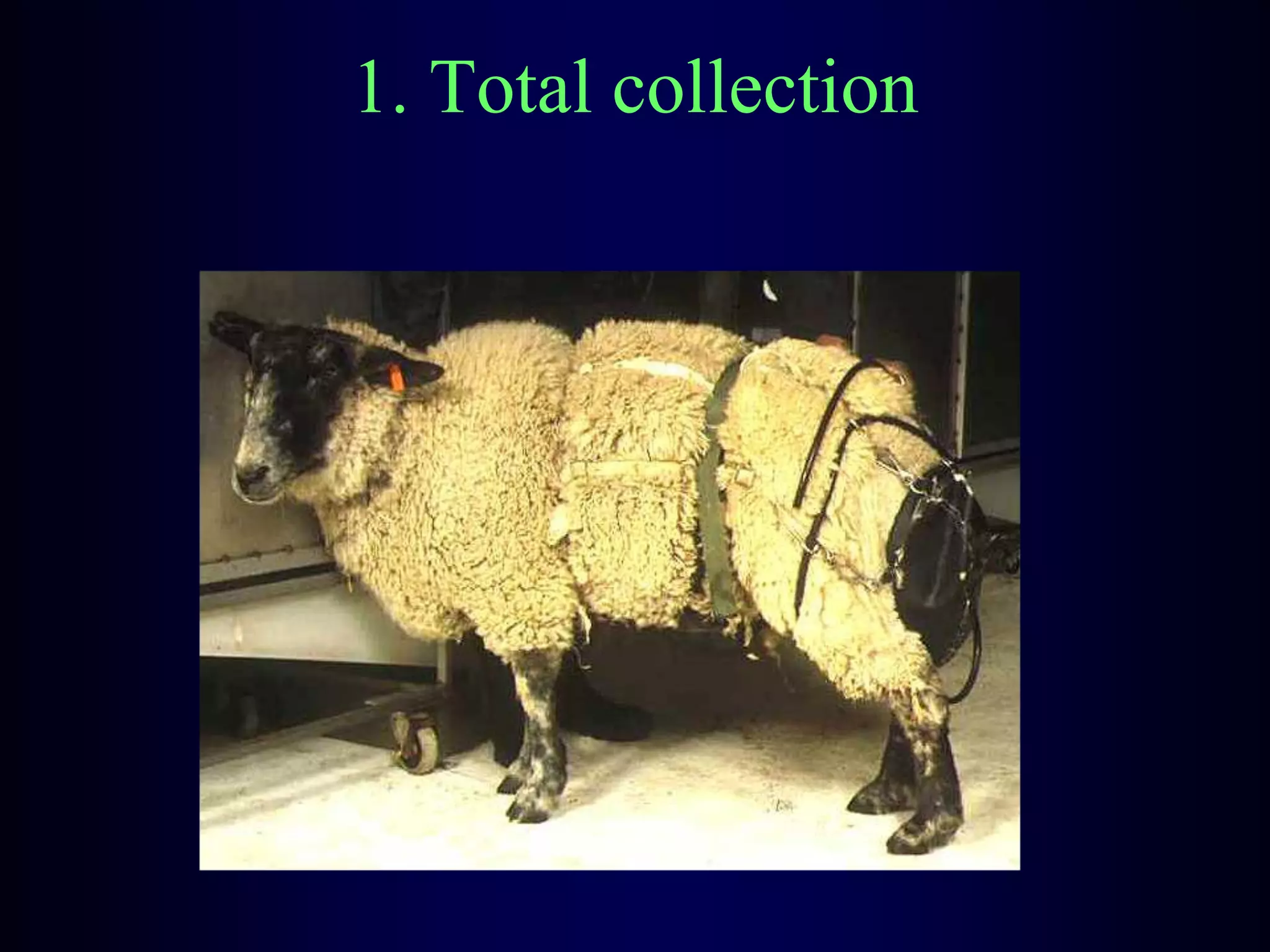
1. Total collection
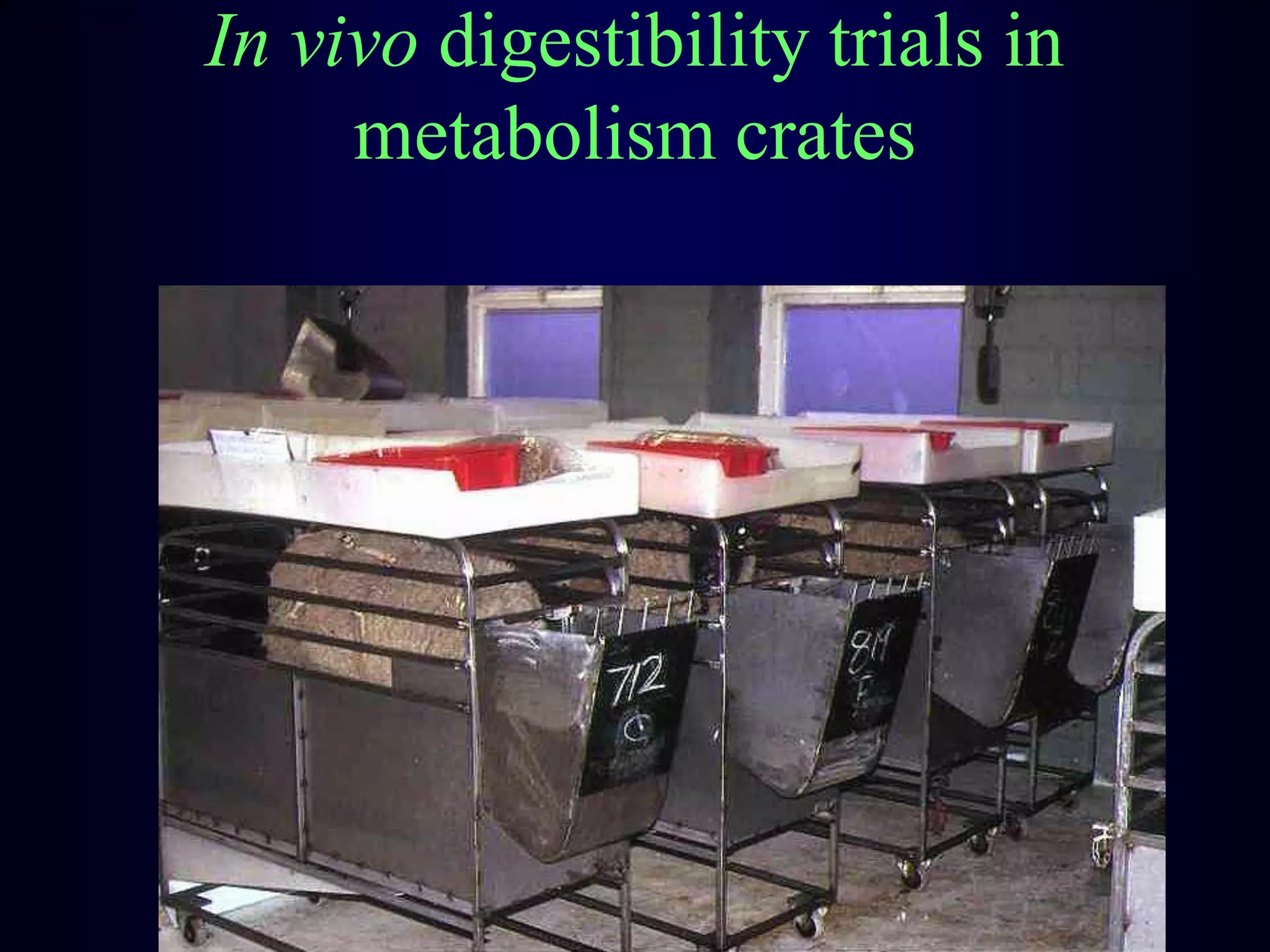
In vivo digestibility trials in
metabolism crates
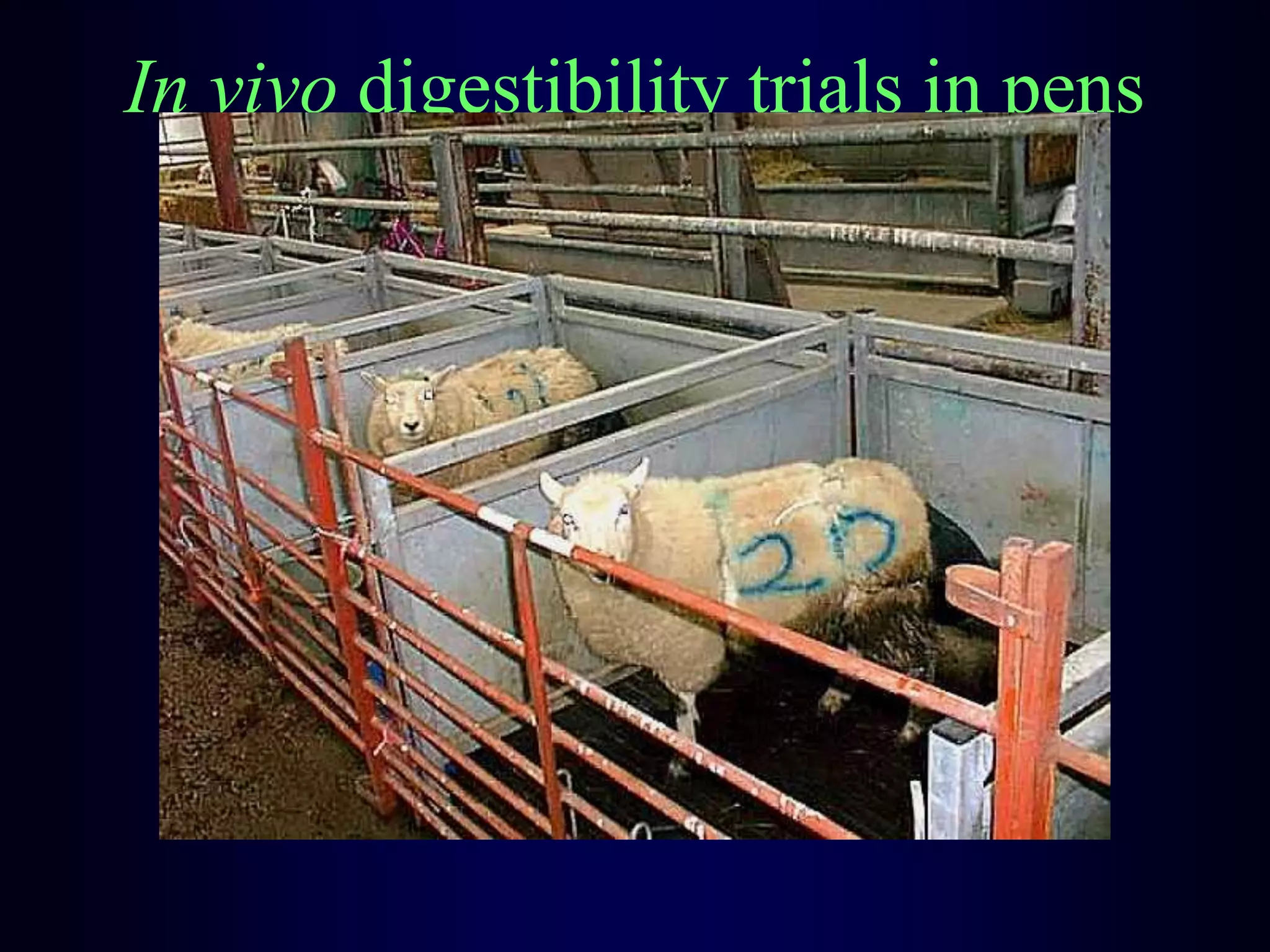
In vivo digestibility trials in pens
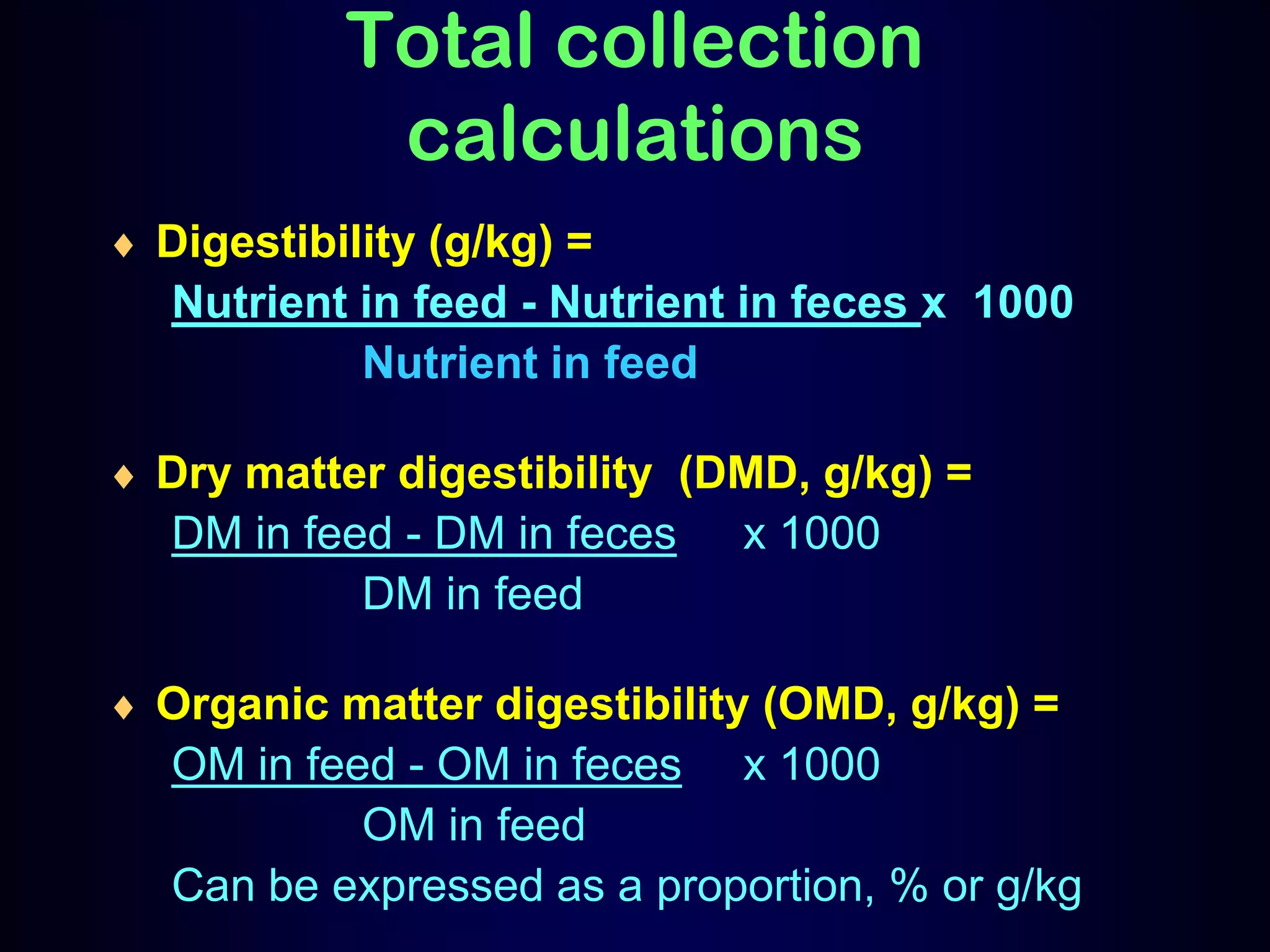
Total collection
calculations
Digestibility (g/kg) =
Nutrient in feed - Nutrient in feces x 1000
Nutrient in feed
Dry matter digestibility (DMD, g/kg) =
DM in feed - DM in feces x 1000
DM in feed
Organic matter digestibility (OMD, g/kg) =
OM in feed - OM in feces x 1000
OM in feed
Can be expressed as a proportion, % or g/kg
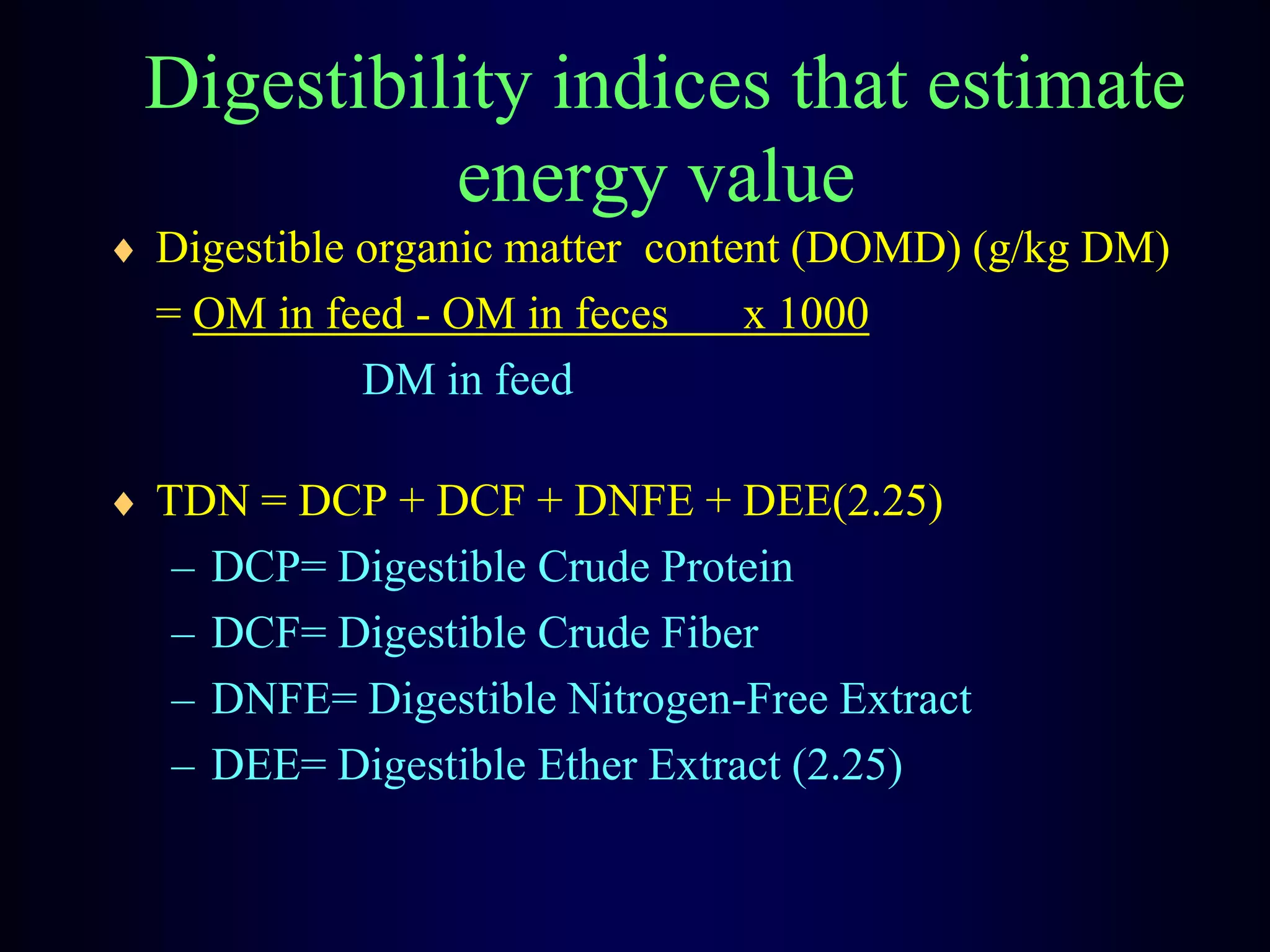
Digestibility indices that estimate
energy value
Digestible organic matter content (DOMD) (g/kg DM)
= OM in feed - OM in feces x 1000
DM in feed
TDN = DCP + DCF + DNFE + DEE(2.25)
– DCP= Digestible Crude Protein
– DCF= Digestible Crude Fiber
– DNFE= Digestible Nitrogen-Free Extract
– DEE= Digestible Ether Extract (2.25)
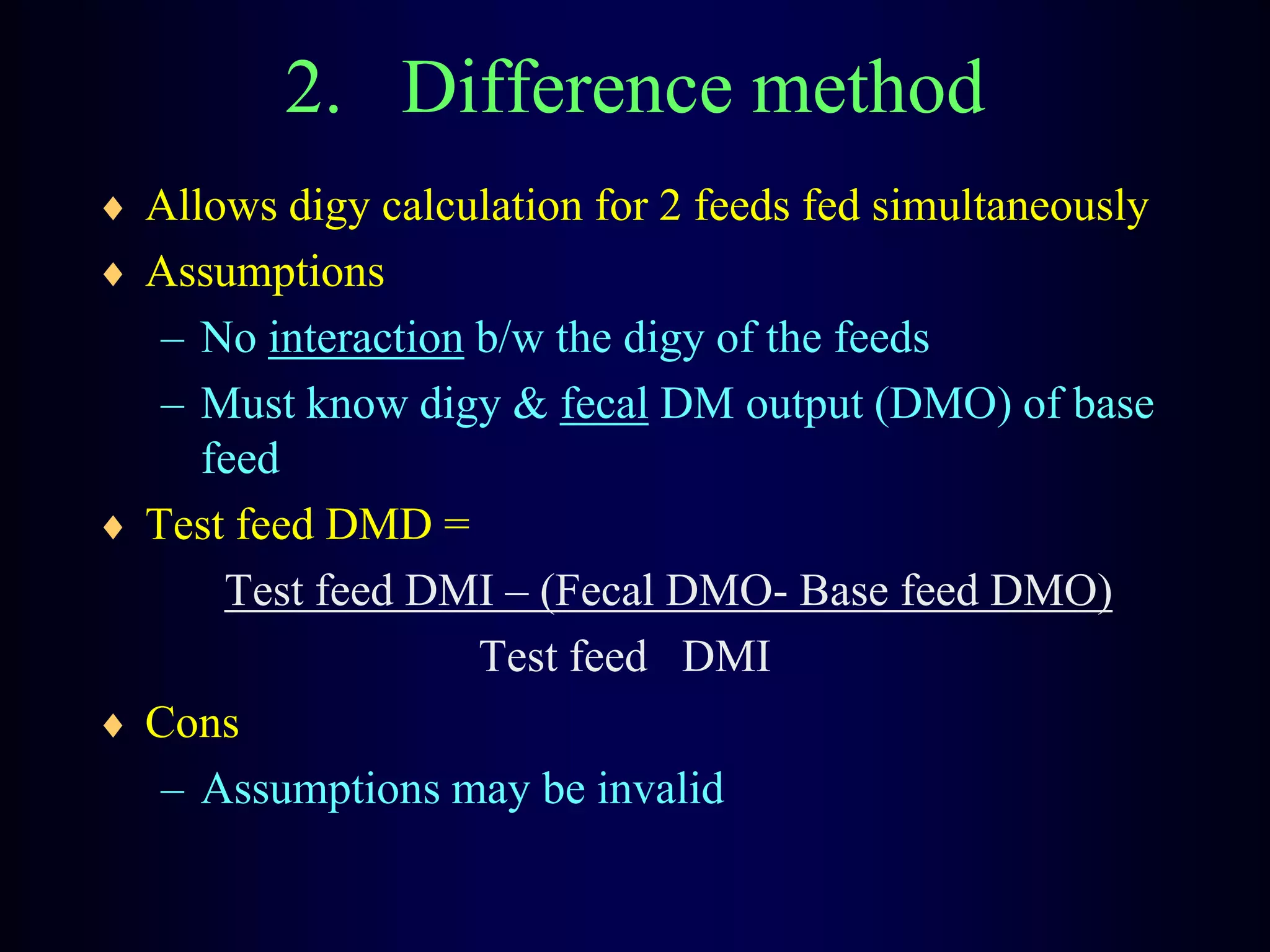
2. Difference method
Allows digy calculation for 2 feeds fed simultaneously
Assumptions
– No interaction b/w the digy of the feeds
– Must know digy & fecal DM output (DMO) of base
feed
Test feed DMD =
Test feed DMI – (Fecal DMO- Base feed DMO)
Test feed DMI
Cons
– Assumptions may be invalid
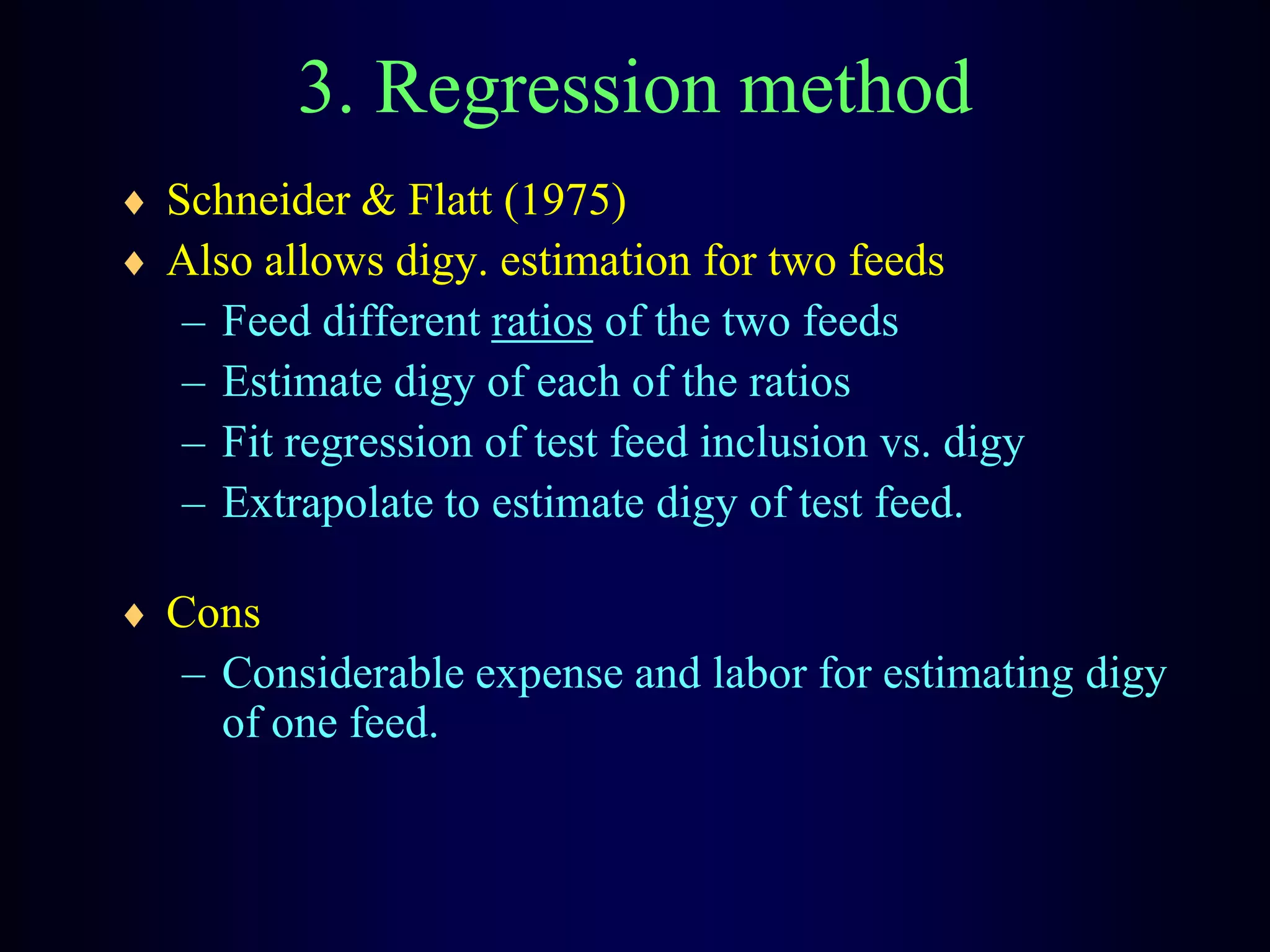
3. Regression method
Schneider & Flatt (1975)
Also allows digy. estimation for two feeds
– Feed different ratios of the two feeds
– Estimate digy of each of the ratios
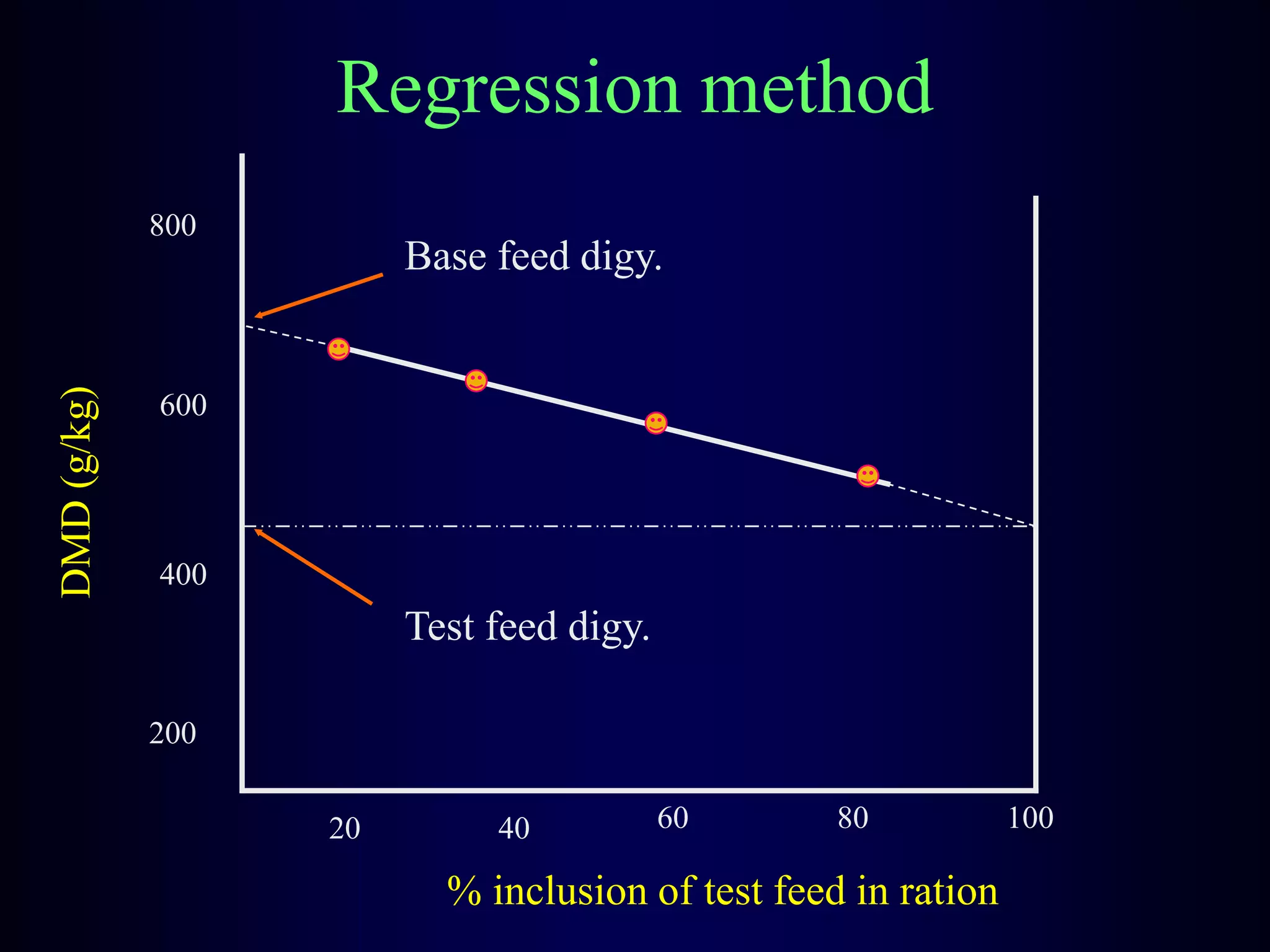
– Fit regression of test feed inclusion vs. digy
– Extrapolate to estimate digy of test feed.
Cons
– Considerable expense and labor for estimating digy
of one feed.
Regression method
20 40 60 80 100
200
400
600
800
Test feed digy.
Base feed digy.
% inclusion of test feed in ration
DMD
(g/kg)
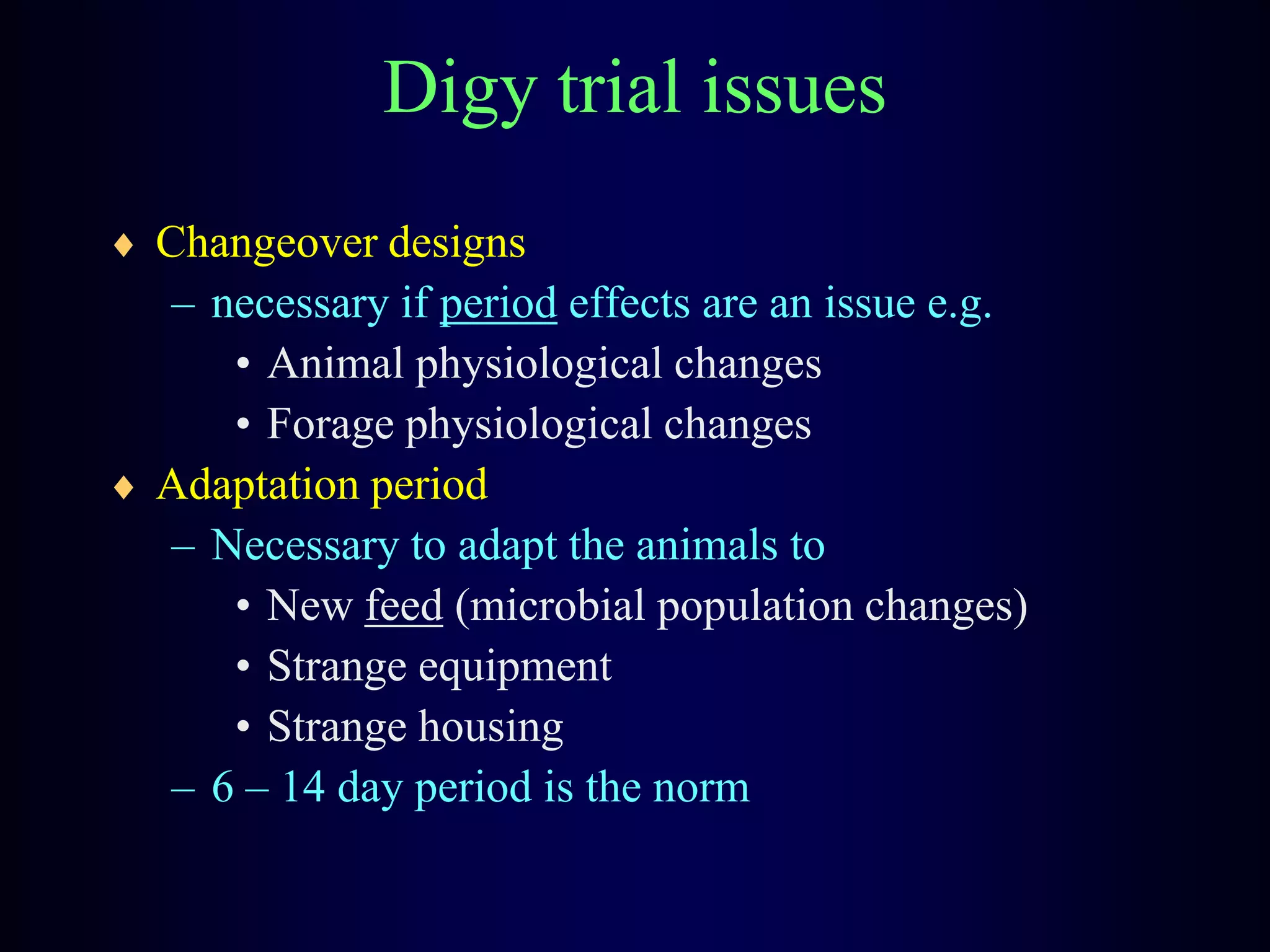
Digy trial issues
Changeover designs
– necessary if period effects are an issue e.g.
• Animal physiological changes
• Forage physiological changes
Adaptation period
– Necessary to adapt the animals to
• New feed (microbial population changes)
• Strange equipment
• Strange housing
– 6 – 14 day period is the norm
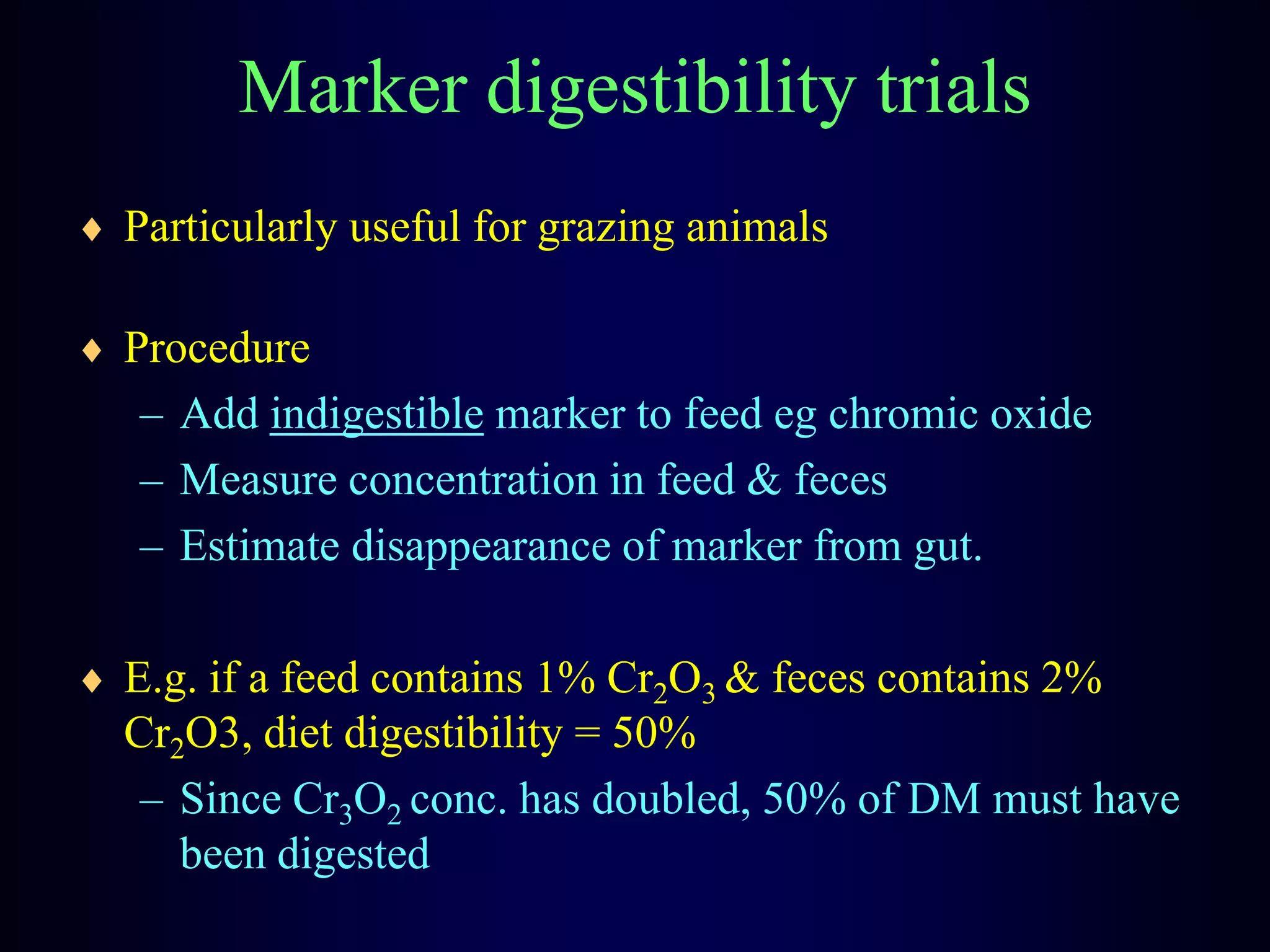
Marker digestibility trials
Particularly useful for grazing animals
Procedure
– Add indigestible marker to feed eg chromic oxide
– Measure concentration in feed & feces
– Estimate disappearance of marker from gut.
E.g. if a feed contains 1% Cr2O3 & feces contains 2%
Cr2O3, diet digestibility = 50%
– Since Cr3O2 conc. has doubled, 50% of DM must have
been digested
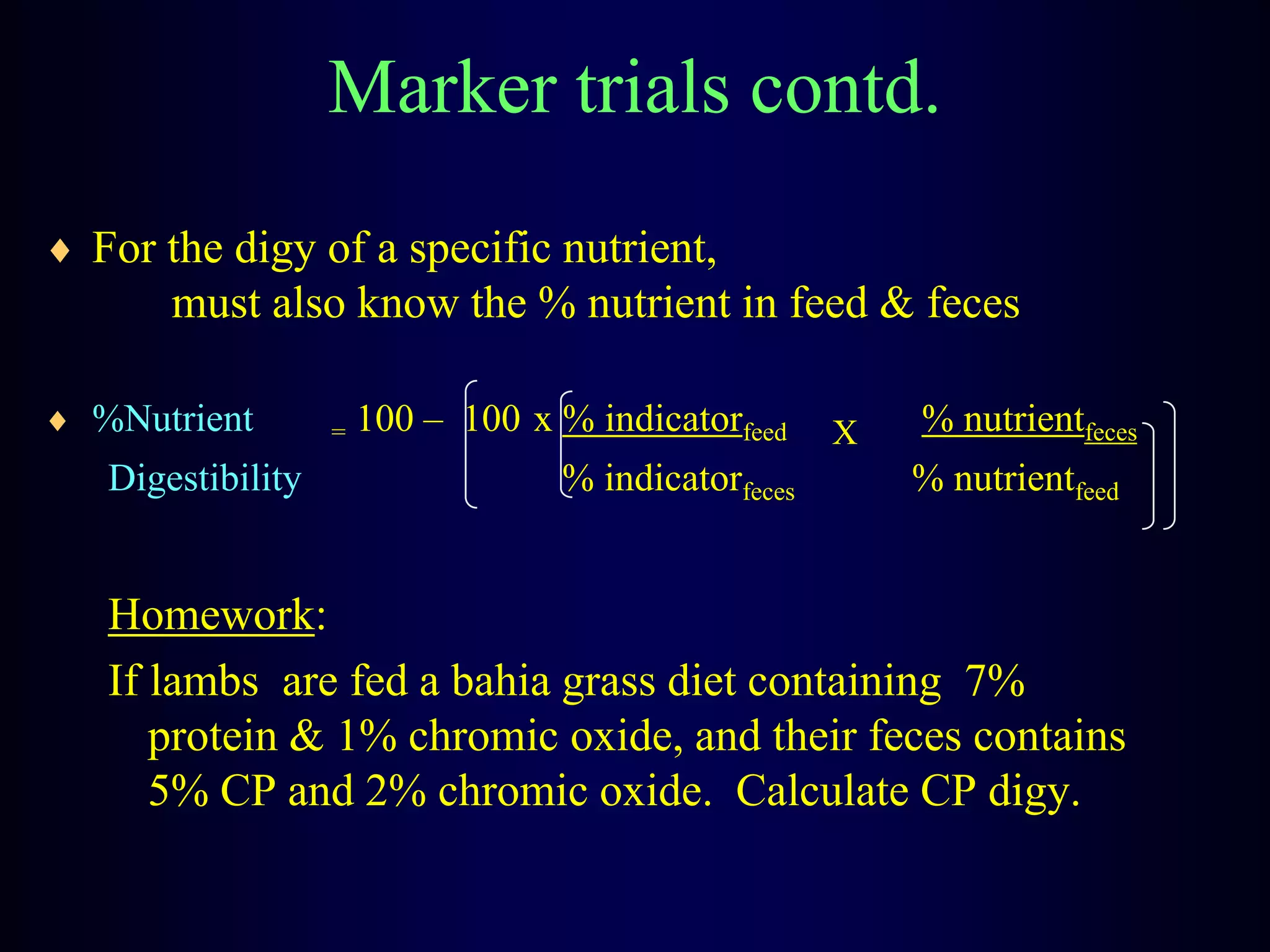
Marker trials contd.
For the digy of a specific nutrient,
must also know the % nutrient in feed & feces
%Nutrient = 100 – 100 x % indicatorfeed X % nutrientfeces
Digestibility % indicatorfeces % nutrientfeed
Homework:
If lambs are fed a bahia grass diet containing 7%
protein & 1% chromic oxide, and their feces contains
5% CP and 2% chromic oxide. Calculate CP digy.
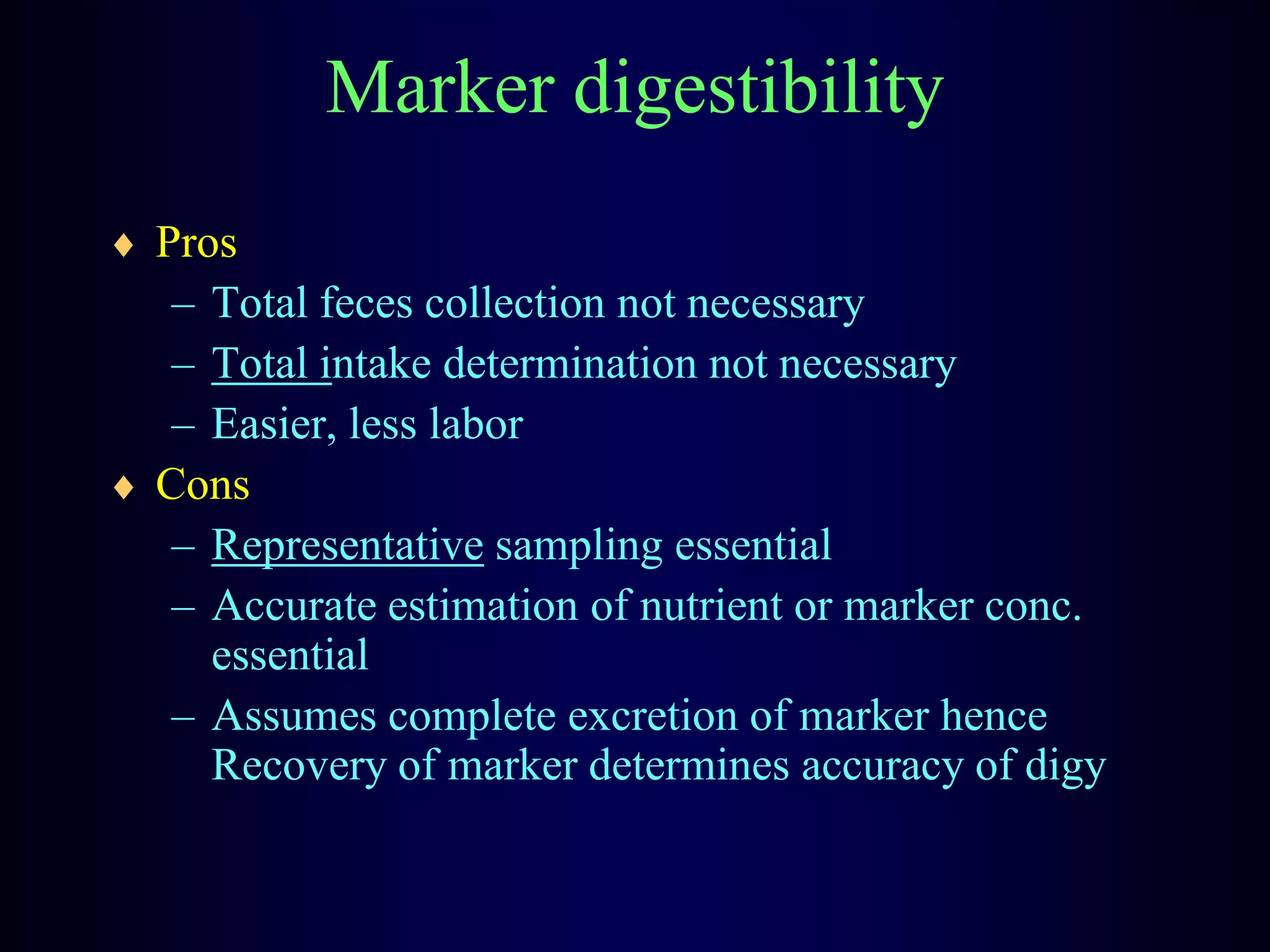
Marker digestibility
Pros
– Total feces collection not necessary
– Total intake determination not necessary
– Easier, less labor
Cons
– Representative sampling essential
– Accurate estimation of nutrient or marker conc.
essential
– Assumes complete excretion of marker hence
Recovery of marker determines accuracy of digy
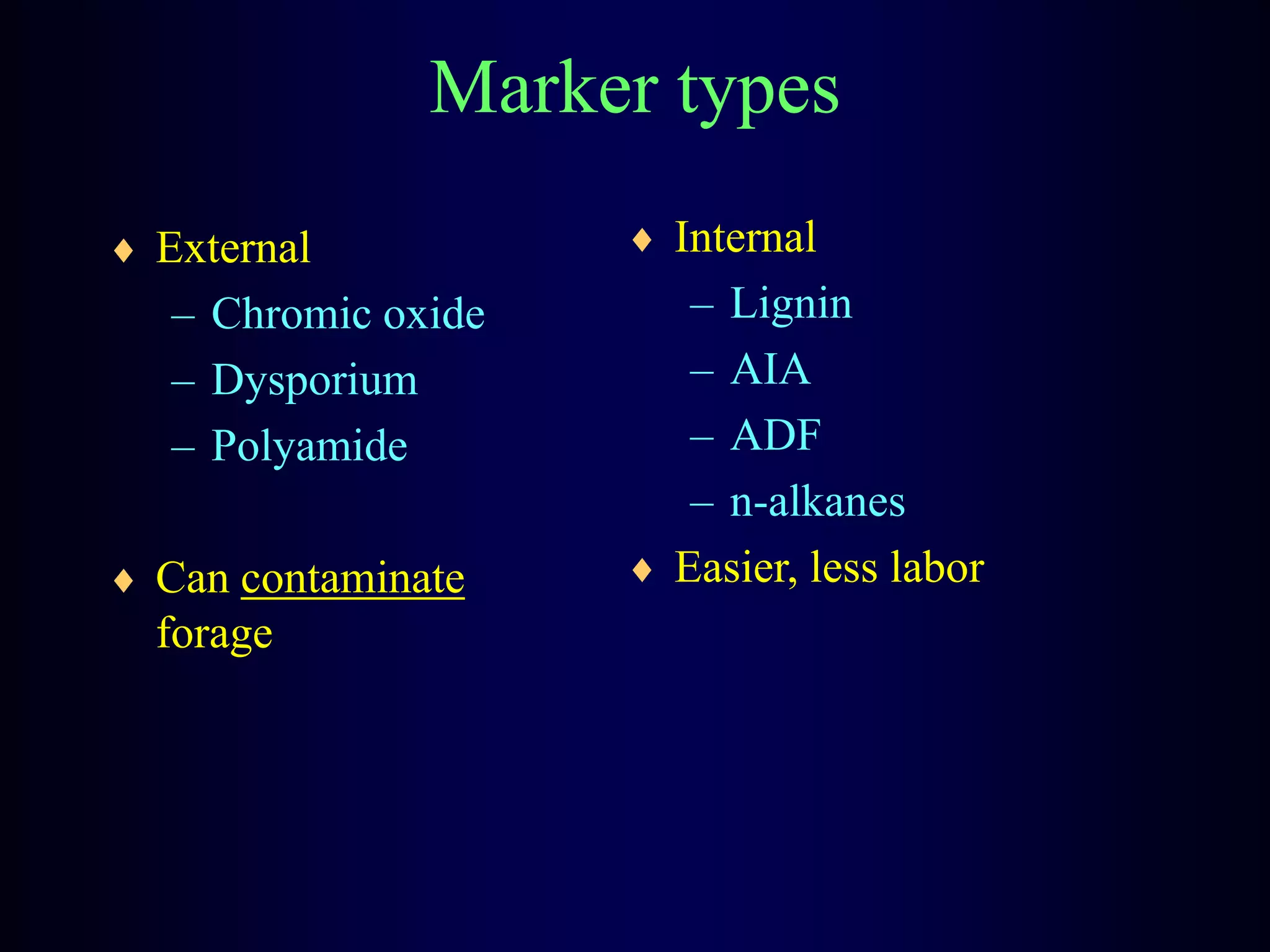
Marker types
External
– Chromic oxide
– Dysporium
– Polyamide
Can contaminate
forage
Internal
– Lignin
– AIA
– ADF
– n-alkanes
Easier, less labor
Marker issues
Difficulty of mixing marker with forages
– Dose cows instead- ( s handling)
Marker migration
– Must not affect feed digy
External markers may contaminate forage
Problems with in vivo
experiments
Animal trials are:
– Expensive
– Protracted
– Laborious
– Public concerns
– Animal stress ???
Must estimate nutritive value with less animal
dependent techniques
Ideal in vitro methods should be:
– Rapid (one step) & routinely practicable
– Accurate
– Cheap & not laborious
– Repeatable & robust
– Biologically meaningful
– Broad-based (apply to all forage types)
– Handle large nos. of samples
– Laboratory-based
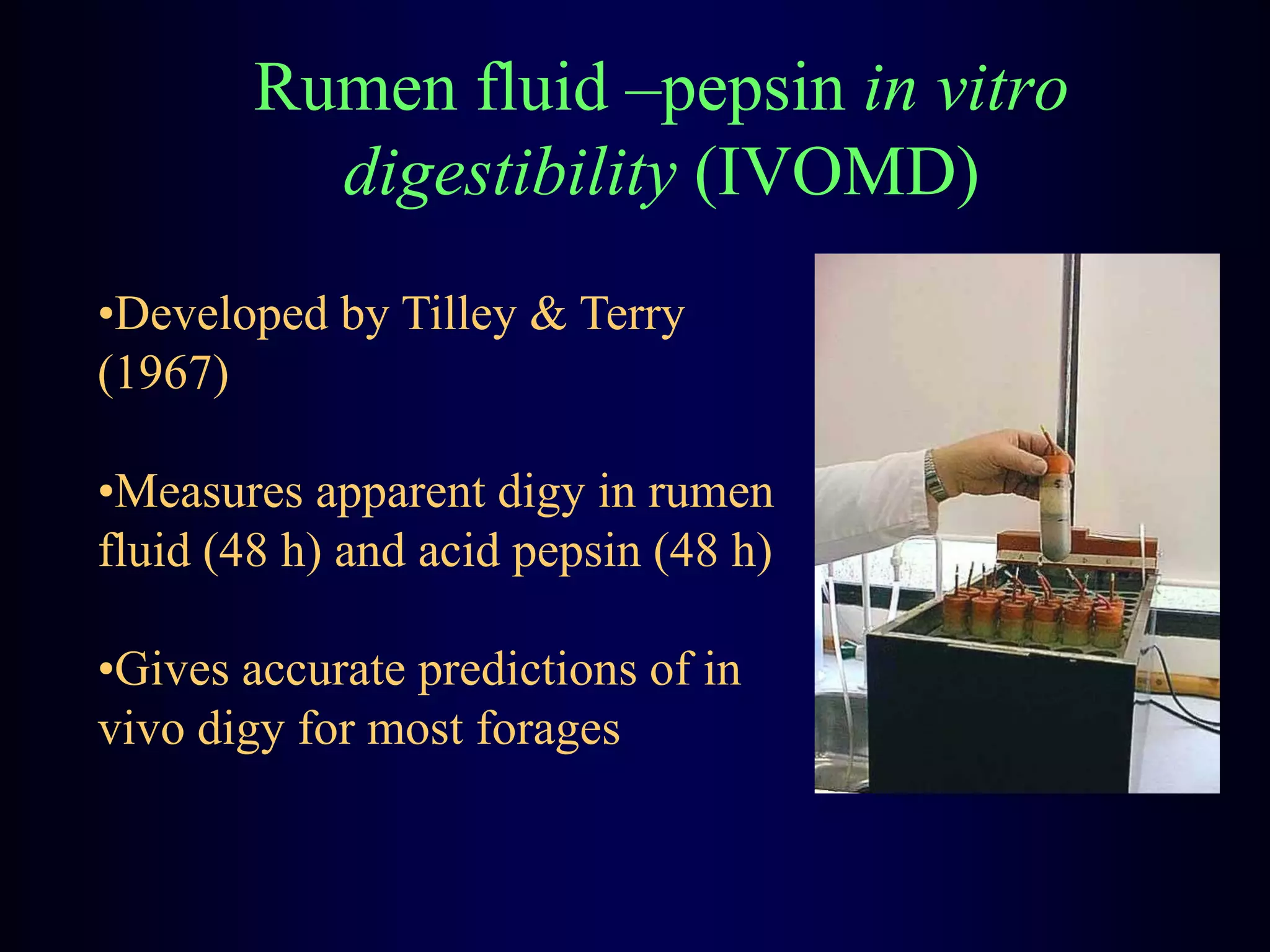
Rumen fluid –pepsin in vitro
digestibility (IVOMD)
•Developed by Tilley & Terry
(1967)
•Measures apparent digy in rumen
fluid (48 h) and acid pepsin (48 h)
•Gives accurate predictions of in
vivo digy for most forages
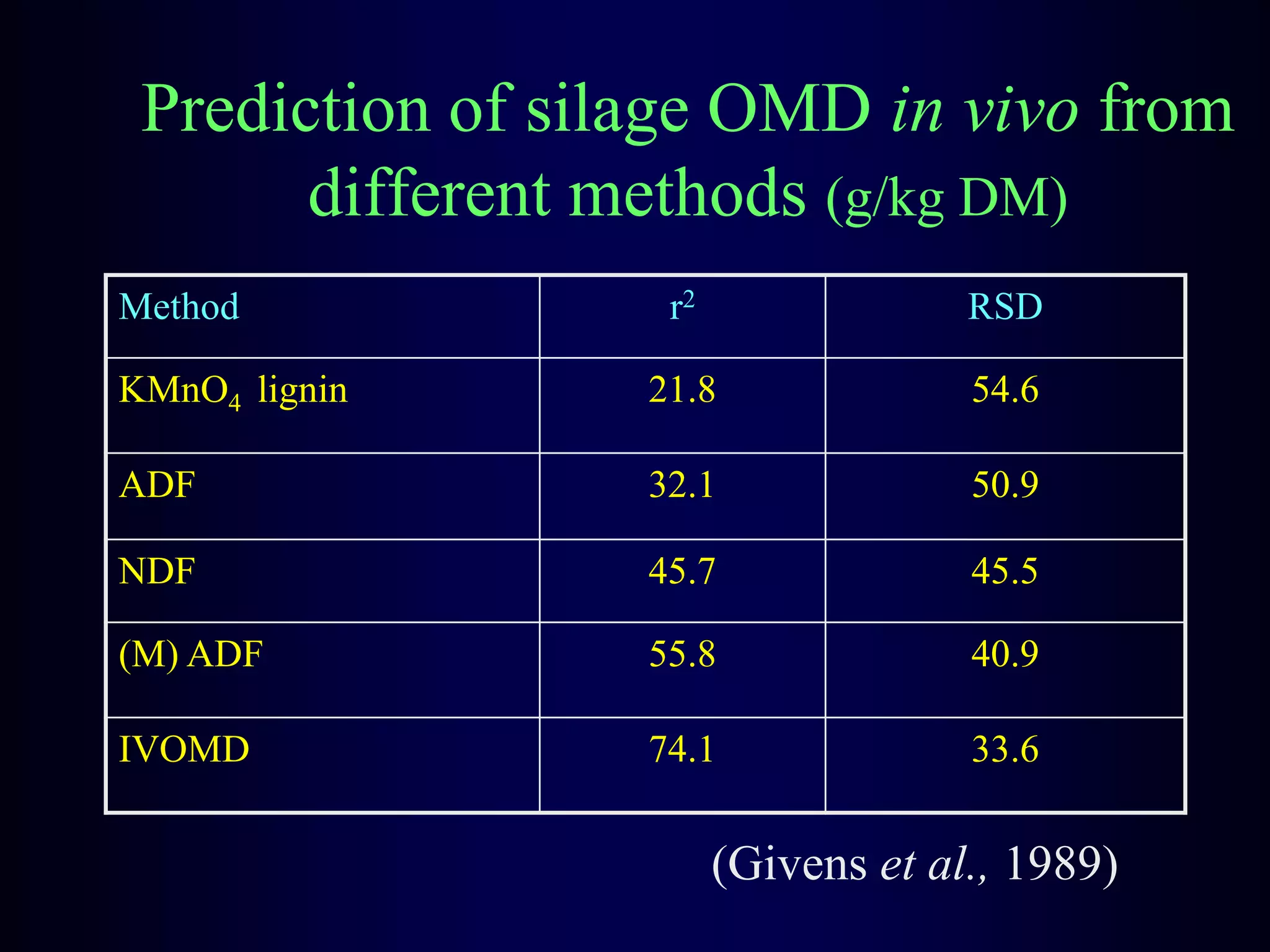
Prediction of silage OMD in vivo from
different methods (g/kg DM)
Method r2 RSD
KMnO4 lignin 21.8 54.6
ADF 32.1 50.9
NDF 45.7 45.5
(M) ADF 55.8 40.9
IVOMD 74.1 33.6
(Givens et al., 1989)
Rumen fluid problems
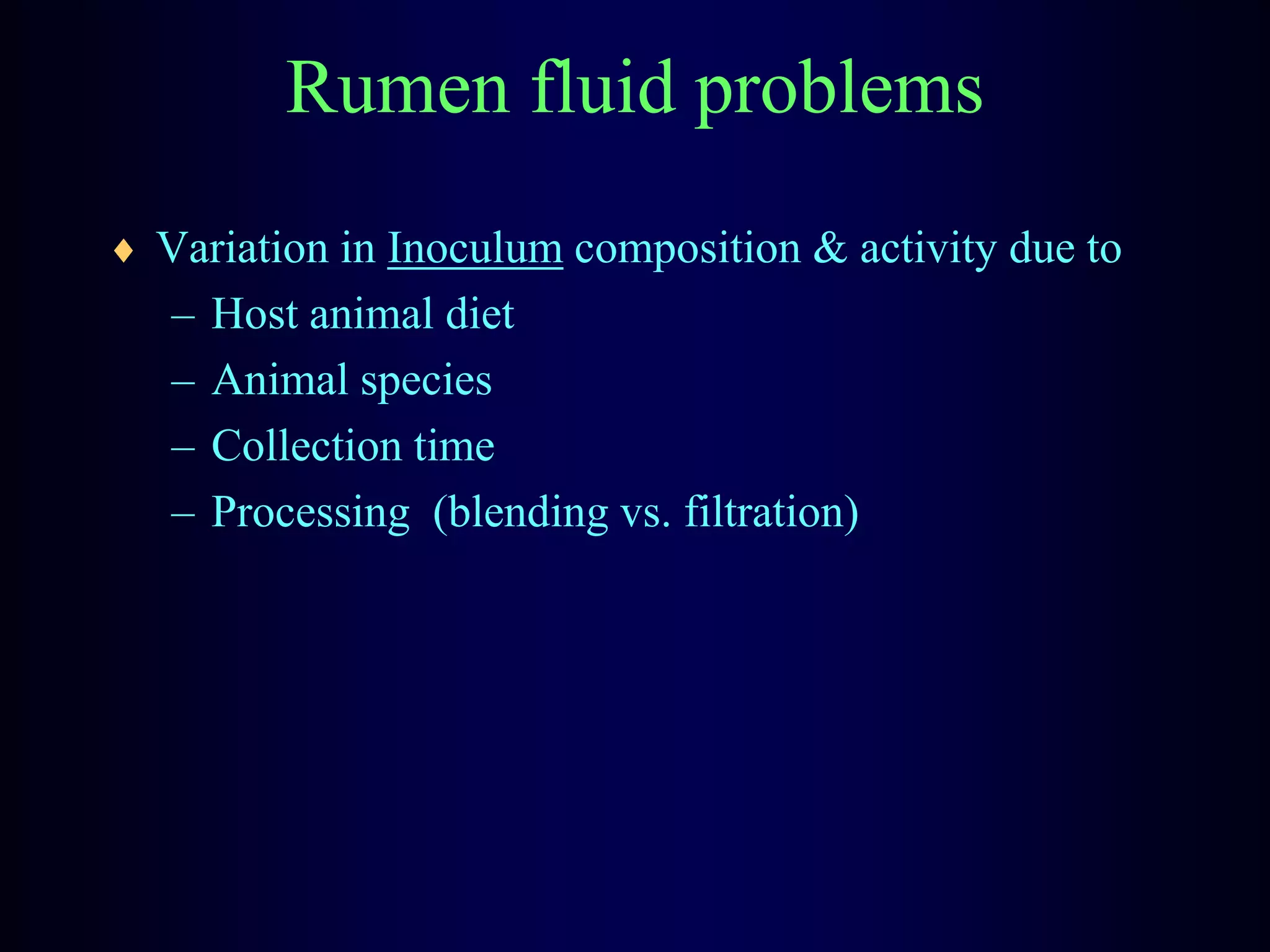
Variation in Inoculum composition & activity due to
– Host animal diet
– Animal species
– Collection time
– Processing (blending vs. filtration)
Rumen fluid problems
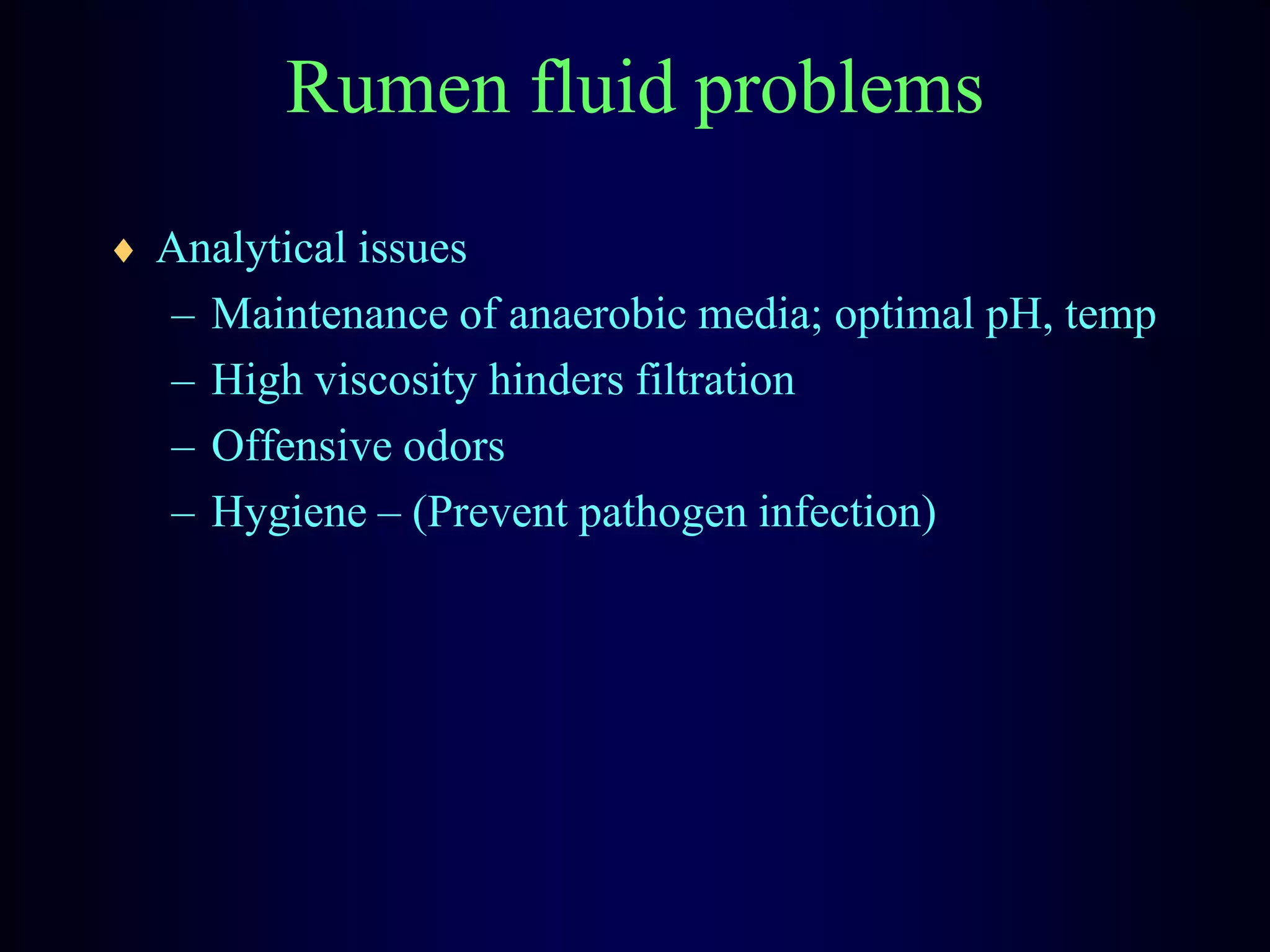
Analytical issues
– Maintenance of anaerobic media; optimal pH, temp
– High viscosity hinders filtration
– Offensive odors
– Hygiene – (Prevent pathogen infection)
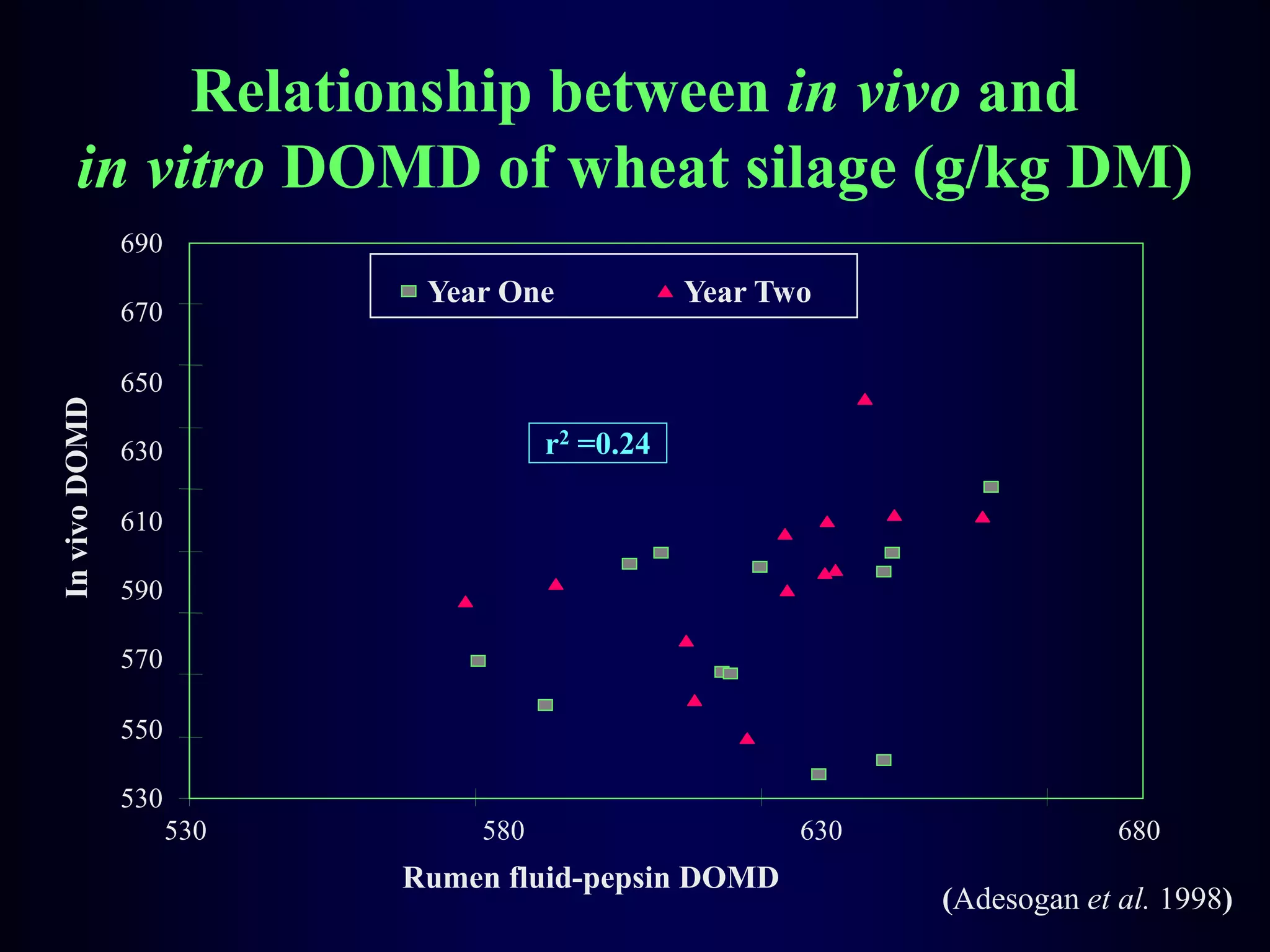
Relationship between in vivo and
in vitro DOMD of wheat silage (g/kg DM)
r2 =0.24
530 580 630 680
Rumen fluid-pepsin DOMD
530
550
570
590
610
630
650
670
690
In
vivo
DOMD
(Adesogan et al. 1998)
Year One Year Two
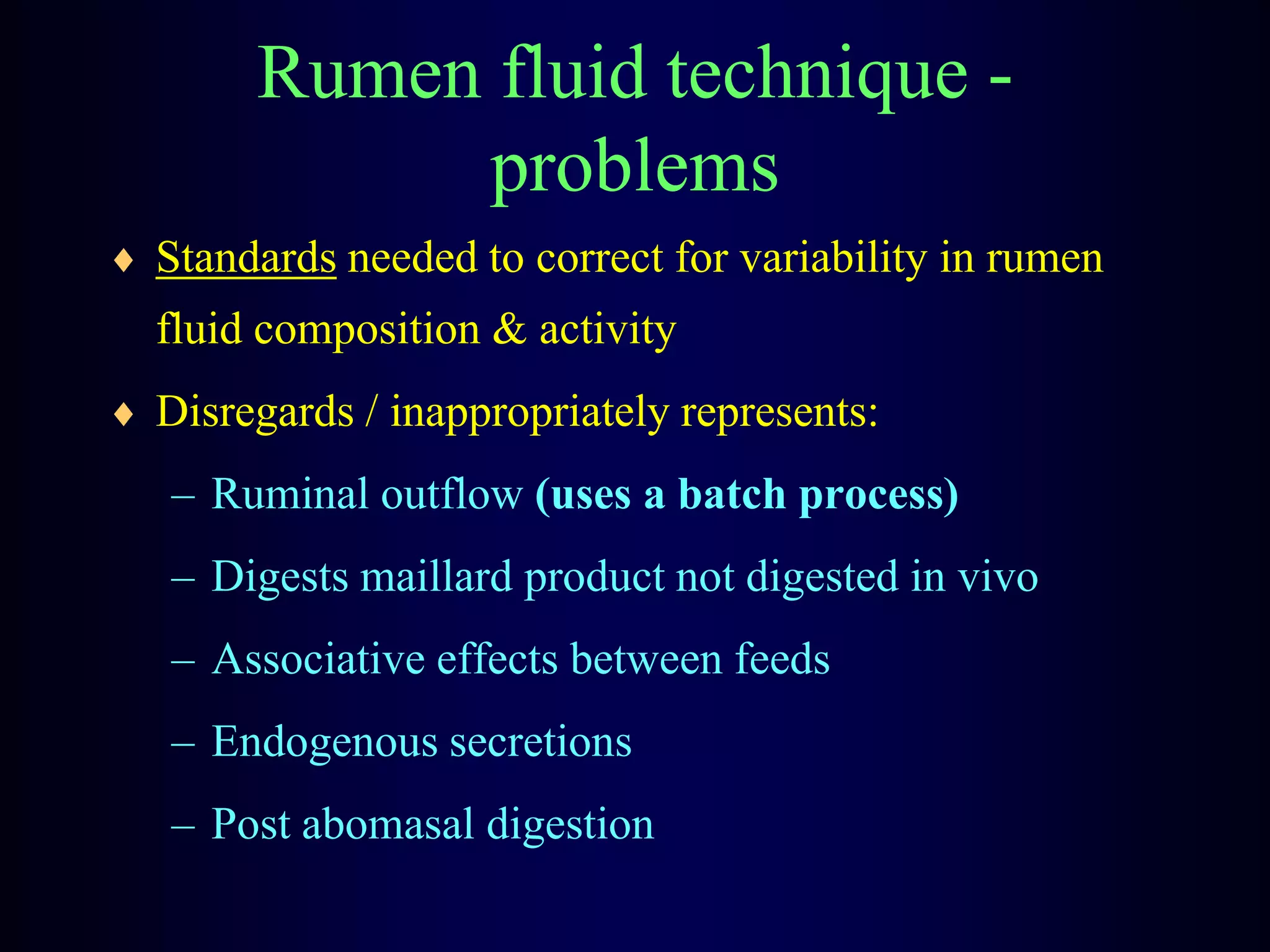
Rumen fluid technique -
problems
Standards needed to correct for variability in rumen
fluid composition & activity
Disregards / inappropriately represents:
– Ruminal outflow (uses a batch process)
– Digests maillard product not digested in vivo
– Associative effects between feeds
– Endogenous secretions
– Post abomasal digestion
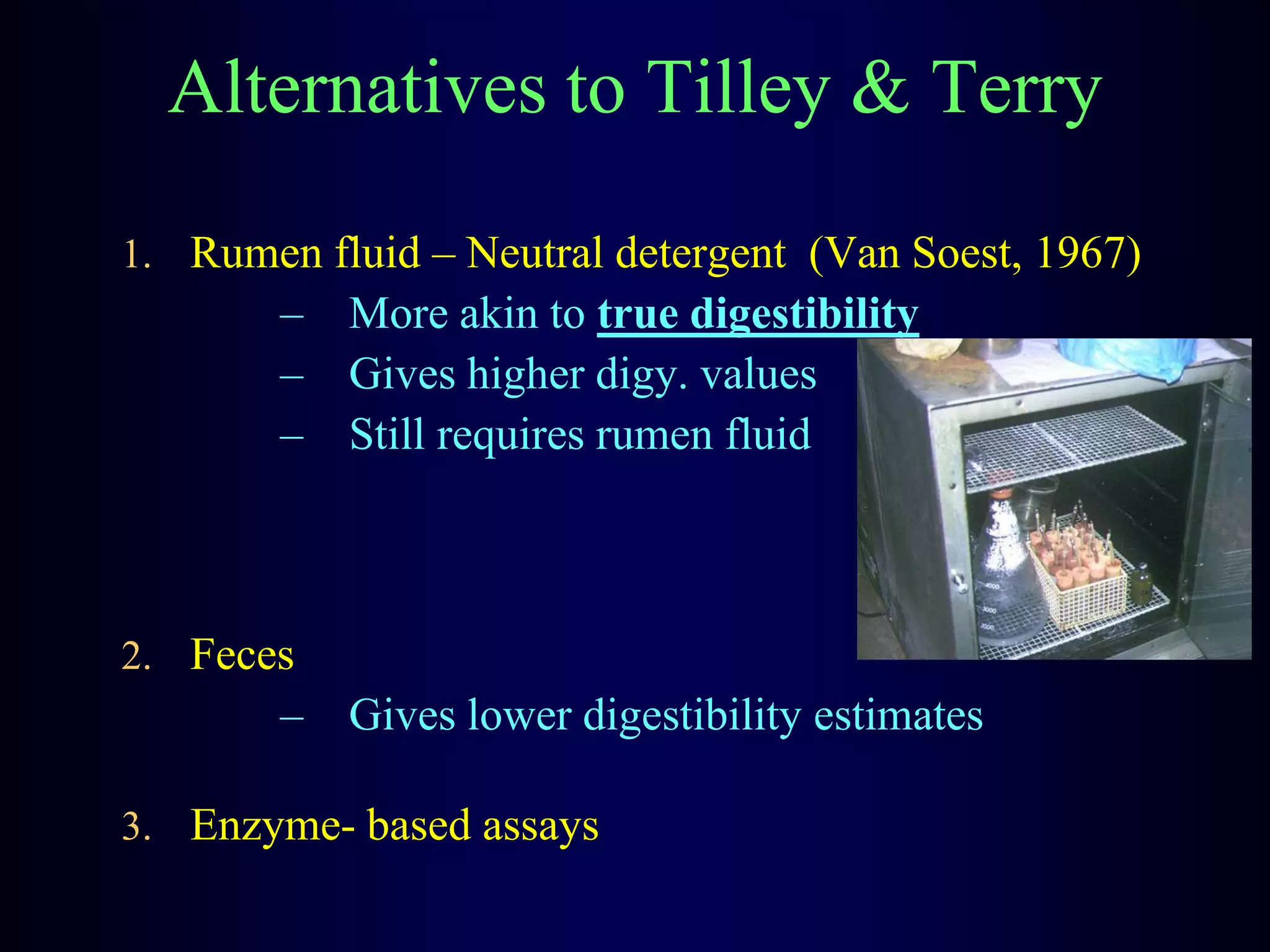
Alternatives to Tilley & Terry
1. Rumen fluid – Neutral detergent (Van Soest, 1967)
– More akin to true digestibility
– Gives higher digy. values
– Still requires rumen fluid
2. Feces
– Gives lower digestibility estimates
3. Enzyme- based assays
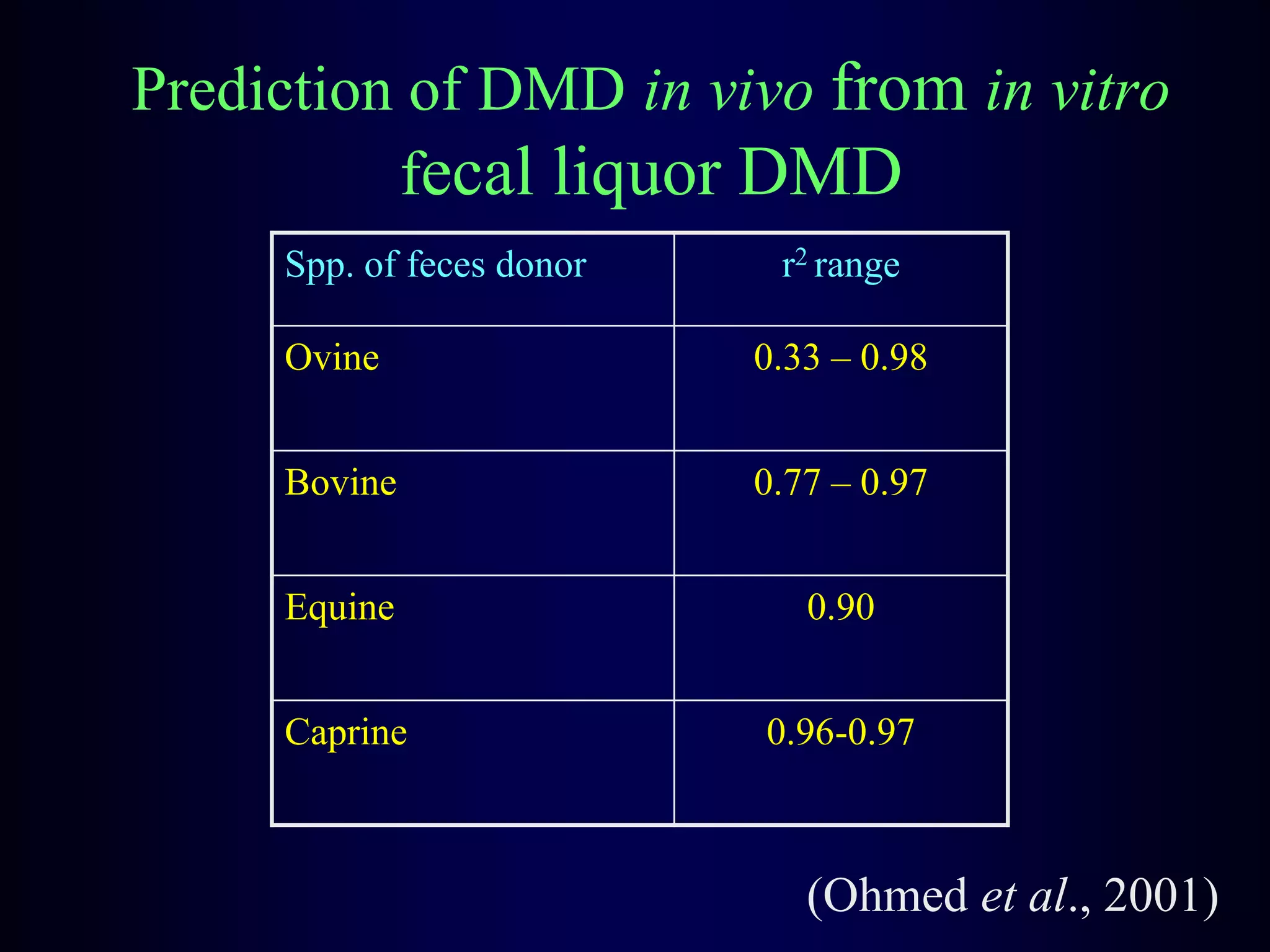
Prediction of DMD in vivo from in vitro
fecal liquor DMD
Spp. of feces donor r2 range
Ovine 0.33 – 0.98
Bovine 0.77 – 0.97
Equine 0.90
Caprine 0.96-0.97
(Ohmed et al., 2001)
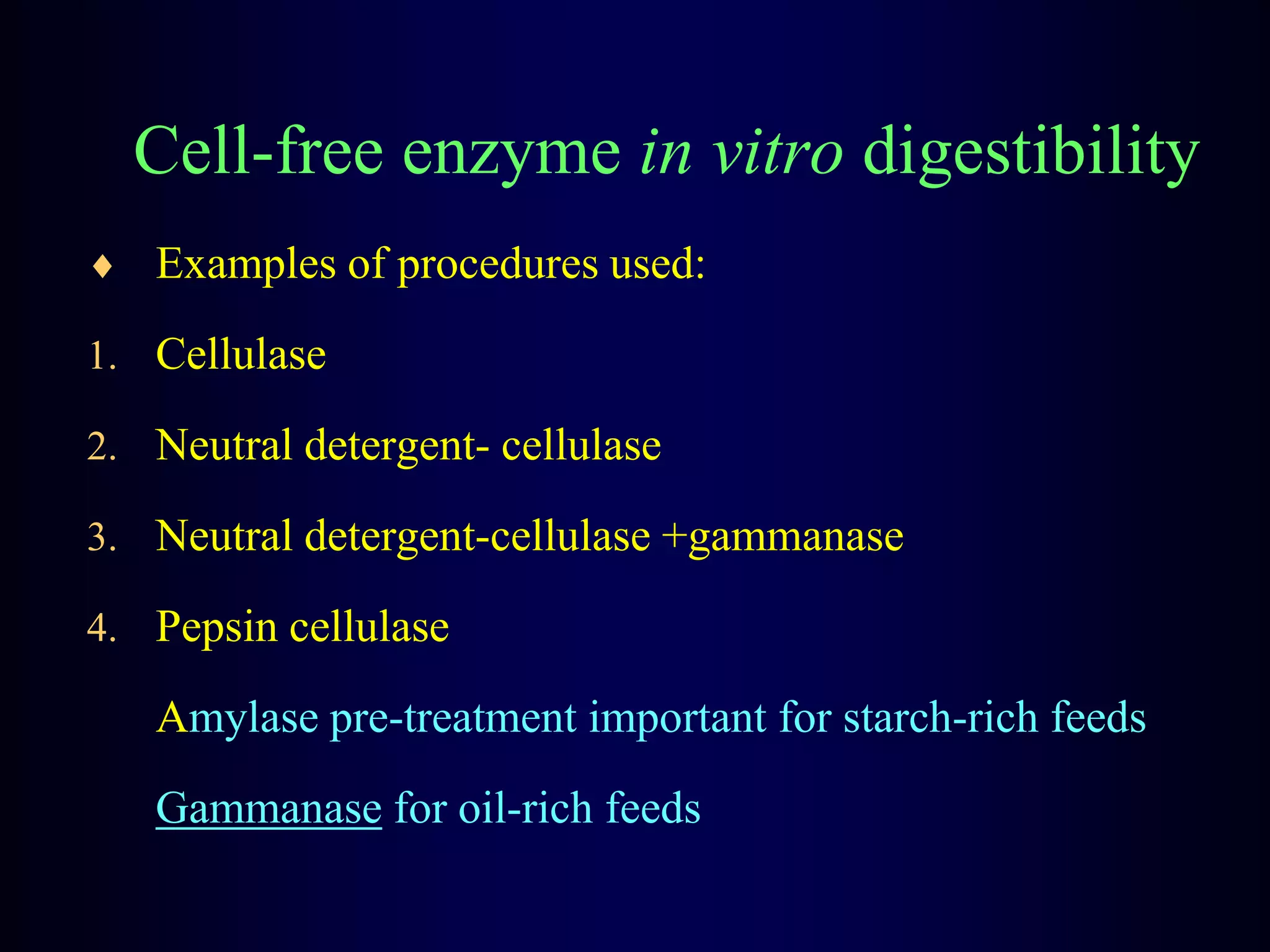
Cell-free enzyme in vitro digestibility
Examples of procedures used:
1. Cellulase
2. Neutral detergent- cellulase
3. Neutral detergent-cellulase +gammanase
4. Pepsin cellulase
Amylase pre-treatment important for starch-rich feeds
Gammanase for oil-rich feeds
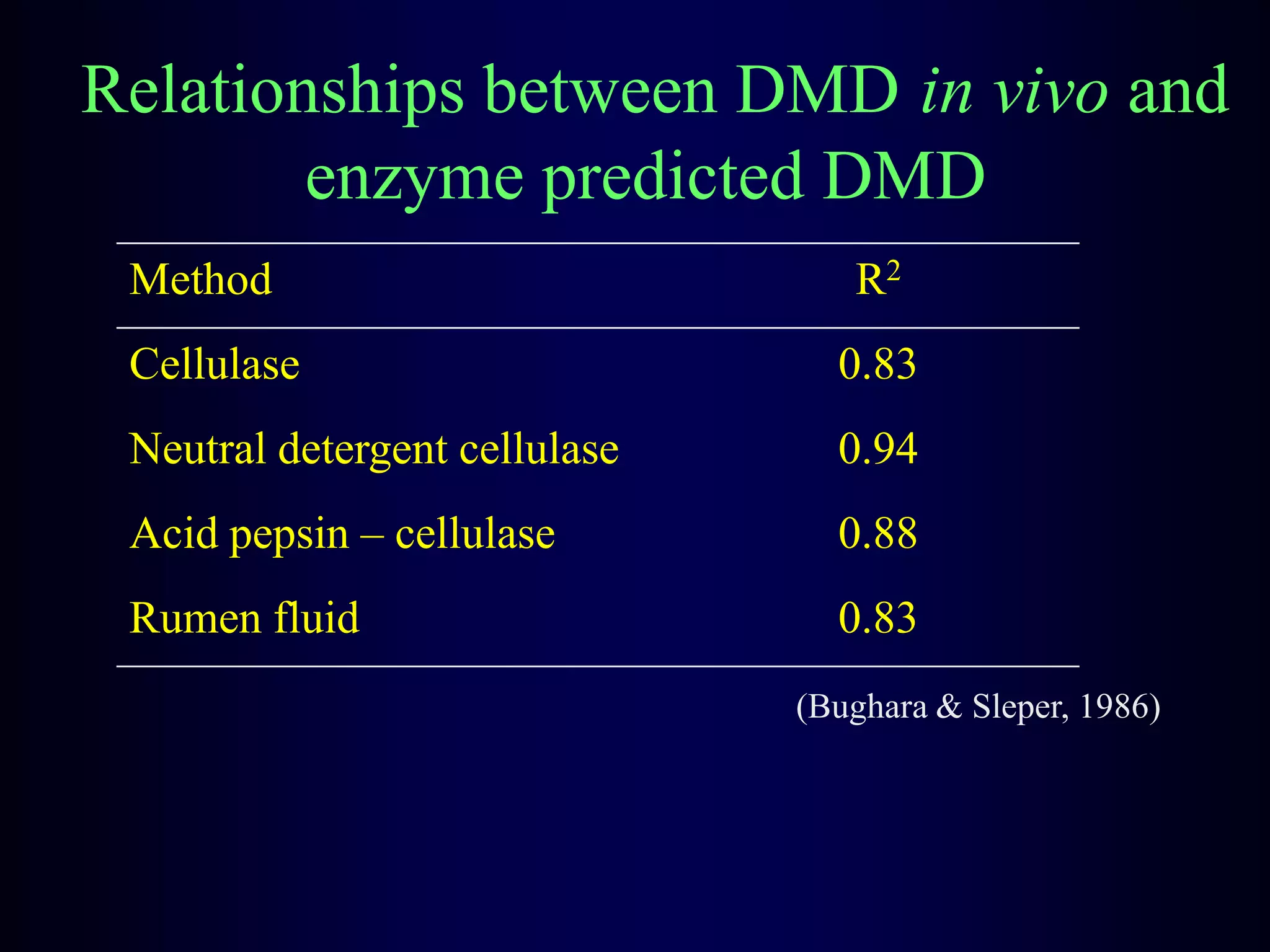
Relationships between DMD in vivo and
enzyme predicted DMD
Method R2
Cellulase 0.83
Neutral detergent cellulase 0.94
Acid pepsin – cellulase 0.88
Rumen fluid 0.83
(Bughara & Sleper, 1986)
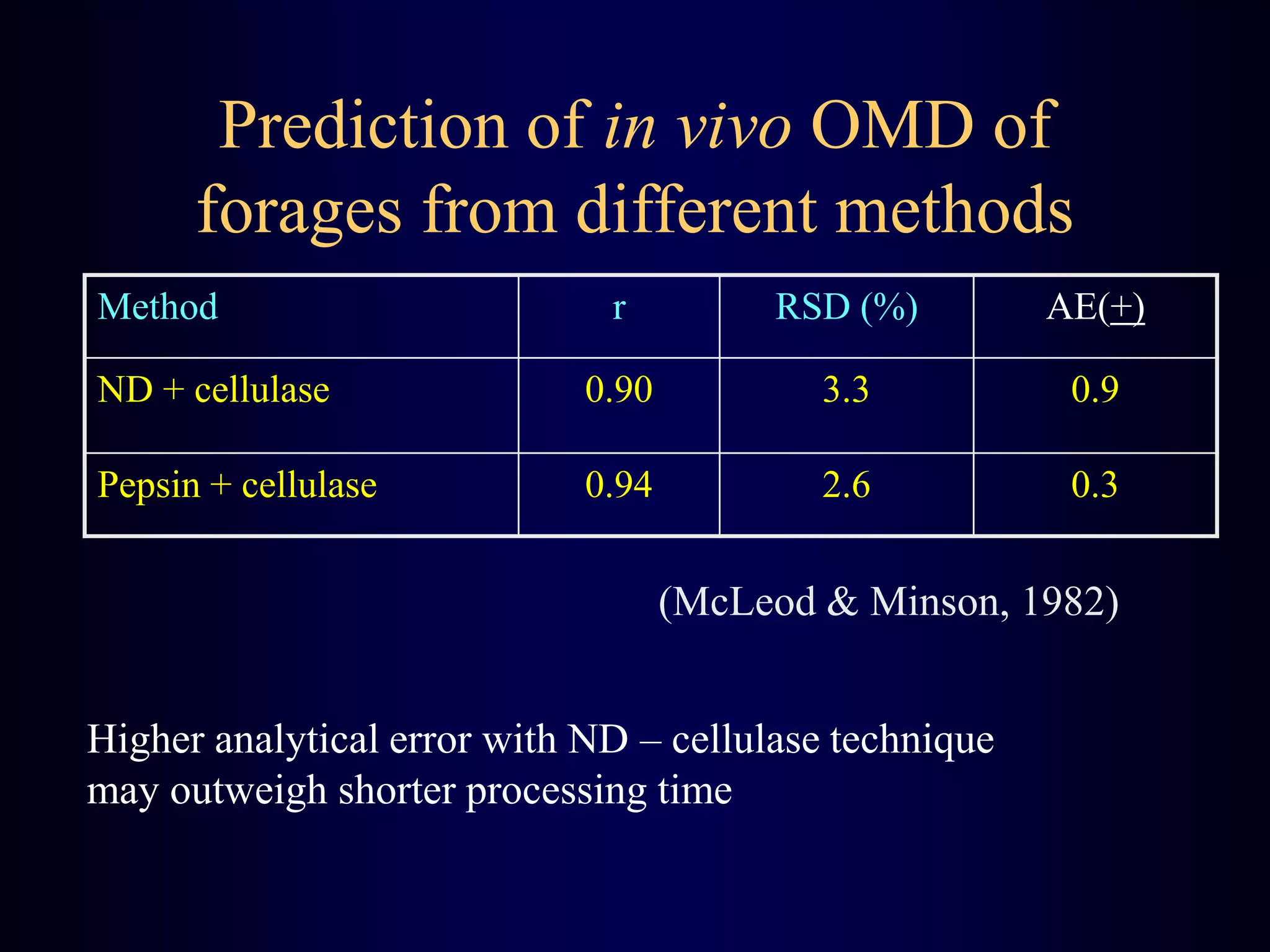
Prediction of in vivo OMD of
forages from different methods
Method r RSD (%) AE(+)
ND + cellulase 0.90 3.3 0.9
Pepsin + cellulase 0.94 2.6 0.3
(McLeod & Minson, 1982)
Higher analytical error with ND – cellulase technique
may outweigh shorter processing time
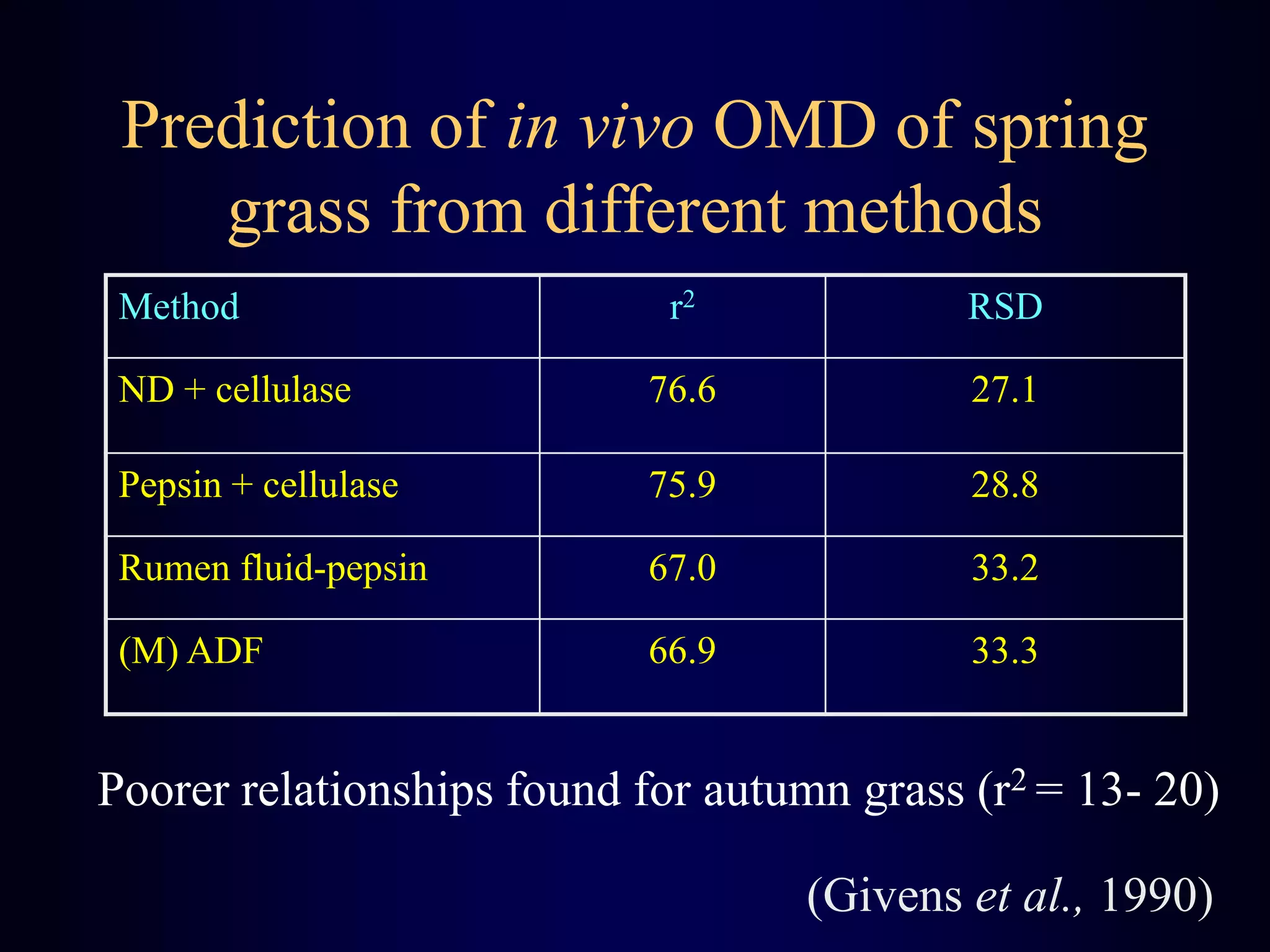
Method r2 RSD
ND + cellulase 76.6 27.1
Pepsin + cellulase 75.9 28.8
Rumen fluid-pepsin 67.0 33.2
(M) ADF 66.9 33.3
(Givens et al., 1990)
Poorer relationships found for autumn grass (r2 = 13- 20)
Prediction of in vivo OMD of spring
grass from different methods
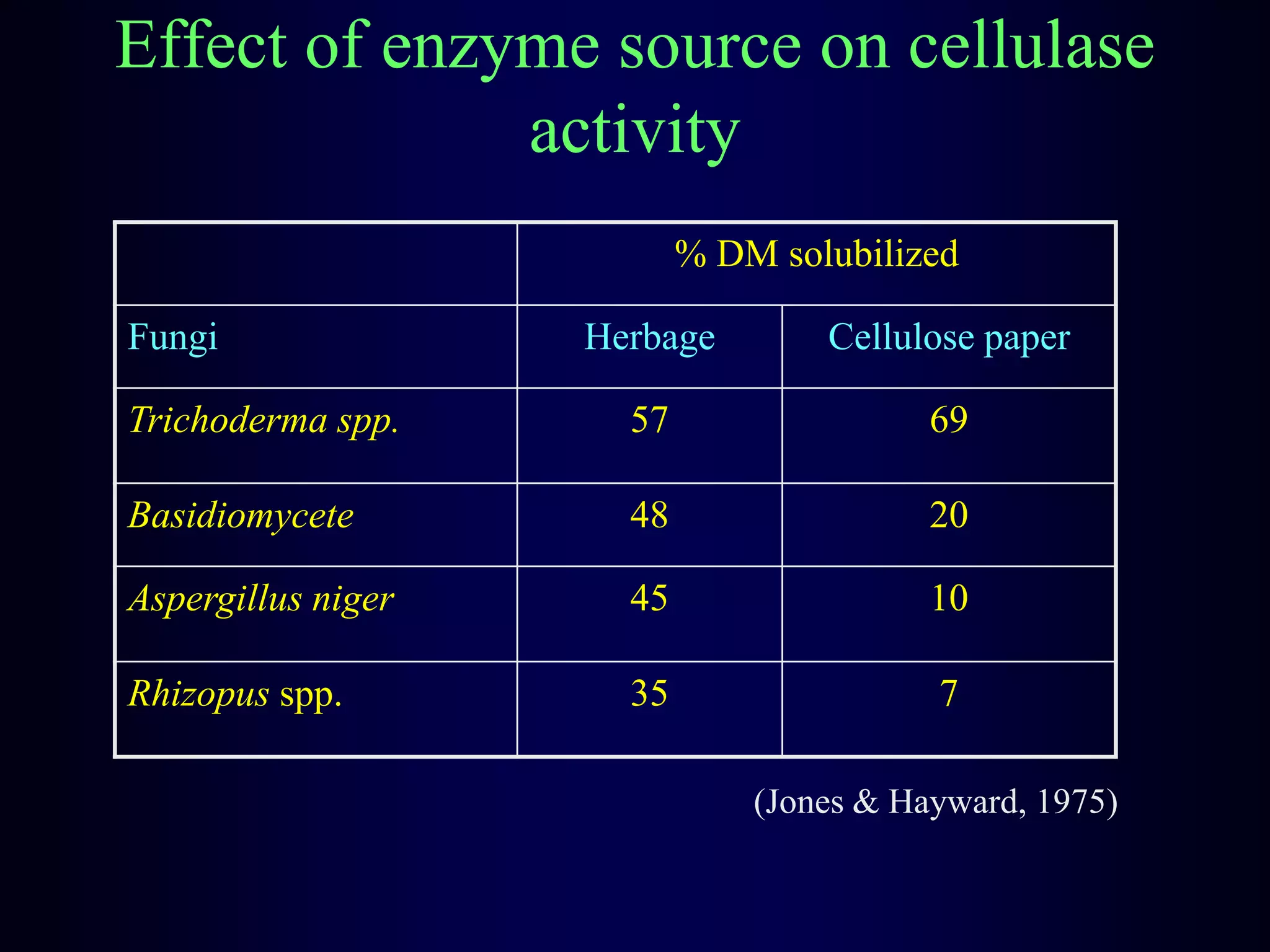
Effect of enzyme source on cellulase
activity
% DM solubilized
Fungi Herbage Cellulose paper
Trichoderma spp. 57 69
Basidiomycete 48 20
Aspergillus niger 45 10
Rhizopus spp. 35 7
(Jones & Hayward, 1975)
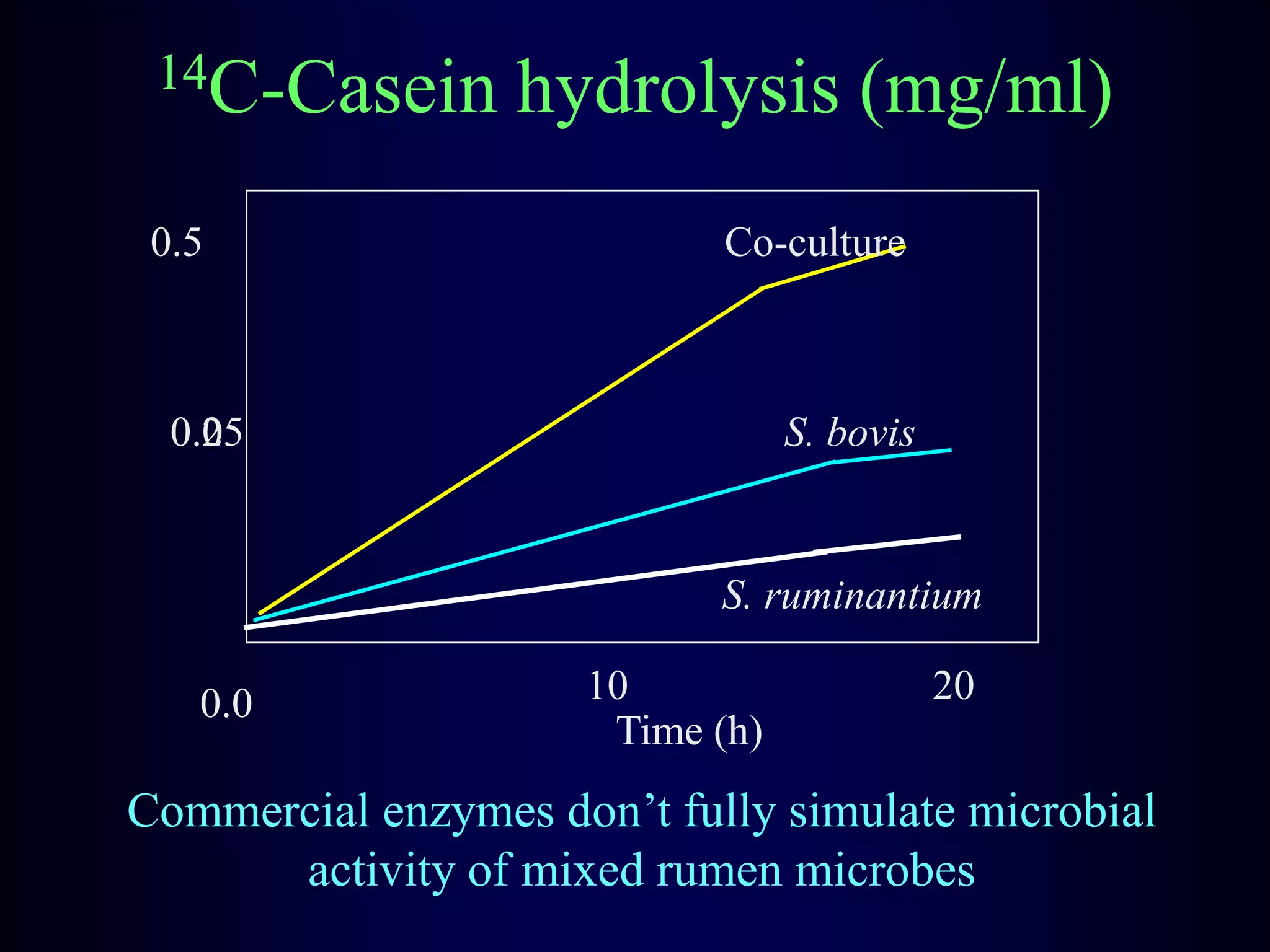
14C-Casein hydrolysis (mg/ml)
0.0 10 20
Time (h)
0.0
0.25
0.5 Co-culture
S. bovis
S. ruminantium
Commercial enzymes don’t fully simulate microbial
activity of mixed rumen microbes
Enzyme method problems
Equations are species-specific
Represent effect of a few enzymes
Variability in enzyme activity
– Due to enzyme source & batch
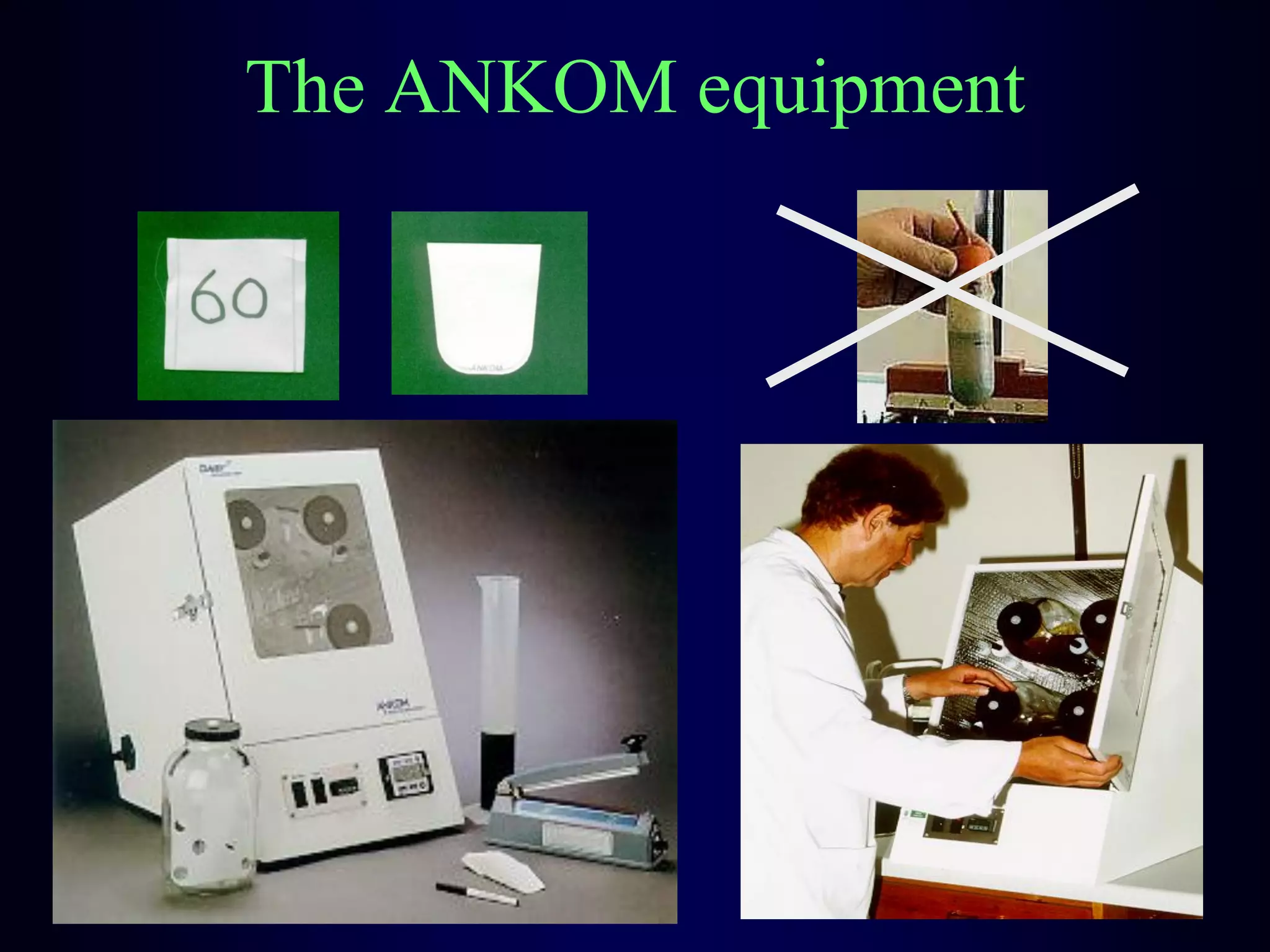
The ANKOM equipment
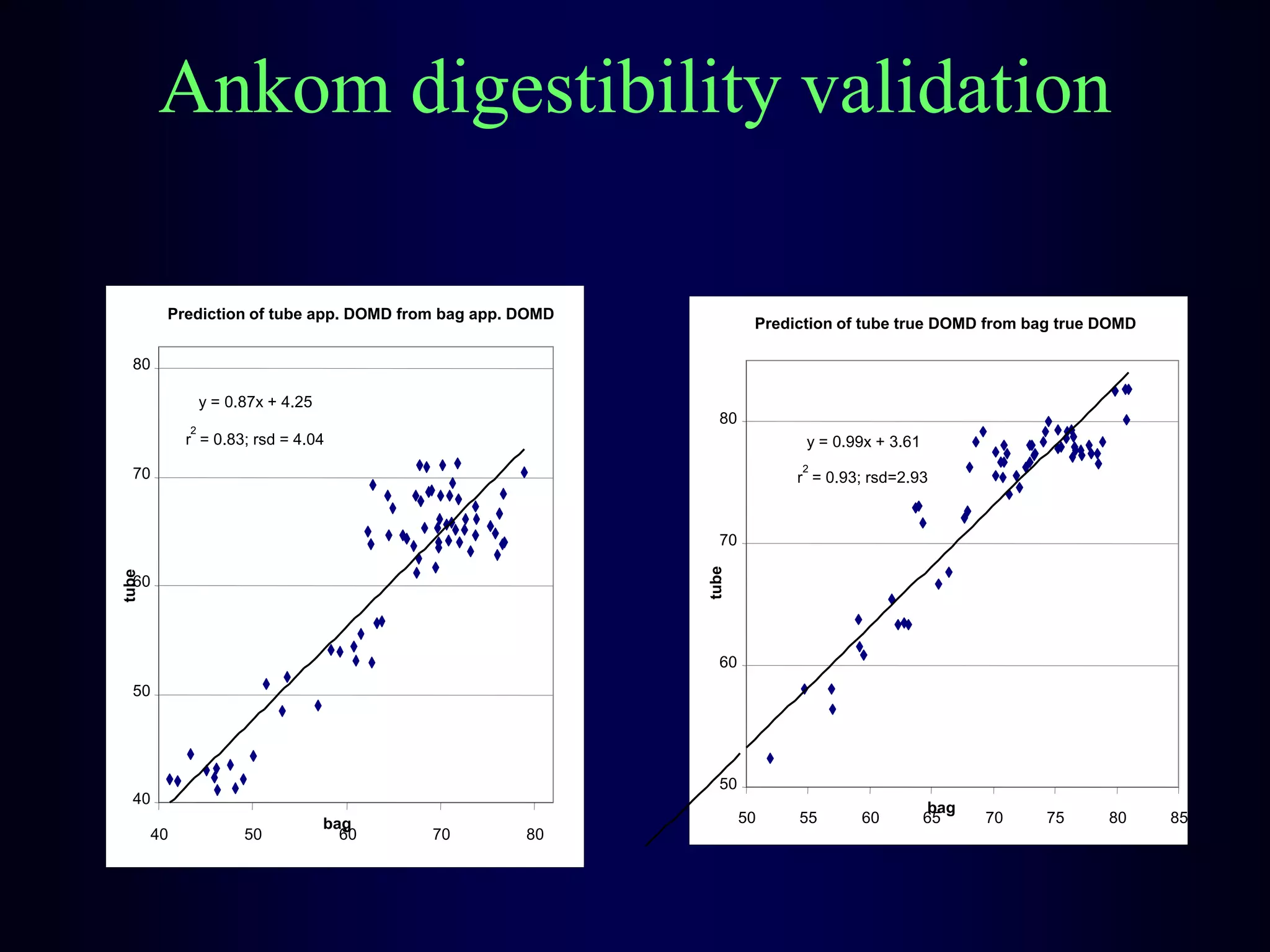
Ankom digestibility validation
Prediction of tube true DOMD from bag true DOMD
y = 0.99x + 3.61
r
2
= 0.93; rsd=2.93
50
60
70
80
50 55 60 65 70 75 80 85
bag
tube
Prediction of tube app. DOMD from bag app. DOMD
y = 0.87x + 4.25
r
2
= 0.83; rsd = 4.04
40
50
60
70
80
40 50 60 70 80
bag
tube
ANKOM pros & cons
Pros
– Simplifies filtration, incubation and mixing
– Uses a batch process (& ash-free bags)
Cons
– Bag pore size may allow excess outflow or restrict
microbial colonization
– Bag material & pore size may affect results
• Monofilamentous cloth – precise aperture
• Multifilamentous cloth – pore size affected by stresses
e.g. dacron
In vitro digestibility summary
Pros
– Predicts in vivo digy more accurately than NDF or
lignin
– Handles several samples & are biologically
meaningful
Cons
– May require fistulated animals
– Labor intensive & protracted
– Plagued by variability in composition & activity of
inoculum/enzyme
– Doesn’t indicate the kinetics of digestion
Chapters 6 – 8 In: D.I. Givens, E. Owen, R.F.E. Axford and H.M. Omed (Editors) 2000,
Forage Evaluation in Ruminant Nutrition. CABI Publishing, Wallingford, UK, pp. 113-
134.
Adesogan, A.T, Givens D.I. and Owen. E. Measuring chemical composition and nutritive
value in forages. Field and Laboratory methods for grassland and animal production
research. CABI Publishing. P 263
Tilley, J.M.A. and Terry, R.A., 1963. A two stage technique for the in vitro digestion of
forage crops. Journal of the British Grassland Society, 18: 104-111.
Van Soest, P.J., Wine, R.H. and Moore, L.A., 1966. Estimation of the true digestibility of
forages by the in vitro digestion of cell walls. Proceedings of , The Xth International
Grassland Congress, Helsinki. Finish Grassland Association., pp 438-441.
Vogel, K.P., Pedersen, J.F., Masterson, S.D. and Toy, J.J., 1999. Evaluation of a filter bag
system for NDF, ADF, and IVDMD forage analysis. Crop Science, 39: 276-279.
Wilman, D. and Adesogan, A., 2000. A comparison of filter bag methods with conventional
tube methods of determining the in vitro digestibility of forages. Animal Feed Science and
Technology, 84: 33-47.
Digestibility references

Digestibility ppt.pdf

  • 1.
  • 2.
    Apparent v. truedigestibility True digestibility involves correction for endogenous losses, apparent digestion does not. Endogenous losses – Include: • Sloughed off intestinal cells • Digestive juices (enzymes) • Microbial matter – Quantified by measuring fecal output of fasted animals – Can be 9.8 to 12.9 % DMI – Should they be quantified?
  • 3.
    In vivo digestibilitymethods Direct or total/complete collection Difference method Regression method Indirect method
  • 4.
  • 5.
    In vivo digestibilitytrials in metabolism crates
  • 6.
    In vivo digestibilitytrials in pens
  • 7.
    Total collection calculations Digestibility (g/kg)= Nutrient in feed - Nutrient in feces x 1000 Nutrient in feed Dry matter digestibility (DMD, g/kg) = DM in feed - DM in feces x 1000 DM in feed Organic matter digestibility (OMD, g/kg) = OM in feed - OM in feces x 1000 OM in feed Can be expressed as a proportion, % or g/kg
  • 8.
    Digestibility indices thatestimate energy value Digestible organic matter content (DOMD) (g/kg DM) = OM in feed - OM in feces x 1000 DM in feed TDN = DCP + DCF + DNFE + DEE(2.25) – DCP= Digestible Crude Protein – DCF= Digestible Crude Fiber – DNFE= Digestible Nitrogen-Free Extract – DEE= Digestible Ether Extract (2.25)
  • 9.
    2. Difference method Allowsdigy calculation for 2 feeds fed simultaneously Assumptions – No interaction b/w the digy of the feeds – Must know digy & fecal DM output (DMO) of base feed Test feed DMD = Test feed DMI – (Fecal DMO- Base feed DMO) Test feed DMI Cons – Assumptions may be invalid
  • 10.
    3. Regression method Schneider& Flatt (1975) Also allows digy. estimation for two feeds – Feed different ratios of the two feeds – Estimate digy of each of the ratios – Fit regression of test feed inclusion vs. digy – Extrapolate to estimate digy of test feed. Cons – Considerable expense and labor for estimating digy of one feed.
  • 11.
    Regression method 20 4060 80 100 200 400 600 800 Test feed digy. Base feed digy. % inclusion of test feed in ration DMD (g/kg)
  • 12.
    Digy trial issues Changeoverdesigns – necessary if period effects are an issue e.g. • Animal physiological changes • Forage physiological changes Adaptation period – Necessary to adapt the animals to • New feed (microbial population changes) • Strange equipment • Strange housing – 6 – 14 day period is the norm
  • 13.
    Marker digestibility trials Particularlyuseful for grazing animals Procedure – Add indigestible marker to feed eg chromic oxide – Measure concentration in feed & feces – Estimate disappearance of marker from gut. E.g. if a feed contains 1% Cr2O3 & feces contains 2% Cr2O3, diet digestibility = 50% – Since Cr3O2 conc. has doubled, 50% of DM must have been digested
  • 14.
    Marker trials contd. Forthe digy of a specific nutrient, must also know the % nutrient in feed & feces %Nutrient = 100 – 100 x % indicatorfeed X % nutrientfeces Digestibility % indicatorfeces % nutrientfeed Homework: If lambs are fed a bahia grass diet containing 7% protein & 1% chromic oxide, and their feces contains 5% CP and 2% chromic oxide. Calculate CP digy.
  • 15.
    Marker digestibility Pros – Totalfeces collection not necessary – Total intake determination not necessary – Easier, less labor Cons – Representative sampling essential – Accurate estimation of nutrient or marker conc. essential – Assumes complete excretion of marker hence Recovery of marker determines accuracy of digy
  • 16.
    Marker types External – Chromicoxide – Dysporium – Polyamide Can contaminate forage Internal – Lignin – AIA – ADF – n-alkanes Easier, less labor
  • 17.
    Marker issues Difficulty ofmixing marker with forages – Dose cows instead- ( s handling) Marker migration – Must not affect feed digy External markers may contaminate forage
  • 18.
    Problems with invivo experiments Animal trials are: – Expensive – Protracted – Laborious – Public concerns – Animal stress ??? Must estimate nutritive value with less animal dependent techniques
  • 19.
    Ideal in vitromethods should be: – Rapid (one step) & routinely practicable – Accurate – Cheap & not laborious – Repeatable & robust – Biologically meaningful – Broad-based (apply to all forage types) – Handle large nos. of samples – Laboratory-based
  • 20.
    Rumen fluid –pepsinin vitro digestibility (IVOMD) •Developed by Tilley & Terry (1967) •Measures apparent digy in rumen fluid (48 h) and acid pepsin (48 h) •Gives accurate predictions of in vivo digy for most forages
  • 21.
    Prediction of silageOMD in vivo from different methods (g/kg DM) Method r2 RSD KMnO4 lignin 21.8 54.6 ADF 32.1 50.9 NDF 45.7 45.5 (M) ADF 55.8 40.9 IVOMD 74.1 33.6 (Givens et al., 1989)
  • 22.
    Rumen fluid problems Variationin Inoculum composition & activity due to – Host animal diet – Animal species – Collection time – Processing (blending vs. filtration)
  • 23.
    Rumen fluid problems Analyticalissues – Maintenance of anaerobic media; optimal pH, temp – High viscosity hinders filtration – Offensive odors – Hygiene – (Prevent pathogen infection)
  • 24.
    Relationship between invivo and in vitro DOMD of wheat silage (g/kg DM) r2 =0.24 530 580 630 680 Rumen fluid-pepsin DOMD 530 550 570 590 610 630 650 670 690 In vivo DOMD (Adesogan et al. 1998) Year One Year Two
  • 25.
    Rumen fluid technique- problems Standards needed to correct for variability in rumen fluid composition & activity Disregards / inappropriately represents: – Ruminal outflow (uses a batch process) – Digests maillard product not digested in vivo – Associative effects between feeds – Endogenous secretions – Post abomasal digestion
  • 26.
    Alternatives to Tilley& Terry 1. Rumen fluid – Neutral detergent (Van Soest, 1967) – More akin to true digestibility – Gives higher digy. values – Still requires rumen fluid 2. Feces – Gives lower digestibility estimates 3. Enzyme- based assays
  • 27.
    Prediction of DMDin vivo from in vitro fecal liquor DMD Spp. of feces donor r2 range Ovine 0.33 – 0.98 Bovine 0.77 – 0.97 Equine 0.90 Caprine 0.96-0.97 (Ohmed et al., 2001)
  • 28.
    Cell-free enzyme invitro digestibility Examples of procedures used: 1. Cellulase 2. Neutral detergent- cellulase 3. Neutral detergent-cellulase +gammanase 4. Pepsin cellulase Amylase pre-treatment important for starch-rich feeds Gammanase for oil-rich feeds
  • 29.
    Relationships between DMDin vivo and enzyme predicted DMD Method R2 Cellulase 0.83 Neutral detergent cellulase 0.94 Acid pepsin – cellulase 0.88 Rumen fluid 0.83 (Bughara & Sleper, 1986)
  • 30.
    Prediction of invivo OMD of forages from different methods Method r RSD (%) AE(+) ND + cellulase 0.90 3.3 0.9 Pepsin + cellulase 0.94 2.6 0.3 (McLeod & Minson, 1982) Higher analytical error with ND – cellulase technique may outweigh shorter processing time
  • 31.
    Method r2 RSD ND+ cellulase 76.6 27.1 Pepsin + cellulase 75.9 28.8 Rumen fluid-pepsin 67.0 33.2 (M) ADF 66.9 33.3 (Givens et al., 1990) Poorer relationships found for autumn grass (r2 = 13- 20) Prediction of in vivo OMD of spring grass from different methods
  • 32.
    Effect of enzymesource on cellulase activity % DM solubilized Fungi Herbage Cellulose paper Trichoderma spp. 57 69 Basidiomycete 48 20 Aspergillus niger 45 10 Rhizopus spp. 35 7 (Jones & Hayward, 1975)
  • 33.
    14C-Casein hydrolysis (mg/ml) 0.010 20 Time (h) 0.0 0.25 0.5 Co-culture S. bovis S. ruminantium Commercial enzymes don’t fully simulate microbial activity of mixed rumen microbes
  • 34.
    Enzyme method problems Equationsare species-specific Represent effect of a few enzymes Variability in enzyme activity – Due to enzyme source & batch
  • 35.
  • 36.
    Ankom digestibility validation Predictionof tube true DOMD from bag true DOMD y = 0.99x + 3.61 r 2 = 0.93; rsd=2.93 50 60 70 80 50 55 60 65 70 75 80 85 bag tube Prediction of tube app. DOMD from bag app. DOMD y = 0.87x + 4.25 r 2 = 0.83; rsd = 4.04 40 50 60 70 80 40 50 60 70 80 bag tube
  • 37.
    ANKOM pros &cons Pros – Simplifies filtration, incubation and mixing – Uses a batch process (& ash-free bags) Cons – Bag pore size may allow excess outflow or restrict microbial colonization – Bag material & pore size may affect results • Monofilamentous cloth – precise aperture • Multifilamentous cloth – pore size affected by stresses e.g. dacron
  • 38.
    In vitro digestibilitysummary Pros – Predicts in vivo digy more accurately than NDF or lignin – Handles several samples & are biologically meaningful Cons – May require fistulated animals – Labor intensive & protracted – Plagued by variability in composition & activity of inoculum/enzyme – Doesn’t indicate the kinetics of digestion
  • 39.
    Chapters 6 –8 In: D.I. Givens, E. Owen, R.F.E. Axford and H.M. Omed (Editors) 2000, Forage Evaluation in Ruminant Nutrition. CABI Publishing, Wallingford, UK, pp. 113- 134. Adesogan, A.T, Givens D.I. and Owen. E. Measuring chemical composition and nutritive value in forages. Field and Laboratory methods for grassland and animal production research. CABI Publishing. P 263 Tilley, J.M.A. and Terry, R.A., 1963. A two stage technique for the in vitro digestion of forage crops. Journal of the British Grassland Society, 18: 104-111. Van Soest, P.J., Wine, R.H. and Moore, L.A., 1966. Estimation of the true digestibility of forages by the in vitro digestion of cell walls. Proceedings of , The Xth International Grassland Congress, Helsinki. Finish Grassland Association., pp 438-441. Vogel, K.P., Pedersen, J.F., Masterson, S.D. and Toy, J.J., 1999. Evaluation of a filter bag system for NDF, ADF, and IVDMD forage analysis. Crop Science, 39: 276-279. Wilman, D. and Adesogan, A., 2000. A comparison of filter bag methods with conventional tube methods of determining the in vitro digestibility of forages. Animal Feed Science and Technology, 84: 33-47. Digestibility references