Basics of Poultry
Feeding/Nutrition
Dr Nusrat Jahan
Faculty, CAS
Major Sources of
Carbohydrates
Corn (maize)
Wheat
Milo (sorghum)
Rice, wheat, other grains
Wheat (or rice) by-products – screenings and
leftover product from flour making. Can vary
significantly in nutritional value.
Major Sources of Protein
Soybean meal (cooked; usually around 45% protein)
Meat meal, meat and bone meal
Poultry by-product meal
Fish meal
Canola meal, rapeseed meal, other meals(….)
Oil seed cakes…
Major Fat and Oil Sources
Tallow (rendered animal fat)
Vegetable oil
Animal-vegetable blend fat
Restaurant grease
Acidulated soapstock (by-product of vegetable oil
refining)
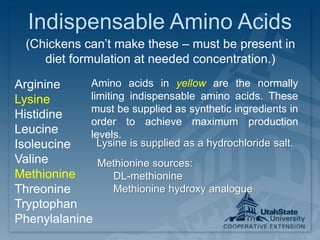
Indispensable Amino Acids
Arginine
Lysine
Histidine
Leucine
Isoleucine
Valine
Methionine
Threonine
Tryptophan
Phenylalanine
(Chickens can’t make these – must be present in
diet formulation at needed concentration.)
Amino acids in yellow are the normally
limiting indispensable amino acids. These
must be supplied as synthetic ingredients in
order to achieve maximum production
levels.
Lysine is supplied as a hydrochloride salt.
Methionine sources:
DL-methionine
Methionine hydroxy analogue
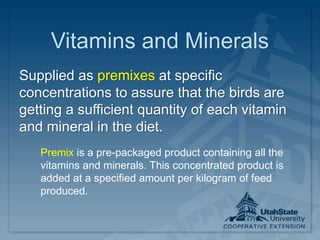
Vitamins and Minerals
Supplied as premixes at specific
concentrations to assure that the birds are
getting a sufficient quantity of each vitamin
and mineral in the diet.
Premix is a pre-packaged product containing all the
vitamins and minerals. This concentrated product is
added at a specified amount per kilogram of feed
produced.
Mash vs. Pellet vs. Crumbles
Mash: Coarsely ground ingredients loosely mixed
together with premixes and minerals. Disadvantage of
mash is that individual feed ingredients may settle out.
Individual birds may also preferentially eat certain
ingredients (e.g. corn particles).
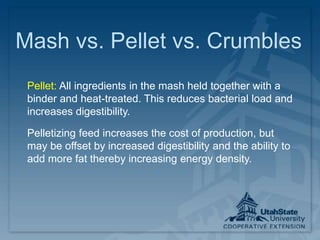
Mash vs. Pellet vs. Crumbles
Pellet: All ingredients in the mash held together with a
binder and heat-treated. This reduces bacterial load and
increases digestibility.
Pelletizing feed increases the cost of production, but
may be offset by increased digestibility and the ability to
add more fat thereby increasing energy density.
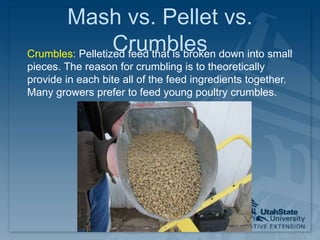
Mash vs. Pellet vs.
CrumblesCrumbles: Pelletized feed that is broken down into small
pieces. The reason for crumbling is to theoretically
provide in each bite all of the feed ingredients together.
Many growers prefer to feed young poultry crumbles.
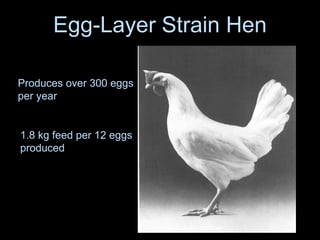
Egg-Layer Strain Hen
Produces over 300 eggs
per year
1.8 kg feed per 12 eggs
produced
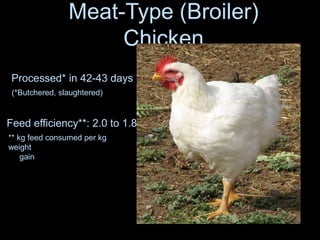
Meat-Type (Broiler)
Chicken
Processed* in 42-43 days
Feed efficiency**: 2.0 to 1.8
(*Butchered, slaughtered)
** kg feed consumed per kg
weight
gain
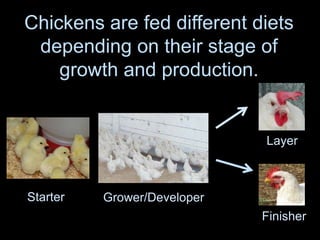
Chickens are fed different diets
depending on their stage of
growth and production.
Starter Grower/Developer
Layer
Finisher
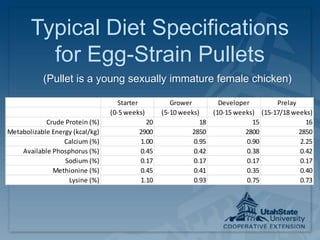
Typical Diet Specifications
for Egg-Strain Pullets
(Pullet is a young sexually immature female chicken)
Starter Grower Developer Prelay
(0-5 weeks) (5-10 weeks) (10-15 weeks) (15-17/18 weeks)
Crude Protein (%) 20 18 15 16
Metabolizable Energy (kcal/kg) 2900 2850 2800 2850
Calcium (%) 1.00 0.95 0.90 2.25
Available Phosphorus (%) 0.45 0.42 0.38 0.42
Sodium (%) 0.17 0.17 0.17 0.17
Methionine (%) 0.45 0.41 0.35 0.40
Lysine (%) 1.10 0.93 0.75 0.73
Typical Diet Specifications
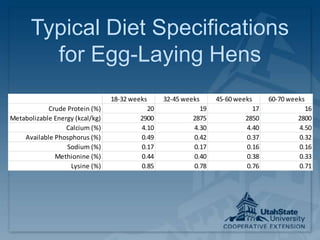
for Egg-Laying Hens
18-32 weeks 32-45 weeks 45-60 weeks 60-70 weeks
Crude Protein (%) 20 19 17 16
Metabolizable Energy (kcal/kg) 2900 2875 2850 2800
Calcium (%) 4.10 4.30 4.40 4.50
Available Phosphorus (%) 0.49 0.42 0.37 0.32
Sodium (%) 0.17 0.17 0.16 0.16
Methionine (%) 0.44 0.40 0.38 0.33
Lysine (%) 0.85 0.78 0.76 0.71
Typical Diet Specifications
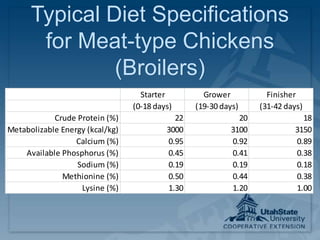
for Meat-type Chickens
(Broilers)
Starter Grower Finisher
(0-18 days) (19-30 days) (31-42 days)
Crude Protein (%) 22 20 18
Metabolizable Energy (kcal/kg) 3000 3100 3150
Calcium (%) 0.95 0.92 0.89
Available Phosphorus (%) 0.45 0.41 0.38
Sodium (%) 0.19 0.19 0.18
Methionine (%) 0.50 0.44 0.38
Lysine (%) 1.30 1.20 1.00
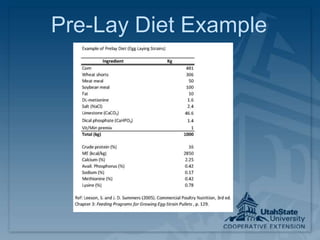
Pre-Lay Diet Example
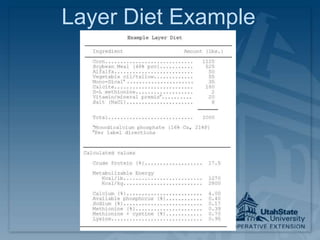
Layer Diet Example
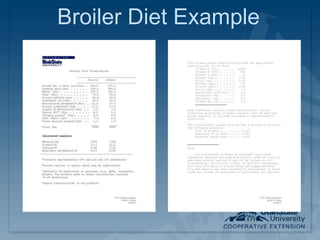
Broiler Diet Example

Poultry feeds and nutrition

  • 1.
    Basics of Poultry Feeding/Nutrition DrNusrat Jahan Faculty, CAS
  • 2.
    Major Sources of Carbohydrates Corn(maize) Wheat Milo (sorghum) Rice, wheat, other grains Wheat (or rice) by-products – screenings and leftover product from flour making. Can vary significantly in nutritional value.
  • 3.
    Major Sources ofProtein Soybean meal (cooked; usually around 45% protein) Meat meal, meat and bone meal Poultry by-product meal Fish meal Canola meal, rapeseed meal, other meals(….) Oil seed cakes…
  • 4.
    Major Fat andOil Sources Tallow (rendered animal fat) Vegetable oil Animal-vegetable blend fat Restaurant grease Acidulated soapstock (by-product of vegetable oil refining)
  • 5.
    Indispensable Amino Acids Arginine Lysine Histidine Leucine Isoleucine Valine Methionine Threonine Tryptophan Phenylalanine (Chickenscan’t make these – must be present in diet formulation at needed concentration.) Amino acids in yellow are the normally limiting indispensable amino acids. These must be supplied as synthetic ingredients in order to achieve maximum production levels. Lysine is supplied as a hydrochloride salt. Methionine sources: DL-methionine Methionine hydroxy analogue
  • 6.
    Vitamins and Minerals Suppliedas premixes at specific concentrations to assure that the birds are getting a sufficient quantity of each vitamin and mineral in the diet. Premix is a pre-packaged product containing all the vitamins and minerals. This concentrated product is added at a specified amount per kilogram of feed produced.
  • 7.
    Mash vs. Pelletvs. Crumbles Mash: Coarsely ground ingredients loosely mixed together with premixes and minerals. Disadvantage of mash is that individual feed ingredients may settle out. Individual birds may also preferentially eat certain ingredients (e.g. corn particles).
  • 8.
    Mash vs. Pelletvs. Crumbles Pellet: All ingredients in the mash held together with a binder and heat-treated. This reduces bacterial load and increases digestibility. Pelletizing feed increases the cost of production, but may be offset by increased digestibility and the ability to add more fat thereby increasing energy density.
  • 9.
    Mash vs. Pelletvs. CrumblesCrumbles: Pelletized feed that is broken down into small pieces. The reason for crumbling is to theoretically provide in each bite all of the feed ingredients together. Many growers prefer to feed young poultry crumbles.
  • 10.
    Egg-Layer Strain Hen Producesover 300 eggs per year 1.8 kg feed per 12 eggs produced
  • 11.
    Meat-Type (Broiler) Chicken Processed* in42-43 days Feed efficiency**: 2.0 to 1.8 (*Butchered, slaughtered) ** kg feed consumed per kg weight gain
  • 12.
    Chickens are feddifferent diets depending on their stage of growth and production. Starter Grower/Developer Layer Finisher
  • 13.
    Typical Diet Specifications forEgg-Strain Pullets (Pullet is a young sexually immature female chicken) Starter Grower Developer Prelay (0-5 weeks) (5-10 weeks) (10-15 weeks) (15-17/18 weeks) Crude Protein (%) 20 18 15 16 Metabolizable Energy (kcal/kg) 2900 2850 2800 2850 Calcium (%) 1.00 0.95 0.90 2.25 Available Phosphorus (%) 0.45 0.42 0.38 0.42 Sodium (%) 0.17 0.17 0.17 0.17 Methionine (%) 0.45 0.41 0.35 0.40 Lysine (%) 1.10 0.93 0.75 0.73
  • 14.
    Typical Diet Specifications forEgg-Laying Hens 18-32 weeks 32-45 weeks 45-60 weeks 60-70 weeks Crude Protein (%) 20 19 17 16 Metabolizable Energy (kcal/kg) 2900 2875 2850 2800 Calcium (%) 4.10 4.30 4.40 4.50 Available Phosphorus (%) 0.49 0.42 0.37 0.32 Sodium (%) 0.17 0.17 0.16 0.16 Methionine (%) 0.44 0.40 0.38 0.33 Lysine (%) 0.85 0.78 0.76 0.71
  • 15.
    Typical Diet Specifications forMeat-type Chickens (Broilers) Starter Grower Finisher (0-18 days) (19-30 days) (31-42 days) Crude Protein (%) 22 20 18 Metabolizable Energy (kcal/kg) 3000 3100 3150 Calcium (%) 0.95 0.92 0.89 Available Phosphorus (%) 0.45 0.41 0.38 Sodium (%) 0.19 0.19 0.18 Methionine (%) 0.50 0.44 0.38 Lysine (%) 1.30 1.20 1.00
  • 16.
  • 17.
  • 18.