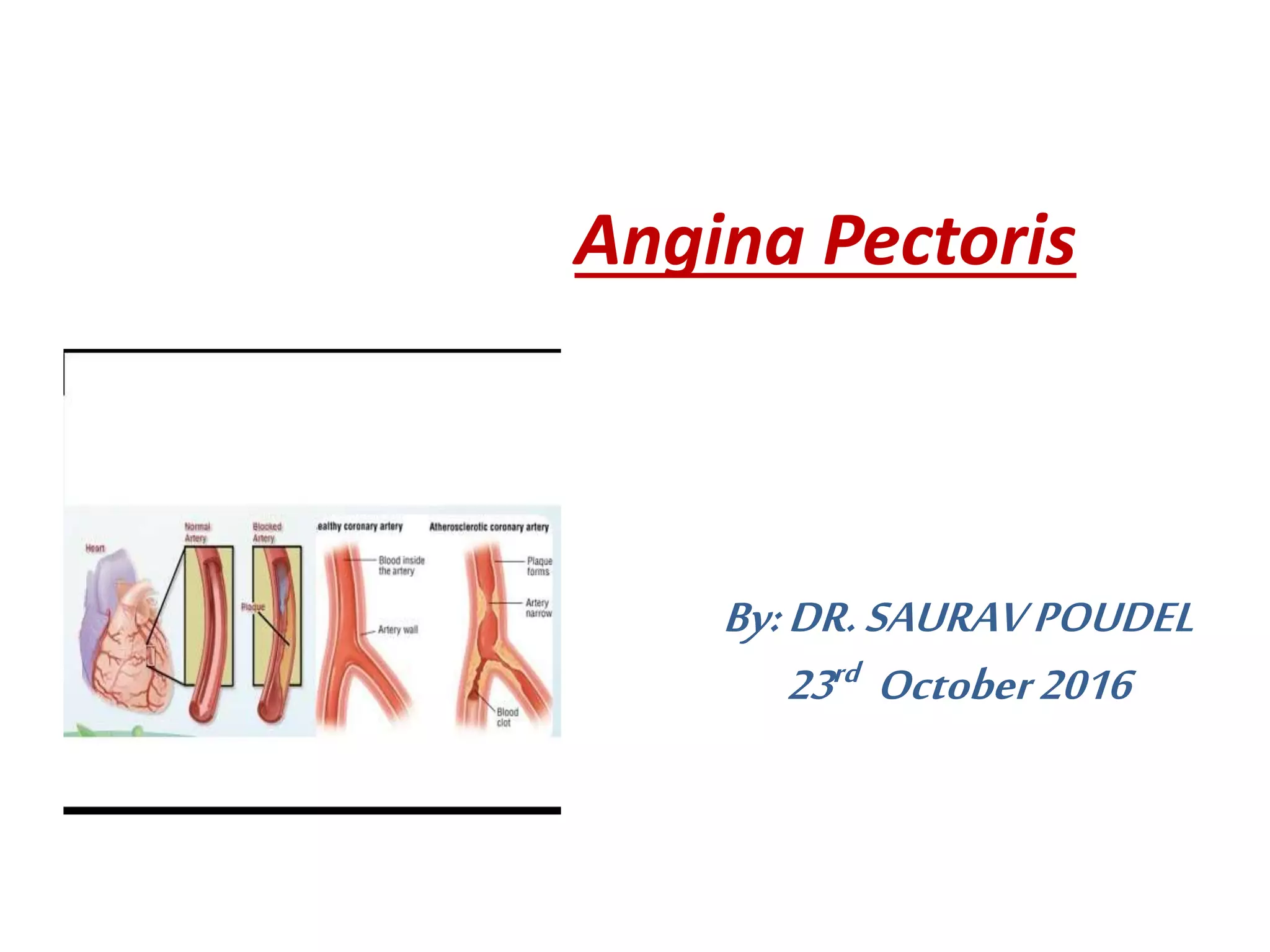
Angina Pectoris
By:DR.SAURAVPOUDEL
23rd October2016
Definition of Angina Pectoris
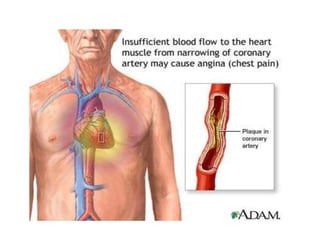
• is the result of myocardial ischemia caused by an
imbalance between myocardial blood supply and
oxygen demand.
• Angina is a common presenting symptom (typically,
chest pain) among patients with coronary artery
disease.
Classification Of Angina Pectoris
1. Stable angina or typical or exertional or classical
angina :induced by effort, relieved by rest.
2. Unstable angina or descendo angina :rapidly
worsening angina or angina at rest.
3. Post –infraction angina
4. Prinzmetal’s or vasospastic angina or variant, angina :
occurs without provocation,usually at rest as a result
of coronary artery spasm.
5. Nocturnal angina: angina that occurs during sleep at
night due to coronary ostial stenosis(narrowing of the
mouths of the coronary arteries as a result of
syphilitic aortitis or atherosclerosis).
Causes
o Coronary artery disease: due to narrowing or
spasm of coronary artery.
o Aortic stenosis
o Aortic regurgitation
o Systemic hypertension
o Severe anaemia
Clinical Features
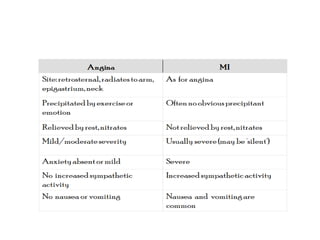
1) Character of angina :
• Site : retrosternal i.e behind sternum
• Radiation : pain radiates to neck,jaw,left shoulder
& medial aspect of upper limb.
• Character :
pressing,squeezing,strangling,constricting,a band
across the chest,a heavy weight on the
chest.Patient cant pinpoint or localized the site of
pain.
• Duration : last 1-3 minutes,never less than 30
seconds and more than 15 minutes.
• Aggravating factors :
-exertion
-emotion
-cold
-heavy meal
-sexual activity
-anger and irritation
• Relieving factors:
-rest
-nitrates
2) Breathlessness
3)History of smoking,hypertension,diabetes and
other risk factors.
a) Important risk factors:-
-smoking
-hypertension
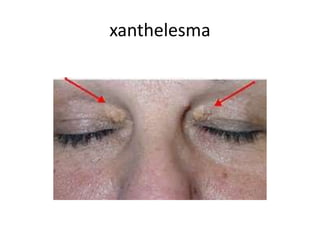
-hyperlipidemia: xanthelsma
-obesity
-diabetes mellitus
-anaemia
xanthelesma
b) Cardiac Manifestation:
-loud second heart sound.
-Gallop rhythm
-Cardiomegaly
-Basal crackles
c)Generalized arterial disease:
-carotid bruit
-peripheral vascular disease.
Differential Diagnosis
• Myocardial infraction
• Pulmonary embolism
• Aortic dissection( occurs when a tear in the inner
wall of the aorta causes blood to flow between
the layers of the wall of the aorta, forcing the
layers apart)
• Esophageal spasm
• Pancreatitis
• pneumonia
Investigation
• General :
-complete blood count
-chest x- ray P/A view
-serum cholesterol and lipid profile
Lipid profile include :
• Serum cholesterol & triglycerides
• Very low density lipoprotien
• Low density lipoprotien
• High density lipoprotien
• Specific :
- Resting electrocardiogram
- May show evidence of previous myocardial infraction(Q
waves,inverted T waves)
- Typical change during acute ischemia,ST segment depression
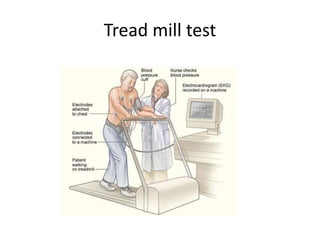
- Stress ECG(tread mill test): ST segment depression considered as
positive.
- Isotope scanning: perfusion defect in myocardium during attack or
stress.
- Coronary angiography : gives detail information about site, extent &
nature of coronary artery disease.
- Echocardiography.
Tread mill test
Management
 General Measures:
-stop cigarette smoking
-control high blood pressure
-low cholesterol diet
-control DM
-regular exercise
-maintain ideal body weight.
Drug used in Angina:
1)Nitrates : sublingual nitroglycerine is used for
acute attack of angina.It is avialable in 0.5mg
tablet.it acts within 3 sec and peak action takes
place by 2 minutes.
-oral nitrate :isosorbide dinitrate 5-10 mg, 4-6hrly
or
-isosorbide mononitrate 10-20 mg, 8-12 hrly.
-Nitroglycerine injection is used when chest pain
due to angina doesnot respond to sublingual or
oral nitrate.
2) Calcium channel blockers:
-Nifedipine retard 10-20 mg twice daily or
-Diltiazem 30-90 mg thrice a day or
-amlodipine 2.5-10 mg daily.
3)Beta-blockers: cardioselective B-blockers:
-atenolol 50-100 mg orally daily or
-metoprolol 200 mg daily
4)Aspirin and clopidegrol
-aspirin 50-100 mg daily or
-clopidegrol 75 mg daily
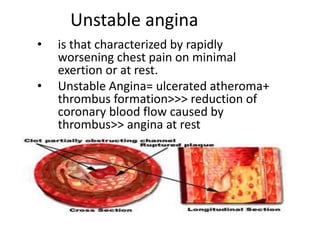
Unstable angina
• is that characterized by rapidly
worsening chest pain on minimal
exertion or at rest.
• Unstable Angina= ulcerated atheroma+
thrombus formation>>> reduction of
coronary blood flow caused by
thrombus>> angina at rest
Treatment
• Initial Medical Management:
- Bed rest
- Hospitalization in CCU
- I.V access with 5% dextrose
- ECG monitoring
- High flow oxygen inhalation
- Correction of precipitating factor such as
hypertension,arrhythmias,anaemia and
hypoxaemia.
• Drug Therapy
-aspirin 150-325 mg po daily or
-clopidegrol 75 mg daily
-Heparin:
• Unfractionated heparin: 60-80 units/kg bolus,followed by
14 units/kg/hr infusion for 48 hrs.
• Activated partial thromboplastin time should be measured
every 6 hour until a therapeutic level of 1.5-2 times the
control value is achieved.
• Low molecular weight heparin:
Enoxaparin 1mg/kg S.C. 12 hourly or
Dalteparin 120mg/kg S.C. 12 hrly
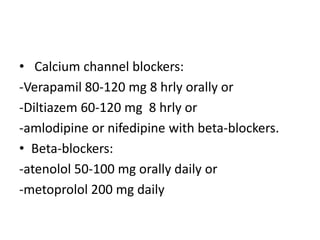
• Calcium channel blockers:
-Verapamil 80-120 mg 8 hrly orally or
-Diltiazem 60-120 mg 8 hrly or
-amlodipine or nifedipine with beta-blockers.
• Beta-blockers:
-atenolol 50-100 mg orally daily or
-metoprolol 200 mg daily
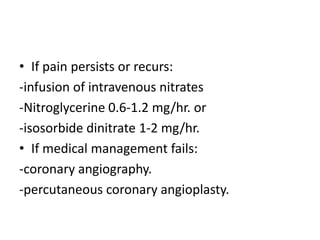
• If pain persists or recurs:
-infusion of intravenous nitrates
-Nitroglycerine 0.6-1.2 mg/hr. or
-isosorbide dinitrate 1-2 mg/hr.
• If medical management fails:
-coronary angiography.
-percutaneous coronary angioplasty.
THANK YOU
From : Dr. Saurav Poudel.
saurav7utd@hotmail.com (if any query).

Angina Pectoris

  • 1.
  • 3.
    Definition of AnginaPectoris • is the result of myocardial ischemia caused by an imbalance between myocardial blood supply and oxygen demand. • Angina is a common presenting symptom (typically, chest pain) among patients with coronary artery disease.
  • 4.
    Classification Of AnginaPectoris 1. Stable angina or typical or exertional or classical angina :induced by effort, relieved by rest. 2. Unstable angina or descendo angina :rapidly worsening angina or angina at rest. 3. Post –infraction angina 4. Prinzmetal’s or vasospastic angina or variant, angina : occurs without provocation,usually at rest as a result of coronary artery spasm. 5. Nocturnal angina: angina that occurs during sleep at night due to coronary ostial stenosis(narrowing of the mouths of the coronary arteries as a result of syphilitic aortitis or atherosclerosis).
  • 5.
    Causes o Coronary arterydisease: due to narrowing or spasm of coronary artery. o Aortic stenosis o Aortic regurgitation o Systemic hypertension o Severe anaemia
  • 6.
    Clinical Features 1) Characterof angina : • Site : retrosternal i.e behind sternum • Radiation : pain radiates to neck,jaw,left shoulder & medial aspect of upper limb. • Character : pressing,squeezing,strangling,constricting,a band across the chest,a heavy weight on the chest.Patient cant pinpoint or localized the site of pain. • Duration : last 1-3 minutes,never less than 30 seconds and more than 15 minutes.
  • 7.
    • Aggravating factors: -exertion -emotion -cold -heavy meal -sexual activity -anger and irritation • Relieving factors: -rest -nitrates
  • 8.
    2) Breathlessness 3)History ofsmoking,hypertension,diabetes and other risk factors. a) Important risk factors:- -smoking -hypertension -hyperlipidemia: xanthelsma -obesity -diabetes mellitus -anaemia
  • 9.
  • 10.
    b) Cardiac Manifestation: -loudsecond heart sound. -Gallop rhythm -Cardiomegaly -Basal crackles c)Generalized arterial disease: -carotid bruit -peripheral vascular disease.
  • 11.
    Differential Diagnosis • Myocardialinfraction • Pulmonary embolism • Aortic dissection( occurs when a tear in the inner wall of the aorta causes blood to flow between the layers of the wall of the aorta, forcing the layers apart) • Esophageal spasm • Pancreatitis • pneumonia
  • 12.
    Investigation • General : -completeblood count -chest x- ray P/A view -serum cholesterol and lipid profile Lipid profile include : • Serum cholesterol & triglycerides • Very low density lipoprotien • Low density lipoprotien • High density lipoprotien
  • 13.
    • Specific : -Resting electrocardiogram - May show evidence of previous myocardial infraction(Q waves,inverted T waves) - Typical change during acute ischemia,ST segment depression - Stress ECG(tread mill test): ST segment depression considered as positive. - Isotope scanning: perfusion defect in myocardium during attack or stress. - Coronary angiography : gives detail information about site, extent & nature of coronary artery disease. - Echocardiography.
  • 14.
  • 15.
    Management  General Measures: -stopcigarette smoking -control high blood pressure -low cholesterol diet -control DM -regular exercise -maintain ideal body weight.
  • 16.
    Drug used inAngina: 1)Nitrates : sublingual nitroglycerine is used for acute attack of angina.It is avialable in 0.5mg tablet.it acts within 3 sec and peak action takes place by 2 minutes. -oral nitrate :isosorbide dinitrate 5-10 mg, 4-6hrly or -isosorbide mononitrate 10-20 mg, 8-12 hrly. -Nitroglycerine injection is used when chest pain due to angina doesnot respond to sublingual or oral nitrate.
  • 17.
    2) Calcium channelblockers: -Nifedipine retard 10-20 mg twice daily or -Diltiazem 30-90 mg thrice a day or -amlodipine 2.5-10 mg daily. 3)Beta-blockers: cardioselective B-blockers: -atenolol 50-100 mg orally daily or -metoprolol 200 mg daily 4)Aspirin and clopidegrol -aspirin 50-100 mg daily or -clopidegrol 75 mg daily
  • 18.
    Unstable angina • isthat characterized by rapidly worsening chest pain on minimal exertion or at rest. • Unstable Angina= ulcerated atheroma+ thrombus formation>>> reduction of coronary blood flow caused by thrombus>> angina at rest
  • 19.
    Treatment • Initial MedicalManagement: - Bed rest - Hospitalization in CCU - I.V access with 5% dextrose - ECG monitoring - High flow oxygen inhalation - Correction of precipitating factor such as hypertension,arrhythmias,anaemia and hypoxaemia.
  • 20.
    • Drug Therapy -aspirin150-325 mg po daily or -clopidegrol 75 mg daily -Heparin: • Unfractionated heparin: 60-80 units/kg bolus,followed by 14 units/kg/hr infusion for 48 hrs. • Activated partial thromboplastin time should be measured every 6 hour until a therapeutic level of 1.5-2 times the control value is achieved. • Low molecular weight heparin: Enoxaparin 1mg/kg S.C. 12 hourly or Dalteparin 120mg/kg S.C. 12 hrly
  • 21.
    • Calcium channelblockers: -Verapamil 80-120 mg 8 hrly orally or -Diltiazem 60-120 mg 8 hrly or -amlodipine or nifedipine with beta-blockers. • Beta-blockers: -atenolol 50-100 mg orally daily or -metoprolol 200 mg daily
  • 22.
    • If painpersists or recurs: -infusion of intravenous nitrates -Nitroglycerine 0.6-1.2 mg/hr. or -isosorbide dinitrate 1-2 mg/hr. • If medical management fails: -coronary angiography. -percutaneous coronary angioplasty.
  • 24.
    THANK YOU From :Dr. Saurav Poudel. saurav7utd@hotmail.com (if any query).