By: Dr. Saurav Poudel
23.10.2016
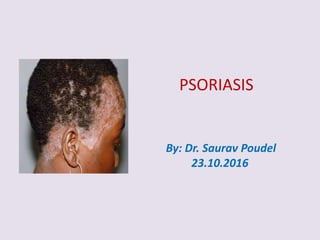
PSORIASIS
• Defination:
it is a chronic,recurrent,non-
infectious,inflammatory disorder of the skin
characterized by well circumscribed
erythematous dry scaling plaques covered by
silvery white scales distributed over the
extensor of the body
(scalp,knee,elbow,sacral regions).
It appears most often between 15 and 40
years.
• aetiology
exact cause is still unknown, but genetic
predisposition most often.
• Pre disposing factor :
stress -90%
infection- RTI,UTI,HIV.
drugs: beta-blocker
lipid lowering agent
chloroquine
NSAIDs
hormonal factor
sunlight
trauma
family history
Clinical presentation
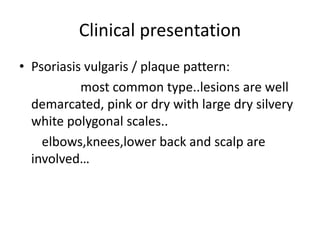
• Psoriasis vulgaris / plaque pattern:
most common type..lesions are well
demarcated, pink or dry with large dry silvery
white polygonal scales..
elbows,knees,lower back and scalp are
involved…
Plaque pattern psoriasis
Guttate psoriasis
• Seen usually in children and adolscents…
may be first sign of the disease,often triggered
by streptococcal tonsillitis.
Numerous small round red macules come up
suddenly in the trunk..
Guttate psoriasis
Scalp psoriasis
• Scalp is often involved..
• Psoriasis overflows just beyond the scalp
margin..
Nails psoriasis
• Involvement of the nails is common with
seperation of the nail from the nail bed.
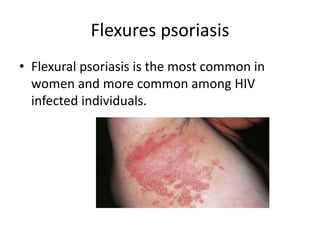
Flexures psoriasis
• Flexural psoriasis is the most common in
women and more common among HIV
infected individuals.
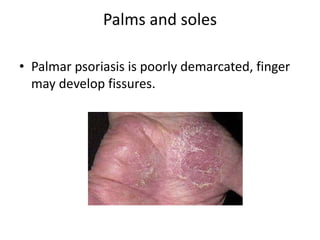
Palms and soles
• Palmar psoriasis is poorly demarcated, finger
may develop fissures.
Palmo-planterpustulosis
• It affects palm and soles with numerous
pustules,lying on the erythematous base.
• It is rare but serious condition.
Erythrodermic psoriasis
• Skin becomes uniformly red with variable
scaling..
general discomfort associated with
erythrodermic psoriasis..
Erythrodermic psoriasis
Clinical features of Psoriasis
• Symptoms :
-itching
- irritation
-burning sensation
- extreme discomfort.
SIGN:
* Auspitz’s sign
*koebner’s sign
• Auspitz’s sign: appearance of bleeding points
on forcible removal of the scales done by glass
slides.
• Koebner’s sign: development of isomorphic
lesion at the site of scratch,trauma,burn and
incision.
INVESTIGATION
• Routine investigation:
I. CBC- Normocytic Normochromic Anaemia,
Increased ESR,WBC raised.
II. Random blood sugar.
III. Urine routine examination.
IV. Chest x-ray.
Specific Investigation
• Skin bioposy:
• FINDINGS:
hyperkeratosis: increase thickness of stratum
corneum.
Parakeratosis: presence of nucleated cells in
s.corneum.
Micromunra abscess: collection of neutrophil in
s.corneum.
• Spongiosis : increased thickness of stratum
spinosum.
• Dilated and tortous capillary loops in the
dermal papillae.
• T-lymphocyte infiltrate in upper dermis.
General Management
• Assurance, explanation of disease.
• Aviodance of precipitating factor.
• Control of secondary infection.
Topical management
• Highly potent steroids:
Clobetasol Propionate;dose depends upon
severity of patient.
• Salicylic acid.
• Vitamin D analogue: calcipotriol.
• Topical methotraxate
• Topical retinoids: tazarotene
• Dithranol .
• Topical PUVA.
Specific management
• Methotraxate:
Dose: 2.5 mg or 5 mg 12hrly, 3 doses in a week for 3-12 months
with folic acid supplementation. Duration of treatment depends on
patient’s condition.
* systemic retinoids: Acitrectin.
• antibiotic, antifungal.
• Photo chemotherapy: Psoralen and ultraviolet A.
 During giving methotrexate & during treatment:
- complete blood count
- liver function test
- renal function test must be done.
** Methotrexate is contra-indicated in pregnancy.
** Never prescribe systemic steroid in psoriasis because it flares up
the condition.
complication
• Secondary bacterial infection.
• Exfoliative dermatitis
• Psoriatic arthropathy.
• Nail psoriasis leads to destruction of whole of
the nail.
THANK YOU
From- Dr. $aurav Poudel.
(saurav7utd@hotmail.com) if any query!!

PSORIASIS

  • 1.
    By: Dr. SauravPoudel 23.10.2016 PSORIASIS
  • 2.
    • Defination: it isa chronic,recurrent,non- infectious,inflammatory disorder of the skin characterized by well circumscribed erythematous dry scaling plaques covered by silvery white scales distributed over the extensor of the body (scalp,knee,elbow,sacral regions). It appears most often between 15 and 40 years.
  • 3.
    • aetiology exact causeis still unknown, but genetic predisposition most often.
  • 4.
    • Pre disposingfactor : stress -90% infection- RTI,UTI,HIV. drugs: beta-blocker lipid lowering agent chloroquine NSAIDs hormonal factor sunlight trauma family history
  • 5.
    Clinical presentation • Psoriasisvulgaris / plaque pattern: most common type..lesions are well demarcated, pink or dry with large dry silvery white polygonal scales.. elbows,knees,lower back and scalp are involved…
  • 6.
  • 7.
    Guttate psoriasis • Seenusually in children and adolscents… may be first sign of the disease,often triggered by streptococcal tonsillitis. Numerous small round red macules come up suddenly in the trunk..
  • 8.
  • 9.
    Scalp psoriasis • Scalpis often involved.. • Psoriasis overflows just beyond the scalp margin..
  • 10.
    Nails psoriasis • Involvementof the nails is common with seperation of the nail from the nail bed.
  • 11.
    Flexures psoriasis • Flexuralpsoriasis is the most common in women and more common among HIV infected individuals.
  • 12.
    Palms and soles •Palmar psoriasis is poorly demarcated, finger may develop fissures.
  • 13.
    Palmo-planterpustulosis • It affectspalm and soles with numerous pustules,lying on the erythematous base. • It is rare but serious condition.
  • 14.
    Erythrodermic psoriasis • Skinbecomes uniformly red with variable scaling.. general discomfort associated with erythrodermic psoriasis..
  • 15.
  • 16.
    Clinical features ofPsoriasis • Symptoms : -itching - irritation -burning sensation - extreme discomfort. SIGN: * Auspitz’s sign *koebner’s sign
  • 17.
    • Auspitz’s sign:appearance of bleeding points on forcible removal of the scales done by glass slides.
  • 18.
    • Koebner’s sign:development of isomorphic lesion at the site of scratch,trauma,burn and incision.
  • 19.
    INVESTIGATION • Routine investigation: I.CBC- Normocytic Normochromic Anaemia, Increased ESR,WBC raised. II. Random blood sugar. III. Urine routine examination. IV. Chest x-ray.
  • 20.
    Specific Investigation • Skinbioposy: • FINDINGS: hyperkeratosis: increase thickness of stratum corneum. Parakeratosis: presence of nucleated cells in s.corneum. Micromunra abscess: collection of neutrophil in s.corneum.
  • 21.
    • Spongiosis :increased thickness of stratum spinosum. • Dilated and tortous capillary loops in the dermal papillae. • T-lymphocyte infiltrate in upper dermis.
  • 22.
    General Management • Assurance,explanation of disease. • Aviodance of precipitating factor. • Control of secondary infection.
  • 23.
    Topical management • Highlypotent steroids: Clobetasol Propionate;dose depends upon severity of patient. • Salicylic acid. • Vitamin D analogue: calcipotriol. • Topical methotraxate • Topical retinoids: tazarotene • Dithranol . • Topical PUVA.
  • 24.
    Specific management • Methotraxate: Dose:2.5 mg or 5 mg 12hrly, 3 doses in a week for 3-12 months with folic acid supplementation. Duration of treatment depends on patient’s condition. * systemic retinoids: Acitrectin. • antibiotic, antifungal. • Photo chemotherapy: Psoralen and ultraviolet A.  During giving methotrexate & during treatment: - complete blood count - liver function test - renal function test must be done. ** Methotrexate is contra-indicated in pregnancy. ** Never prescribe systemic steroid in psoriasis because it flares up the condition.
  • 25.
    complication • Secondary bacterialinfection. • Exfoliative dermatitis • Psoriatic arthropathy. • Nail psoriasis leads to destruction of whole of the nail.
  • 26.
    THANK YOU From- Dr.$aurav Poudel. (saurav7utd@hotmail.com) if any query!!