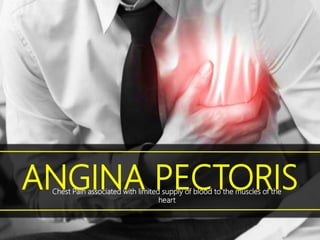
ANGINA PECTORISChest Pain associated with limited supply of blood to the muscles of the
heart
Outline
• Introduction
• Definition of Angina
Pectoris
• Overview
• Causes (Etiology)
• Risk factors
• Symptoms
• Diagnosis
• Treatment
• Complications
• Prevention
Angina pectoris is Latin for “squeezing of the chest”
Definition
Angina – is pain or
discomfort in the chest
that happens when some
part of the heart does not
receive enough oxygen
from the blood
Cont’d
• The heart receives its own supply of blood from the coronary arteries
• Two major coronary arteries branch off from the aorta near the point
where the aorta and the left ventricle meet
• These arteries and their branches supply all parts of the heart muscle
with blood
Identifying Your
Coronary Arteries
Cont’d…
• Angina is a clinical
syndrome rather than a
disease
• Stenocardia (chest pain) is
the medical term for chest
pain or discomfort due
to coronary heart disease
• It means that the heart is
not getting enough blood
and as a result, not enough
oxygen
Cont’d…
• This occur when arteries that carry blood to your heart
become narrowed and blocked because of atherosclerosis
or a blood clot
Cont’d…
• It can also occur because of unstable plaques, poor blood
flow through a narrowed heart valve, a decreased pumping
function of the heart muscle, as well as a coronary artery
spasm Plaques
Buildup of Plague in Blood Vessels
Plaque buildup in blood vessels limits the quantity of blood flow to the heart muscles. Oxygen supply is also
low.
Causes of Angina Pectoris
• Angina pectoris occurs when your heart muscle,
myocardium, does not get enough blood and oxygen for a
given level of work
• Insufficient blood supply is called ischemia
Risk Factos for Angina Pectoris
• Anything that cause your heart muscle to need more blood
or oxygen supply can result in angina. Risk factors include:
→ Physical activity
→ Emotional stress
→ Extreme cold and heat
→ Heavy meals
→ Drinking excessive alcohol
→ Cigarette smoking
Symptoms of Angina Pectoris
• These are the most common symptoms of angina:
̶ A pressing, squeezing, or crushing pain, usually in the
chest under your breastbone
̶ Pain may also occur in your upper back both arms, neck,
or ear lobes
̶ Pain radiating in your arms, shoulders, jaw, neck, or back
̶ Shortness of breath
̶ Weakness and fatigue
̶ Feeling faint
A pressing, squeezing, or crushing pain,
usually in the chest under your breastbone
Shortness of breath
Pain may also occur in your upper back both
arms, neck, or ear lobes
Cont’d…
• Angina chest pain is usually relieved
within a few minutes by resting or by
taking prescribed cardiac medicine,
such as nitroglycerin
• The symptoms of angina pectoris may
look like other medical conditions or
problems
• Always see your healthcare provider
for proper diagnosis or before taking
any pill
How is Angina Diagnosed
• In addition to a complete medical history and medical exam,
your healthcare provider can often diagnose angina from
your symptoms and how and when they occur
• Other test may include:
̶ Electrocardiogram (ECG)
̶ Stress test (usually with ECG; also called treadmill or exercise ECG)
̶ Cardiac catheterization
̶ Cardiac MRI
̶ Coronary CT scan
How is Angina Treated?
• Your healthcare provider will determine specific treatment,
based on:
̶ How old you are
̶ Your overall health and past health
̶ How sick you are
̶ How well you can handle specific medicines, procedures, or
therapies
̶ How long the conditions is expected to last
̶ Your opinion or preference
Treatment Cont’d…
• Your healthcare provider may prescribe medicines if you
have angina
• The most common is nitroglycerin
• This helps to relieve pain by widening your blood vessels
Treatment Cont’d…
• It allows more blood flow to your heart muscle and
decreases the workload of your heart
• Nitroglycerin may be taken as a long-acting form daily to
prevent angina
• Or, it may be taken as a nose spray, or under the tongue
when angina occurs
Treatment Cont’d…
• Beta-blockers and calcium channel blockers are also used
to treat angina
• Your healthcare provider may recommend other medicines
to help treat or prevent angina
• Note: Remember to always consult a healthcare provider
before taking any pills
Complications of Angina Pectoris
• Angina means that you have coronary artery disease and that
some part of your heart is not getting enough blood supply
• If you have angina, you have an increased risk for a heart attack
Heart Attack
Can Angina Pectoris be Prevented?
• Maintaining a health lifestyle can help to delay or prevent
angina pectoris. A healthy lifestyle includes:
̶ A healthy diet
̶ Physical activity and exercise
̶ Stress management
̶ Not smoking or quitting smoking if you do smoke
̶ Keeping or working toward a healthy weight
̶ Taking medicines as prescribed
̶ Treating any related conditions such as high blood pressure, high
cholesterol, diabetes, and overweight
Living with Angina Pectoris
• If you have angina, note the patterns of your symptoms. For
example, pay attention to what causes your chest pain,
what it feels like, how long episodes usually last, and
whether medicine relieves your pain.
• Call an emergency number or pay a visit to the nearest
health center if your angina episode symptoms change
sharply. This is called unstable angina.
• It is very much important to work with your healthcare
provider to treat your underlying coronary artery disease,
which causes angina.
Reference:
• Johns Hopkins Medicine
https://www.hopkinsmedicine.org/health/conditions-
and-diseases/angina-pectoris
FASAMA HILTON KOLLIE
Let’s stay in touch
BSc. Biology/Chemistry, Department of Biology
Stella Maris Polytechnic, Mother Patern College of
Health Sciences
Catholic Archdiocese of Monrovia, Liberia
Twitter.com/@HFasama
Youtube.com/Fasamahkollie
Slideshare.net/Fasamahkollie
Linkedin.com/in/Fasamahkollie
www.facebook.com/fasamahilt
onkollie
Remember:
Learn one, Do one & Teach one

Angina Pectoris

  • 1.
    ANGINA PECTORISChest Painassociated with limited supply of blood to the muscles of the heart
  • 2.
    Outline • Introduction • Definitionof Angina Pectoris • Overview • Causes (Etiology) • Risk factors • Symptoms • Diagnosis • Treatment • Complications • Prevention
  • 3.
    Angina pectoris isLatin for “squeezing of the chest” Definition
  • 4.
    Angina – ispain or discomfort in the chest that happens when some part of the heart does not receive enough oxygen from the blood
  • 5.
    Cont’d • The heartreceives its own supply of blood from the coronary arteries • Two major coronary arteries branch off from the aorta near the point where the aorta and the left ventricle meet • These arteries and their branches supply all parts of the heart muscle with blood
  • 6.
  • 7.
    Cont’d… • Angina isa clinical syndrome rather than a disease • Stenocardia (chest pain) is the medical term for chest pain or discomfort due to coronary heart disease • It means that the heart is not getting enough blood and as a result, not enough oxygen
  • 8.
    Cont’d… • This occurwhen arteries that carry blood to your heart become narrowed and blocked because of atherosclerosis or a blood clot
  • 9.
    Cont’d… • It canalso occur because of unstable plaques, poor blood flow through a narrowed heart valve, a decreased pumping function of the heart muscle, as well as a coronary artery spasm Plaques
  • 10.
    Buildup of Plaguein Blood Vessels Plaque buildup in blood vessels limits the quantity of blood flow to the heart muscles. Oxygen supply is also low.
  • 11.
    Causes of AnginaPectoris • Angina pectoris occurs when your heart muscle, myocardium, does not get enough blood and oxygen for a given level of work • Insufficient blood supply is called ischemia
  • 13.
    Risk Factos forAngina Pectoris • Anything that cause your heart muscle to need more blood or oxygen supply can result in angina. Risk factors include: → Physical activity → Emotional stress → Extreme cold and heat → Heavy meals → Drinking excessive alcohol → Cigarette smoking
  • 14.
    Symptoms of AnginaPectoris • These are the most common symptoms of angina: ̶ A pressing, squeezing, or crushing pain, usually in the chest under your breastbone ̶ Pain may also occur in your upper back both arms, neck, or ear lobes ̶ Pain radiating in your arms, shoulders, jaw, neck, or back ̶ Shortness of breath ̶ Weakness and fatigue ̶ Feeling faint
  • 15.
    A pressing, squeezing,or crushing pain, usually in the chest under your breastbone
  • 16.
  • 17.
    Pain may alsooccur in your upper back both arms, neck, or ear lobes
  • 18.
    Cont’d… • Angina chestpain is usually relieved within a few minutes by resting or by taking prescribed cardiac medicine, such as nitroglycerin • The symptoms of angina pectoris may look like other medical conditions or problems • Always see your healthcare provider for proper diagnosis or before taking any pill
  • 19.
    How is AnginaDiagnosed • In addition to a complete medical history and medical exam, your healthcare provider can often diagnose angina from your symptoms and how and when they occur • Other test may include: ̶ Electrocardiogram (ECG) ̶ Stress test (usually with ECG; also called treadmill or exercise ECG) ̶ Cardiac catheterization ̶ Cardiac MRI ̶ Coronary CT scan
  • 20.
    How is AnginaTreated? • Your healthcare provider will determine specific treatment, based on: ̶ How old you are ̶ Your overall health and past health ̶ How sick you are ̶ How well you can handle specific medicines, procedures, or therapies ̶ How long the conditions is expected to last ̶ Your opinion or preference
  • 21.
    Treatment Cont’d… • Yourhealthcare provider may prescribe medicines if you have angina • The most common is nitroglycerin • This helps to relieve pain by widening your blood vessels
  • 22.
    Treatment Cont’d… • Itallows more blood flow to your heart muscle and decreases the workload of your heart • Nitroglycerin may be taken as a long-acting form daily to prevent angina • Or, it may be taken as a nose spray, or under the tongue when angina occurs
  • 23.
    Treatment Cont’d… • Beta-blockersand calcium channel blockers are also used to treat angina • Your healthcare provider may recommend other medicines to help treat or prevent angina • Note: Remember to always consult a healthcare provider before taking any pills
  • 24.
    Complications of AnginaPectoris • Angina means that you have coronary artery disease and that some part of your heart is not getting enough blood supply • If you have angina, you have an increased risk for a heart attack
  • 25.
  • 26.
    Can Angina Pectorisbe Prevented? • Maintaining a health lifestyle can help to delay or prevent angina pectoris. A healthy lifestyle includes: ̶ A healthy diet ̶ Physical activity and exercise ̶ Stress management ̶ Not smoking or quitting smoking if you do smoke ̶ Keeping or working toward a healthy weight ̶ Taking medicines as prescribed ̶ Treating any related conditions such as high blood pressure, high cholesterol, diabetes, and overweight
  • 27.
    Living with AnginaPectoris • If you have angina, note the patterns of your symptoms. For example, pay attention to what causes your chest pain, what it feels like, how long episodes usually last, and whether medicine relieves your pain. • Call an emergency number or pay a visit to the nearest health center if your angina episode symptoms change sharply. This is called unstable angina. • It is very much important to work with your healthcare provider to treat your underlying coronary artery disease, which causes angina.
  • 28.
    Reference: • Johns HopkinsMedicine https://www.hopkinsmedicine.org/health/conditions- and-diseases/angina-pectoris
  • 29.
    FASAMA HILTON KOLLIE Let’sstay in touch BSc. Biology/Chemistry, Department of Biology Stella Maris Polytechnic, Mother Patern College of Health Sciences Catholic Archdiocese of Monrovia, Liberia Twitter.com/@HFasama Youtube.com/Fasamahkollie Slideshare.net/Fasamahkollie Linkedin.com/in/Fasamahkollie www.facebook.com/fasamahilt onkollie
  • 30.
    Remember: Learn one, Doone & Teach one