1-800-325-3671 • www.sharn.com
www.sharn.comwww.sharn.com
Order Online!
Professional Anesthesia Handbook
1-800-325-3671
© 2012 SHARN Inc, Professional Anesthesia Handbook
1-800-325-3671 • www.sharn.com
Disclaimer
The material included in the handbook is from a variety of sources, as cited in the various
sections. The information is advisory only and is not to be used to establish protocols or
prescribe patient care. The information is not to be construed as official nor is it endorsed by any
of the manufacturers of any of the products mentioned.
Our goal at SHARN
Anesthesia Inc. today is
to make available to you a
variety of anesthesia products
that are of top quality and with
the best pricing available.
SHARN is the only national
sales organization dedicated
to products for anesthesia.
We have a full staff of Inside
Sales Representatives calling
on hospitals and surgery
centers around the country.
Because we do business
with you over the phone, we
are able to save you both
time and money. By avoiding
the expense of having a
salesman in a suit calling on
hospitals, we are able to pass
on significant savings directly
to you.
This Professional Anesthesia
Handbook is yours to keep as
a reference book. If there are
other topics you would like to see
included, drop us an e-mail at mailbox@sharn.com. We hope you will also take a
look at the family of products SHARN Anesthesia has to offer.
We support the American Society of Anesthesia Technologists and Technicians.
Presented by:
Professional Anesthesia Handbook
1-800-325-3671
© 2012 SHARN Inc, Professional Anesthesia Handbook
1-800-325-3671 • www.sharn.com
1	 Airway Management
2	 Anesthesia Gas Machine
3	 Bariatric Patients
4	 Breathing Circuits
5	Capnography
6	 Carbon Dioxide Absorption
7	 Compressed Gas Cylinder Safety
8	 Conversion Charts
9	 Drugs Used in Anesthesia
10	 Eye Protection for Patients
11	 Gas Sampling
12	 Infection Control Procedures
	 for Anesthesia Equipment
13	 Lab Values
14	 Latex Allergy
15	 Moderate Sedation
16	 Perfusion Monitors
17	 Pipeline & Cylinder Gases
18	 Pulse Oximetry
19	 Surgical Instrument Care
20	 Temperature Monitoring
21	Vaporizers
22	 Ventilator Problems & Hazards
Table of Contents
© 2012 SHARN Inc, Professional Anesthesia Handbook
1-800-325-3671 • www.sharn.com
1 Airway Management
© 2012 SHARN Inc, Professional Anesthesia Handbook
Management of the Difficult Airway
Practice Guidelines:
Practice guidelines are systematically developed
recommendations that assist the practitioner
and patient in making decisions about health
care. These recommendations may be adopted,
modified, or rejected according to clinical needs
and constraints. Practice guidelines are not
intended as standards or absolute requirements.
The use of practice guidelines cannot guarantee
any specific outcome. Practice guidelines are
subject to revision as warranted by the evolution
of medical knowledge, technology, and practice.
They provide basic recommendations that are
supported by analysis of the current literature
and by a synthesis of expert opinion, open forum
commentary, and clinical feasibility data.
Suggested Contents of the Portable Storage Unit for Difficult Airway Management
	 1.	 Rigid laryngoscope blades of alternate design and size from those routinely used; this may 		
		 include a rigid fiberoptic laryngoscope
	 2.	 Tracheal tubes of assorted sizes
	 3.	 Tracheal tube guides. Examples include (but are not limited to) semirigid stylets,
		 ventilating tube changer, light wands, and forceps designed to manipulate the distal
		 portion of the tracheal tube
	 4.	 Laryngeal mask airways of assorted sizes	
	 5.	 Flexible fiberoptic intubation equipment
	 6.	 Retrograde intubation equipment
	 7.	 At least one device suitable for emergency noninvasive airway ventilation. Examples
		 include (but are not limited to) an esophageal tracheal Combitube (Kendall-Sheridan
		 Catheter Corp., Argyle, NY), a hollow jet ventilation stylet, and a transtracheal jet ventilator
	 8.	 Equipment suitable for emergency invasive airway access (e.g., cricothyrotomy)
	 9.	 An exhaled CO2 detector
	 The items listed in this table represent suggestions. The contents of the portable
	 storage unit should be
	 customized to meet the specific needs, preferences, and skills of the practitioner
	 and healthcare facility.
For these guidelines a difficult airway is defined
as the clinical situation in which a conventionally
trained anesthesiologist experiences difficulty
with face mask ventilation of the upper airway,
difficulty with tracheal intubation, or both.
Recommendations:
At least one portable storage unit that contains
specialized equipment for difficult airway
management should be readily available.
1-800-325-3671 • www.sharn.com
After successfully managing a difficult airway
The anesthesiologist should inform the patient (or
responsible person) of the airway difficulty that was
encountered. The intent of this communication is to
provide the patient (or responsible person) with a
role in guiding and facilitating the delivery of future
care. The information conveyed may include (but is
not limited to) the presence of a difficult airway, the
apparent reasons for difficulty, how the intubation
was accomplished, and the implications for future
care. Notification systems, such as a written report
or letter to the patient, a written report in the medical
chart, communication with the patient’s surgeon
or primary caregiver, a notification bracelet or
equivalent identification device, or chart flags, may be
considered.
The anesthesiologist should evaluate and follow up
with the patient for potential complications of difficult
airway management. These complications include
(but are not limited to) edema, bleeding, tracheal
and esophageal perforation, pneumothorax, and
aspiration. The patient should be advised of the
potential clinical signs and symptoms associated
with life-threatening complications of difficult airway
management. These signs and symptoms include
(but are not limited to) sore throat, pain or swelling
of the face and neck, chest pain, subcutaneous
emphysema, and difficulty swallowing.
Preplanned strategies can be linked together to form
airway management algorithms.
© 2012 SHARN Inc, Professional Anesthesia Handbook
1-800-325-3671 • www.sharn.com
The disposable Aura-i™ is latest innovation in laryngeal masks
from Ambu. The Aura-i is pre-formed to follow the anatomy of the
human airway with a soft rounded curve that ensures fast and easy
placement and guarantees long-term performance with minimal
patient trauma. The airway tube is designed to allow easy passage
of an appropriately sized ET-tube. 8 sizes. Latex free
• Built-in anatomically correct
curve for easy atraumatic insertion
• Intubating capability using
standard ET-tubes
• Convenient depth marks for
monitoring correct position
• Navigation marks for guiding
Fiber/Videoscope
Order #	 Size		
LMR-326-100	1	
LMR-326-150	1.5		
LMR-326-200	2	
LMR-326-250	2.5		
LMR-326-300	3		
LMR-326-400	4	
LMR-326-500	5	
LMR-326-600	6	
Order #	 Size	
LMR-340-100 Size 1		
LMR-340-150 Size 1.5		
LMR-340-200 Size 2		
LMR-340-250 Size 2.5		
LMR-340-300 Size 3		
LMR-340-400 Size 4		
LMR-340-500 Size 5		
LMR-340-600 Size 6		
Order #	 Size	 Price	
LMI-329-100 Size 1	 $139.00 ea.
LMI-329-150 Size 1.5 $139.00 ea.
LMI-329-200 Size 2	 $139.00 ea.
LMI-329-250 Size 2.5 $139.00 ea.
LMI-329-300 Size 3 $139.00 ea.
LMI-329-400 Size 4 $139.00 ea.
LMI-329-500 Size 5 	 $139.00 ea.
LMI-329-600 Size 6	 $139.00 ea.
Extra soft cuff ensures the best
possible seal with least possible
internal pressure
Cuff and airway tube molded
as single unit for extra safety
Convenient depth marks
Anatomically correct
curve for easy insertion
Color-coded pilot balloon
Reinforced tip resists
bending during insertion
so placement is alway
correct
Ambu AURA 40™ Reusable Laryngeal Masks The Ambu®
Aura40™ is the world’s first reusable la-
ryngeal mask to feature a built-in curve that carefully
replicates natural human anatomy. This curve is molded
directly into the tube so correct insertion is easy without
abrading the upper airway.
Latex Free and MRI Compatible
Reusable Laryngeal Mask
''Intubating'' Laryngeal Mask
Ambu Aura 40™ Standard
Reusable Laryngeal Masks
• Standard shape tube version
• Reusable silicone—ease of use and cleaning
• Fully Autoclavable at 135˚ C for 40 uses
• Clearly marked guidelines for easy insertion,
cuff inflation volume and patient weight on tube
• Latex Free and MRI Compatible
Full Box of 10
© 2012 SHARN Inc, Professional Anesthesia Handbook
Order #		 Size			Price	
LM-324-100		 Size 1		 $160.00-bx/10
LM-324-150		 Size 1.5	 $160.00-bx/10
LM-324-200		 Size 2		 $160.00-bx/10
LM-324-250		 Size 2.5	 $160.00-bx/10
LM-324-300		 Size 3		 $160.00-bx/10
LM-324-400		 Size 4		 $160.00-bx/10
LM-324-500		 Size 5		 $160.00-bx/10
LM-324-600		 Size 6		 $160.00-bx/10
			Full Box of 10	 Half Box of 5
Size			$195.00/ box	 $100.00 / box
2			LMF-327-200	 LMF-327-200H
2 1/2			LMF-327-250	 LMF-327-250H
3			LMF-327-300	 LMF-327-300H
4			LMF-327-400 	 LMF-327-400H
5			LMF-327-500	 LMF-327-500H
6			LMF-327-600	 LMF-327-600H
Order #	 Size		Price	
LM321-100 	1	 $160.00-bx/10
LM321-150	1.5	 $160.00-bx/10
LM321-200	2	 $160.00-bx/10
LM321-250	2.5	 $160.00-bx/10
LM321-300	3	 $160.00-bx/10
LM321-400	4	 $160.00-bx/10
LM321-500	5	 $160.00-bx/10
LM321-600	6	 $160.00-bx/10
Aura Once™ Standard
Disposable Laryngeal Masks
• Standard shape tube version
• Single Use—Disposable, Sterile
• Clearly marked guidelines for easy insertion,
cuff inflation volume, and patient weight on
pilot balloon
• Latex Free and MRI Compatible
Flexible Laryngeal Mask
Ambu Auraflex is a disposable, flexible laryngeal mask
which is specially designed for ENT, ophthalmic, dental
and other head and neck surgeries.
The airway tube is flexible at the cuff
and rigid at the connector for easy,
atraumatic insertion and removal
Smooth sides without
ridges or fins that can
scratch delicate tissue
Reinforced tip will
resist bending
during insertion
so positioning is
always correct
Cuff and airway tube moulded
as single unit with built-in,
anatomically correct curve
Extra soft cuff is 0.4 mm
thin to ensure best
possible seal with least
possible intra-cuff pressure
Ultra thin pilot balloon
with universal check valve
provides precise tactile
indication of degree
of inflation
Practical clear “window”
to view condensation
Ambu AURA Once™ Disposable Laryngeal Masks This Laryngeal Mask features a special
curve that carefully replicates natural human
anatomy. The curve is molded directly into
the tube so that insertion is easy, without
abrading the upper airway. Moreover, the
curve ensures that the patient’s head re-
mains in a natural, supine position when the
mask is in use.
Latex Free and
MRI Compatible
Disposable Laryngeal Mask
Ambu®
AuraFlex
1-800-325-3671 • www.sharn.com
2 Anesthesia Gas Machine
© 2012 SHARN Inc, Professional Anesthesia Handbook
Anesthesia Apparatus Checkout
Recommendations, 19931
This checkout, or a reasonable equivalent,
should be conducted before administration of
anesthesia. These recommendations are only
valid for an anesthesia system that conforms
to current and relevant standards and includes
an ascending bellows ventilator and at least the
following monitors: capnograph, pulse oximeter,
oxygen analyzer, respiratory volume monitor
(spirometer) and breathing system pressure
monitor with high and low pressure alarms.
This is a guideline which users are encouraged
to modify to accommodate differences in
equipment design and variations in local clinical
practice. Such local modifications should have
appropriate peer review. Users should refer to the
operator’s manual for the manufacturer’s specific
procedures and precautions, especially the
manufacturer’s low pressure leak test (step #5).
Emergency Ventilation Equipment
*1.	Verify Backup Ventilation Equipment is 		
	 Available & Functioning
High Pressure System
*2.	Check Oxygen Cylinder Supply
	 a.	Open 02 cylinder and verify at least half full 	
	 	(about 1000 psi).
	 b.	Close cylinder.
*3.	Check Central Pipeline Supplies
	 a.	Check that hoses are connected and 		
		 pipeline gauges read about 50 psi.
Low Pressure Systems
*4.	Check Initial Status of Low Pressure System
	 a.	Close flow control valves and turn
		 vaporizers off.
	 b.	Check fill level and tighten vaporizers’ filler caps.
*5. Perform Leak Check of Machine Low 		
	 Pressure System
	 a.	Verify that the machine master switch and 	
		flow control valves are OFF.
	 b.	Attach “Suction Bulb” to common Fresh gas outlet.
	 c.	Squeeze bulb repeatedly until fully collapsed.
	 d. Verify bulb stays fully collapsed for at least
		 10 seconds.
	 e.	Open one vaporizer at a time and repeat ‘c’ 	
		 and ‘d’ as above.
	 f.	 Remove suction bulb, and reconnect fresh 	
		 gas hose.
*6.	Turn On Machine Master Switch and all 		
	 other necessary electrical equipment.
*7.	Test Flowmeters
	 a.	Adjust flow of all gases through their full
		 range, checking for smooth operation of
		floats and undamaged flowtubes.
	 b.	Attempt to create a hypoxic 02/N20 mixture
		 and verify correct changes in flow and/or alarm.
Scavenging System
*8. Adjust and Check Scavenging System
	 a.	Ensure proper connections between the 		
		 scavenging system and both APL (pop-off) 	
		 valve and ventilator relief valve.
	 b.	Adjust waste gas vacuum (if possible).
	 c.	Fully open APL valve and occlude Y-piece.
	 d.	With minimum 02 flow, allow scavenger
		 reservoir bag to collapse completely and
		 verify that absorber pressure gauge reads
		 about zero.
	 e.	With the 02 flush activated allow the
		 scavenger reservoir bag to distend fully, and
		 then verify that absorber pressure gauge
		 reads <10 cm H20.
Breathing System
*9. Calibrate 02 Monitor
	 a.	Ensure monitor reads 21% in room air.
	 b.	Verify low 02 alarm is enabled and functioning.
	 c.	Reinstall sensor in circuit and flush
		 breathing system with 02.
	 d.	Verify that monitor now reads greater than 90%.
1-800-325-3671 • www.sharn.com
10. Check Initial Status of Breathing System
	 a.	Set selector switch to “Bag” mode.
	 b.	Check that breathing circuit is complete,
		 undamaged and unobstructed.
	 c.	Verify that C02 absorbent is adequate.
	 d.	Install breathing circuit accessory
		 equipment (e.g. humidifier, PEEP valve) to
		 be used during the case.
11. Perform Leak Check of the Breathing System
	 a.	Set all gas flows to zero (or minimum).
	 b.	Close APL (pop-off) valve and occlude Y-piece.
	 c.	Pressurize breathing system to about 30 cm
	H20 with 02 flush.
	 d. 	Ensure that pressure remains fixed for at
		 least 10 seconds.
	 e.	Open APL (Pop-off) valve and ensure that
		 pressure decreases.
Manual and Automatic Ventilation Systems
12.Test Ventilation Systems and 			
	 Unidirectional Valves
	 a.	Place a second breathing bag on Y-piece.
	 b.	Set appropriate ventilator parameters for
		 next patient.
	 c.	Switch to automatic ventilation (Ventilator) mode.
	 d.	Fill bellows and breathing bag with 02 flush
		 and then turn ventilator ON.
	 e.	Set 02 flow to minimum, other gas flows to zero.
	 f.	 Verify that during inspiration bellows
		 delivers appropriate tidal volume and that
		 during expiration bellows fills completely.
	 g.	Set fresh gas flow to about 5 L/min.
	 h. 	Verify that the ventilator bellows and
	 	simulated lungs fill and empty appropriately
without sustained pressure at end expiration.
	 i.	 Check for proper action of unidirectional valves.
	 j. 	Exercise breathing circuit accessories to
	 	ensure proper function.
	 k. 	Turn ventilator OFF and switch to manual
	 	ventilation (Bag/APL) mode.
	 l.	 Ventilate manually and assure inflation and
		 deflation of artificial lungs and appropriate
		 feel of system resistance and compliance.
	 m.	Remove second breathing bag from Y-piece.
Monitors
13. Check, Calibrate and/or Set Alarm Limits
	 of all Monitors
	 Capnometer		 Pulse Oximeter
	 Oxygen Analyzer		 Respiratory Volume
						Monitor (Spirometer)
Pressure Monitor with High and Low Airway Alarms
Final Position
14. Check Final Status of Machine
	 a.	Vaporizers off
	 b.	AFL valve open
	 c.	Selector switch to “Bag”
	 d.	All flowmeters to zero
	 e.	Patient suction level adequate
	 f.	 Breathing system ready to use
* If an anesthesia provider uses the same
machine in successive cases, these steps need
not be repeated or may be abbreviated after the
initial checkout.
1http://www.fda.gov/cdrh/humfac/anesckot.html
© 2012 SHARN Inc, Professional Anesthesia Handbook
JB-1 Replacement Sensor for Datex
Ohmeda™ 4700 Oxicap, 5250 RGM Modulus
& Excel Series, 5120 O2 Monitor, Fabius
12 month warranty. 		
JB-8 Extra-life Replacement Sensor for Datex
Ohmeda™ Modulus & Excel Series, 5120 O2
Monitor, Fabius 24 month warranty
JB-10 Replacement Sensor for Datex™ -
Ohmeda Aestiva 7900 series Smartvent and
Inovent 12 month warranty 	
				
JB-2 Extra-life Replacement Sensor for
Narkomed™ Series 24 mo warranty
JB-11 Dual cathode replacement Sensor for
Narkomed™ Series 12 month warranty 	
				
MAX-23 Replacement Sensor for CSI/Criticare
100 Series, Poet monitors. 12 month
MAX-16 Extra-life Sensor for P-B 840, 860,
740 (24 mos) and Versamed i-Vent
18 month warranty.	
MAX-17 O2 Sensor for Hudson, Teledyne
T-7, TED60T, TED191, TED200T7 (phone
jack) 12 month warranty.	
MAX-18 Replacement Sensor for Hudson
5568. 12 month warranty.	
MAX-43 Replacement Sensor for GE
(Ohmeda) Giraffe. PKG of 2
12 month warranty.
MAX-250E Sensor for MAXTEC MaxO2/
MaxO2+. 24 month warranty.
MAX-250ESF Replacement Sensor for
MAXTEC, most models. 24 month warranty.
MAX-13-250 LONG-life O2 Sensor for
MSA: MiniOxI, II, III, 3000; Puritan Benett
(Mallinckrodt) 7200, 7820; Bird: 6400, 8400	
24 month warranty	
SHARN Anesthesia selection of oxygen sensors fulfills virtually any
customer application. The standard (alkaline-based) sensors meet or
exceed OEM specifications for respiratory applications.
Anesthesia
Max-250 Series sensors use a patented
weak-acid based technology to provide
a more stable signal, longer sensor life,
and withstand high levels of CO2
, CO and
other acidic gases. The Max-250 series
sensors are also known for their superior
performance in high humidity applications.
MAX-3 Replacement for Paragon Platinum
SC430 and Penlon Prima SP2.
12 month warranty
MAX-9	 Extra-life Replacement Sensor for
Hudson: 5500, 5590, 5577, 6477	
14 month warranty.
JB-12 Replacement Sensor for Siemens 900C
and 300 series, Hamilton Galileo,
Raphael, Arabella, Datascope
14 month warranty. 	
MAX-13 Extra-life Sensor for MSA: MiniOx: I,
II, III, 3000; Puritan Benett 7200, 7820; Bird:
6400, 8400, Datascope Anestar 5
14 month warranty.	
Respiratory
Long Life!
Long Life!
1-800-325-3671 • www.sharn.com
3 Bariatric Patients
© 2012 SHARN Inc, Professional Anesthesia Handbook
Bariatric Patients
According to the 2003-2004 National Health
and Nutrition Examination Survey, an estimated
66.2% of U.S. adults age 20 and older are now
classified as “overweight or obese.” This means
there are more than 127 million overweight
adults, 66 million obese adults, and 9 million
morbidly obese adults in the U.S. Body Mass
Index is the commonly accepted formula for
determining obesity. To calculate BMI divide
weight in pounds by height in inches.
	 Underweight		 <20
	 Healthy Weight		 20 – 24.9
	 Overweight		 25 - 29.9
	 Obese 			 30 – 40
	 Morbidly obese 		 40+	
The Center for Disease Control and Prevention
predict that the number of obese adults will
more than double in the next five years in the
U.S. to reach an estimated 168 million. The
U.S. currently has the largest obese population
in the world although the numbers of obese are
increasing in other industrialized nations as well.
With this increase in obesity, health care
providers are more and more frequently faced
with planning care for larger, heavier patients.
This special population can predispose
caregivers to injury. Failure to provide adequate
patient activity and mobility leads to issues of
patient safety and challenges to nurses.
Obesity affects every organ of the body
and is associated with an increased risk for
many diseases, including diabetes, sleep
apnea, hypertension, coronary heart disease,
cardiomyopathy, osteoarthritis, soft tissue
infection, some cancers and impaired circulation.
Lungs and other organs do not increase in
size as the patient becomes obese. Abnormal
diaphragm position, upper airway resistance,
and increased daily CO2 production exacerbate
respiratory load and further increase the work
of breathing. This results in decreased vital
capacity and tidal volume which compromises
tissue oxygenation.
Obesity is strongly correlated with obstructive
sleep apnea syndrome, a condition characterized
by repetitive partial or complete obstruction of the
upper airway that is associated with arterial blood
oxygen desaturations and arousals from sleep. A
decreased respiratory rate and ultimately periods
of apnea occur frequently, with resultant self-
limited periods of severe hypoxia.
A morbidly obese patient’s heart is frequently
stressed by the strain of supplying oxygenated
blood to all the tissues. The pathology of
cardiovascular disease related to obesity involves
an increase in both preload and afterload.
Approximately 3 ml of blood volume are needed
per 100 g of adipose tissue. As BMI increases
so does circulating blood volume. Increased
blood volume increases preload, stroke volume,
cardiac output and myocardial work. Elevated
circulating concentrations of catecholamines,
mineralocorticoids, renin and aldosterone serve
to increase afterload. Hyperkinesia, myocardial
hypertrophy, decreased compliance, diastolic
disfunction and eventually ventricular failure
ensue.
The diastolic disfunction characteristic of obesity
results in poor fluid tolerance. A pulmonary
artery catheter may be useful in obese patients
who require large volume fluid resuscitation.
Noninvasive blood pressure monitoring by cuff
sphygmomanometer is often inaccurate due
to size discrepancy. Therefore, an in-dwelling
arterial catheter should be employed when
hemodynamic stability is in question.
Obesity also makes it very difficult to move and
position a patient properly.
Patient positioning is a key component of surgical
procedures and, if not executed correctly, there
can be serious complications for the patient and
negative effects to the outcome of the surgery
can result. Proper patient positioning can reduce
the risk of unwanted conditions such as ulcers,
pressure sores, nerve damage, excess bleeding,
breathing difficulties and skin breakdown.
1-800-325-3671 • www.sharn.com
Special equipment is necessary for the care of the
obese patient. Wheelchairs, beds, and bathroom
facilities need heavy duty equipment to accommodate
the obese patient.
Pressure-induced rhabdomyolysis is a rare but well-
described postoperative complication that results
from prolonged, unrelieved pressure to muscle during
surgery. Major risks included prolonged operative
time and obesity. Prevention of rhabdomyolysis and
related complications includes attention to padding
and positioning on the operating table, minimization
of operative time, and maintenance of a high index
of suspicion postoperatively. Patients suspected of
having rhabdomyolisis should be monitored in the ICU.
© 2012 SHARN Inc, Professional Anesthesia Handbook
Positioning Products
1-800-325-3671
www.sharn.comwww.sharn.com
Order Online!
1-800-325-3671 • www.sharn.com
Positioning Straps
PPD-52001 Arm 1.5”X32”
50/each
PPD-52023 Knee & Body 3”X60”
16/pair
PPD-175 Art Line Positioner	 Dale Bendable ArmBoard
box of 12				 PPD-AB650	 Adult	 9 x 4” 	10 bx
					PPD-AB651	 Child	 5 x 3”	 10 bx
					PPD-AB652	 Neo	 4 x 1”	 10 bx
Armboard Pads
18”L x 9”W x 2”H
PPD-30-107
24box
	
	
20”L x 6”W x 2”H
PPD-30-108
24 box r	
Multi-Ring Head Rest
PPD-30-122
9” - 7.5”-5.5” with 3” center
box of 24
Ulnar Nerve Protector
PPD-30-111
8”L x 9”W x 4”H
box of 36
Adult Head Cradle
PPD-30-105
8”L x 9”W x 4”H
cut-out 4.75” x 4.75”
box of 24
Headrest-ET slit & memory foam
PPD-30-106-RL-H
11”L x 9”W x 6”H
cut-out 6.75” x 5”
box of 12
Headrest-ET slit
PPD-30-117-H
10.5”L x 9.5”W x 6”H
cut-out 6.25” x 6”
box of 12
Adult Head Cradle
PPD-40400
8”L x 9”W x 4”H
cut-out 4.375” x 4.75”
box of 16
Slotted Adult Positioner
PPD-30-113
8”L x 8.5”W x 4.5”H
cut-out 6” x 3”
box of 24
Head Rest with ET Slit
PPD-40438
10.75”L x 9.5”W x 6”H
cut-out 6.75’’ x 5”
box of 6
Disposable Foam Latex Free
© 2012 SHARN Inc, Professional Anesthesia Handbook
			
Item #			Description						Qty		
PPD-53005		 Pediatric 5.5 inch diameter ring			 24	
PPD-53007		 7 inch diameter ring					 24	
PPD-53009		 9 inch diameter ring					 24	
PPD-LC250		 Light Cloud™ “doughy” foam”		 	 1	
PPD-LC300		 Light Cloud™ “doughy” foam”		 	 3	
PPD-53030		 Slotted Adult Head Positioner			 18	
PPD-53048 	 Convoluted Arm Board Pad 20”x8”x2”		 18	
PPD-53110		 Convoluted Ulnar Nerve Protector		 18	
PPD-53210		 Convoluted Foot and Heel Protector		 12	
PPD-53194		 19 inch x 4 inch x 4 inch Bolster			 12	
Donut Head Pad:
PPG-H2000	 Adult 	 	 8.0” diam x 3.0” c x 1.75” h 	
PPG-H2015	 Bariatric 	 8.0” diam x 3.0” c x 3.0” h 	
PPG-H2004	 Pedi	 	 5.5” diam” x 2.25” c x 1.25” h	 	
PPG-H2005 Neo 	 3.25” diam” x 1.5” c x .75” h	
Horseshoe Head Pad:
PPG-H2007	 Adult 	 	 8.0” diam x 3.0” c x 1.75” h 	
PPG-H2012	 Bariatric 	 8.0” diam x 3.0” c x 3.0” h 	
PPG-H2009	 Pedi	 	 5.5” diam” x 2.25” c x 1.25” h	
PPG-H2008 Neo 	 3.25” diam” x 1.5” c x .75” h
Contoured Head Positioner 			 Richards Style Head Positioner
(use prone or supine) 			 (use lateral or supine)
PPG-H2010-11		 		 PPG-H2021
11”L x 9”W x 6” H		 			 8” L X 9” W X 3” H
						
Ophthalmic Head Rest 				Ulnar Brachial Protector
PPG-2020H		 			 PPG-5011A
12” L X 10” W X 3.875” H 				 18” L X 13” W X .25” H		
					
Oval Ulnar						Elbow pad
PPG-5012		 			 PPG-5025
15.75” L X 6” W X .5” H 		 		 3.25” OD X 1.5” X .75”
						
Gel Positioning Products Latex Free
Re-Posable Positioning Products Latex Free
1-800-325-3671 • www.sharn.com
Heavy duty clamp is designed to secure drapes to drape stands, IV poles,
etc. Can be used for a variety of clamping needs. Washable, does not rust.
Size: 1-7/8” wide x 2-3/4” long
Order #	 		 Description	 		 Qty	
PP-JPC-3NS 		 Heavy duty clamp 		 8 pkg.
PP-JPC-3NSB 		 Big Pack 		 	 16 pkg.
Order #	 	 Description	 	 Qty		 		 Size
PP-P3A-1010 	 Adult			 Box of 10	
PP-P3P-1020 	 Pediatric		 Case of 20	
PP-P3I-1009 	 Infant 			 Box of 9	
Order #	 Description	 Qty	
PPE-1505	 Shoulder Float 	 box of 5 
PPE-1510	 Shoulder Float 	 box of 10 
PPE-1525	 Pelvic Tilt 		 box of 5
PPE-1530	 Pelvic Tilt 		 box of 10
PPE-1605  	 Delgado Post Cuff 	box of 5
PPE-1610	 Delgado Post Cuff 	box of 10
The P3
has proven effective in reducing pressure to the face during procedures requiring the prone
position. It provides increased safety against problems such as blindness. The P’s open design
allows easy access to endotracheal and other tubing used during surgery and in the ICU, as well
as a clear view of the patient’s face. The open end of the U-shape can be pointed in a left or right
direction, for convenient positioning of anesthesia equipment.
10” W x 12.5” L x 4.5”H
8” W x 9.25”L x 3.5”H
6.75”W x 8”L x 2.75”H
•	Infinitely adjustable for positioning and continual pressure relief
•	Easy to inflate / deflate and can also be used with tourniquet pump
•	Help to reduce ischemia or nerve damage due to compression
•	Radiolucent
The P3 Postioning Pillow Latex Free
Inflatable Positioner Latex Free
Peach Clip
© 2012 SHARN Inc, Professional Anesthesia Handbook
Order #		 Description								
PPR-TRP7007		 Reusable Troop EP with wedge, headrest & 5 disp. covers	
PPR-TRP5005		 Reusable Troop EP with headrest & 5 disp. covers		
PPR-TRP6006 		 Reusable extra wedge (use for > 50+ BMI)	 		
PPD-TSP3003		 Disposable barrier cover box of 30	 			
PPD-TRP4004		 Resuable vinyl head rest box of 4	 				
PPR-TRPARM		 Resuable, elevated arm board 26”x 6” x 5”	 		
PPD-TSP1001		 Disposable EP, no head rest box of 4	 		
PPD-TSP1002		 Disposable extra wedge 2 per box (use for >50 BMI)	
An Airway
Management Aid
for high-risk
obese patients
Airway management of
the obese patient can be
particulary challenging.
The Troop Pillow makes it
easier to position the patient in
a way which facilitates easier
induction and intubation as well
as maintaining the airway intra-
operatively, during emegencies
and even post-operatively in
PACU.
Troop Elevated Positioner
Key benefits include:
• Improves patient safety
• Lowers risk
• Improves O.R. time efficiency
(facilitates intubation)
• Latex Free
Reusable head rest 9”L x 9”W x 2-4”H
Extra reusable wedge 26”L x 20”W x 4”H
Reusable Troop EP with Headrest 30”L x 20” x 5-5“H
*Billing code for reimbursement CTP-4 code 99070 “Aid to airway management for high risk obese patient”Items MHP-TSP1001 and MHP-TSP1002 Only
*
*
1-800-325-3671 • www.sharn.com
6’ 375 lbs. head cradle only (with Troop Elevation Pillow)
Morbidly Obese Patient: from fully supine to
Head Elevated Laryngoscopy Postion…(H.E.L.P.)
The elevation Pillow quickly achieves H.E.L.P. This is a much im-
proved “starting position” for airway management
		 …. A position of strength.				
• Patients breathe more comfortably with less anxiety							
	
• Improved pre-oxygenation with higher O2 tension levels						
		
• Facilitates stable H.E.L.P. positioning resulting in shorter start up Anesthesia costs		
		
				
• Helps facilitate spontaneous respirations pre- and post operatively or during
Regional Anesthesia				
• Reusable vinyl or single use foam				
				
• Compliments Glide Scope, AirTraq, intubating laryngeal mask, laryngoscope,
bougie technique etc…
© 2012 SHARN Inc, Professional Anesthesia Handbook
1-800-325-3671 • www.sharn.com
4 Breathing Circuits
© 2012 SHARN Inc, Professional Anesthesia Handbook
BREATHING CIRCUITS 1
The hospital pipeline is the primary gas source
at 50 psi, which is the normal working pressure
of most machines. Oxygen is supplied from
cylinders at around 2000 psi (regulated to
approximately 45 psi after it enters the machine).
Tubing sizes – scavenger 19 or 30mm, ETT or
common gas outlet (CGO) 15mm, breathing
circuits 22mm.
Oxygen has five “tasks” in the anesthesia gas
machine; it powers the
	 1.	 Ventilator driving gas
	 2.	 Flush valve
	 3.	 Oxygen pressure failure alarm
	 4.	 Oxygen pressure sensor shut-off valve 		
			(“fail-safe”)
	 5.	Flowmeters
Delivery System: Breathing Circuits – Circle
System
The circle is the most popular breathing system
in the U.S. It cleanses carbon dioxide from the
patient’s exhalations chemically, which allows
re-breathing of all other exhaled gases (a unique
breathing arrangement in medicine, but used
extensively in other environments; i.e., space,
submarine).
Circle components:
	 •	Fresh gas inflow source
	 •	Inspiratory and expiratory unidirectional 		
		valves
	 •	Inspiratory and expiratory corrugated tubing
	 •	Y connector
	 •	Overflow (called pop-off, adjustable pressure-	
		 limiting value, or APL valve)
	 •	Reservoir bag
	 •	Carbon dioxide absorbent canister and
		granules
Resistance of circle systems is less than 3 cm
H2O (less than the resistance imposed by the
endotracheal tube). Dead space is increased
(by all respiratory apparatus). VD/VT = 0.33
normally, 0.46 if intubated, and 0.65 if mask case.
Mechanical dead space ends at the point where
inspired and expired gas streams diverge (the
Y-connector).
How is the “best” FGF determined?
The fresh gas flow used determines not just
FIO2, but also the speed with which you can
change the composition of gases in the breathing
circuit.
	 •	4L/min is common; a legacy from days
		 when a safety margin was needed for 		
		flowmeters and vaporizers which were much
		 less accurate.
	 •	A circle at 1-1.5 times VE is essentially a 		
		 non-rebreather (5-8L/min for an adult). FGF 	
		 should be this high during pre-oxygenation
		 and induction (allows wash-in) and 			
		 emergency (washout).
	 •	Low flows (0.5-2L/min total FGF) should
		 be	used during maintenance to conserve
		 tracheal heat and humidity, and economize
		 on volatile agents.
			 - Don’t use less than 1 L/min FGF with
			 sevoflurane for more than 2 MAC-hours. 	
			 The package insert (revised late 1997) 		
		 	 advises against it, as lower flows
			 accelerate Compound A formation.
Circle advantages:
	 •	Constant inspired concentrations
	 •	Conserve respiratory heat and humidity
	 •	Useful for all ages (may use down to 10 kg,
		 about one year of age, or less with a
		 pediatric disposable circuit)
	 •	Useful for closed system or low-flow, low 		
		 resistance (less than tracheal tube, but more 	
		 than a NRB circuit)
Circle disadvantages:
	 •	Increased dead space
	 •	Malfunctions of unidirectional valves
1-800-325-3671 • www.sharn.com
What should you do if you lose oxygen pipeline
pressure?
	 1.	 Open the emergency oxygen cylinder fully 	
			 (not just the three or four quick turns used 	
			for checking).
	 2.	 Disconnect the pipeline connection
			 at the wall.
			 - Why? Something is wrong with the
			 oxygen pipeline.
			 - What if the supply problem evolves
			 into a non-oxygen gas in the oxygen
			 pipeline? If so, it will flow (pipeline
			 pressure 50 psi) rather than your oxygen 	
			 cylinder source (down-regulated to
			 45 psi).
	 •	If you are lucky, the oxygen alarm will sound 	
		 to warn you of the change (you do set your 	
		 alarms, don’t you?).
	 •	If for some reason the oxygen analyzer
	 does not warn of the crossover, the pulse 		
	 oximeter will, but only after the oxygen has
	 	been washed out by ventilation from the 		
		 patient’s functional residual capacity and 		
		 vessel-rich group.
		 -	 So disconnect the pipeline connection at 	
			 the wall if oxygen pipeline pressure is lost. 	
			 It’s also easier to remember one strategy
			 which works for any problem with the
			 pipeline, than to remember that sometimes 	
			 you must, and sometimes it is optional, 		
			 to disconnect. And use that oxygen
			analyzer always!
	 3.	 Ventilate by hand rather than with the
			 mechanical ventilator (which uses cylinder 	
			 oxygen for the driving gas if the pipeline is 	
			unavailable.).
1 Michael P. Dosch CRNA MS, University of
Detroit Mercy Graduate Program in Nurse
Anesthesiology, Pontiac MI, “The Anesthesia
Gas Machine, Vaporizers, Compressed Gases,
Safety: Avoiding the Pitfalls,” May 2000
B A
C D
Bag
Side
Patient
Side
Y-piece
Expiratory valve
Expiratory limb
Inspiratory
valve
Inspiratory limb Fresh gas
inflow site
CO absorber2
Bag mounting T-piece
Pop-off for
excess gas
© 2012 SHARN Inc, Professional Anesthesia Handbook
Anesthesia Breathing Circuits
Choose from a wide variety of
adult and pediatric circuits. All
are Latex-Free.
Custom kits are available for
orders of 5 or more cases at a
time. Ask your SHARN repre-
sentative for more information.
Custom Circuit Kits
Available,
Ask for a quote!
Size
(exp =
expandable)
Gas
Sample
Elbow
Parallel
Wye
Gas
Sample
Line
(10’, m/m)
Bacterial
/ Viral
Filter
Mask
Latex
Free
Bag
Case
Price*
Qty/
Cs
Adult Dual Limb
BC- 15207U 40"    M Adlt 3 L $144.00 20
BC- 15208U 60"    M Adlt 3 L $150.00 20
BC- 601013-1-30 60"   1 3 L $129.00 20
BC- B6C112C0A5 60"    1 M Adlt 3 L $159.00 20
BC- 721003-1-30 72"   3 L $119.00 20
BC- 72F1013-1-30 72" exp   1 3 L $165.00 20
BC- B7F112C0A5 72" exp    1 M Adlt 3 L $169.00 20
BC- B7F110C005 72" exp   M Adlt 3 L $159.00 20
Adult Single Limb
BC- N6A112C0A0 60"   1 3 L $164.00 15
BC- N7A112C0A5 72"   1 M Adlt 3 L $219.00 20
Pediatric Dual Limb
BC- B5C412A0B0 36"    1 1 L $129.00 20
BC- 72F1411-1-30 72" exp   1 1 L $118.00 20
* Prices subject to change.
1-800-325-3671 • www.sharn.com
5 Capnography
© 2012 SHARN Inc, Professional Anesthesia Handbook
Making the Case for Capnography
By: Pat Carroll, RN, C, CEN, RRT, MS
Clinicians have a comfort level with pulse oxim-
etry. Remember what saturation is – it tells you
what percent of the hemoglobin binding sites are
filled. However, pulse oximetry cannot determine
which molecules are occupying those binding
sites. For example, if you’re taking care of a
firefighter who’s had smoke inhalation, a third of
his binding sites may be filled with carbon mon-
oxide, while two-thirds are filled with oxygen. Yet,
the pulse oximeter will read 99% because all of
the sites are filled with something. Thus, pulse
oximetry will not provide useful information about
oxygenation in patients with significant carbon
monoxide levels in their blood.
Even if you use the most sophisticated pulse
oximetry technology to accurately assess oxy-
genation, you will not be measuring the other half
of respiration – which is ventilation. That’s where
capnography comes in.
Remember that air flow or ventilation depends
on three factors: a stimulus from the brain to
breathe, a response from the respiratory mus-
cles, and patent airways. When cardiac output is
stable, as it is with most non-critically ill patients,
capnography readings reflect ventilation.
Capnography measures exhaled carbon dioxide
levels. Three things must happen in order for
carbon dioxide to be exhaled. First, there must
be adequate blood flow to carry CO2 from the
tissues to the lungs; second, the gas must dif-
fuse across the alveolar-capillary membrane; and
third, the air must then be able to leave the lungs.
The American College of Emergency Physicians,
the National Association of EMS Physicians, and
the ACLS standards all require measuring ex-
haled carbon dioxide to assure proper tube place-
ment in intubated patients.
Capnography gives you a more comprehensive
picture of your patient’s respiratory status – much
more than you’ll ever get using pulse oximetry
alone. The tracings represent each breath a pa-
tient exhales. Thus, if apnea occurs, no gas will
be exhaled, and the monitor will show a flat line.
You’ll get a much earlier warning of severe hy-
poventilation or apnea – in seconds -- than you
would ever get with pulse oximetry, which takes
minutes to respond.
The beauty of this technology is that it can be
used on patients without artificial airways, and it’s
so simple to use. The patient interface looks like
a nasal cannula. All you have to do it place it on
the patient’s face, attach the tubing, and you’re
ready to go. You’ll get both a digital display of the
exhaled carbon dioxide and a waveform display.
Don’t worry about learning to interpret waveforms
– you can start with a few simple principles, and
refine your interpretation as you gain experience.
If you can read an ECG tracing, you won’t have
any trouble with capnography.
Since you’re monitoring every breath, you’ll im-
mediately know if a patient’s breathing slows or
stops completely. If you’re administering oxygen
and other medications, you’ll have an objective
measurement to see if the patient’s condition is
improving with treatment.
You could use a disposable device that changes
color when carbon dioxide is present. But that’s
only a one-shot assessment. It’s safer to monitor
exhaled CO2 breath-to-breath so you know the
tube stays in the right place. Capnography will
instantly identify accidental extubation -- particu-
larly during repositioning and transfers.	
In the past ten years, procedural sedation has
moved out of the operating room and into both
in- and out-patient settings. The challenge with
procedural sedation is that it’s a balancing act
– you want the patient adequately sedated, but
not too deep. Since everyone responds to drugs
differently, you have to administer a dose, assess
the patient and then titrate from there. This type
of patient management requires undivided atten-
1-800-325-3671 • www.sharn.com
tion – in fact, the American Nurses Association
guidelines state the registered nurse administer-
ing drugs and monitoring a sedated patient must
have no other responsibilities.
	
All medications used for procedural sedation
have the potential to depress respirations. But
it’s impossible to assess whether respirations
are adequate to remove carbon dioxide by sim-
ply looking at a patient. It’s even tougher when
a patient is positioned for a procedure, covered
with drapes, and often in a room that’s darkened
during the procedure. Without monitoring technol-
ogy, it’s also easy to misinterpret signals from a
patient.
For example, a study of patients undergoing
endoscopy in a GI lab revealed that restless
patients were medicated, assuming they were
uncomfortable. But it turned out the restlessness
occurred after patients had been apneic, and they
moved when they started breathing again! Twen-
ty-one times, patients got more sedation within 2
minutes of being apneic!
This study also compared the sensitivity of cap-
nography and pulse oximetry technology when it
came to detecting apnea in sedated patients. Re-
searchers discovered that capnography identified
every apnea episode. Pulse oximetry changed
enough to alert the clinician 37% of the time in
patients who were not receiving oxygen. When
patients were getting just a couple of liters of oxy-
gen by a nasal cannula during sedation, apnea
was detected by pulse oximetry just 7 percent of
the time.
	
Whether you’re sedating patients in an office
setting, a diagnostic procedure center, the ED,
or in the hospital, your patients will be far safer if
you use the best technology – capnography and
pulse oximetry together – to monitor vital respira-
tory functions of both ventilation and oxygenation.
If you are using only pulse oximetry to evaluate
your patients’ respirations, you are only getting
half the picture.
© 2012 SHARN Inc, Professional Anesthesia Handbook
Capnoxygen™ EtCO2/O2 Sampling Mask
The Capnoxygen Mask is a consistent means to monitor breathing of a non-intubated patient, allowing sampling
of exhaled carbon dioxide from both the mouth and nose while at the same time administering oxygen. It is made
from Clear Medical Grade Resin that is Latex Free. The mask is soft and allows form-fitting comfort for the face.
The tubing is non-kinkable (star lumen). The design makes it simple and fast to hook up to oxygen. Can be used
in any area equipped for Sidestream Monitoring. (female luer accepts male sample line)
• Post Anesthesia Care Units
• Intensive Care Units
• Cardiac Catheter Labs
• Labor & Delivery Units
• Sleep Apnea Clinics
• Endoscopy Units
• Operating Rooms
• Pain Clinics
Order #	 Description		 Qty		 	
C02-01	 Adult Mask		 25 units per case
C02-03	 Ophthalmic Mask	 25 units per case
C02-04	 Pediatric Mask	 25 units per case 	
Pediatric
Mask
Hauge & Hauge II™ AIRWAY	
Bite Block, Airway, CO2 port and O2 port All In One! (for Moderate Sedation)
The original Hauge and NEW Hauge II Airways are
designed for simplicity and ease of use for most
moderate sedation cases. The anatomically correct
profile provides an immediate patent airway without
stimulating a gag reflex. There is enough width to keep
the tongue anterior in the oropharynx to ensure airway
patency. The Hauge airways easily accommodate
suction catheters and a variety of scopes. Facilitates
delivery of high flow O2 orally. Ideal for gastric
dilation (ERCP), upper-endoscopies, bronchoscopies
and awake intubations.
Kit includes 7’ kink-resistant O2 tubing, 7’ gas
sampling line, 2” female/male adapter, tongue
Order #		Description					
AWH-6587		 Hauge original 19mm, medium, kit	
AWH-6586		 Hauge original 23mm, large, kit	
AWH-6595		 Hauge II* 25mm, Airway Kit		
(*features reduced posterior curvature)
Latex Free.
1-800-325-3671 • www.sharn.com
Salter Labs Sampling cannula, Divided Cannula & Oral Trac®
The unique divided cannula remains the ‘gold standard’ among
clinicians and is available in a variety of configurations. Latex Free.
Simultaneous O2 delivery with EtCO2 sampling
Adult 				
COC-4707-25 	 7’ O2 line, 7’ CO2 line, male
COC-4707F-25 	 7’ O2 line, 7’ CO2 line, female
Pedi 			 	
COC-4703-25 	 7’ O2 line, 7’ CO2 line, male
COC-4703F-25 	 7’ O2 line, 7’ CO2 line, female
OralTrac® with nasal and oral EtCO2 sampling
Adult 			 	
COC-4797F-25 	 7’ O2 line, 7’ CO2 line, female 	
COC-4797-25 	 7’ O2 line, 7’ CO2 line, male 	
Also available EtCO2 sampling only
Westmed EtC02/02 Divided Cannulas.
The Comfort Soft cannula is lightweight and comfortable and
fits all connector Latex Free.
COC-0503 Adult, 7’ O2 & CO2 lines, male luer
COC-0504 Adult, 7’ O2 & CO2 lines, female luer
Comfort Soft Plus offers a break through material that provides
maximum patient comfort and is less likely to slip out of position.
COC-0538 Adult, 10’ O2 & CO2 lines, male luer
COC-0539 Adult, 10’ O2 & CO2 lines, female luer
Hudson RCI Softech® Bi-Flo® EtCo2 / O2 Cannula
A unique, patented design allows delivery of oxygen to both
nasal prongs and sampling of expired gases from both nares
simultaneously. Latex Free.
COC-1844 Adult , 7’ O2 line, 7’ CO2 line, male luer	
COC-1845 Adult , 7’ O2 line, 7’ CO2 line, female luer
MacSafe™ Sampling Cannulas Latex Free.
“Fitsall” connector on the 02 line so it will work even if the “Christ-
mas tree” is missing from 02 flowmeter. It uses both nares and has
two ports for delivering 02 as well as two ports for sampling C02.
Order #	 Description 	 Qty
COC-0304	 10’ 02 line, 7’ sampling line, male	 25 ea.
COC-0305	 10’ 02 line, 7’ sampling line, female	 25 ea.
EtC02 Sampling Nasal Cannulas
...while CO2
is sampled
from the
other.
SALTER EYES®
O2 is
delivered to
one nare...
permanent
barrier
© 2012 SHARN Inc, Professional Anesthesia Handbook
1-800-325-3671 • www.sharn.com
6 Carbon Dioxide
Absorption
© 2012 SHARN Inc, Professional Anesthesia Handbook
CARBON DIOXIDE ABSORPTION
Function – makes re-breathing possible, thus
conserving gases and volatile agents, decreas-
ing OR pollution, and avoiding hazards of CO2
re-breathing.
Soda lime-Activator is NaOH or KOH. Silica
and kieselguhr added as hardeners.
Indicators for SodasorbTM are colorless when
fresh, and purple when exhausted (such as ethyl
violet) because of pH changes in the granules.
Soda lime is absolutely incompatible with trichlo-
roethylene (causes production of dichloroacety-
lene, a cranial neurotoxin and phosgene, a po-
tent pulmonary irritant). Sevoflurane is unstable
in soda lime, producing Compound A (lethal at
130-340 ppm, or renal injury at 25-50 ppm in
rats; incidence of toxic [hepatic or renal] or lethal
effects in millions of humans are comparable
to desflurane). Compound A concentrations of
25-50 ppm are easily achievable in normal clini-
cal practice. Sevoflurane is not recommended
at total fresh gas flows less than 1 L/min for
more than 2 MAC-Hours. Carbon monoxide is
produced by (desflurane >= enflurane > isoflu-
rane) >> (halothane = sevoflurane). Worse in dry
absorbent, or with baralyme as compared to soda
lime. So turn oxygen off at end of case, change
absorbent regularly; change if FGF left on over
the weekend or overnight, and use low flows.
Amsorb The strong bases (activators NaOH,
KOH) have been convincingly implicated in the
carbon monoxide problem with the ethyl-methyl
ethers, and the generation of Compound A by
sevoflurane. Eliminating the activators produces
an absorbent, which has equivalent physical
characteristics and carbon dioxide absorption effi-
ciency, as compared to soda lime. Amsorb (Arm-
strong Medical Ltd., Coleraine Northern Ireland)
was planned for introduction to the US market in
2000 by Abbott. Read more about Amsorb on-
line, or in Anesthesiology 1999 Nov; 91:1342-8.
Baralyme-activator Ba(OH)2; no hardeners,
slightly less efficient. Colorless or pink changing
to blue-gray with exhaustion.
To Change Canisters
	 1. Wear gloves.
	 2. Loosen clamp.
	 3. Remove and discard top canister.
	 4. Promote the bottom canister to the top 	
	 and put the fresh canister on the bottom.
	 5. Check for circuit leaks.
	 6. Always remove wrap before inserting
	 canister.
	 7. Don’t change mid-case; convert to
	 semi-open circuit by increasing FGF
	 to > 5L/min.
Clinical Signs of Exhaustion of Absorber
	 • Rise (later a fall) in heart rate and
	 blood pressure
	 • Hyperpnea
	 • Respiratory acidosis
	 • Dysrhythmia
	 • Signs of SNS activation
	 - Flushed
	 - Cardiac irregularities
	 - Sweating
	 • Increased bleeding at surgical site
	 • Increased end tidal carbon dioxide
	 • NOT dark or cherry-red blood!
CA(OH)2 94 80 83
NaOH %
%
5 - -
KOH % 1 6 -
CACl2 %
(humectant)
- - 1
CaSO4 %
(hardener)
- - 1
Polyvinylpyrrolidine%
(hardener)
- - 1
Water Content % 14 – 19 11 – 16 (asoctahydrate) 14
Ba(OH)2 -8 H2 O % - 20 -
Size(mesh) 4 – 8 4 – 8 4 – 8
Indicator Yes Yes Yes
Component Soda Lime Baralyme Amsorb
1-800-325-3671 • www.sharn.com
Caution on Potential Fires with
Sevoflurane for Inhalation
FDA Patient Safety News:
Show #23, January 2004
Abbott Laboratories has sent a letter to
healthcare professionals about its product Ultane
or sevoflurane, a general anesthetic. The letter
warns about rare reports of fires or extreme heat
in the respiratory circuit of anesthesia machines
when this product is used.
Although the exact cause of the fires has not
yet been determined, in most cases the CO2
absorbent material used with the Ultane had
become desiccated. This may have led to an
increased exothermic reaction between the
sevoflurane and the absorbent material.
The letter from Abbott provides a number of
recommendations to reduce the risk of fires or
excessive heat. Let us summarize them.
First, replace the CO2 absorbent if you suspect
it’s become desiccated because it hasn’t been
used for a long time.
Turn off the anesthesia machine completely at
the end of each clinical use. If the machine is left
on, fresh gas continues to flow through it at a low
rate, and this may accelerate the drying of the
absorbent.
Turn off all vaporizers when not in use.
Before you use a new CO2 absorbent, check the
integrity of the packaging.
Periodically monitor the temperature of the CO2
absorbent canisters.
Monitor the correlation between the sevoflurane
vaporizer setting and the concentration of the
inspired sevoflurane. If you notice an unusually
delayed rise or an unexpected decline in the
inspired sevoflurane concentration when you
compare it to the vaporizer setting, this could
indicate that there’s excessive heating in the
absorbent canister.
And finally, replace CO2 absorbents routinely
regardless of what the color indicator shows.
The color indicator doesn’t necessarily change
as a result of dessication.
There’s additional important information in
Abbott’s letter. If you use Ultane, be sure you
have a copy. You can get one on our web
site, or from Abbott’s Medical Information
Department, at 1-800-633-9110.
Additional Information:
MedWatch - 2003 Safety Information Alerts
http://www.fda.gov/medwatch/SAFETY/2003/
safety03.htm#ultane
© 2012 SHARN Inc, Professional Anesthesia Handbook
Ordering Information:
Pre-pack Drum, 10/ bx	
Loose-fill Jerrican, 2/ bx	
IS Can for GE, 6/ cs	
The Vein Locator is a portable, battery operated device
which uses special lights to trans-illuminate the patient’s
tissue to highlight veins. Ideal for neonates, pediatric, and
frail adult patients, the Vein Locator assists in finding the
vein and improves your chance of needing just a single
stick. Self-contained, the unit can be cleaned as needed.
Order#	 Description	Qty
VL-U		 Vein Locator	 1 ea.	
						
Order #	 Description			
COA-10005	 Carbolime Prepack Canisters
		12/case
COA-10006	 Carbolime, loose fill bag
		 12/ case. (1.64L /3lb. each bag)
Granular soda lime absorbent for dependable, efficient CO2 absorbtion. Proportionate mix of
calcium hydroxide and a small amount of sodium hydroxide; contains no KOH.
Vein Locator
CO2 Absorbents	
Carbolime™ CO2 Absorbents 	
Intersorb Plus™
Intersorb Plus™ is a
conventional soda lime
Carbon Dioxide absorbent
made of short porous 3mm
diameter strands. Contains
3% sodium hyroxide.
Spherasorb™
Spherasorb™ chemical
formulation has been developed
specifically to address the use
within the medical environment.
• Only 1.5 % Sodium Hydroxide.
• Zeolite to reduce the risk of
drying out.
• 3-4mm spheres minimize dust.
• Lasts 30% longer than
conventional soda lime
products. Saves time, saves
paperwork & save shipping
and waste costs.
Pre-pack Loose-fill IS Can for GE
Drums Jerricans ADU, Avance,
2.2 lb (1kg) 5 liter Aespire, Aisys
NEW!
1-800-325-3671 • www.sharn.com
7 Compressed Gas
Cylinder Safety
© 2012 SHARN Inc, Professional Anesthesia Handbook
COMPRESSED GAS CYLINDER SAFETY
Compressed gases present a unique hazard.
Depending on the particular gas, there is a
potential for simultaneous exposure to both
mechanical and chemical hazards.
Gases may be:
	 • Flammable or combustible
	 • Explosive
	 • Corrosive
	 • Poisonous
	 • Inert
	 • Or a combination of hazards
If the gas is flammable, flash points lower than
room temperature, compounded by high rates of
diffusion, present a danger of fire or explosion.
Additional hazards of reactivity and toxicity of the
gas, as well as asphyxiation, can be caused by
high concentrations of even “harmless” gases,
such as nitrogen. Since the gases are contained
in heavy, highly pressurized metal containers, the
large amount of potential energy resulting from
compression of the gas makes the cylinder a
potential rocket or fragmentation bomb.
Careful procedures are necessary for handling
the various compressed gases, the cylinders
containing the compressed gases, regulators or
valves used to control gas glow, and the piping
used to confine gases during flow.
Identification
Always read the label!! Never rely on the color of
the cylinder for identification.
All gas lines leading from a compressed gas
supply should be clearly labeled to identify the
gas, the laboratory or area served, and the
relevant emergency telephone numbers.
The labels should be color coded to distinguish
hazardous gases (such as flammable, toxic, or
corrosive substances).
Signs should be conspicuously posted in areas
where flammable compressed gases are stored,
identifying the substances and appropriate
precautions (e.g., HYDROGEN – FLAMMABLE
GAS – NO SMOKING – NO OPEN FLAMES).
Handling and Use
Gas cylinders must be secured at all times to
prevent tipping.
If a leaking cylinder is discovered, move it to
a safe place (if it is safe to do so) and inform
Environmental Health Services.
Cylinders should be placed with the valve
accessible at all times. The main cylinder valve
should be closed as soon as it is no longer
necessary that it be open (i.e., it should never be
left open when the equipment is unattended or
not operating).
Cylinders are equipped with either a hand wheel
or stem valve. For cylinders equipped with a
stem valve, the valve spindle key should remain
on the stem while the cylinder is in service.
Only wrenches or tools provided by the cylinder
supplier should be used to open or close a
valve. At no time should pliers be used to open a
cylinder valve.
Cylinder valves should be opened slowly. Main
cylinder vales should never be opened all the
way.
When opening the valve on a cylinder containing
an irritating or toxic gas, the user should position
the cylinder with the valve pointing away from
them and warn those working nearby.
Cylinders containing acetylene should never be
stored on their side.
An open flame shall never be used to detect
leaks of flammable gases.
Oxygen cylinders, full or empty, shall not be
stored in the same vicinity as flammable gases.
The proper storage for oxygen cylinders requires
that a minimum of 50 feet be maintained between
flammable gas cylinders and oxygen cylinders or
the storage areas be separated.
1-800-325-3671 • www.sharn.com
Regulators are gas specific and not
necessary interchangeable! Always make
sure that the regulator and valve fittings are
compatible.
After the regulator is attached, the cylinder
valve should be opened just enough to indicate
pressure on the regulator gauge (no more than
one full turn) and all the connections checked
with a soap solution for leaks. Never use oil or
grease on the regulator of a cylinder valve.
When the cylinder needs to be removed or is
empty, all valves shall be closed, the system
bled, and the regulator removed. The valve cap
shall be replaced, the cylinder clearly marked as
“empty,” and returned to a storage area for pickup
by the supplier.
Empty and full cylinders should be stored in
separate areas.
Always use safety glasses (preferably with a face
shield) when handling and using compressed
gases, especially when connecting and
disconnecting compressed gas regulators and
lines.
Capacity of Cylinders
To install:
	 1. Check and remove labels.
	 2. Hold valve away from face and
	 “crack” valve.
	 3. Place in hanger yoke.
	 4. Observe for appropriate pressure
	 and lack of audible leak.
	 • Leave cylinders on machine closed.
	 • Don’t leave empty cylinder on machine.
Gas
Color US
(international)
Service
Pressure
psi
Capacity
L
Pin
Position
Oxygen Green (whi te) 1900 660 2 – 5
Nitrous Oxide Blue (bl ue) 745 1590 3 – 5
A i r Yellow
(black & white)
1900 625 1 - 5
© 2012 SHARN Inc, Professional Anesthesia Handbook
Order #	 		 Description			 Qty
FS4505		 Full Face Splash Shield		 24/box
FS4511		 Short Face Splash Shield		 24/box
KV-2505 BA		 Mask with Eye Shield (tie)		 100/case
Product #		Description							Qty per pkg.		
SN1025		 Eye Shield Professional Pack (10 frames/25 lenses) 10/25		
SDN100		 Eye Shield Lenses - Dispenser Pack			 100			
SF100			 Eye Shield Frames - Assorted Colors			 100			
SLFN100		 Eye Shield - Assorted Colors (100 frames/100 lenses)	 100/100		
SBF100		 Eye Shield Folding Frames				 100		
SBFN1025		 Eye Shield Pro Pack (10 folding frames/25 lenses)	 10/25		
SF1010		 Face Shield Professional Pack (10 frames, 10 shields) 10/10			 	
SFS4510		Face Shield lenses						 100			
SF4510MC 		Face Shield Frames						 100			
SFF3510		Foam Face Shield						 40			
Eye & Face Shields
Lightweight and
comfortable, the
frames are reusable
and come in mixed
bright colors.
The lenses are
disposable - simply
pull off a dirty lens
and replace it with
a new one. Eye
& Face Shields fit
over eyeglasses
comfortably.
Latex Free
Foam Face ShieldFace ShieldEye Shield
Eye Shield
Folding Frame
Also available with green
protective film. Just ask
your sales rep. for details.
Splash Shield
Face Protection System with maximum face protection.
• Anti-fog
• Optically Clear
• Lightweight for comfort
with new SOFT STRAP
• Latex Free
• 13 inch impenetrable foam
barrier for wide coverage.
• Disposable
• Cost efficient
Full Face Splash Shield Short Face Splash Shield Mask with Eye Shield
4517 George Road, Suite 200, Tampa, FL 33634, 813-889-9614, 1-800-325-3671, Fax 813-886-2701, www.sharn.com
©2006 SHARN INC.081106D
Clear Choice Eye Shields
Instructions for Use
Call your SHARN rep for
order information today!
1-800-325-3671
4517 George Road, Suite 200, Tampa, FL 33634, 813-889-9614, 1-800-325-3671, Fax 813-886-2701, www.sharn.com
©2006 SHARN INC.062106C
Step 2
Snap lens onto frame, film side
facing out. The tab will be on the
left side of frame (see picture).
Start with the center post, then
snap the remaining two holes onto
the outside posts.
Step 1
Look at lens.
The dull side is the film side.
Step 3:
Pull plastic tab and
peel off with film.
Latex Free
Clear Choice Eye Shields
Instructions for Use
Call your SHARN rep for
order information today!
1-800-325-3671
Step 2
Snap lens onto frame, film side
facing out. The tab will be on the
left side of frame (see picture).
Start with the center post, then
snap the remaining two holes onto
the outside posts.
Step 1
Look at lens.
The dull side is the film side.
Step 3:
Pull plastic tab and
peel off with film.
Latex Free
1-800-325-3671 • www.sharn.com
8 Conversion Charts
© 2012 SHARN Inc, Professional Anesthesia Handbook
1-800-325-3671 • www.sharn.com
One size.	
	 • Minimize tooth injury • Disposable white plastic • Latex Free
Order #	Description				Qty		
TP-1-50	 Disposable Tooth Protector		 50		
	 Order #		 Order #
Description 	 (10/pkg.)	 	 (20/pkg.) 		
MacIntosh size 2 	 FDB-MAC-2 	 	 FDB-MAC-220 	
MacIntosh size 3 	 FDB-MAC-3 	 	 FDB-MAC-320 	
MacIntosh size 4 	 FDB-MAC-4 	 	 FDB-MAC-420 	
Miller size 0 	 FDB-MIL-0 	 	 FDB-MIL-020 	
Miller size 1 	 FDB-MIL-1 	 	 FDB-MIL-120 	
Miller size 2 	 FDB-MIL-2 	 	 FDB-MIL-220 	
Miller size 3 	 FDB-MIL-3 	 	 FDB-MIL-320 	
Description 		 Order # 			 Qty
Disposable Medium Handle, LED 	 FDHL-MED20 		 bx/20
Includes batteries
SHARN brings you one of the widest ranges of fiber optic laryngoscope blades and handles available
today. Check with us for all of your needs. Below are a few examples.
Basic GreenLine™ blades are made of lightweight stainless
steel and feature a replaceable fiber light bundle. Over 80 profiles
available. Compatible with all “green” system handles.
5-year unconditional warranty + lifetime warranty against
manufacturer defects.
Super-G German profile blades are crafted of 303/304 surgical
stainless steel and feature a large, integrated fiber bundle for
easier cleaning. Available in MacIntosh and Miller profiles.
(Compare to Heine™ or Propper™)
5-year unconditional warranty + lifetime warranty against
manufacturer defects.
Fiber Optic Laryngoscope
• Compatible with Green Series reusable handles
• Blades are manufactured of polycarbonate
• Handle features a metal reinforced
lock-on assembly
Disposable Laryngoscope Blades
Latex Free
MRI compatable also avialable call for more information!
Tooth Protectors
© 2012 SHARN Inc, Professional Anesthesia Handbook
Order #	 Description	 Qty	
LL-4100-10	 Frosted, small	 10	
LL-4100-25	 Frosted, small	 25	
LL-4100-100	 Frosted, small	 100	
LL-4150-10	 Frosted, large	 10	
LL-4150-25	 Frosted, large	 25	
LL-4150-100	 Frosted, large	 100	
Order #	 Description	 Qty	
LL-4100C-10	 Clear, small	 10	
LL-4100C-25	 Clear, small	 25	
LL-4100C-100	 Clear, small	 100	
LL-4150C-10	 Clear, large	 10	
LL-4150C-25	 Clear, large	 25	
LL-4150C-100	 Clear, large	 100	
LL4X-5	 Super Bright	 5/pk	
Laryngoscope Lamps
Shown Actual Size
Large Small
Super
Bright
Conventional Laryngoscope Blades & Handles
•	 Stainless steel blades
•	 MacIntosh sizes 0-5
•	 Miller sizes 00-4
•	 Over 65 profiles available,
	 including Flex-Tip
All handles are available in
Large (D), Medium (C), Penlight
(AA) & Stubby (AA)
Call for ordering information: 1-800-325-3671.
e
iL ef imt
r
war a tn y
iag
tns
am
funa
ca
ru
'e sr
t
eed
sc .
f t
Standard Conventional
•	 One year unconditional warranty
•	 Choose chrome plated brass, or
	 waterproof stainless steel handles
For conventional blades
1-800-325-3671 • www.sharn.com
9 Drugs Used in Anesthesia
© 2012 SHARN Inc, Professional Anesthesia Handbook
1-800-325-3671 • www.sharn.com
© 2012 SHARN Inc, Professional Anesthesia Handbook
Anesthesia Roll Labels
New PharmaTags roll labels are color-
coded and pre-printed to help prevent
medication mix-ups.
• Bold Print - easy to read
• LARGE Label - provides more writing area
• Strong adhesive - stays on syringe
• Color coded - meets ASTM, JCAHO, FDA
and ISMP guidelines
• Easy to use
• Economical - 500 per roll.
Compare! actual size
ARL-DIS-P10 10-roll acrylic dispenser
* FREE with first order of 10 rolls
Order# Description
1-800-325-3671 • www.sharn.com
10 Eye Protection
for Patients
© 2012 SHARN Inc, Professional Anesthesia Handbook
Eye Protection for Patients
Corneal abrasions are the most common ocular
complications seen during the perioperative
period. At least 3% and perhaps as much as
8% of claims for surgical injuries involve corneal
abrasions. This can occur during general
anesthesia as well as regional or mac anesthesia
cases.
This is a problem that occurs for several reasons.
Most commonly it occurs because patients
under anesthesia generally do not close their
eyes completely. Sixty percent of patients
having general anesthesia do not close their
eyes naturally. During the procedure the eye
and especially the corneal layer dries out as the
patient is not blinking to irrigate the eye. Also
neuromuscular agents as well as propofol impact
eyelid closure.
Without some form of protection it is likely that
one of every four patients will suffer corneal
abrasion. The tendency as a patient awakes
from anesthesia is to rub the eyes. If a patient
is wearing a fingertip pulse oximeter clip it is
very possible that rubbing with the index finger
(normally used for the probe) will scratch the
cornea. One solution to this particular issue is
to place the clip on the 4th finger which is not
typically used to scratch.
Most corneal abrasions are seen in surgeries
lasting 100 minutes or more. It is unusual to see
this problem in shorter surgeries.
There are several ways to protect the eyes
during surgery. The most effective and cost
effective is to tape the lids shut immediately
after the induction of anesthesia. Many doctors
use the common tape so readily available in the
OR. Several problems are associated with this
practice. Cellophane based tapes can cause a
reddening or swelling reaction of the eyelid. They
also remove eyelashes when pulled off. It is also
a challenge to the anesthesiologist to manage
taping the eye with sticky tape while having
gloved hands. It becomes a time consuming
task not to mention frustrating. Commonly gels
or ointments can lead to irritation of the eyes in
many patients.
A cost effective and time saving product is now
available to protect your patients’ eyes during
anesthesia. It is the EyeGard™ eye protector.
The EyeGard is made of hypoallergenic 3M tape
and consists of an oval shaped device with gentle
adhesive and a blue tab containing no adhesive
for easy placement and removal , even with
gloved hands. It takes just seconds to peel the
EyeGard off the backing paper and apply, saving
valuable OR time. The EyeGard comes in adult
and pediatric sizes and is also available in a
less sticky gentle version and an extended wear
version. They are packaged in boxes of 50 pairs.
Just recently introduced is a laser safe version
of the EyeGard, featuring a flexible foil eye
cover with paper backing and adhesive edges to
completely block the possibility of light entering
the eye during laser procedures. This serves two
functions: it keeps the eye securely closed and
protects from any damage from the laser.
For additional protection against any item
which could fall into the eye, consider the Bat
Mask. This is an eye protector with comfortable
cushioned foam backing with rigid clear plastic
protective eye covers. It protects the eyes from
blood, fluid and other foreign materials. It is
frequently used in conjunction with the EyeGard
for additional protection while the EyeGard keeps
the eyelids closed. This product is especially
helpful when a patient is in a prone position to
prevent pressure on the eyes.
1-800-325-3671 • www.sharn.com
Protect your patient’s eyes during surgery with EyeGard. No more
handling sticky tape with gloved hands. Simply peel an EyeGard off
the backing paper and apply to the eye. The tab allows easy removal
at the end of the case.
	 Order#	 Description		 Qty 		
	 S2020		 Adult 			 50 pairs per box	
	 S2020-P	 Pediatric 		 50 pairs per box	
	 S2020-M	 Sensitive 	 	 50 pairs per box	
	 S2020-E	 Extended wear	 50 pairs per box	
	 S2020-L	 Laser			 25 pairs per box	
Order #	 Description	
BAT-D28310	 Adult Sterile - 25 per box 	
BAT-D28200	 Pediatric - 25 per box 	
BAT-D28400	 Laser Adult - 10 per box 	
Order #	 Description
BAT1-25	 Adult Sterile -25 per box	
BAT1-100	 Adult Sterile -100 per box	
BAT2-25	 Double Foam -25 per box	
BAT3-25	 Pediatric Sterile -25 per box	
EYEGARD™
Pediatric size available
EyeGard™ is the safe, effective way
to protect the eyes during surgery.
Bat Mask
OPTI-GARD®
Protect your patient’s eyes during general anesthesia
against corneal abrasion, lacerations and scleral
hemorrhage with the Bat Mask eye cover. This rigid, clear
plastic protective cover is supplied with a non-allergenic
self-adhesive foam cushion for fast and accurate
application. The Bat Mask protects the eyes from blood,
fluid and other foreign materials. Latex Free
OPTI-GARD® Patient Eye Protectors protect your patient’s
eyes against trauma and unintentional contact. They feature
an exclusive “Extra Cushion” layer for additional skin
protection. OPTI-GARD is self adhering for fast and accurate
placement and is latex-free. Non-sterile, pediatric and laser
versions available.
New cushioned backing and easy pull tab!
Latex Free
Double Foam for
extra protection.
© 2012 SHARN Inc, Professional Anesthesia Handbook
1-800-325-3671 • www.sharn.com
11 Gas Sampling
© 2012 SHARN Inc, Professional Anesthesia Handbook
1-800-325-3671 • www.sharn.com
Expired Patient Gas Monitoring
The monitoring of the expired gases of a sedated
or anesthetized patient is required.
Commonly referred to as “Gas Sampling”, this
can actually comprise the monitoring of a number
of gases:
End-tidal CO2
Oxygen concentration
Nitrous Oxide
Anesthesia agents concentration
Others, e.g. Nitrogen, helium, argon
Obtaining a gas sample:
To obtain a sample of the gas to be measured
and monitored, the patient’s exhaled gas or
the gas in the patient’s breathing circuit of an
anesthetized patient must be collected.
The methods utilized depend upon the following
factors:
Is the patient sedated – using nasal prongs
(cannulas) or a face mask, or is the patient
intubated?
What type of monitor?
A. 	“Diverting” - commonly referred to as 			
	 “sidestream” - where a catheter is placed 		
	 in the breathing circuit and a gas sample 		
	 is pulled and goes to the monitor for
	measurement.
B. 	“Non-diverting” - commonly referred 			
	 to as “mainstream” - where a sensor is 		
	 placed in the circuit and analyzes the gas 		
	 as it pass across the sensor.
The most common type of monitor is sidestream.
In this case a connector is placed in the circuit
which is connected to a small bore tubing (gas
sampling line) that is then connected to the gas
inlet of the monitor. A sample of gas from the
breathing circuit is continuously collected by the
monitor and measured. The results are displayed
on the monitor in a graphical waveform plus
numerical values of the measured gases.
Monitoring end-tidal CO2 alone with a monitor
displaying a wave form can help the clinician to
assess the breath rate of the patient and whether
there is adequate ventilation provided. For
example, hyperventilation, an increase in dead
space ventilation, hypoventilation or increase
CO2 delivery to the lungs, obstruction of gas flow,
etc, may be observed.
Example: the normal range of EtCO2 is 5 to 5.5%
or 35 to 40 torr.
For the sedated patient:
The typical gas sampling method is the use
of split nasal prongs, (cannulas) which deliver
oxygen an sample expired gas.
For the intubated patient with a breathing circuit:
there are a number of connectors available.
© 2012 SHARN Inc, Professional Anesthesia Handbook
Gas Sampling Lines –
These small bore tubes have luer fittings which
connect to the female luer port on the breathing
circuit connector via a male luer lock fitting and
the opposite end connecting to the monitor gas
inlet. The “monitor” end can be a female luer,
male luer, plain or a proprietary connector.
The gas sampling lines are either made of PVC
or a co-extruded material – internal layer of
polyethylene and outside layer of PVC. These
“co-extruded” lines are designed to reduce any
absorption of anesthetic agents into the tubing.
Problems:
Water vapor can cause a few problems for ET
CO2 monitors.
Water vapor absorbs light similarly to CO2 and
can mask the measured CO2 results
Water accumulates in the gas sampling line and
“plugs” it so gas is delivered to the monitor
Water enters into the electronics of the monitor
and causes problems
Water vapor problems are handled by:
Adding an in-line filter to the gas sampling line
Placing a water trap at the entrance of the gas
into the monitor
Adding special tubing, called Nafion1
, which is
a permeable membrane material, allowing the
water vapor to escape to atmosphere
The gas sampling lines are either made of PVC
or a co-extruded material – internal layer of
polyethylene and outside layer of PVC. These
“co-extruded” lines are designed to reduce any
absorption of anesthetic agents into the tubing.
(Nafion1
is a registered trademark of Dupont
Chemical CO.)
Reference source:
Understanding Anesthesia Equipment Edition 4,
Dorsch and Dorsch, Lippincott Williams & Wilk-
ens.
1-800-325-3671 • www.sharn.com
The Gas Sampling Catheter allows sampling within the endotracheal tube, improving the ability to
obtain accurate sampling and breath waveforms for patients with low tidal volumes and/or
when using high flow anesthesia breathing circuits. The GSC is a simple catheter and
luer lock connector that extends through the standard luer port of a gas sampling
connector (mask elbow.) Latex Free
Order #	Description			QTY		
GSC-10	 Gas Sampling Catheters	 10/box	
Gas Sampling Catheter
Gas Sampling Lines
Order #	 Description			 Qty	
GSL-90150-H	 PVC, male-male, 10’		 50	
GSL-90151-H	 PVC, male-female, 10’		 50	
GSL-90100-H	 PE/PVC, male-male, 10’	 50	
GSL-2043-F PVC, male-male, 10’ with	 50	
	 0.8 micron hydrophobic filter
Latex Free
© 2012 SHARN Inc, Professional Anesthesia Handbook
1-800-325-3671 • www.sharn.com
12 Infection Control Procedures
for Anesthesia Equipment
© 2012 SHARN Inc, Professional Anesthesia Handbook
Infection Control Procedures for
Anesthesia Equipment
This section provides information necessary
to apply appropriate infection control practices
to anesthesia machine systems, ancillary
instruments, medical devices, accessories,
housekeeping procedures, laundry handling,
and waste containment and disposal. Effective
strategies for infection control programs shall:
1.	 Minimize the risk of exposure to infection
	 for each patient and provider. Ensure that
	 potentially infectious material on or in 		
	 anesthesia equipment and components is
	 not transferred from one patient to another, 		
	 from a clinician to a patient, from a patient to 	
	 a clinician or any other personnel working in 	
	 and around an anesthetizing location.
2.	 Define general conditions that commonly 		
	 require decontamination. Identify those parts 	
	 of the anesthesia machine system, ancillary
	 instruments, and components of medical
	 devices that do and do not come in contact
	 with a patient to protect patients and
	 personnel from risks of exposure to infection.
3.	 Provide appropriate guidance in identifying
	 pathogen-exposed components of the
	 anesthesia machine system, ancillary 		
	 instruments, and medical devices used during 	
	 anesthesia procedures.
4.	 Identify all processes used for
	 decontamination of each component by
	 cleaning, disinfecting, and sterilizing, as
	 recommended by the manufacturer of each		
	 respective device or product.
5. 	Emphasize the importance of pre-
	 use inspection and testing of anesthesia 		
	 equipment following any process of cleaning, 	
	 decontamination or sterilization that requires 	
	 any part or component to be disassembled 		
	 and reassembled prior to its use.
6. 	Identify housekeeping practices and 			
	 procedures to ensure that all work surfaces 		
	 of machines, monitors, carts, and furniture are 	
	 maintained in a clean and sanitary condition.
7.	 Identify and explain the importance of 		
	 procedures used for handling contaminated 		
	laundry.
8.	 Identify those practices and procedures used 	
	 during the containment and disposal of 		
	 regulated waste materials.
A Classification System: Risks of
Transmitting Infection
In 1972, Dr. E. H. Spaulding identified a
classification scheme for use when assigning
disinfection and sterilization procedures to certain
items. His plan divided equipment, instruments,
and other device-related surfaces into categories
based on the degree of risk of infection involved
in their use.1,5 This logical approach was refined
in 19916 and is modified here to meet the
specific needs of anesthesia practice. Illustrated
in Figure 2, this system includes four general risk
categories:
1-800-325-3671 • www.sharn.com
1.	 Critical Risks: Items that enter a sterile area
	 of the body or the vascular system must be 		
	 sterile at the time of use. Examples of critical
	 devices include, but are not limited to,
	 needles, catheters, tubing, stopcocks, and
	 any product used to gain access to the
	 vascular system. Products and devices
	 used in the performance of regional 			
	 anesthesia techniques are also classified as 	
	 critical risk items.
2.	 Semicritical Risks: Items that come in contact
	 with mucous membranes should be sterile
	 or treated to produce a state of high- level 		
	 disinfection. Examples include laryngoscope 	
	 blades; fiberoptic laryngoscope systems;
	 Magill forceps and stylets; and reusable
	 temperature probes, esophageal catheters, 		
	 breathing circuits, and masks.
3.	 Noncritical Risks: Items that do not make
	 contact with the patient and items that touch
	 intact skin should be processed to establish
	 an intermediate or low-level of disinfection. 		
	 Examples in this category are blood pressure
	 cuffs, skin temperature probes, ECG cables 		
	 and electrodes, and pulse oximeter sensors.
4.	 Environmental Surfaces: Environmental
	 surfaces include medical equipment 			
	 surfaces, such as knobs, handles, and carts,
	 and housekeeping surfaces, such as floors,
	 walls, and table tops. Cleaning with warm 		
	 water and detergent or using an intermediate 	
	 or low-level disinfectant will achieve a safe
	 level of decontamination for items listed in this 	
	 category. Items may either be decontaminated
	 by cleaning, disinfection or sterilization.
	 As shown in Figure 3, there are three steps in
	 a decontamination plan: Step 1 applies to
	 items requiring decontamination with
	 detergent and water only. Step 2 involves
	 going through Step 1 and then a disinfection
	 process. Step 3 involves going through Step 1
	 and then an additional sterilization process.
Exterior surfaces of anesthesia equipment,
monitors, carts, and tables should be cleaned
after each patient procedure and require terminal
disinfection at the end of the day or when they
are visibly contaminated with blood or body fluids.
Before selecting the decontamination process
to be used, care must be given to follow the
manufacturer’s recommendation on the proper
method of cleaning, disinfection, and sterilization
appropriate for the instrument, device, or surface
to be reprocessed.
© 2012 SHARN Inc, Professional Anesthesia Handbook
SHARN brings you one of the widest ranges of fiber optic laryngoscope blades and handles available
today. Check with us for all of your needs. Below are a few examples.
Basic GreenLine™ blades are made of lightweight stainless
steel and feature a replaceable fiber light bundle. Over 55 profiles
available. Compatible with all “green” system handles.
5-year unconditional warranty + lifetime warranty against
manufacturer defects.
Super-G German profile blades are crafted of 303/304 surgical
stainless steel and feature a large, integrated fiber bundle for
easier cleaning. Available in MacIntosh and Miller profiles.
(Compare to Heine™ or Propper™)
5-year unconditional warranty + lifetime warranty against
manufacturer defects.
Choose from traditional battery handles or rechargeable handles with halogen lighting or energy-
saving LED illumination. We have a lot to offer!
GreenLine battery operated handles come in 6 sizes ranging from
extra-large to micro-mini to accommodate virtually all providers in
all situations. Stainless steel and economical chrome plated finishes
available. Compatible with all “green” system blades.
5-year unconditional warranty + lifetime warranty against
manufacturer defects.
TruLED™ Rechargeable Handle
Fiber Optic Laryngoscope
Fiber Optic Laryngoscope Handles	
• LED Light emits brilliant bluish/ white light
• Unique ergonomic design
• Removable battery & lamp
• Rechargeable lithium battery
• 10 hours of usage between charges
• Charger does not interfere with other
devices in proximity
Order #	 Description				
FHL-MED-C TruLED rechargeable Handle
FHL-55510 Replacement TruLED battery cartridge
FHL-55530 Replacement TruLED power supply
1-800-325-3671 • www.sharn.com
13 Lab Values
© 2012 SHARN Inc, Professional Anesthesia Handbook
1-800-325-3671 • www.sharn.com
© 2012 SHARN Inc, Professional Anesthesia Handbook
1-800-325-3671 • www.sharn.com
© 2012 SHARN Inc, Professional Anesthesia Handbook
The mask harness is constructed of anti-static materi-
als and molded for comfort. Webbed for ventilation,
the mask harness is reusable. Latex Free
Order #	 Description			Qty	
MHR-A	 Adult mask harness		 5	
MHR-C	 Child mask harness		 5	
MHR-I		 Infant mask harness	 5	
Order #	 Description	 Qty
MHR-35-70-255 	 Adult, white 	 pkg of 10
MHR-35-70-155 	 Child, white 	 pkg of 10
Order #	 Description	 Qty
MHD-SS1005	 Disposable mask harness	 50 case
Reusable Mask Harness
Sof-Strap Disposable Mask Harness
Lightweight mask harness is made of silicone and is autoclavable. Latex-free
Silicone Mask Harness
•	 100% Latex Free
•	 Breathable, comfortable and absorbent
	 textile components
• Engineered with controlled elasticity for better fit,
	 better comfort and less chance of pressure-induced
trauma
• Better for the clinician - even with wet gloved hands
1-800-325-3671 • www.sharn.com
14 Latex Allergy
© 2012 SHARN Inc, Professional Anesthesia Handbook
LATEX ALLERGY1
What is latex?
The term “latex” refers to natural rubber latex, the
product manufactured from a milky fluid derived
from the rubber tree, Hevea brasiliensis.
What is latex allergy?
Latex allergy is a reaction to certain proteins
in latex rubber. The amount of latex exposure
needed to produce sensitization or an allergic
reaction is unknown. Increasing the exposure
to latex proteins increases the risk of developing
allergic symptoms. In sensitized persons, symp-
toms usually begin within minutes of exposure,
but they can occur hours later and can be quite
varied. Mild reactions to latex involve skin red-
ness, rash, hives, or itching. More severe reac-
tions may involve respiratory symptoms such as
runny nose, sneezing, itchy eyes, scratchy throat,
and asthma (difficult breathing, coughing spells,
and wheezing). Rarely, shock may occur; how-
ever, a life-threatening reaction is seldom the first
sign of latex allergy.
Who is at risk of developing latex allergy?
Health care workers are at risk of develop-
ing latex allergy because they use latex gloves
frequently. Workers with less glove use (such
as housekeepers, hairdressers, and workers in
industries that manufacture latex products) are
also at risk.
How is latex allergy treated?
Detecting symptoms early, reducing exposure to
latex, and obtaining medical advice are important
to prevent long-term health effects. Once a per-
son becomes allergic to latex, special precautions
are needed to prevent exposures. Certain medi-
cations may reduce the allergy symptoms, but
complete latex avoidance, though quite difficult,
is the most effective approach.
Are there other types of reactions to latex
besides latex allergy?
Yes. The most common reaction to latex prod-
ucts is irritant contact dermatitis – the develop-
ment of dry, itchy, irritated areas on the skin,
usually the hands. This reaction is caused by
irritation from wearing gloves and by exposure
to the powders added to them. Irritant contact
dermatitis is not a true allergy. Allergic contact
dermatitis (sometimes called chemical sensitivity
dermatitis) results from the chemicals added to
latex during harvesting, processing, or manufac-
turing. These chemicals can cause a skin rash
similar to that of poison ivy. Neither irritant con-
tact dermatitis nor chemical sensitivity dermatitis
is a true allergy.
How to protect against latest allergy?
Learn to recognize the symptoms of latex allergy:
skin rash; hives; flushing; itching; nasal, eye or
sinus symptoms; asthma; and (rarely) shock.
What if I think I have latex allergy?
Avoid direct contact with latex gloves and other
latex-containing products.
Latex-Free Carts
All hospitals should have available latex-free
carts. Develop a list of latex free products to be
available for use on patients with latex sensitiv-
ity. On the Johns Hopkins web site, you will find
a list of specific products, including item numbers
and manufacturers that are latex free. Contact
the American Latex Allergy Association for more
information. Their web site is www.latexallergyre-
sources.org.
What is the well-stocked “latex safe” cart
sporting these days?2
Everything from tubing and tourniquets to syring-
es, stethoscopes and stopcocks. At least that’s
the recommendation of the Association of Oper-
ating Room Nurses (www.aorn.org), Denver, in
1-800-325-3671 • www.sharn.com
its first-ever latex guidelines, Standards, Recom-
mended Practices and Guidelines, 1999.
Latex-free cart staples, according to AORN
Needles (25 g through 15 g)
Intravenous tubing
Anesthesia breathing bag
Blood tubing
3-way stopcocks
Tourniquet
Dermacil tape (1/2”, 1” and 1-1/2”)
Feeding tubes (5 fr to 10 fr)
Micropore tape (1/2”, 1” and 1-1/2”)
Underpads and small chux
Feeding pump bag and tubing
Urinary drainage system
Silastic Foley catheters (3 fr to 18fr)
Blood pressure tubing
Silastic external catheters (pediatric and adult)
Stethoscope
Oxygen cannula, oxygen mask with plastic tie
Exam gloves
Syringes (3cc, 10cc, 20cc, 60cc, tuberculin and
insulin)
Sterile gloves
10cc glass ampules of sodium chloride and ster-
ile water
60cc irrigating bulb syringe
Blood pressure cuffs (infant, pediatric, small and
large adult and thigh sizes); material to wrap cuffs
are not available
ALL SHARN PRODUCTS ARE LATEX FREE
Crystaline®
Temperature Strips for anesthesia
DermaTherm®
Strips for pain management
1 DHHS (NIOSH) Publication No. 98-113,
“Latex Allergy, APrevention Guide”
2 Philip A. Perry, Article Display “A savvy guide to
the latex-safe cart,”
Heath Facilities Management
© 2012 SHARN Inc, Professional Anesthesia Handbook
Temperature Trend Indicators
Perfusion Monitors
SHARN Forehead Temperature Strips have been used on more than
60 million surgical patients. Easy to use, non- invasive and inexpensive,
SHARN temperature strips are a good alternative to electronic probes.
Leave them on during your patient’s stay in PACU for easy monitoring.
These temperature strips are adjusted to display the equivalent of core
temperature. Crystaline™ forehead strips are ideal for use with laryngeal mask
airways, and mac, or regional anesthesia when you don’t have to intubate.
Latex Free & DEHP Free
This handy dispenser mounts on
the wall or on equipment so it’s
nearby when you need it.
Call for further description
and ordering information.
Order #	 Packaged	 QTY
Crystaline
5101C-MLC	 Dispenser	 100
5101H-MLC	 Dispenser	 50	
Crystaline II
5101-II	 Envelope	100
5101B-II	 Bulk		 125
5101F-II	 Dispenser	 125
5101C-II	 Dispenser	 100
5101H-II	 Dispenser	 50	
Crystaline W
5105C	 Dispenser	 100
5105H	 Dispenser	 50
TempAlert II
8501-II	 Dispenser	 100
8501H-II	 Dispenser	 50
Core Adjusted
84 - 106° F
29 - 41° C
Core Adjusted
92 - 106° F
33 - 41° C
Core Adjusted
94 - 106° F
35 - 41° C
Core Adjusted
94 - 106° F
35 - 41° C
Crystaline™
II
Crystaline™
W
TempAlert™
II
Useful for many applications, these Sharn temperature strips read and display skin temperature.
Use these strips in your Pain Management Department to diagnose RSD, as well as to assess the
effectiveness of nerve blocks within minutes by watching for a sympathetic rise in temperature.
They are also useful when doing EMGs. Latex Free & DEHP Free
Order #	 Packaged	 Qty	 Description	
Crystaline ST
6102	 Envelope	100	Strip
6102B	 Bulk		 125	 Strip
6102F	 Dispenser	 125	 Strip
6102C	 Dispenser	 100	 Strip
6102H	 Dispenser	 50	 Strip
DermaTherm
2105PB	 Roll		 50	 Band
2100PB	 Roll		 100	 Band
2150PB	 Roll		 250	 Band
2200PS	 Box		 100	 Strip
Skin Temp
80 - 100° F
26 - 38° C
Skin Temp
79 - 101° F
26 - 38° C
Skin Temp
80 - 100° F
29 - 36° C
SHARNINC
85
30 35 40
90 95 100 105
c
ADJUSTEDFOR
BODYTEMP
F
1-800-325-3671 • www.sharn.com
15 Moderate Sedation
© 2012 SHARN Inc, Professional Anesthesia Handbook
Guidelines for Conscious
(Moderate) Sedation
Conscious (or moderate) sedation has become
an increasingly important subject in recent years.
We have seen a vast increase in the number of
procedures moving from traditional OR settings
to ambulatory surgery centers and office-based
practices over the last decade. As this trend con-
tinues, physicians and staff who have not admin-
istered sedation previously are looking to become
informed on safe and efficient use of sedation in
their patients.
Based on a review of state guidelines from sev-
eral states we have prepared the following:
Every patient needs a free flowing intravenous
line and supplemental oxygen administered via
nasal cannula or face mask.
A health care provider other than the person per-
forming the procedure should monitor the patient
at all times. This is non-negotiable. That person
should record in the medical record at minimum
every five (5) minutes:
Level of consciousness (0 = unconscious, 1 =
sedate but responsive, 2 = alert)
Peripheral oxygenation via pulse oximeter
and respiratory rate
Heart rate, Heart rhythm, Blood Pressure
Pain score (0= none, 1= tolerable, 2= not toler-
ated)
This level of monitoring meets JCAHO guidelines.
The provider monitoring the patient should be
aware of known allergies, medical history, NPO
status, and whether the patient may be difficult
to intubate. Large men with bull necks and small
mouths can be very difficult to ventilate and intu-
bate. Such a person, or those with morbid obe-
sity or other significant airway issues should be
evaluated by an anesthesia provider.
Important history includes personal or family his-
tory of malignant hyperthermia, cardiac arrest,
congestive heart failure, recent MI, stroke or TIA,
heart rhythm disturbance, smoking, diabetes,
COPD, or recent change in respiratory status. Is
there recent onset of URTI or flu? A listing of cur-
rent medications is important. It is recommended
that patients be NPO for eight (8) hours before
drug administration.
There should be suction capability and resusci-
tation equipment immediately available. Do not
start until it is available.
All providers should have ACLS certification.
For almost all patients, a combination of two
drugs, midazolam (Versed: 1 mg/cc) and fentanyl
(Sublimaze: 50 ug/cc) can accomplish the goal of
safely getting the patient through the procedure.
Patients should be tolerating the procedure, and
responsive to a command to open their eyes at
all times. This state is called conscious sedation.
The risk of administering any intravenous seda-
tive or narcotic drug is loss of consciousness,
inability to maintain the
airway or apnea, desaturation and hypoxemia
which if unrecognized and treated can proceed
all the way to cardiac arrest. It can happen.
Midazolam treats anxiety. It has a specific anxi-
olytic action. The onset is 60-90 seconds. The du-
ration of action for small doses is 10-15 minutes.
Dose range for relatively healthy people is 1-5
mg total over 60 minutes. It is important to wait
the 90 seconds to see what the effect of the first
dose is before giving a second dose. Additional
effects of midazolam are antegrade amnesia, and
sedation. By itself, it rarely results in apnea when
given in doses of 0.5 to 1 mg at a time. If the pa-
tient becomes disoriented- stop. Wait 15 minutes
before resuming. Consider trying again later with
an anesthesia provider.
Fentanyl treats pain. Onset of action is 90-120
seconds. Duration is also 10-1 minutes. Initial
dose is 25-50 ug. Again it is important to wait to
evaluate the effect of the first dose before admin-
istering a second dose. Dose range is 50-150 ug
over 60 minutes. Effects of fentanyl are analgesia
1-800-325-3671 • www.sharn.com
and respiratory depression. There may be a sed-
ative effect, but there is rarely loss of conscious-
ness. The patient may experience pruritus.
Each of these drugs by themselves are fairly
predictable. However in combination, especially
when administered simultaneously, there may
be unpredictable loss of consciousness and or
apnea. So do not administer both drugs simulta-
neously. Wait between doses. Patience is good.
For a non-invasive procedure give a milligram
of midazolam after monitoring is established,
and before positioning the patient. For relatively
healthy and robust patients a second milligram
can be given safely.
If the patient still seems to be especially anxious,
continue with midazolam. Wait between doses.
Look for spontaneous eye closure, but with
retained responsiveness to verbal commands.
The simple phrase “Open your eyes” said gen-
tly should be able to establish responsiveness.
Avoid the question “Are you OK?” It requires the
patient to make an abstract evaluation of the
situation. They think you are in charge. Ask what
they sense or feel, and whether it is painful, toler-
able or any other specific question. Warn them
before inserting the examining finger or beginning
the procedure. They probably won’t remember
anything, but they are supposed to be conscious
and should be able to cooperate.
If the patient obviously experiences pain, then
add fentanyl. Once you start using the fentanyl
do not give any more midalozam unless you can
really justify it to yourself. Start with half a cc (25
ug). Wait. Resume the procedure. If not tolerated
repeat the dose. Wait. If you need more than
100-150 ug of fentanyl reexamine the situation.
Fentanyl as the sole drug works nicely in patients
who have previous experience with medical pro-
cedures, or otherwise seem to have good coping
mechanisms. The dose range can be 150-300
ug over 60 minutes in divided doses. In the event
the patient’s respiratory rate slow to 6 breaths per
minute, they may still be able to maintain ad-
equate oxygenation. Occasionally you may have
to encourage them to breathe. At these doses ap-
nea unresponsive to stimulation is unusual unless
there has been prior administration of midazolam.
Meperidine (Demerol) in doses of 25-50 mg to a
maximum of 200 mg is another good agent used
by itself. It increases recovery time.
Another technique involves the use of a constant
infusion of propofol. Propofol is a very short act-
ing anesthetic which has been used frequently for
GI procedures. Repeated use of this drug has the
potential to render the patient unconscious, and
thus it has been employed primarily by specilized
anesthesia providers. Emergency Department
physicians and gastroenterologists with appro-
priate training have successfully administered
propofol for procedures in those arenas. It is used
as a constant infusion to avoid fluctuating levels
of sedation and responsiveness associated with
intermittent bolus administration. Usually a base
pre-medication with 1-2 mg of midazolam given
IV over 5 minutes is followed by 2-3 ccs of propo-
fol as an IV bolus followed by an infusion of 25-75
ug/kg/min. This regimen rarely results in apnea,
but upper airway obstruction is a real possibil-
ity if the patient becomes deeply sedated. A jaw
thrust usually suffices to relieve the obstruction.
Supplemental oxygen administration is obviously
crucial, as is constant awareness of the status of
the patient.
Regardless of the pharmaceutical regimen, if the
patient loses consciousness, but continues to
ventilate and maintain oxygenation, then nothing
needs to be done other than continued evalua-
tion. Avoid further drug administration. If heavy
snoring or desaturation occurs, then a simple jaw
thrust is usually adequate. Unresponsiveness
with cessation of spontaneous ventilation should
be treated with mask ventilation. Hopefully intu-
bation will never be required, but the capacity to
do so should always be available. This is why all
providers should have ACLS Certification.
You can get a feel for how the patient will respond
to the drugs by carefully watching the response to
the first dose. Patients taking narcotics or ben-
© 2012 SHARN Inc, Professional Anesthesia Handbook
zodiazepines chronically may require doubling of
the corresponding doses. The art of it all involves
balancing the dose to the level of stimulation
associated with the procedure, with a common
sense evaluation of how the patient is responding
to the situation. Remember that if higher doses
have been necessary to get the patient through
the procedure, he may become unconscious or
apneic once the stimulation ceases.
It may take 20-50 patients to gain some confi-
dence with the regimen.
Patients should not drive themselves home. If
nausea occurs it can be treated with Zofran, 4
mg, though it usually resolves spontaneously
within 2-3 hours.
John Hexem MD, PhD
Randy Pigg BSN
*Disclaimer*
Our consulting firm and Web-site make every effort to provide
accurate and up-to-date information, which is in accord with ac-
cepted standards and guidelines. Under no circumstances should
any advice or information we may provide be considered the
practice of medicine in Missouri or any other State. Diagnosis and
treatment recommendations can only be made by a licensed in-
dependent practitioner in accordance with any laws or regulations
in the state or states in which they may practice. The Partners
of Conscious Sedation Consulting make no warranties that any
information contained on their web site or which they may offer is
totally free from error. This is the case especially because clinical
standards are constantly changing through research and regula-
tion. Conscious Sedation Consulting therefore disclaims all liability
for direct or consequential damages resulting from the use of
material presented on the web-site, in seminars or presentations,
or in written or spoken responses to questions or requests. The
proper dose for any medication cannot be predicted in advance.
For sedative drugs, it is influenced by 1) the type, location, and
duration of the procedure being performed in which sedation is
being administered. 2) the age, sex, and family history of the
person receiving the drug, 3) the acute or chronic administration
of any other pharmaceuticals, herbal medicines, other treatment
modalities, or other substances such as tobacco, alcohol, narcot-
ics, and any and all other legal and illicit drugs 4) any concomitant
medical, or psychological diseases for which the person may or
may not be receiving treatment 5) the physiological state of the
person including temperature, oxygenation, and function of all
organ systems, and 6) the particular circumstances of any clinical
or treatment situation. The administration of sedative medications
is an art as in any form of healing art.
Posted by Randy Pigg BSN at 6:48 AM
Labels: Moderate SedationGuidelines, Procedural Sedation
Guidelines, Sedation Education, Sedation Procedures
1-800-325-3671 • www.sharn.com
Order #		Description 			
NO-9590-BL		 Onyx Vantage, blue		 	
NO-9590-RD		 Onyx Vantage, red		 	
NO-9590-PR		 Onyx Vantage, purple	 	
NO-9590-BK		 Onyx Vantage, black	
From the leader in fingertip oximetry comes the most accurate device in
this category, the new Onyx Vantage. The Onyx is the
only finger pulse oximeter with scientifically proven accuracy in the
most challenging cases, including patients with low
perfusion or dark skin tones.
•	Accurate – Scientifically proven in the
	 widest range of patient populations
	 and settings
•	Durable – Even against dropping and water 	
	 spills; expect thousands of uses in the most 	
	 demanding environments
•	Efficient – Up to 6,000 spot checks (36 hours of 			
	 continual use) on just two AAA batteries
•	Safe – Built in the USA with lead-free and
	 latex-free construction
•	Versatile – Vantage works on the widest range of patients
	 from pedi to large adult
	
•	Industry leading 4-year warranty
NONIN Onyx® Vantage Finger Tip Oximeter
This innovative technology is an excellent source
for the inexpensive, accurate pulse oximeter that
you’ve been looking for.
Product highlights include:
• Convenient, compact & portable
• Bright, 6-way OLED color display
• Displays SpO2, heart rate & waveform
• 30 hrs of use on two AAA-size batteries
• Auto-off function (after 8 seconds of no use)
• Adult Includes blue protective rubber case
(shown) and neck lanyard.
• Adjustable 10 level brightness
• 1 year warranty
Order # 	
FT-C2 adult	
FT-C5 pedi	 	
Maxtec Finger Tip Oximeters
Adult
Pedi
© 2012 SHARN Inc, Professional Anesthesia Handbook
1-800-325-3671 • www.sharn.com
16 Perfusion Monitors
© 2012 SHARN Inc, Professional Anesthesia Handbook
Some Applications for Perfusion Monitors
To help confirm DIAGNOSIS OF RSD and other
sympathetically maintained pain disorders. By placing
one DermaThermÔ band on the affected site and one
on the contralateral site, you will have a fast, accurate
indication of any significant temperature differences
that may help confirm a diagnosis of RSD. Derma-
Therm bands have a very light adhesive and would be
the least painful to your RSD patients.
For NERVE BLOCK ASSESSMENTS. This is one
of the leading applications for DermaTherm. Simply
place a DermaTherm monitor at the distal end of the
affected extremity. Within minutes you will see a sig-
nificant change in temperature, indicating a successful
block. By leaving the DermaTherm in place, you may
continue to assess the progress of the block. Some
practitioners have reported that they have noticed a
dip in temperature just prior to the return of pain, sug-
gesting the need to re-dose and/or adjust the dosage
given.
As an adjunct to BIOFEEDBACK TRAINING. This
is an excellent application of DermaTherm, for both
you and your patient. As the patient relaxes and va-
sodilation occurs, a marked increase in skin tempera-
ture also occurs. In your office, your patient will read
the DermaTherm and learn to associate the change
in temperature with their level of comfort. When
they leave with the DermaTherm on, they will have a
tool to provide quantifiable feedback all day as they
practice their therapy. We recommend the bands for
all day use for comfort, because the small size makes
them inconspicuous and the patient won’t feel embar-
rassed.
With EMG TESTS. It is generally accepted that
temperature affects conductivity. A quick, easy, and
inexpensive way to determine if an extremity is at a
desirable temperature for an EMG test is to place a
DermaTherm on the site. You’ll be able to read the
skin temperature in seconds!
HYDRO-THERAPY/TREATMENT. Whether for
wound debridement or muscle therapy, or any of the
many other times you choose a hot water therapy
for your patients, it is important that the water be at
a safe temperature relative to the patient. To quickly
determine the patient’s skin temperature, simply apply
a DermaTherm. You’ll know the temperature in sec-
onds and will be able to adjust the water temperature,
rather than risking unnecessary injury.
As an adjunct to THERMOGRAPHY. Those want-
ing to use thermography for patient assessment and
diagnosis are often frustrated or thwarted by skeptical
insurance companies who are unwilling to reimburse
for the costly procedure. An easy, patient-friendly,
quick and inexpensive pre-test can be done with Der-
maTherm. By using pairs of DermaTherm, the tem-
perature of an affected pain site, its contralateral site,
and the surrounding areas may be compared. The
presence or lack of significant temperature difference
may either preclude or justify use of thermography.
INVASCULAR, ORTHOPEDIC or PLASTIC and
RECONSTRUCTIVE SURGERY. DermaTherm
Perfusion Monitors, especially in the soft band form,
provide an easy way to verify restoration of blood flow
during and after surgery. Changes will be reflected
immediately. Post-operatively you will have a continu-
ous monitor, which will indicate possible clotting or
blockage immediately.
For monitoring PHLEBITIS patients. By applying a
DermaTherm to the affected limb and checking it peri-
odically, you will know when Heparin treatments begin
to be effective because you will see the temperature
decrease, even before swelling reduces!
For monitoring AMPUTEE patients. DermaTherm
is a fast and easy way to check the circulation of a re-
maining portion of an amputated limb post-operatively,
both in the hospital and in the patient’s home. Simply
apply DermaTherm post-operatively and record the
temperature. Subsequent readings should be thae
same or warmer. Lower temperatures could be early
indicators of clotting.
To check for DEEP VEIN THROMBOSIS. If you
suspect DVT in one of your patients, a comparison on
contralateral limbs or even upper and lower portions
of a limb with DermaTherm may show a 1° or greater
difference and aid in your diagnosis.
© 2012 SHARN Inc, Professional Anesthesia Handbook
1-800-325-3671 • www.sharn.com
17 Pipeline/Cylinder Gases
© 2012 SHARN Inc, Professional Anesthesia Handbook
Guidelines for Conscious
(Moderate) Sedation
by John Noblitt, MAEd, CBET; and Robert Hijazi,
MS, MHA, CBET
The anesthesia machine utilizes pipeline gases
as a main source of pressure for operation.
These pipeline gases are supplied at 50 psig.
A secondary or backup source consists of gas
cylinders (oxygen or O2, nitrous oxide or N2O,
and air), which are regulated at 45 psig through
cylinder pressure regulators. Pipeline pressure is
higher than the cylinder pressure (50>45 psig),
which is the reason why the anesthesia machine
utilizes pipeline gases before cylinder gases.
The cylinder gases are used when the pipeline
pressure falls below 45 psig. You may also hear
the term “drive gas” for the 50 psig pipeline gas
source.
The cylinder pressure regulators have two func-
tions: Reduce the cylinder pressure to a constant
45 psig, and close off the cylinder gas supply
when pipeline gas supply exceeding 45 psig is
present. This prevents usage and depletion of
the backup cylinder gases when there is still an
adequate pipeline gas supply.
To prevent mixing up the pipeline hoses, the non-
interchangeable screw thread—NIST—system is
used to prevent piped gases from the wall being
accidentally connected to the wrong inlet on the
machine. Another system called the pin index
safety system, or PISS, is used on size E and
smaller cylinders. The pins protruding from the
cylinder yoke of a particular gas have a unique
configuration that fits into corresponding holes
in the cylinder valve. This prevents the miscon-
nection of cylinders to the wrong yokes. So you
cannot connect an oxygen cylinder in place of an
air cylinder—or worse, connect a nitrous cylinder
where air should be.
Safety Features
In today’s health care facility, all gas tanks are
color coded, indicating which gas is in the tank.
We strongly suggest you know your gas color
codes: oxygen—green, nitrous oxide—blue, air—
yellow, carbon dioxide—gray, suction—white/
purple, nitrogen—black, and helium—brown.
Even though anesthesia machines differ, test
questions are usually not manufacturer specific.
One of the safety features you will see on anes-
thesia machines is called a fail-safe device. This
feature will shut off the nitrous oxide supply if
there is a loss of oxygen supply pressure. Nitrous
oxide is hazardous, and so this feature stops
the amount of nitrous oxide delivered when the
oxygen supply is disconnected or lost. In other
words, if the anesthesia machine was leaking
oxygen, then the flow of nitrous oxide would drop
automatically to prevent harm to the patient.
Another feature is the hypoxic safeguard feature
that links the nitrous oxide flow control valve to
the oxygen flow control valve. This feature en-
sures that the ratio of O2 to N2O flow can never
be less than 1:3. The percentage of oxygen
within a mixture should always be at least 21%.
The anesthesia machine prevents users from de-
livering a hypoxic mixture (O2 below 21%), which
is harmful to the patient. So, the flow of nitrous
oxide is automatically lowered when oxygen flow
is decreased, but nitrous oxide flow remains un-
changed, if oxygen flow is increased. An example
would be if there was 9 L/min of nitrous oxide
flowing through the system, then oxygen flow
would have to be at least 3 L/min. Remember, the
1:3 ratio!
The oxygen flush button is used to flush the sys-
tem with oxygen. During the inspiratory phase,
continuously pressing this button will cause the
lungs to overinflate. During expiration, if the oxy-
gen flush button is pressed, the bellow will initially
fill rapidly to its maximum capacity. After reach-
ing maximum capacity, in mechanical mode, any
pressure in excess of 2 to 4 cm H2O will be vent-
1-800-325-3671 • www.sharn.com
ed through the pressure relief valve. A patient has
excess positive pressure accumulation and the
bellows won’t go down. A probable cause would
be failure of the pressure relief valve, which is
preventing the gas from exiting. This is confirmed
if manual ventilation resolves the problem. If not,
then the problem is most likely from the breathing
circuit connected to the patient.
Device Functions
The manual ventilation mode or bag mode is
when the user manually bags the patient to
ensure proper respiration. This mode consists of
an adjustable pressure limiting (APL) valve that
helps control excess pressure buildup and pre-
vents harm to the patient’s lungs. Remember that
APL is only used during manual ventilation. As its
name indicates, the APL valve limits the amount
of pressure buildup that can occur during manual
ventilation. The APL valve can be adjusted to
regulate different pressures. The pressure inside
the breathing circuit must generate a force that
exceeds the spring compression force for the
APL valve to open. As pressure continues to build
from the combination of fresh gas flow and man-
ual compression of the breathing bag, the open-
ing pressure of the APL valve will be exceeded
and excess gas will be vented to the scavenging
system.
The scavenging system functions as a way to
remove waste anesthetic gases, or WAGs, to
minimize staff exposure to harmful anesthetic
gases. Expiration and anesthetic gases are suc-
tioned out of the unit via a suction line connected
to a scavenging system. You may have noticed
that the scavenger system is located in the bot-
tom of the anesthesia machine since anesthetic
gases are heavier than air, which makes it easier
to suction out. Also, remember that anesthetic
gases used today are nonflammable and each
anesthetic agent has a specific vaporizer that it is
used in and, like gas tanks, are color-coded.
The anesthesia machine has one inspiratory and
one expiratory unidirectional flow valve. The in-
spiratory valve makes sure that there is no back-
flow through the inspiratory limb during expira-
tion. The expiratory valve prevents the backflow
through the expiratory limb during inspiration.
There is a Y-piece that extends from the circuit to
the patient. This part of the breathing circuit con-
tains dead space. Flow valves help to minimize
the dead space in the Y connector by ensuring
that there is no backflow of gases.
When looking at an anesthesia machine, you will
notice there is an absorber canister with small
white granules. These granules are soda lime
crystals. The function of soda lime is to absorb
carbon dioxide from the exhaled gas before the
patient breathes it back again. Soda lime crys-
tals change color over time, from white to blue/
purple, due to pH changes in the granules. Re-
member that CO2 is an acid, and that makes
the pH decrease, thus contributing to the color-
changing process of soda lime. You may hear
these canisters referred to as scrubbers as they
scrub the CO2 out of the exhaled patient gas.
This works much like an oxygen concentrator that
has a sieve bed that oxygen flows through while
the sieve bed scrubs off all the gasses except
oxygen, which generates oxygen levels above
21%—which is room air.
The most common problems associated with
anesthesia machines are leaks. A leak may exist
in the manual or mechanical modes of the unit,
or possibly both. The first step before using an
anesthesia machine is to perform a leak test.
This will help reduce problems during cases and
ensure proper function of the unit.
If a leak is prominent in both modes, then you
would want to look at components that are com-
mon between these two. For instance, always
check to see the soda lime canister is securely
closed. Service requests have been made many
times because canisters were opened to drain
water out, and were not closed properly, leading
to a gas leak. Another problem would be ensur-
ing that the oxygen sensor is properly installed.
Gases tend to leak out from the sides of the oxy-
gen sensor if not properly installed.
Many problems are not actual faults of the anes-
thesia machine, but with the ancillary equipment,
such as tubing etc. There are also instances
where the patient might be the problem. An
© 2012 SHARN Inc, Professional Anesthesia Handbook
example would be having a leak in the endotra-
cheal tube cuff connected to the patient. If asked
about anesthesia service questions or servicing
anesthesia units, always work your way from the
gases coming from the wall or cylinders to the
patient. If you have a problem, for instance, with
suction, the first thing you do is check to make
sure the pipeline suction hose is connected, and
then check the tubing. Employing a logical ap-
proach and the “keep it simple” method will serve
you well in repairing anesthesia equipment.
John Noblitt, MAEd, CBET, is the BMET pro-
gram director at Caldwell Community College
and Technical Institute, Hudson, NC; and Robert
Hijazi, MS, MHA, CBET, is a clinical engineer at
Palmetto Health Hospital, Columbia, SC
1-800-325-3671 • www.sharn.com
© 2012 SHARN Inc, Professional Anesthesia Handbook
1-800-325-3671 • www.sharn.com
18 Pulse Oximetry
© 2012 SHARN Inc, Professional Anesthesia Handbook
Pulse oximetry is a continuous, non-invasive
means to monitor oxygenation of the patient’s
tissue level. Because information is rapid
and continuous, pulse oximeters provide
an early indication of many problems such
as inadequate oxygen supply, anesthetic
overdose, and signs of hypoxia before they
become dangerous. Pulse oximetry protects
the patient in high-risk situations and provides
the patient a sense of safety about his or her
condition.
Pulse oximetry is widely adopted for monitoring
under anesthesia. Ever since anesthesia was
launched in the mid-1840s, a lot of ground has
been made in the field of anesthetic monitoring.
The great advancements made in the field of
anesthetics and the related monitoring has
enabled surgeons to carry out surgeries that
were considered to be impossible earlier. For
example, endotracheal anesthesia has enabled
the conducting of operations in the chest with
comparatively less risk. Moreover, the use of
equipment for noting the content of exhaled
gases, in addition to noting the percentage
of oxygen and carbon dioxide in the patients’
blood, arterial pressure and the finding of ST
segment depression has also contributed in a
big way making heart operations more safe.
There are two basic principles that pulse
oximetry is based on:
(1) 	Oxyhemoglobin and deoxyhemoglobin differ 	
	 in their absorption of red and infrared light 		
	 (i.e. oxygenated blood is redder).
(2) 	The volume of arterial blood in the tissue
	 (and therefore light absorption by that
blood)
	 changes during the pulsating cycle of each 		
	heartbeat.
A pulse oximeter measures the oxygen
saturation of arterial hemoglobin (SaO2) by
passing red and infrared light through arterial
perfused tissue.
There are four basic vital signs- temperature,
pulse rate, respiratory rate and blood pressure-
which are used as critical indicators of patient
status and remain the core of basic objective
clinical assessment.
Oxygenation of the blood is an essential
component of cardiopulmonary function but is
not directly assessed by the standard vital signs.
While observing the rate of respiration provides
valuable information about general patient
condition and difficulty of breathing, it provides
only a partial indication of oxygenation of the
blood as it passes through the lungs. Similarly,
pulse rate and blood pressure monitoring allow
estimation of blood flow but give no indications
of the amount of oxygen carried in the blood.
The addition of blood oxygenation measurement
to the standard vital signs significantly expands
the value of basic cardiopulmonary assessment.
The technology of pulse oximetry allows the
measurement of blood oxygen saturation to be
made simply and directly. Pulse oximetry may
very well be the fifth vital sign.
Various forms of pulse oximeters are in use
today. Both disposable and reusable SpO2
sensors are available. Nearly 85% of the sensors
used are the finger-clip style. The Y or ear style
sensor may be used on infants, burn patients,
patients with poor circulation, patients with
missing digits, and hand surgery patients where
the finger sensor would not work.
Inaccuracies do occur when using pulse
oximeters. The most common causes are
low patient perfusion at the sensor site and
patient motion. Ambient light may interfere
with the function of the sensor. Failures may
result in false alarms, inaccurate readings and
interruptions in continuous pulse oximetry data.
Fluorescent and especially xenon operating room
lights may cause false-normal and high readings.
By covering the probe with opaque material
has been shown to minimize these effects of
ambient fluorescent light. Other sources of
inaccuracy include the presence of finger nail
polish, intravenous dyes, carboxyhemoglobin and
methemoglobin.
Conventional pulse oximetry has served clinicians
1-800-325-3671 • www.sharn.com
well in the years since it was commercialized,
giving important oxygen status information in the
majority of cases. Pulse oximetry has evolved
very rapidly over the past four years. There
have been promising clinical results from some
of the latest generation of devices, achieving low
rates of missed events and false alarms, as well
as sensitivities of nearly 100% and specificities
of greater than 90%, even under the difficult
conditions of low perfusion or motion.
© 2012 SHARN Inc, Professional Anesthesia Handbook 10/26/04
Reusable Sp02 Sensors
For Pulse Oximetry
Proven Accuracy:	 Replacement sensors manufactured to meet or exceed original manufacturer’s 	
			accuracy level
Reinforced Cable:	 Durable Kevlar©
cable anchored in the clip reduces breaks, kinks and repairs
Articulated Hinge:	Accommodates fingers of all sizes comfortably
Silicone Pad:	 Good contact, easily cleaned, Latex Free
One Year Warranty on finger sensors. Compatible sensors available for most manufacturers.
SpO2 extension and adapter cables available for most models.
Ohmeda™
HP™
Datex™
CSI™
Datascope™
Novametrix™
BCI™
SpaceLabs™
Critikon™
Sensormedics™
Invivo™
Kontron™
Comfort-Line Finger-Clip Large Comfort-Line Finger-Clip Small Comfort-Line Y-Sensor Comfort-Line Ear-Clip
Disposable Sp02 Sensors
Adult Pediatric Microfoam Infant Neonate
• Economical • +/- 2% Accuracy same as OEM • 4 sizes to cover all patients
• 3M Microfoam®
tape for a comfortable fit and easy re-positioning Latex & DEHP Free
Soft-tip SpO2
1-800-325-3671 • www.sharn.com
19 Surgical Instrument Care
© 2012 SHARN Inc, Professional Anesthesia Handbook
SURGICAL INSTRUMENT CARE1
The quality and integrity of surgical instruments
have an important impact on the quality of
surgical care. Instruments will last much
longer if they are cleaned with an appropriate
solution immediately after surgery and regularly
sharpened, lubricated, and sterilized.
Surgical Residues
Blood, tissue, and surgical residue are
the primary cause of pitting, staining, and
discoloration of surgical instruments. If left
unattended for any extended period, an
instrument will become marked and stained,
especially if the residues are allowed to dry. The
worst-case scenario is when surgical instruments
with dried-on debris are autoclaved. The
autoclave will literally bake the stains onto the
instruments.
Remember: An autoclave does not clean – it
will only sterilize dirt. Every instrument must
therefore always be cleaned and dried within 15
minutes after use.
Clean Immediately After Surgery
The washing process should begin within 10
minutes after surgery, even if sterilization will take
place much later. Washing the instruments within
a few minutes of surgery is the best defense
against corrosion, pitting, and staining.
It is occasionally impossible to tend to surgical
instruments immediately after surgery. In such
cases, keep contaminated instruments moist so
that blood, tissue, and other residue do not dry on
them. The best way to keep instruments moist is
to place a wet towel over them.
Sterilize, Sterilize, Sterilize
Sterilize instruments with their jaws open to allow
better steam penetration. If a pan or tray is to
be used, the perforated varieties enable better
steam penetration and promote better drying. It
is a good idea to put heavy instruments at the
bottom of the autoclave and lighter, more delicate
instruments on top.
When sterilizing equipment in paper or plastic
pouches, never stack the pouches on top of one
another. Standing the pouches up in a spiral
metal letter holder will permit proper steam flow.
Clean Autoclaves Regularly
Taking proper care of the autoclave will not only
optimize performance, it will also extend the life
of the surgical instruments that are sterilized in
the autoclave. The first thing to keep in mind
is to use only distilled water in the autoclave’s
reservoir. Tap water will cause mineral deposits
that will stain the instruments and buaild up
in the autoclave. Second, it is important to
clean the autoclave’s filter regularly, using the
manufacturer’s recommendations as a minimum
guideline. The inside of the autoclave chamber
should be cleaned once a week to prevent the
buildup of scale and allow the sterilizer to operate
aefficiently.
Cleaning and Sterilization 2
Cleaning equipment means removal of
foreign matter without special attempts to kill
microorganisms. Equipment should be pre-
rinsed as soon as possible after use to prevent
drying of organic material; then soaked, removal
of soil, rinsing and drying.
Sterilization
Moist Heat Methods
	 • Pasteurization (less than 100°C) 		
	 disinfects but doesn’t sterilize (destroys 	
	 many but not all organisms).
	 • Boiling kills all forms of bacteria, most 		
	 spores, practically all viruses if boiled at 	
	 least 30 minutes.
	 • Autoclaving (steam sterilization under
	 pressure) kills all bacteria, spores,
	 and viruses.
1-800-325-3671 • www.sharn.com
Liquid Sterilization
Useful for heat-sensitive equipment, but
recontamination possible during drying
and re-wrapping. Of several agents
(chlorhexidine Hibitaneâ, phenolic compounds,
hexachlorophene, ethyl or isopropyl alcohol’s),
glutaraldehyde is the only one effective against
both tubercule bacillus and viruses.
The Steris system uses peracetic acid in a low-
temperature, 30-minute cycle to sterilize objects
such as laryngoscope blades and fiber optic
laryngoscopes.
Chemical Gas Sterilization
Ethylene oxide (ETO) is a synthetic gas widely
used, especially for heat or moisture-sensitive
items like rubber and plastic. Kills bacteria,
spores, fungi, and larger viruses. Can be various
patient reactions if not aerated (in wrapper)
sufficiently after ETO exposure. The gas is also
explosive and toxic.
Other Means
Gamma radiation kills all bacteria, spores, and
viruses. Used for sterilization of disposable
equipment – not practical for everyday needs of
hospitals.
Care of Specific Equipment
	 •	 Carts & Gas Machine – Wipe top, front, 		
		 sides with detergent/germicide (D/G) daily
		 and place a clean covering on top; clean 		
		 entire cart inside and out weekly or after
		 contaminated cases.
	 • Breathing Circuits, ETT, Face Masks,
		 Airways, Resuscitation Bags - Generally
		 single use, or follow department policy and
		 manufacturer’s guidelines.
	 •	 Absorber, Unidirectional Valves, Relief
		 Valve, Bellows – follow manufacturer’s
		 instructions, use disposable components
		 or filters on the circle system for known
		 infected cases.
	 •	 Blades, Magills – Cleanse, glutaraldehyde
		 (or Steris) sterilization, store clean.
	 •	 Headstraps, BP Cuffs – Items in contact
		 with intact skin need periodic cleansing, or
		 should be cleansed if soiled.
1 Rick Schultz, BA, “The Ten Commandments
of Surgical Instruments Care”, Veterinary
Technician, November 1998
ABOUT THE AUTHOR
Mr. Schultz is President of Spectrum Surgical Instruments, Inc., in
Stow OH., which supplies and maintains surgical instruments for
hospitals and private practices.
© 2012 SHARN Inc, Professional Anesthesia Handbook
1-800-325-3671 • www.sharn.com
20 Temperature Monitoring
© 2012 SHARN Inc, Professional Anesthesia Handbook
TEMPERATURE MONITORING1
Temperature trends, rather than tenths-of-a-
degree readings, are important when used with
other vital signs to assess a patient’s condition.
What is normal temperature?
In the mid-1800s, researchers agreed that 98.6°
Fahrenheit was the average temperature of
healthy humans. A 1992 study suggests that the
standard should be revised to 98.2°F.
In actuality, everyone’s temperature varies by
several degrees through the day, with 96-99°F
considered the usual range. Body temperature
follows a circadian rhythm. Age and gender may
affect temperature. Simply digesting a meal
raises body temperature by up to one degree.
Running a marathon can raise it six degrees.
All of these variations occur daily without the
hypothalamus resetting the body’s temperature.
Problems in Determining Absolutes in Body
Temperatures
As stated above, an individual’s body
temperature is constantly changing, up to 3°F
every 24 hours.
There is no method of measurement or body site
offering a specific or absolute temperature, with
the possible exception of an indwelling catheter.
In several studies, physicians have found that
temperature readings can vary widely, depending
on the placement of the temperature-measuring
device. The temperature in different parts of
the esophagus can vary up to almost 6°C. Oral
temperature can vary by almost 3°F, depending
on where the thermometer is placed in the mouth.
Events in surgery (using cold fluids/gases,
opening the body cavity, etc.) will change the
body temperature significantly. Furthermore,
there are inaccuracies in all forms of temperature
monitoring. The leading probe manufacturer,
YSI, claims no better accuracy than + 0.2°F in the
400 Series and + 0.4°F in the 700 Series.
The fact that an electronic monitoring device can
deliver a digital tenth-of-a-degree readout does
not guarantee that the readout accurately reflects
core body temperature.
Different Sites during the Same Procedure
Before, during, and after surgery, patient
temperatures are often measured using different
devices, yielding readings that may not be
comparable. It is not unusual for a surgical
patient to have three different sites used to
monitor his/her temperature. If oral is used in
the Pre-Op holding area, esophageal is used
in the surgical site, aand axillary is used in the
PACU, the “normal” variation from site to site
could provide a wide range in temperature
measurement.2
Continuous Temperature Monitoring
One of the most important benefits of liquid
crystal devices, such as the CrystalineÒ
Indicator, is that they provide continuous
temperature monitoring.
ASA Guidelines for Temperature Monitoring 3
Temperature is a key vital sign that should be
measured routinely in the perioperative period,
and except where hypothermia is specifically
requirement, every attempt should be made to
maintain normothermia.
Forehead skin temperature is an acceptable
method, and if this is not available, then axillary
temperature is acceptable in most cases. The
patient’s temperature can give you clues to
interpreting other thermal and metabolic changes
that are taking place during anesthesia.
Temperature aberrations are remarkably common
in the perioperative period, and management
begins with accurate body temperature
measurement. Anesthesia produces significant
changes in body temperature, which can reduce
1-800-325-3671 • www.sharn.com
patients’ immunocompetence and predispose
them to myocardial ischemia and blood loss,
and produce patient discomfort. For these
reasons and others, body temperature should be
measured during all general anesthetics lasting
more than about 20 minutes and during major
conduction anesthesia. Monitoring temperature
can also provide an early clue to the diagnosis of
malignant hyperthermia.
In a recent study in volunteers, Sessler and
colleagues found good clinical correlation
between core and skin temperature.4 Seven
un-anesthetized volunteers participated in this
portion of the study. Their legs were cooled
sufficiently with forced air and circulating water
to maintain arteriovenous shunt vasoconstriction
(gradient >0°C) during the protocol. The upper
chest, neck, and head were covered with a
cardboard and plastic canopy, and air circulated
at a typical intraoperative flow rate near 5 cm/s).
Air temperature within the canopy was randomly
set to 18, 20, 22, 24, and 26°C. Each air
temperature was maintained for 30 minutes.
Flows and core and skin temperatures were
recorded at 5-minute intervals for 30 minutes
at each ambient temperature. All values were
averaged first within and then among the
volunteers. Changes in core-to-skin temperature
differences induced by manipulating ambient
temperature were evaluated using linear and
second-order regressions.
Skin-surface temperatures were similar when
evaluated using thermocouples or (uncorrected)
liquid crystals. Consequently, only liquid-crystal
cutaneous temperatures were reported.
Inspection of the raw data indicated that
manipulation of ambient temperature altered skin-
surface temperature within minutes, and that skin
temperature subsequently remained constant for
the duration of each 30-minute trial.
Major reasons for monitoring intraoperative
core temperature include detection of (1) fever
(e.g., from mismatched blood transfusions,
blood in the fourth cerebral ventricle, allergic
reactions, or infection, (2) malignant hyperthermia
and hyperthermia from other causes (i.e.,
excessive patient heating), and (3) inadvertent
hypothermia. Hypothermia is by far the most
common among these thermal disturbances,
and reductions in core temperature of only 2°C
are associated with adverse outcomes including
prolonged post-anesthetic recovery, increased
bleeding and transfusion requirement, ventricular
tachycardia and morbid cardiac events, and
reduced resistance to surgical wound infections
and prolonged hospitalization. Conversely, mild
hypothermia may be induced therapeutically
because in animals it may protect against
cerebral ischemia and malignant hyperthermia.
Estimates of core temperature obtained from the
forehead are superior to those from the neck.
Forehead temperature is clearly better linked to
the thermal core than the neck is.
Usual intraoperative alterations in ambient
temperature are unlikely to produce clinically
important bias.
Aside from estimating core temperature, there
are several other reasons anesthesiologists may
wish to measure skin-surface temperatures:
	 1.	Average skin temperature is
	 	 an important thermal input to the central
	 	 thermoregulatory system.
	 2.	Local skin temperature can indicate the
	 	 extent of sympathetic blockade during
	 	 regional anesthesia.
	 3.	Skin-temperature gradients are a simple
	 	 method to quantity peripheral
		 thermoregulatory vasoconstriction.
	 4.	Skin temperature monitoring can
		 prevent burns during active external
		 re-warming.
Monitoring for each purpose has a place in
clinical practice.
© 2012 SHARN Inc, Professional Anesthesia Handbook
SHARN ANESTHESIA CASH BACK PROGRAM
SHARN, Inc. is the leading supplier of liquid
crystal temperature trend indicators in the U.S.
Our products have been used in over 35 million
surgical procedures across the nation.
Now our preferred customers can save even
more by participating in a new program that
helps offset the cost of temperature monitoring
by providing cash back directly to the Anesthesia
Department.
Benefits
	 • Hospital is reimbursed for their commitment 		
		 to the program – you determine how you want 	
		 to receive the cash back.
	 • Guarantees current price of temperature 		
		 indicator for the length of the agreement.
	 • Automatic shipments reduce cost of cutting 		
		 multiple purchase orders.
	 • Shipping schedule of indicators may be 		
		 adjusted to meet changing usage patterns and 	
		 needs of the hospital.
How the program works
	 1.	Commit to purchase our temperature
		 indicators at the same average volume as
		 you have in the past. The number of
		 indicators used each month and the total
		 $ value of the 	 agreement determines the
		 amount of cash back your facility will
		receive.
	 2.	Program is written for 12 or 24 months -- the
		 longer the commitment, the higher the
		 amount of cash savings.
	 3.	Complete an agreement form.
	 4.	Issue a single blanket purchase order to
		 cover the agreement total, time frame, and 	
		 guaranteed pricing (blanket PO requirement
		 is negotiable).
	 5.	Fax or mail to SHARN, Inc.
Options for receiving cash savings
	 •	Receive reimbursement at time of signing up
	 		for the program.
	 •	Receive reimbursement in two equal
			installments: First installment payable halfway
		 through the program, with the balance at
		 program end.
	 •	Applied to the cost of the temperature indicator
			to reduce current hospital pricing.
Save your hospital money on products they
already use – sign up today!
1”The SHARN Crystaline Indicator and Its Use
As A Temperature Trend Indicator for the Surgical
Patient,” October 1992
2 Sladen RN, “Thermal Regulation in Anesthesia
and Surgery,” Philadelphia PA, JB Lippencott,
p.172
3 Linda Pembrook, “ASA Guidelines for
Temperature Monitoring Inadequate, Out of
Date,” Anesthesia News, June 1999, Based
on a report at the 52nd annual Postgraduate
Assembly of the New York State Society
of Anesthesiologists, present by Dr. Henry
aProfessor of Anesthesiolorgy, Jefferson
Medical College of Thomas Jefferson University,
Philadelphia.
4 Takehiko Ikeda MD, Daniel I. Sessler MD,
Danielle Marder BA, Junyu Xiong MD, “Influence
of Thermoregulatory Vasomotion and Ambient
Temperature Variation on the Accuracy of Core-
temperature Estimates by Cutaneous Liquid-
crystal Thermometers,” Anesthesiology, Vol. 86,
No. 3, March 1997, p. 603-612
1-800-325-3671 • www.sharn.com
Temperature Trend Indicators
Perfusion Monitors
SHARN Forehead Temperature Strips have been used on more than
65 million surgical patients. Easy to use, non- invasive and inexpensive,
SHARN temperature strips are a good alternative to electronic probes.
Leave them on during your patient’s stay in PACU for easy monitoring.
These temperature strips are adjusted to display the equivalent of core
temperature. Crystaline™ forehead strips are ideal for use with laryngeal mask
airways, and mac, or regional anesthesia when you don’t have to intubate.
Latex Free & DEHP Free
This handy dispenser mounts on
the wall or on equipment so it’s
nearby when you need it.
Call for further description
and ordering information.
Order #	 Packaged	 QTY
Crystaline
5101C-MLC	 Dispenser	 100
5101H-MLC	 Dispenser	 50	
Crystaline II
5101-II	 Envelope	100
5101B-II	 Bulk		 125
5101F-II	 Dispenser	 125
5101C-II	 Dispenser	 100
5101H-II	 Dispenser	 50	
Crystaline W
5105C	 Dispenser	 100
5105H	 Dispenser	 50
TempAlert II
8501-II	 Dispenser	 100
8501H-II	 Dispenser	 50
Core Adjusted
84 - 106° F
29 - 41° C
Core Adjusted
92 - 106° F
33 - 41° C
Core Adjusted
94 - 106° F
35 - 41° C
Core Adjusted
94 - 106° F
35 - 41° C
Crystaline™
II
Crystaline™
W
TempAlert™
II
Useful for many applications, these Sharn temperature strips read and display skin temperature.
Use these strips in your Pain Management Department to diagnose RSD, as well as to assess the
effectiveness of nerve blocks within minutes by watching for a sympathetic rise in temperature.
They are also useful when doing EMGs. Latex Free & DEHP Free
Order #	 Packaged	 Qty	 Description	
Crystaline ST
6102	 Envelope	100	Strip
6102B	 Bulk		 125	 Strip
6102F	 Dispenser	 125	 Strip
6102C	 Dispenser	 100	 Strip
6102H	 Dispenser	 50	 Strip
DermaTherm
2105PB	 Roll		 50	 Band
2100PB	 Roll		 100	 Band
2150PB	 Roll		 250	 Band
2200PS	 Box		 100	 Strip
Skin Temp
80 - 100° F
26 - 38° C
Skin Temp
79 - 101° F
26 - 38° C
Skin Temp
80 - 100° F
29 - 36° C
SHARNINC
85
30 35 40
90 95 100 105
c
ADJUSTEDFOR
BODYTEMP
F
© 2012 SHARN Inc, Professional Anesthesia Handbook
From pre-op
through recovery
and beyond,
the Crystaline
Temperature
Trend Indicator
stays with the patient. Temperature monitoring in the
holding area has traditionally been done orally or
with infrared tympanic thermometers. This can create
inconsistencies between readings taken by other
electronic methods later in the OR and in recovery.
Understanding the peri-operative temperature “trend”
is critical to achieving satisfactory patient outcomes.
With the Crystaline indicator, temperature readings
are consistent and instantly available. Crystaline
has been successfully used in over 60 million
surgical procedures in the U.S. During recovery,
when surgical complications may be manifested,
there can be long periods of time when patients are
not monitored for temperature. With the Crystaline
indicator in place throughout surgery and recovery,
there are no interruptions in monitoring, and you can
be sure that comparative readings reflect changes in
the patient, not in the monitor.
The Reliability of An Electronic Probe Without the
Electronics. Or the Probe.
Crystaline measures surface temperatures and
gives you a core-adjusted reading on a continuous
scale in both Centigrade (28°-42°C) and Fahrenheit
(84°-106°F). Not only is Crystaline much less
expensive than disposable probes, it also eliminates
hidden costs such as maintenance, repairs,
acquisition, inventory, dispensing and biohazardous
disposal associated with electronic monitoring. As
standardization occurs, Crystaline is the ideal choice
to replace many of the temperature devices typically
stocked in anesthesia.
It Makes Good Sense To Monitor Every
Surgical Patient.
The danger of hypothermia, malignant hyperthermia
and other life-threatening conditions can be as
great for patients undergoing brief surgeries as for
those facing longer procedures. Yet many surgeries,
especially less-invasive procedures, are performed
without temperature monitoring. Because the
Crystaline indicator is a non-invasive device, it is
ideally suited for use in all surgeries. It gives you the
assurance you need, at a cost you can afford.*
If you are using any laryngeal mask airways,
Crystaline is the perfect choice for monitoring
temperature because it is non-invasive, easy to use
and inexpensive.
Crystaline™. The Inexpensive, All-Around,
Every Patient Temperature Strip.
* “Measurement Offset With Liquid Crystal Temperature Indicators,”
Anesthesiology, V 73, No 3A, Sept. 1990. Tests were conducted by T. S.
Shomaker, MD and D. G. Bjorake, MD, Dept. of Anes., University of Florida
College of Medicine, Gainesviiie, FL 32610.
SHARNINC
85
30 35 40
90 95 100 105
c
ADJUSTEDFOR
BODYTEMP
F
1-800-325-3671 • www.sharn.com
21 Vaporizers
© 2012 SHARN Inc, Professional Anesthesia Handbook
Operating Principles of Variable
Bypass Vaporizers
Total fresh gas flow (FGF) enters and splits into
carrier gas (much less than 20%, which becomes
enriched – saturated, actually – with vapor)
and bypass gas (more than 80%). These two
flows rejoin at the vaporizer outlet. The splitting
ratio of these two flows depends on the ratio of
resistances to the flow, which is controlled by
the concentration control dial, and the automatic
temperature compensation valve.
How to Fill Vaporizers
For either funnel or keyed filler types, fill the
vaporizer only to the top etched line within the
sight glass. Do not hold the bottle up on a keyed
filler until it stops bubbling (this will overfill the
chamber, particularly if the concentration control
dial is “on”, or if leaks are present). The only
current vaporizer which can be filled while it is
operating is the Tec 6 (Desflurane).
How Much Liquid Agent Does a Vaporizer Use
Per Hour?
Typically, 1 mL of liquid volatile agent yields
about 200 mL vapor. This is why tipping is so
hazardous – it discharges liquid agent into the
control mechanisms or distal to the outlet. And
minute amounts of liquid agent discharged
distal to the vaporizer outlet result in a large
bolus of saturated vapor delivered to the patient
instantaneously.
Hazards and Safety Features of Contemporary
Vaporizers
Hazards
Incorrect agent
Tipping
• If tipped more than 45° from the vertical, liquid
agent can obstruct valves.
• Treatment: Flush for 20-30 minutes at high-
flow rates and with high concentration set on
dial. Please note that this is the recommended
treatment for the Tec 4 vaporizer. The correct
approach for other models differs, so their
individual operating manuals must be consulted.
Simultaneous inhaled agent administration
• If removing the central vaporizer from a group of
three on an Ohmeda machine, move the
remaining two so that they are adjacent.
On models which were manufactured prior to
1995, removing the center vaporizer of three
defeats the interlock and allows the outer two
vaporizers to be turned on simultaneously.
Reliance on breath by breath gas analysis
rather than preventive maintenance
• Problem: Failure of temperature compensation
device may result in a rapid onset, high output
failure of the vaporizer.
• Failure of renewable components, such as
seals and O-rings, may have the same effect.
Safety Features
Important safety features include:
• Keyed fillers
• Low filling port
• Secured vaporizers (less ability to move them
about minimizes tipping)
• Interlocks
• Concentration dial increases output in all when
rotated counterclockwise (as seen from above)
1-800-325-3671 • www.sharn.com
Classification Datex -Ohmeda Tec 4,
Tec 5, and Aladin
(AS/3 ADU);
Drager Vapor 19.n
Copper Kettle,
Vernitrol
Datex -Ohmeda Tec 6
(Desflurane)
Splitting Ratio
(carrier gas flow)
Variable -bypass
(vaporizer determines
carrier gas split)
Measured -flow
(oper ator determines
carrier gas split)
Dual-circuit
(carrier gas is not split)
Method of
Vaporization
Flow -over Bubble -through Gas/vapor blender
(heat produces vapor,
which is injected into
fresh gas flow)
Temperature
Compensation
Automatic temperature
compensation
mechanism
Manual (i.e., by changes
in carrier gas flow)
Electrically heated to a
constant temperature
(39°C thermostatically
controlled)
Calibration Calibrated, agent -
specific
None; multiple -agent Calibrated, agent -
specific
Position Out of circ uit Out of circuit Out of circuit
Capacity Tec 4 – 125 mL
Tec 5 – 300 mL
Vapor 19.n – 200 mL
Aladin – 250 mL
200-600 mL (no longer
manufactured)
390 mL
VAPORIZERS 2
VAPOFIL
Vapofil
Filler
Plug
Sight
Glass
Overflow
Line
Drain
Valve
Fill
Line
Drain Port Lock Screw
Drain Port
Keyed
Bottle
Adapter
Filler Valve
Filler Port
Lock Screw
Filler
Port
AntiSpil
Max Fill Line
Sight Glass
Min Fill Line
Inlet Valve
Filling
Spout
Drain
Valve
© 2012 SHARN Inc, Professional Anesthesia Handbook
Drager Fill®
for newer models of Drager vaporizers 		
Color		 Order #	
Ultane®
/Sevoflurane	 DF-M36120	
Forane®
/Isoflurane	 DF-M36110	
Vaporizer			Order #	
Ultane®
/Sevoflurane		 8907-S	
Forane®
/Isoflurane		 8907-F	
			
Sevoflurane			 V0507-S	
Forane®
			V0507-F	
Vapofil™ for key filled vaporizers
Stop fighting with your filler keys. Vapofil is designed with 2 inner tubes, 					
one to let the air escape and the other to let the agent flow into the 						
vaporizer. Vapofil prevents vapor-lock.
If you prefer a corrugated tube with a stainless block.
Vaporizer Filler Adapters
Stainless
Steel Block!
AntiSpil™ for funnel-filled vaporizers
Stop wasteful spills by using AntiSpil to fill your funnel-filled vaporizers.
The curved tip and flow meter let you pour the agent with less risk of
spills.
	Vaporizer			 Order #		
	Forane®
/Isoflurane		 9010-F
1-800-325-3671 • www.sharn.com
22 Ventilator Problems
and Hazards
© 2012 SHARN Inc, Professional Anesthesia Handbook
VENTILATOR PROBLEMS & HAZARDS
1
Disconnection
Most common site is Y piece. The most com-
mon preventable equipment-related cause of
mishaps. Direct your vigilance here by: pre-
cordial ALWAYS; if you turn the vent off, keep
your finger on the switch, use apnea alarms,
and don’t silence them.
The biggest problem with ventilators is the
failure to initiate ventilation, or resume it after
it is paused.
Be extremely careful just after initiating venti-
lation – or whenever ventilation is interrupted:
observe and listen to the chest for a few
breathing cycles. Never take for granted that
flipping the switches will cause ventilation to
occur, or that you will always remember to turn
the ventilator back on after an X-ray.
Monitors for Disconnection
Precordial monitor (the most important be-
cause its “alarms” can’t be inactivated)
Capnography
Other monitors for disconnection
- Ascending bellows
- Observe chest excursion and epigastrium
- Airway Pressure monitors
- Exhaled Volume monitors
Occlusion / Obstruction of Breathing Circuit
Beside inability to ventilate, obstruction may
also lead to barotrauma. Obstruction may be
related to:
Tracheal tube (kinked, biting down, plugged,
or cuff balloon herniation). “All that wheezes
is not bronchospasm.”
Incorrect insertion of flow-direction-sensitive
components (PEEP valves which are added
on between the absorber head and corrugated
breathing hoses).
Excess inflow to breathing circuit (flushing dur-
ing ventilator inspiratory cycle)
Bellows leaks
Ventilator relief valve (spill valve) malfunction
APL valve too tight during mask ventilation or not
fully open during pre-oxygenation
Misconnection
Much less of a problem, since breathing circuit
and scavenger tubing sizes have been standard-
ized.
Failure of Emergency Oxygen Supply
May be due to failure to check cylinder contents,
or driving a ventilator with cylinders when the
pipeline is unavailable. This leads to their rapid
depletion, perhaps in as little as an hour, since
you need approximately a VT of driving gas per
breath, substantially more if airway resistance
(RAW) is increased.
Infection
Clean the bellows after any patient with diseases,
which may be spread through airborne droplets,
or don’t use the mechanical ventilator, or use
bacterial filters, or use disposable soda lime as-
sembly, or use a Bain.
AIRWAY MANAGEMENT 2
Equipment and Devices for Aiding in Airway Man-
agement
LMAs (Laryngeal Mask Airways)
Devices that are designed to aid in endotracheal
tube placement. The LMA consists of a tube con-
nected to an elliptical mask with an inflatable rim,
which sits over the larynx. The patient can usual-
ly breathe spontaneously using this airway device
but, to be safe, some doctors like to put patients
on a ventilator while using the LMA. The biggest
advantage of the LMA is that it stays outside the
larynx, so that you don’t need to manipulate the
vocal cords, which is the deepest point of airway
stimulation.
1-800-325-3671 • www.sharn.com
COPAs (Cuffed Oropharyngeal Airways)
Oral airways with a cuff that produces a seal
around the larynx. The COPA works via a differ-
ent concept than the LMA. You cannot intubate
a patient using a COPA; rather it is designed to
help the patient breathe spontaneously through it
(or in combination with a ventilator). The COPA
is positioned against the base of the tongue and
is placed in the pharynx, where the inflatable low-
pressure cuff helps to block the oropharynx and
thereby enables you to ventilate the patient. Like
the LMA, the COPA is designed to avoid tracheal
and laryngeal stimulation.
Oropharnygeal and Nasopharyngeal Airways
Short plastic devices, which are placed in the oral
cavity and the pharynx to help prevent respiratory
obstruction, such as when the tongue falls back.
The oral airway alone can’t help you manage the
airway. They are primarily used in conjunction
with mask ventilation. The nasopharyngeal air-
way works the same way, except that it is placed
through the nasopharynx.
Combitubes
A combination between tube airways and
cuffed devices. It can be blindly placed in
the mouth; you don’t need a laryngoscope.
Bullard Laryngoscopes
Rigid instruments that function as sort of
an indirect fiberoptic laryngoscope. They
have a unique blade (the “Bullard blade”)
attachment that is designed to make the
exposure of the vocal cords better. The
blade portion is designed to match the
body’s anatomical airway. This feature ne-
gates the need to manipulate the patient’s
head and neck to visualize the larynx. The
Bullard scopes are primarily used as an op-
tion for difficult airway cases, particularly in
patients with cervical-spine pathology. The
reason that they are not used more often is
that they require much more setup to use
than a typical laryngoscope.
Protocol for Mechanical Ventilator Failure
1. If the ventilator fails, manually ventilate with the circle system.
© 2012 SHARN Inc, Professional Anesthesia Handbook
Parker Laryngeal Mask Device
Disposable Silicone Laryngeal Masks
Finally a disposable that
feels like a reusable!
The smooth contouring of our 100%
medical grade silicone device
enables easy insertion, is gentle
to the airway, and is designed
to produce an effective seal.
The unique color-
coded and printed pilot
balloon allows for
fast and correct size
identification.
The clear 15mm
connector allows a
potential blockage to be
seen.
Latex-free & DEHP free
Order #		 	 Size		 Price
LP-HPLMD-10 	 Size 1.0		$60.00 / box of 5
LP-HPLMD-15 	 Size 1.5 		$60.00 / box of 5
LP-HPLMD-20 	 Size 2.0		$60.00 / box of 5
LP-HPLMD-25 	 Size 2.5		$60.00 / box of 5
LP-HPLMD-30 	 Size 3.0		$60.00 / box of 5
LP-HPLMD-40 	 Size 4.0		$60.00 / box of 5
LP-HPLMD-50 	 Size 5.0		$60.00 / box of 5
Order #		 	 Size		 Price
LP-HPLMDR-10 Size 1.0		$150.00 / box of 5
LP-HPLMDR-15 Size 1.5 		$150.00 / box of 5
LP-HPLMDR-20 Size 2.0		$150.00 / box of 5
LP-HPLMDR-25 Size 2.5		$150.00 / box of 5
LP-HPLMDR-30 Size 3.0		$150.00 / box of 5
LP-HPLMDR-40 Size 4.0		$150.00 / box of 5
LP-HPLMDR-50 Size 5.0		$150.00 / box of 5
Silicone Disposable ReinforcedSilicone Disposable

Anesthesia pdf 2

  • 1.
    1-800-325-3671 • www.sharn.com www.sharn.comwww.sharn.com OrderOnline! Professional Anesthesia Handbook 1-800-325-3671
  • 2.
    © 2012 SHARNInc, Professional Anesthesia Handbook
  • 3.
    1-800-325-3671 • www.sharn.com Disclaimer Thematerial included in the handbook is from a variety of sources, as cited in the various sections. The information is advisory only and is not to be used to establish protocols or prescribe patient care. The information is not to be construed as official nor is it endorsed by any of the manufacturers of any of the products mentioned. Our goal at SHARN Anesthesia Inc. today is to make available to you a variety of anesthesia products that are of top quality and with the best pricing available. SHARN is the only national sales organization dedicated to products for anesthesia. We have a full staff of Inside Sales Representatives calling on hospitals and surgery centers around the country. Because we do business with you over the phone, we are able to save you both time and money. By avoiding the expense of having a salesman in a suit calling on hospitals, we are able to pass on significant savings directly to you. This Professional Anesthesia Handbook is yours to keep as a reference book. If there are other topics you would like to see included, drop us an e-mail at mailbox@sharn.com. We hope you will also take a look at the family of products SHARN Anesthesia has to offer. We support the American Society of Anesthesia Technologists and Technicians. Presented by: Professional Anesthesia Handbook 1-800-325-3671
  • 4.
    © 2012 SHARNInc, Professional Anesthesia Handbook
  • 5.
    1-800-325-3671 • www.sharn.com 1 Airway Management 2 Anesthesia Gas Machine 3 Bariatric Patients 4 Breathing Circuits 5 Capnography 6 Carbon Dioxide Absorption 7 Compressed Gas Cylinder Safety 8 Conversion Charts 9 Drugs Used in Anesthesia 10 Eye Protection for Patients 11 Gas Sampling 12 Infection Control Procedures for Anesthesia Equipment 13 Lab Values 14 Latex Allergy 15 Moderate Sedation 16 Perfusion Monitors 17 Pipeline & Cylinder Gases 18 Pulse Oximetry 19 Surgical Instrument Care 20 Temperature Monitoring 21 Vaporizers 22 Ventilator Problems & Hazards Table of Contents
  • 6.
    © 2012 SHARNInc, Professional Anesthesia Handbook
  • 7.
  • 8.
    © 2012 SHARNInc, Professional Anesthesia Handbook Management of the Difficult Airway Practice Guidelines: Practice guidelines are systematically developed recommendations that assist the practitioner and patient in making decisions about health care. These recommendations may be adopted, modified, or rejected according to clinical needs and constraints. Practice guidelines are not intended as standards or absolute requirements. The use of practice guidelines cannot guarantee any specific outcome. Practice guidelines are subject to revision as warranted by the evolution of medical knowledge, technology, and practice. They provide basic recommendations that are supported by analysis of the current literature and by a synthesis of expert opinion, open forum commentary, and clinical feasibility data. Suggested Contents of the Portable Storage Unit for Difficult Airway Management 1. Rigid laryngoscope blades of alternate design and size from those routinely used; this may include a rigid fiberoptic laryngoscope 2. Tracheal tubes of assorted sizes 3. Tracheal tube guides. Examples include (but are not limited to) semirigid stylets, ventilating tube changer, light wands, and forceps designed to manipulate the distal portion of the tracheal tube 4. Laryngeal mask airways of assorted sizes 5. Flexible fiberoptic intubation equipment 6. Retrograde intubation equipment 7. At least one device suitable for emergency noninvasive airway ventilation. Examples include (but are not limited to) an esophageal tracheal Combitube (Kendall-Sheridan Catheter Corp., Argyle, NY), a hollow jet ventilation stylet, and a transtracheal jet ventilator 8. Equipment suitable for emergency invasive airway access (e.g., cricothyrotomy) 9. An exhaled CO2 detector The items listed in this table represent suggestions. The contents of the portable storage unit should be customized to meet the specific needs, preferences, and skills of the practitioner and healthcare facility. For these guidelines a difficult airway is defined as the clinical situation in which a conventionally trained anesthesiologist experiences difficulty with face mask ventilation of the upper airway, difficulty with tracheal intubation, or both. Recommendations: At least one portable storage unit that contains specialized equipment for difficult airway management should be readily available.
  • 9.
    1-800-325-3671 • www.sharn.com Aftersuccessfully managing a difficult airway The anesthesiologist should inform the patient (or responsible person) of the airway difficulty that was encountered. The intent of this communication is to provide the patient (or responsible person) with a role in guiding and facilitating the delivery of future care. The information conveyed may include (but is not limited to) the presence of a difficult airway, the apparent reasons for difficulty, how the intubation was accomplished, and the implications for future care. Notification systems, such as a written report or letter to the patient, a written report in the medical chart, communication with the patient’s surgeon or primary caregiver, a notification bracelet or equivalent identification device, or chart flags, may be considered. The anesthesiologist should evaluate and follow up with the patient for potential complications of difficult airway management. These complications include (but are not limited to) edema, bleeding, tracheal and esophageal perforation, pneumothorax, and aspiration. The patient should be advised of the potential clinical signs and symptoms associated with life-threatening complications of difficult airway management. These signs and symptoms include (but are not limited to) sore throat, pain or swelling of the face and neck, chest pain, subcutaneous emphysema, and difficulty swallowing. Preplanned strategies can be linked together to form airway management algorithms.
  • 10.
    © 2012 SHARNInc, Professional Anesthesia Handbook
  • 11.
    1-800-325-3671 • www.sharn.com Thedisposable Aura-i™ is latest innovation in laryngeal masks from Ambu. The Aura-i is pre-formed to follow the anatomy of the human airway with a soft rounded curve that ensures fast and easy placement and guarantees long-term performance with minimal patient trauma. The airway tube is designed to allow easy passage of an appropriately sized ET-tube. 8 sizes. Latex free • Built-in anatomically correct curve for easy atraumatic insertion • Intubating capability using standard ET-tubes • Convenient depth marks for monitoring correct position • Navigation marks for guiding Fiber/Videoscope Order # Size LMR-326-100 1 LMR-326-150 1.5 LMR-326-200 2 LMR-326-250 2.5 LMR-326-300 3 LMR-326-400 4 LMR-326-500 5 LMR-326-600 6 Order # Size LMR-340-100 Size 1 LMR-340-150 Size 1.5 LMR-340-200 Size 2 LMR-340-250 Size 2.5 LMR-340-300 Size 3 LMR-340-400 Size 4 LMR-340-500 Size 5 LMR-340-600 Size 6 Order # Size Price LMI-329-100 Size 1 $139.00 ea. LMI-329-150 Size 1.5 $139.00 ea. LMI-329-200 Size 2 $139.00 ea. LMI-329-250 Size 2.5 $139.00 ea. LMI-329-300 Size 3 $139.00 ea. LMI-329-400 Size 4 $139.00 ea. LMI-329-500 Size 5 $139.00 ea. LMI-329-600 Size 6 $139.00 ea. Extra soft cuff ensures the best possible seal with least possible internal pressure Cuff and airway tube molded as single unit for extra safety Convenient depth marks Anatomically correct curve for easy insertion Color-coded pilot balloon Reinforced tip resists bending during insertion so placement is alway correct Ambu AURA 40™ Reusable Laryngeal Masks The Ambu® Aura40™ is the world’s first reusable la- ryngeal mask to feature a built-in curve that carefully replicates natural human anatomy. This curve is molded directly into the tube so correct insertion is easy without abrading the upper airway. Latex Free and MRI Compatible Reusable Laryngeal Mask ''Intubating'' Laryngeal Mask Ambu Aura 40™ Standard Reusable Laryngeal Masks • Standard shape tube version • Reusable silicone—ease of use and cleaning • Fully Autoclavable at 135˚ C for 40 uses • Clearly marked guidelines for easy insertion, cuff inflation volume and patient weight on tube • Latex Free and MRI Compatible Full Box of 10
  • 12.
    © 2012 SHARNInc, Professional Anesthesia Handbook Order # Size Price LM-324-100 Size 1 $160.00-bx/10 LM-324-150 Size 1.5 $160.00-bx/10 LM-324-200 Size 2 $160.00-bx/10 LM-324-250 Size 2.5 $160.00-bx/10 LM-324-300 Size 3 $160.00-bx/10 LM-324-400 Size 4 $160.00-bx/10 LM-324-500 Size 5 $160.00-bx/10 LM-324-600 Size 6 $160.00-bx/10 Full Box of 10 Half Box of 5 Size $195.00/ box $100.00 / box 2 LMF-327-200 LMF-327-200H 2 1/2 LMF-327-250 LMF-327-250H 3 LMF-327-300 LMF-327-300H 4 LMF-327-400 LMF-327-400H 5 LMF-327-500 LMF-327-500H 6 LMF-327-600 LMF-327-600H Order # Size Price LM321-100 1 $160.00-bx/10 LM321-150 1.5 $160.00-bx/10 LM321-200 2 $160.00-bx/10 LM321-250 2.5 $160.00-bx/10 LM321-300 3 $160.00-bx/10 LM321-400 4 $160.00-bx/10 LM321-500 5 $160.00-bx/10 LM321-600 6 $160.00-bx/10 Aura Once™ Standard Disposable Laryngeal Masks • Standard shape tube version • Single Use—Disposable, Sterile • Clearly marked guidelines for easy insertion, cuff inflation volume, and patient weight on pilot balloon • Latex Free and MRI Compatible Flexible Laryngeal Mask Ambu Auraflex is a disposable, flexible laryngeal mask which is specially designed for ENT, ophthalmic, dental and other head and neck surgeries. The airway tube is flexible at the cuff and rigid at the connector for easy, atraumatic insertion and removal Smooth sides without ridges or fins that can scratch delicate tissue Reinforced tip will resist bending during insertion so positioning is always correct Cuff and airway tube moulded as single unit with built-in, anatomically correct curve Extra soft cuff is 0.4 mm thin to ensure best possible seal with least possible intra-cuff pressure Ultra thin pilot balloon with universal check valve provides precise tactile indication of degree of inflation Practical clear “window” to view condensation Ambu AURA Once™ Disposable Laryngeal Masks This Laryngeal Mask features a special curve that carefully replicates natural human anatomy. The curve is molded directly into the tube so that insertion is easy, without abrading the upper airway. Moreover, the curve ensures that the patient’s head re- mains in a natural, supine position when the mask is in use. Latex Free and MRI Compatible Disposable Laryngeal Mask Ambu® AuraFlex
  • 13.
    1-800-325-3671 • www.sharn.com 2Anesthesia Gas Machine
  • 14.
    © 2012 SHARNInc, Professional Anesthesia Handbook Anesthesia Apparatus Checkout Recommendations, 19931 This checkout, or a reasonable equivalent, should be conducted before administration of anesthesia. These recommendations are only valid for an anesthesia system that conforms to current and relevant standards and includes an ascending bellows ventilator and at least the following monitors: capnograph, pulse oximeter, oxygen analyzer, respiratory volume monitor (spirometer) and breathing system pressure monitor with high and low pressure alarms. This is a guideline which users are encouraged to modify to accommodate differences in equipment design and variations in local clinical practice. Such local modifications should have appropriate peer review. Users should refer to the operator’s manual for the manufacturer’s specific procedures and precautions, especially the manufacturer’s low pressure leak test (step #5). Emergency Ventilation Equipment *1. Verify Backup Ventilation Equipment is Available & Functioning High Pressure System *2. Check Oxygen Cylinder Supply a. Open 02 cylinder and verify at least half full (about 1000 psi). b. Close cylinder. *3. Check Central Pipeline Supplies a. Check that hoses are connected and pipeline gauges read about 50 psi. Low Pressure Systems *4. Check Initial Status of Low Pressure System a. Close flow control valves and turn vaporizers off. b. Check fill level and tighten vaporizers’ filler caps. *5. Perform Leak Check of Machine Low Pressure System a. Verify that the machine master switch and flow control valves are OFF. b. Attach “Suction Bulb” to common Fresh gas outlet. c. Squeeze bulb repeatedly until fully collapsed. d. Verify bulb stays fully collapsed for at least 10 seconds. e. Open one vaporizer at a time and repeat ‘c’ and ‘d’ as above. f. Remove suction bulb, and reconnect fresh gas hose. *6. Turn On Machine Master Switch and all other necessary electrical equipment. *7. Test Flowmeters a. Adjust flow of all gases through their full range, checking for smooth operation of floats and undamaged flowtubes. b. Attempt to create a hypoxic 02/N20 mixture and verify correct changes in flow and/or alarm. Scavenging System *8. Adjust and Check Scavenging System a. Ensure proper connections between the scavenging system and both APL (pop-off) valve and ventilator relief valve. b. Adjust waste gas vacuum (if possible). c. Fully open APL valve and occlude Y-piece. d. With minimum 02 flow, allow scavenger reservoir bag to collapse completely and verify that absorber pressure gauge reads about zero. e. With the 02 flush activated allow the scavenger reservoir bag to distend fully, and then verify that absorber pressure gauge reads <10 cm H20. Breathing System *9. Calibrate 02 Monitor a. Ensure monitor reads 21% in room air. b. Verify low 02 alarm is enabled and functioning. c. Reinstall sensor in circuit and flush breathing system with 02. d. Verify that monitor now reads greater than 90%.
  • 15.
    1-800-325-3671 • www.sharn.com 10.Check Initial Status of Breathing System a. Set selector switch to “Bag” mode. b. Check that breathing circuit is complete, undamaged and unobstructed. c. Verify that C02 absorbent is adequate. d. Install breathing circuit accessory equipment (e.g. humidifier, PEEP valve) to be used during the case. 11. Perform Leak Check of the Breathing System a. Set all gas flows to zero (or minimum). b. Close APL (pop-off) valve and occlude Y-piece. c. Pressurize breathing system to about 30 cm H20 with 02 flush. d. Ensure that pressure remains fixed for at least 10 seconds. e. Open APL (Pop-off) valve and ensure that pressure decreases. Manual and Automatic Ventilation Systems 12.Test Ventilation Systems and Unidirectional Valves a. Place a second breathing bag on Y-piece. b. Set appropriate ventilator parameters for next patient. c. Switch to automatic ventilation (Ventilator) mode. d. Fill bellows and breathing bag with 02 flush and then turn ventilator ON. e. Set 02 flow to minimum, other gas flows to zero. f. Verify that during inspiration bellows delivers appropriate tidal volume and that during expiration bellows fills completely. g. Set fresh gas flow to about 5 L/min. h. Verify that the ventilator bellows and simulated lungs fill and empty appropriately without sustained pressure at end expiration. i. Check for proper action of unidirectional valves. j. Exercise breathing circuit accessories to ensure proper function. k. Turn ventilator OFF and switch to manual ventilation (Bag/APL) mode. l. Ventilate manually and assure inflation and deflation of artificial lungs and appropriate feel of system resistance and compliance. m. Remove second breathing bag from Y-piece. Monitors 13. Check, Calibrate and/or Set Alarm Limits of all Monitors Capnometer Pulse Oximeter Oxygen Analyzer Respiratory Volume Monitor (Spirometer) Pressure Monitor with High and Low Airway Alarms Final Position 14. Check Final Status of Machine a. Vaporizers off b. AFL valve open c. Selector switch to “Bag” d. All flowmeters to zero e. Patient suction level adequate f. Breathing system ready to use * If an anesthesia provider uses the same machine in successive cases, these steps need not be repeated or may be abbreviated after the initial checkout. 1http://www.fda.gov/cdrh/humfac/anesckot.html
  • 16.
    © 2012 SHARNInc, Professional Anesthesia Handbook JB-1 Replacement Sensor for Datex Ohmeda™ 4700 Oxicap, 5250 RGM Modulus & Excel Series, 5120 O2 Monitor, Fabius 12 month warranty. JB-8 Extra-life Replacement Sensor for Datex Ohmeda™ Modulus & Excel Series, 5120 O2 Monitor, Fabius 24 month warranty JB-10 Replacement Sensor for Datex™ - Ohmeda Aestiva 7900 series Smartvent and Inovent 12 month warranty JB-2 Extra-life Replacement Sensor for Narkomed™ Series 24 mo warranty JB-11 Dual cathode replacement Sensor for Narkomed™ Series 12 month warranty MAX-23 Replacement Sensor for CSI/Criticare 100 Series, Poet monitors. 12 month MAX-16 Extra-life Sensor for P-B 840, 860, 740 (24 mos) and Versamed i-Vent 18 month warranty. MAX-17 O2 Sensor for Hudson, Teledyne T-7, TED60T, TED191, TED200T7 (phone jack) 12 month warranty. MAX-18 Replacement Sensor for Hudson 5568. 12 month warranty. MAX-43 Replacement Sensor for GE (Ohmeda) Giraffe. PKG of 2 12 month warranty. MAX-250E Sensor for MAXTEC MaxO2/ MaxO2+. 24 month warranty. MAX-250ESF Replacement Sensor for MAXTEC, most models. 24 month warranty. MAX-13-250 LONG-life O2 Sensor for MSA: MiniOxI, II, III, 3000; Puritan Benett (Mallinckrodt) 7200, 7820; Bird: 6400, 8400 24 month warranty SHARN Anesthesia selection of oxygen sensors fulfills virtually any customer application. The standard (alkaline-based) sensors meet or exceed OEM specifications for respiratory applications. Anesthesia Max-250 Series sensors use a patented weak-acid based technology to provide a more stable signal, longer sensor life, and withstand high levels of CO2 , CO and other acidic gases. The Max-250 series sensors are also known for their superior performance in high humidity applications. MAX-3 Replacement for Paragon Platinum SC430 and Penlon Prima SP2. 12 month warranty MAX-9 Extra-life Replacement Sensor for Hudson: 5500, 5590, 5577, 6477 14 month warranty. JB-12 Replacement Sensor for Siemens 900C and 300 series, Hamilton Galileo, Raphael, Arabella, Datascope 14 month warranty. MAX-13 Extra-life Sensor for MSA: MiniOx: I, II, III, 3000; Puritan Benett 7200, 7820; Bird: 6400, 8400, Datascope Anestar 5 14 month warranty. Respiratory Long Life! Long Life!
  • 17.
  • 18.
    © 2012 SHARNInc, Professional Anesthesia Handbook Bariatric Patients According to the 2003-2004 National Health and Nutrition Examination Survey, an estimated 66.2% of U.S. adults age 20 and older are now classified as “overweight or obese.” This means there are more than 127 million overweight adults, 66 million obese adults, and 9 million morbidly obese adults in the U.S. Body Mass Index is the commonly accepted formula for determining obesity. To calculate BMI divide weight in pounds by height in inches. Underweight <20 Healthy Weight 20 – 24.9 Overweight 25 - 29.9 Obese 30 – 40 Morbidly obese 40+ The Center for Disease Control and Prevention predict that the number of obese adults will more than double in the next five years in the U.S. to reach an estimated 168 million. The U.S. currently has the largest obese population in the world although the numbers of obese are increasing in other industrialized nations as well. With this increase in obesity, health care providers are more and more frequently faced with planning care for larger, heavier patients. This special population can predispose caregivers to injury. Failure to provide adequate patient activity and mobility leads to issues of patient safety and challenges to nurses. Obesity affects every organ of the body and is associated with an increased risk for many diseases, including diabetes, sleep apnea, hypertension, coronary heart disease, cardiomyopathy, osteoarthritis, soft tissue infection, some cancers and impaired circulation. Lungs and other organs do not increase in size as the patient becomes obese. Abnormal diaphragm position, upper airway resistance, and increased daily CO2 production exacerbate respiratory load and further increase the work of breathing. This results in decreased vital capacity and tidal volume which compromises tissue oxygenation. Obesity is strongly correlated with obstructive sleep apnea syndrome, a condition characterized by repetitive partial or complete obstruction of the upper airway that is associated with arterial blood oxygen desaturations and arousals from sleep. A decreased respiratory rate and ultimately periods of apnea occur frequently, with resultant self- limited periods of severe hypoxia. A morbidly obese patient’s heart is frequently stressed by the strain of supplying oxygenated blood to all the tissues. The pathology of cardiovascular disease related to obesity involves an increase in both preload and afterload. Approximately 3 ml of blood volume are needed per 100 g of adipose tissue. As BMI increases so does circulating blood volume. Increased blood volume increases preload, stroke volume, cardiac output and myocardial work. Elevated circulating concentrations of catecholamines, mineralocorticoids, renin and aldosterone serve to increase afterload. Hyperkinesia, myocardial hypertrophy, decreased compliance, diastolic disfunction and eventually ventricular failure ensue. The diastolic disfunction characteristic of obesity results in poor fluid tolerance. A pulmonary artery catheter may be useful in obese patients who require large volume fluid resuscitation. Noninvasive blood pressure monitoring by cuff sphygmomanometer is often inaccurate due to size discrepancy. Therefore, an in-dwelling arterial catheter should be employed when hemodynamic stability is in question. Obesity also makes it very difficult to move and position a patient properly. Patient positioning is a key component of surgical procedures and, if not executed correctly, there can be serious complications for the patient and negative effects to the outcome of the surgery can result. Proper patient positioning can reduce the risk of unwanted conditions such as ulcers, pressure sores, nerve damage, excess bleeding, breathing difficulties and skin breakdown.
  • 19.
    1-800-325-3671 • www.sharn.com Specialequipment is necessary for the care of the obese patient. Wheelchairs, beds, and bathroom facilities need heavy duty equipment to accommodate the obese patient. Pressure-induced rhabdomyolysis is a rare but well- described postoperative complication that results from prolonged, unrelieved pressure to muscle during surgery. Major risks included prolonged operative time and obesity. Prevention of rhabdomyolysis and related complications includes attention to padding and positioning on the operating table, minimization of operative time, and maintenance of a high index of suspicion postoperatively. Patients suspected of having rhabdomyolisis should be monitored in the ICU.
  • 20.
    © 2012 SHARNInc, Professional Anesthesia Handbook Positioning Products 1-800-325-3671 www.sharn.comwww.sharn.com Order Online!
  • 21.
    1-800-325-3671 • www.sharn.com PositioningStraps PPD-52001 Arm 1.5”X32” 50/each PPD-52023 Knee & Body 3”X60” 16/pair PPD-175 Art Line Positioner Dale Bendable ArmBoard box of 12 PPD-AB650 Adult 9 x 4” 10 bx PPD-AB651 Child 5 x 3” 10 bx PPD-AB652 Neo 4 x 1” 10 bx Armboard Pads 18”L x 9”W x 2”H PPD-30-107 24box 20”L x 6”W x 2”H PPD-30-108 24 box r Multi-Ring Head Rest PPD-30-122 9” - 7.5”-5.5” with 3” center box of 24 Ulnar Nerve Protector PPD-30-111 8”L x 9”W x 4”H box of 36 Adult Head Cradle PPD-30-105 8”L x 9”W x 4”H cut-out 4.75” x 4.75” box of 24 Headrest-ET slit & memory foam PPD-30-106-RL-H 11”L x 9”W x 6”H cut-out 6.75” x 5” box of 12 Headrest-ET slit PPD-30-117-H 10.5”L x 9.5”W x 6”H cut-out 6.25” x 6” box of 12 Adult Head Cradle PPD-40400 8”L x 9”W x 4”H cut-out 4.375” x 4.75” box of 16 Slotted Adult Positioner PPD-30-113 8”L x 8.5”W x 4.5”H cut-out 6” x 3” box of 24 Head Rest with ET Slit PPD-40438 10.75”L x 9.5”W x 6”H cut-out 6.75’’ x 5” box of 6 Disposable Foam Latex Free
  • 22.
    © 2012 SHARNInc, Professional Anesthesia Handbook Item # Description Qty PPD-53005 Pediatric 5.5 inch diameter ring 24 PPD-53007 7 inch diameter ring 24 PPD-53009 9 inch diameter ring 24 PPD-LC250 Light Cloud™ “doughy” foam” 1 PPD-LC300 Light Cloud™ “doughy” foam” 3 PPD-53030 Slotted Adult Head Positioner 18 PPD-53048 Convoluted Arm Board Pad 20”x8”x2” 18 PPD-53110 Convoluted Ulnar Nerve Protector 18 PPD-53210 Convoluted Foot and Heel Protector 12 PPD-53194 19 inch x 4 inch x 4 inch Bolster 12 Donut Head Pad: PPG-H2000 Adult 8.0” diam x 3.0” c x 1.75” h PPG-H2015 Bariatric 8.0” diam x 3.0” c x 3.0” h PPG-H2004 Pedi 5.5” diam” x 2.25” c x 1.25” h PPG-H2005 Neo 3.25” diam” x 1.5” c x .75” h Horseshoe Head Pad: PPG-H2007 Adult 8.0” diam x 3.0” c x 1.75” h PPG-H2012 Bariatric 8.0” diam x 3.0” c x 3.0” h PPG-H2009 Pedi 5.5” diam” x 2.25” c x 1.25” h PPG-H2008 Neo 3.25” diam” x 1.5” c x .75” h Contoured Head Positioner Richards Style Head Positioner (use prone or supine) (use lateral or supine) PPG-H2010-11 PPG-H2021 11”L x 9”W x 6” H 8” L X 9” W X 3” H Ophthalmic Head Rest Ulnar Brachial Protector PPG-2020H PPG-5011A 12” L X 10” W X 3.875” H 18” L X 13” W X .25” H Oval Ulnar Elbow pad PPG-5012 PPG-5025 15.75” L X 6” W X .5” H 3.25” OD X 1.5” X .75” Gel Positioning Products Latex Free Re-Posable Positioning Products Latex Free
  • 23.
    1-800-325-3671 • www.sharn.com Heavyduty clamp is designed to secure drapes to drape stands, IV poles, etc. Can be used for a variety of clamping needs. Washable, does not rust. Size: 1-7/8” wide x 2-3/4” long Order # Description Qty PP-JPC-3NS Heavy duty clamp 8 pkg. PP-JPC-3NSB Big Pack 16 pkg. Order # Description Qty Size PP-P3A-1010 Adult Box of 10 PP-P3P-1020 Pediatric Case of 20 PP-P3I-1009 Infant Box of 9 Order # Description Qty PPE-1505 Shoulder Float box of 5  PPE-1510 Shoulder Float box of 10  PPE-1525 Pelvic Tilt box of 5 PPE-1530 Pelvic Tilt box of 10 PPE-1605   Delgado Post Cuff box of 5 PPE-1610 Delgado Post Cuff box of 10 The P3 has proven effective in reducing pressure to the face during procedures requiring the prone position. It provides increased safety against problems such as blindness. The P’s open design allows easy access to endotracheal and other tubing used during surgery and in the ICU, as well as a clear view of the patient’s face. The open end of the U-shape can be pointed in a left or right direction, for convenient positioning of anesthesia equipment. 10” W x 12.5” L x 4.5”H 8” W x 9.25”L x 3.5”H 6.75”W x 8”L x 2.75”H • Infinitely adjustable for positioning and continual pressure relief • Easy to inflate / deflate and can also be used with tourniquet pump • Help to reduce ischemia or nerve damage due to compression • Radiolucent The P3 Postioning Pillow Latex Free Inflatable Positioner Latex Free Peach Clip
  • 24.
    © 2012 SHARNInc, Professional Anesthesia Handbook Order # Description PPR-TRP7007 Reusable Troop EP with wedge, headrest & 5 disp. covers PPR-TRP5005 Reusable Troop EP with headrest & 5 disp. covers PPR-TRP6006 Reusable extra wedge (use for > 50+ BMI) PPD-TSP3003 Disposable barrier cover box of 30 PPD-TRP4004 Resuable vinyl head rest box of 4 PPR-TRPARM Resuable, elevated arm board 26”x 6” x 5” PPD-TSP1001 Disposable EP, no head rest box of 4 PPD-TSP1002 Disposable extra wedge 2 per box (use for >50 BMI) An Airway Management Aid for high-risk obese patients Airway management of the obese patient can be particulary challenging. The Troop Pillow makes it easier to position the patient in a way which facilitates easier induction and intubation as well as maintaining the airway intra- operatively, during emegencies and even post-operatively in PACU. Troop Elevated Positioner Key benefits include: • Improves patient safety • Lowers risk • Improves O.R. time efficiency (facilitates intubation) • Latex Free Reusable head rest 9”L x 9”W x 2-4”H Extra reusable wedge 26”L x 20”W x 4”H Reusable Troop EP with Headrest 30”L x 20” x 5-5“H *Billing code for reimbursement CTP-4 code 99070 “Aid to airway management for high risk obese patient”Items MHP-TSP1001 and MHP-TSP1002 Only * *
  • 25.
    1-800-325-3671 • www.sharn.com 6’375 lbs. head cradle only (with Troop Elevation Pillow) Morbidly Obese Patient: from fully supine to Head Elevated Laryngoscopy Postion…(H.E.L.P.) The elevation Pillow quickly achieves H.E.L.P. This is a much im- proved “starting position” for airway management …. A position of strength. • Patients breathe more comfortably with less anxiety • Improved pre-oxygenation with higher O2 tension levels • Facilitates stable H.E.L.P. positioning resulting in shorter start up Anesthesia costs • Helps facilitate spontaneous respirations pre- and post operatively or during Regional Anesthesia • Reusable vinyl or single use foam • Compliments Glide Scope, AirTraq, intubating laryngeal mask, laryngoscope, bougie technique etc…
  • 26.
    © 2012 SHARNInc, Professional Anesthesia Handbook
  • 27.
  • 28.
    © 2012 SHARNInc, Professional Anesthesia Handbook BREATHING CIRCUITS 1 The hospital pipeline is the primary gas source at 50 psi, which is the normal working pressure of most machines. Oxygen is supplied from cylinders at around 2000 psi (regulated to approximately 45 psi after it enters the machine). Tubing sizes – scavenger 19 or 30mm, ETT or common gas outlet (CGO) 15mm, breathing circuits 22mm. Oxygen has five “tasks” in the anesthesia gas machine; it powers the 1. Ventilator driving gas 2. Flush valve 3. Oxygen pressure failure alarm 4. Oxygen pressure sensor shut-off valve (“fail-safe”) 5. Flowmeters Delivery System: Breathing Circuits – Circle System The circle is the most popular breathing system in the U.S. It cleanses carbon dioxide from the patient’s exhalations chemically, which allows re-breathing of all other exhaled gases (a unique breathing arrangement in medicine, but used extensively in other environments; i.e., space, submarine). Circle components: • Fresh gas inflow source • Inspiratory and expiratory unidirectional valves • Inspiratory and expiratory corrugated tubing • Y connector • Overflow (called pop-off, adjustable pressure- limiting value, or APL valve) • Reservoir bag • Carbon dioxide absorbent canister and granules Resistance of circle systems is less than 3 cm H2O (less than the resistance imposed by the endotracheal tube). Dead space is increased (by all respiratory apparatus). VD/VT = 0.33 normally, 0.46 if intubated, and 0.65 if mask case. Mechanical dead space ends at the point where inspired and expired gas streams diverge (the Y-connector). How is the “best” FGF determined? The fresh gas flow used determines not just FIO2, but also the speed with which you can change the composition of gases in the breathing circuit. • 4L/min is common; a legacy from days when a safety margin was needed for flowmeters and vaporizers which were much less accurate. • A circle at 1-1.5 times VE is essentially a non-rebreather (5-8L/min for an adult). FGF should be this high during pre-oxygenation and induction (allows wash-in) and emergency (washout). • Low flows (0.5-2L/min total FGF) should be used during maintenance to conserve tracheal heat and humidity, and economize on volatile agents. - Don’t use less than 1 L/min FGF with sevoflurane for more than 2 MAC-hours. The package insert (revised late 1997) advises against it, as lower flows accelerate Compound A formation. Circle advantages: • Constant inspired concentrations • Conserve respiratory heat and humidity • Useful for all ages (may use down to 10 kg, about one year of age, or less with a pediatric disposable circuit) • Useful for closed system or low-flow, low resistance (less than tracheal tube, but more than a NRB circuit) Circle disadvantages: • Increased dead space • Malfunctions of unidirectional valves
  • 29.
    1-800-325-3671 • www.sharn.com Whatshould you do if you lose oxygen pipeline pressure? 1. Open the emergency oxygen cylinder fully (not just the three or four quick turns used for checking). 2. Disconnect the pipeline connection at the wall. - Why? Something is wrong with the oxygen pipeline. - What if the supply problem evolves into a non-oxygen gas in the oxygen pipeline? If so, it will flow (pipeline pressure 50 psi) rather than your oxygen cylinder source (down-regulated to 45 psi). • If you are lucky, the oxygen alarm will sound to warn you of the change (you do set your alarms, don’t you?). • If for some reason the oxygen analyzer does not warn of the crossover, the pulse oximeter will, but only after the oxygen has been washed out by ventilation from the patient’s functional residual capacity and vessel-rich group. - So disconnect the pipeline connection at the wall if oxygen pipeline pressure is lost. It’s also easier to remember one strategy which works for any problem with the pipeline, than to remember that sometimes you must, and sometimes it is optional, to disconnect. And use that oxygen analyzer always! 3. Ventilate by hand rather than with the mechanical ventilator (which uses cylinder oxygen for the driving gas if the pipeline is unavailable.). 1 Michael P. Dosch CRNA MS, University of Detroit Mercy Graduate Program in Nurse Anesthesiology, Pontiac MI, “The Anesthesia Gas Machine, Vaporizers, Compressed Gases, Safety: Avoiding the Pitfalls,” May 2000 B A C D Bag Side Patient Side Y-piece Expiratory valve Expiratory limb Inspiratory valve Inspiratory limb Fresh gas inflow site CO absorber2 Bag mounting T-piece Pop-off for excess gas
  • 30.
    © 2012 SHARNInc, Professional Anesthesia Handbook Anesthesia Breathing Circuits Choose from a wide variety of adult and pediatric circuits. All are Latex-Free. Custom kits are available for orders of 5 or more cases at a time. Ask your SHARN repre- sentative for more information. Custom Circuit Kits Available, Ask for a quote! Size (exp = expandable) Gas Sample Elbow Parallel Wye Gas Sample Line (10’, m/m) Bacterial / Viral Filter Mask Latex Free Bag Case Price* Qty/ Cs Adult Dual Limb BC- 15207U 40"    M Adlt 3 L $144.00 20 BC- 15208U 60"    M Adlt 3 L $150.00 20 BC- 601013-1-30 60"   1 3 L $129.00 20 BC- B6C112C0A5 60"    1 M Adlt 3 L $159.00 20 BC- 721003-1-30 72"   3 L $119.00 20 BC- 72F1013-1-30 72" exp   1 3 L $165.00 20 BC- B7F112C0A5 72" exp    1 M Adlt 3 L $169.00 20 BC- B7F110C005 72" exp   M Adlt 3 L $159.00 20 Adult Single Limb BC- N6A112C0A0 60"   1 3 L $164.00 15 BC- N7A112C0A5 72"   1 M Adlt 3 L $219.00 20 Pediatric Dual Limb BC- B5C412A0B0 36"    1 1 L $129.00 20 BC- 72F1411-1-30 72" exp   1 1 L $118.00 20 * Prices subject to change.
  • 31.
  • 32.
    © 2012 SHARNInc, Professional Anesthesia Handbook Making the Case for Capnography By: Pat Carroll, RN, C, CEN, RRT, MS Clinicians have a comfort level with pulse oxim- etry. Remember what saturation is – it tells you what percent of the hemoglobin binding sites are filled. However, pulse oximetry cannot determine which molecules are occupying those binding sites. For example, if you’re taking care of a firefighter who’s had smoke inhalation, a third of his binding sites may be filled with carbon mon- oxide, while two-thirds are filled with oxygen. Yet, the pulse oximeter will read 99% because all of the sites are filled with something. Thus, pulse oximetry will not provide useful information about oxygenation in patients with significant carbon monoxide levels in their blood. Even if you use the most sophisticated pulse oximetry technology to accurately assess oxy- genation, you will not be measuring the other half of respiration – which is ventilation. That’s where capnography comes in. Remember that air flow or ventilation depends on three factors: a stimulus from the brain to breathe, a response from the respiratory mus- cles, and patent airways. When cardiac output is stable, as it is with most non-critically ill patients, capnography readings reflect ventilation. Capnography measures exhaled carbon dioxide levels. Three things must happen in order for carbon dioxide to be exhaled. First, there must be adequate blood flow to carry CO2 from the tissues to the lungs; second, the gas must dif- fuse across the alveolar-capillary membrane; and third, the air must then be able to leave the lungs. The American College of Emergency Physicians, the National Association of EMS Physicians, and the ACLS standards all require measuring ex- haled carbon dioxide to assure proper tube place- ment in intubated patients. Capnography gives you a more comprehensive picture of your patient’s respiratory status – much more than you’ll ever get using pulse oximetry alone. The tracings represent each breath a pa- tient exhales. Thus, if apnea occurs, no gas will be exhaled, and the monitor will show a flat line. You’ll get a much earlier warning of severe hy- poventilation or apnea – in seconds -- than you would ever get with pulse oximetry, which takes minutes to respond. The beauty of this technology is that it can be used on patients without artificial airways, and it’s so simple to use. The patient interface looks like a nasal cannula. All you have to do it place it on the patient’s face, attach the tubing, and you’re ready to go. You’ll get both a digital display of the exhaled carbon dioxide and a waveform display. Don’t worry about learning to interpret waveforms – you can start with a few simple principles, and refine your interpretation as you gain experience. If you can read an ECG tracing, you won’t have any trouble with capnography. Since you’re monitoring every breath, you’ll im- mediately know if a patient’s breathing slows or stops completely. If you’re administering oxygen and other medications, you’ll have an objective measurement to see if the patient’s condition is improving with treatment. You could use a disposable device that changes color when carbon dioxide is present. But that’s only a one-shot assessment. It’s safer to monitor exhaled CO2 breath-to-breath so you know the tube stays in the right place. Capnography will instantly identify accidental extubation -- particu- larly during repositioning and transfers. In the past ten years, procedural sedation has moved out of the operating room and into both in- and out-patient settings. The challenge with procedural sedation is that it’s a balancing act – you want the patient adequately sedated, but not too deep. Since everyone responds to drugs differently, you have to administer a dose, assess the patient and then titrate from there. This type of patient management requires undivided atten-
  • 33.
    1-800-325-3671 • www.sharn.com tion– in fact, the American Nurses Association guidelines state the registered nurse administer- ing drugs and monitoring a sedated patient must have no other responsibilities. All medications used for procedural sedation have the potential to depress respirations. But it’s impossible to assess whether respirations are adequate to remove carbon dioxide by sim- ply looking at a patient. It’s even tougher when a patient is positioned for a procedure, covered with drapes, and often in a room that’s darkened during the procedure. Without monitoring technol- ogy, it’s also easy to misinterpret signals from a patient. For example, a study of patients undergoing endoscopy in a GI lab revealed that restless patients were medicated, assuming they were uncomfortable. But it turned out the restlessness occurred after patients had been apneic, and they moved when they started breathing again! Twen- ty-one times, patients got more sedation within 2 minutes of being apneic! This study also compared the sensitivity of cap- nography and pulse oximetry technology when it came to detecting apnea in sedated patients. Re- searchers discovered that capnography identified every apnea episode. Pulse oximetry changed enough to alert the clinician 37% of the time in patients who were not receiving oxygen. When patients were getting just a couple of liters of oxy- gen by a nasal cannula during sedation, apnea was detected by pulse oximetry just 7 percent of the time. Whether you’re sedating patients in an office setting, a diagnostic procedure center, the ED, or in the hospital, your patients will be far safer if you use the best technology – capnography and pulse oximetry together – to monitor vital respira- tory functions of both ventilation and oxygenation. If you are using only pulse oximetry to evaluate your patients’ respirations, you are only getting half the picture.
  • 34.
    © 2012 SHARNInc, Professional Anesthesia Handbook Capnoxygen™ EtCO2/O2 Sampling Mask The Capnoxygen Mask is a consistent means to monitor breathing of a non-intubated patient, allowing sampling of exhaled carbon dioxide from both the mouth and nose while at the same time administering oxygen. It is made from Clear Medical Grade Resin that is Latex Free. The mask is soft and allows form-fitting comfort for the face. The tubing is non-kinkable (star lumen). The design makes it simple and fast to hook up to oxygen. Can be used in any area equipped for Sidestream Monitoring. (female luer accepts male sample line) • Post Anesthesia Care Units • Intensive Care Units • Cardiac Catheter Labs • Labor & Delivery Units • Sleep Apnea Clinics • Endoscopy Units • Operating Rooms • Pain Clinics Order # Description Qty C02-01 Adult Mask 25 units per case C02-03 Ophthalmic Mask 25 units per case C02-04 Pediatric Mask 25 units per case Pediatric Mask Hauge & Hauge II™ AIRWAY Bite Block, Airway, CO2 port and O2 port All In One! (for Moderate Sedation) The original Hauge and NEW Hauge II Airways are designed for simplicity and ease of use for most moderate sedation cases. The anatomically correct profile provides an immediate patent airway without stimulating a gag reflex. There is enough width to keep the tongue anterior in the oropharynx to ensure airway patency. The Hauge airways easily accommodate suction catheters and a variety of scopes. Facilitates delivery of high flow O2 orally. Ideal for gastric dilation (ERCP), upper-endoscopies, bronchoscopies and awake intubations. Kit includes 7’ kink-resistant O2 tubing, 7’ gas sampling line, 2” female/male adapter, tongue Order # Description AWH-6587 Hauge original 19mm, medium, kit AWH-6586 Hauge original 23mm, large, kit AWH-6595 Hauge II* 25mm, Airway Kit (*features reduced posterior curvature) Latex Free.
  • 35.
    1-800-325-3671 • www.sharn.com SalterLabs Sampling cannula, Divided Cannula & Oral Trac® The unique divided cannula remains the ‘gold standard’ among clinicians and is available in a variety of configurations. Latex Free. Simultaneous O2 delivery with EtCO2 sampling Adult COC-4707-25 7’ O2 line, 7’ CO2 line, male COC-4707F-25 7’ O2 line, 7’ CO2 line, female Pedi COC-4703-25 7’ O2 line, 7’ CO2 line, male COC-4703F-25 7’ O2 line, 7’ CO2 line, female OralTrac® with nasal and oral EtCO2 sampling Adult COC-4797F-25 7’ O2 line, 7’ CO2 line, female COC-4797-25 7’ O2 line, 7’ CO2 line, male Also available EtCO2 sampling only Westmed EtC02/02 Divided Cannulas. The Comfort Soft cannula is lightweight and comfortable and fits all connector Latex Free. COC-0503 Adult, 7’ O2 & CO2 lines, male luer COC-0504 Adult, 7’ O2 & CO2 lines, female luer Comfort Soft Plus offers a break through material that provides maximum patient comfort and is less likely to slip out of position. COC-0538 Adult, 10’ O2 & CO2 lines, male luer COC-0539 Adult, 10’ O2 & CO2 lines, female luer Hudson RCI Softech® Bi-Flo® EtCo2 / O2 Cannula A unique, patented design allows delivery of oxygen to both nasal prongs and sampling of expired gases from both nares simultaneously. Latex Free. COC-1844 Adult , 7’ O2 line, 7’ CO2 line, male luer COC-1845 Adult , 7’ O2 line, 7’ CO2 line, female luer MacSafe™ Sampling Cannulas Latex Free. “Fitsall” connector on the 02 line so it will work even if the “Christ- mas tree” is missing from 02 flowmeter. It uses both nares and has two ports for delivering 02 as well as two ports for sampling C02. Order # Description Qty COC-0304 10’ 02 line, 7’ sampling line, male 25 ea. COC-0305 10’ 02 line, 7’ sampling line, female 25 ea. EtC02 Sampling Nasal Cannulas ...while CO2 is sampled from the other. SALTER EYES® O2 is delivered to one nare... permanent barrier
  • 36.
    © 2012 SHARNInc, Professional Anesthesia Handbook
  • 37.
    1-800-325-3671 • www.sharn.com 6Carbon Dioxide Absorption
  • 38.
    © 2012 SHARNInc, Professional Anesthesia Handbook CARBON DIOXIDE ABSORPTION Function – makes re-breathing possible, thus conserving gases and volatile agents, decreas- ing OR pollution, and avoiding hazards of CO2 re-breathing. Soda lime-Activator is NaOH or KOH. Silica and kieselguhr added as hardeners. Indicators for SodasorbTM are colorless when fresh, and purple when exhausted (such as ethyl violet) because of pH changes in the granules. Soda lime is absolutely incompatible with trichlo- roethylene (causes production of dichloroacety- lene, a cranial neurotoxin and phosgene, a po- tent pulmonary irritant). Sevoflurane is unstable in soda lime, producing Compound A (lethal at 130-340 ppm, or renal injury at 25-50 ppm in rats; incidence of toxic [hepatic or renal] or lethal effects in millions of humans are comparable to desflurane). Compound A concentrations of 25-50 ppm are easily achievable in normal clini- cal practice. Sevoflurane is not recommended at total fresh gas flows less than 1 L/min for more than 2 MAC-Hours. Carbon monoxide is produced by (desflurane >= enflurane > isoflu- rane) >> (halothane = sevoflurane). Worse in dry absorbent, or with baralyme as compared to soda lime. So turn oxygen off at end of case, change absorbent regularly; change if FGF left on over the weekend or overnight, and use low flows. Amsorb The strong bases (activators NaOH, KOH) have been convincingly implicated in the carbon monoxide problem with the ethyl-methyl ethers, and the generation of Compound A by sevoflurane. Eliminating the activators produces an absorbent, which has equivalent physical characteristics and carbon dioxide absorption effi- ciency, as compared to soda lime. Amsorb (Arm- strong Medical Ltd., Coleraine Northern Ireland) was planned for introduction to the US market in 2000 by Abbott. Read more about Amsorb on- line, or in Anesthesiology 1999 Nov; 91:1342-8. Baralyme-activator Ba(OH)2; no hardeners, slightly less efficient. Colorless or pink changing to blue-gray with exhaustion. To Change Canisters 1. Wear gloves. 2. Loosen clamp. 3. Remove and discard top canister. 4. Promote the bottom canister to the top and put the fresh canister on the bottom. 5. Check for circuit leaks. 6. Always remove wrap before inserting canister. 7. Don’t change mid-case; convert to semi-open circuit by increasing FGF to > 5L/min. Clinical Signs of Exhaustion of Absorber • Rise (later a fall) in heart rate and blood pressure • Hyperpnea • Respiratory acidosis • Dysrhythmia • Signs of SNS activation - Flushed - Cardiac irregularities - Sweating • Increased bleeding at surgical site • Increased end tidal carbon dioxide • NOT dark or cherry-red blood! CA(OH)2 94 80 83 NaOH % % 5 - - KOH % 1 6 - CACl2 % (humectant) - - 1 CaSO4 % (hardener) - - 1 Polyvinylpyrrolidine% (hardener) - - 1 Water Content % 14 – 19 11 – 16 (asoctahydrate) 14 Ba(OH)2 -8 H2 O % - 20 - Size(mesh) 4 – 8 4 – 8 4 – 8 Indicator Yes Yes Yes Component Soda Lime Baralyme Amsorb
  • 39.
    1-800-325-3671 • www.sharn.com Cautionon Potential Fires with Sevoflurane for Inhalation FDA Patient Safety News: Show #23, January 2004 Abbott Laboratories has sent a letter to healthcare professionals about its product Ultane or sevoflurane, a general anesthetic. The letter warns about rare reports of fires or extreme heat in the respiratory circuit of anesthesia machines when this product is used. Although the exact cause of the fires has not yet been determined, in most cases the CO2 absorbent material used with the Ultane had become desiccated. This may have led to an increased exothermic reaction between the sevoflurane and the absorbent material. The letter from Abbott provides a number of recommendations to reduce the risk of fires or excessive heat. Let us summarize them. First, replace the CO2 absorbent if you suspect it’s become desiccated because it hasn’t been used for a long time. Turn off the anesthesia machine completely at the end of each clinical use. If the machine is left on, fresh gas continues to flow through it at a low rate, and this may accelerate the drying of the absorbent. Turn off all vaporizers when not in use. Before you use a new CO2 absorbent, check the integrity of the packaging. Periodically monitor the temperature of the CO2 absorbent canisters. Monitor the correlation between the sevoflurane vaporizer setting and the concentration of the inspired sevoflurane. If you notice an unusually delayed rise or an unexpected decline in the inspired sevoflurane concentration when you compare it to the vaporizer setting, this could indicate that there’s excessive heating in the absorbent canister. And finally, replace CO2 absorbents routinely regardless of what the color indicator shows. The color indicator doesn’t necessarily change as a result of dessication. There’s additional important information in Abbott’s letter. If you use Ultane, be sure you have a copy. You can get one on our web site, or from Abbott’s Medical Information Department, at 1-800-633-9110. Additional Information: MedWatch - 2003 Safety Information Alerts http://www.fda.gov/medwatch/SAFETY/2003/ safety03.htm#ultane
  • 40.
    © 2012 SHARNInc, Professional Anesthesia Handbook Ordering Information: Pre-pack Drum, 10/ bx Loose-fill Jerrican, 2/ bx IS Can for GE, 6/ cs The Vein Locator is a portable, battery operated device which uses special lights to trans-illuminate the patient’s tissue to highlight veins. Ideal for neonates, pediatric, and frail adult patients, the Vein Locator assists in finding the vein and improves your chance of needing just a single stick. Self-contained, the unit can be cleaned as needed. Order# Description Qty VL-U Vein Locator 1 ea. Order # Description COA-10005 Carbolime Prepack Canisters 12/case COA-10006 Carbolime, loose fill bag 12/ case. (1.64L /3lb. each bag) Granular soda lime absorbent for dependable, efficient CO2 absorbtion. Proportionate mix of calcium hydroxide and a small amount of sodium hydroxide; contains no KOH. Vein Locator CO2 Absorbents Carbolime™ CO2 Absorbents Intersorb Plus™ Intersorb Plus™ is a conventional soda lime Carbon Dioxide absorbent made of short porous 3mm diameter strands. Contains 3% sodium hyroxide. Spherasorb™ Spherasorb™ chemical formulation has been developed specifically to address the use within the medical environment. • Only 1.5 % Sodium Hydroxide. • Zeolite to reduce the risk of drying out. • 3-4mm spheres minimize dust. • Lasts 30% longer than conventional soda lime products. Saves time, saves paperwork & save shipping and waste costs. Pre-pack Loose-fill IS Can for GE Drums Jerricans ADU, Avance, 2.2 lb (1kg) 5 liter Aespire, Aisys NEW!
  • 41.
    1-800-325-3671 • www.sharn.com 7Compressed Gas Cylinder Safety
  • 42.
    © 2012 SHARNInc, Professional Anesthesia Handbook COMPRESSED GAS CYLINDER SAFETY Compressed gases present a unique hazard. Depending on the particular gas, there is a potential for simultaneous exposure to both mechanical and chemical hazards. Gases may be: • Flammable or combustible • Explosive • Corrosive • Poisonous • Inert • Or a combination of hazards If the gas is flammable, flash points lower than room temperature, compounded by high rates of diffusion, present a danger of fire or explosion. Additional hazards of reactivity and toxicity of the gas, as well as asphyxiation, can be caused by high concentrations of even “harmless” gases, such as nitrogen. Since the gases are contained in heavy, highly pressurized metal containers, the large amount of potential energy resulting from compression of the gas makes the cylinder a potential rocket or fragmentation bomb. Careful procedures are necessary for handling the various compressed gases, the cylinders containing the compressed gases, regulators or valves used to control gas glow, and the piping used to confine gases during flow. Identification Always read the label!! Never rely on the color of the cylinder for identification. All gas lines leading from a compressed gas supply should be clearly labeled to identify the gas, the laboratory or area served, and the relevant emergency telephone numbers. The labels should be color coded to distinguish hazardous gases (such as flammable, toxic, or corrosive substances). Signs should be conspicuously posted in areas where flammable compressed gases are stored, identifying the substances and appropriate precautions (e.g., HYDROGEN – FLAMMABLE GAS – NO SMOKING – NO OPEN FLAMES). Handling and Use Gas cylinders must be secured at all times to prevent tipping. If a leaking cylinder is discovered, move it to a safe place (if it is safe to do so) and inform Environmental Health Services. Cylinders should be placed with the valve accessible at all times. The main cylinder valve should be closed as soon as it is no longer necessary that it be open (i.e., it should never be left open when the equipment is unattended or not operating). Cylinders are equipped with either a hand wheel or stem valve. For cylinders equipped with a stem valve, the valve spindle key should remain on the stem while the cylinder is in service. Only wrenches or tools provided by the cylinder supplier should be used to open or close a valve. At no time should pliers be used to open a cylinder valve. Cylinder valves should be opened slowly. Main cylinder vales should never be opened all the way. When opening the valve on a cylinder containing an irritating or toxic gas, the user should position the cylinder with the valve pointing away from them and warn those working nearby. Cylinders containing acetylene should never be stored on their side. An open flame shall never be used to detect leaks of flammable gases. Oxygen cylinders, full or empty, shall not be stored in the same vicinity as flammable gases. The proper storage for oxygen cylinders requires that a minimum of 50 feet be maintained between flammable gas cylinders and oxygen cylinders or the storage areas be separated.
  • 43.
    1-800-325-3671 • www.sharn.com Regulatorsare gas specific and not necessary interchangeable! Always make sure that the regulator and valve fittings are compatible. After the regulator is attached, the cylinder valve should be opened just enough to indicate pressure on the regulator gauge (no more than one full turn) and all the connections checked with a soap solution for leaks. Never use oil or grease on the regulator of a cylinder valve. When the cylinder needs to be removed or is empty, all valves shall be closed, the system bled, and the regulator removed. The valve cap shall be replaced, the cylinder clearly marked as “empty,” and returned to a storage area for pickup by the supplier. Empty and full cylinders should be stored in separate areas. Always use safety glasses (preferably with a face shield) when handling and using compressed gases, especially when connecting and disconnecting compressed gas regulators and lines. Capacity of Cylinders To install: 1. Check and remove labels. 2. Hold valve away from face and “crack” valve. 3. Place in hanger yoke. 4. Observe for appropriate pressure and lack of audible leak. • Leave cylinders on machine closed. • Don’t leave empty cylinder on machine. Gas Color US (international) Service Pressure psi Capacity L Pin Position Oxygen Green (whi te) 1900 660 2 – 5 Nitrous Oxide Blue (bl ue) 745 1590 3 – 5 A i r Yellow (black & white) 1900 625 1 - 5
  • 44.
    © 2012 SHARNInc, Professional Anesthesia Handbook Order # Description Qty FS4505 Full Face Splash Shield 24/box FS4511 Short Face Splash Shield 24/box KV-2505 BA Mask with Eye Shield (tie) 100/case Product # Description Qty per pkg. SN1025 Eye Shield Professional Pack (10 frames/25 lenses) 10/25 SDN100 Eye Shield Lenses - Dispenser Pack 100 SF100 Eye Shield Frames - Assorted Colors 100 SLFN100 Eye Shield - Assorted Colors (100 frames/100 lenses) 100/100 SBF100 Eye Shield Folding Frames 100 SBFN1025 Eye Shield Pro Pack (10 folding frames/25 lenses) 10/25 SF1010 Face Shield Professional Pack (10 frames, 10 shields) 10/10 SFS4510 Face Shield lenses 100 SF4510MC Face Shield Frames 100 SFF3510 Foam Face Shield 40 Eye & Face Shields Lightweight and comfortable, the frames are reusable and come in mixed bright colors. The lenses are disposable - simply pull off a dirty lens and replace it with a new one. Eye & Face Shields fit over eyeglasses comfortably. Latex Free Foam Face ShieldFace ShieldEye Shield Eye Shield Folding Frame Also available with green protective film. Just ask your sales rep. for details. Splash Shield Face Protection System with maximum face protection. • Anti-fog • Optically Clear • Lightweight for comfort with new SOFT STRAP • Latex Free • 13 inch impenetrable foam barrier for wide coverage. • Disposable • Cost efficient Full Face Splash Shield Short Face Splash Shield Mask with Eye Shield 4517 George Road, Suite 200, Tampa, FL 33634, 813-889-9614, 1-800-325-3671, Fax 813-886-2701, www.sharn.com ©2006 SHARN INC.081106D Clear Choice Eye Shields Instructions for Use Call your SHARN rep for order information today! 1-800-325-3671 4517 George Road, Suite 200, Tampa, FL 33634, 813-889-9614, 1-800-325-3671, Fax 813-886-2701, www.sharn.com ©2006 SHARN INC.062106C Step 2 Snap lens onto frame, film side facing out. The tab will be on the left side of frame (see picture). Start with the center post, then snap the remaining two holes onto the outside posts. Step 1 Look at lens. The dull side is the film side. Step 3: Pull plastic tab and peel off with film. Latex Free Clear Choice Eye Shields Instructions for Use Call your SHARN rep for order information today! 1-800-325-3671 Step 2 Snap lens onto frame, film side facing out. The tab will be on the left side of frame (see picture). Start with the center post, then snap the remaining two holes onto the outside posts. Step 1 Look at lens. The dull side is the film side. Step 3: Pull plastic tab and peel off with film. Latex Free
  • 45.
  • 46.
    © 2012 SHARNInc, Professional Anesthesia Handbook
  • 47.
    1-800-325-3671 • www.sharn.com Onesize. • Minimize tooth injury • Disposable white plastic • Latex Free Order # Description Qty TP-1-50 Disposable Tooth Protector 50 Order # Order # Description (10/pkg.) (20/pkg.) MacIntosh size 2 FDB-MAC-2 FDB-MAC-220 MacIntosh size 3 FDB-MAC-3 FDB-MAC-320 MacIntosh size 4 FDB-MAC-4 FDB-MAC-420 Miller size 0 FDB-MIL-0 FDB-MIL-020 Miller size 1 FDB-MIL-1 FDB-MIL-120 Miller size 2 FDB-MIL-2 FDB-MIL-220 Miller size 3 FDB-MIL-3 FDB-MIL-320 Description Order # Qty Disposable Medium Handle, LED FDHL-MED20 bx/20 Includes batteries SHARN brings you one of the widest ranges of fiber optic laryngoscope blades and handles available today. Check with us for all of your needs. Below are a few examples. Basic GreenLine™ blades are made of lightweight stainless steel and feature a replaceable fiber light bundle. Over 80 profiles available. Compatible with all “green” system handles. 5-year unconditional warranty + lifetime warranty against manufacturer defects. Super-G German profile blades are crafted of 303/304 surgical stainless steel and feature a large, integrated fiber bundle for easier cleaning. Available in MacIntosh and Miller profiles. (Compare to Heine™ or Propper™) 5-year unconditional warranty + lifetime warranty against manufacturer defects. Fiber Optic Laryngoscope • Compatible with Green Series reusable handles • Blades are manufactured of polycarbonate • Handle features a metal reinforced lock-on assembly Disposable Laryngoscope Blades Latex Free MRI compatable also avialable call for more information! Tooth Protectors
  • 48.
    © 2012 SHARNInc, Professional Anesthesia Handbook Order # Description Qty LL-4100-10 Frosted, small 10 LL-4100-25 Frosted, small 25 LL-4100-100 Frosted, small 100 LL-4150-10 Frosted, large 10 LL-4150-25 Frosted, large 25 LL-4150-100 Frosted, large 100 Order # Description Qty LL-4100C-10 Clear, small 10 LL-4100C-25 Clear, small 25 LL-4100C-100 Clear, small 100 LL-4150C-10 Clear, large 10 LL-4150C-25 Clear, large 25 LL-4150C-100 Clear, large 100 LL4X-5 Super Bright 5/pk Laryngoscope Lamps Shown Actual Size Large Small Super Bright Conventional Laryngoscope Blades & Handles • Stainless steel blades • MacIntosh sizes 0-5 • Miller sizes 00-4 • Over 65 profiles available, including Flex-Tip All handles are available in Large (D), Medium (C), Penlight (AA) & Stubby (AA) Call for ordering information: 1-800-325-3671. e iL ef imt r war a tn y iag tns am funa ca ru 'e sr t eed sc . f t Standard Conventional • One year unconditional warranty • Choose chrome plated brass, or waterproof stainless steel handles For conventional blades
  • 49.
    1-800-325-3671 • www.sharn.com 9Drugs Used in Anesthesia
  • 50.
    © 2012 SHARNInc, Professional Anesthesia Handbook
  • 51.
  • 52.
    © 2012 SHARNInc, Professional Anesthesia Handbook Anesthesia Roll Labels New PharmaTags roll labels are color- coded and pre-printed to help prevent medication mix-ups. • Bold Print - easy to read • LARGE Label - provides more writing area • Strong adhesive - stays on syringe • Color coded - meets ASTM, JCAHO, FDA and ISMP guidelines • Easy to use • Economical - 500 per roll. Compare! actual size ARL-DIS-P10 10-roll acrylic dispenser * FREE with first order of 10 rolls Order# Description
  • 53.
    1-800-325-3671 • www.sharn.com 10Eye Protection for Patients
  • 54.
    © 2012 SHARNInc, Professional Anesthesia Handbook Eye Protection for Patients Corneal abrasions are the most common ocular complications seen during the perioperative period. At least 3% and perhaps as much as 8% of claims for surgical injuries involve corneal abrasions. This can occur during general anesthesia as well as regional or mac anesthesia cases. This is a problem that occurs for several reasons. Most commonly it occurs because patients under anesthesia generally do not close their eyes completely. Sixty percent of patients having general anesthesia do not close their eyes naturally. During the procedure the eye and especially the corneal layer dries out as the patient is not blinking to irrigate the eye. Also neuromuscular agents as well as propofol impact eyelid closure. Without some form of protection it is likely that one of every four patients will suffer corneal abrasion. The tendency as a patient awakes from anesthesia is to rub the eyes. If a patient is wearing a fingertip pulse oximeter clip it is very possible that rubbing with the index finger (normally used for the probe) will scratch the cornea. One solution to this particular issue is to place the clip on the 4th finger which is not typically used to scratch. Most corneal abrasions are seen in surgeries lasting 100 minutes or more. It is unusual to see this problem in shorter surgeries. There are several ways to protect the eyes during surgery. The most effective and cost effective is to tape the lids shut immediately after the induction of anesthesia. Many doctors use the common tape so readily available in the OR. Several problems are associated with this practice. Cellophane based tapes can cause a reddening or swelling reaction of the eyelid. They also remove eyelashes when pulled off. It is also a challenge to the anesthesiologist to manage taping the eye with sticky tape while having gloved hands. It becomes a time consuming task not to mention frustrating. Commonly gels or ointments can lead to irritation of the eyes in many patients. A cost effective and time saving product is now available to protect your patients’ eyes during anesthesia. It is the EyeGard™ eye protector. The EyeGard is made of hypoallergenic 3M tape and consists of an oval shaped device with gentle adhesive and a blue tab containing no adhesive for easy placement and removal , even with gloved hands. It takes just seconds to peel the EyeGard off the backing paper and apply, saving valuable OR time. The EyeGard comes in adult and pediatric sizes and is also available in a less sticky gentle version and an extended wear version. They are packaged in boxes of 50 pairs. Just recently introduced is a laser safe version of the EyeGard, featuring a flexible foil eye cover with paper backing and adhesive edges to completely block the possibility of light entering the eye during laser procedures. This serves two functions: it keeps the eye securely closed and protects from any damage from the laser. For additional protection against any item which could fall into the eye, consider the Bat Mask. This is an eye protector with comfortable cushioned foam backing with rigid clear plastic protective eye covers. It protects the eyes from blood, fluid and other foreign materials. It is frequently used in conjunction with the EyeGard for additional protection while the EyeGard keeps the eyelids closed. This product is especially helpful when a patient is in a prone position to prevent pressure on the eyes.
  • 55.
    1-800-325-3671 • www.sharn.com Protectyour patient’s eyes during surgery with EyeGard. No more handling sticky tape with gloved hands. Simply peel an EyeGard off the backing paper and apply to the eye. The tab allows easy removal at the end of the case. Order# Description Qty S2020 Adult 50 pairs per box S2020-P Pediatric 50 pairs per box S2020-M Sensitive 50 pairs per box S2020-E Extended wear 50 pairs per box S2020-L Laser 25 pairs per box Order # Description BAT-D28310 Adult Sterile - 25 per box BAT-D28200 Pediatric - 25 per box BAT-D28400 Laser Adult - 10 per box Order # Description BAT1-25 Adult Sterile -25 per box BAT1-100 Adult Sterile -100 per box BAT2-25 Double Foam -25 per box BAT3-25 Pediatric Sterile -25 per box EYEGARD™ Pediatric size available EyeGard™ is the safe, effective way to protect the eyes during surgery. Bat Mask OPTI-GARD® Protect your patient’s eyes during general anesthesia against corneal abrasion, lacerations and scleral hemorrhage with the Bat Mask eye cover. This rigid, clear plastic protective cover is supplied with a non-allergenic self-adhesive foam cushion for fast and accurate application. The Bat Mask protects the eyes from blood, fluid and other foreign materials. Latex Free OPTI-GARD® Patient Eye Protectors protect your patient’s eyes against trauma and unintentional contact. They feature an exclusive “Extra Cushion” layer for additional skin protection. OPTI-GARD is self adhering for fast and accurate placement and is latex-free. Non-sterile, pediatric and laser versions available. New cushioned backing and easy pull tab! Latex Free Double Foam for extra protection.
  • 56.
    © 2012 SHARNInc, Professional Anesthesia Handbook
  • 57.
  • 58.
    © 2012 SHARNInc, Professional Anesthesia Handbook
  • 59.
    1-800-325-3671 • www.sharn.com ExpiredPatient Gas Monitoring The monitoring of the expired gases of a sedated or anesthetized patient is required. Commonly referred to as “Gas Sampling”, this can actually comprise the monitoring of a number of gases: End-tidal CO2 Oxygen concentration Nitrous Oxide Anesthesia agents concentration Others, e.g. Nitrogen, helium, argon Obtaining a gas sample: To obtain a sample of the gas to be measured and monitored, the patient’s exhaled gas or the gas in the patient’s breathing circuit of an anesthetized patient must be collected. The methods utilized depend upon the following factors: Is the patient sedated – using nasal prongs (cannulas) or a face mask, or is the patient intubated? What type of monitor? A. “Diverting” - commonly referred to as “sidestream” - where a catheter is placed in the breathing circuit and a gas sample is pulled and goes to the monitor for measurement. B. “Non-diverting” - commonly referred to as “mainstream” - where a sensor is placed in the circuit and analyzes the gas as it pass across the sensor. The most common type of monitor is sidestream. In this case a connector is placed in the circuit which is connected to a small bore tubing (gas sampling line) that is then connected to the gas inlet of the monitor. A sample of gas from the breathing circuit is continuously collected by the monitor and measured. The results are displayed on the monitor in a graphical waveform plus numerical values of the measured gases. Monitoring end-tidal CO2 alone with a monitor displaying a wave form can help the clinician to assess the breath rate of the patient and whether there is adequate ventilation provided. For example, hyperventilation, an increase in dead space ventilation, hypoventilation or increase CO2 delivery to the lungs, obstruction of gas flow, etc, may be observed. Example: the normal range of EtCO2 is 5 to 5.5% or 35 to 40 torr. For the sedated patient: The typical gas sampling method is the use of split nasal prongs, (cannulas) which deliver oxygen an sample expired gas. For the intubated patient with a breathing circuit: there are a number of connectors available.
  • 60.
    © 2012 SHARNInc, Professional Anesthesia Handbook Gas Sampling Lines – These small bore tubes have luer fittings which connect to the female luer port on the breathing circuit connector via a male luer lock fitting and the opposite end connecting to the monitor gas inlet. The “monitor” end can be a female luer, male luer, plain or a proprietary connector. The gas sampling lines are either made of PVC or a co-extruded material – internal layer of polyethylene and outside layer of PVC. These “co-extruded” lines are designed to reduce any absorption of anesthetic agents into the tubing. Problems: Water vapor can cause a few problems for ET CO2 monitors. Water vapor absorbs light similarly to CO2 and can mask the measured CO2 results Water accumulates in the gas sampling line and “plugs” it so gas is delivered to the monitor Water enters into the electronics of the monitor and causes problems Water vapor problems are handled by: Adding an in-line filter to the gas sampling line Placing a water trap at the entrance of the gas into the monitor Adding special tubing, called Nafion1 , which is a permeable membrane material, allowing the water vapor to escape to atmosphere The gas sampling lines are either made of PVC or a co-extruded material – internal layer of polyethylene and outside layer of PVC. These “co-extruded” lines are designed to reduce any absorption of anesthetic agents into the tubing. (Nafion1 is a registered trademark of Dupont Chemical CO.) Reference source: Understanding Anesthesia Equipment Edition 4, Dorsch and Dorsch, Lippincott Williams & Wilk- ens.
  • 61.
    1-800-325-3671 • www.sharn.com TheGas Sampling Catheter allows sampling within the endotracheal tube, improving the ability to obtain accurate sampling and breath waveforms for patients with low tidal volumes and/or when using high flow anesthesia breathing circuits. The GSC is a simple catheter and luer lock connector that extends through the standard luer port of a gas sampling connector (mask elbow.) Latex Free Order # Description QTY GSC-10 Gas Sampling Catheters 10/box Gas Sampling Catheter Gas Sampling Lines Order # Description Qty GSL-90150-H PVC, male-male, 10’ 50 GSL-90151-H PVC, male-female, 10’ 50 GSL-90100-H PE/PVC, male-male, 10’ 50 GSL-2043-F PVC, male-male, 10’ with 50 0.8 micron hydrophobic filter Latex Free
  • 62.
    © 2012 SHARNInc, Professional Anesthesia Handbook
  • 63.
    1-800-325-3671 • www.sharn.com 12Infection Control Procedures for Anesthesia Equipment
  • 64.
    © 2012 SHARNInc, Professional Anesthesia Handbook Infection Control Procedures for Anesthesia Equipment This section provides information necessary to apply appropriate infection control practices to anesthesia machine systems, ancillary instruments, medical devices, accessories, housekeeping procedures, laundry handling, and waste containment and disposal. Effective strategies for infection control programs shall: 1. Minimize the risk of exposure to infection for each patient and provider. Ensure that potentially infectious material on or in anesthesia equipment and components is not transferred from one patient to another, from a clinician to a patient, from a patient to a clinician or any other personnel working in and around an anesthetizing location. 2. Define general conditions that commonly require decontamination. Identify those parts of the anesthesia machine system, ancillary instruments, and components of medical devices that do and do not come in contact with a patient to protect patients and personnel from risks of exposure to infection. 3. Provide appropriate guidance in identifying pathogen-exposed components of the anesthesia machine system, ancillary instruments, and medical devices used during anesthesia procedures. 4. Identify all processes used for decontamination of each component by cleaning, disinfecting, and sterilizing, as recommended by the manufacturer of each respective device or product. 5. Emphasize the importance of pre- use inspection and testing of anesthesia equipment following any process of cleaning, decontamination or sterilization that requires any part or component to be disassembled and reassembled prior to its use. 6. Identify housekeeping practices and procedures to ensure that all work surfaces of machines, monitors, carts, and furniture are maintained in a clean and sanitary condition. 7. Identify and explain the importance of procedures used for handling contaminated laundry. 8. Identify those practices and procedures used during the containment and disposal of regulated waste materials. A Classification System: Risks of Transmitting Infection In 1972, Dr. E. H. Spaulding identified a classification scheme for use when assigning disinfection and sterilization procedures to certain items. His plan divided equipment, instruments, and other device-related surfaces into categories based on the degree of risk of infection involved in their use.1,5 This logical approach was refined in 19916 and is modified here to meet the specific needs of anesthesia practice. Illustrated in Figure 2, this system includes four general risk categories:
  • 65.
    1-800-325-3671 • www.sharn.com 1. Critical Risks: Items that enter a sterile area of the body or the vascular system must be sterile at the time of use. Examples of critical devices include, but are not limited to, needles, catheters, tubing, stopcocks, and any product used to gain access to the vascular system. Products and devices used in the performance of regional anesthesia techniques are also classified as critical risk items. 2. Semicritical Risks: Items that come in contact with mucous membranes should be sterile or treated to produce a state of high- level disinfection. Examples include laryngoscope blades; fiberoptic laryngoscope systems; Magill forceps and stylets; and reusable temperature probes, esophageal catheters, breathing circuits, and masks. 3. Noncritical Risks: Items that do not make contact with the patient and items that touch intact skin should be processed to establish an intermediate or low-level of disinfection. Examples in this category are blood pressure cuffs, skin temperature probes, ECG cables and electrodes, and pulse oximeter sensors. 4. Environmental Surfaces: Environmental surfaces include medical equipment surfaces, such as knobs, handles, and carts, and housekeeping surfaces, such as floors, walls, and table tops. Cleaning with warm water and detergent or using an intermediate or low-level disinfectant will achieve a safe level of decontamination for items listed in this category. Items may either be decontaminated by cleaning, disinfection or sterilization. As shown in Figure 3, there are three steps in a decontamination plan: Step 1 applies to items requiring decontamination with detergent and water only. Step 2 involves going through Step 1 and then a disinfection process. Step 3 involves going through Step 1 and then an additional sterilization process. Exterior surfaces of anesthesia equipment, monitors, carts, and tables should be cleaned after each patient procedure and require terminal disinfection at the end of the day or when they are visibly contaminated with blood or body fluids. Before selecting the decontamination process to be used, care must be given to follow the manufacturer’s recommendation on the proper method of cleaning, disinfection, and sterilization appropriate for the instrument, device, or surface to be reprocessed.
  • 66.
    © 2012 SHARNInc, Professional Anesthesia Handbook SHARN brings you one of the widest ranges of fiber optic laryngoscope blades and handles available today. Check with us for all of your needs. Below are a few examples. Basic GreenLine™ blades are made of lightweight stainless steel and feature a replaceable fiber light bundle. Over 55 profiles available. Compatible with all “green” system handles. 5-year unconditional warranty + lifetime warranty against manufacturer defects. Super-G German profile blades are crafted of 303/304 surgical stainless steel and feature a large, integrated fiber bundle for easier cleaning. Available in MacIntosh and Miller profiles. (Compare to Heine™ or Propper™) 5-year unconditional warranty + lifetime warranty against manufacturer defects. Choose from traditional battery handles or rechargeable handles with halogen lighting or energy- saving LED illumination. We have a lot to offer! GreenLine battery operated handles come in 6 sizes ranging from extra-large to micro-mini to accommodate virtually all providers in all situations. Stainless steel and economical chrome plated finishes available. Compatible with all “green” system blades. 5-year unconditional warranty + lifetime warranty against manufacturer defects. TruLED™ Rechargeable Handle Fiber Optic Laryngoscope Fiber Optic Laryngoscope Handles • LED Light emits brilliant bluish/ white light • Unique ergonomic design • Removable battery & lamp • Rechargeable lithium battery • 10 hours of usage between charges • Charger does not interfere with other devices in proximity Order # Description FHL-MED-C TruLED rechargeable Handle FHL-55510 Replacement TruLED battery cartridge FHL-55530 Replacement TruLED power supply
  • 67.
  • 68.
    © 2012 SHARNInc, Professional Anesthesia Handbook
  • 69.
  • 70.
    © 2012 SHARNInc, Professional Anesthesia Handbook
  • 71.
  • 72.
    © 2012 SHARNInc, Professional Anesthesia Handbook The mask harness is constructed of anti-static materi- als and molded for comfort. Webbed for ventilation, the mask harness is reusable. Latex Free Order # Description Qty MHR-A Adult mask harness 5 MHR-C Child mask harness 5 MHR-I Infant mask harness 5 Order # Description Qty MHR-35-70-255 Adult, white pkg of 10 MHR-35-70-155 Child, white pkg of 10 Order # Description Qty MHD-SS1005 Disposable mask harness 50 case Reusable Mask Harness Sof-Strap Disposable Mask Harness Lightweight mask harness is made of silicone and is autoclavable. Latex-free Silicone Mask Harness • 100% Latex Free • Breathable, comfortable and absorbent textile components • Engineered with controlled elasticity for better fit, better comfort and less chance of pressure-induced trauma • Better for the clinician - even with wet gloved hands
  • 73.
  • 74.
    © 2012 SHARNInc, Professional Anesthesia Handbook LATEX ALLERGY1 What is latex? The term “latex” refers to natural rubber latex, the product manufactured from a milky fluid derived from the rubber tree, Hevea brasiliensis. What is latex allergy? Latex allergy is a reaction to certain proteins in latex rubber. The amount of latex exposure needed to produce sensitization or an allergic reaction is unknown. Increasing the exposure to latex proteins increases the risk of developing allergic symptoms. In sensitized persons, symp- toms usually begin within minutes of exposure, but they can occur hours later and can be quite varied. Mild reactions to latex involve skin red- ness, rash, hives, or itching. More severe reac- tions may involve respiratory symptoms such as runny nose, sneezing, itchy eyes, scratchy throat, and asthma (difficult breathing, coughing spells, and wheezing). Rarely, shock may occur; how- ever, a life-threatening reaction is seldom the first sign of latex allergy. Who is at risk of developing latex allergy? Health care workers are at risk of develop- ing latex allergy because they use latex gloves frequently. Workers with less glove use (such as housekeepers, hairdressers, and workers in industries that manufacture latex products) are also at risk. How is latex allergy treated? Detecting symptoms early, reducing exposure to latex, and obtaining medical advice are important to prevent long-term health effects. Once a per- son becomes allergic to latex, special precautions are needed to prevent exposures. Certain medi- cations may reduce the allergy symptoms, but complete latex avoidance, though quite difficult, is the most effective approach. Are there other types of reactions to latex besides latex allergy? Yes. The most common reaction to latex prod- ucts is irritant contact dermatitis – the develop- ment of dry, itchy, irritated areas on the skin, usually the hands. This reaction is caused by irritation from wearing gloves and by exposure to the powders added to them. Irritant contact dermatitis is not a true allergy. Allergic contact dermatitis (sometimes called chemical sensitivity dermatitis) results from the chemicals added to latex during harvesting, processing, or manufac- turing. These chemicals can cause a skin rash similar to that of poison ivy. Neither irritant con- tact dermatitis nor chemical sensitivity dermatitis is a true allergy. How to protect against latest allergy? Learn to recognize the symptoms of latex allergy: skin rash; hives; flushing; itching; nasal, eye or sinus symptoms; asthma; and (rarely) shock. What if I think I have latex allergy? Avoid direct contact with latex gloves and other latex-containing products. Latex-Free Carts All hospitals should have available latex-free carts. Develop a list of latex free products to be available for use on patients with latex sensitiv- ity. On the Johns Hopkins web site, you will find a list of specific products, including item numbers and manufacturers that are latex free. Contact the American Latex Allergy Association for more information. Their web site is www.latexallergyre- sources.org. What is the well-stocked “latex safe” cart sporting these days?2 Everything from tubing and tourniquets to syring- es, stethoscopes and stopcocks. At least that’s the recommendation of the Association of Oper- ating Room Nurses (www.aorn.org), Denver, in
  • 75.
    1-800-325-3671 • www.sharn.com itsfirst-ever latex guidelines, Standards, Recom- mended Practices and Guidelines, 1999. Latex-free cart staples, according to AORN Needles (25 g through 15 g) Intravenous tubing Anesthesia breathing bag Blood tubing 3-way stopcocks Tourniquet Dermacil tape (1/2”, 1” and 1-1/2”) Feeding tubes (5 fr to 10 fr) Micropore tape (1/2”, 1” and 1-1/2”) Underpads and small chux Feeding pump bag and tubing Urinary drainage system Silastic Foley catheters (3 fr to 18fr) Blood pressure tubing Silastic external catheters (pediatric and adult) Stethoscope Oxygen cannula, oxygen mask with plastic tie Exam gloves Syringes (3cc, 10cc, 20cc, 60cc, tuberculin and insulin) Sterile gloves 10cc glass ampules of sodium chloride and ster- ile water 60cc irrigating bulb syringe Blood pressure cuffs (infant, pediatric, small and large adult and thigh sizes); material to wrap cuffs are not available ALL SHARN PRODUCTS ARE LATEX FREE Crystaline® Temperature Strips for anesthesia DermaTherm® Strips for pain management 1 DHHS (NIOSH) Publication No. 98-113, “Latex Allergy, APrevention Guide” 2 Philip A. Perry, Article Display “A savvy guide to the latex-safe cart,” Heath Facilities Management
  • 76.
    © 2012 SHARNInc, Professional Anesthesia Handbook Temperature Trend Indicators Perfusion Monitors SHARN Forehead Temperature Strips have been used on more than 60 million surgical patients. Easy to use, non- invasive and inexpensive, SHARN temperature strips are a good alternative to electronic probes. Leave them on during your patient’s stay in PACU for easy monitoring. These temperature strips are adjusted to display the equivalent of core temperature. Crystaline™ forehead strips are ideal for use with laryngeal mask airways, and mac, or regional anesthesia when you don’t have to intubate. Latex Free & DEHP Free This handy dispenser mounts on the wall or on equipment so it’s nearby when you need it. Call for further description and ordering information. Order # Packaged QTY Crystaline 5101C-MLC Dispenser 100 5101H-MLC Dispenser 50 Crystaline II 5101-II Envelope 100 5101B-II Bulk 125 5101F-II Dispenser 125 5101C-II Dispenser 100 5101H-II Dispenser 50 Crystaline W 5105C Dispenser 100 5105H Dispenser 50 TempAlert II 8501-II Dispenser 100 8501H-II Dispenser 50 Core Adjusted 84 - 106° F 29 - 41° C Core Adjusted 92 - 106° F 33 - 41° C Core Adjusted 94 - 106° F 35 - 41° C Core Adjusted 94 - 106° F 35 - 41° C Crystaline™ II Crystaline™ W TempAlert™ II Useful for many applications, these Sharn temperature strips read and display skin temperature. Use these strips in your Pain Management Department to diagnose RSD, as well as to assess the effectiveness of nerve blocks within minutes by watching for a sympathetic rise in temperature. They are also useful when doing EMGs. Latex Free & DEHP Free Order # Packaged Qty Description Crystaline ST 6102 Envelope 100 Strip 6102B Bulk 125 Strip 6102F Dispenser 125 Strip 6102C Dispenser 100 Strip 6102H Dispenser 50 Strip DermaTherm 2105PB Roll 50 Band 2100PB Roll 100 Band 2150PB Roll 250 Band 2200PS Box 100 Strip Skin Temp 80 - 100° F 26 - 38° C Skin Temp 79 - 101° F 26 - 38° C Skin Temp 80 - 100° F 29 - 36° C SHARNINC 85 30 35 40 90 95 100 105 c ADJUSTEDFOR BODYTEMP F
  • 77.
  • 78.
    © 2012 SHARNInc, Professional Anesthesia Handbook Guidelines for Conscious (Moderate) Sedation Conscious (or moderate) sedation has become an increasingly important subject in recent years. We have seen a vast increase in the number of procedures moving from traditional OR settings to ambulatory surgery centers and office-based practices over the last decade. As this trend con- tinues, physicians and staff who have not admin- istered sedation previously are looking to become informed on safe and efficient use of sedation in their patients. Based on a review of state guidelines from sev- eral states we have prepared the following: Every patient needs a free flowing intravenous line and supplemental oxygen administered via nasal cannula or face mask. A health care provider other than the person per- forming the procedure should monitor the patient at all times. This is non-negotiable. That person should record in the medical record at minimum every five (5) minutes: Level of consciousness (0 = unconscious, 1 = sedate but responsive, 2 = alert) Peripheral oxygenation via pulse oximeter and respiratory rate Heart rate, Heart rhythm, Blood Pressure Pain score (0= none, 1= tolerable, 2= not toler- ated) This level of monitoring meets JCAHO guidelines. The provider monitoring the patient should be aware of known allergies, medical history, NPO status, and whether the patient may be difficult to intubate. Large men with bull necks and small mouths can be very difficult to ventilate and intu- bate. Such a person, or those with morbid obe- sity or other significant airway issues should be evaluated by an anesthesia provider. Important history includes personal or family his- tory of malignant hyperthermia, cardiac arrest, congestive heart failure, recent MI, stroke or TIA, heart rhythm disturbance, smoking, diabetes, COPD, or recent change in respiratory status. Is there recent onset of URTI or flu? A listing of cur- rent medications is important. It is recommended that patients be NPO for eight (8) hours before drug administration. There should be suction capability and resusci- tation equipment immediately available. Do not start until it is available. All providers should have ACLS certification. For almost all patients, a combination of two drugs, midazolam (Versed: 1 mg/cc) and fentanyl (Sublimaze: 50 ug/cc) can accomplish the goal of safely getting the patient through the procedure. Patients should be tolerating the procedure, and responsive to a command to open their eyes at all times. This state is called conscious sedation. The risk of administering any intravenous seda- tive or narcotic drug is loss of consciousness, inability to maintain the airway or apnea, desaturation and hypoxemia which if unrecognized and treated can proceed all the way to cardiac arrest. It can happen. Midazolam treats anxiety. It has a specific anxi- olytic action. The onset is 60-90 seconds. The du- ration of action for small doses is 10-15 minutes. Dose range for relatively healthy people is 1-5 mg total over 60 minutes. It is important to wait the 90 seconds to see what the effect of the first dose is before giving a second dose. Additional effects of midazolam are antegrade amnesia, and sedation. By itself, it rarely results in apnea when given in doses of 0.5 to 1 mg at a time. If the pa- tient becomes disoriented- stop. Wait 15 minutes before resuming. Consider trying again later with an anesthesia provider. Fentanyl treats pain. Onset of action is 90-120 seconds. Duration is also 10-1 minutes. Initial dose is 25-50 ug. Again it is important to wait to evaluate the effect of the first dose before admin- istering a second dose. Dose range is 50-150 ug over 60 minutes. Effects of fentanyl are analgesia
  • 79.
    1-800-325-3671 • www.sharn.com andrespiratory depression. There may be a sed- ative effect, but there is rarely loss of conscious- ness. The patient may experience pruritus. Each of these drugs by themselves are fairly predictable. However in combination, especially when administered simultaneously, there may be unpredictable loss of consciousness and or apnea. So do not administer both drugs simulta- neously. Wait between doses. Patience is good. For a non-invasive procedure give a milligram of midazolam after monitoring is established, and before positioning the patient. For relatively healthy and robust patients a second milligram can be given safely. If the patient still seems to be especially anxious, continue with midazolam. Wait between doses. Look for spontaneous eye closure, but with retained responsiveness to verbal commands. The simple phrase “Open your eyes” said gen- tly should be able to establish responsiveness. Avoid the question “Are you OK?” It requires the patient to make an abstract evaluation of the situation. They think you are in charge. Ask what they sense or feel, and whether it is painful, toler- able or any other specific question. Warn them before inserting the examining finger or beginning the procedure. They probably won’t remember anything, but they are supposed to be conscious and should be able to cooperate. If the patient obviously experiences pain, then add fentanyl. Once you start using the fentanyl do not give any more midalozam unless you can really justify it to yourself. Start with half a cc (25 ug). Wait. Resume the procedure. If not tolerated repeat the dose. Wait. If you need more than 100-150 ug of fentanyl reexamine the situation. Fentanyl as the sole drug works nicely in patients who have previous experience with medical pro- cedures, or otherwise seem to have good coping mechanisms. The dose range can be 150-300 ug over 60 minutes in divided doses. In the event the patient’s respiratory rate slow to 6 breaths per minute, they may still be able to maintain ad- equate oxygenation. Occasionally you may have to encourage them to breathe. At these doses ap- nea unresponsive to stimulation is unusual unless there has been prior administration of midazolam. Meperidine (Demerol) in doses of 25-50 mg to a maximum of 200 mg is another good agent used by itself. It increases recovery time. Another technique involves the use of a constant infusion of propofol. Propofol is a very short act- ing anesthetic which has been used frequently for GI procedures. Repeated use of this drug has the potential to render the patient unconscious, and thus it has been employed primarily by specilized anesthesia providers. Emergency Department physicians and gastroenterologists with appro- priate training have successfully administered propofol for procedures in those arenas. It is used as a constant infusion to avoid fluctuating levels of sedation and responsiveness associated with intermittent bolus administration. Usually a base pre-medication with 1-2 mg of midazolam given IV over 5 minutes is followed by 2-3 ccs of propo- fol as an IV bolus followed by an infusion of 25-75 ug/kg/min. This regimen rarely results in apnea, but upper airway obstruction is a real possibil- ity if the patient becomes deeply sedated. A jaw thrust usually suffices to relieve the obstruction. Supplemental oxygen administration is obviously crucial, as is constant awareness of the status of the patient. Regardless of the pharmaceutical regimen, if the patient loses consciousness, but continues to ventilate and maintain oxygenation, then nothing needs to be done other than continued evalua- tion. Avoid further drug administration. If heavy snoring or desaturation occurs, then a simple jaw thrust is usually adequate. Unresponsiveness with cessation of spontaneous ventilation should be treated with mask ventilation. Hopefully intu- bation will never be required, but the capacity to do so should always be available. This is why all providers should have ACLS Certification. You can get a feel for how the patient will respond to the drugs by carefully watching the response to the first dose. Patients taking narcotics or ben-
  • 80.
    © 2012 SHARNInc, Professional Anesthesia Handbook zodiazepines chronically may require doubling of the corresponding doses. The art of it all involves balancing the dose to the level of stimulation associated with the procedure, with a common sense evaluation of how the patient is responding to the situation. Remember that if higher doses have been necessary to get the patient through the procedure, he may become unconscious or apneic once the stimulation ceases. It may take 20-50 patients to gain some confi- dence with the regimen. Patients should not drive themselves home. If nausea occurs it can be treated with Zofran, 4 mg, though it usually resolves spontaneously within 2-3 hours. John Hexem MD, PhD Randy Pigg BSN *Disclaimer* Our consulting firm and Web-site make every effort to provide accurate and up-to-date information, which is in accord with ac- cepted standards and guidelines. Under no circumstances should any advice or information we may provide be considered the practice of medicine in Missouri or any other State. Diagnosis and treatment recommendations can only be made by a licensed in- dependent practitioner in accordance with any laws or regulations in the state or states in which they may practice. The Partners of Conscious Sedation Consulting make no warranties that any information contained on their web site or which they may offer is totally free from error. This is the case especially because clinical standards are constantly changing through research and regula- tion. Conscious Sedation Consulting therefore disclaims all liability for direct or consequential damages resulting from the use of material presented on the web-site, in seminars or presentations, or in written or spoken responses to questions or requests. The proper dose for any medication cannot be predicted in advance. For sedative drugs, it is influenced by 1) the type, location, and duration of the procedure being performed in which sedation is being administered. 2) the age, sex, and family history of the person receiving the drug, 3) the acute or chronic administration of any other pharmaceuticals, herbal medicines, other treatment modalities, or other substances such as tobacco, alcohol, narcot- ics, and any and all other legal and illicit drugs 4) any concomitant medical, or psychological diseases for which the person may or may not be receiving treatment 5) the physiological state of the person including temperature, oxygenation, and function of all organ systems, and 6) the particular circumstances of any clinical or treatment situation. The administration of sedative medications is an art as in any form of healing art. Posted by Randy Pigg BSN at 6:48 AM Labels: Moderate SedationGuidelines, Procedural Sedation Guidelines, Sedation Education, Sedation Procedures
  • 81.
    1-800-325-3671 • www.sharn.com Order# Description NO-9590-BL Onyx Vantage, blue NO-9590-RD Onyx Vantage, red NO-9590-PR Onyx Vantage, purple NO-9590-BK Onyx Vantage, black From the leader in fingertip oximetry comes the most accurate device in this category, the new Onyx Vantage. The Onyx is the only finger pulse oximeter with scientifically proven accuracy in the most challenging cases, including patients with low perfusion or dark skin tones. • Accurate – Scientifically proven in the widest range of patient populations and settings • Durable – Even against dropping and water spills; expect thousands of uses in the most demanding environments • Efficient – Up to 6,000 spot checks (36 hours of continual use) on just two AAA batteries • Safe – Built in the USA with lead-free and latex-free construction • Versatile – Vantage works on the widest range of patients from pedi to large adult • Industry leading 4-year warranty NONIN Onyx® Vantage Finger Tip Oximeter This innovative technology is an excellent source for the inexpensive, accurate pulse oximeter that you’ve been looking for. Product highlights include: • Convenient, compact & portable • Bright, 6-way OLED color display • Displays SpO2, heart rate & waveform • 30 hrs of use on two AAA-size batteries • Auto-off function (after 8 seconds of no use) • Adult Includes blue protective rubber case (shown) and neck lanyard. • Adjustable 10 level brightness • 1 year warranty Order # FT-C2 adult FT-C5 pedi Maxtec Finger Tip Oximeters Adult Pedi
  • 82.
    © 2012 SHARNInc, Professional Anesthesia Handbook
  • 83.
  • 84.
    © 2012 SHARNInc, Professional Anesthesia Handbook Some Applications for Perfusion Monitors To help confirm DIAGNOSIS OF RSD and other sympathetically maintained pain disorders. By placing one DermaThermÔ band on the affected site and one on the contralateral site, you will have a fast, accurate indication of any significant temperature differences that may help confirm a diagnosis of RSD. Derma- Therm bands have a very light adhesive and would be the least painful to your RSD patients. For NERVE BLOCK ASSESSMENTS. This is one of the leading applications for DermaTherm. Simply place a DermaTherm monitor at the distal end of the affected extremity. Within minutes you will see a sig- nificant change in temperature, indicating a successful block. By leaving the DermaTherm in place, you may continue to assess the progress of the block. Some practitioners have reported that they have noticed a dip in temperature just prior to the return of pain, sug- gesting the need to re-dose and/or adjust the dosage given. As an adjunct to BIOFEEDBACK TRAINING. This is an excellent application of DermaTherm, for both you and your patient. As the patient relaxes and va- sodilation occurs, a marked increase in skin tempera- ture also occurs. In your office, your patient will read the DermaTherm and learn to associate the change in temperature with their level of comfort. When they leave with the DermaTherm on, they will have a tool to provide quantifiable feedback all day as they practice their therapy. We recommend the bands for all day use for comfort, because the small size makes them inconspicuous and the patient won’t feel embar- rassed. With EMG TESTS. It is generally accepted that temperature affects conductivity. A quick, easy, and inexpensive way to determine if an extremity is at a desirable temperature for an EMG test is to place a DermaTherm on the site. You’ll be able to read the skin temperature in seconds! HYDRO-THERAPY/TREATMENT. Whether for wound debridement or muscle therapy, or any of the many other times you choose a hot water therapy for your patients, it is important that the water be at a safe temperature relative to the patient. To quickly determine the patient’s skin temperature, simply apply a DermaTherm. You’ll know the temperature in sec- onds and will be able to adjust the water temperature, rather than risking unnecessary injury. As an adjunct to THERMOGRAPHY. Those want- ing to use thermography for patient assessment and diagnosis are often frustrated or thwarted by skeptical insurance companies who are unwilling to reimburse for the costly procedure. An easy, patient-friendly, quick and inexpensive pre-test can be done with Der- maTherm. By using pairs of DermaTherm, the tem- perature of an affected pain site, its contralateral site, and the surrounding areas may be compared. The presence or lack of significant temperature difference may either preclude or justify use of thermography. INVASCULAR, ORTHOPEDIC or PLASTIC and RECONSTRUCTIVE SURGERY. DermaTherm Perfusion Monitors, especially in the soft band form, provide an easy way to verify restoration of blood flow during and after surgery. Changes will be reflected immediately. Post-operatively you will have a continu- ous monitor, which will indicate possible clotting or blockage immediately. For monitoring PHLEBITIS patients. By applying a DermaTherm to the affected limb and checking it peri- odically, you will know when Heparin treatments begin to be effective because you will see the temperature decrease, even before swelling reduces! For monitoring AMPUTEE patients. DermaTherm is a fast and easy way to check the circulation of a re- maining portion of an amputated limb post-operatively, both in the hospital and in the patient’s home. Simply apply DermaTherm post-operatively and record the temperature. Subsequent readings should be thae same or warmer. Lower temperatures could be early indicators of clotting. To check for DEEP VEIN THROMBOSIS. If you suspect DVT in one of your patients, a comparison on contralateral limbs or even upper and lower portions of a limb with DermaTherm may show a 1° or greater difference and aid in your diagnosis.
  • 86.
    © 2012 SHARNInc, Professional Anesthesia Handbook
  • 87.
    1-800-325-3671 • www.sharn.com 17Pipeline/Cylinder Gases
  • 88.
    © 2012 SHARNInc, Professional Anesthesia Handbook Guidelines for Conscious (Moderate) Sedation by John Noblitt, MAEd, CBET; and Robert Hijazi, MS, MHA, CBET The anesthesia machine utilizes pipeline gases as a main source of pressure for operation. These pipeline gases are supplied at 50 psig. A secondary or backup source consists of gas cylinders (oxygen or O2, nitrous oxide or N2O, and air), which are regulated at 45 psig through cylinder pressure regulators. Pipeline pressure is higher than the cylinder pressure (50>45 psig), which is the reason why the anesthesia machine utilizes pipeline gases before cylinder gases. The cylinder gases are used when the pipeline pressure falls below 45 psig. You may also hear the term “drive gas” for the 50 psig pipeline gas source. The cylinder pressure regulators have two func- tions: Reduce the cylinder pressure to a constant 45 psig, and close off the cylinder gas supply when pipeline gas supply exceeding 45 psig is present. This prevents usage and depletion of the backup cylinder gases when there is still an adequate pipeline gas supply. To prevent mixing up the pipeline hoses, the non- interchangeable screw thread—NIST—system is used to prevent piped gases from the wall being accidentally connected to the wrong inlet on the machine. Another system called the pin index safety system, or PISS, is used on size E and smaller cylinders. The pins protruding from the cylinder yoke of a particular gas have a unique configuration that fits into corresponding holes in the cylinder valve. This prevents the miscon- nection of cylinders to the wrong yokes. So you cannot connect an oxygen cylinder in place of an air cylinder—or worse, connect a nitrous cylinder where air should be. Safety Features In today’s health care facility, all gas tanks are color coded, indicating which gas is in the tank. We strongly suggest you know your gas color codes: oxygen—green, nitrous oxide—blue, air— yellow, carbon dioxide—gray, suction—white/ purple, nitrogen—black, and helium—brown. Even though anesthesia machines differ, test questions are usually not manufacturer specific. One of the safety features you will see on anes- thesia machines is called a fail-safe device. This feature will shut off the nitrous oxide supply if there is a loss of oxygen supply pressure. Nitrous oxide is hazardous, and so this feature stops the amount of nitrous oxide delivered when the oxygen supply is disconnected or lost. In other words, if the anesthesia machine was leaking oxygen, then the flow of nitrous oxide would drop automatically to prevent harm to the patient. Another feature is the hypoxic safeguard feature that links the nitrous oxide flow control valve to the oxygen flow control valve. This feature en- sures that the ratio of O2 to N2O flow can never be less than 1:3. The percentage of oxygen within a mixture should always be at least 21%. The anesthesia machine prevents users from de- livering a hypoxic mixture (O2 below 21%), which is harmful to the patient. So, the flow of nitrous oxide is automatically lowered when oxygen flow is decreased, but nitrous oxide flow remains un- changed, if oxygen flow is increased. An example would be if there was 9 L/min of nitrous oxide flowing through the system, then oxygen flow would have to be at least 3 L/min. Remember, the 1:3 ratio! The oxygen flush button is used to flush the sys- tem with oxygen. During the inspiratory phase, continuously pressing this button will cause the lungs to overinflate. During expiration, if the oxy- gen flush button is pressed, the bellow will initially fill rapidly to its maximum capacity. After reach- ing maximum capacity, in mechanical mode, any pressure in excess of 2 to 4 cm H2O will be vent-
  • 89.
    1-800-325-3671 • www.sharn.com edthrough the pressure relief valve. A patient has excess positive pressure accumulation and the bellows won’t go down. A probable cause would be failure of the pressure relief valve, which is preventing the gas from exiting. This is confirmed if manual ventilation resolves the problem. If not, then the problem is most likely from the breathing circuit connected to the patient. Device Functions The manual ventilation mode or bag mode is when the user manually bags the patient to ensure proper respiration. This mode consists of an adjustable pressure limiting (APL) valve that helps control excess pressure buildup and pre- vents harm to the patient’s lungs. Remember that APL is only used during manual ventilation. As its name indicates, the APL valve limits the amount of pressure buildup that can occur during manual ventilation. The APL valve can be adjusted to regulate different pressures. The pressure inside the breathing circuit must generate a force that exceeds the spring compression force for the APL valve to open. As pressure continues to build from the combination of fresh gas flow and man- ual compression of the breathing bag, the open- ing pressure of the APL valve will be exceeded and excess gas will be vented to the scavenging system. The scavenging system functions as a way to remove waste anesthetic gases, or WAGs, to minimize staff exposure to harmful anesthetic gases. Expiration and anesthetic gases are suc- tioned out of the unit via a suction line connected to a scavenging system. You may have noticed that the scavenger system is located in the bot- tom of the anesthesia machine since anesthetic gases are heavier than air, which makes it easier to suction out. Also, remember that anesthetic gases used today are nonflammable and each anesthetic agent has a specific vaporizer that it is used in and, like gas tanks, are color-coded. The anesthesia machine has one inspiratory and one expiratory unidirectional flow valve. The in- spiratory valve makes sure that there is no back- flow through the inspiratory limb during expira- tion. The expiratory valve prevents the backflow through the expiratory limb during inspiration. There is a Y-piece that extends from the circuit to the patient. This part of the breathing circuit con- tains dead space. Flow valves help to minimize the dead space in the Y connector by ensuring that there is no backflow of gases. When looking at an anesthesia machine, you will notice there is an absorber canister with small white granules. These granules are soda lime crystals. The function of soda lime is to absorb carbon dioxide from the exhaled gas before the patient breathes it back again. Soda lime crys- tals change color over time, from white to blue/ purple, due to pH changes in the granules. Re- member that CO2 is an acid, and that makes the pH decrease, thus contributing to the color- changing process of soda lime. You may hear these canisters referred to as scrubbers as they scrub the CO2 out of the exhaled patient gas. This works much like an oxygen concentrator that has a sieve bed that oxygen flows through while the sieve bed scrubs off all the gasses except oxygen, which generates oxygen levels above 21%—which is room air. The most common problems associated with anesthesia machines are leaks. A leak may exist in the manual or mechanical modes of the unit, or possibly both. The first step before using an anesthesia machine is to perform a leak test. This will help reduce problems during cases and ensure proper function of the unit. If a leak is prominent in both modes, then you would want to look at components that are com- mon between these two. For instance, always check to see the soda lime canister is securely closed. Service requests have been made many times because canisters were opened to drain water out, and were not closed properly, leading to a gas leak. Another problem would be ensur- ing that the oxygen sensor is properly installed. Gases tend to leak out from the sides of the oxy- gen sensor if not properly installed. Many problems are not actual faults of the anes- thesia machine, but with the ancillary equipment, such as tubing etc. There are also instances where the patient might be the problem. An
  • 90.
    © 2012 SHARNInc, Professional Anesthesia Handbook example would be having a leak in the endotra- cheal tube cuff connected to the patient. If asked about anesthesia service questions or servicing anesthesia units, always work your way from the gases coming from the wall or cylinders to the patient. If you have a problem, for instance, with suction, the first thing you do is check to make sure the pipeline suction hose is connected, and then check the tubing. Employing a logical ap- proach and the “keep it simple” method will serve you well in repairing anesthesia equipment. John Noblitt, MAEd, CBET, is the BMET pro- gram director at Caldwell Community College and Technical Institute, Hudson, NC; and Robert Hijazi, MS, MHA, CBET, is a clinical engineer at Palmetto Health Hospital, Columbia, SC
  • 91.
  • 92.
    © 2012 SHARNInc, Professional Anesthesia Handbook
  • 93.
  • 94.
    © 2012 SHARNInc, Professional Anesthesia Handbook Pulse oximetry is a continuous, non-invasive means to monitor oxygenation of the patient’s tissue level. Because information is rapid and continuous, pulse oximeters provide an early indication of many problems such as inadequate oxygen supply, anesthetic overdose, and signs of hypoxia before they become dangerous. Pulse oximetry protects the patient in high-risk situations and provides the patient a sense of safety about his or her condition. Pulse oximetry is widely adopted for monitoring under anesthesia. Ever since anesthesia was launched in the mid-1840s, a lot of ground has been made in the field of anesthetic monitoring. The great advancements made in the field of anesthetics and the related monitoring has enabled surgeons to carry out surgeries that were considered to be impossible earlier. For example, endotracheal anesthesia has enabled the conducting of operations in the chest with comparatively less risk. Moreover, the use of equipment for noting the content of exhaled gases, in addition to noting the percentage of oxygen and carbon dioxide in the patients’ blood, arterial pressure and the finding of ST segment depression has also contributed in a big way making heart operations more safe. There are two basic principles that pulse oximetry is based on: (1) Oxyhemoglobin and deoxyhemoglobin differ in their absorption of red and infrared light (i.e. oxygenated blood is redder). (2) The volume of arterial blood in the tissue (and therefore light absorption by that blood) changes during the pulsating cycle of each heartbeat. A pulse oximeter measures the oxygen saturation of arterial hemoglobin (SaO2) by passing red and infrared light through arterial perfused tissue. There are four basic vital signs- temperature, pulse rate, respiratory rate and blood pressure- which are used as critical indicators of patient status and remain the core of basic objective clinical assessment. Oxygenation of the blood is an essential component of cardiopulmonary function but is not directly assessed by the standard vital signs. While observing the rate of respiration provides valuable information about general patient condition and difficulty of breathing, it provides only a partial indication of oxygenation of the blood as it passes through the lungs. Similarly, pulse rate and blood pressure monitoring allow estimation of blood flow but give no indications of the amount of oxygen carried in the blood. The addition of blood oxygenation measurement to the standard vital signs significantly expands the value of basic cardiopulmonary assessment. The technology of pulse oximetry allows the measurement of blood oxygen saturation to be made simply and directly. Pulse oximetry may very well be the fifth vital sign. Various forms of pulse oximeters are in use today. Both disposable and reusable SpO2 sensors are available. Nearly 85% of the sensors used are the finger-clip style. The Y or ear style sensor may be used on infants, burn patients, patients with poor circulation, patients with missing digits, and hand surgery patients where the finger sensor would not work. Inaccuracies do occur when using pulse oximeters. The most common causes are low patient perfusion at the sensor site and patient motion. Ambient light may interfere with the function of the sensor. Failures may result in false alarms, inaccurate readings and interruptions in continuous pulse oximetry data. Fluorescent and especially xenon operating room lights may cause false-normal and high readings. By covering the probe with opaque material has been shown to minimize these effects of ambient fluorescent light. Other sources of inaccuracy include the presence of finger nail polish, intravenous dyes, carboxyhemoglobin and methemoglobin. Conventional pulse oximetry has served clinicians
  • 95.
    1-800-325-3671 • www.sharn.com wellin the years since it was commercialized, giving important oxygen status information in the majority of cases. Pulse oximetry has evolved very rapidly over the past four years. There have been promising clinical results from some of the latest generation of devices, achieving low rates of missed events and false alarms, as well as sensitivities of nearly 100% and specificities of greater than 90%, even under the difficult conditions of low perfusion or motion.
  • 96.
    © 2012 SHARNInc, Professional Anesthesia Handbook 10/26/04 Reusable Sp02 Sensors For Pulse Oximetry Proven Accuracy: Replacement sensors manufactured to meet or exceed original manufacturer’s accuracy level Reinforced Cable: Durable Kevlar© cable anchored in the clip reduces breaks, kinks and repairs Articulated Hinge: Accommodates fingers of all sizes comfortably Silicone Pad: Good contact, easily cleaned, Latex Free One Year Warranty on finger sensors. Compatible sensors available for most manufacturers. SpO2 extension and adapter cables available for most models. Ohmeda™ HP™ Datex™ CSI™ Datascope™ Novametrix™ BCI™ SpaceLabs™ Critikon™ Sensormedics™ Invivo™ Kontron™ Comfort-Line Finger-Clip Large Comfort-Line Finger-Clip Small Comfort-Line Y-Sensor Comfort-Line Ear-Clip Disposable Sp02 Sensors Adult Pediatric Microfoam Infant Neonate • Economical • +/- 2% Accuracy same as OEM • 4 sizes to cover all patients • 3M Microfoam® tape for a comfortable fit and easy re-positioning Latex & DEHP Free Soft-tip SpO2
  • 97.
    1-800-325-3671 • www.sharn.com 19Surgical Instrument Care
  • 98.
    © 2012 SHARNInc, Professional Anesthesia Handbook SURGICAL INSTRUMENT CARE1 The quality and integrity of surgical instruments have an important impact on the quality of surgical care. Instruments will last much longer if they are cleaned with an appropriate solution immediately after surgery and regularly sharpened, lubricated, and sterilized. Surgical Residues Blood, tissue, and surgical residue are the primary cause of pitting, staining, and discoloration of surgical instruments. If left unattended for any extended period, an instrument will become marked and stained, especially if the residues are allowed to dry. The worst-case scenario is when surgical instruments with dried-on debris are autoclaved. The autoclave will literally bake the stains onto the instruments. Remember: An autoclave does not clean – it will only sterilize dirt. Every instrument must therefore always be cleaned and dried within 15 minutes after use. Clean Immediately After Surgery The washing process should begin within 10 minutes after surgery, even if sterilization will take place much later. Washing the instruments within a few minutes of surgery is the best defense against corrosion, pitting, and staining. It is occasionally impossible to tend to surgical instruments immediately after surgery. In such cases, keep contaminated instruments moist so that blood, tissue, and other residue do not dry on them. The best way to keep instruments moist is to place a wet towel over them. Sterilize, Sterilize, Sterilize Sterilize instruments with their jaws open to allow better steam penetration. If a pan or tray is to be used, the perforated varieties enable better steam penetration and promote better drying. It is a good idea to put heavy instruments at the bottom of the autoclave and lighter, more delicate instruments on top. When sterilizing equipment in paper or plastic pouches, never stack the pouches on top of one another. Standing the pouches up in a spiral metal letter holder will permit proper steam flow. Clean Autoclaves Regularly Taking proper care of the autoclave will not only optimize performance, it will also extend the life of the surgical instruments that are sterilized in the autoclave. The first thing to keep in mind is to use only distilled water in the autoclave’s reservoir. Tap water will cause mineral deposits that will stain the instruments and buaild up in the autoclave. Second, it is important to clean the autoclave’s filter regularly, using the manufacturer’s recommendations as a minimum guideline. The inside of the autoclave chamber should be cleaned once a week to prevent the buildup of scale and allow the sterilizer to operate aefficiently. Cleaning and Sterilization 2 Cleaning equipment means removal of foreign matter without special attempts to kill microorganisms. Equipment should be pre- rinsed as soon as possible after use to prevent drying of organic material; then soaked, removal of soil, rinsing and drying. Sterilization Moist Heat Methods • Pasteurization (less than 100°C) disinfects but doesn’t sterilize (destroys many but not all organisms). • Boiling kills all forms of bacteria, most spores, practically all viruses if boiled at least 30 minutes. • Autoclaving (steam sterilization under pressure) kills all bacteria, spores, and viruses.
  • 99.
    1-800-325-3671 • www.sharn.com LiquidSterilization Useful for heat-sensitive equipment, but recontamination possible during drying and re-wrapping. Of several agents (chlorhexidine Hibitaneâ, phenolic compounds, hexachlorophene, ethyl or isopropyl alcohol’s), glutaraldehyde is the only one effective against both tubercule bacillus and viruses. The Steris system uses peracetic acid in a low- temperature, 30-minute cycle to sterilize objects such as laryngoscope blades and fiber optic laryngoscopes. Chemical Gas Sterilization Ethylene oxide (ETO) is a synthetic gas widely used, especially for heat or moisture-sensitive items like rubber and plastic. Kills bacteria, spores, fungi, and larger viruses. Can be various patient reactions if not aerated (in wrapper) sufficiently after ETO exposure. The gas is also explosive and toxic. Other Means Gamma radiation kills all bacteria, spores, and viruses. Used for sterilization of disposable equipment – not practical for everyday needs of hospitals. Care of Specific Equipment • Carts & Gas Machine – Wipe top, front, sides with detergent/germicide (D/G) daily and place a clean covering on top; clean entire cart inside and out weekly or after contaminated cases. • Breathing Circuits, ETT, Face Masks, Airways, Resuscitation Bags - Generally single use, or follow department policy and manufacturer’s guidelines. • Absorber, Unidirectional Valves, Relief Valve, Bellows – follow manufacturer’s instructions, use disposable components or filters on the circle system for known infected cases. • Blades, Magills – Cleanse, glutaraldehyde (or Steris) sterilization, store clean. • Headstraps, BP Cuffs – Items in contact with intact skin need periodic cleansing, or should be cleansed if soiled. 1 Rick Schultz, BA, “The Ten Commandments of Surgical Instruments Care”, Veterinary Technician, November 1998 ABOUT THE AUTHOR Mr. Schultz is President of Spectrum Surgical Instruments, Inc., in Stow OH., which supplies and maintains surgical instruments for hospitals and private practices.
  • 100.
    © 2012 SHARNInc, Professional Anesthesia Handbook
  • 101.
  • 102.
    © 2012 SHARNInc, Professional Anesthesia Handbook TEMPERATURE MONITORING1 Temperature trends, rather than tenths-of-a- degree readings, are important when used with other vital signs to assess a patient’s condition. What is normal temperature? In the mid-1800s, researchers agreed that 98.6° Fahrenheit was the average temperature of healthy humans. A 1992 study suggests that the standard should be revised to 98.2°F. In actuality, everyone’s temperature varies by several degrees through the day, with 96-99°F considered the usual range. Body temperature follows a circadian rhythm. Age and gender may affect temperature. Simply digesting a meal raises body temperature by up to one degree. Running a marathon can raise it six degrees. All of these variations occur daily without the hypothalamus resetting the body’s temperature. Problems in Determining Absolutes in Body Temperatures As stated above, an individual’s body temperature is constantly changing, up to 3°F every 24 hours. There is no method of measurement or body site offering a specific or absolute temperature, with the possible exception of an indwelling catheter. In several studies, physicians have found that temperature readings can vary widely, depending on the placement of the temperature-measuring device. The temperature in different parts of the esophagus can vary up to almost 6°C. Oral temperature can vary by almost 3°F, depending on where the thermometer is placed in the mouth. Events in surgery (using cold fluids/gases, opening the body cavity, etc.) will change the body temperature significantly. Furthermore, there are inaccuracies in all forms of temperature monitoring. The leading probe manufacturer, YSI, claims no better accuracy than + 0.2°F in the 400 Series and + 0.4°F in the 700 Series. The fact that an electronic monitoring device can deliver a digital tenth-of-a-degree readout does not guarantee that the readout accurately reflects core body temperature. Different Sites during the Same Procedure Before, during, and after surgery, patient temperatures are often measured using different devices, yielding readings that may not be comparable. It is not unusual for a surgical patient to have three different sites used to monitor his/her temperature. If oral is used in the Pre-Op holding area, esophageal is used in the surgical site, aand axillary is used in the PACU, the “normal” variation from site to site could provide a wide range in temperature measurement.2 Continuous Temperature Monitoring One of the most important benefits of liquid crystal devices, such as the CrystalineÒ Indicator, is that they provide continuous temperature monitoring. ASA Guidelines for Temperature Monitoring 3 Temperature is a key vital sign that should be measured routinely in the perioperative period, and except where hypothermia is specifically requirement, every attempt should be made to maintain normothermia. Forehead skin temperature is an acceptable method, and if this is not available, then axillary temperature is acceptable in most cases. The patient’s temperature can give you clues to interpreting other thermal and metabolic changes that are taking place during anesthesia. Temperature aberrations are remarkably common in the perioperative period, and management begins with accurate body temperature measurement. Anesthesia produces significant changes in body temperature, which can reduce
  • 103.
    1-800-325-3671 • www.sharn.com patients’immunocompetence and predispose them to myocardial ischemia and blood loss, and produce patient discomfort. For these reasons and others, body temperature should be measured during all general anesthetics lasting more than about 20 minutes and during major conduction anesthesia. Monitoring temperature can also provide an early clue to the diagnosis of malignant hyperthermia. In a recent study in volunteers, Sessler and colleagues found good clinical correlation between core and skin temperature.4 Seven un-anesthetized volunteers participated in this portion of the study. Their legs were cooled sufficiently with forced air and circulating water to maintain arteriovenous shunt vasoconstriction (gradient >0°C) during the protocol. The upper chest, neck, and head were covered with a cardboard and plastic canopy, and air circulated at a typical intraoperative flow rate near 5 cm/s). Air temperature within the canopy was randomly set to 18, 20, 22, 24, and 26°C. Each air temperature was maintained for 30 minutes. Flows and core and skin temperatures were recorded at 5-minute intervals for 30 minutes at each ambient temperature. All values were averaged first within and then among the volunteers. Changes in core-to-skin temperature differences induced by manipulating ambient temperature were evaluated using linear and second-order regressions. Skin-surface temperatures were similar when evaluated using thermocouples or (uncorrected) liquid crystals. Consequently, only liquid-crystal cutaneous temperatures were reported. Inspection of the raw data indicated that manipulation of ambient temperature altered skin- surface temperature within minutes, and that skin temperature subsequently remained constant for the duration of each 30-minute trial. Major reasons for monitoring intraoperative core temperature include detection of (1) fever (e.g., from mismatched blood transfusions, blood in the fourth cerebral ventricle, allergic reactions, or infection, (2) malignant hyperthermia and hyperthermia from other causes (i.e., excessive patient heating), and (3) inadvertent hypothermia. Hypothermia is by far the most common among these thermal disturbances, and reductions in core temperature of only 2°C are associated with adverse outcomes including prolonged post-anesthetic recovery, increased bleeding and transfusion requirement, ventricular tachycardia and morbid cardiac events, and reduced resistance to surgical wound infections and prolonged hospitalization. Conversely, mild hypothermia may be induced therapeutically because in animals it may protect against cerebral ischemia and malignant hyperthermia. Estimates of core temperature obtained from the forehead are superior to those from the neck. Forehead temperature is clearly better linked to the thermal core than the neck is. Usual intraoperative alterations in ambient temperature are unlikely to produce clinically important bias. Aside from estimating core temperature, there are several other reasons anesthesiologists may wish to measure skin-surface temperatures: 1. Average skin temperature is an important thermal input to the central thermoregulatory system. 2. Local skin temperature can indicate the extent of sympathetic blockade during regional anesthesia. 3. Skin-temperature gradients are a simple method to quantity peripheral thermoregulatory vasoconstriction. 4. Skin temperature monitoring can prevent burns during active external re-warming. Monitoring for each purpose has a place in clinical practice.
  • 104.
    © 2012 SHARNInc, Professional Anesthesia Handbook SHARN ANESTHESIA CASH BACK PROGRAM SHARN, Inc. is the leading supplier of liquid crystal temperature trend indicators in the U.S. Our products have been used in over 35 million surgical procedures across the nation. Now our preferred customers can save even more by participating in a new program that helps offset the cost of temperature monitoring by providing cash back directly to the Anesthesia Department. Benefits • Hospital is reimbursed for their commitment to the program – you determine how you want to receive the cash back. • Guarantees current price of temperature indicator for the length of the agreement. • Automatic shipments reduce cost of cutting multiple purchase orders. • Shipping schedule of indicators may be adjusted to meet changing usage patterns and needs of the hospital. How the program works 1. Commit to purchase our temperature indicators at the same average volume as you have in the past. The number of indicators used each month and the total $ value of the agreement determines the amount of cash back your facility will receive. 2. Program is written for 12 or 24 months -- the longer the commitment, the higher the amount of cash savings. 3. Complete an agreement form. 4. Issue a single blanket purchase order to cover the agreement total, time frame, and guaranteed pricing (blanket PO requirement is negotiable). 5. Fax or mail to SHARN, Inc. Options for receiving cash savings • Receive reimbursement at time of signing up for the program. • Receive reimbursement in two equal installments: First installment payable halfway through the program, with the balance at program end. • Applied to the cost of the temperature indicator to reduce current hospital pricing. Save your hospital money on products they already use – sign up today! 1”The SHARN Crystaline Indicator and Its Use As A Temperature Trend Indicator for the Surgical Patient,” October 1992 2 Sladen RN, “Thermal Regulation in Anesthesia and Surgery,” Philadelphia PA, JB Lippencott, p.172 3 Linda Pembrook, “ASA Guidelines for Temperature Monitoring Inadequate, Out of Date,” Anesthesia News, June 1999, Based on a report at the 52nd annual Postgraduate Assembly of the New York State Society of Anesthesiologists, present by Dr. Henry aProfessor of Anesthesiolorgy, Jefferson Medical College of Thomas Jefferson University, Philadelphia. 4 Takehiko Ikeda MD, Daniel I. Sessler MD, Danielle Marder BA, Junyu Xiong MD, “Influence of Thermoregulatory Vasomotion and Ambient Temperature Variation on the Accuracy of Core- temperature Estimates by Cutaneous Liquid- crystal Thermometers,” Anesthesiology, Vol. 86, No. 3, March 1997, p. 603-612
  • 105.
    1-800-325-3671 • www.sharn.com TemperatureTrend Indicators Perfusion Monitors SHARN Forehead Temperature Strips have been used on more than 65 million surgical patients. Easy to use, non- invasive and inexpensive, SHARN temperature strips are a good alternative to electronic probes. Leave them on during your patient’s stay in PACU for easy monitoring. These temperature strips are adjusted to display the equivalent of core temperature. Crystaline™ forehead strips are ideal for use with laryngeal mask airways, and mac, or regional anesthesia when you don’t have to intubate. Latex Free & DEHP Free This handy dispenser mounts on the wall or on equipment so it’s nearby when you need it. Call for further description and ordering information. Order # Packaged QTY Crystaline 5101C-MLC Dispenser 100 5101H-MLC Dispenser 50 Crystaline II 5101-II Envelope 100 5101B-II Bulk 125 5101F-II Dispenser 125 5101C-II Dispenser 100 5101H-II Dispenser 50 Crystaline W 5105C Dispenser 100 5105H Dispenser 50 TempAlert II 8501-II Dispenser 100 8501H-II Dispenser 50 Core Adjusted 84 - 106° F 29 - 41° C Core Adjusted 92 - 106° F 33 - 41° C Core Adjusted 94 - 106° F 35 - 41° C Core Adjusted 94 - 106° F 35 - 41° C Crystaline™ II Crystaline™ W TempAlert™ II Useful for many applications, these Sharn temperature strips read and display skin temperature. Use these strips in your Pain Management Department to diagnose RSD, as well as to assess the effectiveness of nerve blocks within minutes by watching for a sympathetic rise in temperature. They are also useful when doing EMGs. Latex Free & DEHP Free Order # Packaged Qty Description Crystaline ST 6102 Envelope 100 Strip 6102B Bulk 125 Strip 6102F Dispenser 125 Strip 6102C Dispenser 100 Strip 6102H Dispenser 50 Strip DermaTherm 2105PB Roll 50 Band 2100PB Roll 100 Band 2150PB Roll 250 Band 2200PS Box 100 Strip Skin Temp 80 - 100° F 26 - 38° C Skin Temp 79 - 101° F 26 - 38° C Skin Temp 80 - 100° F 29 - 36° C SHARNINC 85 30 35 40 90 95 100 105 c ADJUSTEDFOR BODYTEMP F
  • 106.
    © 2012 SHARNInc, Professional Anesthesia Handbook From pre-op through recovery and beyond, the Crystaline Temperature Trend Indicator stays with the patient. Temperature monitoring in the holding area has traditionally been done orally or with infrared tympanic thermometers. This can create inconsistencies between readings taken by other electronic methods later in the OR and in recovery. Understanding the peri-operative temperature “trend” is critical to achieving satisfactory patient outcomes. With the Crystaline indicator, temperature readings are consistent and instantly available. Crystaline has been successfully used in over 60 million surgical procedures in the U.S. During recovery, when surgical complications may be manifested, there can be long periods of time when patients are not monitored for temperature. With the Crystaline indicator in place throughout surgery and recovery, there are no interruptions in monitoring, and you can be sure that comparative readings reflect changes in the patient, not in the monitor. The Reliability of An Electronic Probe Without the Electronics. Or the Probe. Crystaline measures surface temperatures and gives you a core-adjusted reading on a continuous scale in both Centigrade (28°-42°C) and Fahrenheit (84°-106°F). Not only is Crystaline much less expensive than disposable probes, it also eliminates hidden costs such as maintenance, repairs, acquisition, inventory, dispensing and biohazardous disposal associated with electronic monitoring. As standardization occurs, Crystaline is the ideal choice to replace many of the temperature devices typically stocked in anesthesia. It Makes Good Sense To Monitor Every Surgical Patient. The danger of hypothermia, malignant hyperthermia and other life-threatening conditions can be as great for patients undergoing brief surgeries as for those facing longer procedures. Yet many surgeries, especially less-invasive procedures, are performed without temperature monitoring. Because the Crystaline indicator is a non-invasive device, it is ideally suited for use in all surgeries. It gives you the assurance you need, at a cost you can afford.* If you are using any laryngeal mask airways, Crystaline is the perfect choice for monitoring temperature because it is non-invasive, easy to use and inexpensive. Crystaline™. The Inexpensive, All-Around, Every Patient Temperature Strip. * “Measurement Offset With Liquid Crystal Temperature Indicators,” Anesthesiology, V 73, No 3A, Sept. 1990. Tests were conducted by T. S. Shomaker, MD and D. G. Bjorake, MD, Dept. of Anes., University of Florida College of Medicine, Gainesviiie, FL 32610. SHARNINC 85 30 35 40 90 95 100 105 c ADJUSTEDFOR BODYTEMP F
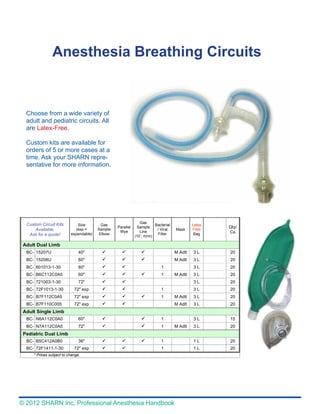
  • 107.
  • 108.
    © 2012 SHARNInc, Professional Anesthesia Handbook Operating Principles of Variable Bypass Vaporizers Total fresh gas flow (FGF) enters and splits into carrier gas (much less than 20%, which becomes enriched – saturated, actually – with vapor) and bypass gas (more than 80%). These two flows rejoin at the vaporizer outlet. The splitting ratio of these two flows depends on the ratio of resistances to the flow, which is controlled by the concentration control dial, and the automatic temperature compensation valve. How to Fill Vaporizers For either funnel or keyed filler types, fill the vaporizer only to the top etched line within the sight glass. Do not hold the bottle up on a keyed filler until it stops bubbling (this will overfill the chamber, particularly if the concentration control dial is “on”, or if leaks are present). The only current vaporizer which can be filled while it is operating is the Tec 6 (Desflurane). How Much Liquid Agent Does a Vaporizer Use Per Hour? Typically, 1 mL of liquid volatile agent yields about 200 mL vapor. This is why tipping is so hazardous – it discharges liquid agent into the control mechanisms or distal to the outlet. And minute amounts of liquid agent discharged distal to the vaporizer outlet result in a large bolus of saturated vapor delivered to the patient instantaneously. Hazards and Safety Features of Contemporary Vaporizers Hazards Incorrect agent Tipping • If tipped more than 45° from the vertical, liquid agent can obstruct valves. • Treatment: Flush for 20-30 minutes at high- flow rates and with high concentration set on dial. Please note that this is the recommended treatment for the Tec 4 vaporizer. The correct approach for other models differs, so their individual operating manuals must be consulted. Simultaneous inhaled agent administration • If removing the central vaporizer from a group of three on an Ohmeda machine, move the remaining two so that they are adjacent. On models which were manufactured prior to 1995, removing the center vaporizer of three defeats the interlock and allows the outer two vaporizers to be turned on simultaneously. Reliance on breath by breath gas analysis rather than preventive maintenance • Problem: Failure of temperature compensation device may result in a rapid onset, high output failure of the vaporizer. • Failure of renewable components, such as seals and O-rings, may have the same effect. Safety Features Important safety features include: • Keyed fillers • Low filling port • Secured vaporizers (less ability to move them about minimizes tipping) • Interlocks • Concentration dial increases output in all when rotated counterclockwise (as seen from above)
  • 109.
    1-800-325-3671 • www.sharn.com ClassificationDatex -Ohmeda Tec 4, Tec 5, and Aladin (AS/3 ADU); Drager Vapor 19.n Copper Kettle, Vernitrol Datex -Ohmeda Tec 6 (Desflurane) Splitting Ratio (carrier gas flow) Variable -bypass (vaporizer determines carrier gas split) Measured -flow (oper ator determines carrier gas split) Dual-circuit (carrier gas is not split) Method of Vaporization Flow -over Bubble -through Gas/vapor blender (heat produces vapor, which is injected into fresh gas flow) Temperature Compensation Automatic temperature compensation mechanism Manual (i.e., by changes in carrier gas flow) Electrically heated to a constant temperature (39°C thermostatically controlled) Calibration Calibrated, agent - specific None; multiple -agent Calibrated, agent - specific Position Out of circ uit Out of circuit Out of circuit Capacity Tec 4 – 125 mL Tec 5 – 300 mL Vapor 19.n – 200 mL Aladin – 250 mL 200-600 mL (no longer manufactured) 390 mL VAPORIZERS 2 VAPOFIL Vapofil Filler Plug Sight Glass Overflow Line Drain Valve Fill Line Drain Port Lock Screw Drain Port Keyed Bottle Adapter Filler Valve Filler Port Lock Screw Filler Port AntiSpil Max Fill Line Sight Glass Min Fill Line Inlet Valve Filling Spout Drain Valve
  • 110.
    © 2012 SHARNInc, Professional Anesthesia Handbook Drager Fill® for newer models of Drager vaporizers Color Order # Ultane® /Sevoflurane DF-M36120 Forane® /Isoflurane DF-M36110 Vaporizer Order # Ultane® /Sevoflurane 8907-S Forane® /Isoflurane 8907-F Sevoflurane V0507-S Forane® V0507-F Vapofil™ for key filled vaporizers Stop fighting with your filler keys. Vapofil is designed with 2 inner tubes, one to let the air escape and the other to let the agent flow into the vaporizer. Vapofil prevents vapor-lock. If you prefer a corrugated tube with a stainless block. Vaporizer Filler Adapters Stainless Steel Block! AntiSpil™ for funnel-filled vaporizers Stop wasteful spills by using AntiSpil to fill your funnel-filled vaporizers. The curved tip and flow meter let you pour the agent with less risk of spills. Vaporizer Order # Forane® /Isoflurane 9010-F
  • 111.
    1-800-325-3671 • www.sharn.com 22Ventilator Problems and Hazards
  • 112.
    © 2012 SHARNInc, Professional Anesthesia Handbook VENTILATOR PROBLEMS & HAZARDS 1 Disconnection Most common site is Y piece. The most com- mon preventable equipment-related cause of mishaps. Direct your vigilance here by: pre- cordial ALWAYS; if you turn the vent off, keep your finger on the switch, use apnea alarms, and don’t silence them. The biggest problem with ventilators is the failure to initiate ventilation, or resume it after it is paused. Be extremely careful just after initiating venti- lation – or whenever ventilation is interrupted: observe and listen to the chest for a few breathing cycles. Never take for granted that flipping the switches will cause ventilation to occur, or that you will always remember to turn the ventilator back on after an X-ray. Monitors for Disconnection Precordial monitor (the most important be- cause its “alarms” can’t be inactivated) Capnography Other monitors for disconnection - Ascending bellows - Observe chest excursion and epigastrium - Airway Pressure monitors - Exhaled Volume monitors Occlusion / Obstruction of Breathing Circuit Beside inability to ventilate, obstruction may also lead to barotrauma. Obstruction may be related to: Tracheal tube (kinked, biting down, plugged, or cuff balloon herniation). “All that wheezes is not bronchospasm.” Incorrect insertion of flow-direction-sensitive components (PEEP valves which are added on between the absorber head and corrugated breathing hoses). Excess inflow to breathing circuit (flushing dur- ing ventilator inspiratory cycle) Bellows leaks Ventilator relief valve (spill valve) malfunction APL valve too tight during mask ventilation or not fully open during pre-oxygenation Misconnection Much less of a problem, since breathing circuit and scavenger tubing sizes have been standard- ized. Failure of Emergency Oxygen Supply May be due to failure to check cylinder contents, or driving a ventilator with cylinders when the pipeline is unavailable. This leads to their rapid depletion, perhaps in as little as an hour, since you need approximately a VT of driving gas per breath, substantially more if airway resistance (RAW) is increased. Infection Clean the bellows after any patient with diseases, which may be spread through airborne droplets, or don’t use the mechanical ventilator, or use bacterial filters, or use disposable soda lime as- sembly, or use a Bain. AIRWAY MANAGEMENT 2 Equipment and Devices for Aiding in Airway Man- agement LMAs (Laryngeal Mask Airways) Devices that are designed to aid in endotracheal tube placement. The LMA consists of a tube con- nected to an elliptical mask with an inflatable rim, which sits over the larynx. The patient can usual- ly breathe spontaneously using this airway device but, to be safe, some doctors like to put patients on a ventilator while using the LMA. The biggest advantage of the LMA is that it stays outside the larynx, so that you don’t need to manipulate the vocal cords, which is the deepest point of airway stimulation.
  • 113.
    1-800-325-3671 • www.sharn.com COPAs(Cuffed Oropharyngeal Airways) Oral airways with a cuff that produces a seal around the larynx. The COPA works via a differ- ent concept than the LMA. You cannot intubate a patient using a COPA; rather it is designed to help the patient breathe spontaneously through it (or in combination with a ventilator). The COPA is positioned against the base of the tongue and is placed in the pharynx, where the inflatable low- pressure cuff helps to block the oropharynx and thereby enables you to ventilate the patient. Like the LMA, the COPA is designed to avoid tracheal and laryngeal stimulation. Oropharnygeal and Nasopharyngeal Airways Short plastic devices, which are placed in the oral cavity and the pharynx to help prevent respiratory obstruction, such as when the tongue falls back. The oral airway alone can’t help you manage the airway. They are primarily used in conjunction with mask ventilation. The nasopharyngeal air- way works the same way, except that it is placed through the nasopharynx. Combitubes A combination between tube airways and cuffed devices. It can be blindly placed in the mouth; you don’t need a laryngoscope. Bullard Laryngoscopes Rigid instruments that function as sort of an indirect fiberoptic laryngoscope. They have a unique blade (the “Bullard blade”) attachment that is designed to make the exposure of the vocal cords better. The blade portion is designed to match the body’s anatomical airway. This feature ne- gates the need to manipulate the patient’s head and neck to visualize the larynx. The Bullard scopes are primarily used as an op- tion for difficult airway cases, particularly in patients with cervical-spine pathology. The reason that they are not used more often is that they require much more setup to use than a typical laryngoscope. Protocol for Mechanical Ventilator Failure 1. If the ventilator fails, manually ventilate with the circle system.
  • 114.
    © 2012 SHARNInc, Professional Anesthesia Handbook Parker Laryngeal Mask Device Disposable Silicone Laryngeal Masks Finally a disposable that feels like a reusable! The smooth contouring of our 100% medical grade silicone device enables easy insertion, is gentle to the airway, and is designed to produce an effective seal. The unique color- coded and printed pilot balloon allows for fast and correct size identification. The clear 15mm connector allows a potential blockage to be seen. Latex-free & DEHP free Order # Size Price LP-HPLMD-10 Size 1.0 $60.00 / box of 5 LP-HPLMD-15 Size 1.5 $60.00 / box of 5 LP-HPLMD-20 Size 2.0 $60.00 / box of 5 LP-HPLMD-25 Size 2.5 $60.00 / box of 5 LP-HPLMD-30 Size 3.0 $60.00 / box of 5 LP-HPLMD-40 Size 4.0 $60.00 / box of 5 LP-HPLMD-50 Size 5.0 $60.00 / box of 5 Order # Size Price LP-HPLMDR-10 Size 1.0 $150.00 / box of 5 LP-HPLMDR-15 Size 1.5 $150.00 / box of 5 LP-HPLMDR-20 Size 2.0 $150.00 / box of 5 LP-HPLMDR-25 Size 2.5 $150.00 / box of 5 LP-HPLMDR-30 Size 3.0 $150.00 / box of 5 LP-HPLMDR-40 Size 4.0 $150.00 / box of 5 LP-HPLMDR-50 Size 5.0 $150.00 / box of 5 Silicone Disposable ReinforcedSilicone Disposable