AIRWAY ALGORITHM REVIEW
WHY AIRWAY REVIEW? Most important aspect of patient care (?) Failure = Gravest Consequence
WHY AIRWAY REVIEW? Many Quality Assurance Concerns: - Gausche et al study   -PALS update  -Burton et al study -Kendall et al study -Marcolini et al study
MAINE’S PLAN These Concerns led MDPB to do a comprehensive review of the current airway protocol and create the new… Airway Algorithm
AIRWAY PROTOCOL -Makes airway procedures a “step by step” process -Adds concept of “rescue airway” -Adds new airway devices
AIRWAY PROTOCOL Protocol Initiated 5/23/05 The MDPB’s goal is to train all intubating providers by a yet to be determined date   *Providers may use new protocol if trained but not until they are trained
MANDATORY EQUIPMENT Goal is for services to comply with mandatory airway devices by a yet to be determined roll out date.  MEMS will allow time for budgeting
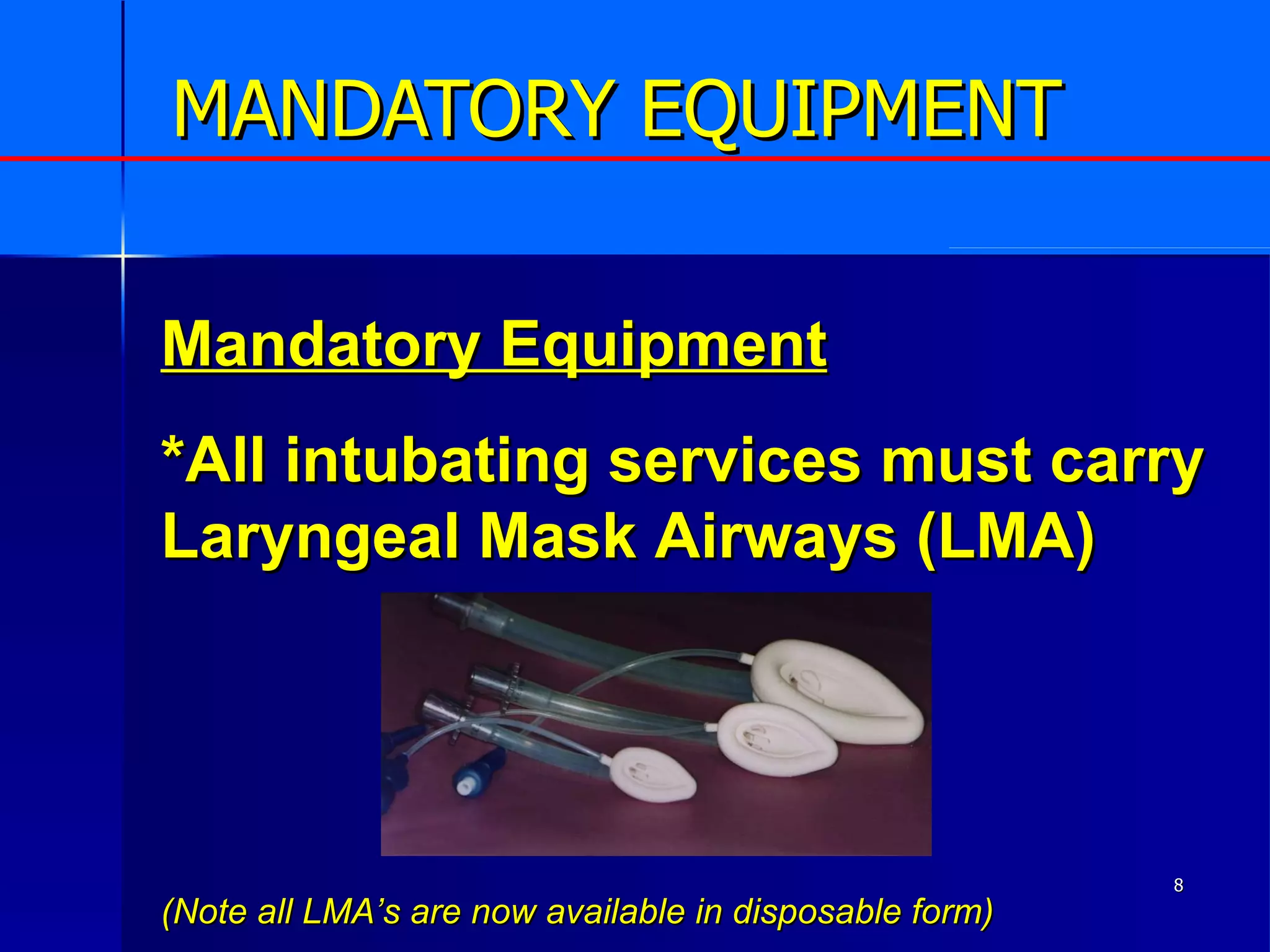
MANDATORY EQUIPMENT Mandatory Equipment *All intubating services must carry Laryngeal Mask Airways (LMA)  (Note all LMA’s are now available in disposable form)
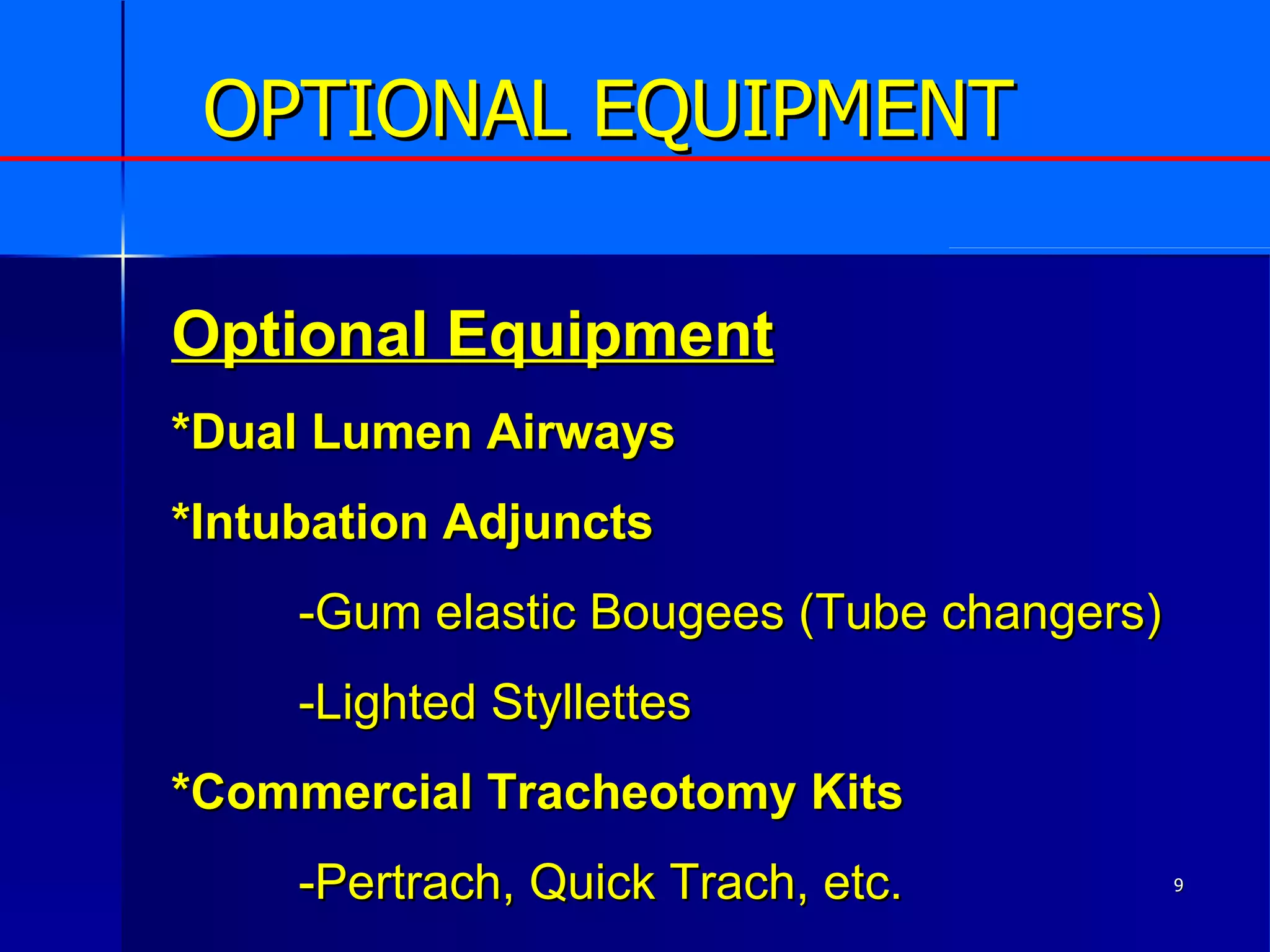
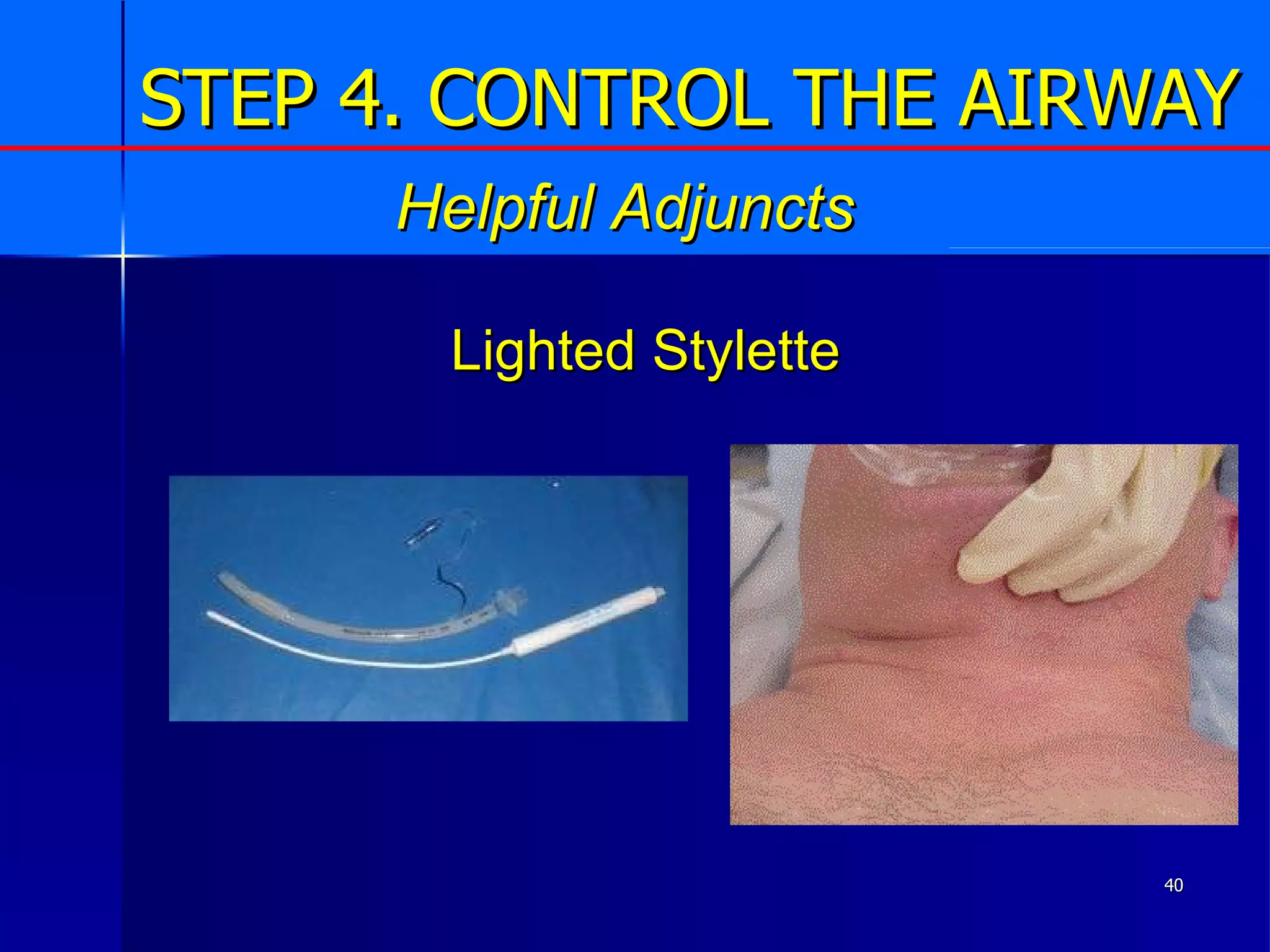
OPTIONAL EQUIPMENT Optional Equipment *Dual Lumen Airways *Intubation Adjuncts -Gum elastic Bougees (Tube changers) -Lighted Styllettes *Commercial Tracheotomy Kits -Pertrach, Quick Trach, etc.
AIRWAY PROTOCOL QA Component
TRAINING OBJECTIVES -Practical walk through airway management from BLS to ALS -Introduce the algorithm idea -Review fundamental concepts  -Practice hands on skills -Debunk myths -Trade tips
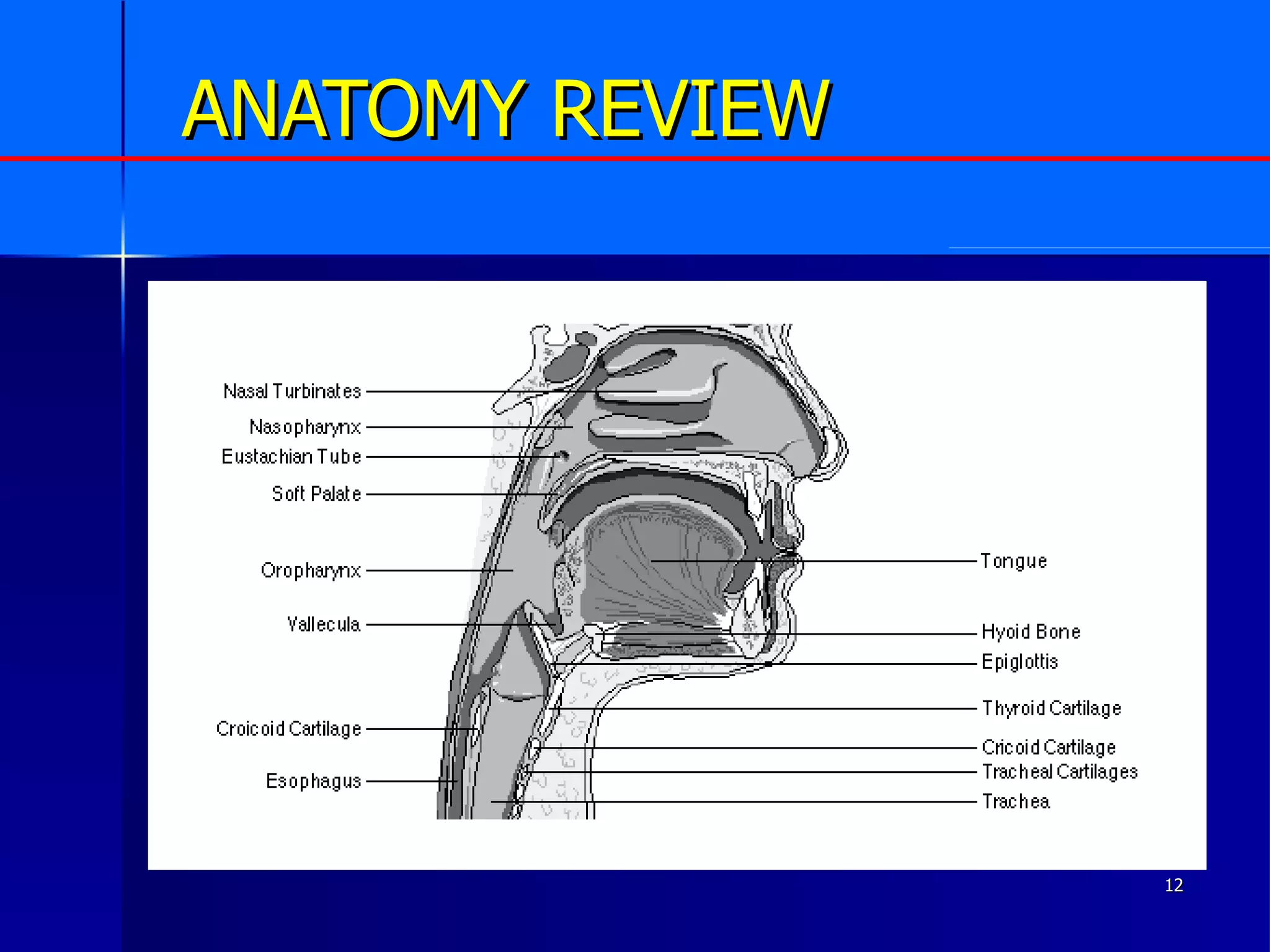
ANATOMY REVIEW
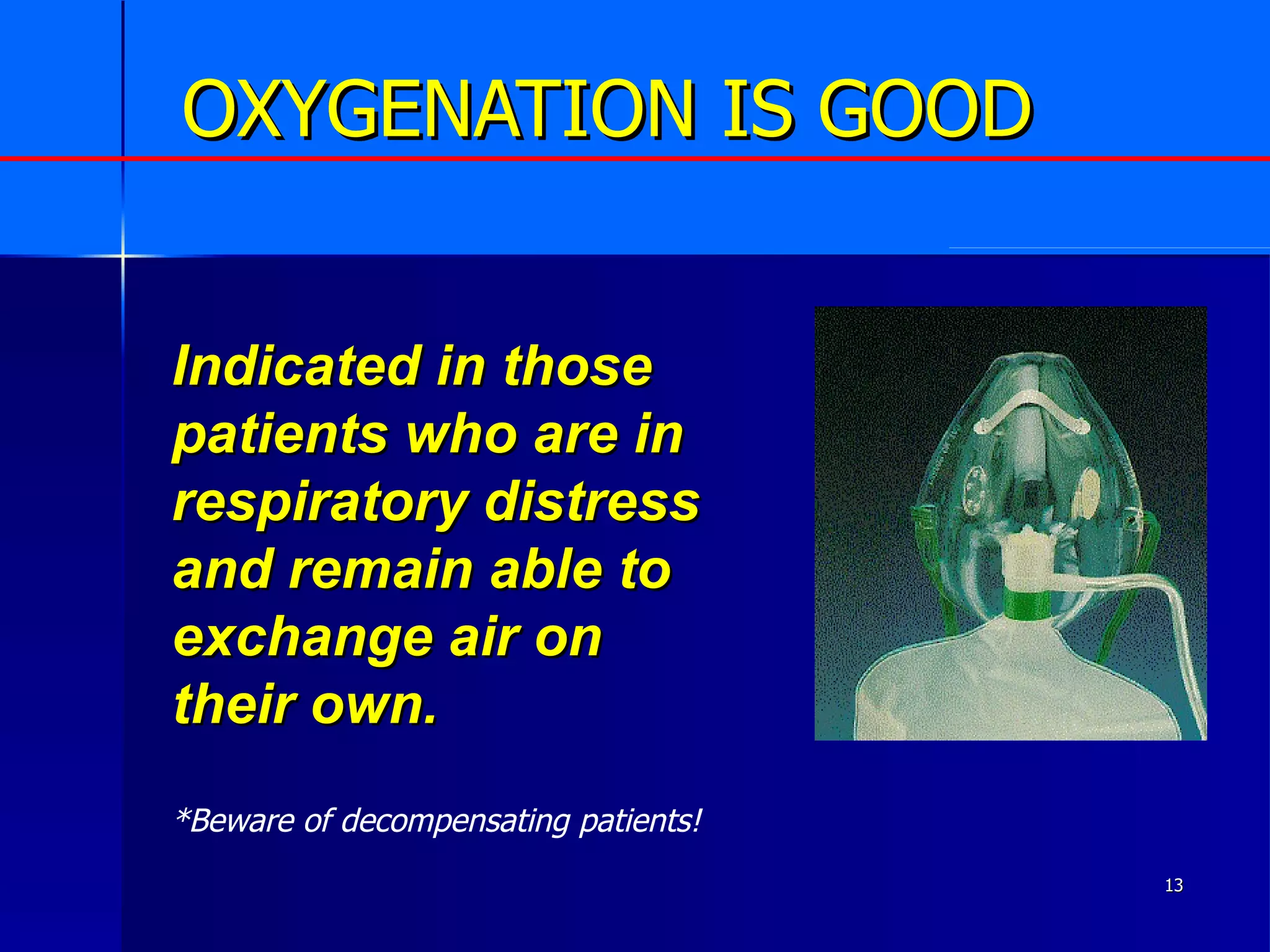
OXYGENATION IS GOOD Indicated in those patients who are in respiratory distress and remain able to exchange air on their own. *Beware of decompensating patients!
WHY MANAGE AN AIRWAY Anyone can be taught to use a BVM or intubate…the real question is   why manage an airway?
AIRWAY MANAGEMENT Reasons To Manage an Airway: -Obstruction -None present, (trauma, medical) -Decompensating (not maintaining) -Breathing too fast or too slow? What are your indicators?
AIRWAY MANAGEMENT Respiratory Distress vs. Respiratory Failure Distress -Increased work of breathing - Relative  hypoxia/hypercapnea - Compensating Failure -Increased work of breathing - Profound  hypoxia/hypercapnea - Decompensating It’s a constant reassessment process…
AIRWAY ALGORITHM A step by step approach at evaluating each patients ability to maintain an open airway. Immediate corrective actions based on this assessment A constant reassessment of current procedures to determine the need to be more or less aggressive in the best interest to the patient.
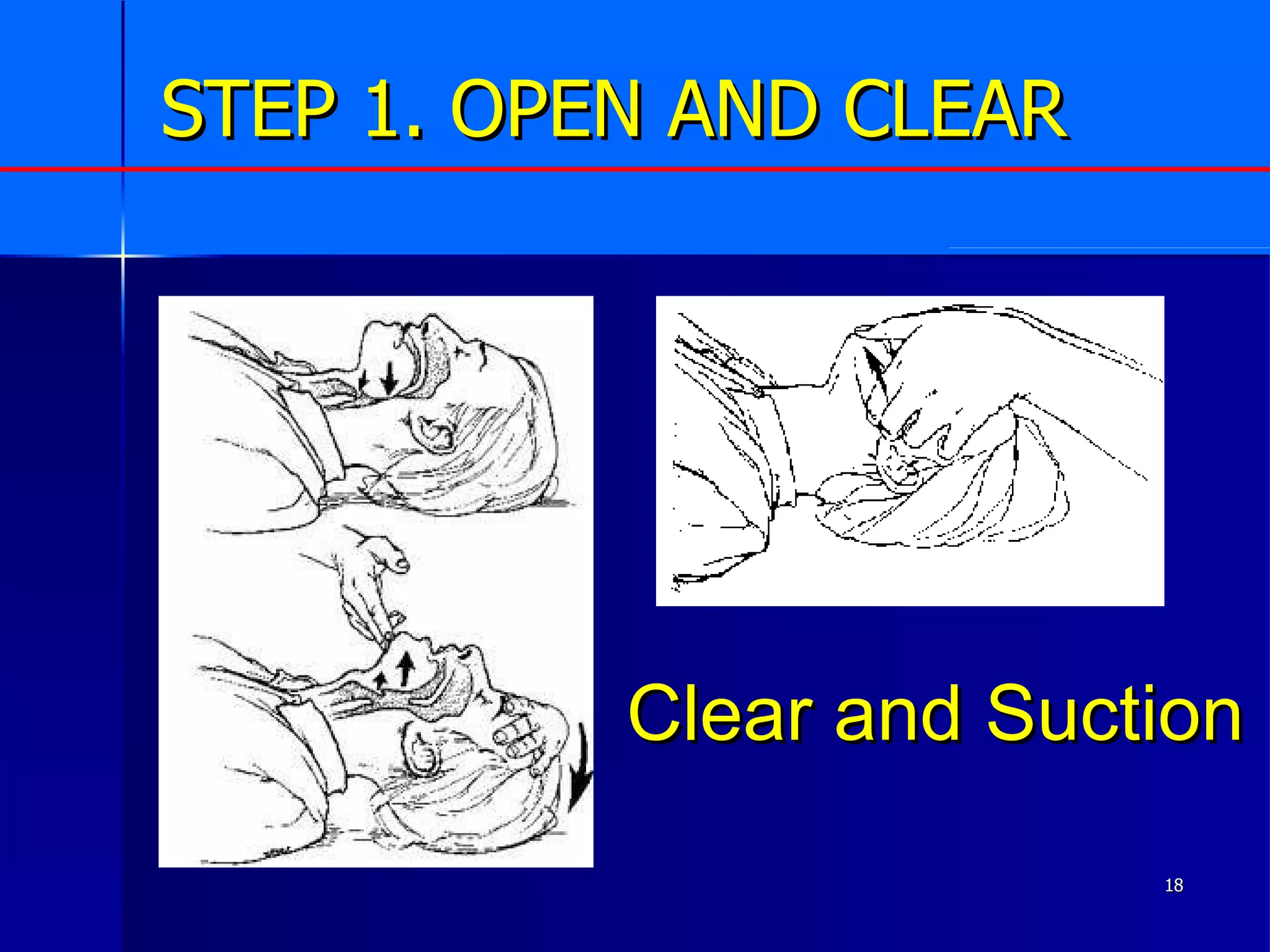
STEP 1. OPEN AND CLEAR Clear and Suction
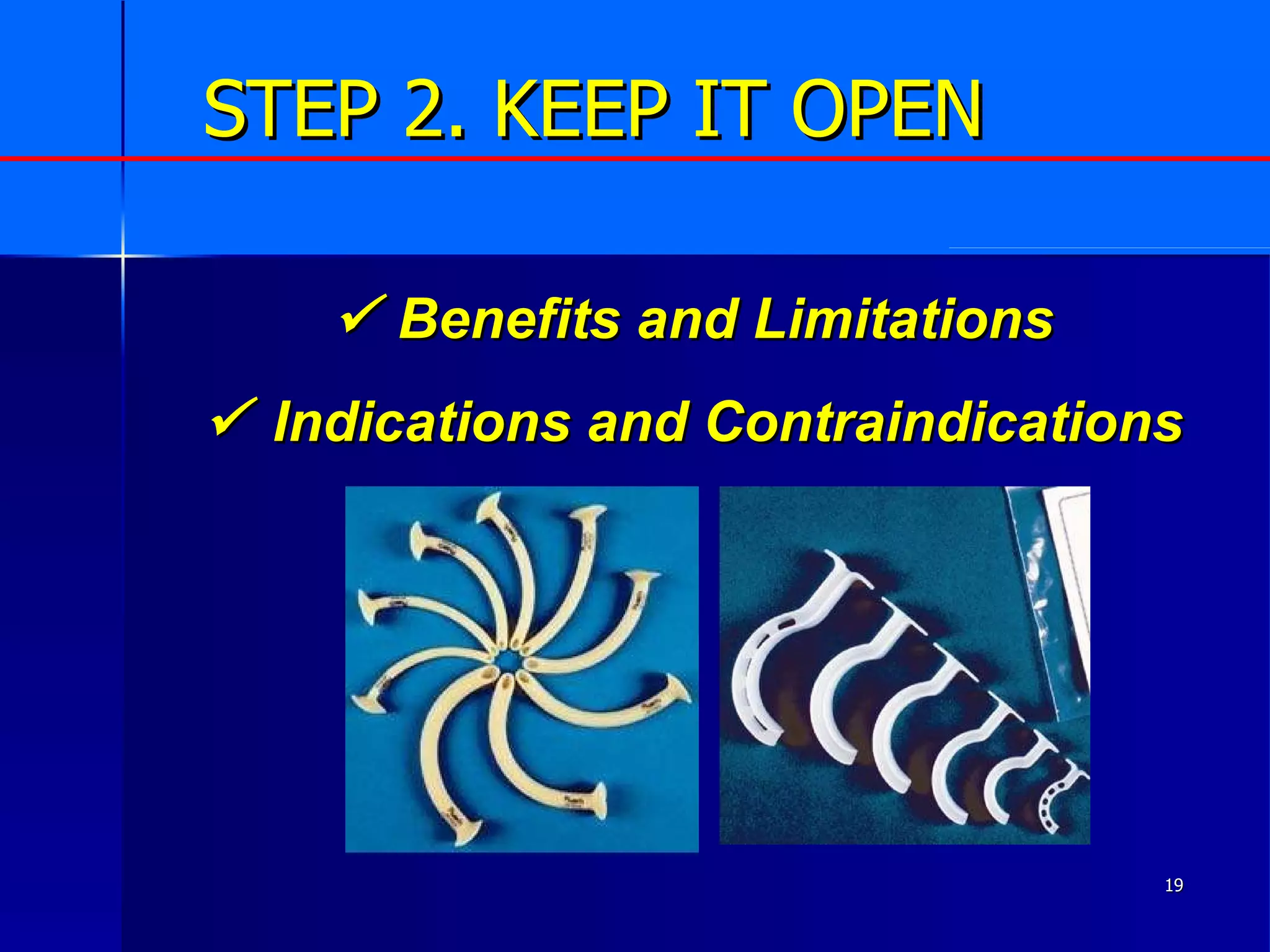
STEP 2. KEEP IT OPEN    Benefits and Limitations    Indications and Contraindications
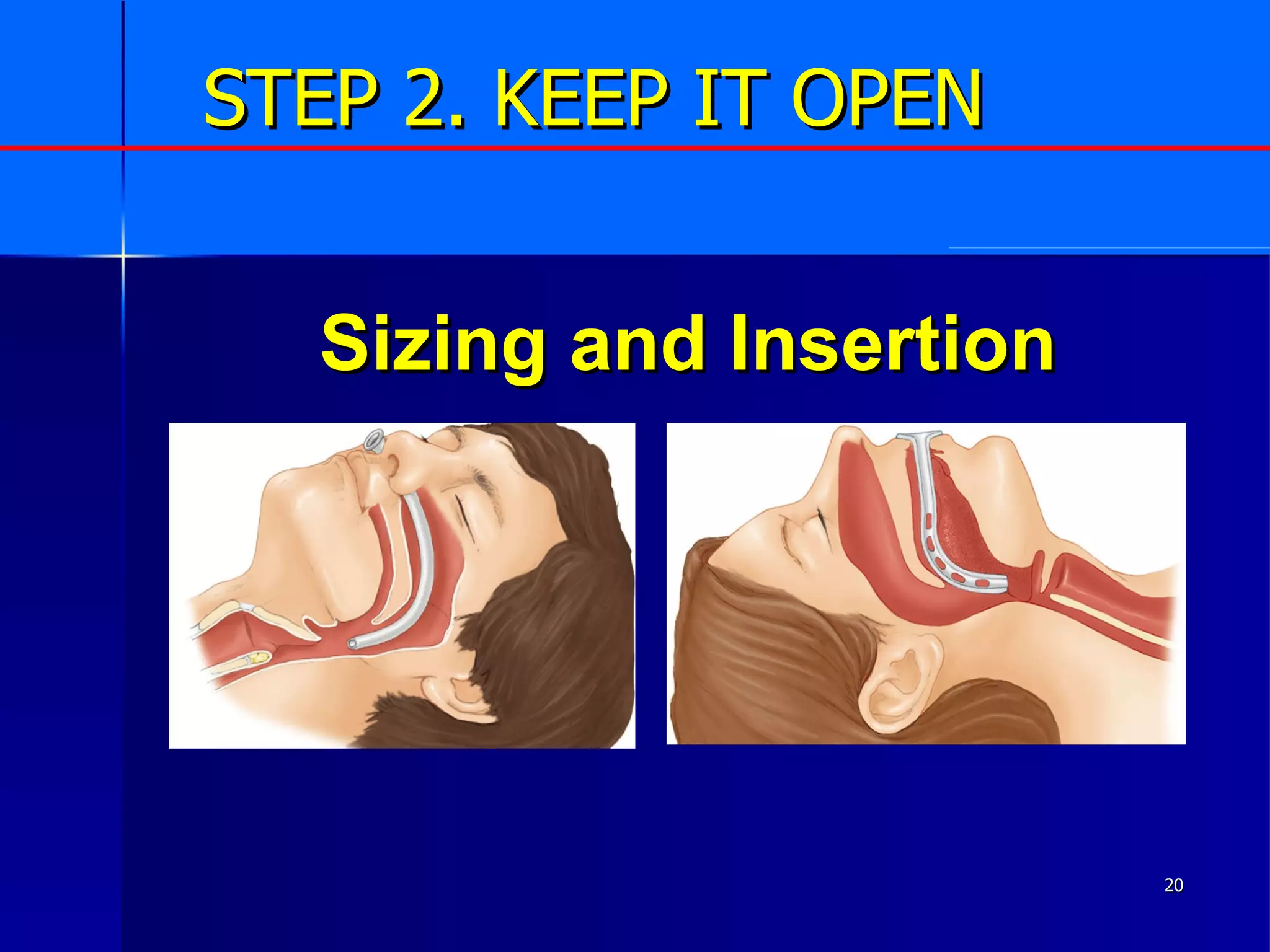
STEP 2. KEEP IT OPEN Sizing and Insertion
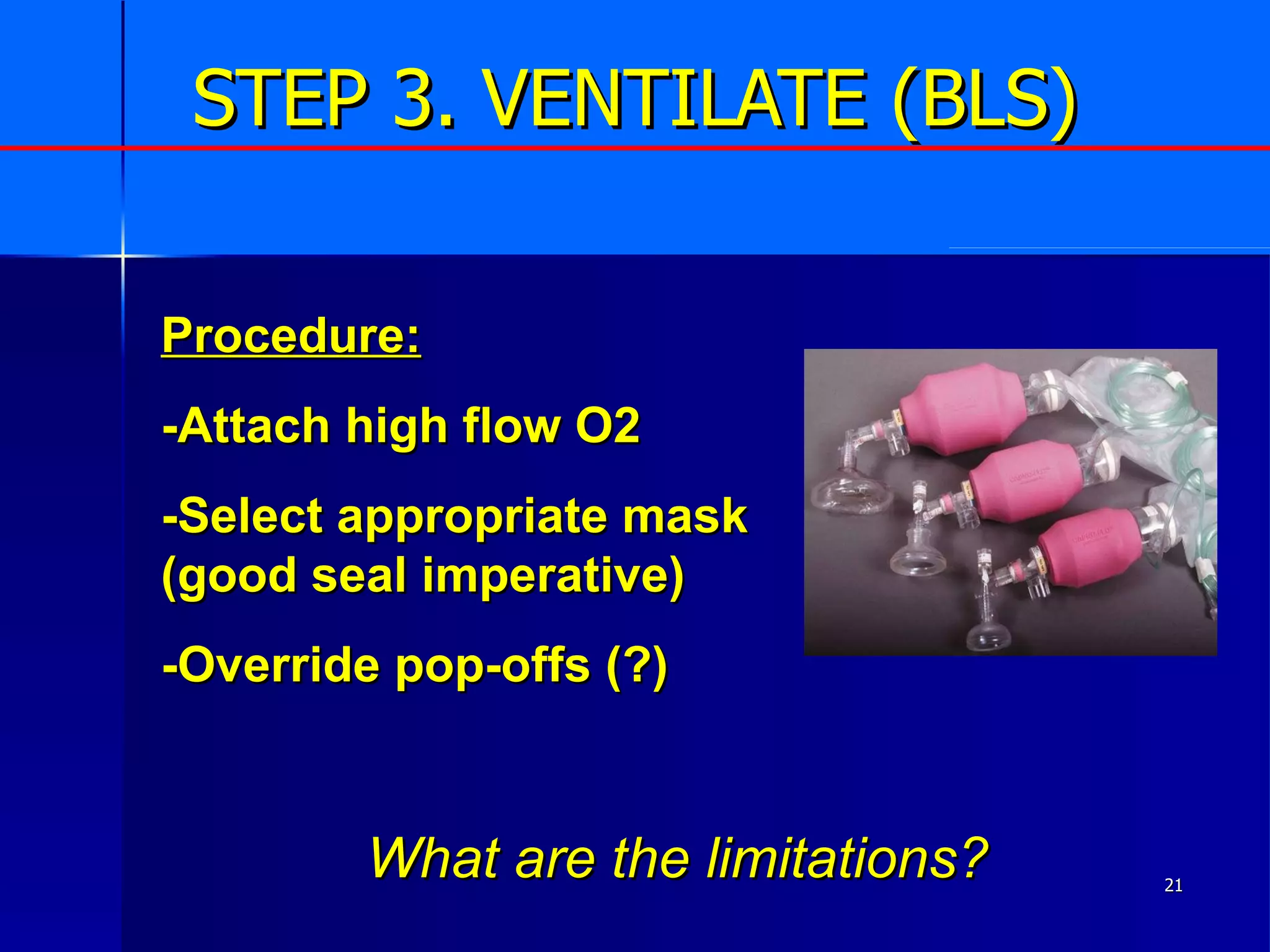
STEP 3. VENTILATE (BLS) Procedure: -Attach high flow O2 -Select appropriate mask (good seal imperative) -Override pop-offs (?) What are the limitations?
STEP 3. VENTILATE (BLS) -BVM Rate Re-Examined -BVM Depth Re-Examined Practical Exercise on Ventilation
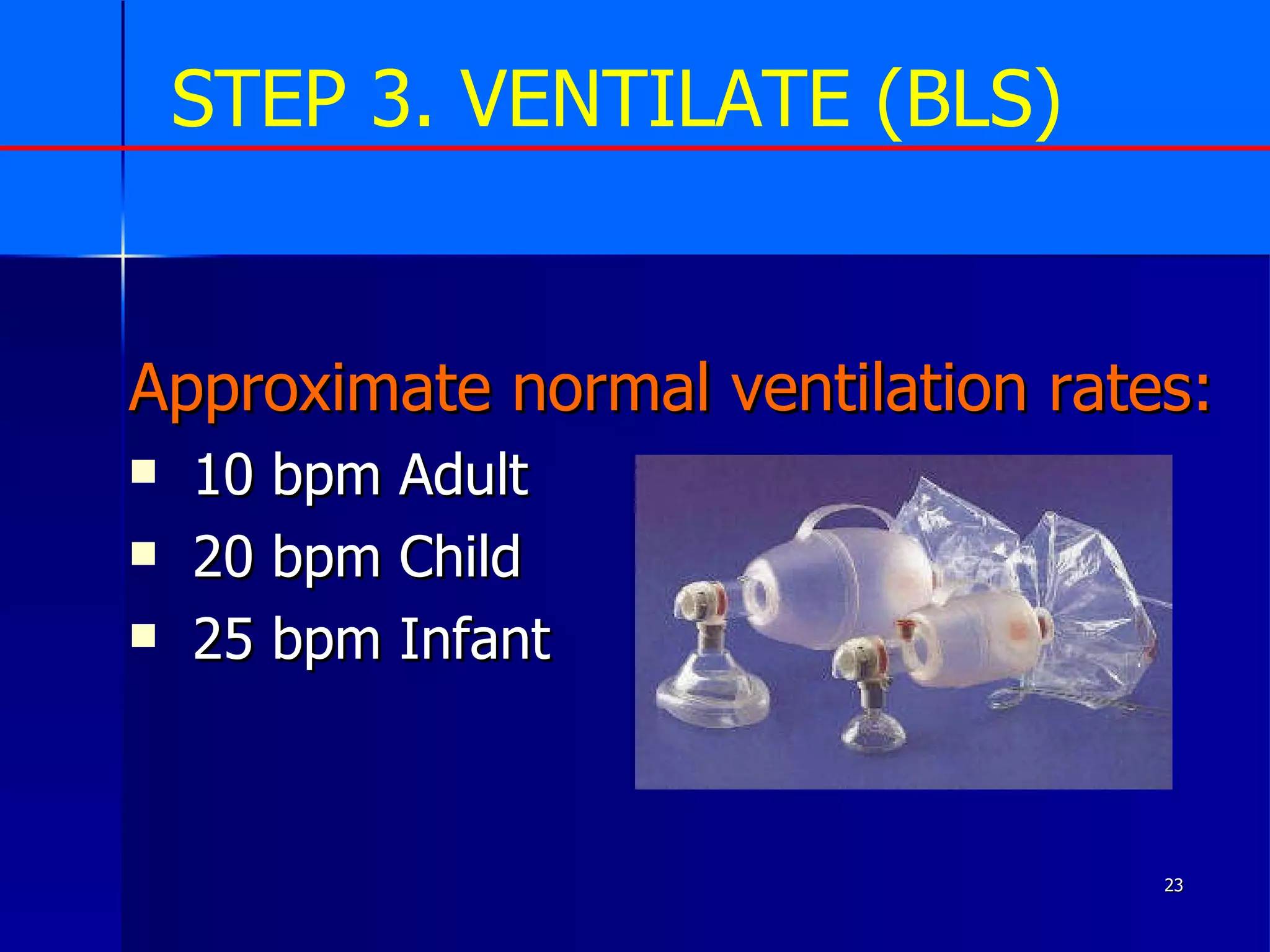
Approximate normal ventilation rates: 10 bpm Adult 20 bpm Child 25 bpm Infant STEP 3. VENTILATE (BLS)
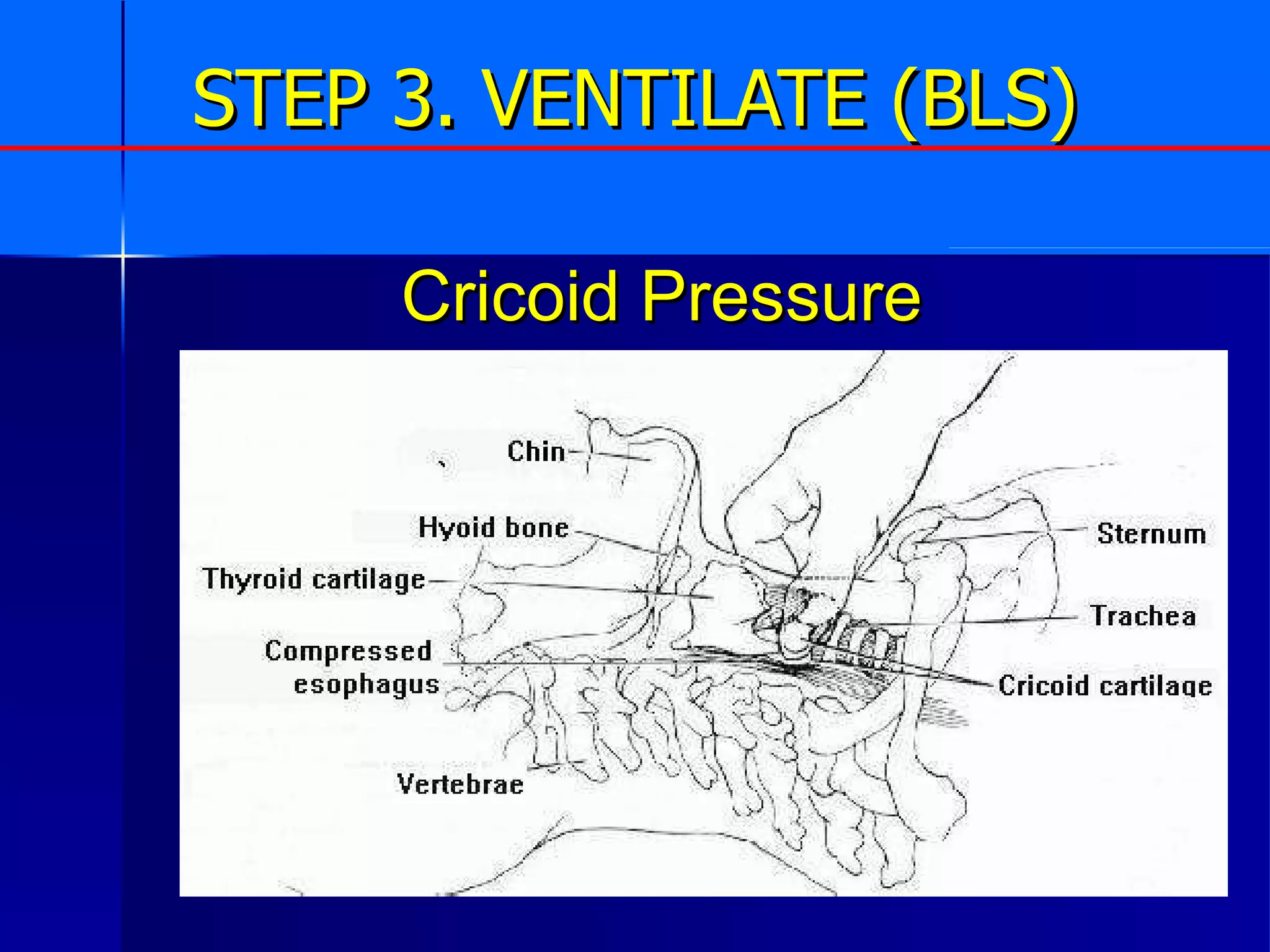
STEP 3. VENTILATE (BLS) Cricoid Pressure
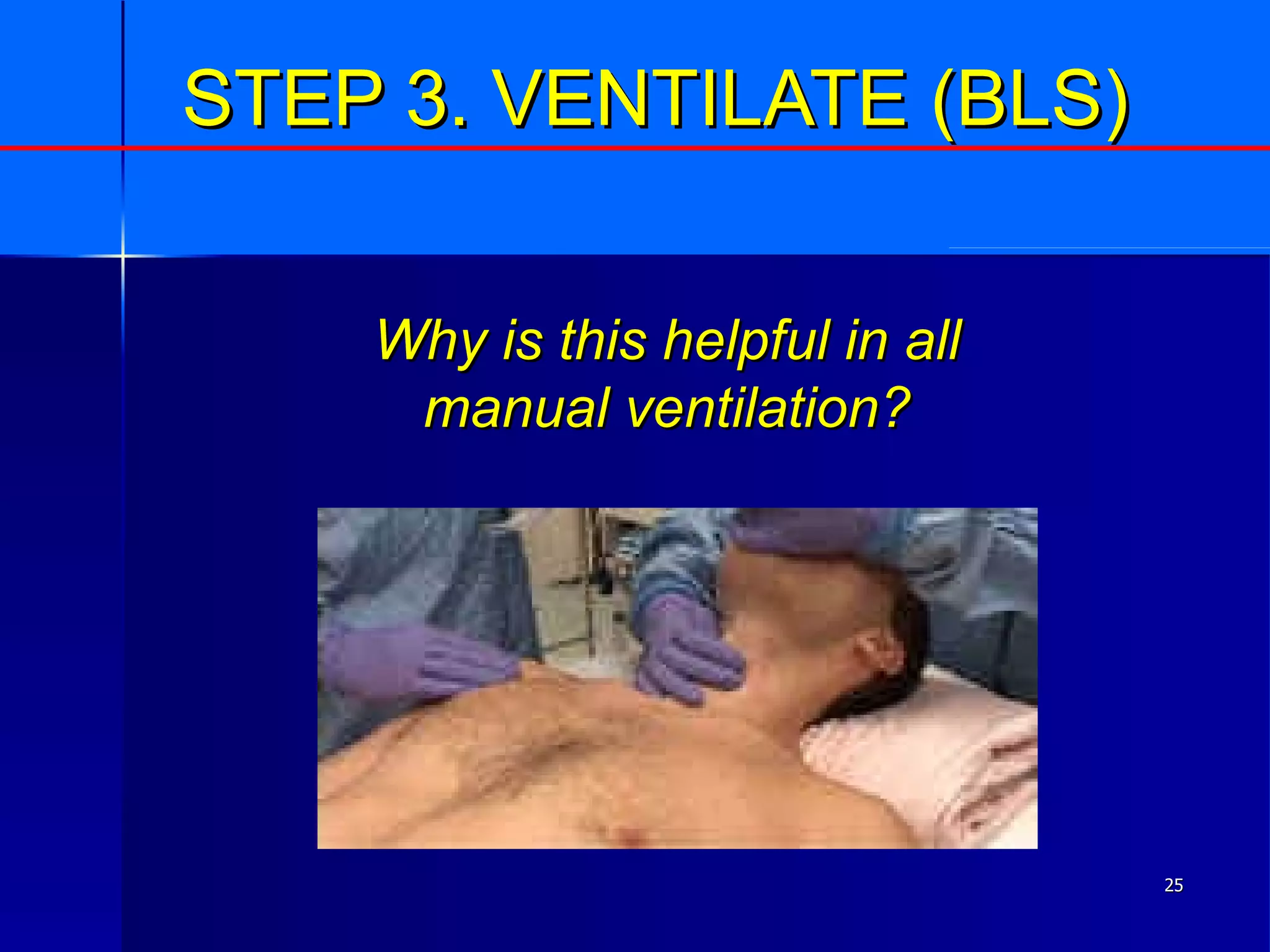
STEP 3. VENTILATE (BLS) Why is this helpful in all manual ventilation?
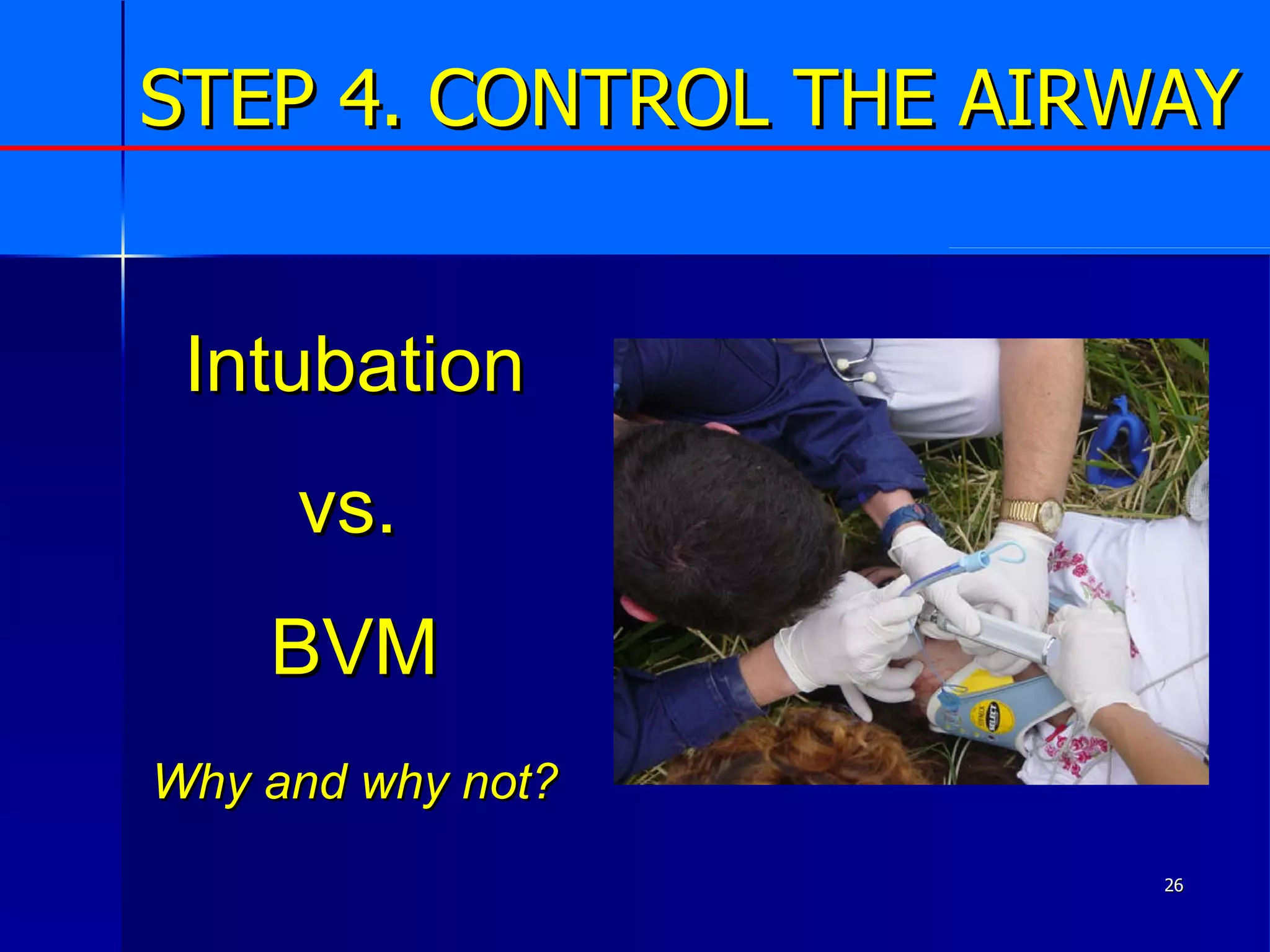
STEP 4. CONTROL THE AIRWAY Intubation vs.  BVM Why and why not?
STEP 4. CONTROL THE AIRWAY Airway Management Decision Process (Judge how aggressive you need to be.) -Time/Distance -Personnel -Equipment -Other Considerations?
STEP 4. CONTROL THE AIRWAY “ Evaluate for signs of difficult intubation”   (this may help in your decision as well) -Obesity -Small body habitus -Small jaw -Large teeth -Burns -Trauma -Anaphylaxis -Stridor
STEP 4. CONTROL THE AIRWAY The BLS vs. ALS airway decision may not be based on one single factor, but rather based on an overall assessment of many factors.
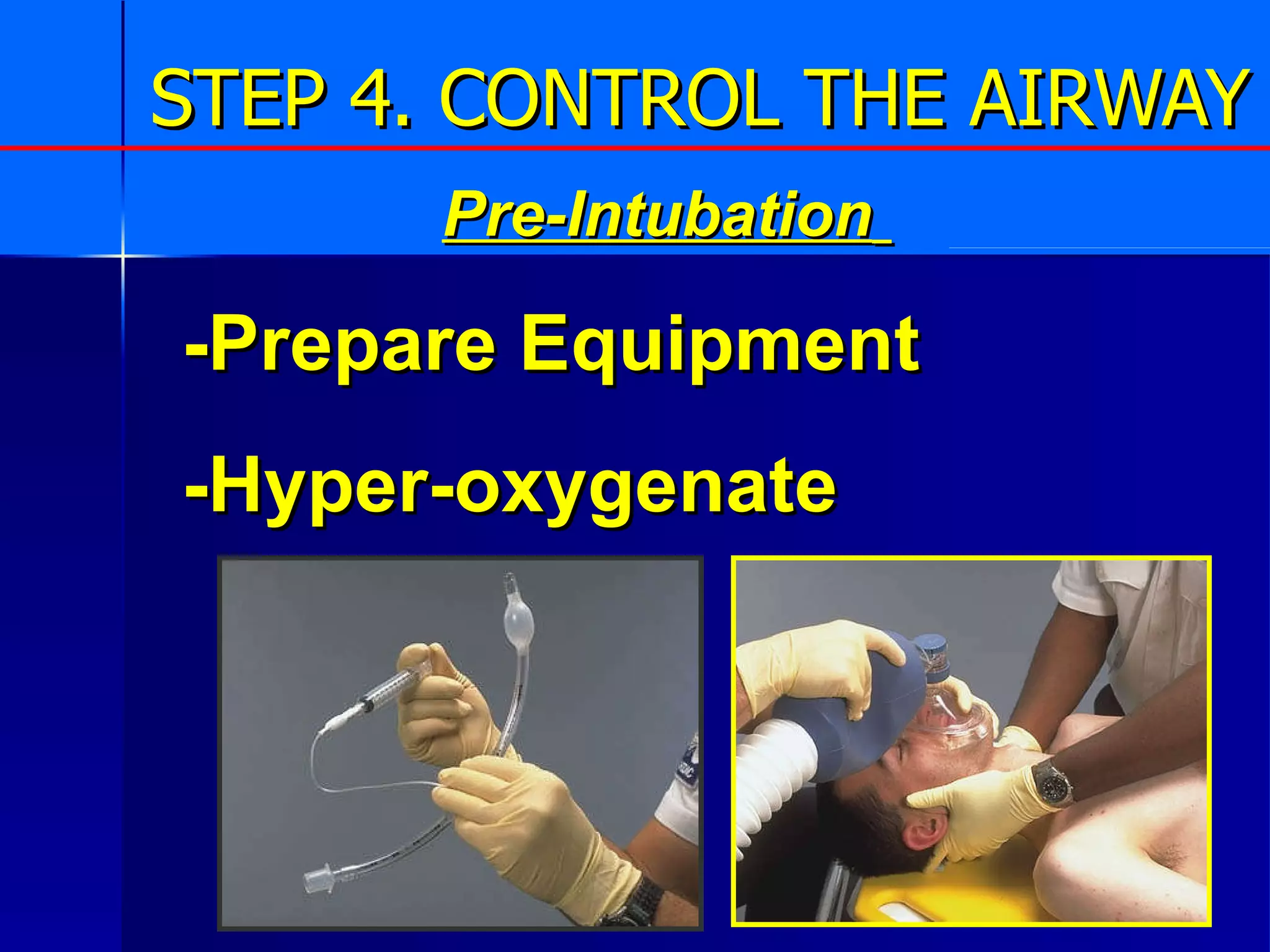
STEP 4. CONTROL THE AIRWAY Pre-Intubation   -Prepare Equipment -Hyper-oxygenate
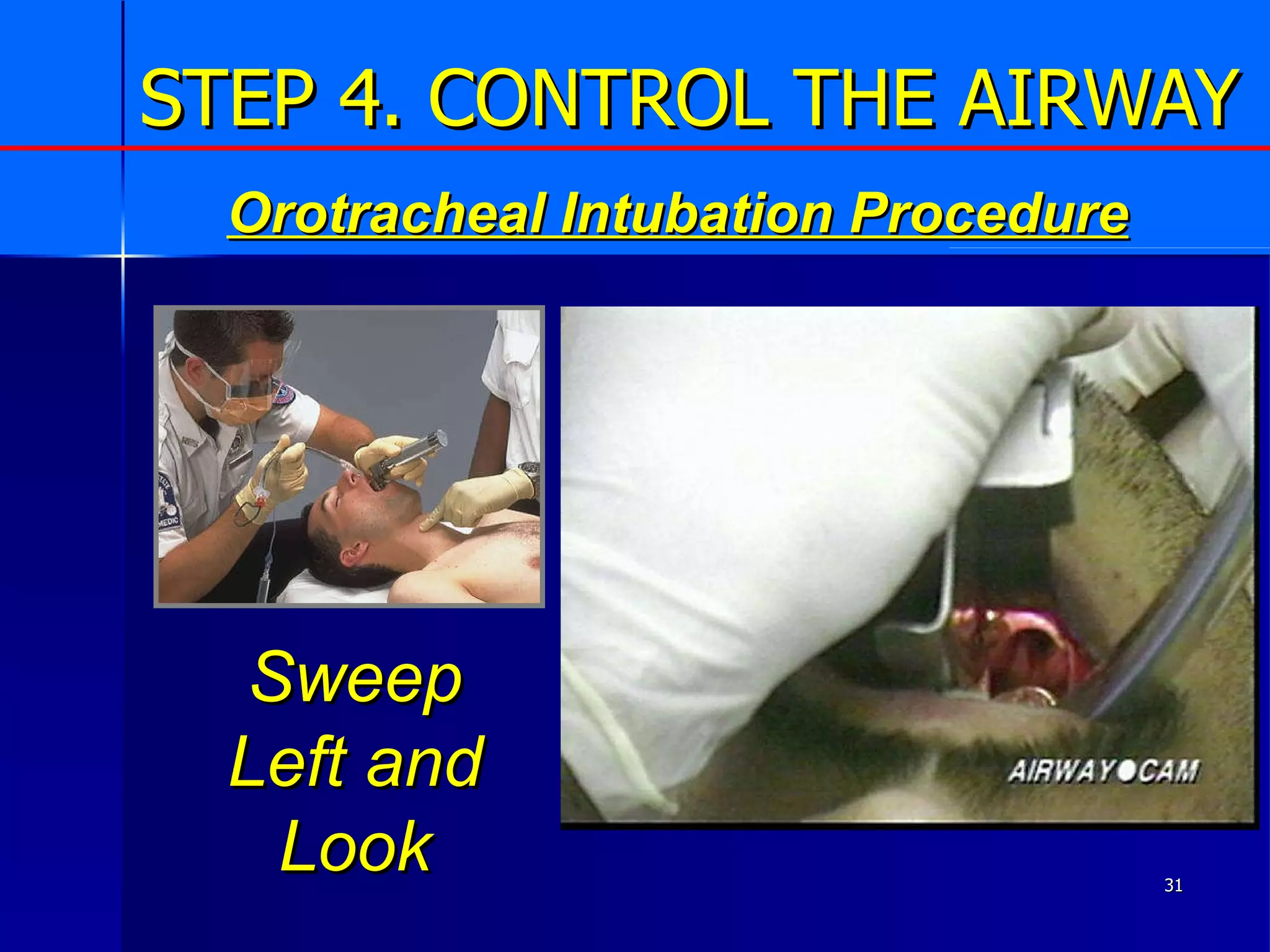
STEP 4. CONTROL THE AIRWAY Orotracheal Intubation Procedure Sweep Left and Look
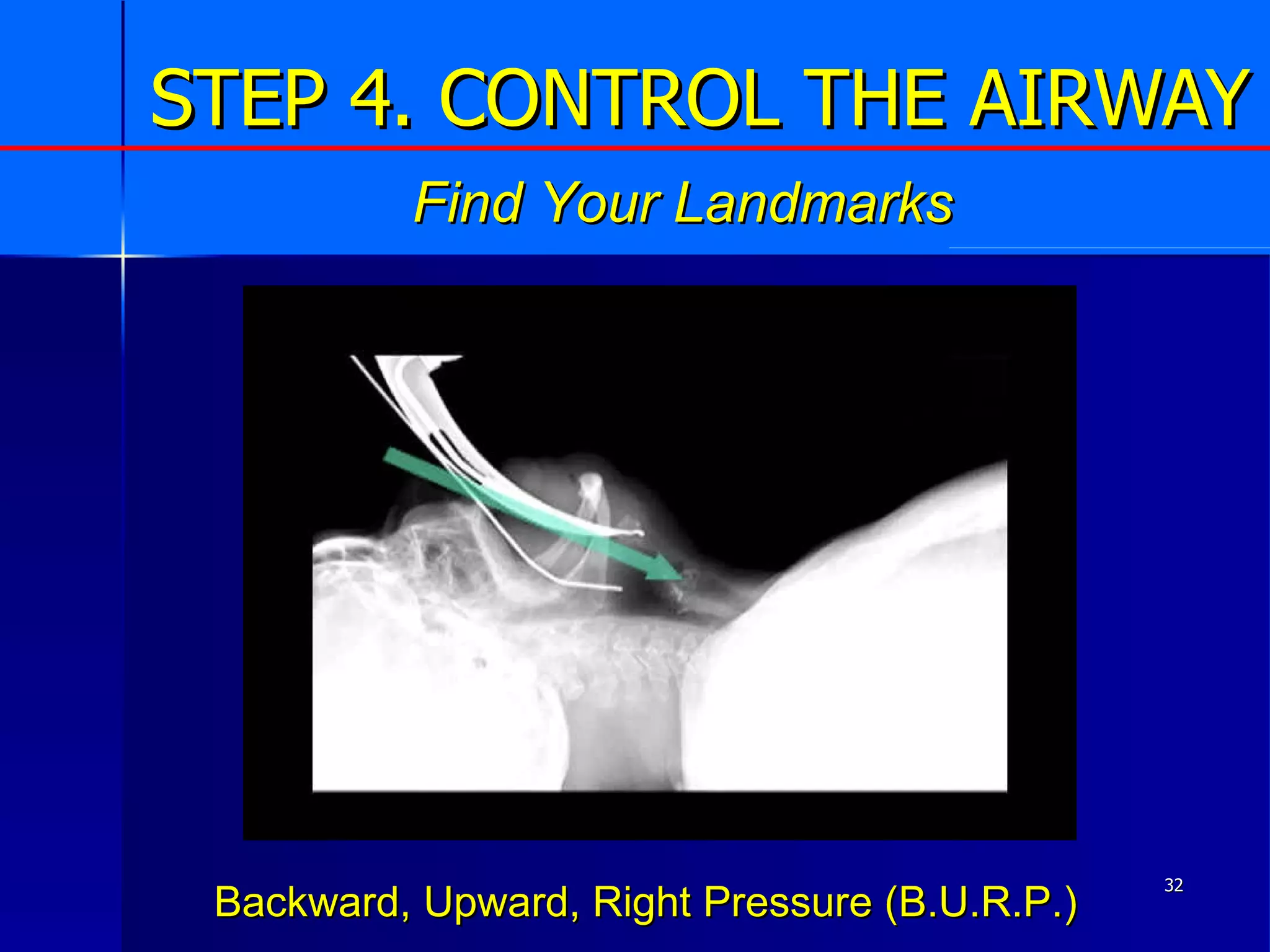
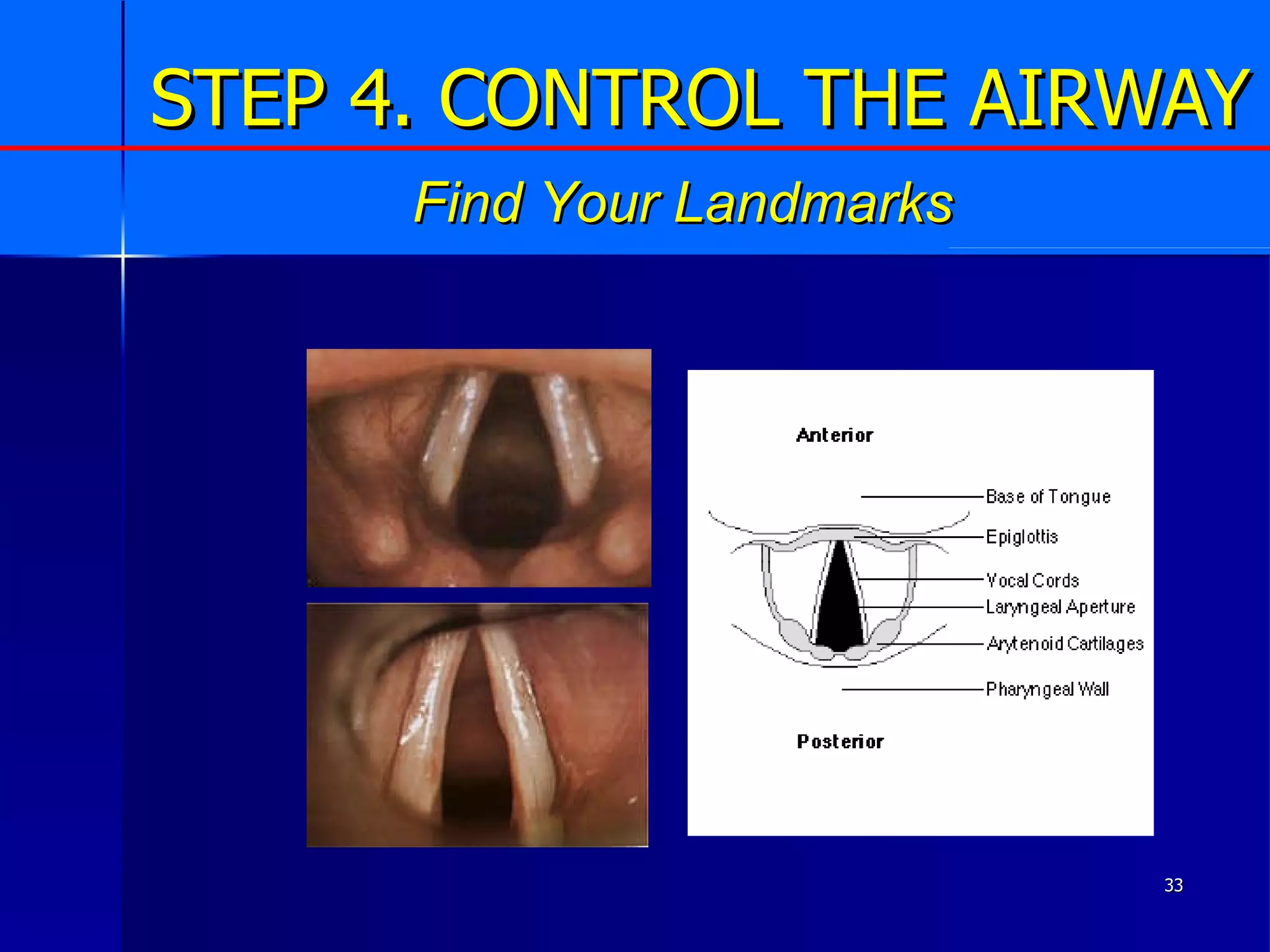
STEP 4. CONTROL THE AIRWAY Backward, Upward, Right Pressure (B.U.R.P.) Find Your Landmarks
STEP 4. CONTROL THE AIRWAY Find Your Landmarks
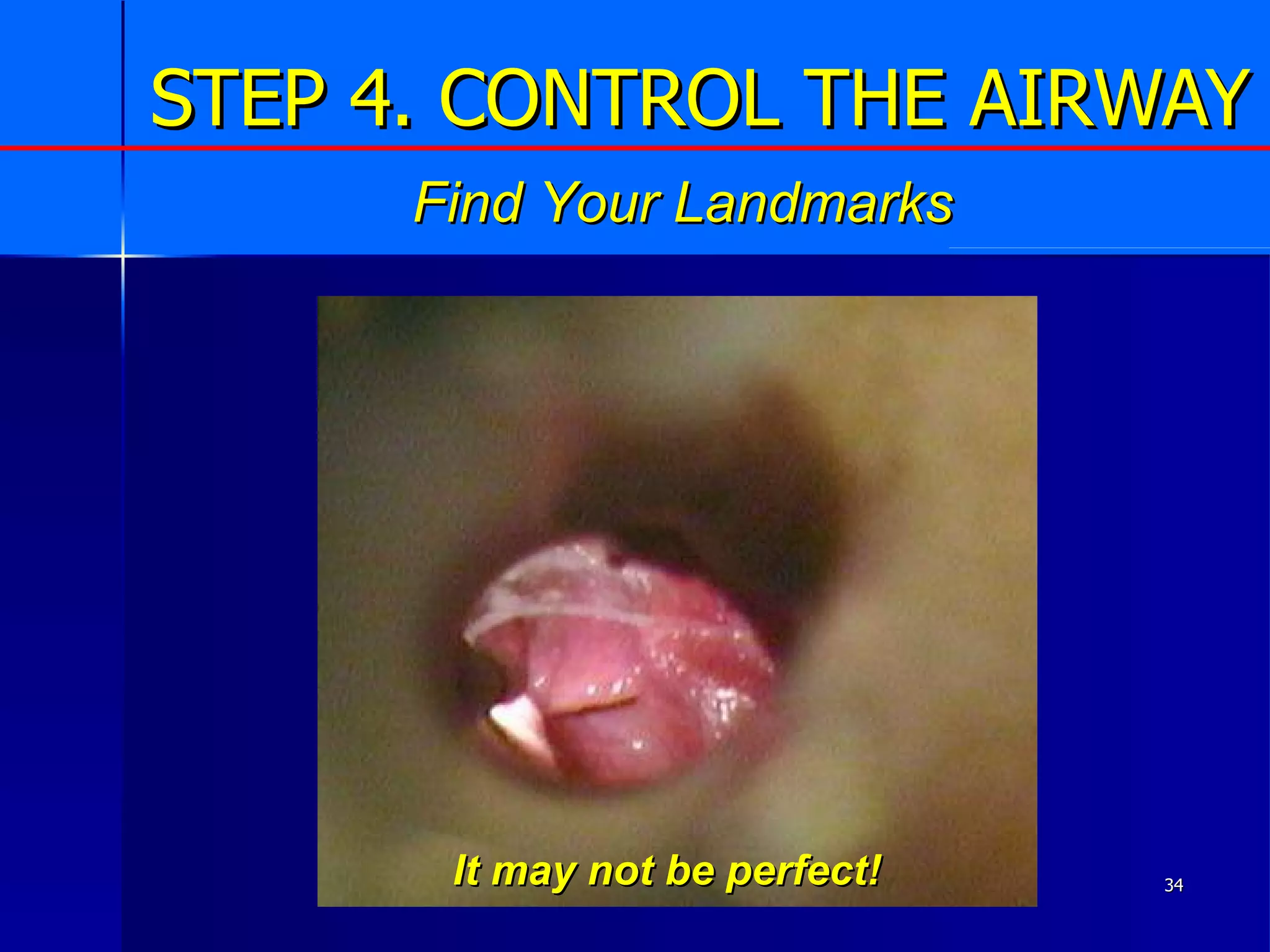
STEP 4. CONTROL THE AIRWAY It may not be perfect! Find Your Landmarks
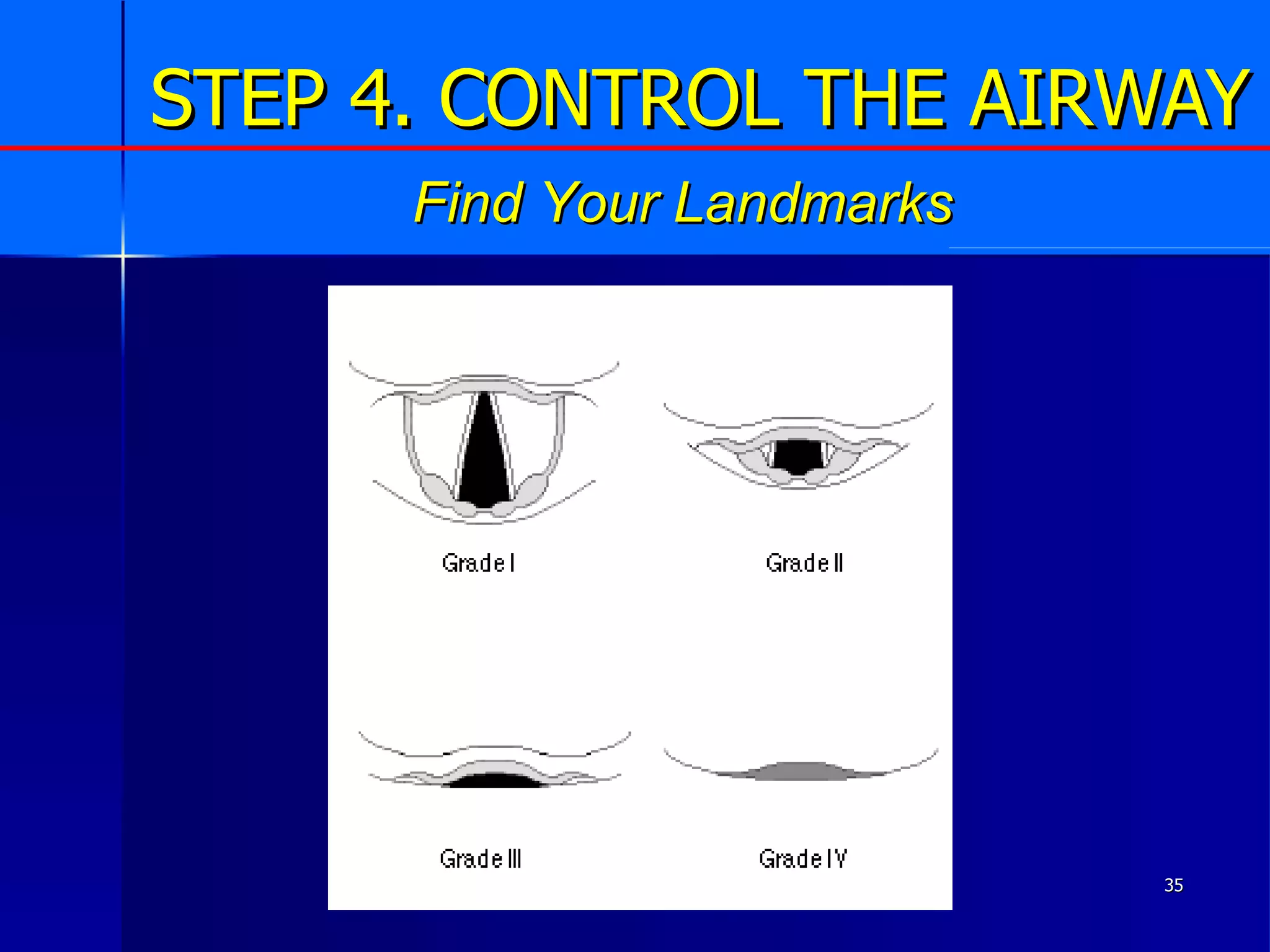
STEP 4. CONTROL THE AIRWAY Find Your Landmarks
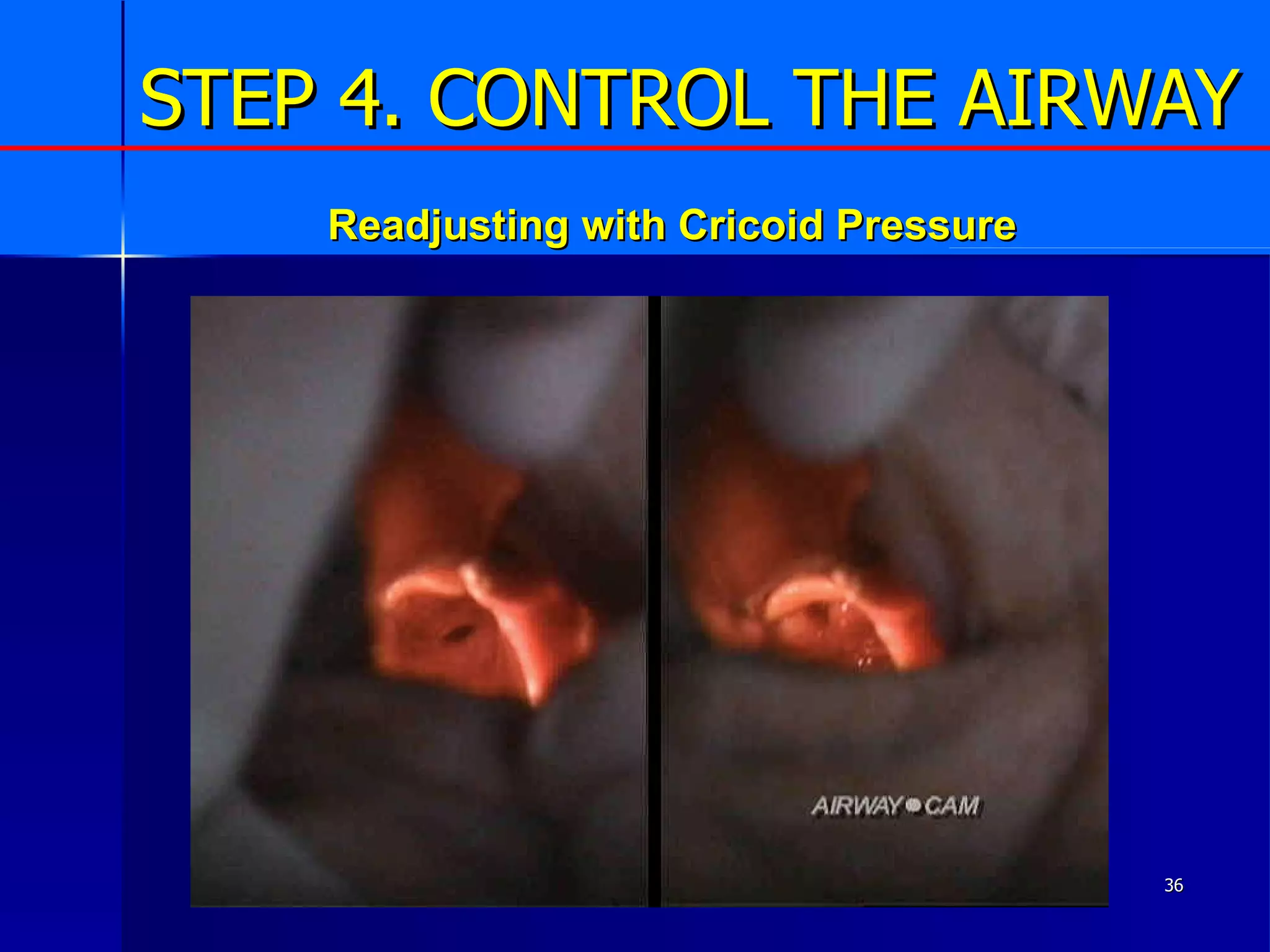
STEP 4. CONTROL THE AIRWAY Readjusting with Cricoid Pressure
STEP 4. CONTROL THE AIRWAY Common Provider Mistakes * Making a difficult intubation more difficult *Rushing *Poor equipment preparation *Suction (lack there of)
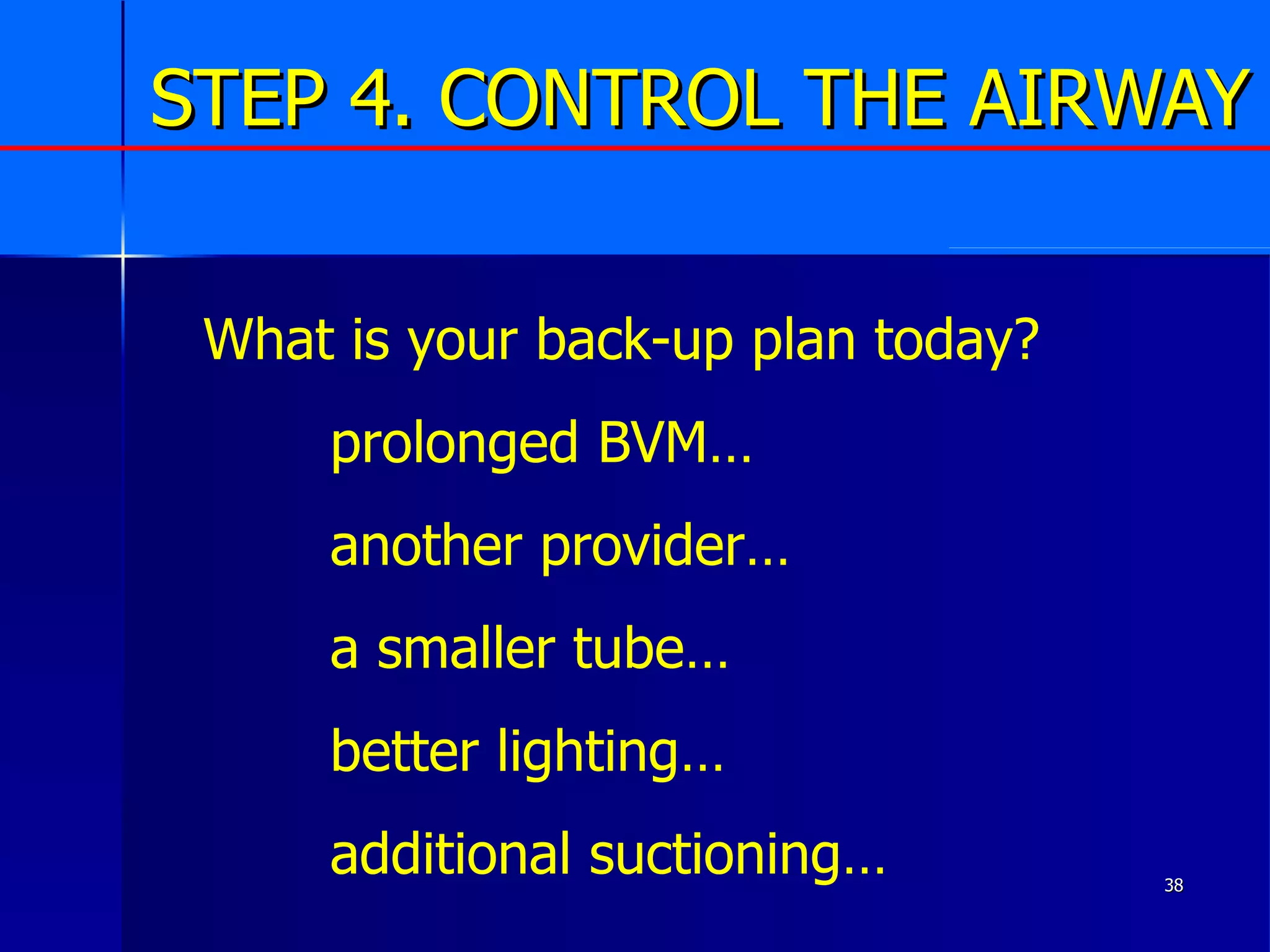
STEP 4. CONTROL THE AIRWAY What is your back-up plan today? prolonged BVM… another provider… a smaller tube… better lighting… additional suctioning…
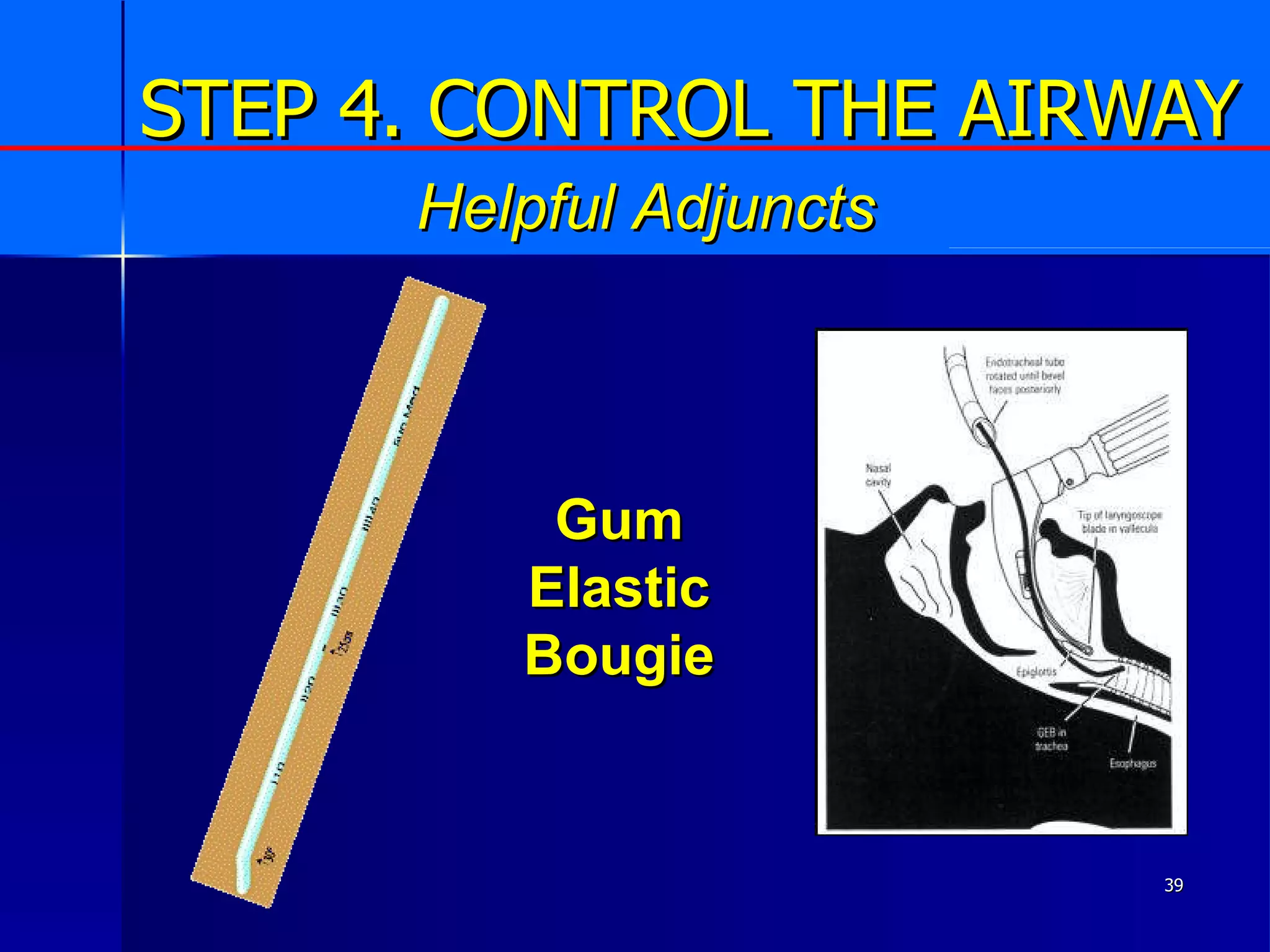
STEP 4. CONTROL THE AIRWAY Helpful Adjuncts Gum Elastic Bougie
STEP 4. CONTROL THE AIRWAY Helpful Adjuncts Lighted Stylette
Nasotracheal Intubation Indications : “ Patient still breathing but in respiratory failure and in whom oral intubation is impossible or difficult.”   STEP 4. CONTROL THE AIRWAY -AAOS
Contraindications : -Apnea -Resistance in the nares -Blood clotting or anticoagulation problems -Basilar Skull Fx (?) STEP 4. CONTROL THE AIRWAY Nasotracheal Intubation
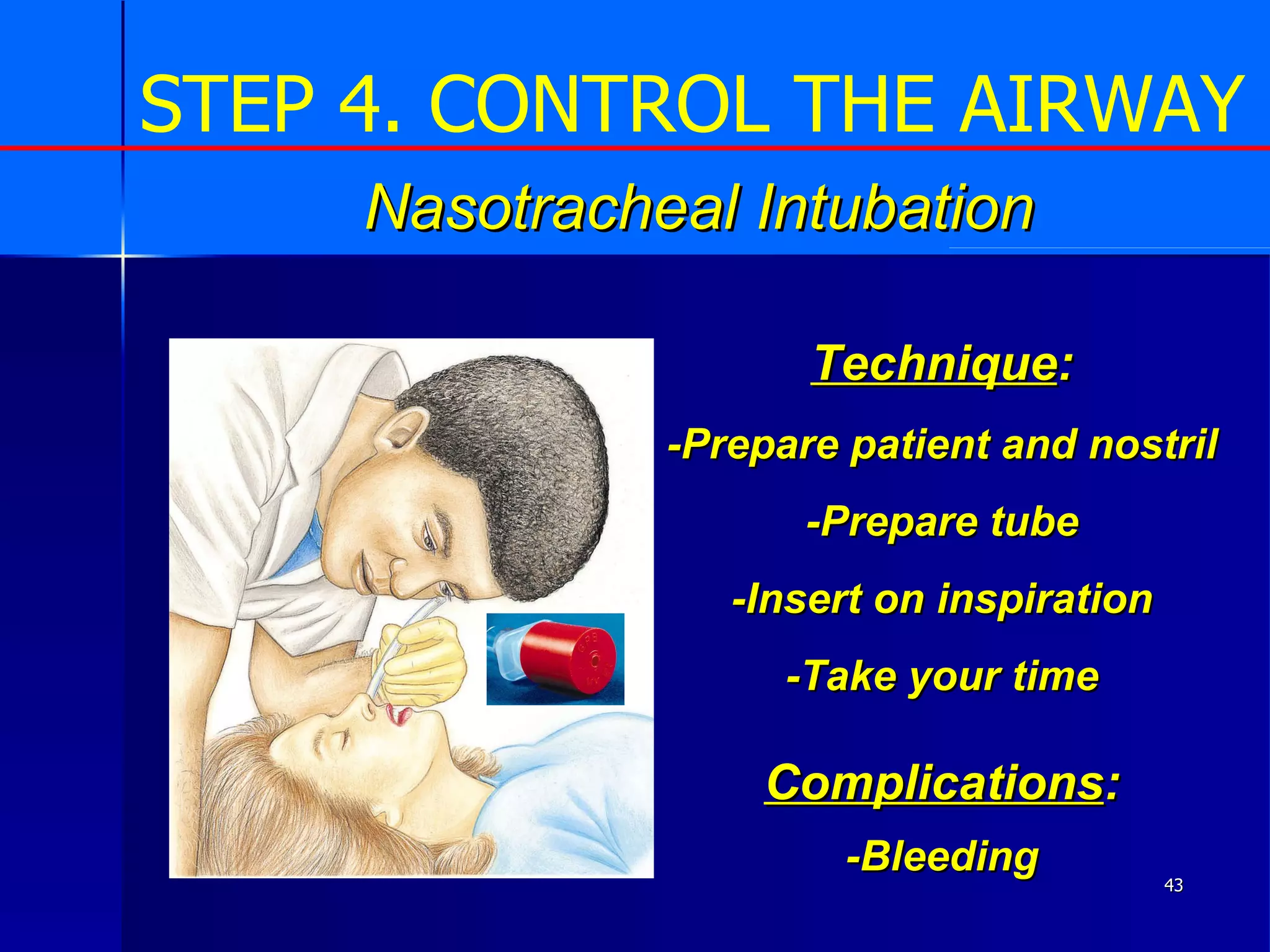
Technique : -Prepare patient and nostril -Prepare tube -Insert on inspiration -Take your time Complications : -Bleeding STEP 4. CONTROL THE AIRWAY Nasotracheal Intubation
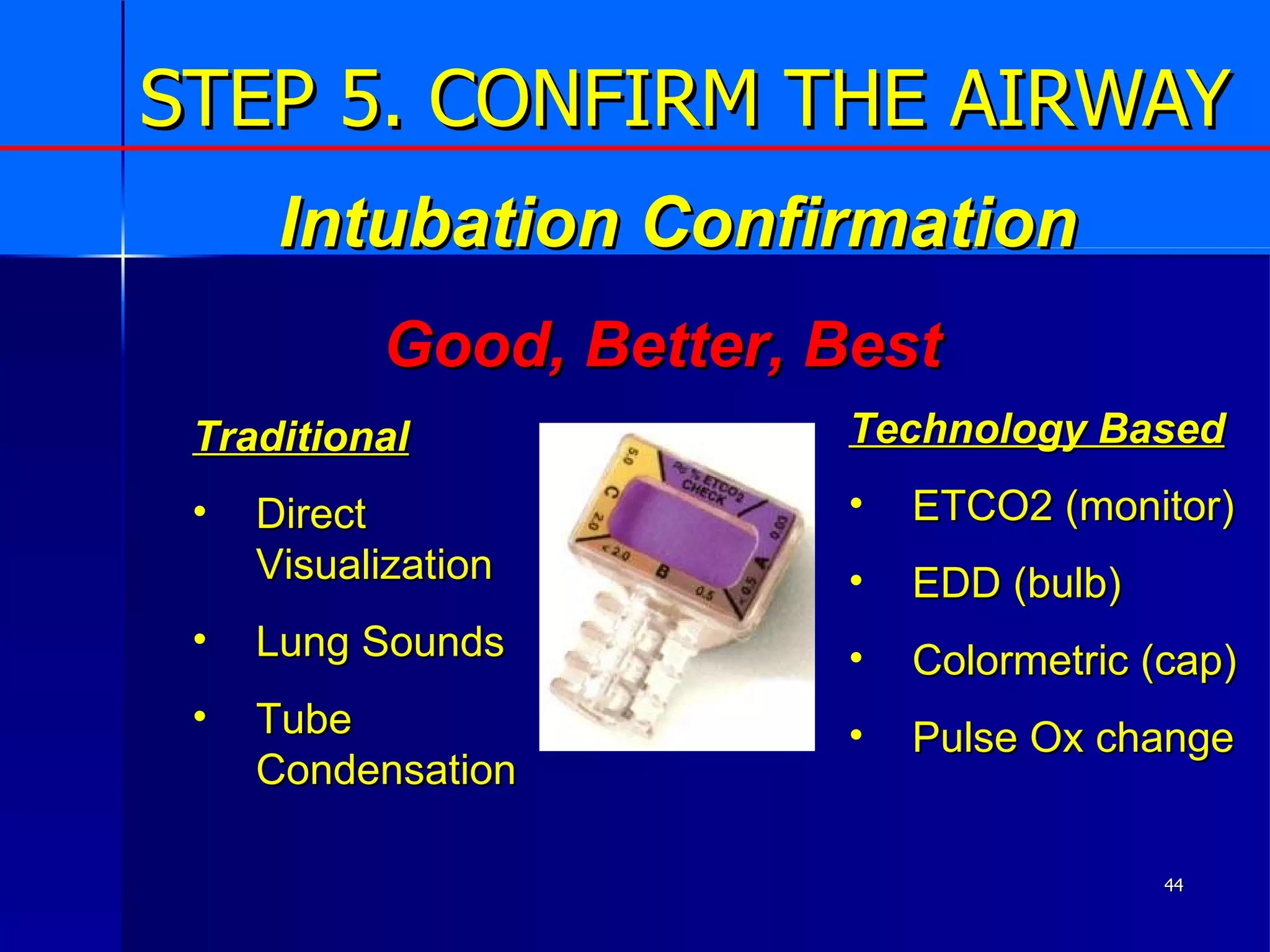
STEP 5. CONFIRM THE AIRWAY Technology Based ETCO2 (monitor) EDD (bulb) Colormetric (cap) Pulse Ox change Intubation Confirmation Good, Better, Best Traditional Direct Visualization Lung Sounds Tube Condensation
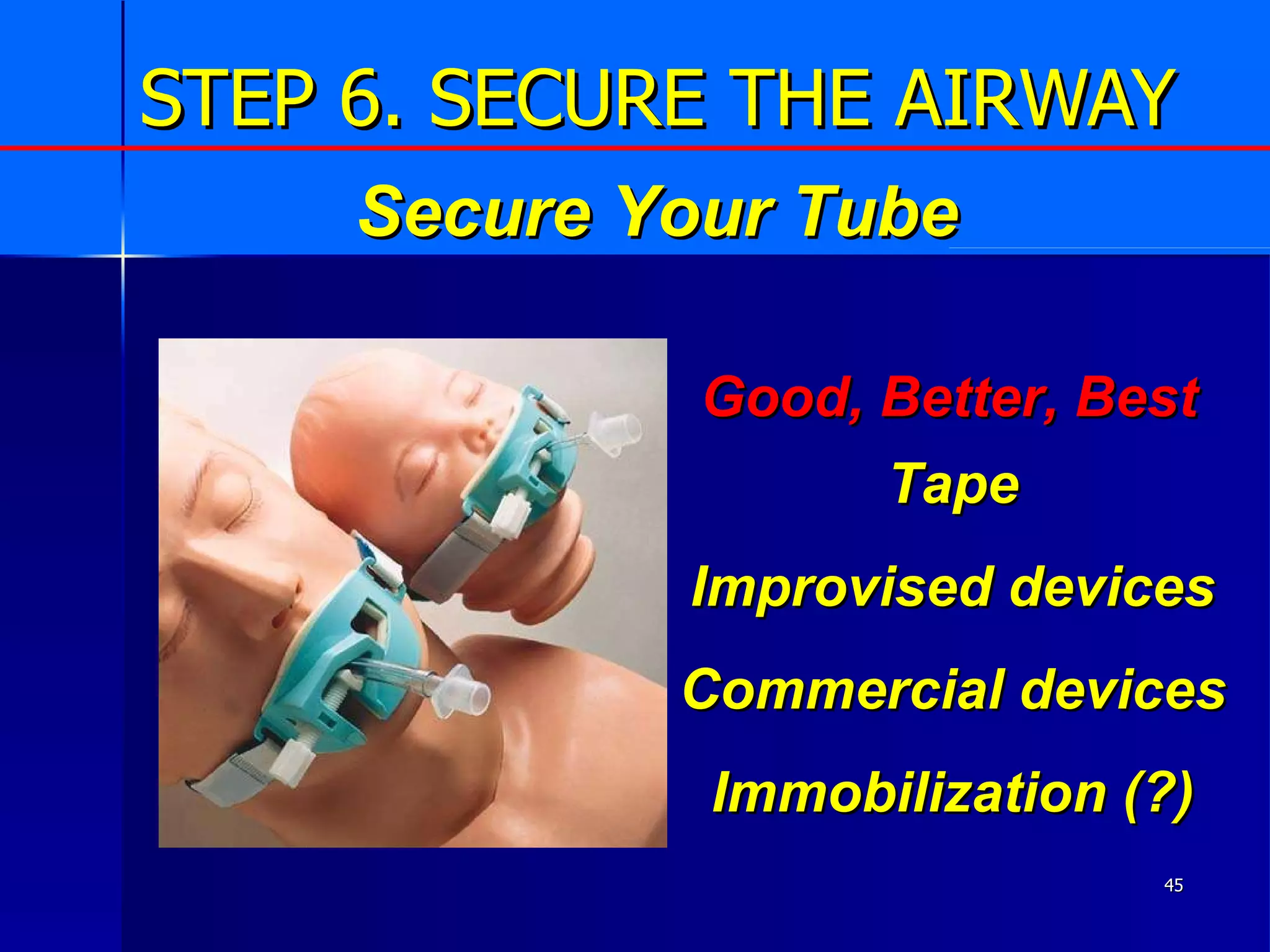
STEP 6. SECURE THE AIRWAY Tape Improvised devices Commercial devices Immobilization (?) Secure Your Tube Good, Better, Best
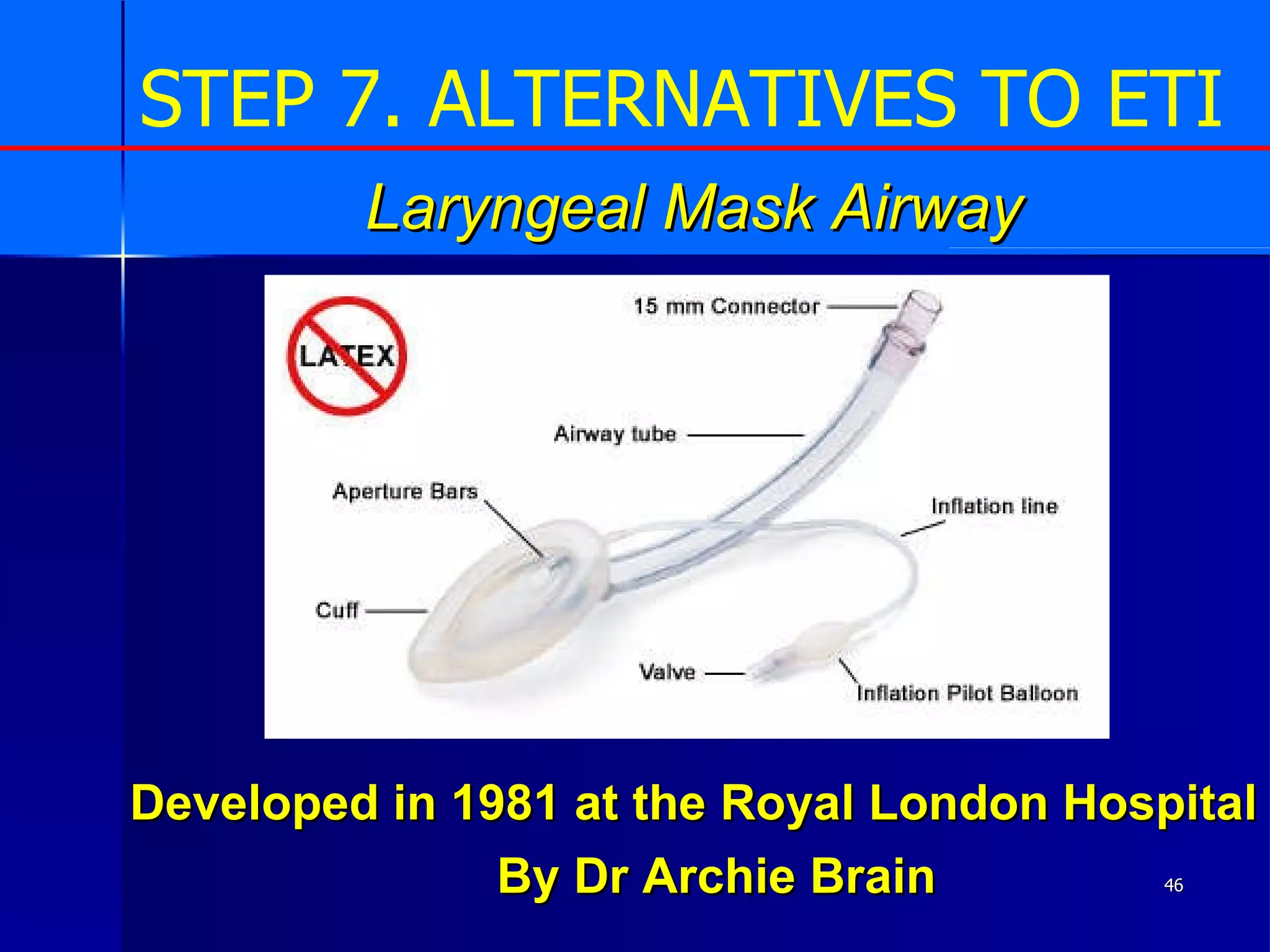
Laryngeal Mask Airway Developed in 1981 at the Royal London Hospital By Dr Archie Brain   STEP 7. ALTERNATIVES TO ETI
Indications: -When definitive airway management cannot be obtained. (ETT) Not a substitute for definitive airway management Laryngeal Mask Airway STEP 7. ALTERNATIVES TO ETI
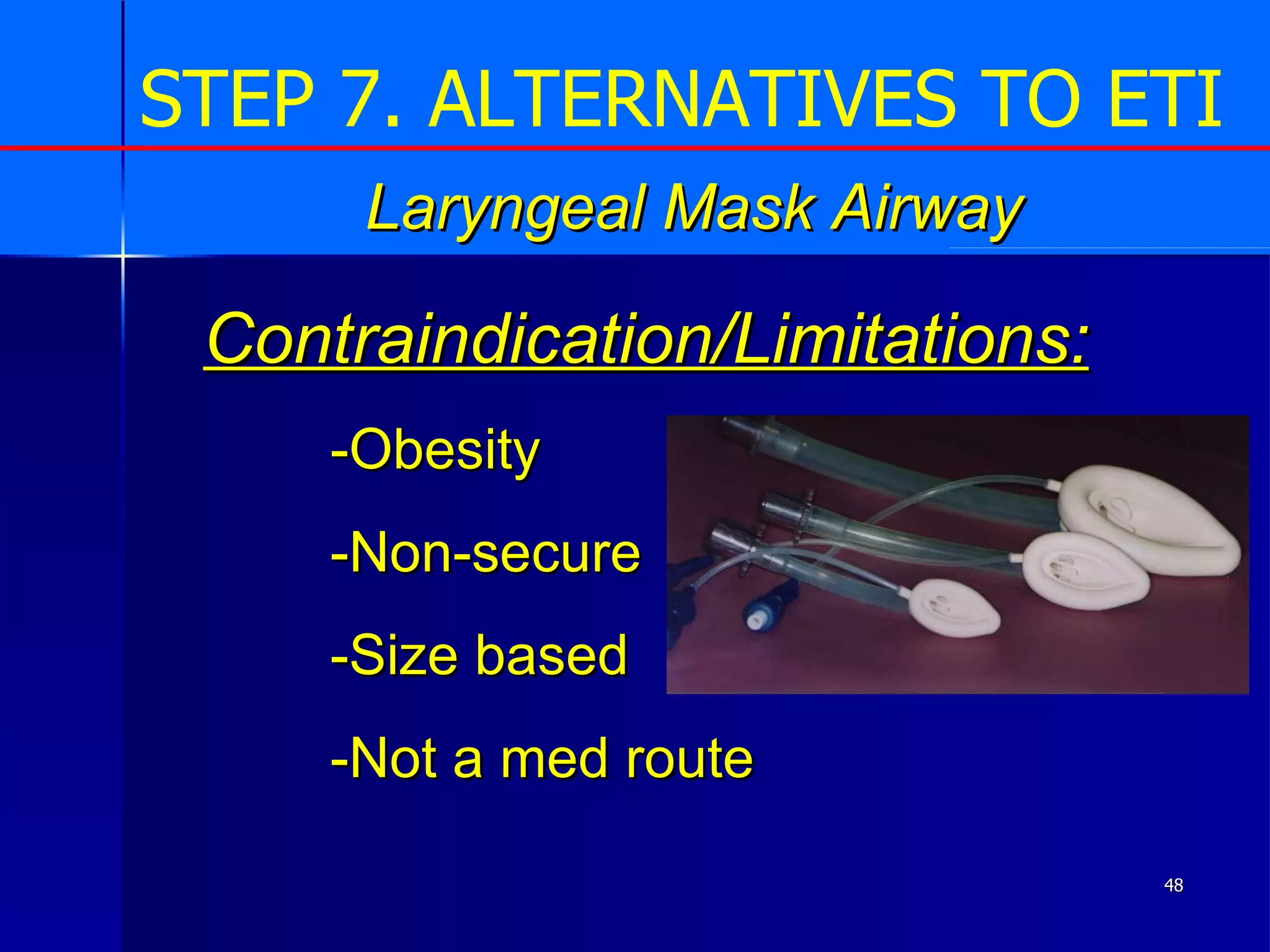
Contraindication/Limitations: -Obesity -Non-secure -Size based -Not a med route Laryngeal Mask Airway STEP 7. ALTERNATIVES TO ETI
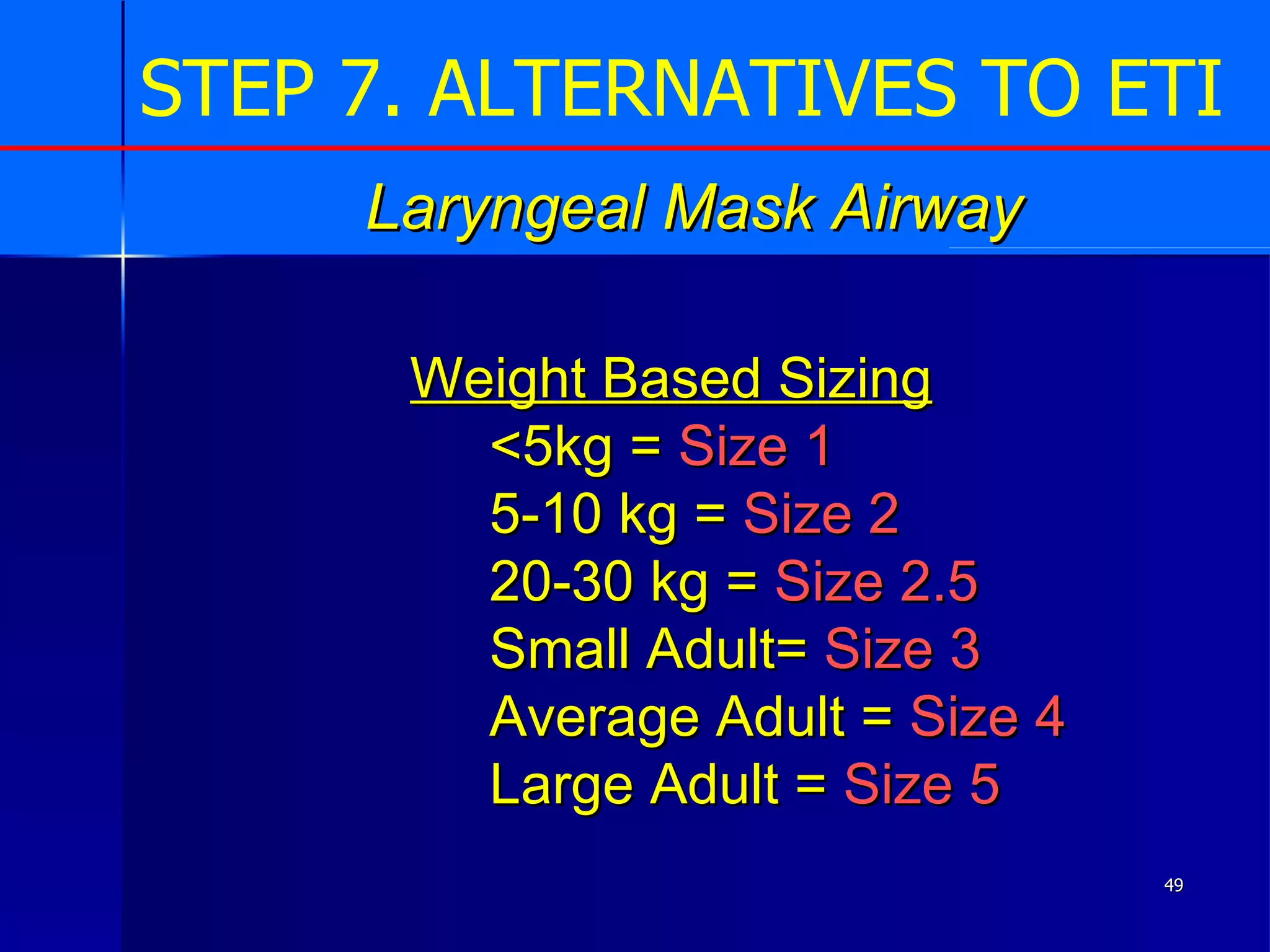
Weight Based Sizing <5kg =  Size 1 5-10 kg =  Size 2 20-30 kg =  Size 2.5 Small Adult=  Size 3 Average Adult =  Size 4   Large Adult =  Size 5 Laryngeal Mask Airway STEP 7. ALTERNATIVES TO ETI
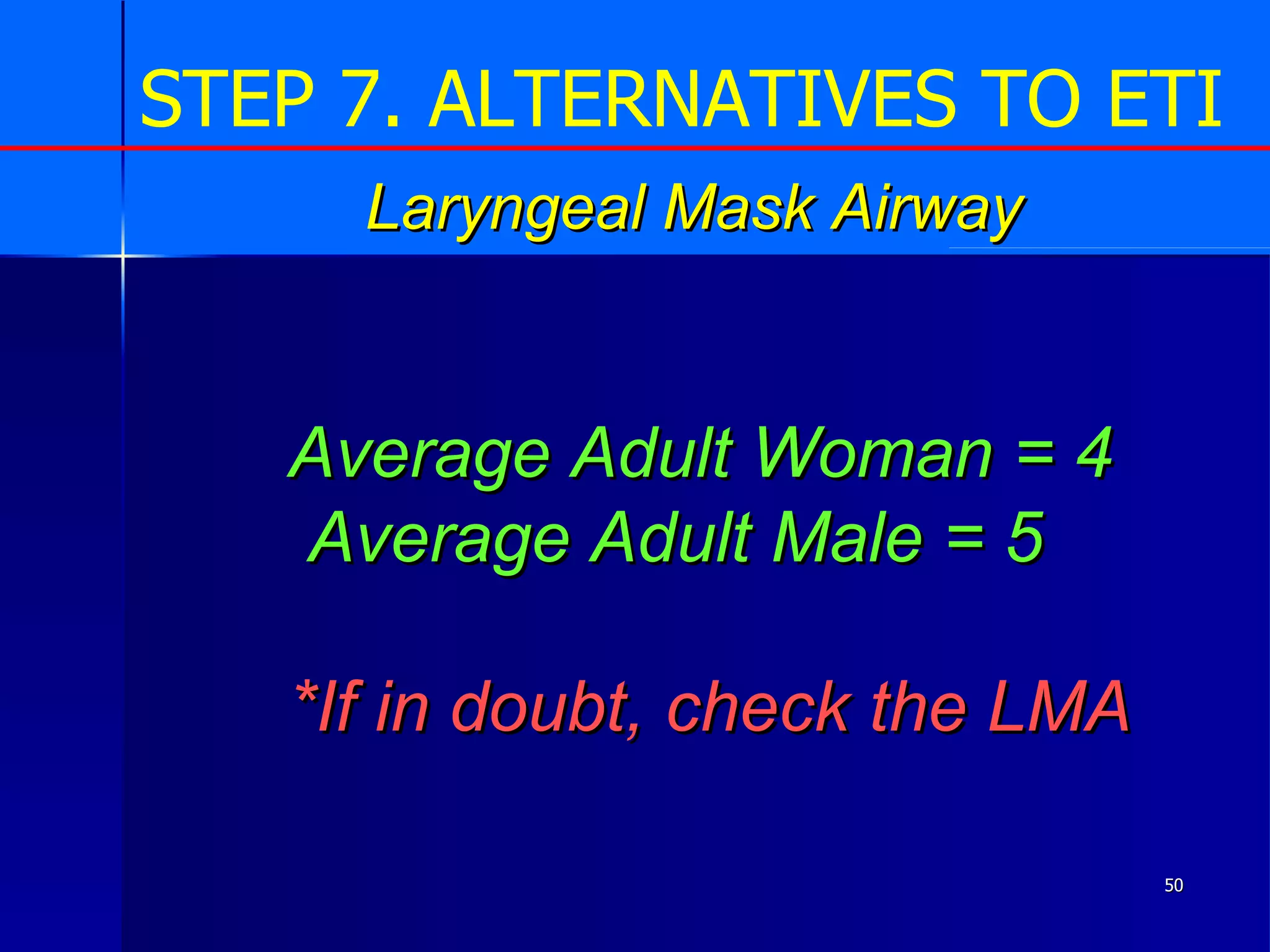
Average Adult Woman = 4 Average Adult Male = 5 *If in doubt, check the LMA Laryngeal Mask Airway STEP 7. ALTERNATIVES TO ETI
Procedure: -Hyper oxygenate -Check cuff  -Lubricate  posterior  cuff -Head in neutral or slightly flexed position -Insert following hard palate (use index finger to guide) -Stop when met with resistance -Let go and inflate cuff (visualize “pop”) -Confirm and secure Laryngeal Mask Airway STEP 7. ALTERNATIVES TO ETI
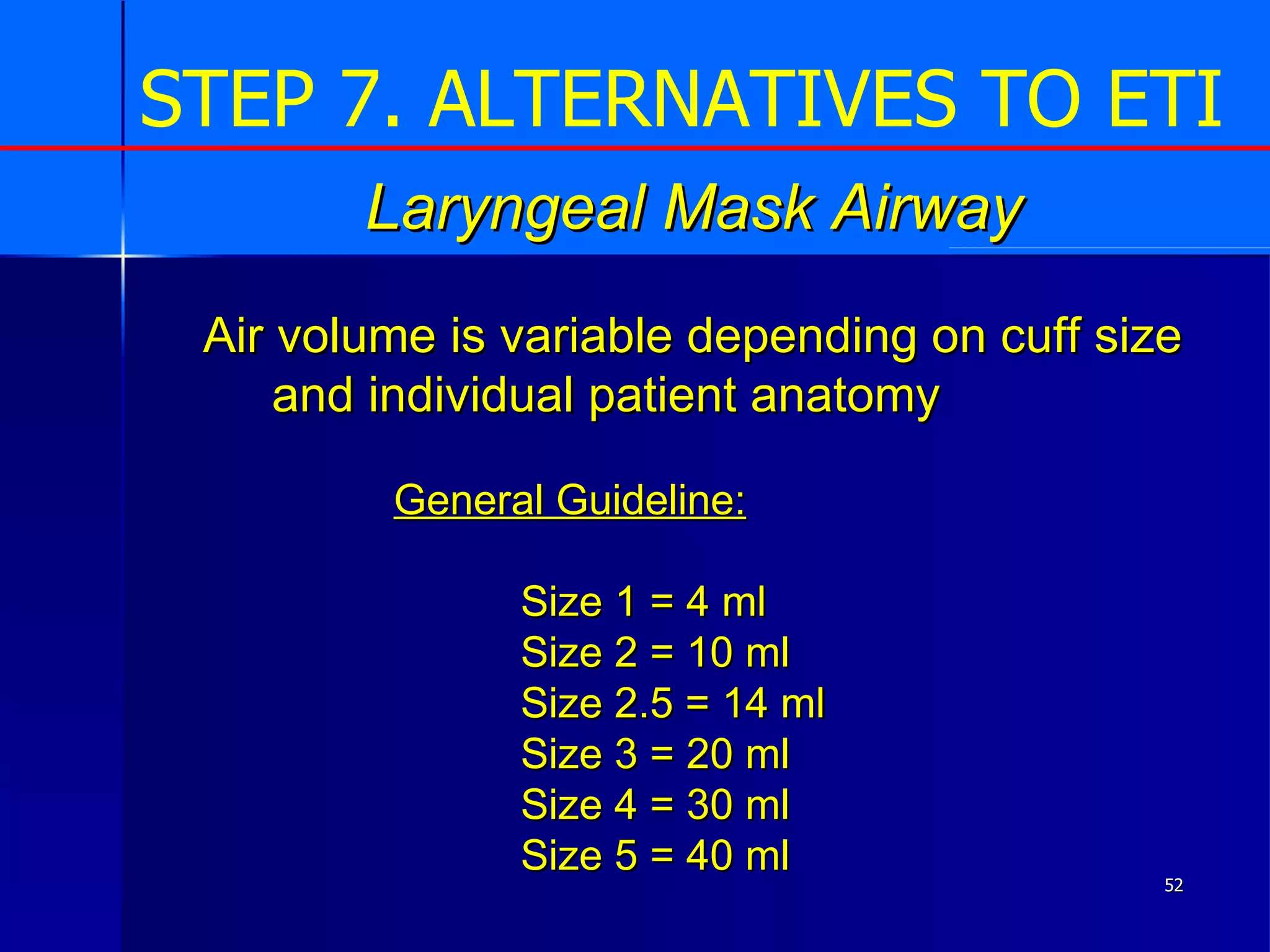
Air volume is variable depending on cuff size and individual patient anatomy General Guideline: Size 1 = 4 ml Size 2 = 10 ml Size 2.5 = 14 ml Size 3 = 20 ml Size 4 = 30 ml Size 5 = 40 ml Laryngeal Mask Airway STEP 7. ALTERNATIVES TO ETI
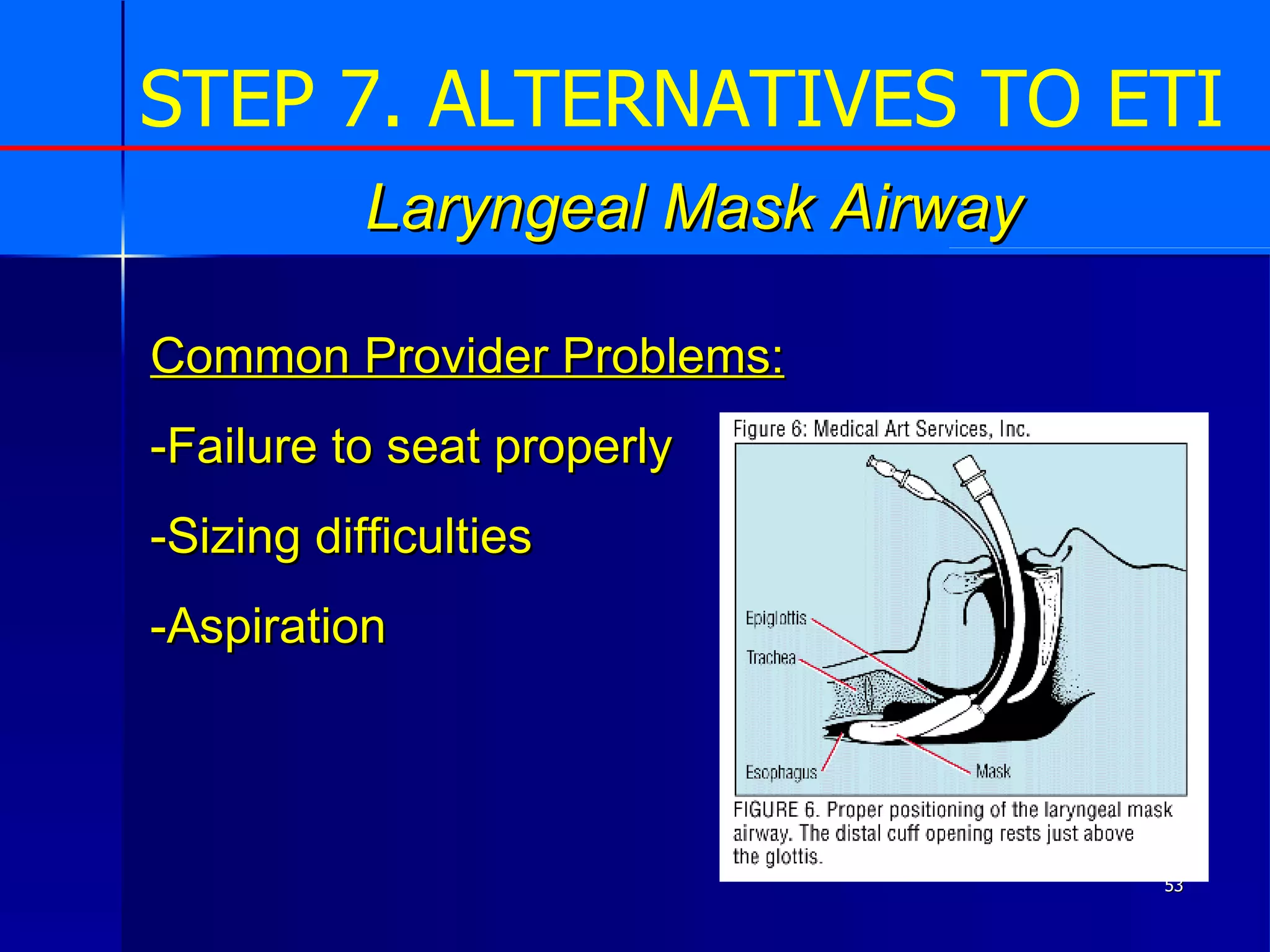
Common Provider Problems: -Failure to seat properly -Sizing difficulties  -Aspiration Laryngeal Mask Airway STEP 7. ALTERNATIVES TO ETI
Laryngeal Mask Airway STEP 7. ALTERNATIVES TO ETI
MDPB has approved all  “ non-intubating ”  LMA type devices Laryngeal Mask Airway STEP 7. ALTERNATIVES TO ETI
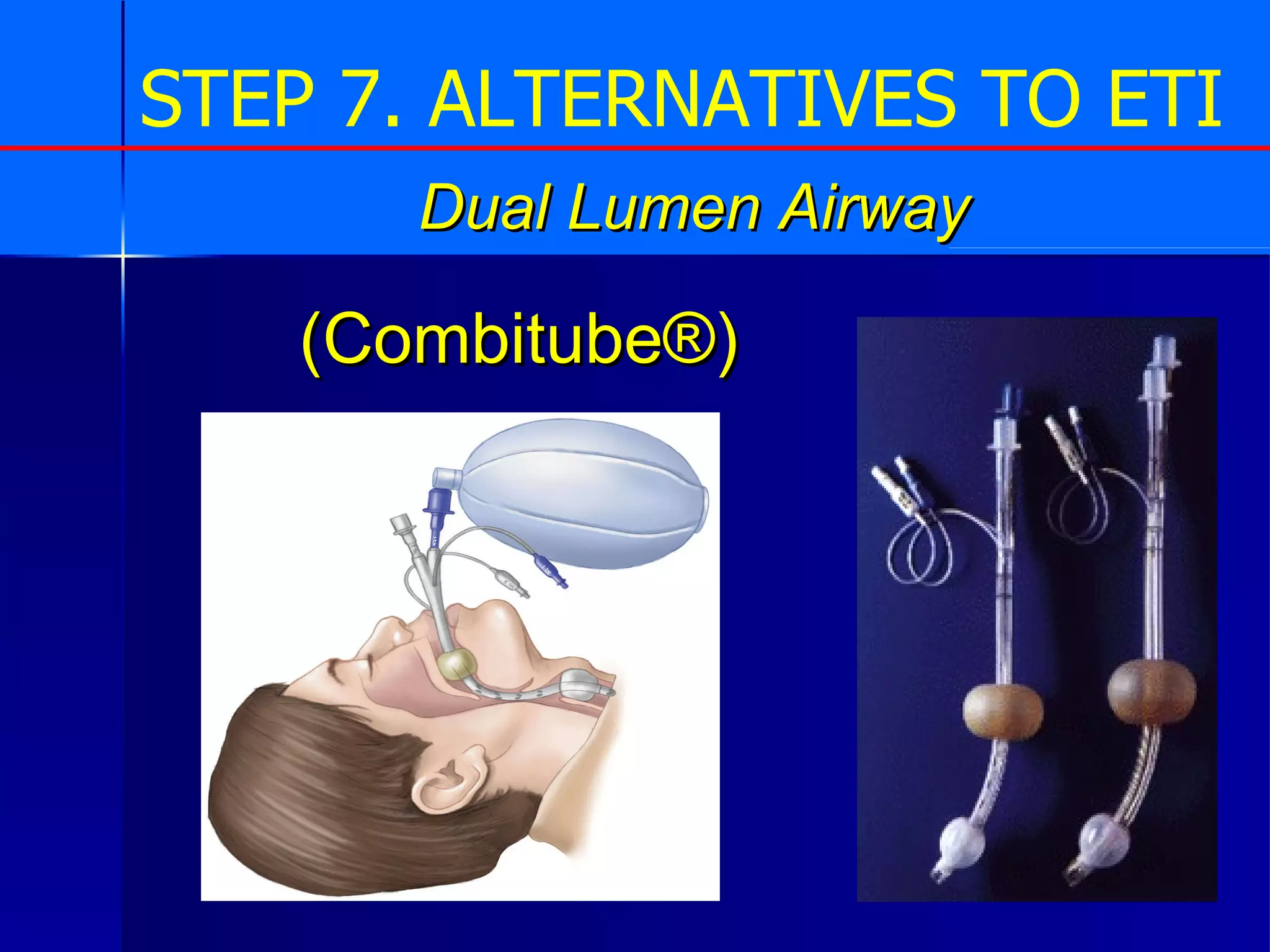
(Combitube ® ) STEP 7. ALTERNATIVES TO ETI Dual Lumen Airway
Indications: -When definitive airway management cannot be obtained. (ETT) Not a substitute for definitive airway management Dual Lumen Airway STEP 7. ALTERNATIVES TO ETI
Contraindications/Limitations : -No pediatrics -5’7-7’ tall (SA 4’-5’6) -Pathological esophageal disease -Non-secure airway -Latex sensitivity -Toxic or Caustic Ingestions STEP 7. ALTERNATIVES TO ETI Dual Lumen Airway
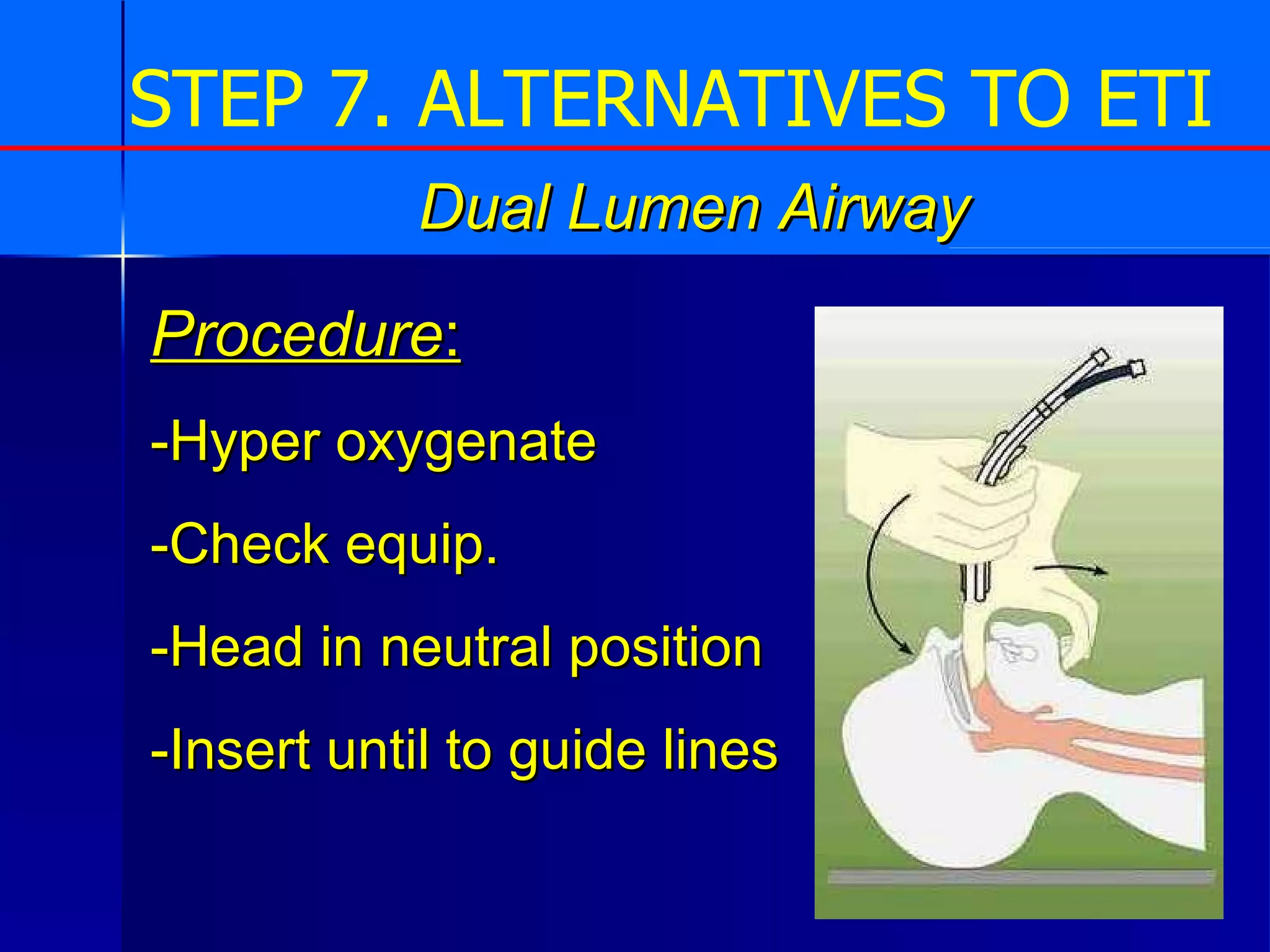
Procedure : -Hyper oxygenate -Check equip.  -Head in neutral position -Insert until to guide lines STEP 7. ALTERNATIVES TO ETI Dual Lumen Airway
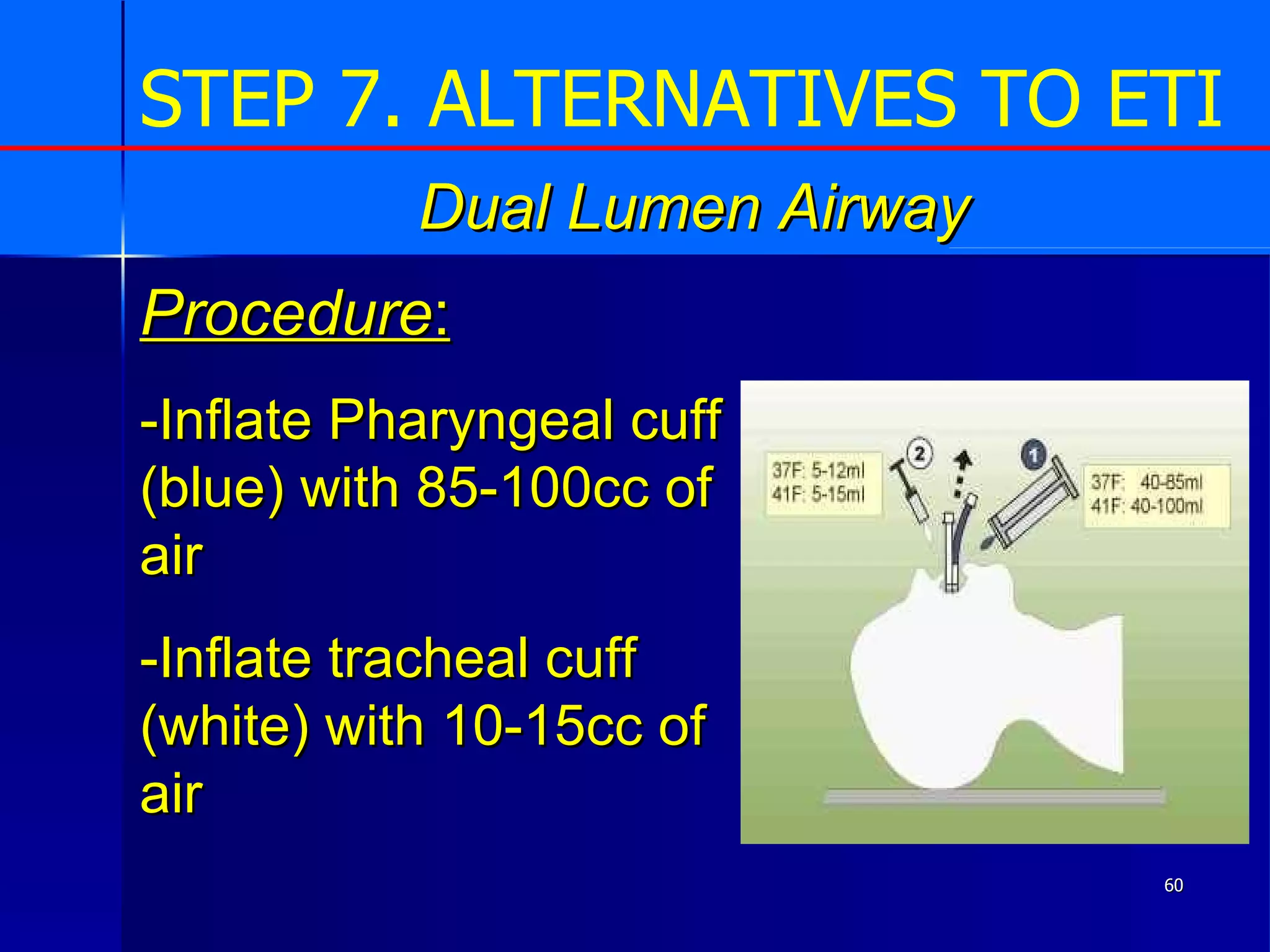
Procedure : -Inflate Pharyngeal cuff (blue) with 85-100cc of air -Inflate tracheal cuff (white) with 10-15cc of air STEP 7. ALTERNATIVES TO ETI Dual Lumen Airway
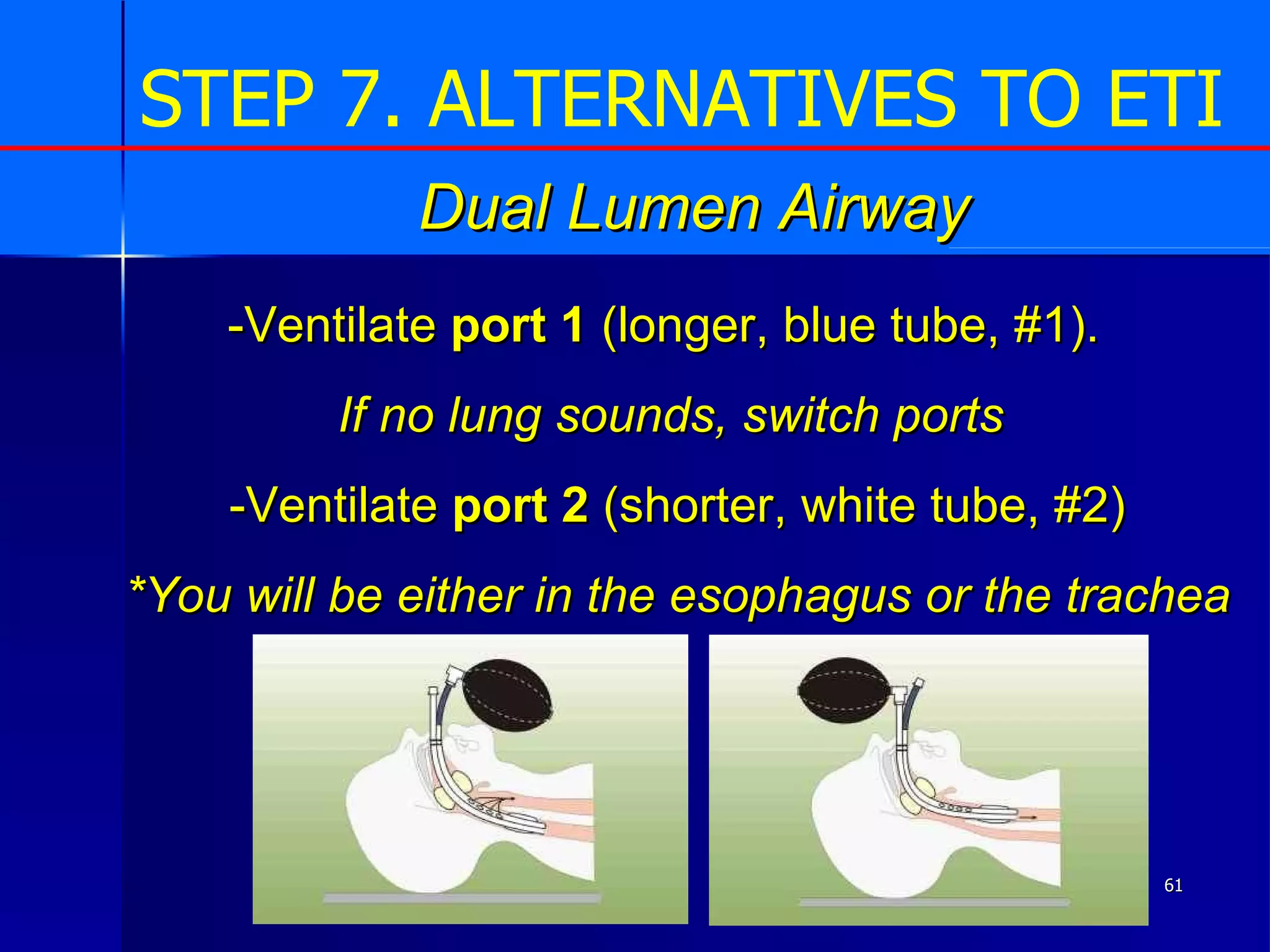
-Ventilate  port 1  (longer, blue tube, #1).  If no lung sounds, switch ports   -Ventilate  port 2  (shorter, white tube, #2) *You will be either in the esophagus or the trachea STEP 7. ALTERNATIVES TO ETI Dual Lumen Airway
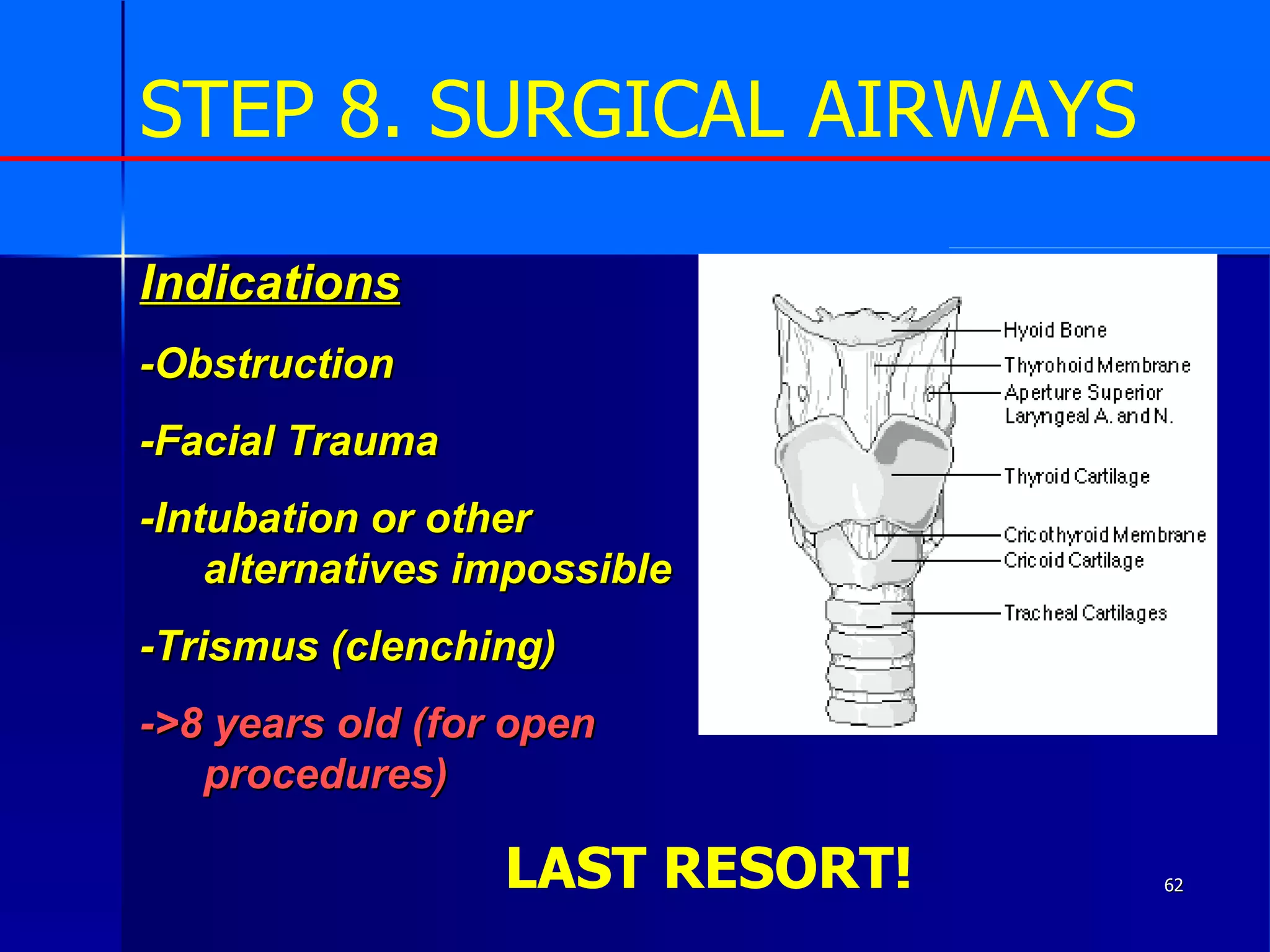
Indications -Obstruction -Facial Trauma -Intubation or other alternatives impossible   -Trismus (clenching)   ->8 years old (for open procedures)   STEP 8. SURGICAL AIRWAYS LAST RESORT!
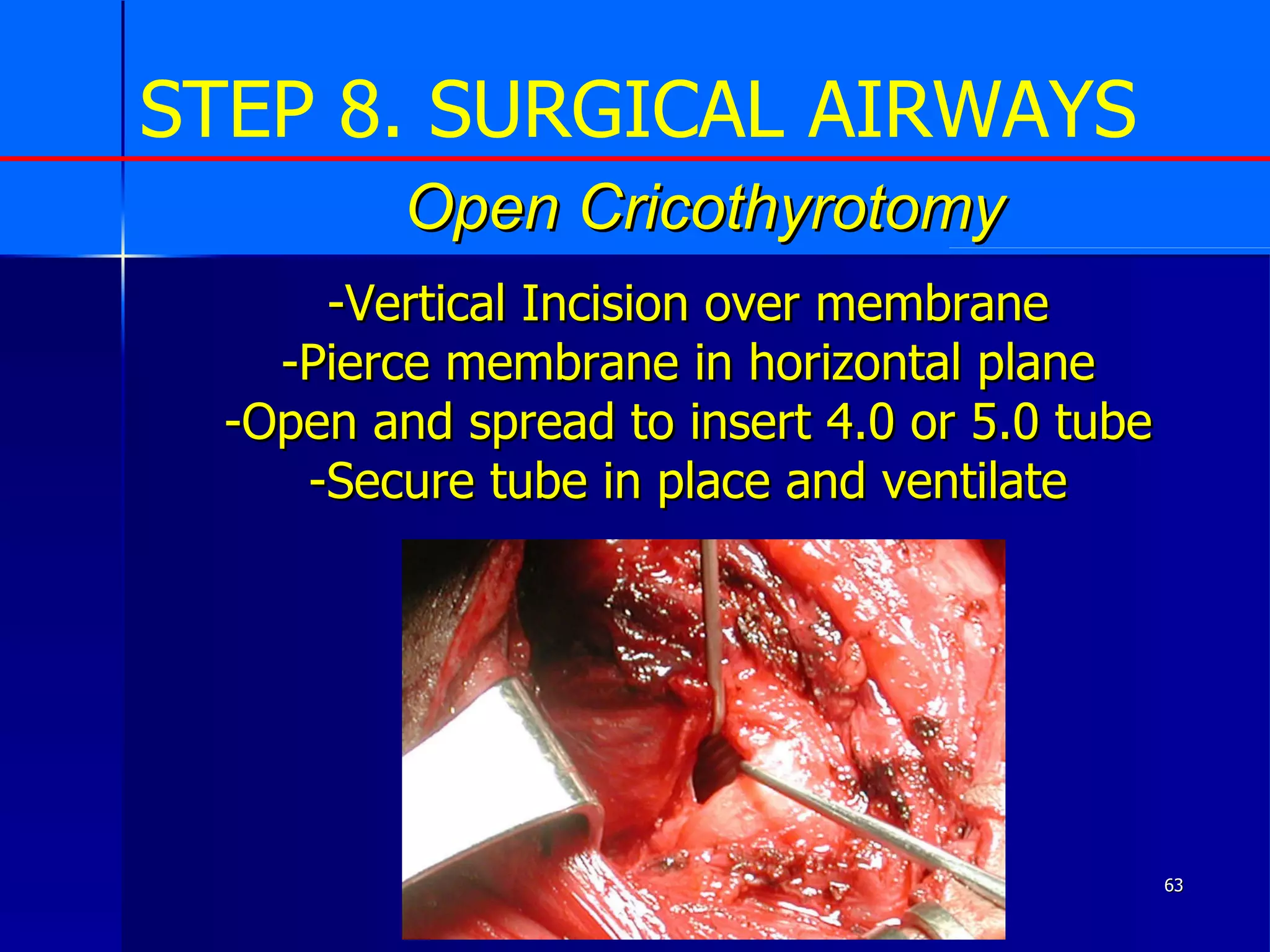
STEP 8. SURGICAL AIRWAYS Open Cricothyrotomy -Vertical Incision over membrane -Pierce membrane in horizontal plane -Open and spread to insert 4.0 or 5.0 tube -Secure tube in place and ventilate
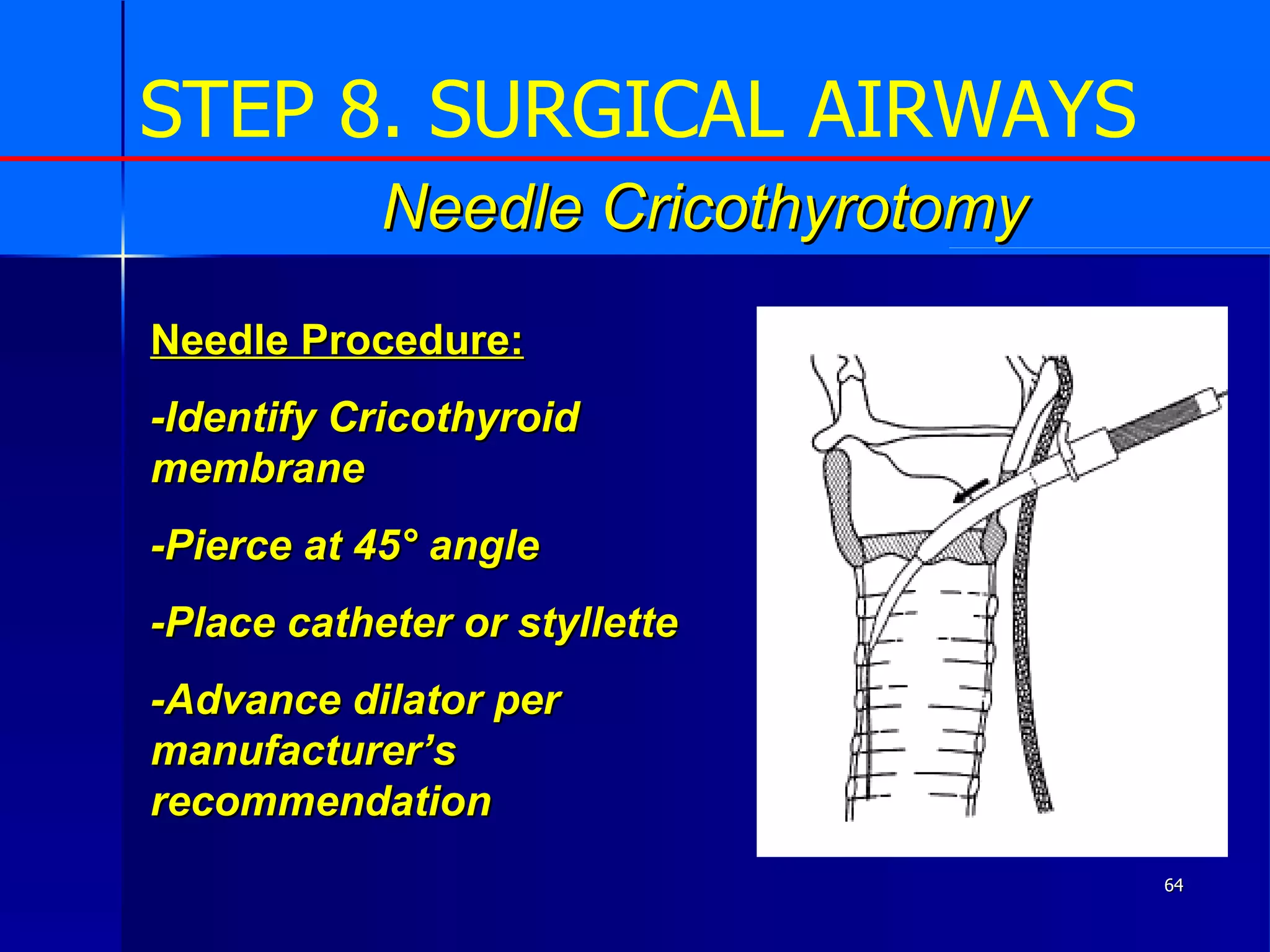
Needle Procedure: -Identify Cricothyroid membrane -Pierce at 45 ° angle  -Place catheter or styllette -Advance dilator per manufacturer’s recommendation STEP 8. SURGICAL AIRWAYS Needle Cricothyrotomy
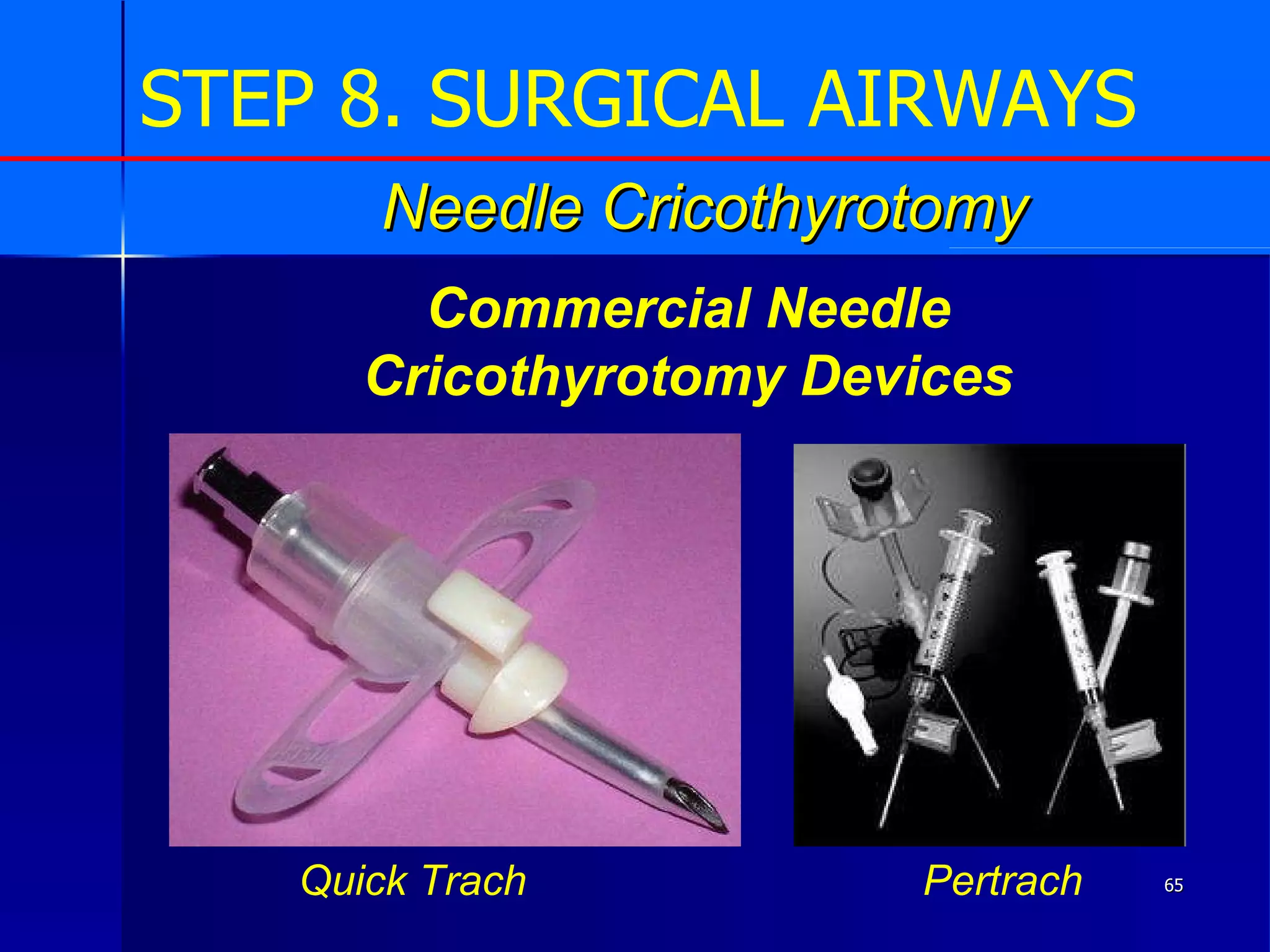
Commercial Needle Cricothyrotomy Devices Quick Trach Pertrach STEP 8. SURGICAL AIRWAYS Needle Cricothyrotomy
WHY AN ALGORITHM? Step by step process in order Start simple and work up Alternatives Be sure Get it done
Questions?
MAINE EMS WISHES TO THANK THE FOLLOWING MANUFACTURERS FOR THEIR CONTRIBUTIONS OF TRAINING MATERIALS. Boundtree Medical  -  LMA Products, Lighted Stylletes Mike Evers-Jenkins (800) 533-0523 ext. 550 Tri-Anim -  Cobra PLA, Per-Trach Jaclyn Emanuelson (877) 207-4329 ext 6306 Rüsch -  Quick Trach Dave Henry (800) 848-3766 ext. 1707

Airway algorithm review

  • 1.
  • 2.
    WHY AIRWAY REVIEW?Most important aspect of patient care (?) Failure = Gravest Consequence
  • 3.
    WHY AIRWAY REVIEW?Many Quality Assurance Concerns: - Gausche et al study -PALS update -Burton et al study -Kendall et al study -Marcolini et al study
  • 4.
    MAINE’S PLAN TheseConcerns led MDPB to do a comprehensive review of the current airway protocol and create the new… Airway Algorithm
  • 5.
    AIRWAY PROTOCOL -Makesairway procedures a “step by step” process -Adds concept of “rescue airway” -Adds new airway devices
  • 6.
    AIRWAY PROTOCOL ProtocolInitiated 5/23/05 The MDPB’s goal is to train all intubating providers by a yet to be determined date *Providers may use new protocol if trained but not until they are trained
  • 7.
    MANDATORY EQUIPMENT Goalis for services to comply with mandatory airway devices by a yet to be determined roll out date. MEMS will allow time for budgeting
  • 8.
    MANDATORY EQUIPMENT MandatoryEquipment *All intubating services must carry Laryngeal Mask Airways (LMA) (Note all LMA’s are now available in disposable form)
  • 9.
    OPTIONAL EQUIPMENT OptionalEquipment *Dual Lumen Airways *Intubation Adjuncts -Gum elastic Bougees (Tube changers) -Lighted Styllettes *Commercial Tracheotomy Kits -Pertrach, Quick Trach, etc.
  • 10.
  • 11.
    TRAINING OBJECTIVES -Practicalwalk through airway management from BLS to ALS -Introduce the algorithm idea -Review fundamental concepts -Practice hands on skills -Debunk myths -Trade tips
  • 12.
  • 13.
    OXYGENATION IS GOODIndicated in those patients who are in respiratory distress and remain able to exchange air on their own. *Beware of decompensating patients!
  • 14.
    WHY MANAGE ANAIRWAY Anyone can be taught to use a BVM or intubate…the real question is why manage an airway?
  • 15.
    AIRWAY MANAGEMENT ReasonsTo Manage an Airway: -Obstruction -None present, (trauma, medical) -Decompensating (not maintaining) -Breathing too fast or too slow? What are your indicators?
  • 16.
    AIRWAY MANAGEMENT RespiratoryDistress vs. Respiratory Failure Distress -Increased work of breathing - Relative hypoxia/hypercapnea - Compensating Failure -Increased work of breathing - Profound hypoxia/hypercapnea - Decompensating It’s a constant reassessment process…
  • 17.
    AIRWAY ALGORITHM Astep by step approach at evaluating each patients ability to maintain an open airway. Immediate corrective actions based on this assessment A constant reassessment of current procedures to determine the need to be more or less aggressive in the best interest to the patient.
  • 18.
    STEP 1. OPENAND CLEAR Clear and Suction
  • 19.
    STEP 2. KEEPIT OPEN  Benefits and Limitations  Indications and Contraindications
  • 20.
    STEP 2. KEEPIT OPEN Sizing and Insertion
  • 21.
    STEP 3. VENTILATE(BLS) Procedure: -Attach high flow O2 -Select appropriate mask (good seal imperative) -Override pop-offs (?) What are the limitations?
  • 22.
    STEP 3. VENTILATE(BLS) -BVM Rate Re-Examined -BVM Depth Re-Examined Practical Exercise on Ventilation
  • 23.
    Approximate normal ventilationrates: 10 bpm Adult 20 bpm Child 25 bpm Infant STEP 3. VENTILATE (BLS)
  • 24.
    STEP 3. VENTILATE(BLS) Cricoid Pressure
  • 25.
    STEP 3. VENTILATE(BLS) Why is this helpful in all manual ventilation?
  • 26.
    STEP 4. CONTROLTHE AIRWAY Intubation vs. BVM Why and why not?
  • 27.
    STEP 4. CONTROLTHE AIRWAY Airway Management Decision Process (Judge how aggressive you need to be.) -Time/Distance -Personnel -Equipment -Other Considerations?
  • 28.
    STEP 4. CONTROLTHE AIRWAY “ Evaluate for signs of difficult intubation” (this may help in your decision as well) -Obesity -Small body habitus -Small jaw -Large teeth -Burns -Trauma -Anaphylaxis -Stridor
  • 29.
    STEP 4. CONTROLTHE AIRWAY The BLS vs. ALS airway decision may not be based on one single factor, but rather based on an overall assessment of many factors.
  • 30.
    STEP 4. CONTROLTHE AIRWAY Pre-Intubation -Prepare Equipment -Hyper-oxygenate
  • 31.
    STEP 4. CONTROLTHE AIRWAY Orotracheal Intubation Procedure Sweep Left and Look
  • 32.
    STEP 4. CONTROLTHE AIRWAY Backward, Upward, Right Pressure (B.U.R.P.) Find Your Landmarks
  • 33.
    STEP 4. CONTROLTHE AIRWAY Find Your Landmarks
  • 34.
    STEP 4. CONTROLTHE AIRWAY It may not be perfect! Find Your Landmarks
  • 35.
    STEP 4. CONTROLTHE AIRWAY Find Your Landmarks
  • 36.
    STEP 4. CONTROLTHE AIRWAY Readjusting with Cricoid Pressure
  • 37.
    STEP 4. CONTROLTHE AIRWAY Common Provider Mistakes * Making a difficult intubation more difficult *Rushing *Poor equipment preparation *Suction (lack there of)
  • 38.
    STEP 4. CONTROLTHE AIRWAY What is your back-up plan today? prolonged BVM… another provider… a smaller tube… better lighting… additional suctioning…
  • 39.
    STEP 4. CONTROLTHE AIRWAY Helpful Adjuncts Gum Elastic Bougie
  • 40.
    STEP 4. CONTROLTHE AIRWAY Helpful Adjuncts Lighted Stylette
  • 41.
    Nasotracheal Intubation Indications: “ Patient still breathing but in respiratory failure and in whom oral intubation is impossible or difficult.” STEP 4. CONTROL THE AIRWAY -AAOS
  • 42.
    Contraindications : -Apnea-Resistance in the nares -Blood clotting or anticoagulation problems -Basilar Skull Fx (?) STEP 4. CONTROL THE AIRWAY Nasotracheal Intubation
  • 43.
    Technique : -Preparepatient and nostril -Prepare tube -Insert on inspiration -Take your time Complications : -Bleeding STEP 4. CONTROL THE AIRWAY Nasotracheal Intubation
  • 44.
    STEP 5. CONFIRMTHE AIRWAY Technology Based ETCO2 (monitor) EDD (bulb) Colormetric (cap) Pulse Ox change Intubation Confirmation Good, Better, Best Traditional Direct Visualization Lung Sounds Tube Condensation
  • 45.
    STEP 6. SECURETHE AIRWAY Tape Improvised devices Commercial devices Immobilization (?) Secure Your Tube Good, Better, Best
  • 46.
    Laryngeal Mask AirwayDeveloped in 1981 at the Royal London Hospital By Dr Archie Brain STEP 7. ALTERNATIVES TO ETI
  • 47.
    Indications: -When definitiveairway management cannot be obtained. (ETT) Not a substitute for definitive airway management Laryngeal Mask Airway STEP 7. ALTERNATIVES TO ETI
  • 48.
    Contraindication/Limitations: -Obesity -Non-secure-Size based -Not a med route Laryngeal Mask Airway STEP 7. ALTERNATIVES TO ETI
  • 49.
    Weight Based Sizing<5kg = Size 1 5-10 kg = Size 2 20-30 kg = Size 2.5 Small Adult= Size 3 Average Adult = Size 4 Large Adult = Size 5 Laryngeal Mask Airway STEP 7. ALTERNATIVES TO ETI
  • 50.
    Average Adult Woman= 4 Average Adult Male = 5 *If in doubt, check the LMA Laryngeal Mask Airway STEP 7. ALTERNATIVES TO ETI
  • 51.
    Procedure: -Hyper oxygenate-Check cuff -Lubricate posterior cuff -Head in neutral or slightly flexed position -Insert following hard palate (use index finger to guide) -Stop when met with resistance -Let go and inflate cuff (visualize “pop”) -Confirm and secure Laryngeal Mask Airway STEP 7. ALTERNATIVES TO ETI
  • 52.
    Air volume isvariable depending on cuff size and individual patient anatomy General Guideline: Size 1 = 4 ml Size 2 = 10 ml Size 2.5 = 14 ml Size 3 = 20 ml Size 4 = 30 ml Size 5 = 40 ml Laryngeal Mask Airway STEP 7. ALTERNATIVES TO ETI
  • 53.
    Common Provider Problems:-Failure to seat properly -Sizing difficulties -Aspiration Laryngeal Mask Airway STEP 7. ALTERNATIVES TO ETI
  • 54.
    Laryngeal Mask AirwaySTEP 7. ALTERNATIVES TO ETI
  • 55.
    MDPB has approvedall “ non-intubating ” LMA type devices Laryngeal Mask Airway STEP 7. ALTERNATIVES TO ETI
  • 56.
    (Combitube ® )STEP 7. ALTERNATIVES TO ETI Dual Lumen Airway
  • 57.
    Indications: -When definitiveairway management cannot be obtained. (ETT) Not a substitute for definitive airway management Dual Lumen Airway STEP 7. ALTERNATIVES TO ETI
  • 58.
    Contraindications/Limitations : -Nopediatrics -5’7-7’ tall (SA 4’-5’6) -Pathological esophageal disease -Non-secure airway -Latex sensitivity -Toxic or Caustic Ingestions STEP 7. ALTERNATIVES TO ETI Dual Lumen Airway
  • 59.
    Procedure : -Hyperoxygenate -Check equip. -Head in neutral position -Insert until to guide lines STEP 7. ALTERNATIVES TO ETI Dual Lumen Airway
  • 60.
    Procedure : -InflatePharyngeal cuff (blue) with 85-100cc of air -Inflate tracheal cuff (white) with 10-15cc of air STEP 7. ALTERNATIVES TO ETI Dual Lumen Airway
  • 61.
    -Ventilate port1 (longer, blue tube, #1). If no lung sounds, switch ports -Ventilate port 2 (shorter, white tube, #2) *You will be either in the esophagus or the trachea STEP 7. ALTERNATIVES TO ETI Dual Lumen Airway
  • 62.
    Indications -Obstruction -FacialTrauma -Intubation or other alternatives impossible -Trismus (clenching) ->8 years old (for open procedures) STEP 8. SURGICAL AIRWAYS LAST RESORT!
  • 63.
    STEP 8. SURGICALAIRWAYS Open Cricothyrotomy -Vertical Incision over membrane -Pierce membrane in horizontal plane -Open and spread to insert 4.0 or 5.0 tube -Secure tube in place and ventilate
  • 64.
    Needle Procedure: -IdentifyCricothyroid membrane -Pierce at 45 ° angle -Place catheter or styllette -Advance dilator per manufacturer’s recommendation STEP 8. SURGICAL AIRWAYS Needle Cricothyrotomy
  • 65.
    Commercial Needle CricothyrotomyDevices Quick Trach Pertrach STEP 8. SURGICAL AIRWAYS Needle Cricothyrotomy
  • 66.
    WHY AN ALGORITHM?Step by step process in order Start simple and work up Alternatives Be sure Get it done
  • 67.
  • 68.
    MAINE EMS WISHESTO THANK THE FOLLOWING MANUFACTURERS FOR THEIR CONTRIBUTIONS OF TRAINING MATERIALS. Boundtree Medical - LMA Products, Lighted Stylletes Mike Evers-Jenkins (800) 533-0523 ext. 550 Tri-Anim - Cobra PLA, Per-Trach Jaclyn Emanuelson (877) 207-4329 ext 6306 Rüsch - Quick Trach Dave Henry (800) 848-3766 ext. 1707

Editor's Notes

  • #24 With regards to respiratory rates, the BTF values of 10, 20, and 25 are ventilation rates when bagging a patient to maintain normocarbia. This is different than the normal breathing rates in an adult, children or infant. The BTF numbers are close to the American Heart Association’s CPR values for assisted breathing. Before I show you the rates for hyperventilation, let’s first talk about the effects of hyperventilation in the severe TBI patient.