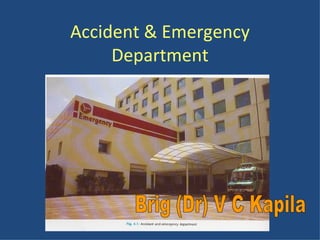
Accident & Emergency Department Brig (Dr) V C Kapila
Introduction EMS is an integral part of any hospital Microcosm of the hospital as a whole “ Front door” of the hospital Portal of entry that interacts with the highest volume of patients requiring critical care
Definitions Emergency has been defined as a condition determined clinically or  considered by the patient or his/her relatives as requiring urgent medical services, failing which, it could result in loss of life or limb……………WHO  Medical emergency is a situation when patient requires urgent & high quality medical care to prevent loss of life or limb and/or to initiate action for the restoration of normal healthy life.
Importance Public  perception & opinion of a hospital is often based on their visit to the accident  &  emergency department This facility, usually accounts for a significant number of all hospital admissions Effective functional operations in the department are important variables for staff, patient & visitors satisfaction
Functions Provision of immediate & correct life saving treatment at all times & for all situations Collection of casualties Rapid institution of BLS to critically ill at site, en route & in hospital Information centre to render advice on telephone or in person on simple medical queries Capacity & capability to provide effective management during disaster situations
Functions….. Liaison with courts & police in a medico-legal cases Provision of ambulance services Act as information & communication center especially during disasters To provide education, training & research
Types of A & E Departments Type I :  Large hospital with all specialists available round the clock Type II :  Emergency  room physician available round the clock where specialists on  call Type III :  Standby emergency  facilities with physician & nurse on call Type IV :  Referral  emergency service where only nurse is available. First aid & refer
Planning Location Should be loc on the ground floor Direct access from the main road Separate approach, other than OPD  with a spacious parking area Loc  adjacent  to OPD Well lighted  & boldly sign posted both for day & night A helipad is required for major trauma centres, hilly or unapproachable areas
Interrelationship Close relationship with: OT ICU Blood bank Laboratory OPD Mortuary Some authorities recommend  a close relationship with CCU as well Many sub-depts  like OT, Diagnostics etc  may be required  in  the dept itself
Work & Traffic flow
Lay out Core type Treatment spaces situated around a central point in which emergency dept personnel work Ideally, there should be a corridor outside the treatment area through which the patients enter the cubicles Support rooms( plaster cast room, obstetrics & gynae room) are along the periphery of the corridor Greatest freedom of movements for emergency dept personnel
Core Design
Lay out…. Arena type Essentially a core plan design without the periphery corridor Provides a good view of all the cubicles from  the nursing & physician work areas Less fatigue as distances are less Best suited for emergency depts that are smaller in size
Arena design
Lay out Corridor type Many variants possible depending on the size of the dept Desirable plan for large emergency depts Separate space is provided for each specialty
Corridor plan
Entrance Separate from main hospital entrance Separate entrance for ambulant &  stretcher  bound  patients coming by ambulance Should be well marked & illuminated It should open into spacious lobby Porch outside the lobby to protect the unloading of the patients from rain & sunlight Approach to lobby should be in the form of ramp & steps Approach & access should be appropriate to usage by the disabled
Reception & information area Entrance should open in to a large open space with reception desk in front Trolley, stretcher & wheel chair parking area It should be adjacent to triage area Should be close to waiting area Should have communication links such as telephones Worship room, grief room, flower, chemist & book shop Space for medico-social worker, toilets, registration &  records BIS has recommended 1.75 sqm per hosp bed for the reception area
Trolley bay
Reception and Information area
Waiting Area Should provide sufficient & comfortable space for waiting patients & relatives/escorts Area should be easily observed from reception & triage areas Should be appropriately furnished with visual displays on health education & hospital related information Should cater for facilities such as drinking water, ladies & gents toilets, television & channel music
Examination & Treatment Areas Triage Area:  A separate area or lobby may be used Nursing Work Station Centrally located to enable staff to monitor patient care areas Should preferably include central cardiac monitor station Communication links to triage & resuscitation areas Doctors Work Area Centrally loc for facilitating response to an emergency Should provide privacy Loc such that doctors & nurses able to view central cardiac monitoring station
 
Examination & Treatment Area… Acute Treatment Area Utilized for management of patients with acute illnesses Should be able to fit a standard mobile bed with ample storage & usage space Area should include a service panel, examination light, wall mounted sphygmomanometer, emergency call facilities 2.4m of clear floor space between beds Each treatment area requires space of 15 sqm, doors at least 1.3m wide
Acute patient care room
 
Resuscitation Room Should have space to accommodate specialized resuscitation bed, allow 360 degrees access to all parts of the patient for facilitating procedures & monitoring Imaging  facilities should include: Overhead X-ray Lead lining of walls & partitions between beds Radiolucent resuscitation trolley with cassette trays X-ray viewing/digital electronic imaging system An OT light should be made available All electric power should be on emergency stand-by circuits
Resuscitation Room… Ceiling arrangements needs to be carefully planned so that surgical lights, X-ray tracks, curtains & IV racks do not interfere with each other If room not directly visible from the work area, it should have alarm line to the nursing work area Storage cabinets should have glass panels to facilitate view of stored items & their retrieval as & when required Should have O2 & suction outlets Patient’s privacy should be ensured An area of about 30 sq m is suggested
Resuscitation Room
Observation ward Utilized for patients who have been evaluated & need extended treatment, observation, re-evaluation or time consuming procedures A 6 to 8 bedded ward is recommended
 
Special Treatment Rooms Obstetric room S Equipped for pelvic exam Evaluation of patients in labour & emergency delivery Ophthalmology & ENT rooms Equipped with slit lamp & other necessary eqpt Dental room S Should have a dental chair Decontamination room Should have a flexible hose shower
Support Areas Radiology Size & facility depend on relation & distance from main radiology dept Unless the latter is just adjacent a satellite X-ray unit required Besides a mandatory mobile unit 300-500Ma unit recommended for a large A & E unit Laboratory An emergency facility for performing routine blood, urine analysis, bacterial smears & stains required Advanced tests such as BGA, biochemistry may be done in main laboratory  ECG
Support Areas…. Blood Bank Closely related to or easy access to blood bank is recommended Duty room A 9 sqm room with bed, chair, desk lockers, toilet, telephone is required Storage area An area/alcove for mobile eqpt; mobile X-ray, crash cart, ventilators etc and for storing clean instruments, linen, drugs iv fluids Janitors closet
Administrative areas Office for director Office for matron Conference hall especially for teaching institute Pantry: A 7 sqm pantry adequate for providing hot & cold fluid/beverage Communication room Secretary’s office
Communication Two way radio communication with ambulances & inter communication between hospitals are required outside the hospital Intramural communication in the form of PA system, telephone (incl hot line), intercom, computer network etc
Engineering Services OT, ICU, main treatment area and resuscitation areas should be air conditioned 300 lux lighting is required for general area 1100 lux for examination area Stand by supply should be planned for essential areas preferably for whole department & UPS for life saving  equipment
Thank You!

Accident & emergency

  • 1.
    Accident & EmergencyDepartment Brig (Dr) V C Kapila
  • 2.
    Introduction EMS isan integral part of any hospital Microcosm of the hospital as a whole “ Front door” of the hospital Portal of entry that interacts with the highest volume of patients requiring critical care
  • 3.
    Definitions Emergency hasbeen defined as a condition determined clinically or considered by the patient or his/her relatives as requiring urgent medical services, failing which, it could result in loss of life or limb……………WHO Medical emergency is a situation when patient requires urgent & high quality medical care to prevent loss of life or limb and/or to initiate action for the restoration of normal healthy life.
  • 4.
    Importance Public perception & opinion of a hospital is often based on their visit to the accident & emergency department This facility, usually accounts for a significant number of all hospital admissions Effective functional operations in the department are important variables for staff, patient & visitors satisfaction
  • 5.
    Functions Provision ofimmediate & correct life saving treatment at all times & for all situations Collection of casualties Rapid institution of BLS to critically ill at site, en route & in hospital Information centre to render advice on telephone or in person on simple medical queries Capacity & capability to provide effective management during disaster situations
  • 6.
    Functions….. Liaison withcourts & police in a medico-legal cases Provision of ambulance services Act as information & communication center especially during disasters To provide education, training & research
  • 7.
    Types of A& E Departments Type I : Large hospital with all specialists available round the clock Type II : Emergency room physician available round the clock where specialists on call Type III : Standby emergency facilities with physician & nurse on call Type IV : Referral emergency service where only nurse is available. First aid & refer
  • 8.
    Planning Location Shouldbe loc on the ground floor Direct access from the main road Separate approach, other than OPD with a spacious parking area Loc adjacent to OPD Well lighted & boldly sign posted both for day & night A helipad is required for major trauma centres, hilly or unapproachable areas
  • 9.
    Interrelationship Close relationshipwith: OT ICU Blood bank Laboratory OPD Mortuary Some authorities recommend a close relationship with CCU as well Many sub-depts like OT, Diagnostics etc may be required in the dept itself
  • 10.
  • 11.
    Lay out Coretype Treatment spaces situated around a central point in which emergency dept personnel work Ideally, there should be a corridor outside the treatment area through which the patients enter the cubicles Support rooms( plaster cast room, obstetrics & gynae room) are along the periphery of the corridor Greatest freedom of movements for emergency dept personnel
  • 12.
  • 13.
    Lay out…. Arenatype Essentially a core plan design without the periphery corridor Provides a good view of all the cubicles from the nursing & physician work areas Less fatigue as distances are less Best suited for emergency depts that are smaller in size
  • 14.
  • 15.
    Lay out Corridortype Many variants possible depending on the size of the dept Desirable plan for large emergency depts Separate space is provided for each specialty
  • 16.
  • 17.
    Entrance Separate frommain hospital entrance Separate entrance for ambulant & stretcher bound patients coming by ambulance Should be well marked & illuminated It should open into spacious lobby Porch outside the lobby to protect the unloading of the patients from rain & sunlight Approach to lobby should be in the form of ramp & steps Approach & access should be appropriate to usage by the disabled
  • 18.
    Reception & informationarea Entrance should open in to a large open space with reception desk in front Trolley, stretcher & wheel chair parking area It should be adjacent to triage area Should be close to waiting area Should have communication links such as telephones Worship room, grief room, flower, chemist & book shop Space for medico-social worker, toilets, registration & records BIS has recommended 1.75 sqm per hosp bed for the reception area
  • 19.
  • 20.
  • 21.
    Waiting Area Shouldprovide sufficient & comfortable space for waiting patients & relatives/escorts Area should be easily observed from reception & triage areas Should be appropriately furnished with visual displays on health education & hospital related information Should cater for facilities such as drinking water, ladies & gents toilets, television & channel music
  • 22.
    Examination & TreatmentAreas Triage Area: A separate area or lobby may be used Nursing Work Station Centrally located to enable staff to monitor patient care areas Should preferably include central cardiac monitor station Communication links to triage & resuscitation areas Doctors Work Area Centrally loc for facilitating response to an emergency Should provide privacy Loc such that doctors & nurses able to view central cardiac monitoring station
  • 23.
  • 24.
    Examination & TreatmentArea… Acute Treatment Area Utilized for management of patients with acute illnesses Should be able to fit a standard mobile bed with ample storage & usage space Area should include a service panel, examination light, wall mounted sphygmomanometer, emergency call facilities 2.4m of clear floor space between beds Each treatment area requires space of 15 sqm, doors at least 1.3m wide
  • 25.
  • 26.
  • 27.
    Resuscitation Room Shouldhave space to accommodate specialized resuscitation bed, allow 360 degrees access to all parts of the patient for facilitating procedures & monitoring Imaging facilities should include: Overhead X-ray Lead lining of walls & partitions between beds Radiolucent resuscitation trolley with cassette trays X-ray viewing/digital electronic imaging system An OT light should be made available All electric power should be on emergency stand-by circuits
  • 28.
    Resuscitation Room… Ceilingarrangements needs to be carefully planned so that surgical lights, X-ray tracks, curtains & IV racks do not interfere with each other If room not directly visible from the work area, it should have alarm line to the nursing work area Storage cabinets should have glass panels to facilitate view of stored items & their retrieval as & when required Should have O2 & suction outlets Patient’s privacy should be ensured An area of about 30 sq m is suggested
  • 29.
  • 30.
    Observation ward Utilizedfor patients who have been evaluated & need extended treatment, observation, re-evaluation or time consuming procedures A 6 to 8 bedded ward is recommended
  • 31.
  • 32.
    Special Treatment RoomsObstetric room S Equipped for pelvic exam Evaluation of patients in labour & emergency delivery Ophthalmology & ENT rooms Equipped with slit lamp & other necessary eqpt Dental room S Should have a dental chair Decontamination room Should have a flexible hose shower
  • 33.
    Support Areas RadiologySize & facility depend on relation & distance from main radiology dept Unless the latter is just adjacent a satellite X-ray unit required Besides a mandatory mobile unit 300-500Ma unit recommended for a large A & E unit Laboratory An emergency facility for performing routine blood, urine analysis, bacterial smears & stains required Advanced tests such as BGA, biochemistry may be done in main laboratory ECG
  • 34.
    Support Areas…. BloodBank Closely related to or easy access to blood bank is recommended Duty room A 9 sqm room with bed, chair, desk lockers, toilet, telephone is required Storage area An area/alcove for mobile eqpt; mobile X-ray, crash cart, ventilators etc and for storing clean instruments, linen, drugs iv fluids Janitors closet
  • 35.
    Administrative areas Officefor director Office for matron Conference hall especially for teaching institute Pantry: A 7 sqm pantry adequate for providing hot & cold fluid/beverage Communication room Secretary’s office
  • 36.
    Communication Two wayradio communication with ambulances & inter communication between hospitals are required outside the hospital Intramural communication in the form of PA system, telephone (incl hot line), intercom, computer network etc
  • 37.
    Engineering Services OT,ICU, main treatment area and resuscitation areas should be air conditioned 300 lux lighting is required for general area 1100 lux for examination area Stand by supply should be planned for essential areas preferably for whole department & UPS for life saving equipment
  • 38.