Carbon dioxide transport
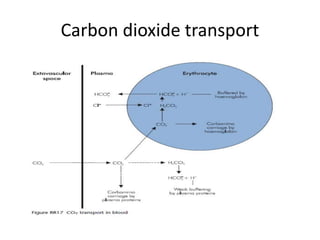
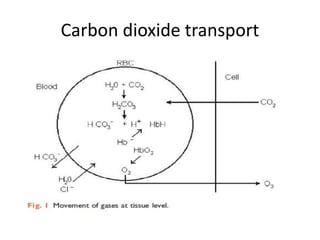
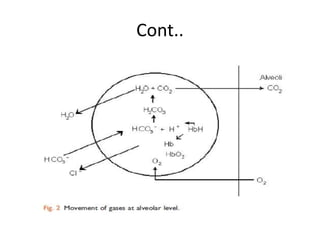
Carbon dioxide is transported in the blood in three
ways:
(i) dissolved in solution(5%)
(ii) buffered with water as carbonic acid(85%)
(iii) bound to proteins, particularly haemoglobin(10%)
Carbon dioxide transport
• Dissolved carbon dioxide
• Carbon dioxide is 20 times more soluble than oxygen;
– causes CO2 to diffuse more readily than oxygen
• Pco2 is 5.3 KPa in arterial blood and 6.1 kPa in mixed venous
blood
• A cardiac output of 5 litre min1 will carry 150 ml of dissolved
carbon dioxide to the lung, of which 25 ml will be exhaled.
Carbon dioxide transport
Cont..
Cont..
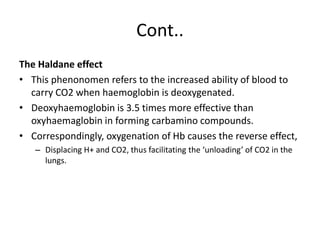
The Haldane effect
• This phenonomen refers to the increased ability of blood to
carry CO2 when haemoglobin is deoxygenated.
• Deoxyhaemoglobin is 3.5 times more effective than
oxyhaemaglobin in forming carbamino compounds.
• Correspondingly, oxygenation of Hb causes the reverse effect,
– Displacing H+ and CO2, thus facilitating the ‘unloading’ of CO2 in the
lungs.
Effect of co2 excess
• Central nervous system:-
 increase blood flow to the brain
 Increase cerebral volume
 raise intracranial pressure
Signs:-= headache
= nausea
= vomiting
= coma
Cont..
• Respiratory system:
 stimulate directly and reflex
 if the pressure of co2 in the blood stream rises by 1.5mmHg
the tidal volume is doubled
 shift oxyhemoglobin dissociation curve to the right
• Cardiovascular system:
 co increase by direct effect of co2
 HR increase and irregular
 peripheral resistance increase
 BP rise at first
Cont..
Causes of hypercapnia in anesthesia
• Respiratory obstruction causing inadequate ventilation
• Inadequate ventilation due to depression of the respiratory
center or the action of muscle relaxant
• Faulty co2 absorption in circle absorber
• Accidental administration of co2
Low Co2
• Excessive ventilation reduce co2 tension in the blood. The
patient become hypocapnic
• hyperventilation best avoided in during general anesthesia.
• It can result in cerebral vasoconstriction
• May also result in foetal asphyxia during c/s
• Hypocapnia delay onset of breathing at the end of anesthetic
• Shift oxyhemoglobin curve to the left and reduce o2 release
to the tissue
Physiology of apnoea
Contents
• What happens during apnoea?
• Types of hypoxia
• Preoxygenation
What happens during apnoea?
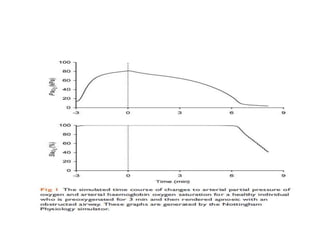
• During apnoea, alveolar partial pressure of oxygen (PAO2)
decreases steadily, because
– the oxygen is being removed from the lungs
• this oxygen removal generates a substantial negative
intrathoracic pressure if the airway is obstructed
• PaO2 decreases in direct relation to the PAO2,
• SaO2 remains >90% as long as the haemoglobin can be re-
oxygenated in the lungs
• The SaO2 only starts to decrease when the store of oxygen in
the lungs is depleted and the PaO2 is of the order of 6–7 kPa.
• Its subsequent decline is of a constant and rapid nature, about
30% every minute.
• At the start of this rapid decline, the SaO2 is still 90–95%.
• This inflection point we will define as ‘critical hypoxia’.
Cont..
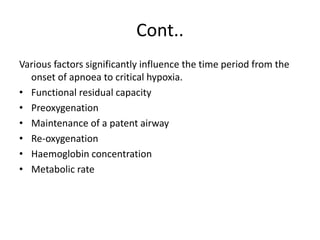
Various factors significantly influence the time period from the
onset of apnoea to critical hypoxia.
• Functional residual capacity
• Preoxygenation
• Maintenance of a patent airway
• Re-oxygenation
• Haemoglobin concentration
• Metabolic rate
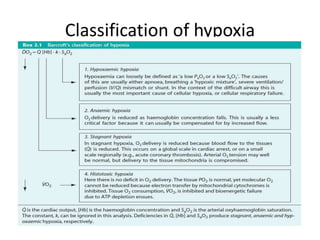
Classification of hypoxia
Cont..
Diffusion hypoxia
• Occur at the end of anesthetic where n2o/o2 is used.
• N2o passes blood stream in to alveoli faster than N2 in
air- dilute concentration of inspired o2
• If patient breathing atmospheric air then this falls to
below 20%
• Overcome by giving 100% o2
Pre-oxygenation
• Pre-oxygenation aims to increase body O2 stores to their
maximum,
– so that periods of apnoea are tolerated for longer before critical
desaturation occurs.
• There are two elements within the practice of
preoxygenation:
• Supplying 100% inspired O2:
• Time required for effective de-nitrogenation with 100% O2:
• The aim is to maximise O2 stores within the lung and the
blood.
• O2 content of blood
– O2 carried by Hb = [Hb] conc X saturation X 1.39 ml 100 ml1 blood
– O2 dissolved in plasma = O2 partial pressure (kPa) X 0.022 ml 100 ml1
plasma
• The major change during pre-oxygenation is in the amount of
O2 in the lungs.

Carbon dioxide transport

  • 1.
  • 2.
    Carbon dioxide transport Carbondioxide is transported in the blood in three ways: (i) dissolved in solution(5%) (ii) buffered with water as carbonic acid(85%) (iii) bound to proteins, particularly haemoglobin(10%)
  • 3.
    Carbon dioxide transport •Dissolved carbon dioxide • Carbon dioxide is 20 times more soluble than oxygen; – causes CO2 to diffuse more readily than oxygen • Pco2 is 5.3 KPa in arterial blood and 6.1 kPa in mixed venous blood • A cardiac output of 5 litre min1 will carry 150 ml of dissolved carbon dioxide to the lung, of which 25 ml will be exhaled.
  • 4.
  • 5.
  • 6.
  • 7.
    Cont.. The Haldane effect •This phenonomen refers to the increased ability of blood to carry CO2 when haemoglobin is deoxygenated. • Deoxyhaemoglobin is 3.5 times more effective than oxyhaemaglobin in forming carbamino compounds. • Correspondingly, oxygenation of Hb causes the reverse effect, – Displacing H+ and CO2, thus facilitating the ‘unloading’ of CO2 in the lungs.
  • 8.
    Effect of co2excess • Central nervous system:-  increase blood flow to the brain  Increase cerebral volume  raise intracranial pressure Signs:-= headache = nausea = vomiting = coma
  • 9.
    Cont.. • Respiratory system: stimulate directly and reflex  if the pressure of co2 in the blood stream rises by 1.5mmHg the tidal volume is doubled  shift oxyhemoglobin dissociation curve to the right • Cardiovascular system:  co increase by direct effect of co2  HR increase and irregular  peripheral resistance increase  BP rise at first
  • 10.
    Cont.. Causes of hypercapniain anesthesia • Respiratory obstruction causing inadequate ventilation • Inadequate ventilation due to depression of the respiratory center or the action of muscle relaxant • Faulty co2 absorption in circle absorber • Accidental administration of co2
  • 11.
    Low Co2 • Excessiveventilation reduce co2 tension in the blood. The patient become hypocapnic • hyperventilation best avoided in during general anesthesia. • It can result in cerebral vasoconstriction • May also result in foetal asphyxia during c/s • Hypocapnia delay onset of breathing at the end of anesthetic • Shift oxyhemoglobin curve to the left and reduce o2 release to the tissue
  • 12.
    Physiology of apnoea Contents •What happens during apnoea? • Types of hypoxia • Preoxygenation
  • 13.
    What happens duringapnoea? • During apnoea, alveolar partial pressure of oxygen (PAO2) decreases steadily, because – the oxygen is being removed from the lungs • this oxygen removal generates a substantial negative intrathoracic pressure if the airway is obstructed • PaO2 decreases in direct relation to the PAO2, • SaO2 remains >90% as long as the haemoglobin can be re- oxygenated in the lungs
  • 14.
    • The SaO2only starts to decrease when the store of oxygen in the lungs is depleted and the PaO2 is of the order of 6–7 kPa. • Its subsequent decline is of a constant and rapid nature, about 30% every minute. • At the start of this rapid decline, the SaO2 is still 90–95%. • This inflection point we will define as ‘critical hypoxia’.
  • 16.
    Cont.. Various factors significantlyinfluence the time period from the onset of apnoea to critical hypoxia. • Functional residual capacity • Preoxygenation • Maintenance of a patent airway • Re-oxygenation • Haemoglobin concentration • Metabolic rate
  • 17.
  • 18.
    Cont.. Diffusion hypoxia • Occurat the end of anesthetic where n2o/o2 is used. • N2o passes blood stream in to alveoli faster than N2 in air- dilute concentration of inspired o2 • If patient breathing atmospheric air then this falls to below 20% • Overcome by giving 100% o2
  • 19.
    Pre-oxygenation • Pre-oxygenation aimsto increase body O2 stores to their maximum, – so that periods of apnoea are tolerated for longer before critical desaturation occurs. • There are two elements within the practice of preoxygenation: • Supplying 100% inspired O2: • Time required for effective de-nitrogenation with 100% O2:
  • 20.
    • The aimis to maximise O2 stores within the lung and the blood. • O2 content of blood – O2 carried by Hb = [Hb] conc X saturation X 1.39 ml 100 ml1 blood – O2 dissolved in plasma = O2 partial pressure (kPa) X 0.022 ml 100 ml1 plasma • The major change during pre-oxygenation is in the amount of O2 in the lungs.