Oxygen Transport and Consumption
Learning Objectives
• By the end of this session you will be able to:
– Calculate how much oxygen the body consumes at rest
– Explain how oxygen is carried in the blood and the different ways it
can be measured
– Recognize when the rate of oxygen consumption may be increased
– Identify how more oxygen can be delivered to the tissues when
needed
Introduction
Introductory Knowledge Check
1. What percentage of oxygen is present in the air?
2. What partial pressure does that represent at sea level?
3. What is the normal cardiac output at rest?
4. How is an increase in cardiac output brought about?
5. What is the normal alveolar minute volume?
Oxygen and Metabolism
• Oxygen (O2) is used in mitochondria to sustain ATP production
via oxidative phosphorylation in the Kreb’s cycle/electron
transport chain.
• Oxygen consumption at rest: At rest the body uses
approximately 250 mL O2 per min.
• O2 consumption = VA x (Fi – FE)
= 5000 x (0.21 – 0.16)
= 250 mL/min
Oxygen cascade
• Oxygen is transported from the air that we breath to the
mitochondria
• O2 moves down the pressure or concentration gradient
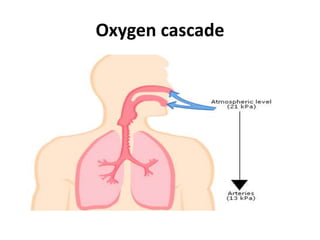
• The PaO2 in air (at sea level) is about 21 kPa, falling to 1-1.5
kPa in the mitochondria
• The process by which this decrease in partial pressure occurs
is called the oxygen cascade.
• It involves different transport mechanisms,
– Convection,
– Diffusion through gas and liquid media
– Bound to Hb.
Oxygen cascade
Oxygen cascade
Oxygen cascade
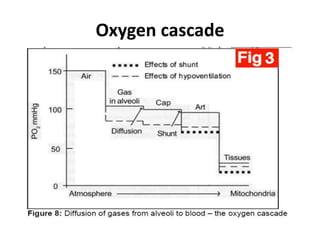
• The successive step down in PaO2 occur for physiological
reason:
1. In the upper airway, humidification adds water vapour
2. In the alveoli, O2 is taken up in exchange for CO2
3. In the circulation, from the small physiological shunt caused by:
 the bronchial circulation and Thebesian veins
• But they can be influenced by pathological states:
– Hypoventilation
– Pathological shunt( diffusion abnormality)
Oxygen cascade
 Atmosphere to alveolus
• By the time inspired gas reaches the trachea;
– It is diluted by water vapour which reduces the partial pressure of
oxygen Water vapour – 6.3 KPa/ 47mmHg
– PO2 = 0.21 x (760-47)= 149mmHg
– PO2 = 0.21 x (100-6.3) = 19.8KPa
 At the alveoli
• When the gas reaches the alveoli the PO2 decrease
– As O2 is taken up in exchange for CO2
– The PO2 at this point can be determined by using the alveolar gas
equation.
Oxygen cascade
• The alveolar gas equation thus becomes
• PAO2 = PiO2 − PaCO2/RQ
– where RQ is the respiratory quotient, and
– RQ = VCO2/VO2, usually 0.8
• PAO2 = 0.21- 5/0.8 = 13.4KPa (106mmHg)
• Alveoli to arterial blood
– Again when the gas reaches the arterial blood a further small drop in
Po2 will occurred
– As blood known as venous admixture with a lower oxygen content
mixes with the oxygenated alveolar blood.
– Venous admixture is made up on:
• V/Q mismatch and slow diffusion across alveolar-capillary mm
Diffusion of Gases Across the Alveolar
Membrane
• The speed and ease of diffusion are controlled by the laws of
diffusion.
• Fick’s law of diffusion states that:
– gas transfer across a membrane is directly proportional to the
concentration gradient.
• Graham’s law states that :
– diffusion of a gas is inversely proportional to the square root of the
molecular weight of the molecule.
Cont..
• Other factors which increase diffusion:
• Large surface area
• Thin membrane
• High solubility
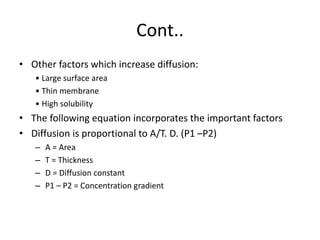
• The following equation incorporates the important factors
• Diffusion is proportional to A/T. D. (P1 –P2)
– A = Area
– T = Thickness
– D = Diffusion constant
– P1 – P2 = Concentration gradient
Oxygen transport
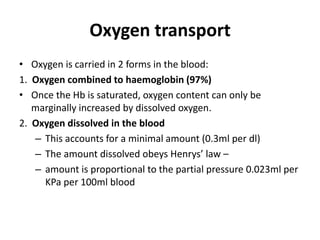
• Oxygen is carried in 2 forms in the blood:
1. Oxygen combined to haemoglobin (97%)
• Once the Hb is saturated, oxygen content can only be
marginally increased by dissolved oxygen.
2. Oxygen dissolved in the blood
– This accounts for a minimal amount (0.3ml per dl)
– The amount dissolved obeys Henrys’ law –
– amount is proportional to the partial pressure 0.023ml per
KPa per 100ml blood
Oxygen transport
Haemoglobin
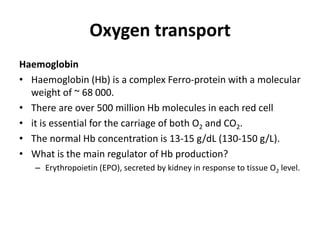
• Haemoglobin (Hb) is a complex Ferro-protein with a molecular
weight of ~ 68 000.
• There are over 500 million Hb molecules in each red cell
• it is essential for the carriage of both O2 and CO2.
• The normal Hb concentration is 13-15 g/dL (130-150 g/L).
• What is the main regulator of Hb production?
– Erythropoietin (EPO), secreted by kidney in response to tissue O2 level.
Cont..
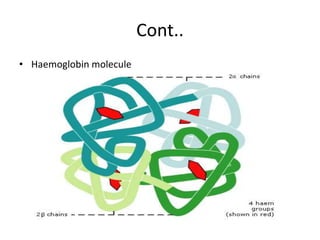
• Haemoglobin molecule
Cont..
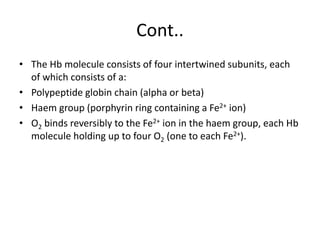
• The Hb molecule consists of four intertwined subunits, each
of which consists of a:
• Polypeptide globin chain (alpha or beta)
• Haem group (porphyrin ring containing a Fe2+ ion)
• O2 binds reversibly to the Fe2+ ion in the haem group, each Hb
molecule holding up to four O2 (one to each Fe2+).
Haemoglobin-Oxygen Binding
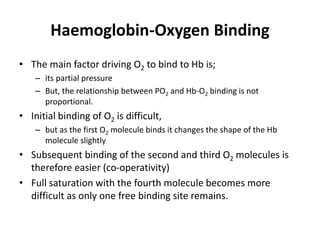
• The main factor driving O2 to bind to Hb is;
– its partial pressure
– But, the relationship between PO2 and Hb-O2 binding is not
proportional.
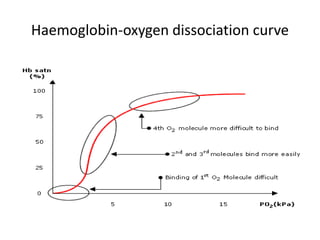
• Initial binding of O2 is difficult,
– but as the first O2 molecule binds it changes the shape of the Hb
molecule slightly
• Subsequent binding of the second and third O2 molecules is
therefore easier (co-operativity)
• Full saturation with the fourth molecule becomes more
difficult as only one free binding site remains.
Haemoglobin-oxygen dissociation curve
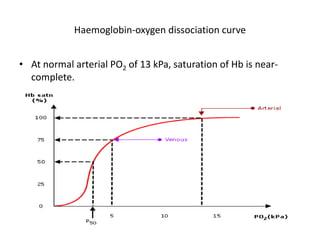
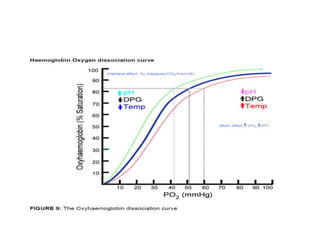
• At normal arterial PO2 of 13 kPa, saturation of Hb is near-
complete.
Oxyheamoglobine dissociation curve
• Sigmoid shaped curve relating the fact that binding of oxygen
to the heamoglobin molecule is a cooperative process
• Describes the relationship of saturation of haemoglobin with
oxygen at varying partial pressures
• Be aware of the P50 –(point at which Hb is 50% saturated)
 It is a reference point that describes the position of the curve and;
 changes as the curve moves under different conditions
Cont..
‘Left shift’ of the ODC
• This represents an increase in the affinity of Hb for oxygen in the
pulmonary capillaries
– but requires lower tissue capillary PO2 to achieve adequate oxygen
delivery.
• In a left shifted situation the Hb is less likely to release oxygen to
the tissues
• P50 is reduced by factors causing a left shift, which include:
– Alkalosis
– Decreased PCO2
– Decreased concentration of 2,3-DPG
– Decreased temperature
– Presence of HbF rather than adult forms of Hb
‘Right shift’ of the ODC
• This represents an increase in the affinity of Hb for oxygen.
• In this situation P50 is increased, requiring higher pulmonary
capillary saturations to saturate the Hb,
• If a right shift occurs the Hb molecule is more likely to offload
oxygen to the tissues
• Factors causing a right shift of the ODC include:
– Acidosis
– Increased PCO2
– Increased concentration of 2,3-DPG
– Increased temperature
2,3-DPG
• This molecule binds to deoxygenated Hb
– it reduces the affinity of haemoglobin for oxygen and therefore ensures
offloading of oxygen to the tissues.
Bohr effect
• The shift in position of the ODC caused by CO2 entering or leaving
blood is known as the Bohr effect.
• On entering red blood cells the following reaction occurs:
– CO2 + H2O ↔ H2CO3 ↔ H+ + HCO3-
• An increase in H+ will cause an acidosis and therefore encourage
the release of oxygen from Hb.
• In the lungs where the CO2 is being removed, the alkalosis will
encourage the uptake of oxygen.
Oxygen Delivery
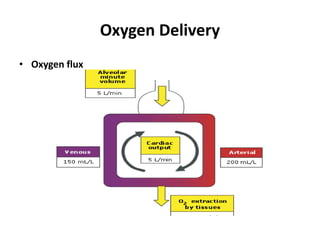
• Oxygen flux
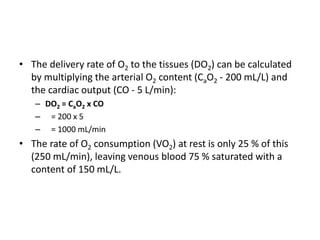
• The delivery rate of O2 to the tissues (DO2) can be calculated
by multiplying the arterial O2 content (CaO2 - 200 mL/L) and
the cardiac output (CO - 5 L/min):
– DO2 = CaO2 x CO
– = 200 x 5
– = 1000 mL/min
• The rate of O2 consumption (VO2) at rest is only 25 % of this
(250 mL/min), leaving venous blood 75 % saturated with a
content of 150 mL/L.
O2 content
• O2 content is the truest measure of oxygen present but is
difficult to measure directly and so is normally estimated from
the other values.
Calculating O2 content
• When fully saturated, 1 g of Hb holds 1.34 mL O2.
• Assuming a Hb concentration of 150 g/L (15 g/dL), we can
calculate the oxygen content in arterial blood (CaO2).
CaO2= Hb-bound + dissolved
= ([Hb] x 1.34 x satn) + (0.23 x PO2)
= (150 x 1.34 x 0.98) + (0.23 x 13)
= 197 + 3
= 200 mL/L
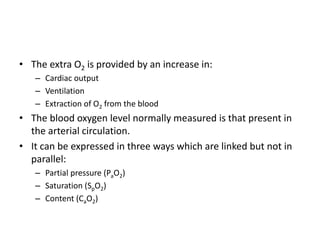
• The extra O2 is provided by an increase in:
– Cardiac output
– Ventilation
– Extraction of O2 from the blood
• The blood oxygen level normally measured is that present in
the arterial circulation.
• It can be expressed in three ways which are linked but not in
parallel:
– Partial pressure (PaO2)
– Saturation (SpO2)
– Content (CaO2)
Cyanosis
• It is detected clinically when ≥ 5 g/dL deoxy-Hb can be seen in
the skin or mucous membranes.
• With a [Hb] of 15 g/dL this is 33 % of the total, with the
remaining 67 % being saturated.
• In practice, patients appear cyanosed when the pulse
oximetry reading is much higher, around 85 %.
• Cyanosis is seen in capillary blood, whilst a pulse oximeter
reading is based on the arterial value, which will be
substantially higher because:
– PO2 is slightly higher in the artery than the capillary
– The saturation curve in the capillary has a small right shift (Bohr effect)
Anaemia
• Because almost all O2 is carried bound to Hb, anaemia
reduces O2 content approximately in proportion to the fall in
Hb.
• The saturation will be unaffected as all the Hb present is
saturated and the PO2 is unchanged as it measures the level in
plasma.
• How would the body compensate for this acutely?

Oxygen transport

  • 1.
  • 2.
    Learning Objectives • Bythe end of this session you will be able to: – Calculate how much oxygen the body consumes at rest – Explain how oxygen is carried in the blood and the different ways it can be measured – Recognize when the rate of oxygen consumption may be increased – Identify how more oxygen can be delivered to the tissues when needed
  • 3.
    Introduction Introductory Knowledge Check 1.What percentage of oxygen is present in the air? 2. What partial pressure does that represent at sea level? 3. What is the normal cardiac output at rest? 4. How is an increase in cardiac output brought about? 5. What is the normal alveolar minute volume?
  • 4.
    Oxygen and Metabolism •Oxygen (O2) is used in mitochondria to sustain ATP production via oxidative phosphorylation in the Kreb’s cycle/electron transport chain. • Oxygen consumption at rest: At rest the body uses approximately 250 mL O2 per min. • O2 consumption = VA x (Fi – FE) = 5000 x (0.21 – 0.16) = 250 mL/min
  • 5.
    Oxygen cascade • Oxygenis transported from the air that we breath to the mitochondria • O2 moves down the pressure or concentration gradient • The PaO2 in air (at sea level) is about 21 kPa, falling to 1-1.5 kPa in the mitochondria • The process by which this decrease in partial pressure occurs is called the oxygen cascade. • It involves different transport mechanisms, – Convection, – Diffusion through gas and liquid media – Bound to Hb.
  • 6.
  • 7.
  • 8.
    Oxygen cascade • Thesuccessive step down in PaO2 occur for physiological reason: 1. In the upper airway, humidification adds water vapour 2. In the alveoli, O2 is taken up in exchange for CO2 3. In the circulation, from the small physiological shunt caused by:  the bronchial circulation and Thebesian veins • But they can be influenced by pathological states: – Hypoventilation – Pathological shunt( diffusion abnormality)
  • 9.
    Oxygen cascade  Atmosphereto alveolus • By the time inspired gas reaches the trachea; – It is diluted by water vapour which reduces the partial pressure of oxygen Water vapour – 6.3 KPa/ 47mmHg – PO2 = 0.21 x (760-47)= 149mmHg – PO2 = 0.21 x (100-6.3) = 19.8KPa  At the alveoli • When the gas reaches the alveoli the PO2 decrease – As O2 is taken up in exchange for CO2 – The PO2 at this point can be determined by using the alveolar gas equation.
  • 10.
    Oxygen cascade • Thealveolar gas equation thus becomes • PAO2 = PiO2 − PaCO2/RQ – where RQ is the respiratory quotient, and – RQ = VCO2/VO2, usually 0.8 • PAO2 = 0.21- 5/0.8 = 13.4KPa (106mmHg) • Alveoli to arterial blood – Again when the gas reaches the arterial blood a further small drop in Po2 will occurred – As blood known as venous admixture with a lower oxygen content mixes with the oxygenated alveolar blood. – Venous admixture is made up on: • V/Q mismatch and slow diffusion across alveolar-capillary mm
  • 11.
    Diffusion of GasesAcross the Alveolar Membrane • The speed and ease of diffusion are controlled by the laws of diffusion. • Fick’s law of diffusion states that: – gas transfer across a membrane is directly proportional to the concentration gradient. • Graham’s law states that : – diffusion of a gas is inversely proportional to the square root of the molecular weight of the molecule.
  • 12.
    Cont.. • Other factorswhich increase diffusion: • Large surface area • Thin membrane • High solubility • The following equation incorporates the important factors • Diffusion is proportional to A/T. D. (P1 –P2) – A = Area – T = Thickness – D = Diffusion constant – P1 – P2 = Concentration gradient
  • 13.
    Oxygen transport • Oxygenis carried in 2 forms in the blood: 1. Oxygen combined to haemoglobin (97%) • Once the Hb is saturated, oxygen content can only be marginally increased by dissolved oxygen. 2. Oxygen dissolved in the blood – This accounts for a minimal amount (0.3ml per dl) – The amount dissolved obeys Henrys’ law – – amount is proportional to the partial pressure 0.023ml per KPa per 100ml blood
  • 14.
    Oxygen transport Haemoglobin • Haemoglobin(Hb) is a complex Ferro-protein with a molecular weight of ~ 68 000. • There are over 500 million Hb molecules in each red cell • it is essential for the carriage of both O2 and CO2. • The normal Hb concentration is 13-15 g/dL (130-150 g/L). • What is the main regulator of Hb production? – Erythropoietin (EPO), secreted by kidney in response to tissue O2 level.
  • 15.
  • 16.
    Cont.. • The Hbmolecule consists of four intertwined subunits, each of which consists of a: • Polypeptide globin chain (alpha or beta) • Haem group (porphyrin ring containing a Fe2+ ion) • O2 binds reversibly to the Fe2+ ion in the haem group, each Hb molecule holding up to four O2 (one to each Fe2+).
  • 17.
    Haemoglobin-Oxygen Binding • Themain factor driving O2 to bind to Hb is; – its partial pressure – But, the relationship between PO2 and Hb-O2 binding is not proportional. • Initial binding of O2 is difficult, – but as the first O2 molecule binds it changes the shape of the Hb molecule slightly • Subsequent binding of the second and third O2 molecules is therefore easier (co-operativity) • Full saturation with the fourth molecule becomes more difficult as only one free binding site remains.
  • 18.
  • 19.
    Haemoglobin-oxygen dissociation curve •At normal arterial PO2 of 13 kPa, saturation of Hb is near- complete.
  • 20.
    Oxyheamoglobine dissociation curve •Sigmoid shaped curve relating the fact that binding of oxygen to the heamoglobin molecule is a cooperative process • Describes the relationship of saturation of haemoglobin with oxygen at varying partial pressures • Be aware of the P50 –(point at which Hb is 50% saturated)  It is a reference point that describes the position of the curve and;  changes as the curve moves under different conditions
  • 21.
    Cont.. ‘Left shift’ ofthe ODC • This represents an increase in the affinity of Hb for oxygen in the pulmonary capillaries – but requires lower tissue capillary PO2 to achieve adequate oxygen delivery. • In a left shifted situation the Hb is less likely to release oxygen to the tissues • P50 is reduced by factors causing a left shift, which include: – Alkalosis – Decreased PCO2 – Decreased concentration of 2,3-DPG – Decreased temperature – Presence of HbF rather than adult forms of Hb
  • 22.
    ‘Right shift’ ofthe ODC • This represents an increase in the affinity of Hb for oxygen. • In this situation P50 is increased, requiring higher pulmonary capillary saturations to saturate the Hb, • If a right shift occurs the Hb molecule is more likely to offload oxygen to the tissues • Factors causing a right shift of the ODC include: – Acidosis – Increased PCO2 – Increased concentration of 2,3-DPG – Increased temperature
  • 24.
    2,3-DPG • This moleculebinds to deoxygenated Hb – it reduces the affinity of haemoglobin for oxygen and therefore ensures offloading of oxygen to the tissues. Bohr effect • The shift in position of the ODC caused by CO2 entering or leaving blood is known as the Bohr effect. • On entering red blood cells the following reaction occurs: – CO2 + H2O ↔ H2CO3 ↔ H+ + HCO3- • An increase in H+ will cause an acidosis and therefore encourage the release of oxygen from Hb. • In the lungs where the CO2 is being removed, the alkalosis will encourage the uptake of oxygen.
  • 25.
  • 26.
    • The deliveryrate of O2 to the tissues (DO2) can be calculated by multiplying the arterial O2 content (CaO2 - 200 mL/L) and the cardiac output (CO - 5 L/min): – DO2 = CaO2 x CO – = 200 x 5 – = 1000 mL/min • The rate of O2 consumption (VO2) at rest is only 25 % of this (250 mL/min), leaving venous blood 75 % saturated with a content of 150 mL/L.
  • 27.
    O2 content • O2content is the truest measure of oxygen present but is difficult to measure directly and so is normally estimated from the other values. Calculating O2 content • When fully saturated, 1 g of Hb holds 1.34 mL O2. • Assuming a Hb concentration of 150 g/L (15 g/dL), we can calculate the oxygen content in arterial blood (CaO2). CaO2= Hb-bound + dissolved = ([Hb] x 1.34 x satn) + (0.23 x PO2) = (150 x 1.34 x 0.98) + (0.23 x 13) = 197 + 3 = 200 mL/L
  • 28.
    • The extraO2 is provided by an increase in: – Cardiac output – Ventilation – Extraction of O2 from the blood • The blood oxygen level normally measured is that present in the arterial circulation. • It can be expressed in three ways which are linked but not in parallel: – Partial pressure (PaO2) – Saturation (SpO2) – Content (CaO2)
  • 29.
    Cyanosis • It isdetected clinically when ≥ 5 g/dL deoxy-Hb can be seen in the skin or mucous membranes. • With a [Hb] of 15 g/dL this is 33 % of the total, with the remaining 67 % being saturated. • In practice, patients appear cyanosed when the pulse oximetry reading is much higher, around 85 %. • Cyanosis is seen in capillary blood, whilst a pulse oximeter reading is based on the arterial value, which will be substantially higher because: – PO2 is slightly higher in the artery than the capillary – The saturation curve in the capillary has a small right shift (Bohr effect)
  • 30.
    Anaemia • Because almostall O2 is carried bound to Hb, anaemia reduces O2 content approximately in proportion to the fall in Hb. • The saturation will be unaffected as all the Hb present is saturated and the PO2 is unchanged as it measures the level in plasma. • How would the body compensate for this acutely?