E- OS
By
Ajal A J
Assistant Professor (Guest) , ECE
EMBEDDED OPERATING SYSTEM
• An embedded operating system is an operating system
for embedded computer systems.
• These operating systems are designed to be compact,
efficient, and reliable.
• E-OS are frequently also real-time operating systems,
and the term RTOS is often used as a synonym for
embedded operating system.
E- OS vs desktop operating
systems
• An important
difference between
most embedded
operating systems and
desktop operating
systems is that the
application, including
the operating system,
is usually statically
linked together
into a single
executable file.
• Unlike a desktop
operating system,
the embedded
operating system
does not load and
execute
applications. This
means that the
system is only able
to run a single
application.
What makes a good Embedded OS?
• Modular
• Scalable
• Configurable
• Small footprint
• CPU support
• Device drivers
• etc, etc, etc...
Examples
Android , Symbian
•In the small and rapidly growing world the need
of mobiles and its applications are obvious.
• To meet the users embedded OS are playing
the vital.
•Android is much advanced and provides more
value to the end users.
•Symbian needs updates its features.
Example I
ANDROID OS
ARCHITECTURE
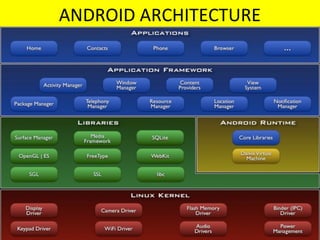
ANDROID ARCHITECTURE
• Use a colour of font that contrasts sharply
with the background
– Ex: blue font on white background
• Use colour to reinforce the logic of your
structure
– Ex: light blue title and dark blue text
• Use colour to emphasize a point
– But only use this occasionally
Applications
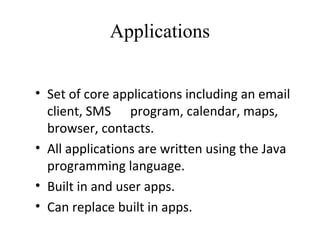
• Set of core applications including an email
client, SMS program, calendar, maps,
browser, contacts.
• All applications are written using the Java
programming language.
• Built in and user apps.
• Can replace built in apps.
Application Framework
• Access location information, run background services,
set alarms, add notifications to the status bar, and much,
much more.
• Build an application, including lists, grids, text boxes,
buttons, and even an embeddable web browser
• Providing access to non-code resources such as localized
strings, graphics, and layout files.
• Activity manager – manages application life cycle.
Android Runtime
• Includes a set of core libraries of JAVA that
provides most of the functionality
• Runs in its own process, with its own
instance of the Dalvik Virtual Machine
• The Dalvik VM executes files in the Dalvik
Executable (.dex)
– Compact and efficient than class files
– Limited memory and battery power
Dalvik Virtual Machine
• All applications written in Java and converted to the Dalvik
executable .dex.
• Every android app runs its own process, with its own instance of the
Dalvik virtual machine.
• Not a traditional JVM, but a custom VM designed to run multiple
instances efficiently on a single device.
• VM uses Linux kernel to handle low-level functionality including
security, threading, process and memory managemet.
Linux Kernel
• Acts as an abstraction layer between the
hardware and the rest of the software stack.
• Relies on Linux version 2.6 for core system
services such as security, memory
management, process management, network
stack, and driver model.
• Works as a HAL
Libraries
System C library - implementation of the C library (libc).
Media Libraries - based on PacketVideo's Open CORE.
Surface Manager - composites 2D and 3D graphic layers
LibWebCore - a modern embeddable web view.
SGL - the underlying 2D graphics engine.
3D libraries - based on OpenGL ES 1.0 APIs; the libraries use
hardware 3D acceleration.
FreeType - bitmap and vector font rendering
SQLite - a powerful and lightweight relational database engine .
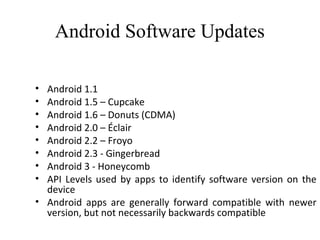
Android Software Updates
• Android 1.1
• Android 1.5 – Cupcake
• Android 1.6 – Donuts (CDMA)
• Android 2.0 – Éclair
• Android 2.2 – Froyo
• Android 2.3 - Gingerbread
• Android 3 - Honeycomb
• API Levels used by apps to identify software version on the
device
• Android apps are generally forward compatible with newer
version, but not necessarily backwards compatible
Example II
SYMBIAN OS
ARCHITECTURE
Example of Applications where the
Symbian OS is being used
• Nokia Series 80 interface
• UIQ interface(Used for PDAs such as Sony Ericsson P800 )
• Nokia S60 interface
SYMBIAN OS…(INTRODUCTION)
Symbian OS is one of Nokia's mobile
operating system for mobile devices and
smartphones, with associated libraries,
user interface, frameworks and
reference implementations of common
tools, originally developed by Symbian
Ltd.
HISTORY
• Psion founded by David Potter inn 1980 launched the Psion Organizer,
the world's first volume-produced handheld computer in 1984.
• In June 1998 - Symbian is established as a private independent company
and is owned by Ericsson, Nokia, Motorola and Psion. From this point
onwards has EPOC OS been called Symbian OS.
• In February 2004 - Symbian OS v8.0 is announced.
• In February 2005 - Symbian OS v9 is announced.
• In May 2006 - 100th commercial phone model ships.
HISTORY Contd..
• In November 2006 - 100 million Symbian smartphones shipped.
• In 2008, the former Symbian Software Limited was acquired by Nokia and a
new independent non-profit organization called the Symbian Foundation
was established.
• The platform has been designated as the successor to Symbian OS,
following the official launch of the Symbian Foundation in April 2009.
• The Symbian Platform was officially made available as open source code in
February 2010.
CHARACTERISTICS..
• PROCESSING THREAD BASED
• MEMORY MANAGEMENT
• INPUT/OUTPUT
KERNEL EXTENSION
DEVICE DRIVERS
DMA(DIRECT MEMORY ACCESS
BLOCKING I/O
STOAGE MEDIA
MEMORY MANAGEMENT
How Symbian OS Addresses Memory
– Symbian OS is a 32-bit operating system, addresses
can range up to 4 GB
– Symbian OS divides memory into virtual pages and
physical frames
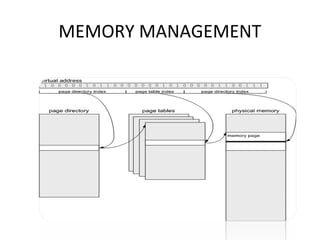
– Symbian OS adopts a two-level page table strategy
MEMORY MANAGEMENT
FEATURES
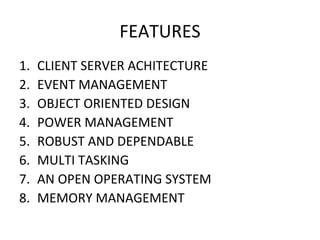
1. CLIENT SERVER ACHITECTURE
2. EVENT MANAGEMENT
3. OBJECT ORIENTED DESIGN
4. POWER MANAGEMENT
5. ROBUST AND DEPENDABLE
6. MULTI TASKING
7. AN OPEN OPERATING SYSTEM
8. MEMORY MANAGEMENT
STRENGTHS AND WEAKNESS
STRENGTH
•MEMORY MANAGEMENT
•EXECUTION IN ONE PLACE
WEAKNESS
•NO VITUAL MEMORY
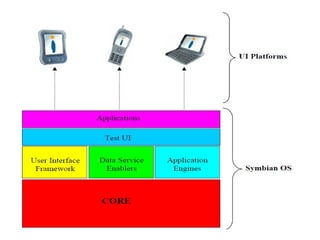
SYMBIAN ACHITECTURE
• Symbian has a microkernel architecture, which means that
the minimum necessary is within the kernel to maximise
robustness, availability and responsiveness.
• Symbian is designed to emphasise compatibility with other
devices, especially removable media file systems.
• There is also a large volume of User Interface (UI) Code.
• Symbian includes a reference user-interface called
"TechView".
• It is very similar to the user interface from the Psion Series 5
personal organiser and is not used for any production
phone user interface.
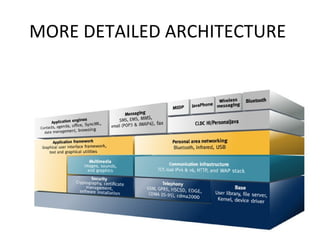
MORE DETAILED ARCHITECTURE
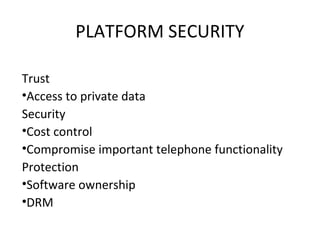
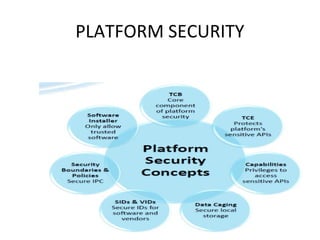
PLATFORM SECURITY
Trust
•Access to private data
Security
•Cost control
•Compromise important telephone functionality
Protection
•Software ownership
•DRM
PLATFORM SECURITY
ADVANTAGES
• Greater range of applications.
• High quality games.
• Better inbuilt wap browser.
• Connectivity is lot more easier and faster.
• Real Player, Smart movie player etc. sort of application are not available
with java phones.
• You can install software and applications of any type
• You can download big files through your phone easily with 3G around.
DISADVANTAGE
• The OS is not available for PCs .
• The Symbian OS can be easily affected by a
Virus.
COMPARSION OF SYMBIAN & ANDROID
• OPERATING SOFTWARE or FIRMWARE
• FLASHING Your phone with new FIRMWARE
• CHANGING PHONE FEATURES
• PROCESSOR and its SPEED
• MODIFICATIONS

android vs symbian

  • 1.
    E- OS By Ajal AJ Assistant Professor (Guest) , ECE EMBEDDED OPERATING SYSTEM
  • 2.
    EMBEDDED OPERATING SYSTEM •An embedded operating system is an operating system for embedded computer systems. • These operating systems are designed to be compact, efficient, and reliable. • E-OS are frequently also real-time operating systems, and the term RTOS is often used as a synonym for embedded operating system.
  • 3.
    E- OS vsdesktop operating systems • An important difference between most embedded operating systems and desktop operating systems is that the application, including the operating system, is usually statically linked together into a single executable file. • Unlike a desktop operating system, the embedded operating system does not load and execute applications. This means that the system is only able to run a single application.
  • 4.
    What makes agood Embedded OS? • Modular • Scalable • Configurable • Small footprint • CPU support • Device drivers • etc, etc, etc...
  • 5.
  • 6.
    Android , Symbian •Inthe small and rapidly growing world the need of mobiles and its applications are obvious. • To meet the users embedded OS are playing the vital. •Android is much advanced and provides more value to the end users. •Symbian needs updates its features.
  • 7.
  • 8.
    ANDROID ARCHITECTURE • Usea colour of font that contrasts sharply with the background – Ex: blue font on white background • Use colour to reinforce the logic of your structure – Ex: light blue title and dark blue text • Use colour to emphasize a point – But only use this occasionally
  • 9.
    Applications • Set ofcore applications including an email client, SMS program, calendar, maps, browser, contacts. • All applications are written using the Java programming language. • Built in and user apps. • Can replace built in apps.
  • 10.
    Application Framework • Accesslocation information, run background services, set alarms, add notifications to the status bar, and much, much more. • Build an application, including lists, grids, text boxes, buttons, and even an embeddable web browser • Providing access to non-code resources such as localized strings, graphics, and layout files. • Activity manager – manages application life cycle.
  • 11.
    Android Runtime • Includesa set of core libraries of JAVA that provides most of the functionality • Runs in its own process, with its own instance of the Dalvik Virtual Machine • The Dalvik VM executes files in the Dalvik Executable (.dex) – Compact and efficient than class files – Limited memory and battery power
  • 12.
    Dalvik Virtual Machine •All applications written in Java and converted to the Dalvik executable .dex. • Every android app runs its own process, with its own instance of the Dalvik virtual machine. • Not a traditional JVM, but a custom VM designed to run multiple instances efficiently on a single device. • VM uses Linux kernel to handle low-level functionality including security, threading, process and memory managemet.
  • 13.
    Linux Kernel • Actsas an abstraction layer between the hardware and the rest of the software stack. • Relies on Linux version 2.6 for core system services such as security, memory management, process management, network stack, and driver model. • Works as a HAL
  • 14.
    Libraries System C library- implementation of the C library (libc). Media Libraries - based on PacketVideo's Open CORE. Surface Manager - composites 2D and 3D graphic layers LibWebCore - a modern embeddable web view. SGL - the underlying 2D graphics engine. 3D libraries - based on OpenGL ES 1.0 APIs; the libraries use hardware 3D acceleration. FreeType - bitmap and vector font rendering SQLite - a powerful and lightweight relational database engine .
  • 15.
    Android Software Updates •Android 1.1 • Android 1.5 – Cupcake • Android 1.6 – Donuts (CDMA) • Android 2.0 – Éclair • Android 2.2 – Froyo • Android 2.3 - Gingerbread • Android 3 - Honeycomb • API Levels used by apps to identify software version on the device • Android apps are generally forward compatible with newer version, but not necessarily backwards compatible
  • 16.
  • 17.
    Example of Applicationswhere the Symbian OS is being used • Nokia Series 80 interface • UIQ interface(Used for PDAs such as Sony Ericsson P800 ) • Nokia S60 interface
  • 18.
    SYMBIAN OS…(INTRODUCTION) Symbian OSis one of Nokia's mobile operating system for mobile devices and smartphones, with associated libraries, user interface, frameworks and reference implementations of common tools, originally developed by Symbian Ltd.
  • 19.
    HISTORY • Psion foundedby David Potter inn 1980 launched the Psion Organizer, the world's first volume-produced handheld computer in 1984. • In June 1998 - Symbian is established as a private independent company and is owned by Ericsson, Nokia, Motorola and Psion. From this point onwards has EPOC OS been called Symbian OS. • In February 2004 - Symbian OS v8.0 is announced. • In February 2005 - Symbian OS v9 is announced. • In May 2006 - 100th commercial phone model ships.
  • 20.
    HISTORY Contd.. • InNovember 2006 - 100 million Symbian smartphones shipped. • In 2008, the former Symbian Software Limited was acquired by Nokia and a new independent non-profit organization called the Symbian Foundation was established. • The platform has been designated as the successor to Symbian OS, following the official launch of the Symbian Foundation in April 2009. • The Symbian Platform was officially made available as open source code in February 2010.
  • 21.
    CHARACTERISTICS.. • PROCESSING THREADBASED • MEMORY MANAGEMENT • INPUT/OUTPUT KERNEL EXTENSION DEVICE DRIVERS DMA(DIRECT MEMORY ACCESS BLOCKING I/O STOAGE MEDIA
  • 22.
    MEMORY MANAGEMENT How SymbianOS Addresses Memory – Symbian OS is a 32-bit operating system, addresses can range up to 4 GB – Symbian OS divides memory into virtual pages and physical frames – Symbian OS adopts a two-level page table strategy
  • 23.
  • 24.
    FEATURES 1. CLIENT SERVERACHITECTURE 2. EVENT MANAGEMENT 3. OBJECT ORIENTED DESIGN 4. POWER MANAGEMENT 5. ROBUST AND DEPENDABLE 6. MULTI TASKING 7. AN OPEN OPERATING SYSTEM 8. MEMORY MANAGEMENT
  • 25.
    STRENGTHS AND WEAKNESS STRENGTH •MEMORYMANAGEMENT •EXECUTION IN ONE PLACE WEAKNESS •NO VITUAL MEMORY
  • 26.
    SYMBIAN ACHITECTURE • Symbianhas a microkernel architecture, which means that the minimum necessary is within the kernel to maximise robustness, availability and responsiveness. • Symbian is designed to emphasise compatibility with other devices, especially removable media file systems. • There is also a large volume of User Interface (UI) Code. • Symbian includes a reference user-interface called "TechView". • It is very similar to the user interface from the Psion Series 5 personal organiser and is not used for any production phone user interface.
  • 28.
  • 29.
    PLATFORM SECURITY Trust •Access toprivate data Security •Cost control •Compromise important telephone functionality Protection •Software ownership •DRM
  • 30.
  • 31.
    ADVANTAGES • Greater rangeof applications. • High quality games. • Better inbuilt wap browser. • Connectivity is lot more easier and faster. • Real Player, Smart movie player etc. sort of application are not available with java phones. • You can install software and applications of any type • You can download big files through your phone easily with 3G around.
  • 32.
    DISADVANTAGE • The OSis not available for PCs . • The Symbian OS can be easily affected by a Virus.
  • 33.
    COMPARSION OF SYMBIAN& ANDROID • OPERATING SOFTWARE or FIRMWARE • FLASHING Your phone with new FIRMWARE • CHANGING PHONE FEATURES • PROCESSOR and its SPEED • MODIFICATIONS