SYMBIAN OS


By
Deva Ashish Singh
 Introduction
 Need  for Symbian OS
 Evolution in the various versions
 Architecture
 Architectural Overview
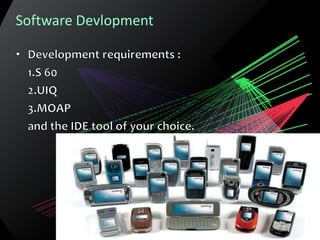
 Software Development
 Programming Languages
 Advantages & Disadvantages
 Conclusion
   Symbian OS is designed for the mobile phone environment.

   The Smartphone operating system Symbian OS is produced
    by the software development and licensing company
    Symbian Ltd.

   Symbian Ltd was established in June 1998 and is
    headquartered in Southwark in the UK, and the current
    CEO is Nigel Clifford.
Need for Symbian OS

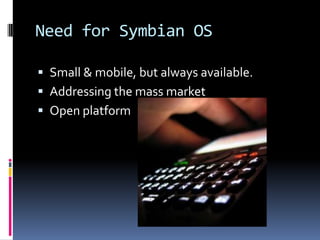
 Small & mobile, but always available.
 Addressing the mass market
 Open platform
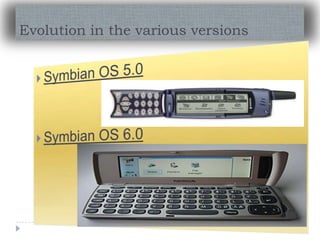
Evolution in the various versions
•   Symbian OS 7.0
•   Symbian OS 8.0
•   Symbian OS 9.1
•   Symbian OS 9.3
•   Symbian OS 9.4
•   Symbian Os 9.5
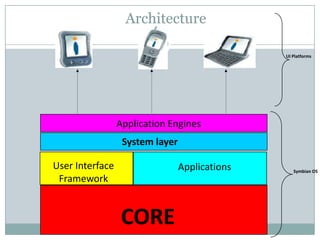
Architecture

                                                UI Platforms


                 Application Engines
                  System layer

User Interface                   Applications      Symbian OS
 Framework


                  CORE
Architectural Overview

1.   Core : Symbian OS core is common to all
     devices i.e. kernel, file server, memory
     management & device drivers.

2. System layer : It provides communication &
   computing services such as TCP/IP, SMS &
   database management.
3. Application Engines : It’s above the system layer,
   enabling the software developers to create user
   interface to data.
4. User Interface Software : It can be
  made or licensed by
  manufacturers.
5. Applications : are slotted aboved
  the user interface & pre-loaded in
  the Symbian OS mobile phone.
Software Devlopment
What is IDE ?
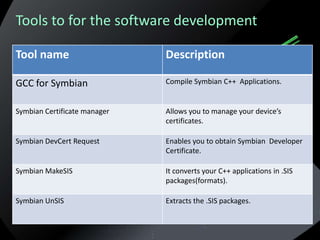
Tools to for the software development

Tool name                     Description

GCC for Symbian               Compile Symbian C++ Applications.


Symbian Certificate manager   Allows you to manage your device’s
                              certificates.

Symbian DevCert Request       Enables you to obtain Symbian Developer
                              Certificate.

Symbian MakeSIS               It converts your C++ applications in .SIS
                              packages(formats).

Symbian UnSIS                 Extracts the .SIS packages.
   Symbian OS offers a choice of programming
    languages to the developer. It’s written in C++.
   Java, 2nd the most important programming
    language on Symbian OS.
   Other programming languages are Java Script,
    Assembler, Visual Basic and So on…
ADVANTAGES

   It’s an open platform based on C++ (Object
    Oriented Concepts), which is easy to configure.
   Giving an additional feature of Power
    Management like “ Power Saving”.
   Fully multitasking.
   Small but with a lots of in-built features.
DISADVANTAGES

   Not available for PCs.
Conclusion
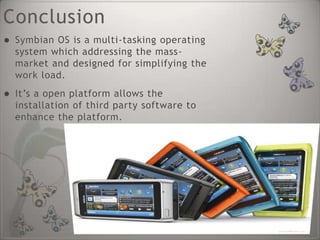
   Symbian OS is a multi-tasking operating
    system which addressing the mass-
    market and designed for simplifying the
    work load.
   It’s a open platform allows the
    installation of third party software to
    enhance the platform.
Thank YOU.


             Follow me on

Symbian OS

  • 1.
  • 2.
     Introduction  Need for Symbian OS  Evolution in the various versions  Architecture  Architectural Overview  Software Development  Programming Languages  Advantages & Disadvantages  Conclusion
  • 3.
    Symbian OS is designed for the mobile phone environment.  The Smartphone operating system Symbian OS is produced by the software development and licensing company Symbian Ltd.  Symbian Ltd was established in June 1998 and is headquartered in Southwark in the UK, and the current CEO is Nigel Clifford.
  • 4.
    Need for SymbianOS  Small & mobile, but always available.  Addressing the mass market  Open platform
  • 5.
    Evolution in thevarious versions
  • 6.
    Symbian OS 7.0 • Symbian OS 8.0 • Symbian OS 9.1 • Symbian OS 9.3 • Symbian OS 9.4 • Symbian Os 9.5
  • 7.
    Architecture UI Platforms Application Engines System layer User Interface Applications Symbian OS Framework CORE
  • 8.
    Architectural Overview 1. Core : Symbian OS core is common to all devices i.e. kernel, file server, memory management & device drivers. 2. System layer : It provides communication & computing services such as TCP/IP, SMS & database management. 3. Application Engines : It’s above the system layer, enabling the software developers to create user interface to data.
  • 9.
    4. User InterfaceSoftware : It can be made or licensed by manufacturers. 5. Applications : are slotted aboved the user interface & pre-loaded in the Symbian OS mobile phone.
  • 10.
  • 11.
  • 12.
    Tools to forthe software development Tool name Description GCC for Symbian Compile Symbian C++ Applications. Symbian Certificate manager Allows you to manage your device’s certificates. Symbian DevCert Request Enables you to obtain Symbian Developer Certificate. Symbian MakeSIS It converts your C++ applications in .SIS packages(formats). Symbian UnSIS Extracts the .SIS packages.
  • 13.
    Symbian OS offers a choice of programming languages to the developer. It’s written in C++.  Java, 2nd the most important programming language on Symbian OS.  Other programming languages are Java Script, Assembler, Visual Basic and So on…
  • 14.
    ADVANTAGES  It’s an open platform based on C++ (Object Oriented Concepts), which is easy to configure.  Giving an additional feature of Power Management like “ Power Saving”.  Fully multitasking.  Small but with a lots of in-built features.
  • 15.
    DISADVANTAGES  Not available for PCs.
  • 16.
    Conclusion  Symbian OS is a multi-tasking operating system which addressing the mass- market and designed for simplifying the work load.  It’s a open platform allows the installation of third party software to enhance the platform.
  • 17.
    Thank YOU. Follow me on