


Symbian Mobile Operating SystemSymbian Mobile Operating System
Submitted By
Arun s kurupArun s kurup
S5 CTS5 CT
• IntroductionIntroduction
• Need for Symbian OSNeed for Symbian OS
• Evolution in the various versionsEvolution in the various versions
• ArchitectureArchitecture
• Architectural OverviewArchitectural Overview
• Software DevelopmentSoftware Development
• Programming LanguagesProgramming Languages
• Advantages & DisadvantagesAdvantages & Disadvantages
• ConclusionConclusion
• Symbian OS is designed for the mobile phone environment.Symbian OS is designed for the mobile phone environment.
• The Smartphone operating system Symbian OS is producedThe Smartphone operating system Symbian OS is produced
by the software development and licensing companyby the software development and licensing company
Symbian Ltd.Symbian Ltd.
• Symbian Ltd was established in June 1998 and isSymbian Ltd was established in June 1998 and is
headquartered in Southwark in the UK, and the current CEOheadquartered in Southwark in the UK, and the current CEO
is Nigel Cliffordis Nigel Clifford..
IntroductionIntroduction
Need for Symbian OS
• Small & mobile, but always available.Small & mobile, but always available.
• Addressing the mass marketAddressing the mass market
• Open platformOpen platform
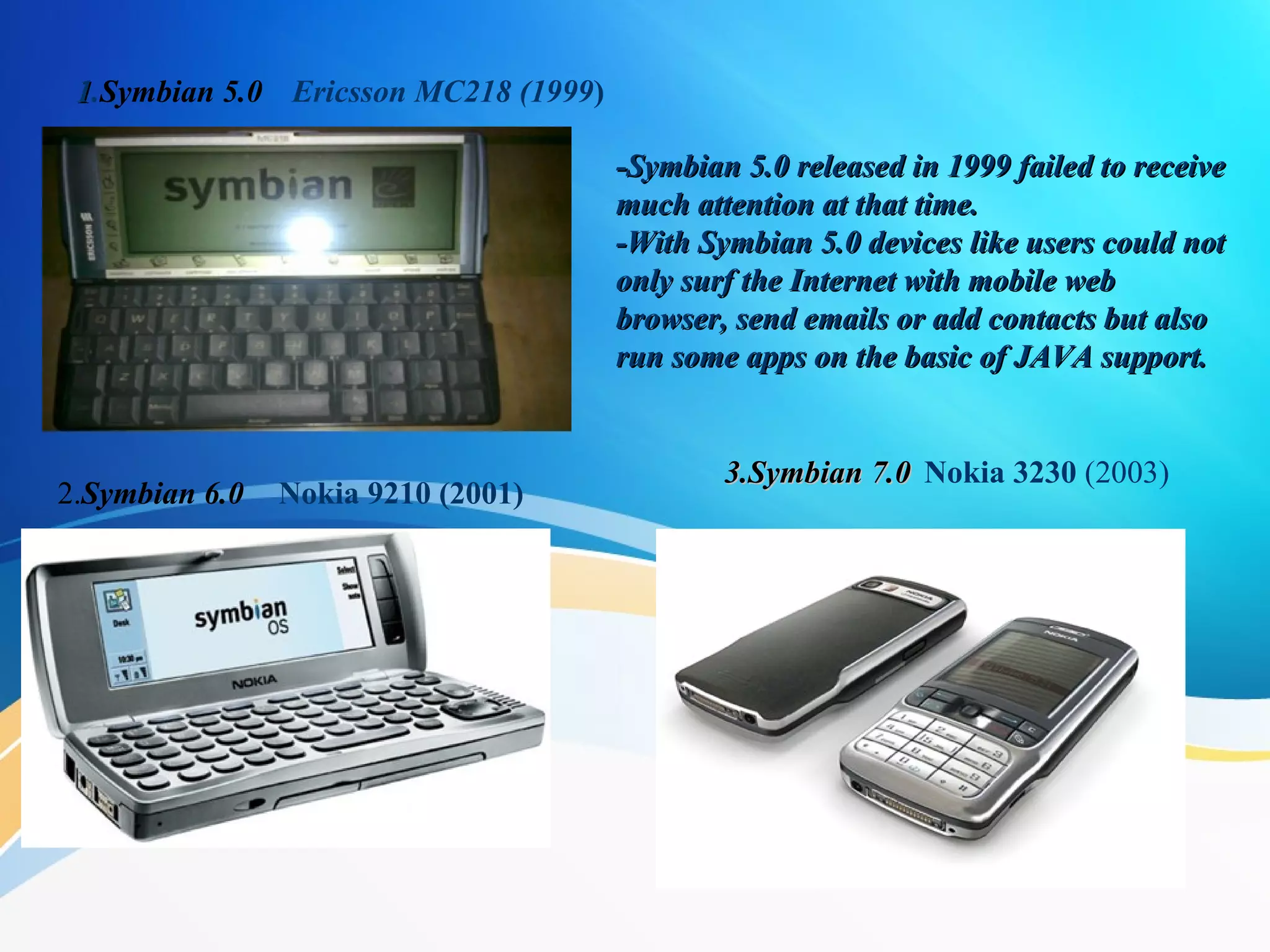
11.Symbian 5.0
-Symbian 5.0 released in 1999 failed to receive-Symbian 5.0 released in 1999 failed to receive
much attention at that time.much attention at that time.
-With Symbian 5.0 devices like users could not-With Symbian 5.0 devices like users could not
only surf the Internet with mobile webonly surf the Internet with mobile web
browser, send emails or add contacts but alsobrowser, send emails or add contacts but also
run some apps on the basic of JAVA support.run some apps on the basic of JAVA support.
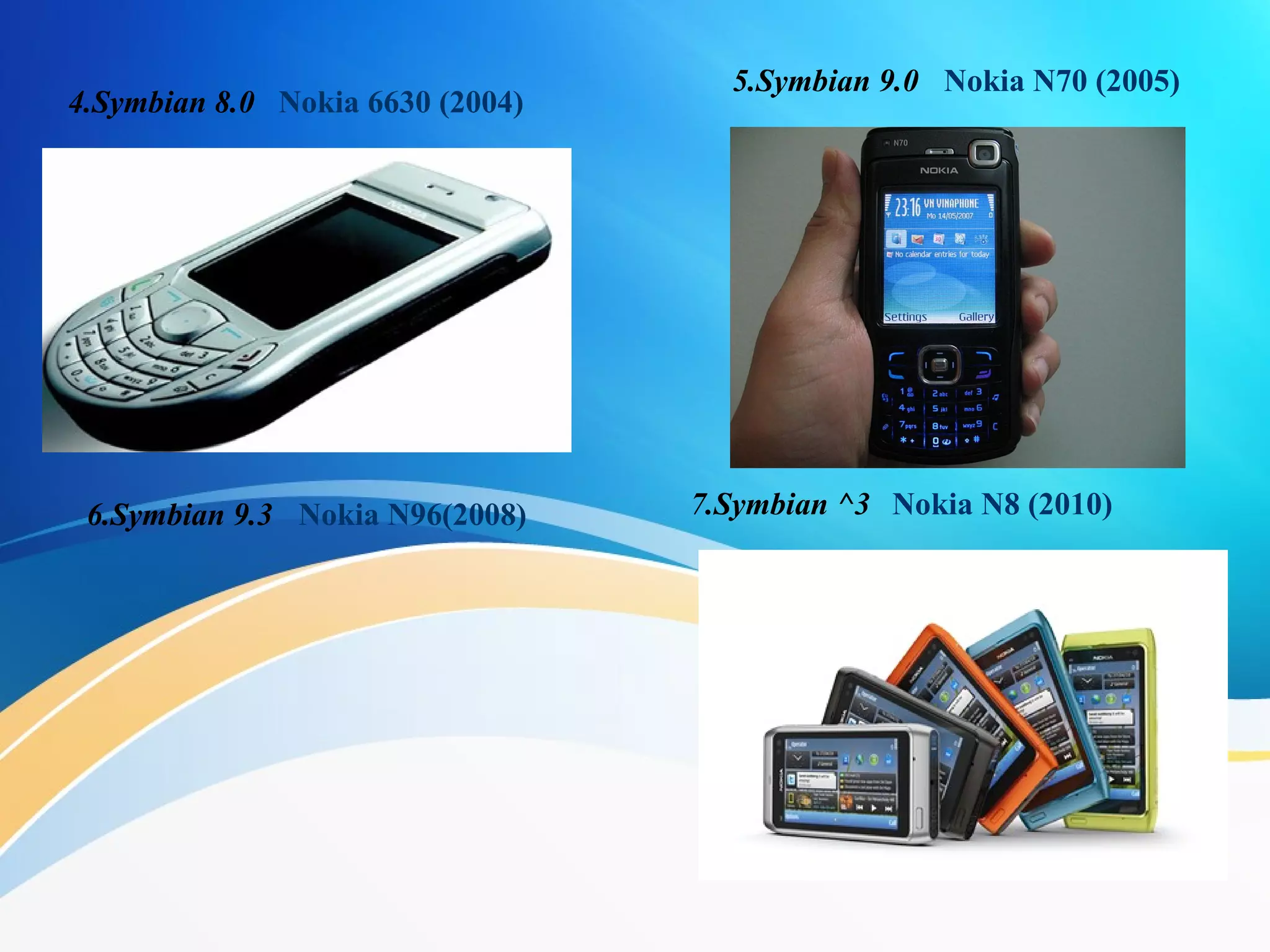
2.Symbian 6.0
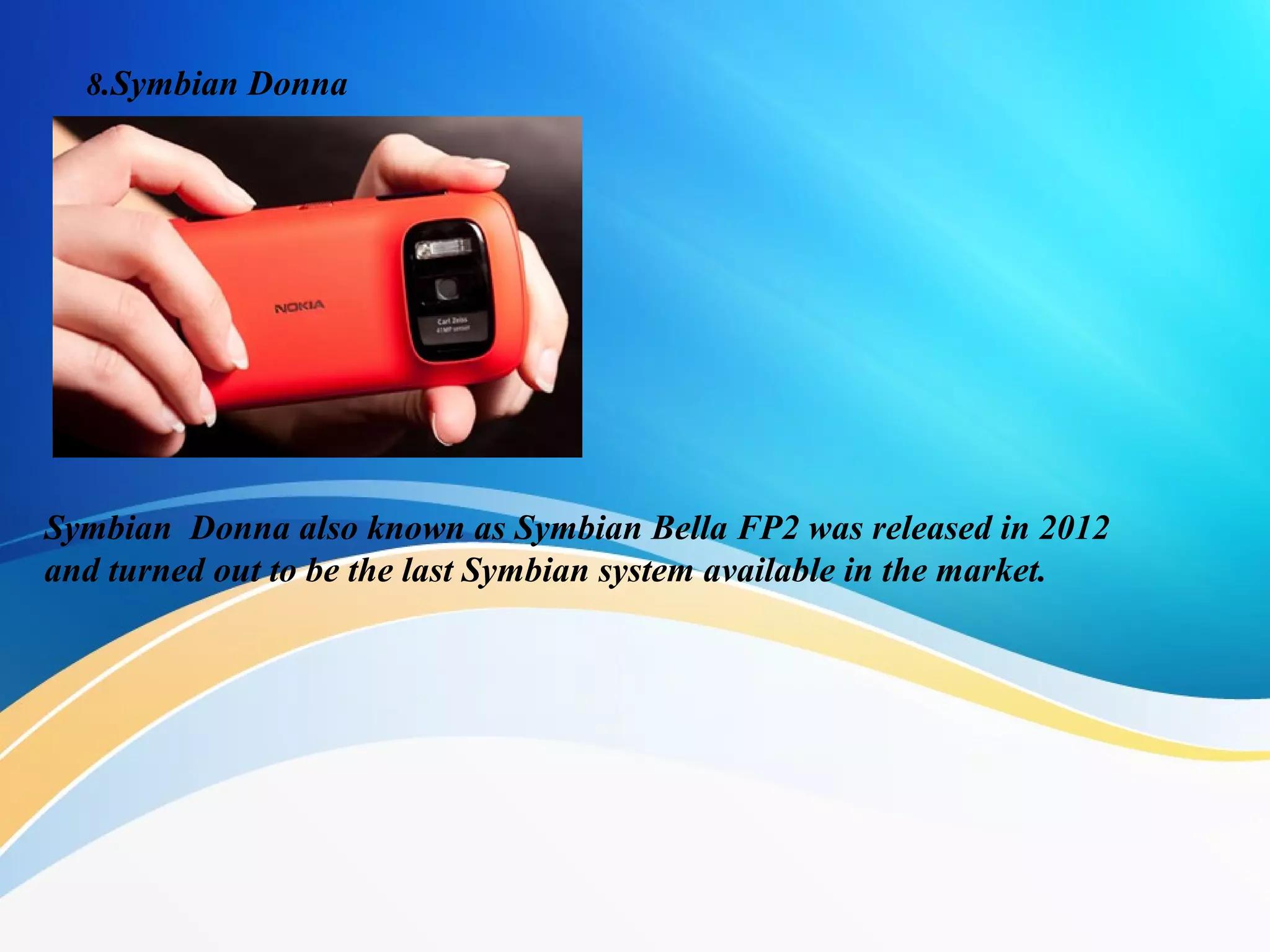
3.Symbian 7.03.Symbian 7.0 Nokia 3230 (2003)
Nokia 9210 (2001) 
Ericsson MC218 (1999)
6.Symbian 9.3
5.Symbian 9.0
4.Symbian 8.0
7.Symbian ^3 Nokia N8 (2010)Nokia N96(2008)
Nokia N70 (2005)
Nokia 6630 (2004)
8.Symbian Donna
Symbian Donna also known as Symbian Bella FP2 was released in 2012
and turned out to be the last Symbian system available in the market.
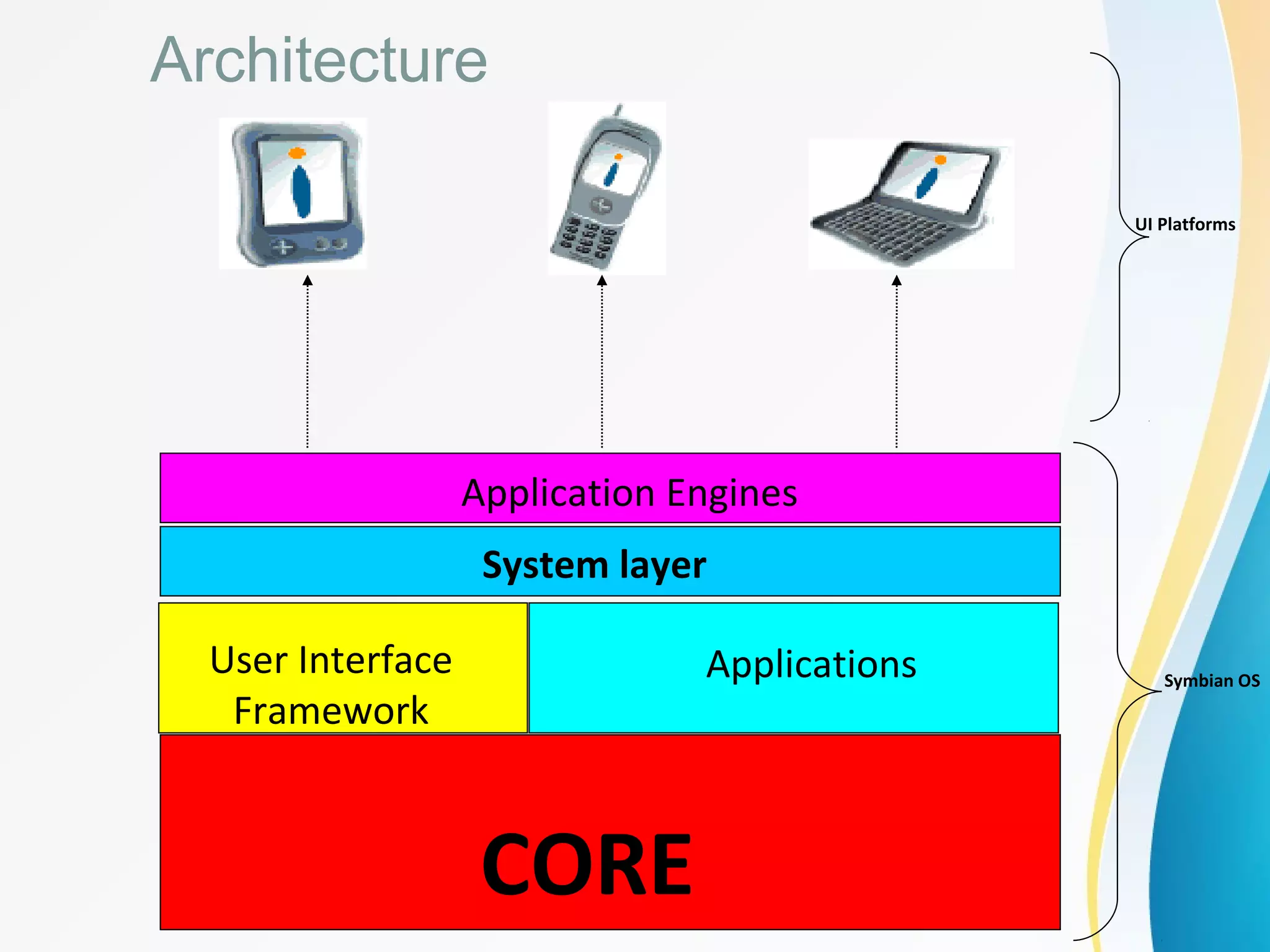
Architecture
Application Engines
User Interface
Framework
Applications
System layer
CORE
Symbian OS
UI Platforms
Architectural Overview
1. Core : Symbian OS core is common to all
devices i.e. kernel, file server,
memory management & device
drivers.
2. System layer : It provides communication
& computing services such as TCP/IP,
SMS & database management.
3. Application Engines : It’s above the
system layer, enabling the software
4. User Interface Software : It
can be made or licensed by
manufacturers.
5. Applications : are slotted
aboved the user interface &
pre-loaded in the Symbian
OS mobile phone.
Software Devlopment
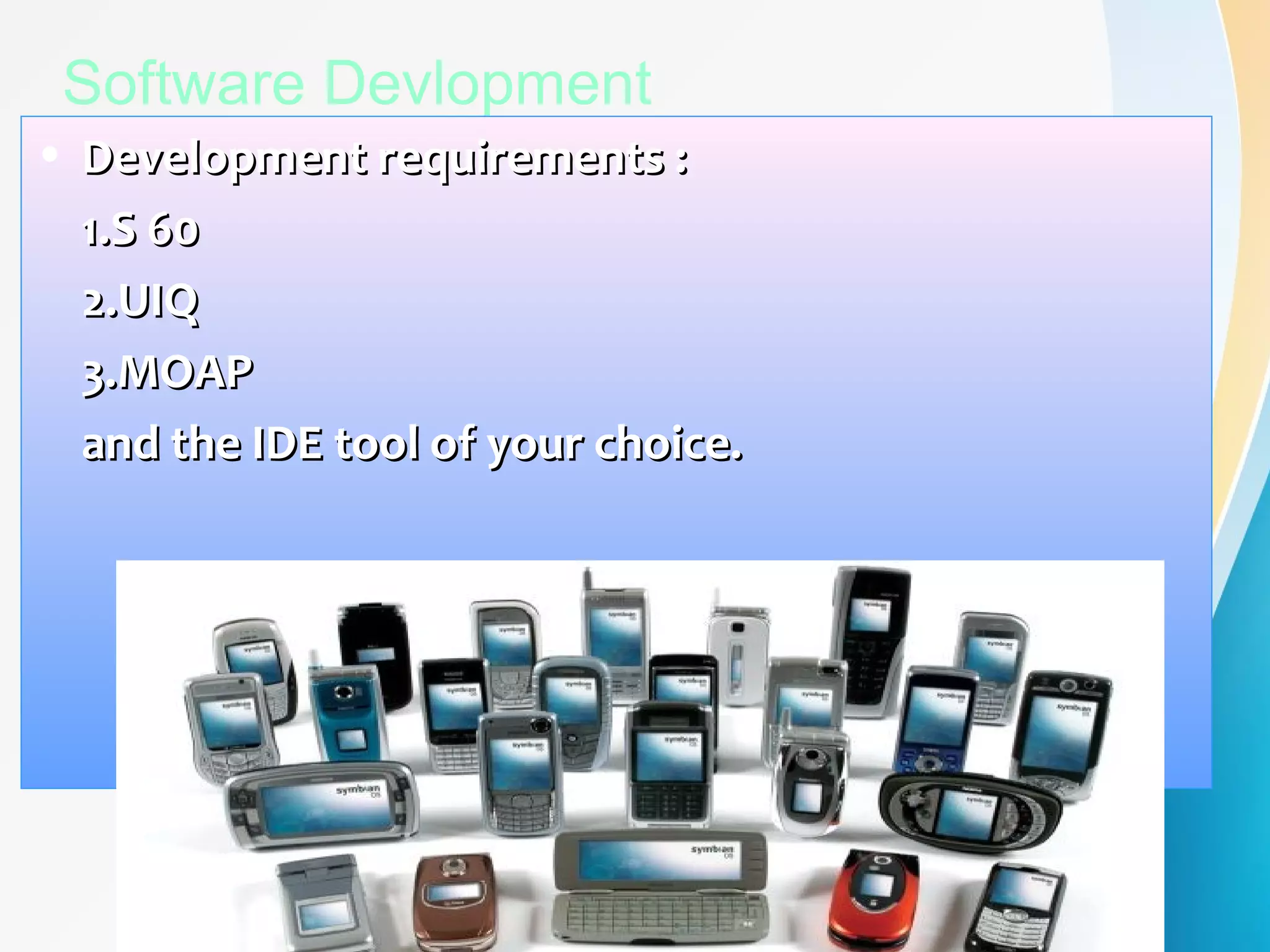
• Development requirements :Development requirements :
1.S 601.S 60
2.UIQ2.UIQ
3.MOAP3.MOAP
and the IDE tool of your choice.and the IDE tool of your choice.
What is IDE ?
• An IDE is a software application that allows the
computer programmer to develop a software for a
certain platform. An IDE has a source editor,
compiler and debugger.
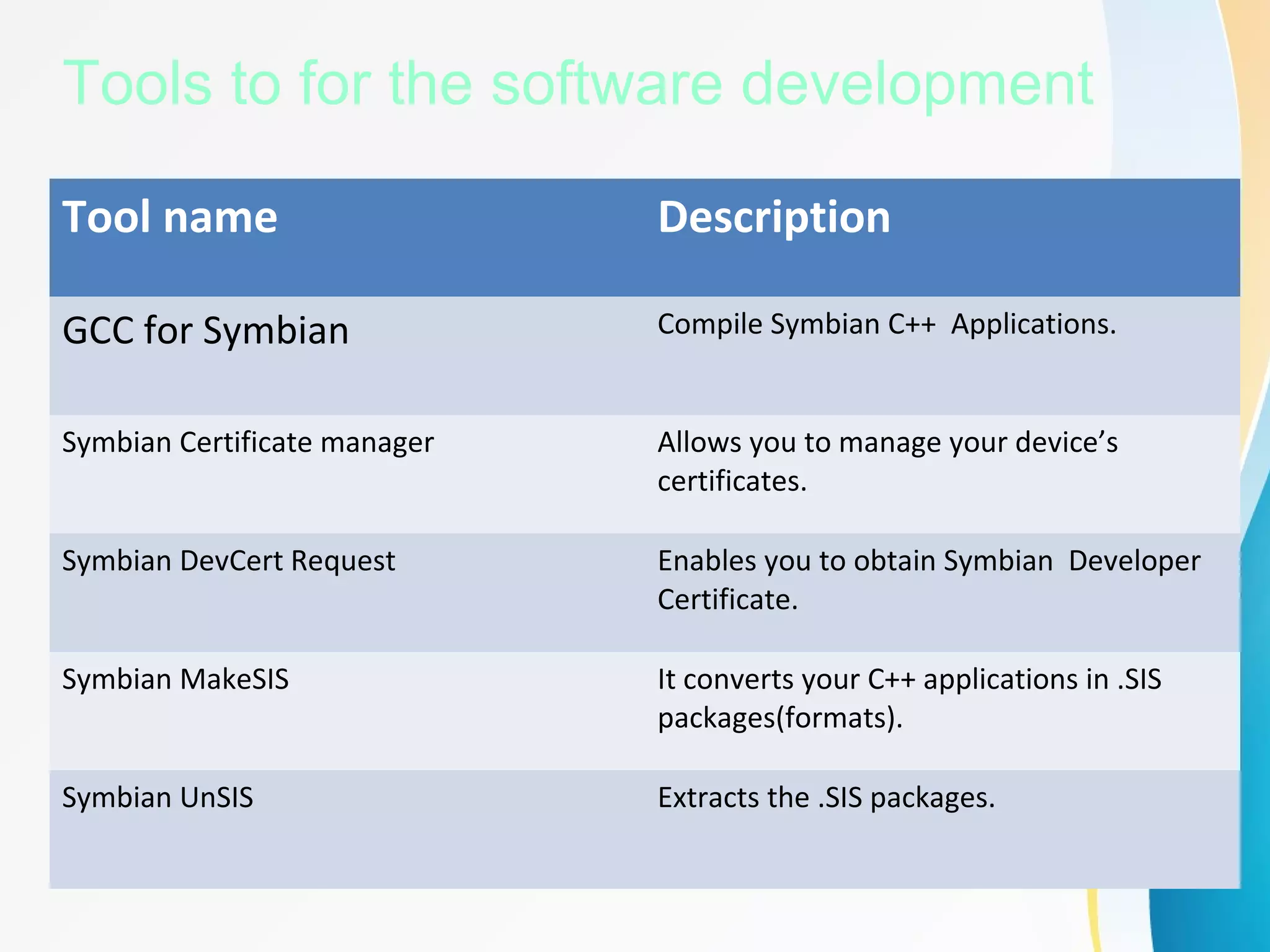
Tools to for the software development
Tool name Description
GCC for Symbian Compile Symbian C++ Applications.
Symbian Certificate manager Allows you to manage your device’s
certificates.
Symbian DevCert Request Enables you to obtain Symbian Developer
Certificate.
Symbian MakeSIS It converts your C++ applications in .SIS
packages(formats).
Symbian UnSIS Extracts the .SIS packages.
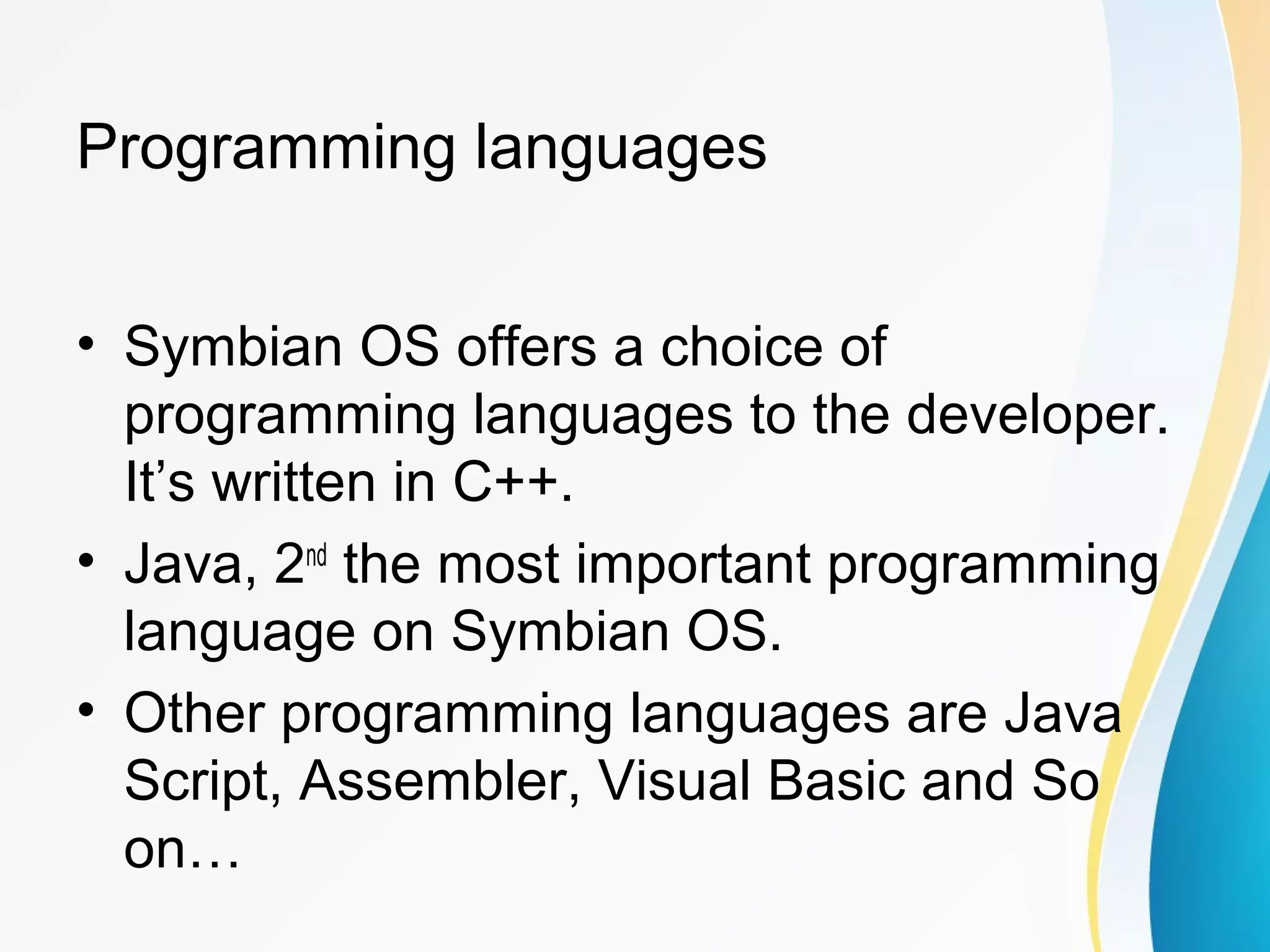
Programming languages
• Symbian OS offers a choice of
programming languages to the developer.
It’s written in C++.
• Java, 2nd
the most important programming
language on Symbian OS.
• Other programming languages are Java
Script, Assembler, Visual Basic and So
on…
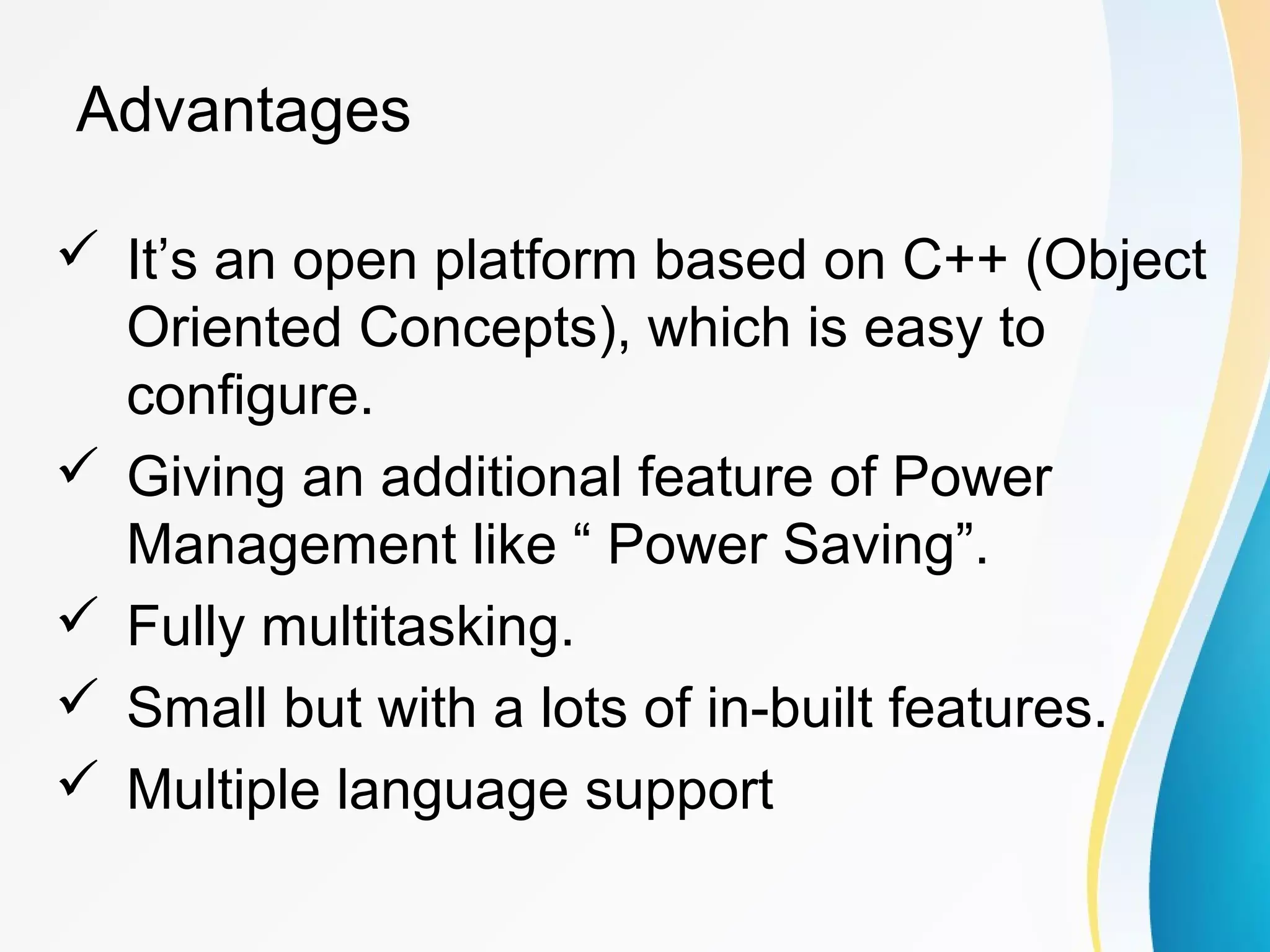
Advantages
 It’s an open platform based on C++ (Object
Oriented Concepts), which is easy to
configure.
 Giving an additional feature of Power
Management like “ Power Saving”.
 Fully multitasking.
 Small but with a lots of in-built features.
 Multiple language support
Disadvantages
• Not available for PCs.
• Level of security is low and such accessibility
makes the OS vulnerable to viruses.
Conclusion
• Symbian OS is a multi-tasking
operating system which
addressing the mass-market
and designed for simplifying
the work load.
• It’s a open platform allows the
installation of third party
software to enhance the
platform.
Symbian OS
Symbian OS

Symbian OS

  • 2.
    Symbian Mobile OperatingSystemSymbian Mobile Operating System Submitted By Arun s kurupArun s kurup S5 CTS5 CT
  • 3.
    • IntroductionIntroduction • Needfor Symbian OSNeed for Symbian OS • Evolution in the various versionsEvolution in the various versions • ArchitectureArchitecture • Architectural OverviewArchitectural Overview • Software DevelopmentSoftware Development • Programming LanguagesProgramming Languages • Advantages & DisadvantagesAdvantages & Disadvantages • ConclusionConclusion
  • 4.
    • Symbian OSis designed for the mobile phone environment.Symbian OS is designed for the mobile phone environment. • The Smartphone operating system Symbian OS is producedThe Smartphone operating system Symbian OS is produced by the software development and licensing companyby the software development and licensing company Symbian Ltd.Symbian Ltd. • Symbian Ltd was established in June 1998 and isSymbian Ltd was established in June 1998 and is headquartered in Southwark in the UK, and the current CEOheadquartered in Southwark in the UK, and the current CEO is Nigel Cliffordis Nigel Clifford.. IntroductionIntroduction
  • 5.
    Need for SymbianOS • Small & mobile, but always available.Small & mobile, but always available. • Addressing the mass marketAddressing the mass market • Open platformOpen platform
  • 6.
    11.Symbian 5.0 -Symbian 5.0released in 1999 failed to receive-Symbian 5.0 released in 1999 failed to receive much attention at that time.much attention at that time. -With Symbian 5.0 devices like users could not-With Symbian 5.0 devices like users could not only surf the Internet with mobile webonly surf the Internet with mobile web browser, send emails or add contacts but alsobrowser, send emails or add contacts but also run some apps on the basic of JAVA support.run some apps on the basic of JAVA support. 2.Symbian 6.0 3.Symbian 7.03.Symbian 7.0 Nokia 3230 (2003) Nokia 9210 (2001)  Ericsson MC218 (1999)
  • 7.
    6.Symbian 9.3 5.Symbian 9.0 4.Symbian8.0 7.Symbian ^3 Nokia N8 (2010)Nokia N96(2008) Nokia N70 (2005) Nokia 6630 (2004)
  • 8.
    8.Symbian Donna Symbian Donnaalso known as Symbian Bella FP2 was released in 2012 and turned out to be the last Symbian system available in the market.
  • 9.
  • 10.
    Architectural Overview 1. Core: Symbian OS core is common to all devices i.e. kernel, file server, memory management & device drivers. 2. System layer : It provides communication & computing services such as TCP/IP, SMS & database management. 3. Application Engines : It’s above the system layer, enabling the software
  • 11.
    4. User InterfaceSoftware : It can be made or licensed by manufacturers. 5. Applications : are slotted aboved the user interface & pre-loaded in the Symbian OS mobile phone.
  • 12.
    Software Devlopment • Developmentrequirements :Development requirements : 1.S 601.S 60 2.UIQ2.UIQ 3.MOAP3.MOAP and the IDE tool of your choice.and the IDE tool of your choice.
  • 13.
    What is IDE? • An IDE is a software application that allows the computer programmer to develop a software for a certain platform. An IDE has a source editor, compiler and debugger.
  • 14.
    Tools to forthe software development Tool name Description GCC for Symbian Compile Symbian C++ Applications. Symbian Certificate manager Allows you to manage your device’s certificates. Symbian DevCert Request Enables you to obtain Symbian Developer Certificate. Symbian MakeSIS It converts your C++ applications in .SIS packages(formats). Symbian UnSIS Extracts the .SIS packages.
  • 15.
    Programming languages • SymbianOS offers a choice of programming languages to the developer. It’s written in C++. • Java, 2nd the most important programming language on Symbian OS. • Other programming languages are Java Script, Assembler, Visual Basic and So on…
  • 16.
    Advantages  It’s anopen platform based on C++ (Object Oriented Concepts), which is easy to configure.  Giving an additional feature of Power Management like “ Power Saving”.  Fully multitasking.  Small but with a lots of in-built features.  Multiple language support
  • 17.
    Disadvantages • Not availablefor PCs. • Level of security is low and such accessibility makes the OS vulnerable to viruses.
  • 18.
    Conclusion • Symbian OSis a multi-tasking operating system which addressing the mass-market and designed for simplifying the work load. • It’s a open platform allows the installation of third party software to enhance the platform.