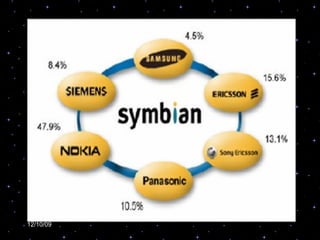
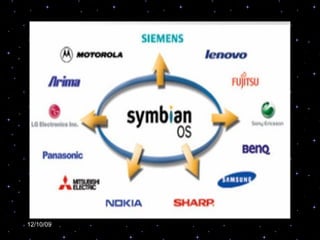
INTRODUCTION a  proprietary  operating system, designed for mobile devices, with associated libraries, user interface frameworks and reference implementations of common tools produced by Symbian Pvt Ltd. currently owned by Nokia ,Sony Ericsson, Panasonic, Siemens AG and Samsung  a descendant of Psion’s   EPOC
More … Market leader with a 70% share runs exclusively on ARM processors Structure:32 bit micro kernel architecture  Developing language :Commonly C++ and Java  Design: event based ,pre-emptive multitasking and multithreading  Openness :not ‘open’ in the sense of Open source software-the source code is not publicly available
Contd… Applications are object oriented Restricted memory Optimum memory management performance Reduced power consumption
 
 
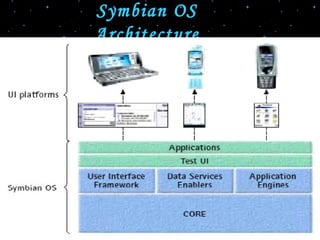
Symbian OS Architecture
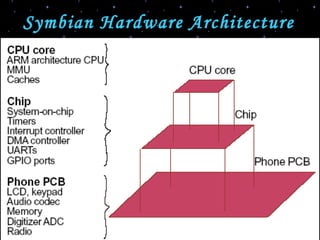
Symbian Hardware Architecture
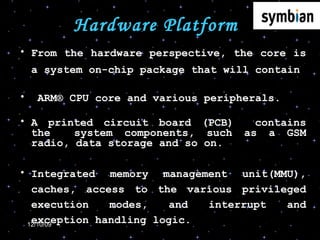
Hardware Platform From the hardware perspective, the core is a system on-chip package that will contain ARM® CPU core and various peripherals. A printed circuit board (PCB)  contains the  system components, such as a GSM radio, data storage and so on. Integrated memory management unit(MMU), caches, access to the various privileged execution modes, and interrupt and exception handling logic.
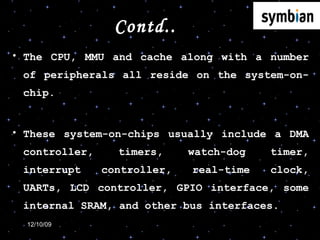
Contd.. The CPU, MMU and cache along with a number of peripherals all reside on the system-on-chip. These system-on-chips usually include a DMA controller, timers, watch-dog timer, interrupt controller, real-time clock, UARTs, LCD controller, GPIO interface, some internal SRAM, and other bus interfaces.
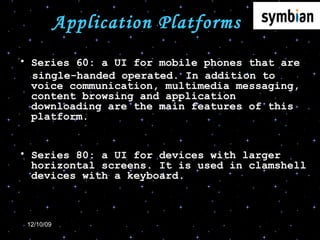
Application Platforms Series 60: a UI for mobile phones that are  single-handed operated. In addition to voice communication, multimedia messaging, content browsing and application downloading are the main features of this platform. Series 80: a UI for devices with larger horizontal screens. It is used in clamshell devices with a keyboard.
Contd … UIQ : a customizable pen-based user interface platform for media-rich mobile phones based on Symbian OS. Symbian OS is also being used in the new Series 90 platform, which is being introduced in the Nokia 7700phone. With a pen input user interface, a horizontal screen and an optional television tuner, the Nokia 7700 brings mobile multimedia to a new level
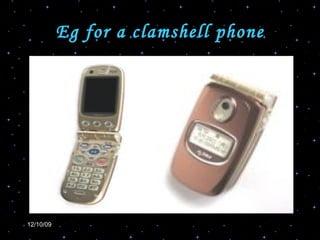
Eg for a clamshell phone
History EPOC16 OS EPOC32 OS   Symbian OS(1998) Symbian v5.1: The first phone Ericsson R380 in  2000 Symbian OS v6.0 and v6.1 Nokia 9210 using v6.0 Symbian OS v7.0 and v7.0s  2003 UIQ(S E P800,P900,p910,Motorola A925,A1000),S80(Nokia9300,9500),S90(Nokia7710),S60(Nokia6600,7310),FOMA phones .
Contd… Symbian OS v8.0  2004 Symbian OS v8.1:  v8.1a and v8.1b  popular among Japanese phone companies  Symbian v9.0 Symbian v9.1  2005 S60 3 rd  edition phones ,S E M600i,P990 Symbian v9.2   first quarter of 2006 Symbian v9.3  July 2006 Symbian v9.5  March 2007
About Symbian v9.5 Memory management: flash and expansion card memory ,kernel runs with its own address space File management: file server provides access. The drive ,directory and file hierarchy is VFAT. File manager for file handling application. Provides local file systems (RAM, ROM and removable media)
Contd … Introducing demand paging RAM defragmentation and 25% reduced RAM usage File caching Memory optimization SQL database Active synchronization
Contd… More scalable database Real time networking Location based service frameworks Support for mobile digital television broadcasts Advanced camera features
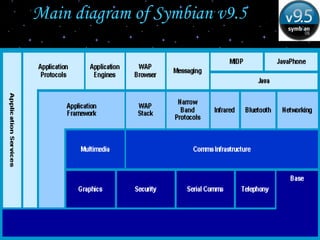
Main diagram of Symbian v9.5
base security graphics application framework application engines multimedia application services application protocols communication infrastructure infrared, bluetooth ,networking Details…
Contd … telephony messaging WAP stack WAP browser MIDP (Mobile Information Device Profile) Java
Development Kits Symbian OS Customization Kit (CustKit) Symbian OS Development Kit (DevKit) Symbian OS Binary Access Kit (BAK) Symbian OS Technology Preview SDK(TPSDK)
User’s of Symbian OS Ericsson R380 (2000) was the first commercially  available phone based on Symbian OS. As with the modern "FOMA" phones, this device was closed, and the user could not install new C++ applications. Unlike those, however, the R380 could not even run Java applications. Nokia 9210 Communicator smartphone (32-bit 66 MHz ARM9-based RISC CPU) (2001), 9300 Communicator (2004), 9500 Communicator (2004) using the Nokia Series 80 interface  UIQ interface: Used for PDAs such as Sony Ericsson  P800 (2002), P900 (2003), P910 (2004), P990, W950, M600, Motorola A920, A925, A1000, DoCoMoM1000, BenQ P30, P31 and Nokia  6708 using this interface.
Contd… Nokia S60 (2002):  The first being the Nokia 7650,Nokia 3650, Nokia 3620/3660, Nokia NGage and Nokia N-Gage QD gaming/smartphone combos. It was also used on other manufacturers' phones such as the Siemens SX1, Sendo X, Panasonic X700, Panasonic X800, Samsung SGH-D730 etc. A next generation N series, including the Nokia N70, Nokia N72,  Nokia N73, Nokia N75, Nokia N80, Nokia N90, Nokia N91, Nokia N92, Nokia N93 and Nokia N95, and the enterprise (i.e. business) model E  series, including the Nokia E50, Nokia E60, Nokia E61, Nokia E62 etc
Contd… Nokia 7710 (2004) using the Nokia Series 90 interface: Fujitsu, Mitsubishi, Sony Ericsson and Sharp phones for NTT DoCoMo in Japan,  using an interface developed specifically for DoCoMo's FOMA "Freedom of Mobile Access" network brand. This UI platform is called MOAP  "Mobile Orientated Applications Platform" and is based on the UI from earlier Fujitsu FOMA models.
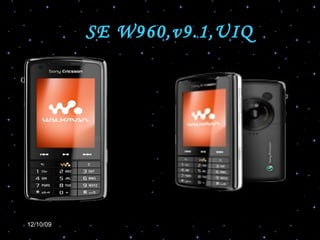
SE W960,v9.1,UIQ
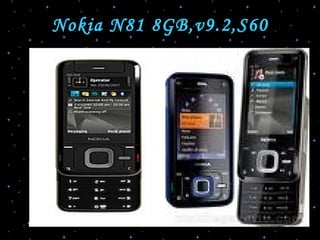
Nokia N81 8GB,v9.2,S60
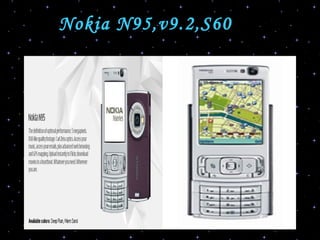
Nokia N95,v9.2,S60
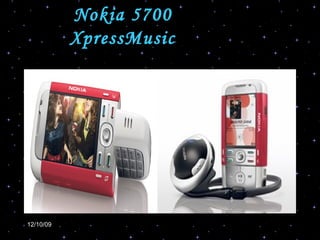
Nokia 5700 XpressMusic Nokia
Advantages  Boots in seconds Optimum memory management performance Reduced power consumption APIs are publicly documented and anyone can develop software for Symbian OS Offering extensive customization options and supporting global technology standards as well as languages from 99% of the world’s countries 3G and HSDPA (High Speed Downlink Packet Access)  Seamless multitasking for uninterrupted VoIP ,push email
Contd… High resolution support Unlocking youth market demands Seamless connectivity for music and pictures and so on
Issues … Symbian OS subject to a variety of viruses ,the best known of which is  Cabir SIS (Symbian Installation Source) file trojans like Drever.A  Frontal.A
Future … super 3G WiMax and 4G all IP wireless broadband and bearer mobility Ultra high resolution color displays Rich multimedia enablers (for creation ,consumption, communication) High speed, low-latency real-time networking
Contd … Large memories and persistent storage Superior graphics effects in the user interface Energy and thermal efficiency and so on
Summary It has support for all the leading industry standards that will be essential for the current and forthcoming generations of data enabled mobile phones.  The open platform allows the installation of third party software to further enhance the user experience with these phones. Symbian OS is trying to replace PC.
THANK YOU

Symbian OS

  • 1.
  • 2.
    INTRODUCTION a proprietary operating system, designed for mobile devices, with associated libraries, user interface frameworks and reference implementations of common tools produced by Symbian Pvt Ltd. currently owned by Nokia ,Sony Ericsson, Panasonic, Siemens AG and Samsung a descendant of Psion’s EPOC
  • 3.
    More … Marketleader with a 70% share runs exclusively on ARM processors Structure:32 bit micro kernel architecture Developing language :Commonly C++ and Java Design: event based ,pre-emptive multitasking and multithreading Openness :not ‘open’ in the sense of Open source software-the source code is not publicly available
  • 4.
    Contd… Applications areobject oriented Restricted memory Optimum memory management performance Reduced power consumption
  • 5.
  • 6.
  • 7.
  • 8.
  • 9.
    Hardware Platform Fromthe hardware perspective, the core is a system on-chip package that will contain ARM® CPU core and various peripherals. A printed circuit board (PCB) contains the system components, such as a GSM radio, data storage and so on. Integrated memory management unit(MMU), caches, access to the various privileged execution modes, and interrupt and exception handling logic.
  • 10.
    Contd.. The CPU,MMU and cache along with a number of peripherals all reside on the system-on-chip. These system-on-chips usually include a DMA controller, timers, watch-dog timer, interrupt controller, real-time clock, UARTs, LCD controller, GPIO interface, some internal SRAM, and other bus interfaces.
  • 11.
    Application Platforms Series60: a UI for mobile phones that are single-handed operated. In addition to voice communication, multimedia messaging, content browsing and application downloading are the main features of this platform. Series 80: a UI for devices with larger horizontal screens. It is used in clamshell devices with a keyboard.
  • 12.
    Contd … UIQ: a customizable pen-based user interface platform for media-rich mobile phones based on Symbian OS. Symbian OS is also being used in the new Series 90 platform, which is being introduced in the Nokia 7700phone. With a pen input user interface, a horizontal screen and an optional television tuner, the Nokia 7700 brings mobile multimedia to a new level
  • 13.
    Eg for aclamshell phone
  • 14.
    History EPOC16 OSEPOC32 OS  Symbian OS(1998) Symbian v5.1: The first phone Ericsson R380 in 2000 Symbian OS v6.0 and v6.1 Nokia 9210 using v6.0 Symbian OS v7.0 and v7.0s  2003 UIQ(S E P800,P900,p910,Motorola A925,A1000),S80(Nokia9300,9500),S90(Nokia7710),S60(Nokia6600,7310),FOMA phones .
  • 15.
    Contd… Symbian OSv8.0  2004 Symbian OS v8.1: v8.1a and v8.1b popular among Japanese phone companies Symbian v9.0 Symbian v9.1  2005 S60 3 rd edition phones ,S E M600i,P990 Symbian v9.2  first quarter of 2006 Symbian v9.3  July 2006 Symbian v9.5  March 2007
  • 16.
    About Symbian v9.5Memory management: flash and expansion card memory ,kernel runs with its own address space File management: file server provides access. The drive ,directory and file hierarchy is VFAT. File manager for file handling application. Provides local file systems (RAM, ROM and removable media)
  • 17.
    Contd … Introducingdemand paging RAM defragmentation and 25% reduced RAM usage File caching Memory optimization SQL database Active synchronization
  • 18.
    Contd… More scalabledatabase Real time networking Location based service frameworks Support for mobile digital television broadcasts Advanced camera features
  • 19.
    Main diagram ofSymbian v9.5
  • 20.
    base security graphicsapplication framework application engines multimedia application services application protocols communication infrastructure infrared, bluetooth ,networking Details…
  • 21.
    Contd … telephonymessaging WAP stack WAP browser MIDP (Mobile Information Device Profile) Java
  • 22.
    Development Kits SymbianOS Customization Kit (CustKit) Symbian OS Development Kit (DevKit) Symbian OS Binary Access Kit (BAK) Symbian OS Technology Preview SDK(TPSDK)
  • 23.
    User’s of SymbianOS Ericsson R380 (2000) was the first commercially available phone based on Symbian OS. As with the modern "FOMA" phones, this device was closed, and the user could not install new C++ applications. Unlike those, however, the R380 could not even run Java applications. Nokia 9210 Communicator smartphone (32-bit 66 MHz ARM9-based RISC CPU) (2001), 9300 Communicator (2004), 9500 Communicator (2004) using the Nokia Series 80 interface UIQ interface: Used for PDAs such as Sony Ericsson P800 (2002), P900 (2003), P910 (2004), P990, W950, M600, Motorola A920, A925, A1000, DoCoMoM1000, BenQ P30, P31 and Nokia 6708 using this interface.
  • 24.
    Contd… Nokia S60(2002): The first being the Nokia 7650,Nokia 3650, Nokia 3620/3660, Nokia NGage and Nokia N-Gage QD gaming/smartphone combos. It was also used on other manufacturers' phones such as the Siemens SX1, Sendo X, Panasonic X700, Panasonic X800, Samsung SGH-D730 etc. A next generation N series, including the Nokia N70, Nokia N72, Nokia N73, Nokia N75, Nokia N80, Nokia N90, Nokia N91, Nokia N92, Nokia N93 and Nokia N95, and the enterprise (i.e. business) model E series, including the Nokia E50, Nokia E60, Nokia E61, Nokia E62 etc
  • 25.
    Contd… Nokia 7710(2004) using the Nokia Series 90 interface: Fujitsu, Mitsubishi, Sony Ericsson and Sharp phones for NTT DoCoMo in Japan, using an interface developed specifically for DoCoMo's FOMA "Freedom of Mobile Access" network brand. This UI platform is called MOAP "Mobile Orientated Applications Platform" and is based on the UI from earlier Fujitsu FOMA models.
  • 26.
  • 27.
  • 28.
  • 29.
  • 30.
    Advantages Bootsin seconds Optimum memory management performance Reduced power consumption APIs are publicly documented and anyone can develop software for Symbian OS Offering extensive customization options and supporting global technology standards as well as languages from 99% of the world’s countries 3G and HSDPA (High Speed Downlink Packet Access) Seamless multitasking for uninterrupted VoIP ,push email
  • 31.
    Contd… High resolutionsupport Unlocking youth market demands Seamless connectivity for music and pictures and so on
  • 32.
    Issues … SymbianOS subject to a variety of viruses ,the best known of which is Cabir SIS (Symbian Installation Source) file trojans like Drever.A Frontal.A
  • 33.
    Future … super3G WiMax and 4G all IP wireless broadband and bearer mobility Ultra high resolution color displays Rich multimedia enablers (for creation ,consumption, communication) High speed, low-latency real-time networking
  • 34.
    Contd … Largememories and persistent storage Superior graphics effects in the user interface Energy and thermal efficiency and so on
  • 35.
    Summary It hassupport for all the leading industry standards that will be essential for the current and forthcoming generations of data enabled mobile phones. The open platform allows the installation of third party software to further enhance the user experience with these phones. Symbian OS is trying to replace PC.
  • 36.