Revised Bloom’s Taxonomy,
2001
Dr Shiva Shukla
Associate Professor, Guru Kashi University, Talwandi Sabo
What is Bloom’s Taxonomy
• Specific Learning Objectives and Assessment criterion
• Three domains of learning: cognitive, affective and psychomotor
• The cognitive domain is adapted for classroom use as a planning tool
• Organizes thinking at six hierarchical levels
• From the most basic level of thinking to the most complex level of
thinking
• The verb generally refers to actions associated with the intended
cognitive process
• The object generally describes the knowledge students are expected
to acquire or construct
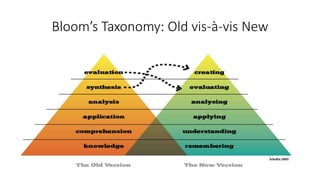
Bloom’s Taxonomy: Old vis-à-vis New
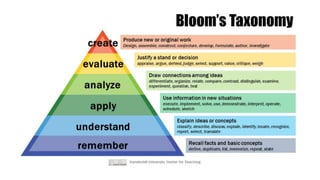
Revised Bloom’s Taxonomy
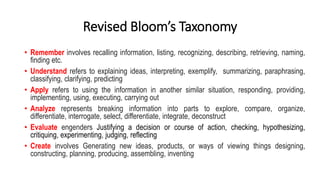
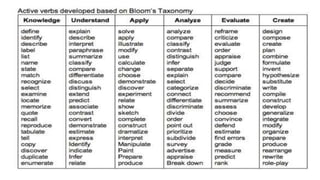
• Remember involves recalling information, listing, recognizing, describing, retrieving, naming,
finding etc.
• Understand refers to explaining ideas, interpreting, exemplify, summarizing, paraphrasing,
classifying, clarifying, predicting
• Apply refers to using the information in another similar situation, responding, providing,
implementing, using, executing, carrying out
• Analyze represents breaking information into parts to explore, compare, organize,
differentiate, interrogate, select, differentiate, integrate, deconstruct
• Evaluate engenders Justifying a decision or course of action, checking, hypothesizing,
critiquing, experimenting, judging, reflecting
• Create involves Generating new ideas, products, or ways of viewing things designing,
constructing, planning, producing, assembling, inventing
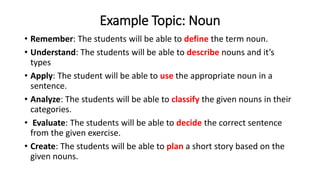
Example Topic: Noun
• Remember: The students will be able to define the term noun.
• Understand: The students will be able to describe nouns and it’s
types
• Apply: The student will be able to use the appropriate noun in a
sentence.
• Analyze: The students will be able to classify the given nouns in their
categories.
• Evaluate: The students will be able to decide the correct sentence
from the given exercise.
• Create: The students will be able to plan a short story based on the
given nouns.
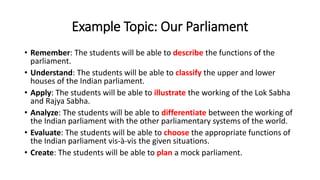
Example Topic: Our Parliament
• Remember: The students will be able to describe the functions of the
parliament.
• Understand: The students will be able to classify the upper and lower
houses of the Indian parliament.
• Apply: The students will be able to illustrate the working of the Lok Sabha
and Rajya Sabha.
• Analyze: The students will be able to differentiate between the working of
the Indian parliament with the other parliamentary systems of the world.
• Evaluate: The students will be able to choose the appropriate functions of
the Indian parliament vis-à-vis the given situations.
• Create: The students will be able to plan a mock parliament.
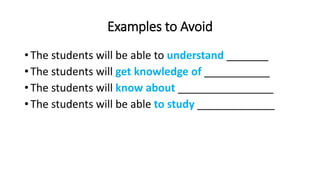
Examples to Avoid
• The students will be able to understand _______
• The students will get knowledge of ___________
• The students will know about ________________
• The students will be able to study _____________

Revised Bloom’s Taxonomy.pptx

  • 1.
    Revised Bloom’s Taxonomy, 2001 DrShiva Shukla Associate Professor, Guru Kashi University, Talwandi Sabo
  • 2.
    What is Bloom’sTaxonomy • Specific Learning Objectives and Assessment criterion • Three domains of learning: cognitive, affective and psychomotor • The cognitive domain is adapted for classroom use as a planning tool • Organizes thinking at six hierarchical levels • From the most basic level of thinking to the most complex level of thinking • The verb generally refers to actions associated with the intended cognitive process • The object generally describes the knowledge students are expected to acquire or construct
  • 3.
  • 5.
    Revised Bloom’s Taxonomy •Remember involves recalling information, listing, recognizing, describing, retrieving, naming, finding etc. • Understand refers to explaining ideas, interpreting, exemplify, summarizing, paraphrasing, classifying, clarifying, predicting • Apply refers to using the information in another similar situation, responding, providing, implementing, using, executing, carrying out • Analyze represents breaking information into parts to explore, compare, organize, differentiate, interrogate, select, differentiate, integrate, deconstruct • Evaluate engenders Justifying a decision or course of action, checking, hypothesizing, critiquing, experimenting, judging, reflecting • Create involves Generating new ideas, products, or ways of viewing things designing, constructing, planning, producing, assembling, inventing
  • 7.
    Example Topic: Noun •Remember: The students will be able to define the term noun. • Understand: The students will be able to describe nouns and it’s types • Apply: The student will be able to use the appropriate noun in a sentence. • Analyze: The students will be able to classify the given nouns in their categories. • Evaluate: The students will be able to decide the correct sentence from the given exercise. • Create: The students will be able to plan a short story based on the given nouns.
  • 8.
    Example Topic: OurParliament • Remember: The students will be able to describe the functions of the parliament. • Understand: The students will be able to classify the upper and lower houses of the Indian parliament. • Apply: The students will be able to illustrate the working of the Lok Sabha and Rajya Sabha. • Analyze: The students will be able to differentiate between the working of the Indian parliament with the other parliamentary systems of the world. • Evaluate: The students will be able to choose the appropriate functions of the Indian parliament vis-à-vis the given situations. • Create: The students will be able to plan a mock parliament.
  • 9.
    Examples to Avoid •The students will be able to understand _______ • The students will get knowledge of ___________ • The students will know about ________________ • The students will be able to study _____________