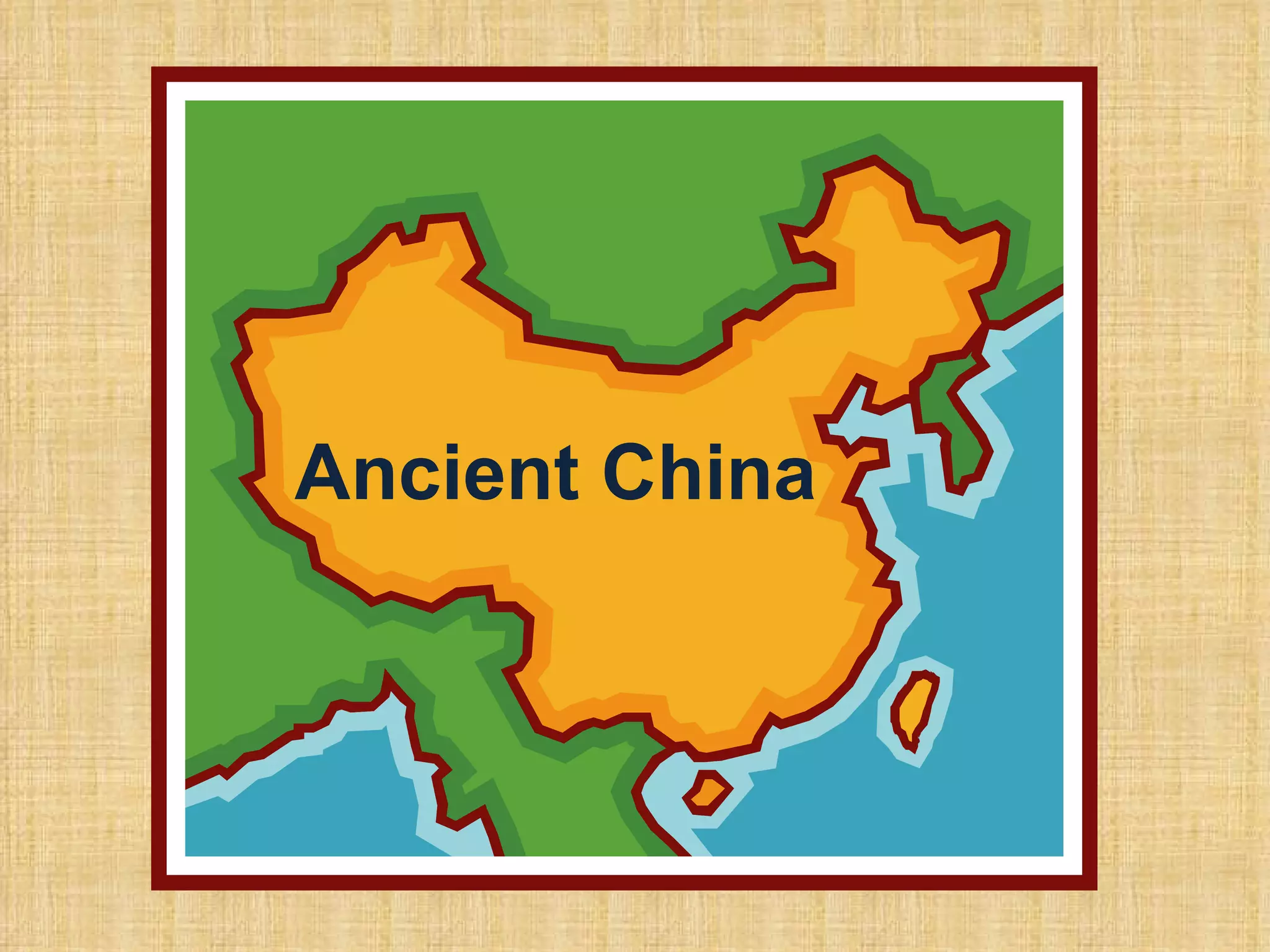
Ancient China
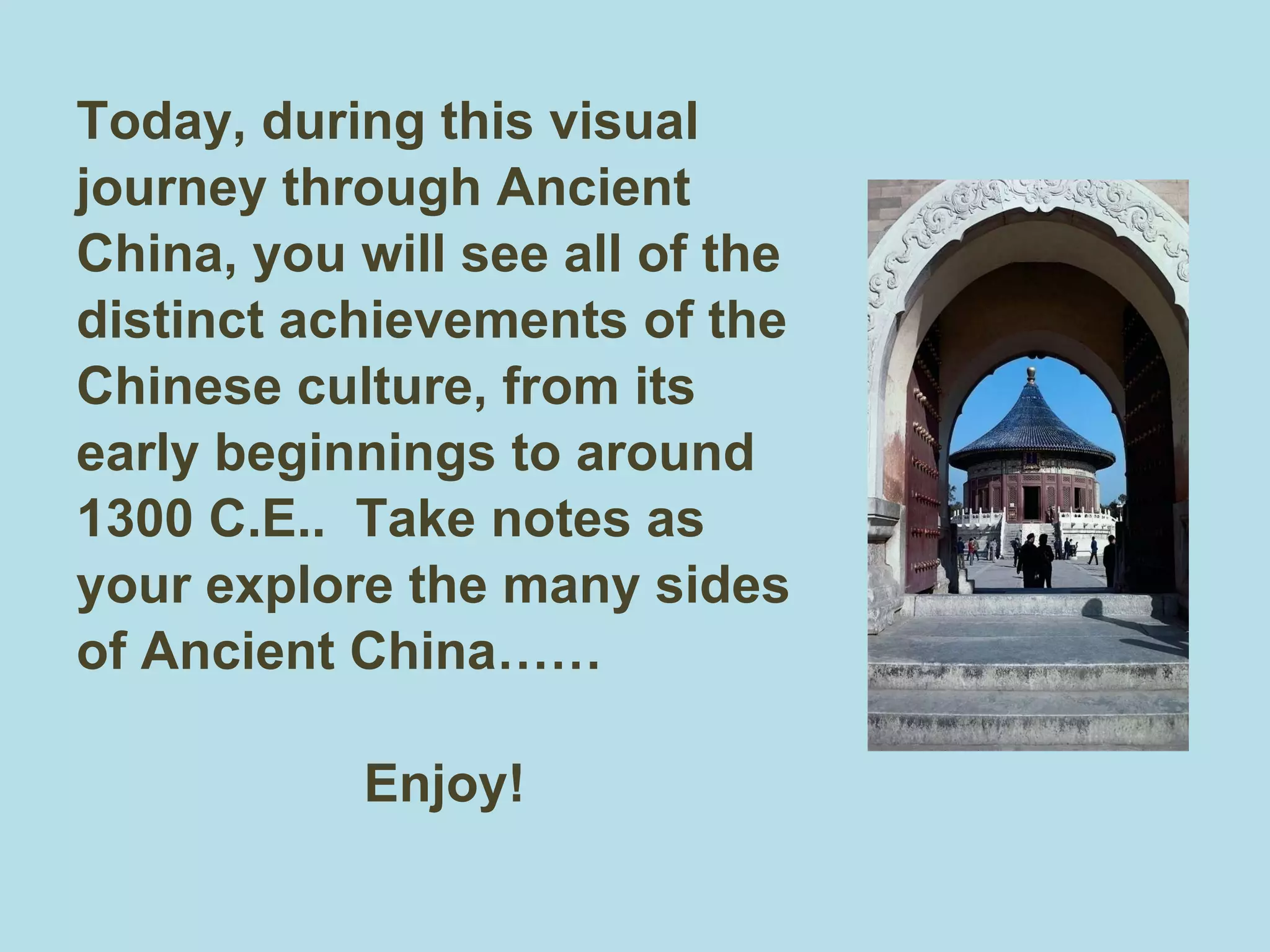
Today, during this visual journey through Ancient China, you will see all of the distinct achievements of the  Chinese culture, from its early beginnings to around 1300 C.E..  Take notes as your explore the many sides of Ancient China…… Enjoy!
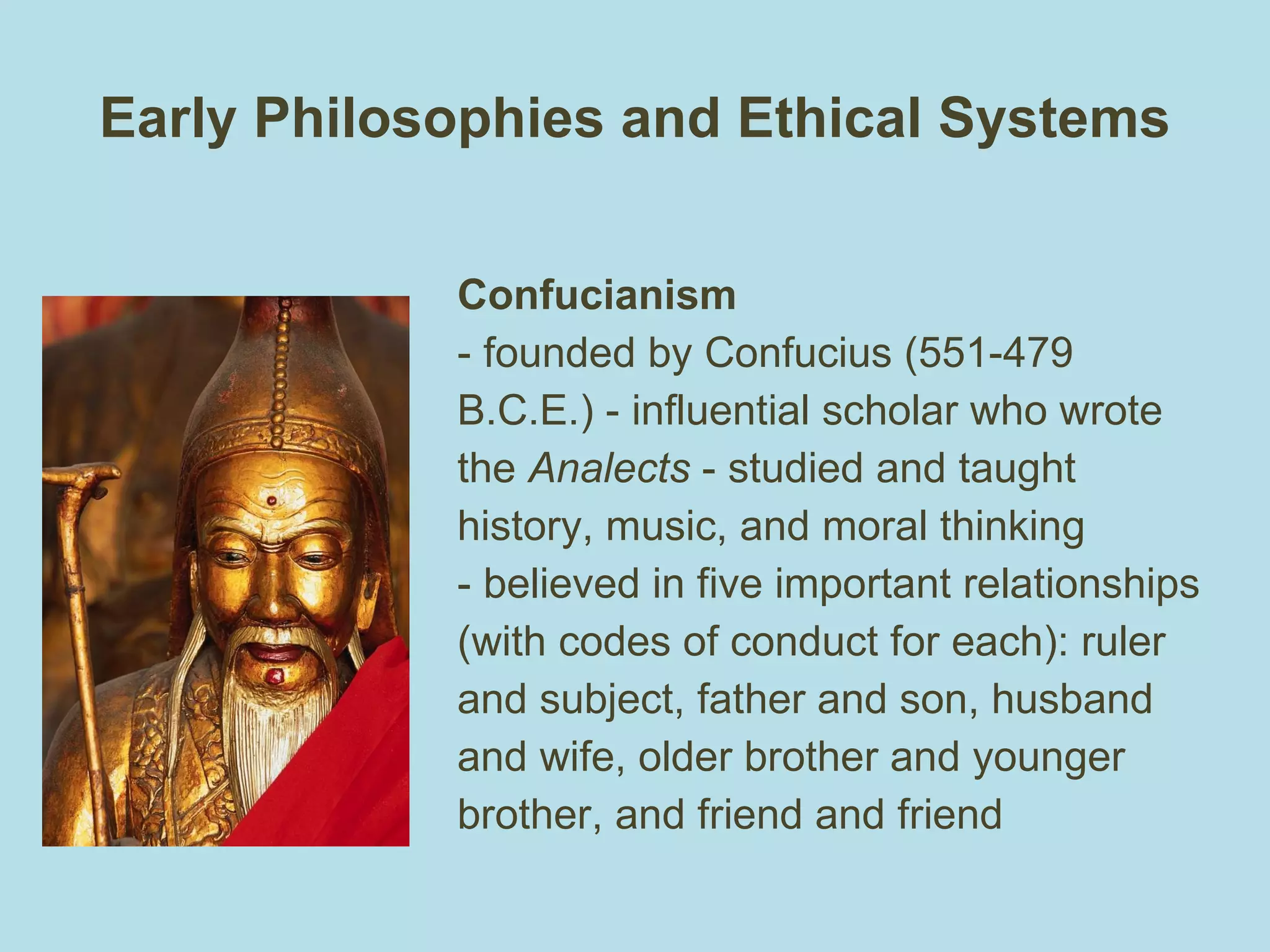
Early Philosophies and Ethical Systems Confucianism - founded by Confucius (551-479 B.C.E.) - influential scholar who wrote the  Analects  - studied and taught history, music, and moral thinking - believed in five important relationships (with codes of conduct for each): ruler and subject, father and son, husband and wife, older brother and younger brother, and friend and friend
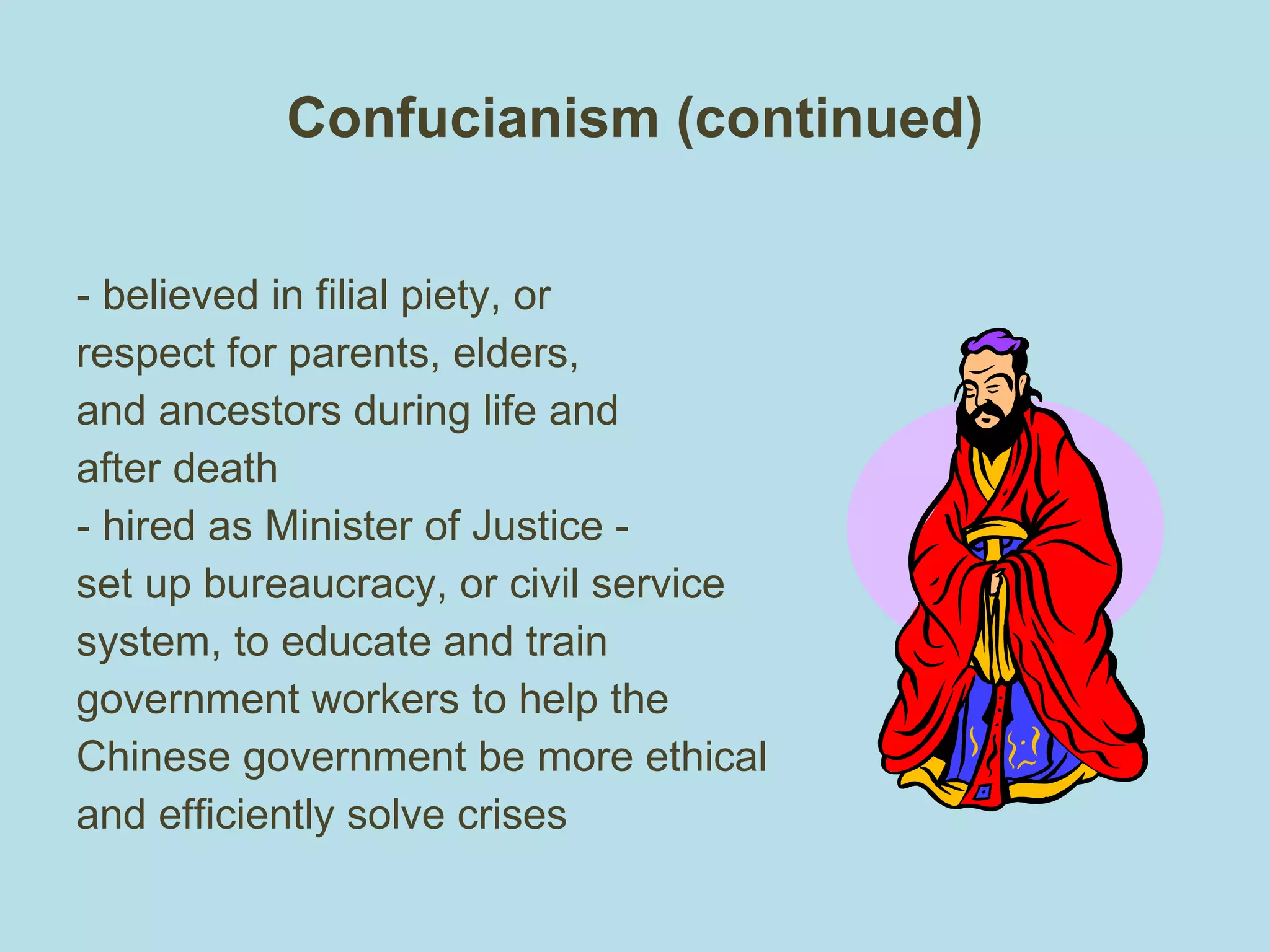
Confucianism (continued) - believed in filial piety, or respect for parents, elders, and ancestors during life and after death - hired as Minister of Justice - set up bureaucracy, or civil service system, to educate and train government workers to help the Chinese government be more ethical and efficiently solve crises
Other Ethical Systems:  Daoism versus Legalism Daoism - started by Laozi during the 6 th  Century B.C.E.  - believed the Dao, or “the way,” guided all things in nature except for humans, who refused to follow - thought humans should live in harmony with nature as natural order is more important than social order, which inspired believers to pursue scientific studies Legalism - founded by Hanfiezi and Li Si - thought a well run and powerful government allows for social order while laws and punishments help maintain social order along with rewards for the obedient  - believed ideas should be controlled and books that criticize the government should be destroyed
Chinese Dynasties Dynasties covered in this PowerPoint: Qin Han Sui Tang Song
Qin Dynasty (221-202 B.C.E.)  Shi Huangdi, the first emperor - used Legalist tactics to unify and strengthen China and its government  stopped invaders and expanded China  put down civil unrest at home by crushing political rivals and burning books by his opponents  - created an autocracy, or government with limitless power
Qin Dynasty Achievements  and Downfall - created a national highway system - set a standard for laws, writing,  weights, and measurements - created advanced irrigation systems - pushed for trade - made poor workers build the Great Wall of China  - taxed people to create these programs - dynasty fell because of oppressive father and son rulers
Han Dynasty (200 B.C.E. – 220 C.E.)  - split into two periods  - Liu Bang, the first emperor, created a centralized government, or government in which a central authority controls the country - the emperor was well liked because he lowered taxes and relaxed punishments - Wudi - “Martial Emperor” - dealt with invaders militarily and expanded China almost to its present day boundaries
Han Government and Social Classes Han government alliances made to gain the crown and rivals were assassinated bureaucracy collected taxes, recruited soldiers, and gathered workers to maintain the empire  workers took a civil service exam on Confucian beliefs to acquire jobs pushed for agriculture and trade to support its growing population Han social structure - emperors -> kings/governors -> nobles/state officials/scholars -> peasant farmers -> artisans/merchants -> soldiers -> slaves - conquered people were lowest and encouraged to assimilate, or adopt Chinese culture to unify the country
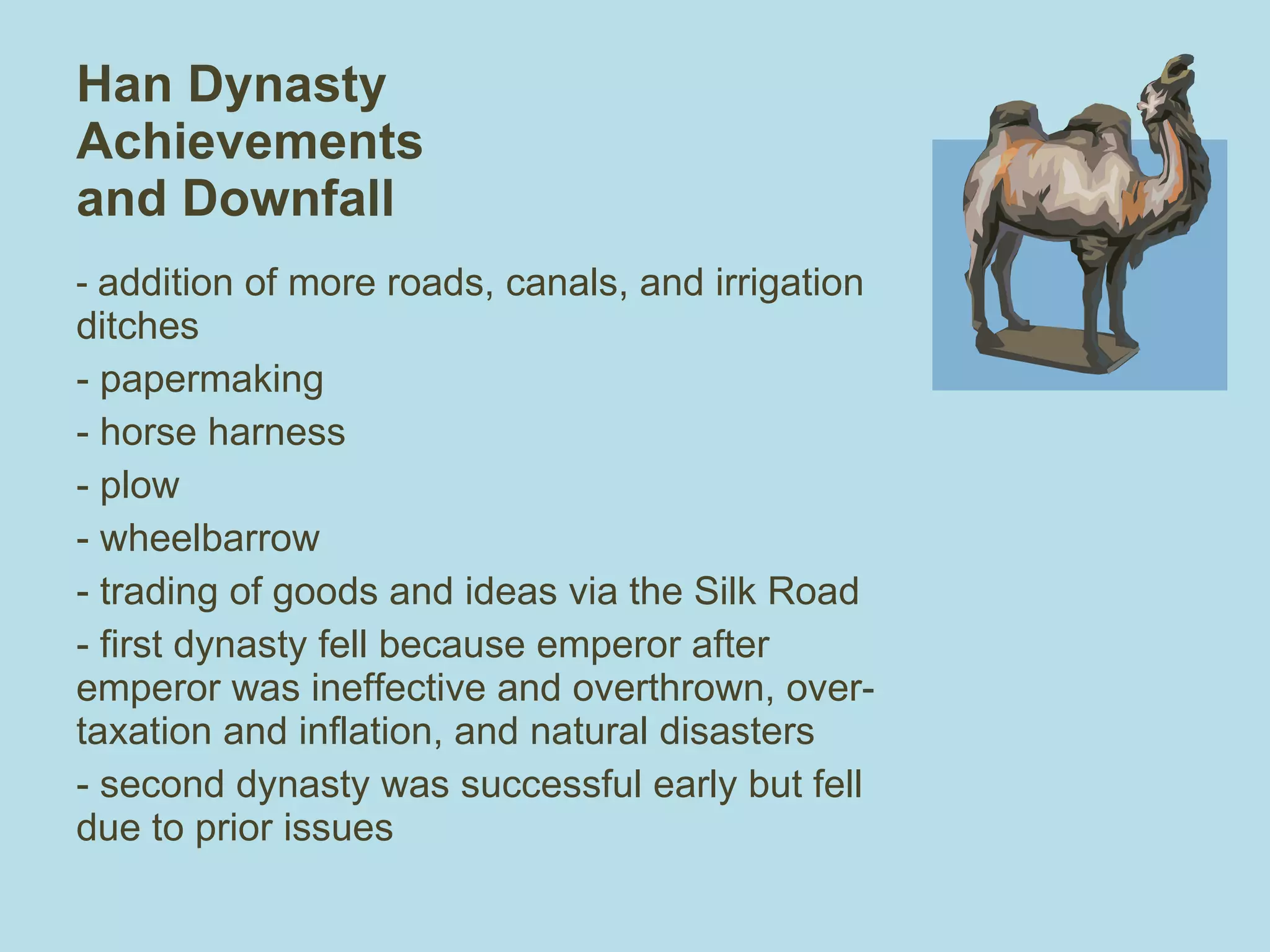
Han Dynasty Achievements and Downfall addition of more roads, canals, and irrigation ditches papermaking  horse harness plow wheelbarrow trading of goods and ideas via the Silk Road - first dynasty fell because emperor after emperor was ineffective and overthrown, over-taxation and inflation, and natural disasters - second dynasty was successful early but fell due to prior issues
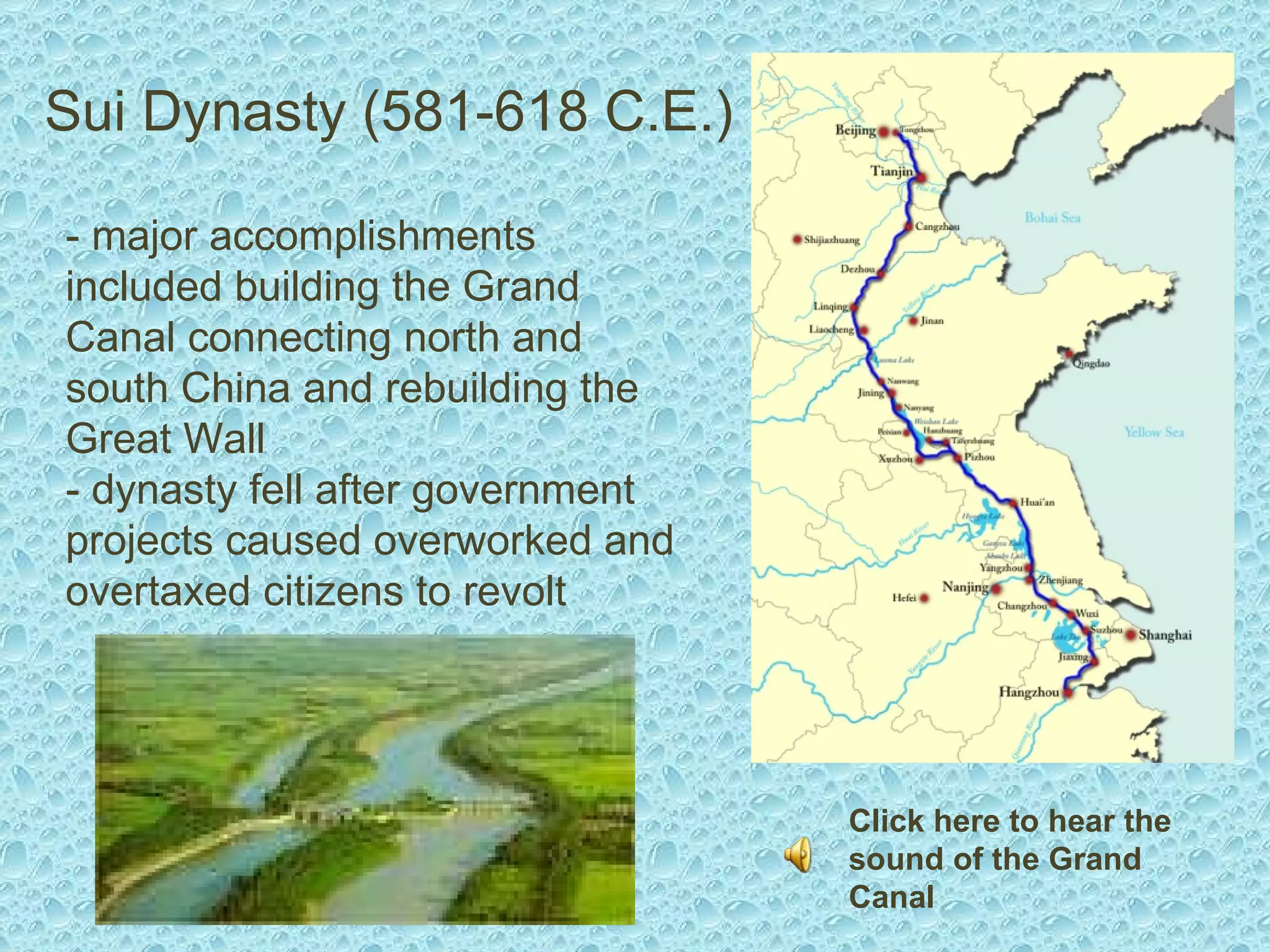
Sui Dynasty (581-618 C.E.) - major accomplishments included building the Grand Canal connecting north and south China and rebuilding the Great Wall - dynasty fell after government projects caused overworked and overtaxed citizens to revolt Click here to hear the sound of the Grand Canal
Tang Dynasty (618-907 C.E.)  Song Dynasty (960-1279 C.E.)  Tang Dynasty - expanded China and created a bureaucracy of  scholar-officials, an elite group of educated upper and middle class officials - dynasty fell due to overtaxing citizens for building programs, losing territory to Muslim invaders, and internal rebellion Song Dynasty - ruled a smaller area due to invaders and tried to keep enemies at bay by paying tributes, or fees, which did not work - eventually the Song Dynasty ruled only southern China, which prospered from trade  - dynasty fell after Mongols claimed China in 1279 C.E. Click here to listen to a Chinese song
Tang and Song Achievements - movable type (wooden block letters put into a frame to print a page of information) - gunpowder - porcelain for pottery  - mechanical clock - paper money - magnetic compass for sailing  - use of negative numbers in math - acupuncture for treatment of illnesses - improvements in rice cultivation to feed more people - new poetry and art reflecting Confucian and Daoist views - development of the gentry, or upper class citizens with scholar and government backgrounds - gentry -> urban middle class -> merchants/artisans ->laborers/soldiers/servants -> peasants - women were subservient except for peasant women who helped their families gain income
The End Works Cited All pictures, music, and sounds came from Microsoft Office Clip Art except: http ://upload.wikimedia.org/wikipedia/commons/thumb/c/cb/Modern_Course_of_Grand_Canal_of_China.png/400px-Modern_Course_of_Grand_Canal_of_China.png http://www.economiabr.defesabr.com/Fotos/China_GrandCanal.jpg

Unit 4 lesson 3 power point ancient china 1

  • 1.
  • 2.
    Today, during thisvisual journey through Ancient China, you will see all of the distinct achievements of the Chinese culture, from its early beginnings to around 1300 C.E.. Take notes as your explore the many sides of Ancient China…… Enjoy!
  • 3.
    Early Philosophies andEthical Systems Confucianism - founded by Confucius (551-479 B.C.E.) - influential scholar who wrote the Analects - studied and taught history, music, and moral thinking - believed in five important relationships (with codes of conduct for each): ruler and subject, father and son, husband and wife, older brother and younger brother, and friend and friend
  • 4.
    Confucianism (continued) -believed in filial piety, or respect for parents, elders, and ancestors during life and after death - hired as Minister of Justice - set up bureaucracy, or civil service system, to educate and train government workers to help the Chinese government be more ethical and efficiently solve crises
  • 5.
    Other Ethical Systems: Daoism versus Legalism Daoism - started by Laozi during the 6 th Century B.C.E. - believed the Dao, or “the way,” guided all things in nature except for humans, who refused to follow - thought humans should live in harmony with nature as natural order is more important than social order, which inspired believers to pursue scientific studies Legalism - founded by Hanfiezi and Li Si - thought a well run and powerful government allows for social order while laws and punishments help maintain social order along with rewards for the obedient - believed ideas should be controlled and books that criticize the government should be destroyed
  • 6.
    Chinese Dynasties Dynastiescovered in this PowerPoint: Qin Han Sui Tang Song
  • 7.
    Qin Dynasty (221-202B.C.E.) Shi Huangdi, the first emperor - used Legalist tactics to unify and strengthen China and its government stopped invaders and expanded China put down civil unrest at home by crushing political rivals and burning books by his opponents - created an autocracy, or government with limitless power
  • 8.
    Qin Dynasty Achievements and Downfall - created a national highway system - set a standard for laws, writing, weights, and measurements - created advanced irrigation systems - pushed for trade - made poor workers build the Great Wall of China - taxed people to create these programs - dynasty fell because of oppressive father and son rulers
  • 9.
    Han Dynasty (200B.C.E. – 220 C.E.) - split into two periods - Liu Bang, the first emperor, created a centralized government, or government in which a central authority controls the country - the emperor was well liked because he lowered taxes and relaxed punishments - Wudi - “Martial Emperor” - dealt with invaders militarily and expanded China almost to its present day boundaries
  • 10.
    Han Government andSocial Classes Han government alliances made to gain the crown and rivals were assassinated bureaucracy collected taxes, recruited soldiers, and gathered workers to maintain the empire workers took a civil service exam on Confucian beliefs to acquire jobs pushed for agriculture and trade to support its growing population Han social structure - emperors -> kings/governors -> nobles/state officials/scholars -> peasant farmers -> artisans/merchants -> soldiers -> slaves - conquered people were lowest and encouraged to assimilate, or adopt Chinese culture to unify the country
  • 11.
    Han Dynasty Achievementsand Downfall addition of more roads, canals, and irrigation ditches papermaking horse harness plow wheelbarrow trading of goods and ideas via the Silk Road - first dynasty fell because emperor after emperor was ineffective and overthrown, over-taxation and inflation, and natural disasters - second dynasty was successful early but fell due to prior issues
  • 12.
    Sui Dynasty (581-618C.E.) - major accomplishments included building the Grand Canal connecting north and south China and rebuilding the Great Wall - dynasty fell after government projects caused overworked and overtaxed citizens to revolt Click here to hear the sound of the Grand Canal
  • 13.
    Tang Dynasty (618-907C.E.) Song Dynasty (960-1279 C.E.) Tang Dynasty - expanded China and created a bureaucracy of scholar-officials, an elite group of educated upper and middle class officials - dynasty fell due to overtaxing citizens for building programs, losing territory to Muslim invaders, and internal rebellion Song Dynasty - ruled a smaller area due to invaders and tried to keep enemies at bay by paying tributes, or fees, which did not work - eventually the Song Dynasty ruled only southern China, which prospered from trade - dynasty fell after Mongols claimed China in 1279 C.E. Click here to listen to a Chinese song
  • 14.
    Tang and SongAchievements - movable type (wooden block letters put into a frame to print a page of information) - gunpowder - porcelain for pottery - mechanical clock - paper money - magnetic compass for sailing - use of negative numbers in math - acupuncture for treatment of illnesses - improvements in rice cultivation to feed more people - new poetry and art reflecting Confucian and Daoist views - development of the gentry, or upper class citizens with scholar and government backgrounds - gentry -> urban middle class -> merchants/artisans ->laborers/soldiers/servants -> peasants - women were subservient except for peasant women who helped their families gain income
  • 15.
    The End WorksCited All pictures, music, and sounds came from Microsoft Office Clip Art except: http ://upload.wikimedia.org/wikipedia/commons/thumb/c/cb/Modern_Course_of_Grand_Canal_of_China.png/400px-Modern_Course_of_Grand_Canal_of_China.png http://www.economiabr.defesabr.com/Fotos/China_GrandCanal.jpg