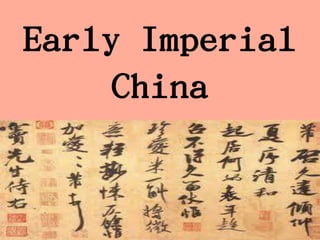
Early Imperial
     China
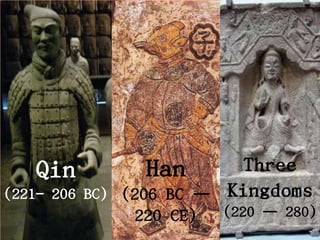
Qin             Han     Three
(221- 206 BC)   (206 BC – Kingdoms
                 220 CE)   (220 – 280)
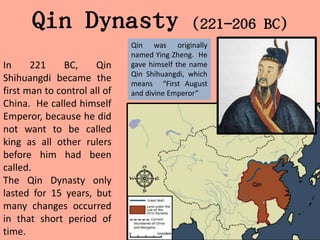
Qin Dynasty                            (221-206 BC)
                              Qin was originally
                              named Ying Zheng. He
In     221     BC,     Qin    gave himself the name
                              Qin Shihuangdi, which
Shihuangdi became the         means “First August
first man to control all of   and divine Emperor”
China. He called himself
Emperor, because he did
not want to be called
king as all other rulers
before him had been
called.
The Qin Dynasty only
lasted for 15 years, but
many changes occurred
in that short period of
time.
Bureaucracy
Qin was a harsh leader, and did not   Bureaucracy is a type of government
trust his people. He believed that    with fixed rules and procedures. Qin
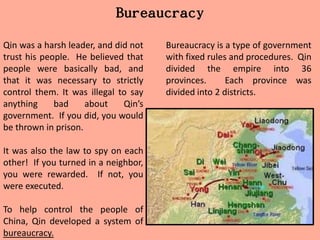
people were basically bad, and        divided the empire into 36
that it was necessary to strictly     provinces.      Each province was
control them. It was illegal to say   divided into 2 districts.
anything     bad     about    Qin’s
government. If you did, you would
be thrown in prison.

It was also the law to spy on each
other! If you turned in a neighbor,
you were rewarded. If not, you
were executed.

To help control the people of
China, Qin developed a system of
bureaucracy.
Changes Under Qin
• Ownership of land: Qin took land away from the nobles because he did not
  want them to have power and rise up against him.
• Standardization: All of China was unified by one system of weights,
  measures, written language, money, and laws.
• Law Code: Qin created a law enforcement group to enforce laws
• Jobs: all peasants were assigned a job of either silk maker or farmer. If they
  tried to do anything else, they were sent away to work on the Great Wall.
• Great Wall: Qin used slave labor to link together all of the old packed-earth
  defensive walls into one great wall (later, during the Ming dynasty, it
  became the huge masonry construction that it is today)
• Censorship: Qin destroyed books, especially those by Confucius. Over 400
  scholars who refused to turn in books were either buried alive or sent to
  work on the wall.
• Public Works: Because he was able to force people to work, he was able to
  create a large infrastructure of roads and canals.
During Qin’s reign, Qin ordered the construction of a
mausoleum, created to accompany the first emperor
into the afterlife. More than 700,000 laborers worked
on the project.

Work was halted on the project in 209 BC – a year after
Qin’s death in 210 BC – due to uprisings by the people.

This mausoleum, nicknamed the “Terra-Cotta Army”,
was discovered by workers digging a well outside the
city of Xi’an, China, in 1974.
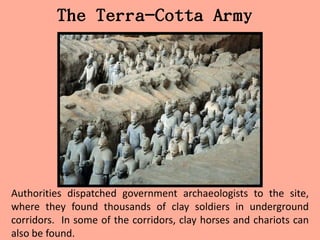
The Terra-Cotta Army


Authorities dispatched government archaeologists to the site,
where they found thousands of clay soldiers in underground
corridors. In some of the corridors, clay horses and chariots can
also be found.
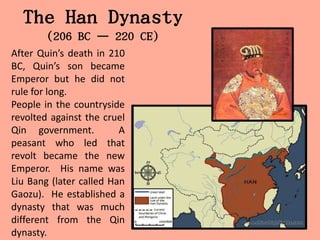
The Han Dynasty
        (206 BC – 220 CE)
After Quin’s death in 210
BC, Quin’s son became
Emperor but he did not
rule for long.
People in the countryside
revolted against the cruel
Qin government.          A
peasant who led that
revolt became the new
Emperor. His name was
Liu Bang (later called Han
Gaozu). He established a
dynasty that was much
different from the Qin
dynasty.
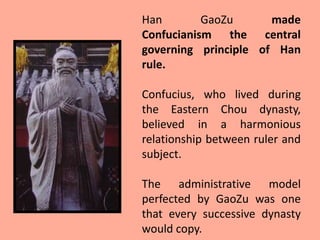
Han        GaoZu      made
Confucianism the central
governing principle of Han
rule.

Confucius, who lived during
the Eastern Chou dynasty,
believed in a harmonious
relationship between ruler and
subject.

The administrative model
perfected by GaoZu was one
that every successive dynasty
would copy.
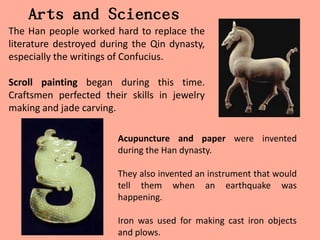
Arts and Sciences
The Han people worked hard to replace the
literature destroyed during the Qin dynasty,
especially the writings of Confucius.

Scroll painting began during this time.
Craftsmen perfected their skills in jewelry
making and jade carving.

                        Acupuncture and paper were invented
                        during the Han dynasty.

                        They also invented an instrument that would
                        tell them when an earthquake was
                        happening.

                        Iron was used for making cast iron objects
                        and plows.
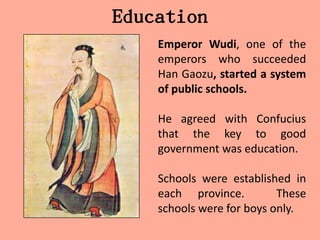
Education
    Emperor Wudi, one of the
    emperors who succeeded
    Han Gaozu, started a system
    of public schools.

    He agreed with Confucius
    that the key to good
    government was education.

    Schools were established in
    each province.         These
    schools were for boys only.
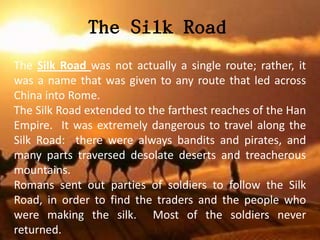
The Silk Road
The Silk Road was not actually a single route; rather, it
was a name that was given to any route that led across
China into Rome.
The Silk Road extended to the farthest reaches of the Han
Empire. It was extremely dangerous to travel along the
Silk Road: there were always bandits and pirates, and
many parts traversed desolate deserts and treacherous
mountains.
Romans sent out parties of soldiers to follow the Silk
Road, in order to find the traders and the people who
were making the silk. Most of the soldiers never
returned.
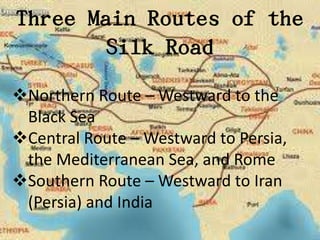
Three Main Routes of the
        Silk Road
Northern Route – Westward to the
 Black Sea
Central Route – Westward to Persia,
 the Mediterranean Sea, and Rome
Southern Route – Westward to Iran
 (Persia) and India
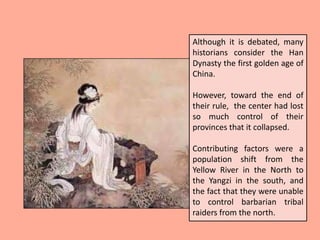
Although it is debated, many
historians consider the Han
Dynasty the first golden age of
China.

However, toward the end of
their rule, the center had lost
so much control of their
provinces that it collapsed.

Contributing factors were a
population shift from the
Yellow River in the North to
the Yangzi in the south, and
the fact that they were unable
to control barbarian tribal
raiders from the north.
Contributions of the Han Dynasty
   The Silk Road
   Papermaking
   Iron technology (cast iron)
   Plow (kuan)
   Glazed pottery
   Wheelbarrow
   Seismograph
   Compass
   Ship’s rudder
   Stirrups
   Drawloom weaving
   Hot Air Balloon
   Chinese Examination System
   Decorative Embroidery
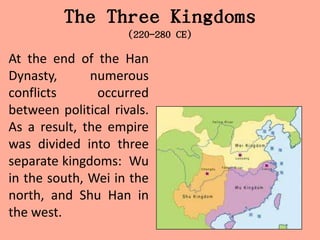
The Three Kingdoms
                     (220-280 CE)

At the end of the Han
Dynasty,      numerous
conflicts      occurred
between political rivals.
As a result, the empire
was divided into three
separate kingdoms: Wu
in the south, Wei in the
north, and Shu Han in
the west.
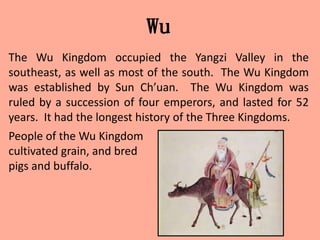
Wu
The Wu Kingdom occupied the Yangzi Valley in the
southeast, as well as most of the south. The Wu Kingdom
was established by Sun Ch’uan. The Wu Kingdom was
ruled by a succession of four emperors, and lasted for 52
years. It had the longest history of the Three Kingdoms.
People of the Wu Kingdom
cultivated grain, and bred
pigs and buffalo.
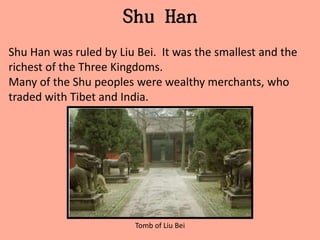
Shu Han
Shu Han was ruled by Liu Bei. It was the smallest and the
richest of the Three Kingdoms.
Many of the Shu peoples were wealthy merchants, who
traded with Tibet and India.


                        Tomb of Liu Bei
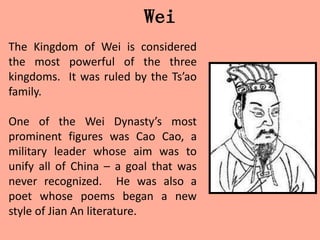
Wei
The Kingdom of Wei is considered
the most powerful of the three
kingdoms. It was ruled by the Ts’ao
family.

One of the Wei Dynasty’s most
prominent figures was Cao Cao, a
military leader whose aim was to
unify all of China – a goal that was
never recognized. He was also a
poet whose poems began a new
style of Jian An literature.
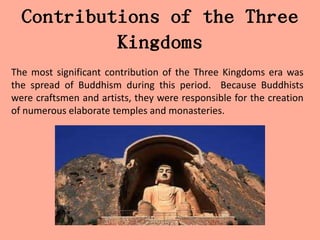
Contributions of the Three
           Kingdoms
The most significant contribution of the Three Kingdoms era was
the spread of Buddhism during this period. Because Buddhists
were craftsmen and artists, they were responsible for the creation
of numerous elaborate temples and monasteries.
Vocabulary
•   Qin Dynasty
•   Han Dynasty
•   Three Kingdoms
•   Bureaucracy
•   Confucianism
•   Qin Shihuangdi
•   Han Gaozu
•   Emperor Wudi
•   Silk Road
•   Wu
•   Shu Han
•   Wei
•   Cao Cao
Works Cited

www.dynastiesofasia.com/asian-history-references/threekingdoms
www.historyforkids.org/learn/china
www.travelchinaguide.com/intro/history
http://condensedchina.com/china2.html
www.cucas.edu.cn/HomePage/2009-05-25
http://china.mrdonn.org/han.html
http://science.nationalgeographic.com/science/archaeology/emperor-qin/

Early imperial china

  • 1.
  • 2.
    Qin Han Three (221- 206 BC) (206 BC – Kingdoms 220 CE) (220 – 280)
  • 3.
    Qin Dynasty (221-206 BC) Qin was originally named Ying Zheng. He In 221 BC, Qin gave himself the name Qin Shihuangdi, which Shihuangdi became the means “First August first man to control all of and divine Emperor” China. He called himself Emperor, because he did not want to be called king as all other rulers before him had been called. The Qin Dynasty only lasted for 15 years, but many changes occurred in that short period of time.
  • 4.
    Bureaucracy Qin was aharsh leader, and did not Bureaucracy is a type of government trust his people. He believed that with fixed rules and procedures. Qin people were basically bad, and divided the empire into 36 that it was necessary to strictly provinces. Each province was control them. It was illegal to say divided into 2 districts. anything bad about Qin’s government. If you did, you would be thrown in prison. It was also the law to spy on each other! If you turned in a neighbor, you were rewarded. If not, you were executed. To help control the people of China, Qin developed a system of bureaucracy.
  • 5.
    Changes Under Qin •Ownership of land: Qin took land away from the nobles because he did not want them to have power and rise up against him. • Standardization: All of China was unified by one system of weights, measures, written language, money, and laws. • Law Code: Qin created a law enforcement group to enforce laws • Jobs: all peasants were assigned a job of either silk maker or farmer. If they tried to do anything else, they were sent away to work on the Great Wall. • Great Wall: Qin used slave labor to link together all of the old packed-earth defensive walls into one great wall (later, during the Ming dynasty, it became the huge masonry construction that it is today) • Censorship: Qin destroyed books, especially those by Confucius. Over 400 scholars who refused to turn in books were either buried alive or sent to work on the wall. • Public Works: Because he was able to force people to work, he was able to create a large infrastructure of roads and canals.
  • 6.
    During Qin’s reign,Qin ordered the construction of a mausoleum, created to accompany the first emperor into the afterlife. More than 700,000 laborers worked on the project. Work was halted on the project in 209 BC – a year after Qin’s death in 210 BC – due to uprisings by the people. This mausoleum, nicknamed the “Terra-Cotta Army”, was discovered by workers digging a well outside the city of Xi’an, China, in 1974.
  • 7.
    The Terra-Cotta Army Authoritiesdispatched government archaeologists to the site, where they found thousands of clay soldiers in underground corridors. In some of the corridors, clay horses and chariots can also be found.
  • 8.
    The Han Dynasty (206 BC – 220 CE) After Quin’s death in 210 BC, Quin’s son became Emperor but he did not rule for long. People in the countryside revolted against the cruel Qin government. A peasant who led that revolt became the new Emperor. His name was Liu Bang (later called Han Gaozu). He established a dynasty that was much different from the Qin dynasty.
  • 9.
    Han GaoZu made Confucianism the central governing principle of Han rule. Confucius, who lived during the Eastern Chou dynasty, believed in a harmonious relationship between ruler and subject. The administrative model perfected by GaoZu was one that every successive dynasty would copy.
  • 10.
    Arts and Sciences TheHan people worked hard to replace the literature destroyed during the Qin dynasty, especially the writings of Confucius. Scroll painting began during this time. Craftsmen perfected their skills in jewelry making and jade carving. Acupuncture and paper were invented during the Han dynasty. They also invented an instrument that would tell them when an earthquake was happening. Iron was used for making cast iron objects and plows.
  • 11.
    Education Emperor Wudi, one of the emperors who succeeded Han Gaozu, started a system of public schools. He agreed with Confucius that the key to good government was education. Schools were established in each province. These schools were for boys only.
  • 12.
    The Silk Road TheSilk Road was not actually a single route; rather, it was a name that was given to any route that led across China into Rome. The Silk Road extended to the farthest reaches of the Han Empire. It was extremely dangerous to travel along the Silk Road: there were always bandits and pirates, and many parts traversed desolate deserts and treacherous mountains. Romans sent out parties of soldiers to follow the Silk Road, in order to find the traders and the people who were making the silk. Most of the soldiers never returned.
  • 13.
    Three Main Routesof the Silk Road Northern Route – Westward to the Black Sea Central Route – Westward to Persia, the Mediterranean Sea, and Rome Southern Route – Westward to Iran (Persia) and India
  • 14.
    Although it isdebated, many historians consider the Han Dynasty the first golden age of China. However, toward the end of their rule, the center had lost so much control of their provinces that it collapsed. Contributing factors were a population shift from the Yellow River in the North to the Yangzi in the south, and the fact that they were unable to control barbarian tribal raiders from the north.
  • 15.
    Contributions of theHan Dynasty  The Silk Road  Papermaking  Iron technology (cast iron)  Plow (kuan)  Glazed pottery  Wheelbarrow  Seismograph  Compass  Ship’s rudder  Stirrups  Drawloom weaving  Hot Air Balloon  Chinese Examination System  Decorative Embroidery
  • 16.
    The Three Kingdoms (220-280 CE) At the end of the Han Dynasty, numerous conflicts occurred between political rivals. As a result, the empire was divided into three separate kingdoms: Wu in the south, Wei in the north, and Shu Han in the west.
  • 17.
    Wu The Wu Kingdomoccupied the Yangzi Valley in the southeast, as well as most of the south. The Wu Kingdom was established by Sun Ch’uan. The Wu Kingdom was ruled by a succession of four emperors, and lasted for 52 years. It had the longest history of the Three Kingdoms. People of the Wu Kingdom cultivated grain, and bred pigs and buffalo.
  • 18.
    Shu Han Shu Hanwas ruled by Liu Bei. It was the smallest and the richest of the Three Kingdoms. Many of the Shu peoples were wealthy merchants, who traded with Tibet and India. Tomb of Liu Bei
  • 19.
    Wei The Kingdom ofWei is considered the most powerful of the three kingdoms. It was ruled by the Ts’ao family. One of the Wei Dynasty’s most prominent figures was Cao Cao, a military leader whose aim was to unify all of China – a goal that was never recognized. He was also a poet whose poems began a new style of Jian An literature.
  • 20.
    Contributions of theThree Kingdoms The most significant contribution of the Three Kingdoms era was the spread of Buddhism during this period. Because Buddhists were craftsmen and artists, they were responsible for the creation of numerous elaborate temples and monasteries.
  • 21.
    Vocabulary • Qin Dynasty • Han Dynasty • Three Kingdoms • Bureaucracy • Confucianism • Qin Shihuangdi • Han Gaozu • Emperor Wudi • Silk Road • Wu • Shu Han • Wei • Cao Cao
  • 22.