Rise and Accomplishments of Classical ChinaLesson 5 PBA – Christopher Yuan
Government and ControlThe Dynasty SystemEach family of kings creates a dynasty – within dynasties are several EmperorsDynasty rules until it is brought down by another DynastyDynasties can last for centuries, or for as little as 19 years in the case of the Qin DynastyThe ZhouZhou Dynasty lasted from 1029 to 258 BCEDid not establish a strong central government – instead relied on relationships with regional princes and aristocratic familiesThough central government was weak, the Zhou dynasty heightened the focus on the central government by claiming that they had direct links to the previous rulers (the Shang), and that the Mandate of Heaven had given the Zhou the right to rule China.  The Mandate of Heaven was an important political justification for Imperial rule from this point forward.
Government and Control, Cont.The economy flourished and there was much stability until around 700 BCETook the Yangtze river valley, forming the Middle KingdomThe QinCreated in 221BCE as the Zhou dynasty disintegratedQin Shi Huangdi deposed the last Zhou emperor and declared himself the sole ruler of ChinaIncredibly harsh ruler“The heart of a tiger and a wolf”Realized the weaknesses of the Zhou empire and so formed a strong central government, ordering nobles to leave their regions and appear at his courtExpanded China south towards modern-day Hong KongOrdered the construction of the Great Wall of China, a wall built using forced labor.  The wall spanned 3000+ miles and was wide enough for chariots to ride on its crestThe Qin’s attack on intellectuals made its reign quite short lived.  The Qin dynasty ended in 202 BCE
Government and Control, Cont..The HanLast dynasty of Classical ChinaRuled from 202 BCE to 220 CE – quite a long reignRounded out China’s political and intellectual structureSought to reduce the “brutal repression” of the Qin dynastyExpanded Chinese territory into Korea, Indochina, and Central AsiaEnforced peace throughout AsiaGovernment emphasized Confucian philosophyExpanded the powers of the bureaucracy
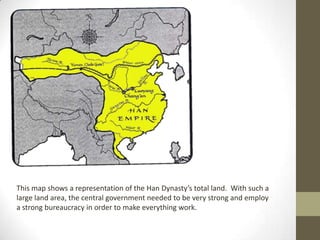
This map shows a representation of the Han Dynasty’s total land.  With such a large land area, the central government needed to be very strong and employ a strong bureaucracy in order to make everything work.
ConfucianismConfucianismConfucius lived from 551 to 478 BCE, during the Zhou DynastyLife was devoted to teachingNot a religious leader – believed in a divine order but refused to speculate about itTaught that if people could be taught personal virtue, than a solid political life would resultConfucius believed that leaders should have:Moderate behaviorVeneration of custom and ritualLove of wisdomBelieved that subordinates, or people in lower positions, should have obedience and respect to those above them socially.  However, he believed that rank should not be based on birth but on intelligence and education
DaoismDaoismMore religious than Confucianism“Dao” means “The path”, or “The way of nature”Furthered by Laozi, who lived during the 5th century BCEDaoist harmony with nature is claimed through humility and frugal livingMany secret ritualsBelieved in magic and mysteriesUsually people did not believe 100% in Confucianism or Daoism, but instead combined the two into a hybrid
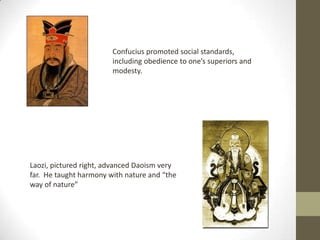
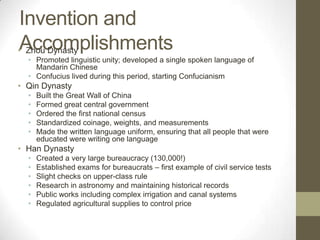
Confucius promoted social standards, including obedience to one’s superiors and modesty.Laozi, pictured right, advanced Daoism very far.  He taught harmony with nature and “the way of nature”
Invention and AccomplishmentsZhou DynastyPromoted linguistic unity; developed a single spoken language of Mandarin ChineseConfucius lived during this period, starting ConfucianismQin DynastyBuilt the Great Wall of ChinaFormed great central governmentOrdered the first national censusStandardized coinage, weights, and measurementsMade the written language uniform, ensuring that all people that were educated were writing one languageHan DynastyCreated a very large bureaucracy (130,000!)Established exams for bureaucrats – first example of civil service testsSlight checks on upper-class ruleResearch in astronomy and maintaining historical recordsPublic works including complex irrigation and canal systemsRegulated agricultural supplies to control price
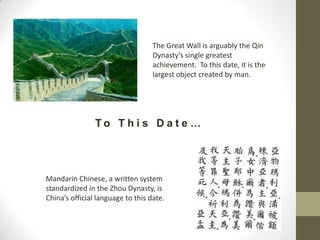
The Great Wall is arguably the Qin Dynasty’s single greatest achievement.  To this date, it is the largest object created by man.To This Date…Mandarin Chinese, a written system standardized in the Zhou Dynasty, is China’s official language to this date.
ContributionsMandarin Chinese, both spoken and written, were standardized in Classical China.  This language is still spoken todayFirst national census was conducted during the Qin DynastyFirst central government formed during this periodFirst bureaucracy formed during the classical periodThe first civil examination for bureaucrats was created during this period – barring people of low intelligence from controlling the countryThe first small system of checks and balances was instituted during the Classical period.  There were a small number of peasants that got to join the bureaucracy – ensuring that the government was not controlled only by aristocrats
Cited WorksStearns, Peter N. World Civilizations: The Global Experience. 4th ed. Pearson Education, 2006. 35-49. Print."Zhou Dynasty." ThinkQuest. N.p., n.d. Web. 27 Sep 2011. <http://library.thinkquest.org/12255/library/dynasty/zhou.html>."Qin." ThinkQuest. N.p., n.d. Web. 27 Sep 2011. <http://library.thinkquest.org/12255/library/dynasty/qin.html>.

AP World History Lesson 5 PBA

  • 1.
    Rise and Accomplishmentsof Classical ChinaLesson 5 PBA – Christopher Yuan
  • 2.
    Government and ControlTheDynasty SystemEach family of kings creates a dynasty – within dynasties are several EmperorsDynasty rules until it is brought down by another DynastyDynasties can last for centuries, or for as little as 19 years in the case of the Qin DynastyThe ZhouZhou Dynasty lasted from 1029 to 258 BCEDid not establish a strong central government – instead relied on relationships with regional princes and aristocratic familiesThough central government was weak, the Zhou dynasty heightened the focus on the central government by claiming that they had direct links to the previous rulers (the Shang), and that the Mandate of Heaven had given the Zhou the right to rule China. The Mandate of Heaven was an important political justification for Imperial rule from this point forward.
  • 3.
    Government and Control,Cont.The economy flourished and there was much stability until around 700 BCETook the Yangtze river valley, forming the Middle KingdomThe QinCreated in 221BCE as the Zhou dynasty disintegratedQin Shi Huangdi deposed the last Zhou emperor and declared himself the sole ruler of ChinaIncredibly harsh ruler“The heart of a tiger and a wolf”Realized the weaknesses of the Zhou empire and so formed a strong central government, ordering nobles to leave their regions and appear at his courtExpanded China south towards modern-day Hong KongOrdered the construction of the Great Wall of China, a wall built using forced labor. The wall spanned 3000+ miles and was wide enough for chariots to ride on its crestThe Qin’s attack on intellectuals made its reign quite short lived. The Qin dynasty ended in 202 BCE
  • 4.
    Government and Control,Cont..The HanLast dynasty of Classical ChinaRuled from 202 BCE to 220 CE – quite a long reignRounded out China’s political and intellectual structureSought to reduce the “brutal repression” of the Qin dynastyExpanded Chinese territory into Korea, Indochina, and Central AsiaEnforced peace throughout AsiaGovernment emphasized Confucian philosophyExpanded the powers of the bureaucracy
  • 5.
    This map showsa representation of the Han Dynasty’s total land. With such a large land area, the central government needed to be very strong and employ a strong bureaucracy in order to make everything work.
  • 6.
    ConfucianismConfucianismConfucius lived from551 to 478 BCE, during the Zhou DynastyLife was devoted to teachingNot a religious leader – believed in a divine order but refused to speculate about itTaught that if people could be taught personal virtue, than a solid political life would resultConfucius believed that leaders should have:Moderate behaviorVeneration of custom and ritualLove of wisdomBelieved that subordinates, or people in lower positions, should have obedience and respect to those above them socially. However, he believed that rank should not be based on birth but on intelligence and education
  • 7.
    DaoismDaoismMore religious thanConfucianism“Dao” means “The path”, or “The way of nature”Furthered by Laozi, who lived during the 5th century BCEDaoist harmony with nature is claimed through humility and frugal livingMany secret ritualsBelieved in magic and mysteriesUsually people did not believe 100% in Confucianism or Daoism, but instead combined the two into a hybrid
  • 8.
    Confucius promoted socialstandards, including obedience to one’s superiors and modesty.Laozi, pictured right, advanced Daoism very far. He taught harmony with nature and “the way of nature”
  • 9.
    Invention and AccomplishmentsZhouDynastyPromoted linguistic unity; developed a single spoken language of Mandarin ChineseConfucius lived during this period, starting ConfucianismQin DynastyBuilt the Great Wall of ChinaFormed great central governmentOrdered the first national censusStandardized coinage, weights, and measurementsMade the written language uniform, ensuring that all people that were educated were writing one languageHan DynastyCreated a very large bureaucracy (130,000!)Established exams for bureaucrats – first example of civil service testsSlight checks on upper-class ruleResearch in astronomy and maintaining historical recordsPublic works including complex irrigation and canal systemsRegulated agricultural supplies to control price
  • 10.
    The Great Wallis arguably the Qin Dynasty’s single greatest achievement. To this date, it is the largest object created by man.To This Date…Mandarin Chinese, a written system standardized in the Zhou Dynasty, is China’s official language to this date.
  • 11.
    ContributionsMandarin Chinese, bothspoken and written, were standardized in Classical China. This language is still spoken todayFirst national census was conducted during the Qin DynastyFirst central government formed during this periodFirst bureaucracy formed during the classical periodThe first civil examination for bureaucrats was created during this period – barring people of low intelligence from controlling the countryThe first small system of checks and balances was instituted during the Classical period. There were a small number of peasants that got to join the bureaucracy – ensuring that the government was not controlled only by aristocrats
  • 12.
    Cited WorksStearns, PeterN. World Civilizations: The Global Experience. 4th ed. Pearson Education, 2006. 35-49. Print."Zhou Dynasty." ThinkQuest. N.p., n.d. Web. 27 Sep 2011. <http://library.thinkquest.org/12255/library/dynasty/zhou.html>."Qin." ThinkQuest. N.p., n.d. Web. 27 Sep 2011. <http://library.thinkquest.org/12255/library/dynasty/qin.html>.