Ancient China
220 BCE – 1912 CE
2132 years of Imperial Yellow
Comparing
Qin Dynasty and Han Dynasty
221BCE – 206BCE 202BCE – 220CE
What is an Empire?
All empires in history have common features:
- Large efficient armed forces
- Controls a large area of land
- Lasts a long period of time
- Systematic and organized way of collecting taxes
- Long periods of internal peace & prosperity
- Produces great works of art, literature
and architecture
- One nationality controls many other separate ones.
- An organized complex government led by
a “supreme leader”.
America is often accused of being an empire by those who hate us.
Are their accusations correct?
- Large efficient armed forces - Yes
- Controls a large area of land - Yes
- Lasts a long period of time – Maybe – ( is 230+ years long? )
- Systematic and organized way of collecting taxes - Yes
- Long periods of internal peace & prosperity - Yes
- Produces great works of art, literature
and architecture - Yes
- One nationality controls many other separate ones. - NO
- An organized complex government led by
a “supreme leader”. - NO
America is NOT an empire.
Setting: What is the geography of this location like?
Qin Dynasty
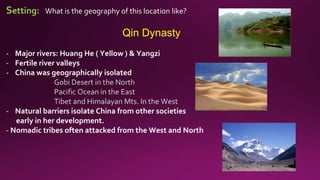
- Major rivers: Huang He ( Yellow ) & Yangzi
- Fertile river valleys
- China was geographically isolated
Gobi Desert in the North
Pacific Ocean in the East
Tibet and Himalayan Mts. In the West
- Natural barriers isolate China from other societies
early in her development.
- Nomadic tribes often attacked from the West and North
Politics: How is this society governed?
Qin Dynasty
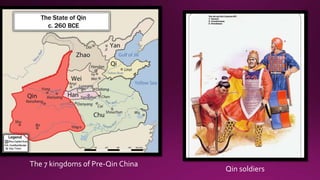
- The warrior King of Qin conquered his 6 neighboring kingdoms
- Qin Shi Huangdi becomes the first Emperor of China
- Creates a highly centralized government ( under his direct control )
- Claimed the Mandate of Heaven
1. Heaven grants him the right to rule
2. only 1 heaven = only 1 emperor
3. Virtue determines his right to rule
4. No dynasty has permanent right to rule
- Adopts Legalism
- 100’s of Confucian scholars are murdered
- The Dynasty consisted of only 2 emperors
The 7 kingdoms of Pre-Qin China
Qin soldiers
Religion: What were the beliefs of this culture?
Qin Dynasty
- Under the Qin, philosophy rather than religion existed
- Legalism
Harsh emperor-centered belief that rewarded those who
followed orders and did their duty.
- Confucianism was punished “The Fires of Qin”
Books burned and scholars buried
Elimination of non-Qin philosophies and beliefs
- Daoism, an old philosophy was suppressed by the Qin
Innovations & Technology: What were the accomplishments of this culture?
Qin Dynasty
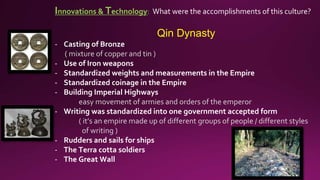
- Casting of Bronze
( mixture of copper and tin )
- Use of Iron weapons
- Standardized weights and measurements in the Empire
- Standardized coinage in the Empire
- Building Imperial Highways
easy movement of armies and orders of the emperor
- Writing was standardized into one government accepted form
( it’s an empire made up of different groups of people / different styles
of writing )
- Rudders and sails for ships
- The Terra cotta soldiers
- The Great Wall
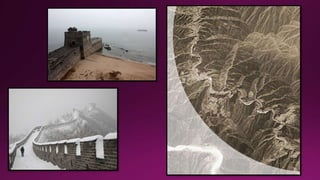
The Great Wall of China
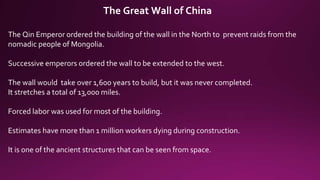
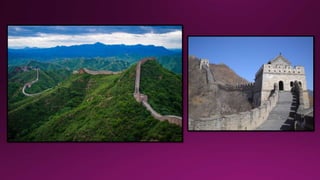
The Qin Emperor ordered the building of the wall in the North to prevent raids from the
nomadic people of Mongolia.
Successive emperors ordered the wall to be extended to the west.
The wall would take over 1,600 years to build, but it was never completed.
It stretches a total of 13,000 miles.
Forced labor was used for most of the building.
Estimates have more than 1 million workers dying during construction.
It is one of the ancient structures that can be seen from space.
The Terra Cotta Army
The First Qin Emperor was obsessed with immortality.
He had a tomb constructed and built a replica, life-size army out of terra cotta ( clay ).
8,000 foot soldiers
130 chariots with 520 horses
150 cavalry horses
40 Generals and government administrators
30 Acrobats
50 musicians
Their purpose was to guard his tomb in death and provide the emperor with an army in the
afterlife. Each figure was given an unique face. When the army was complete, the artisans
who’d created them had their tongues cut out and were killed, so they couldn’t spill the
beans to the afterlife.
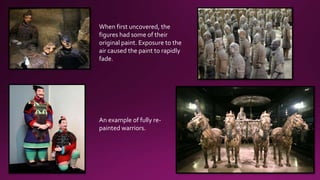
When first uncovered, the
figures had some of their
original paint. Exposure to the
air caused the paint to rapidly
fade.
An example of fully re-
painted warriors.
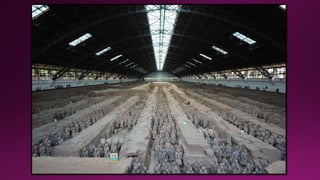
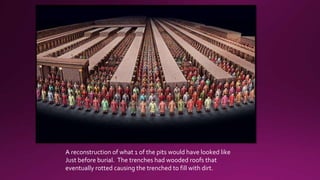
A reconstruction of what 1 of the pits would have looked like
Just before burial. The trenches had wooded roofs that
eventually rotted causing the trenched to fill with dirt.
Economy: How did this culture deal with trade and money?
Qin Dynasty
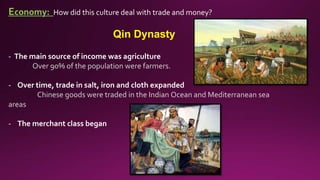
- The main source of income was agriculture
Over 90% of the population were farmers.
- Over time, trade in salt, iron and cloth expanded
Chinese goods were traded in the Indian Ocean and Mediterranean sea
areas
- The merchant class began
Society: How were the people of this culture organized?
Qin Dynasty
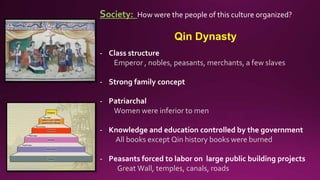
- Class structure
Emperor , nobles, peasants, merchants, a few slaves
- Strong family concept
- Patriarchal
Women were inferior to men
- Knowledge and education controlled by the government
All books except Qin history books were burned
- Peasants forced to labor on large public building projects
Great Wall, temples, canals, roads
Intermission
a pause in Dynasties
CIVIL WAR
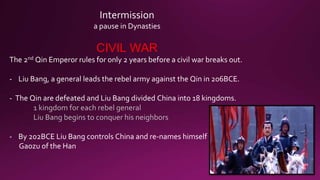
The 2nd Qin Emperor rules for only 2 years before a civil war breaks out.
- Liu Bang, a general leads the rebel army against the Qin in 206BCE.
- The Qin are defeated and Liu Bang divided China into 18 kingdoms.
1 kingdom for each rebel general
Liu Bang begins to conquer his neighbors
- By 202BCE Liu Bang controls China and re-names himself
Gaozu of the Han
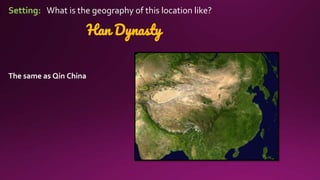
Setting: What is the geography of this location like?
Han Dynasty
The same as Qin China
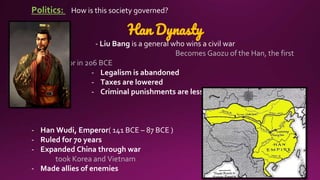
Politics: How is this society governed?
Han Dynasty
- Liu Bang is a general who wins a civil war
Becomes Gaozu of the Han, the first
Han Emperor in 206 BCE
- Legalism is abandoned
- Taxes are lowered
- Criminal punishments are lessened
- Han Wudi, Emperor( 141 BCE – 87 BCE )
- Ruled for 70 years
- Expanded China through war
took Korea and Vietnam
- Made allies of enemies
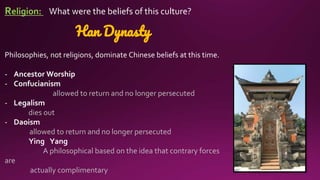
Religion: What were the beliefs of this culture?
Han Dynasty
Philosophies, not religions, dominate Chinese beliefs at this time.
- Ancestor Worship
- Confucianism
allowed to return and no longer persecuted
- Legalism
dies out
- Daoism
allowed to return and no longer persecuted
Ying Yang
A philosophical based on the idea that contrary forces
are
actually complimentary
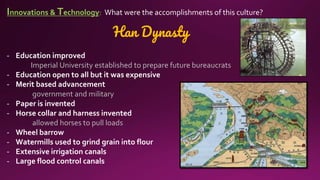
Innovations & Technology: What were the accomplishments of this culture?
Han Dynasty
- Education improved
Imperial University established to prepare future bureaucrats
- Education open to all but it was expensive
- Merit based advancement
government and military
- Paper is invented
- Horse collar and harness invented
allowed horses to pull loads
- Wheel barrow
- Watermills used to grind grain into flour
- Extensive irrigation canals
- Large flood control canals
Economy: How did this culture deal with trade and money?
Han Dynasty
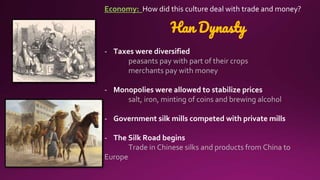
- Taxes were diversified
peasants pay with part of their crops
merchants pay with money
- Monopolies were allowed to stabilize prices
salt, iron, minting of coins and brewing alcohol
- Government silk mills competed with private mills
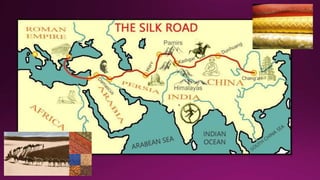
- The Silk Road begins
Trade in Chinese silks and products from China to
Europe
Society: How were the people of this culture organized?
Han Dynasty
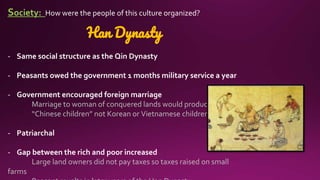
- Same social structure as the Qin Dynasty
- Peasants owed the government 1 months military service a year
- Government encouraged foreign marriage
Marriage to woman of conquered lands would produce
“Chinese children” not Korean or Vietnamese children.
- Patriarchal
- Gap between the rich and poor increased
Large land owners did not pay taxes so taxes raised on small
farms

Ancient China

  • 1.
    Ancient China 220 BCE– 1912 CE 2132 years of Imperial Yellow Comparing Qin Dynasty and Han Dynasty 221BCE – 206BCE 202BCE – 220CE
  • 2.
    What is anEmpire? All empires in history have common features: - Large efficient armed forces - Controls a large area of land - Lasts a long period of time - Systematic and organized way of collecting taxes - Long periods of internal peace & prosperity - Produces great works of art, literature and architecture - One nationality controls many other separate ones. - An organized complex government led by a “supreme leader”.
  • 3.
    America is oftenaccused of being an empire by those who hate us. Are their accusations correct? - Large efficient armed forces - Yes - Controls a large area of land - Yes - Lasts a long period of time – Maybe – ( is 230+ years long? ) - Systematic and organized way of collecting taxes - Yes - Long periods of internal peace & prosperity - Yes - Produces great works of art, literature and architecture - Yes - One nationality controls many other separate ones. - NO - An organized complex government led by a “supreme leader”. - NO America is NOT an empire.
  • 4.
    Setting: What isthe geography of this location like? Qin Dynasty - Major rivers: Huang He ( Yellow ) & Yangzi - Fertile river valleys - China was geographically isolated Gobi Desert in the North Pacific Ocean in the East Tibet and Himalayan Mts. In the West - Natural barriers isolate China from other societies early in her development. - Nomadic tribes often attacked from the West and North
  • 5.
    Politics: How isthis society governed? Qin Dynasty - The warrior King of Qin conquered his 6 neighboring kingdoms - Qin Shi Huangdi becomes the first Emperor of China - Creates a highly centralized government ( under his direct control ) - Claimed the Mandate of Heaven 1. Heaven grants him the right to rule 2. only 1 heaven = only 1 emperor 3. Virtue determines his right to rule 4. No dynasty has permanent right to rule - Adopts Legalism - 100’s of Confucian scholars are murdered - The Dynasty consisted of only 2 emperors
  • 6.
    The 7 kingdomsof Pre-Qin China Qin soldiers
  • 7.
    Religion: What werethe beliefs of this culture? Qin Dynasty - Under the Qin, philosophy rather than religion existed - Legalism Harsh emperor-centered belief that rewarded those who followed orders and did their duty. - Confucianism was punished “The Fires of Qin” Books burned and scholars buried Elimination of non-Qin philosophies and beliefs - Daoism, an old philosophy was suppressed by the Qin
  • 8.
    Innovations & Technology:What were the accomplishments of this culture? Qin Dynasty - Casting of Bronze ( mixture of copper and tin ) - Use of Iron weapons - Standardized weights and measurements in the Empire - Standardized coinage in the Empire - Building Imperial Highways easy movement of armies and orders of the emperor - Writing was standardized into one government accepted form ( it’s an empire made up of different groups of people / different styles of writing ) - Rudders and sails for ships - The Terra cotta soldiers - The Great Wall
  • 9.
    The Great Wallof China The Qin Emperor ordered the building of the wall in the North to prevent raids from the nomadic people of Mongolia. Successive emperors ordered the wall to be extended to the west. The wall would take over 1,600 years to build, but it was never completed. It stretches a total of 13,000 miles. Forced labor was used for most of the building. Estimates have more than 1 million workers dying during construction. It is one of the ancient structures that can be seen from space.
  • 12.
    The Terra CottaArmy The First Qin Emperor was obsessed with immortality. He had a tomb constructed and built a replica, life-size army out of terra cotta ( clay ). 8,000 foot soldiers 130 chariots with 520 horses 150 cavalry horses 40 Generals and government administrators 30 Acrobats 50 musicians Their purpose was to guard his tomb in death and provide the emperor with an army in the afterlife. Each figure was given an unique face. When the army was complete, the artisans who’d created them had their tongues cut out and were killed, so they couldn’t spill the beans to the afterlife.
  • 14.
    When first uncovered,the figures had some of their original paint. Exposure to the air caused the paint to rapidly fade. An example of fully re- painted warriors.
  • 15.
    A reconstruction ofwhat 1 of the pits would have looked like Just before burial. The trenches had wooded roofs that eventually rotted causing the trenched to fill with dirt.
  • 16.
    Economy: How didthis culture deal with trade and money? Qin Dynasty - The main source of income was agriculture Over 90% of the population were farmers. - Over time, trade in salt, iron and cloth expanded Chinese goods were traded in the Indian Ocean and Mediterranean sea areas - The merchant class began
  • 17.
    Society: How werethe people of this culture organized? Qin Dynasty - Class structure Emperor , nobles, peasants, merchants, a few slaves - Strong family concept - Patriarchal Women were inferior to men - Knowledge and education controlled by the government All books except Qin history books were burned - Peasants forced to labor on large public building projects Great Wall, temples, canals, roads
  • 18.
    Intermission a pause inDynasties CIVIL WAR The 2nd Qin Emperor rules for only 2 years before a civil war breaks out. - Liu Bang, a general leads the rebel army against the Qin in 206BCE. - The Qin are defeated and Liu Bang divided China into 18 kingdoms. 1 kingdom for each rebel general Liu Bang begins to conquer his neighbors - By 202BCE Liu Bang controls China and re-names himself Gaozu of the Han
  • 19.
    Setting: What isthe geography of this location like? Han Dynasty The same as Qin China
  • 20.
    Politics: How isthis society governed? Han Dynasty - Liu Bang is a general who wins a civil war Becomes Gaozu of the Han, the first Han Emperor in 206 BCE - Legalism is abandoned - Taxes are lowered - Criminal punishments are lessened - Han Wudi, Emperor( 141 BCE – 87 BCE ) - Ruled for 70 years - Expanded China through war took Korea and Vietnam - Made allies of enemies
  • 21.
    Religion: What werethe beliefs of this culture? Han Dynasty Philosophies, not religions, dominate Chinese beliefs at this time. - Ancestor Worship - Confucianism allowed to return and no longer persecuted - Legalism dies out - Daoism allowed to return and no longer persecuted Ying Yang A philosophical based on the idea that contrary forces are actually complimentary
  • 22.
    Innovations & Technology:What were the accomplishments of this culture? Han Dynasty - Education improved Imperial University established to prepare future bureaucrats - Education open to all but it was expensive - Merit based advancement government and military - Paper is invented - Horse collar and harness invented allowed horses to pull loads - Wheel barrow - Watermills used to grind grain into flour - Extensive irrigation canals - Large flood control canals
  • 23.
    Economy: How didthis culture deal with trade and money? Han Dynasty - Taxes were diversified peasants pay with part of their crops merchants pay with money - Monopolies were allowed to stabilize prices salt, iron, minting of coins and brewing alcohol - Government silk mills competed with private mills - The Silk Road begins Trade in Chinese silks and products from China to Europe
  • 25.
    Society: How werethe people of this culture organized? Han Dynasty - Same social structure as the Qin Dynasty - Peasants owed the government 1 months military service a year - Government encouraged foreign marriage Marriage to woman of conquered lands would produce “Chinese children” not Korean or Vietnamese children. - Patriarchal - Gap between the rich and poor increased Large land owners did not pay taxes so taxes raised on small farms