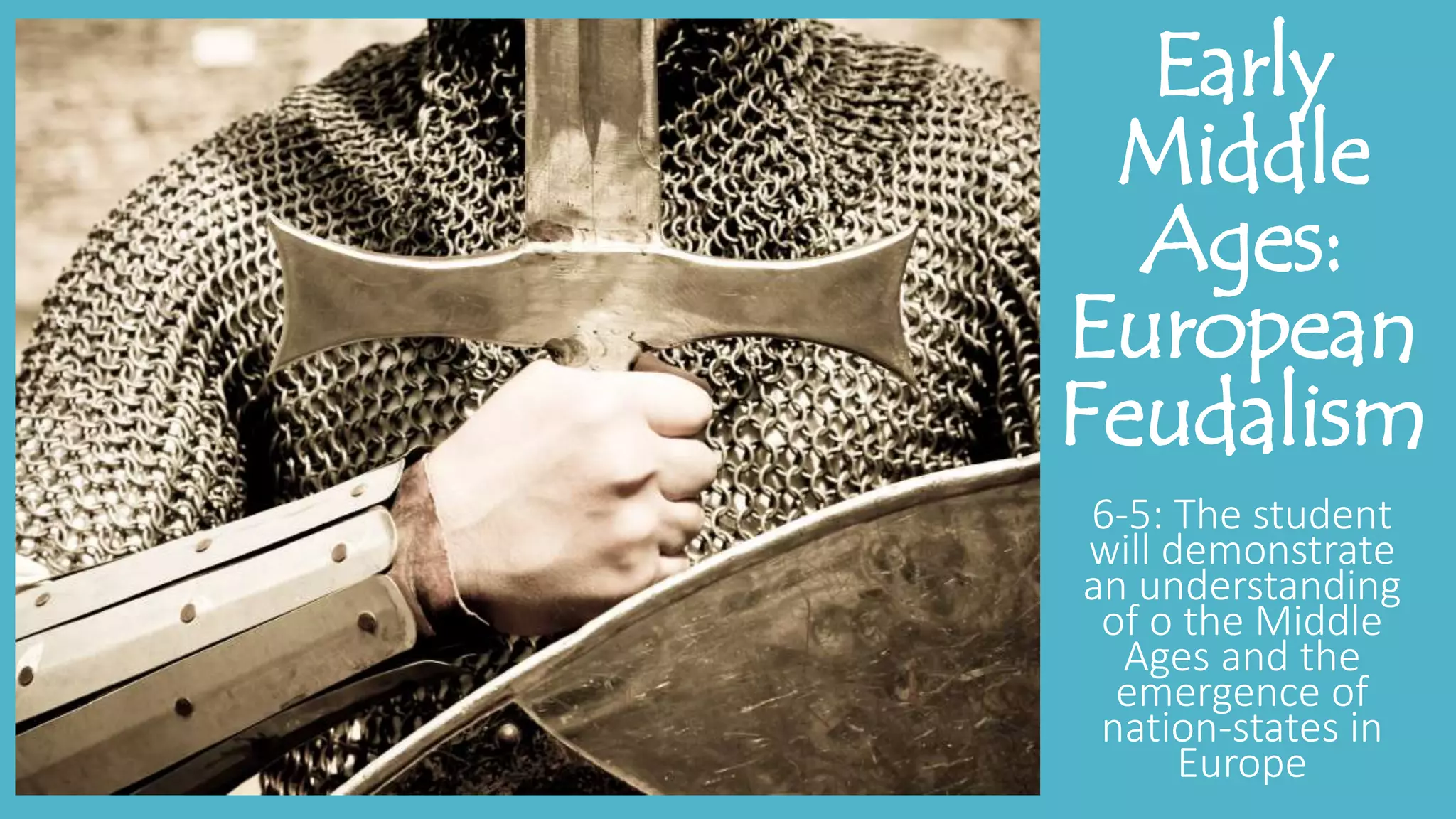
Early
Middle
Ages:
European
Feudalism
6-5: The student
will demonstrate
an understanding
of o the Middle
Ages and the
emergence of
nation-states in
Europe
Europe After the Fall of Rome
Different groups
from the north and
east moved into
former Roman lands
Created their own
states ruled by
warlords who called
named themselves
kings
They fought amongst
each other during the
500s
Christianity Spreads to Northern Europe
The creation of these
kingdom marks the
beginning of the Middle
Ages or medieval times
(500-1500 AD)
Christianity was
brought to the regions
through missionaries
and monks from places
like Spain and Italy-
formerly parts of the
Roman Empire
Missionaries
•Popes (leader of the Catholic Church)
were responsible for sending
missionaries to teach Christianity to
northern European kingdoms
•Britain was one of the first places
missionaries went; then to France and
Germany
•They travelled in groups
•Saint Patrick- a monk who traveled
alone from Britain to Ireland to
convert people to Christianity in the
400’s
Video: Legend of St. Patrick
Monks
•Monks lived in communities called monasteries
where they lived separate from society to pray,
work, and meditate
•Italian monk- Benedict created a code of rules
for monks to live by called the Benedict Rule
•Monks:
• Gave aid to the people in the community
• Ran schools and copied books
• Collected & saved ancient writings from
Greece & Rome
• Served as scribes & advisors to local rulers
• Spread Christian teachings into new areas
Video: The Monk’s Song: Horrible Histories
Charlemagne
•The Franks took control of Gaul (modern day
France) in the 480s
•Became Christians under King Clovis
•Kingdom reached its height in the 700s under
King Charlemagne- a strong Christian king &
warrior
•Charlemagne conquered many neighboring
kingdoms of the former Roman Empire,
expanding to all of France, and into modern
Italy, Germany, Austria, & Spain
•In the 800s, the Pope crowned him Emperor
of the Romans on Christmas Day
Video: 10 min
Invaders
•Charlemagne's Empire was under
constant attack
•Muslims attacked from
Southern France & northern Italy
•Magyars attacked from the east
•Vikings attacked from
Scandinavia
-Raided Britain, Ireland, parts of Western
Europe
-looted towns & monasteries; taking
prisoners to sell into slavery
-Europeans lived in fear of Viking raids
Feudalism & Manor Life
Kingscouldn’toffertheprotectiontotheirpeopleneededduringtheinvasions.
Lords&nobleshadtodefendtheirownlands;resultingintheirgrowingpower
Feudal
Society
-King
-Nobles &
Lords
-Knights
-Peasants/
Serfs
Lord & Vassal Duties
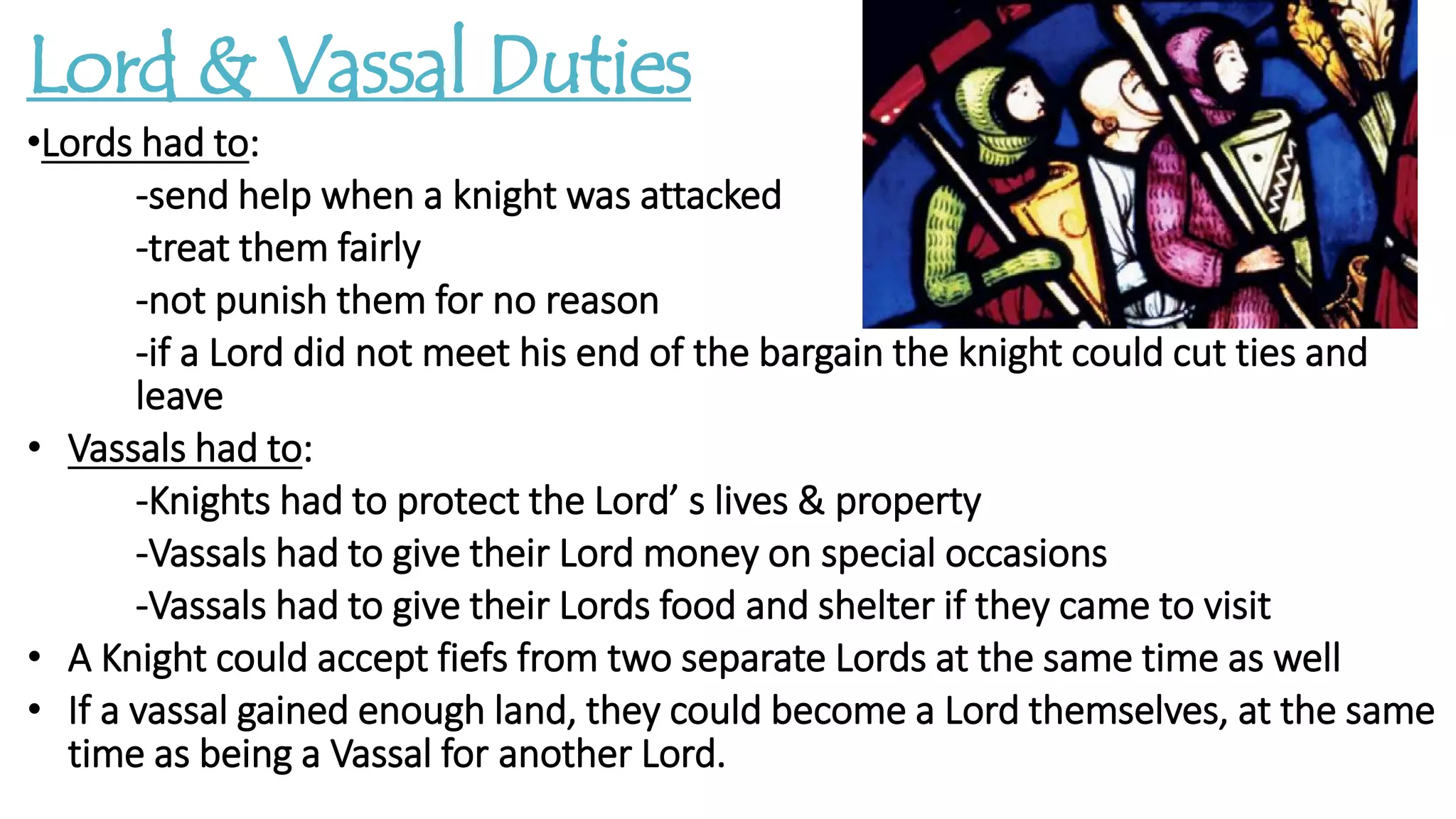
•Lords had to:
-send help when a knight was attacked
-treat them fairly
-not punish them for no reason
-if a Lord did not meet his end of the bargain the knight could cut ties and
leave
• Vassals had to:
-Knights had to protect the Lord’ s lives & property
-Vassals had to give their Lord money on special occasions
-Vassals had to give their Lords food and shelter if they came to visit
• A Knight could accept fiefs from two separate Lords at the same time as well
• If a vassal gained enough land, they could become a Lord themselves, at the same
time as being a Vassal for another Lord.
Lord’s House
motte
Village for peasants,
serfs & workers
Quick Check
1. Nobles who gave land in return for military service were
called…
A) knights B) lords C) serfs D) kings
2. Which of the following duties did a vassal owe his lord?
A) land B) military service C) servants D) horses
3. They system of promises that governed lords and vassals is
known as:
A) obligations B) manorialism C) fie D) feudalism
Feudalism Spreads
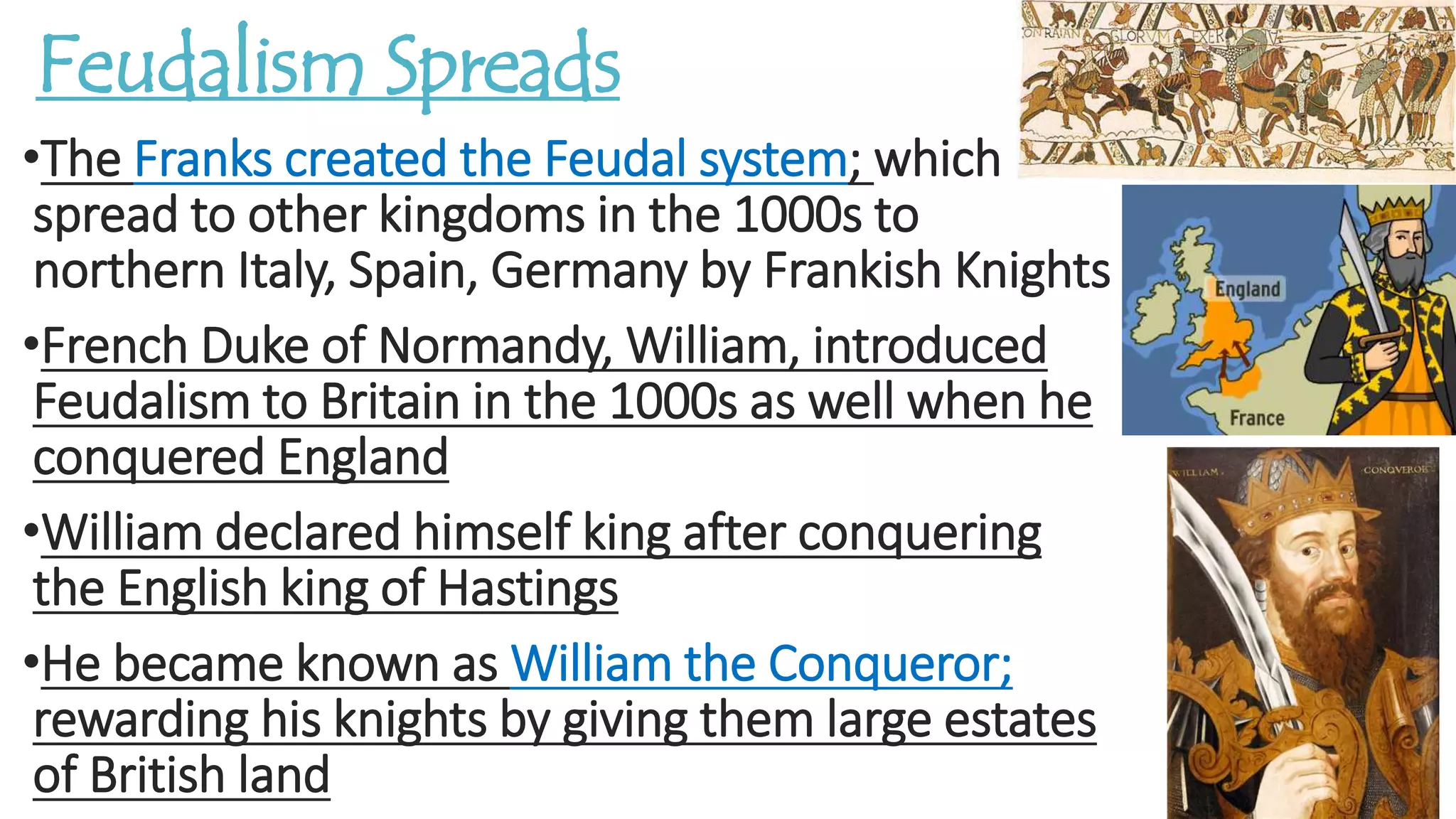
•The Franks created the Feudal system; which
spread to other kingdoms in the 1000s to
northern Italy, Spain, Germany by Frankish Knights
•French Duke of Normandy, William, introduced
Feudalism to Britain in the 1000s as well when he
conquered England
•William declared himself king after conquering
the English king of Hastings
•He became known as William the Conqueror;
rewarding his knights by giving them large estates
of British land
The Manor System
•Knights needed a way to farm the land that
they received from the Lords for their service
while they fought
•Peasants (serfs), small farmers, needed land
to grow food to live
•New Economic System emerged (The Manor
System): Knights allowed peasants to farm &
live on the land they owned in return for food
or other payment
•Each manor included a large house or castle,
pastures, fields, & a forest… and a village
where the peasants lived
Video-7:17 min
Peasants and Serfs
•Two-Thirds of a Lord’s land was divided among
the use of Peasants or Serfs
•Peasant- small farmer; Serf- is tied to the land
on which they live and work
•Serfs were not slaves, but were not allowed to
leave the land without permission form the
lord
•Serfs works the Lord’s fields- in return they got
a very small piece of land to work for
themselves & the Lord’s protection from
raiders
Manor Lords
•Controlled everything that
happened of his land
•His word was the law there
•Resolved disputes & punished
people who misbehaved
•Collected taxes from the people
who lived on his land
•Most lived in large houses or
wooded castles
Women of the Middle Ages
•Regardless of their social class, women had
fewer rights than men
•Had to obey the wishes of their fathers and
husbands
•Peasant women worked to support their
families
•Noblewomen supervised the servants & and
governed the manor when their husband was
away at war
•Women who wanted political power joined
the Christian Church, like Eleanor of Aquitaine
Textbook page 510
Early Middle Age Technology
•Heavier plow that could dig deeper into the soil,
helping the plats grow better
•Horse collar allowed farmers to plow using
horses to pull the load of the plow; enabling
them to plow larger fields, grow more food, and
feed more people
•Surplus of food resulted in increased trade and
population growth in towns
•The chance to trade goods & make money
prompted many to leave their farms & go to
cities
•In time, trade led to the decline in feudalism
Quick Check
1. Who first created feudalism?
A) Spanish B) Germans C) Franks D) Italians
2. Knights did not have time to…
A) Support nobles B) fight battles
C) Serve their lords D) work in the fields
3. In return for farming knights’ land, peasants had to….
A) Give knights food B) Fight for knights
C) Care for knight’s children D) provide weapons
Feudal System Comparison
EUROPE
•Land was the basis of the
Feudal system
•Kings & Lords gave knights
land to protect and fight
for them
•Lords allowed peasants &
serfs to work their land in
return for food and
payments
JAPAN
•Emperor gave land to great
lords (daimyo)
•Lords (daimyo) employed
warriors called samurai
•Samurai fought & protected
the lords in return for rice,
grain, & shelter
•Lords got the rice & grain
from peasants who farmed
the land and paid in food
Feudal Warrior Comparison
EUROPE
•Swear loyalty to their Lord
•Expected to live disciplined
& honorable lives
•Follow the code of Chivalry
•Admired by society
•Heroic stories & songs
written about them in battle
JAPAN
•Swear loyalty to their
daimyo
•Expected to live disciplined
& honorable lives
•Follow the code of Bushido
•Admired by society
•Heroic stories and songs
written about them in
battle
Rewind- Remind-Quiz
1. What two groups of people were largely responsible for the
northern spread of Christianity?
2. In what ways was the empire if Franks under Charlemagne
like the Roman Empire?
3. How was feudalism related to medieval Europe’s economic
system?
4. Who were the Japanese counterparts to European knights?
5. Why do you think people wrote about knights and samurai
in literature?

The Middle Ages: Feudalism

  • 1.
    Early Middle Ages: European Feudalism 6-5: The student willdemonstrate an understanding of o the Middle Ages and the emergence of nation-states in Europe
  • 2.
    Europe After theFall of Rome Different groups from the north and east moved into former Roman lands Created their own states ruled by warlords who called named themselves kings They fought amongst each other during the 500s
  • 3.
    Christianity Spreads toNorthern Europe The creation of these kingdom marks the beginning of the Middle Ages or medieval times (500-1500 AD) Christianity was brought to the regions through missionaries and monks from places like Spain and Italy- formerly parts of the Roman Empire
  • 4.
    Missionaries •Popes (leader ofthe Catholic Church) were responsible for sending missionaries to teach Christianity to northern European kingdoms •Britain was one of the first places missionaries went; then to France and Germany •They travelled in groups •Saint Patrick- a monk who traveled alone from Britain to Ireland to convert people to Christianity in the 400’s Video: Legend of St. Patrick
  • 5.
    Monks •Monks lived incommunities called monasteries where they lived separate from society to pray, work, and meditate •Italian monk- Benedict created a code of rules for monks to live by called the Benedict Rule •Monks: • Gave aid to the people in the community • Ran schools and copied books • Collected & saved ancient writings from Greece & Rome • Served as scribes & advisors to local rulers • Spread Christian teachings into new areas Video: The Monk’s Song: Horrible Histories
  • 6.
    Charlemagne •The Franks tookcontrol of Gaul (modern day France) in the 480s •Became Christians under King Clovis •Kingdom reached its height in the 700s under King Charlemagne- a strong Christian king & warrior •Charlemagne conquered many neighboring kingdoms of the former Roman Empire, expanding to all of France, and into modern Italy, Germany, Austria, & Spain •In the 800s, the Pope crowned him Emperor of the Romans on Christmas Day Video: 10 min
  • 7.
    Invaders •Charlemagne's Empire wasunder constant attack •Muslims attacked from Southern France & northern Italy •Magyars attacked from the east •Vikings attacked from Scandinavia -Raided Britain, Ireland, parts of Western Europe -looted towns & monasteries; taking prisoners to sell into slavery -Europeans lived in fear of Viking raids
  • 8.
    Feudalism & ManorLife Kingscouldn’toffertheprotectiontotheirpeopleneededduringtheinvasions. Lords&nobleshadtodefendtheirownlands;resultingintheirgrowingpower
  • 9.
  • 10.
    Lord & VassalDuties •Lords had to: -send help when a knight was attacked -treat them fairly -not punish them for no reason -if a Lord did not meet his end of the bargain the knight could cut ties and leave • Vassals had to: -Knights had to protect the Lord’ s lives & property -Vassals had to give their Lord money on special occasions -Vassals had to give their Lords food and shelter if they came to visit • A Knight could accept fiefs from two separate Lords at the same time as well • If a vassal gained enough land, they could become a Lord themselves, at the same time as being a Vassal for another Lord.
  • 11.
    Lord’s House motte Village forpeasants, serfs & workers
  • 12.
    Quick Check 1. Nobleswho gave land in return for military service were called… A) knights B) lords C) serfs D) kings 2. Which of the following duties did a vassal owe his lord? A) land B) military service C) servants D) horses 3. They system of promises that governed lords and vassals is known as: A) obligations B) manorialism C) fie D) feudalism
  • 13.
    Feudalism Spreads •The Frankscreated the Feudal system; which spread to other kingdoms in the 1000s to northern Italy, Spain, Germany by Frankish Knights •French Duke of Normandy, William, introduced Feudalism to Britain in the 1000s as well when he conquered England •William declared himself king after conquering the English king of Hastings •He became known as William the Conqueror; rewarding his knights by giving them large estates of British land
  • 14.
    The Manor System •Knightsneeded a way to farm the land that they received from the Lords for their service while they fought •Peasants (serfs), small farmers, needed land to grow food to live •New Economic System emerged (The Manor System): Knights allowed peasants to farm & live on the land they owned in return for food or other payment •Each manor included a large house or castle, pastures, fields, & a forest… and a village where the peasants lived
  • 15.
  • 16.
    Peasants and Serfs •Two-Thirdsof a Lord’s land was divided among the use of Peasants or Serfs •Peasant- small farmer; Serf- is tied to the land on which they live and work •Serfs were not slaves, but were not allowed to leave the land without permission form the lord •Serfs works the Lord’s fields- in return they got a very small piece of land to work for themselves & the Lord’s protection from raiders
  • 17.
    Manor Lords •Controlled everythingthat happened of his land •His word was the law there •Resolved disputes & punished people who misbehaved •Collected taxes from the people who lived on his land •Most lived in large houses or wooded castles
  • 18.
    Women of theMiddle Ages •Regardless of their social class, women had fewer rights than men •Had to obey the wishes of their fathers and husbands •Peasant women worked to support their families •Noblewomen supervised the servants & and governed the manor when their husband was away at war •Women who wanted political power joined the Christian Church, like Eleanor of Aquitaine Textbook page 510
  • 19.
    Early Middle AgeTechnology •Heavier plow that could dig deeper into the soil, helping the plats grow better •Horse collar allowed farmers to plow using horses to pull the load of the plow; enabling them to plow larger fields, grow more food, and feed more people •Surplus of food resulted in increased trade and population growth in towns •The chance to trade goods & make money prompted many to leave their farms & go to cities •In time, trade led to the decline in feudalism
  • 20.
    Quick Check 1. Whofirst created feudalism? A) Spanish B) Germans C) Franks D) Italians 2. Knights did not have time to… A) Support nobles B) fight battles C) Serve their lords D) work in the fields 3. In return for farming knights’ land, peasants had to…. A) Give knights food B) Fight for knights C) Care for knight’s children D) provide weapons
  • 21.
    Feudal System Comparison EUROPE •Landwas the basis of the Feudal system •Kings & Lords gave knights land to protect and fight for them •Lords allowed peasants & serfs to work their land in return for food and payments JAPAN •Emperor gave land to great lords (daimyo) •Lords (daimyo) employed warriors called samurai •Samurai fought & protected the lords in return for rice, grain, & shelter •Lords got the rice & grain from peasants who farmed the land and paid in food
  • 22.
    Feudal Warrior Comparison EUROPE •Swearloyalty to their Lord •Expected to live disciplined & honorable lives •Follow the code of Chivalry •Admired by society •Heroic stories & songs written about them in battle JAPAN •Swear loyalty to their daimyo •Expected to live disciplined & honorable lives •Follow the code of Bushido •Admired by society •Heroic stories and songs written about them in battle
  • 23.
    Rewind- Remind-Quiz 1. Whattwo groups of people were largely responsible for the northern spread of Christianity? 2. In what ways was the empire if Franks under Charlemagne like the Roman Empire? 3. How was feudalism related to medieval Europe’s economic system? 4. Who were the Japanese counterparts to European knights? 5. Why do you think people wrote about knights and samurai in literature?