
http://www.cpi-team.com
http://www.youtube.com/watch?v=8qUuQbi4ocQ
http://www.youtube.com/watch?v=eICMSgr-x14&feature=related
ROCK
ANCHORS
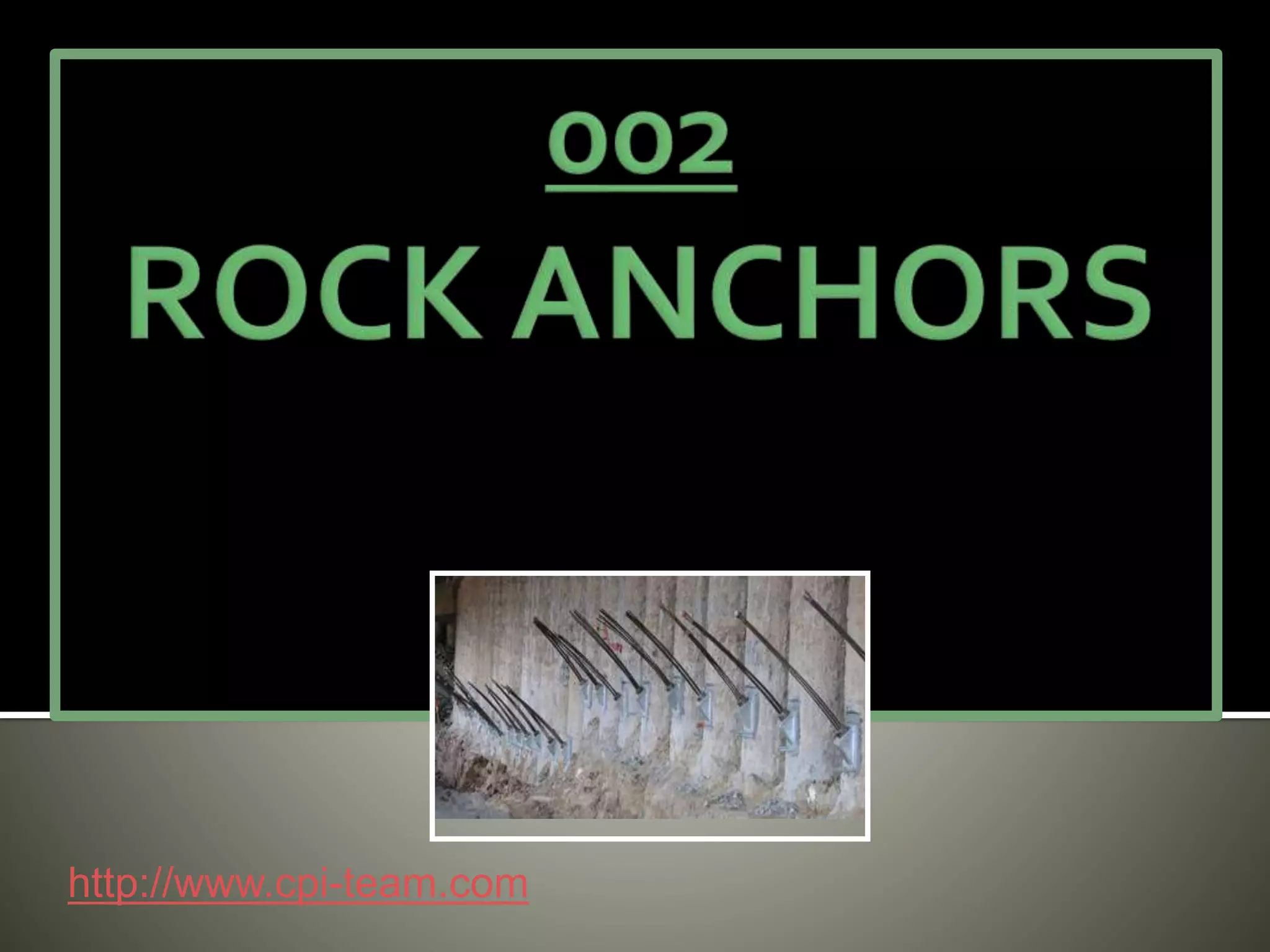
• Ground anchors had been
used in the U.S. since the
early 1960’s primarily as
temporary “tie backs” and
as permanent installations
for dams since 1968.
ROCK
ANCHORS
•How long will the anchors
last?
•What is the cost?
ROCK
ANCHORS
• Database of over 400 dam
anchor projects completed in
North America from 1968 to
2004
Rock Anchor Components (PCI,
1974).
(Note the lack of protection to the
steel other than grout.)
ROCK
ANCHORS
• 1996. Permanence is now defined as
a minimum of 24 months in a
completely revise set of
Recommendations.
ROCK
ANCHORS
• A wider spectrum of issues than
simple chemistry now have to be
considered when selecting
corrosion protection principles.
A major breakthrough was to
identify two classes of protection
(Class I and II) for permanent
anchors
It replaced the poorly defined
“double” and “single” corrosion
protection systems offered by
various tendon manufacturers.
ROCK
ANCHORS
The details are summarized
inTable 1 and a “decision
tree” (Figure 2) was
provided for the guidance
of designers.
Figure 2. Corrosion Protection
DecisionTree (PTI, 1996).
2004
 The existing Recommendations
were revalidated while it is stated
that, for permanent anchors,
“aggressive conditions shall be
assumed if the aggressively of the
ground has not been quantified by
testing.”
 Table 1 was revised, as shown inTable
1R, mainly to clarify the Class I status of
epoxy protected steel in a “water
proofed hole.”
 The sophistication of contemporary
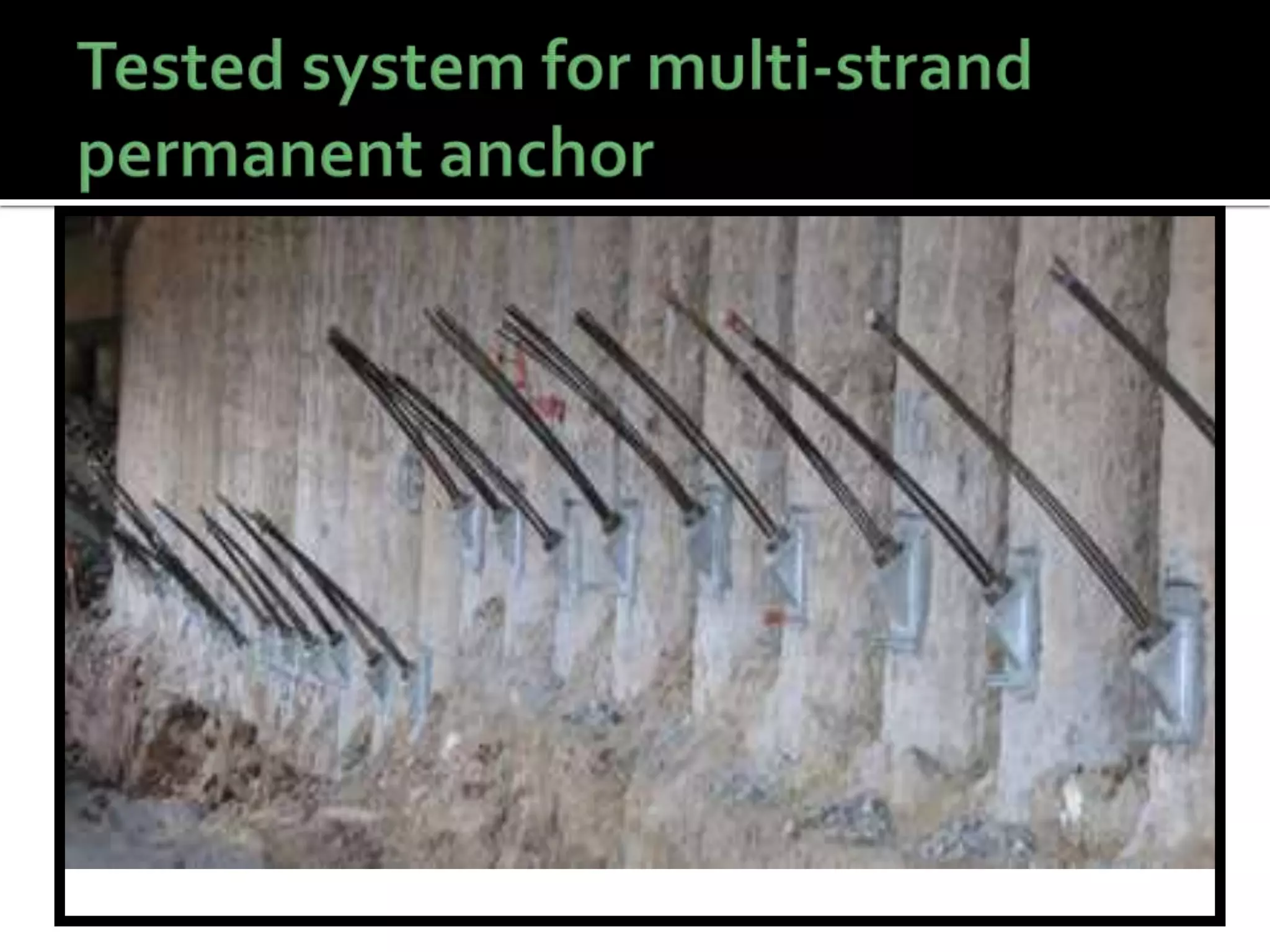
tendons is shown in Figure 3 and 4. A
long supplement is devoted to epoxy
protected strand.
Between 1974 and 2006
(i) Extremely sophisticated corrosion
protection systems were developed and
(ii) (ii) the latitude offered to designers relative
to choice of corrosion protection intensity
and details was severely restricted: to install
a permanent anchor in a dam without Class I
protection is now not only impermissible,
but unthinkable.
Permanent Anchors
 Permanent anchors come in many
different shapes, sizes and types.
 (supply of all materials,
fabrication, installation, grouting,
testing, tensioning, lift-off
testing).
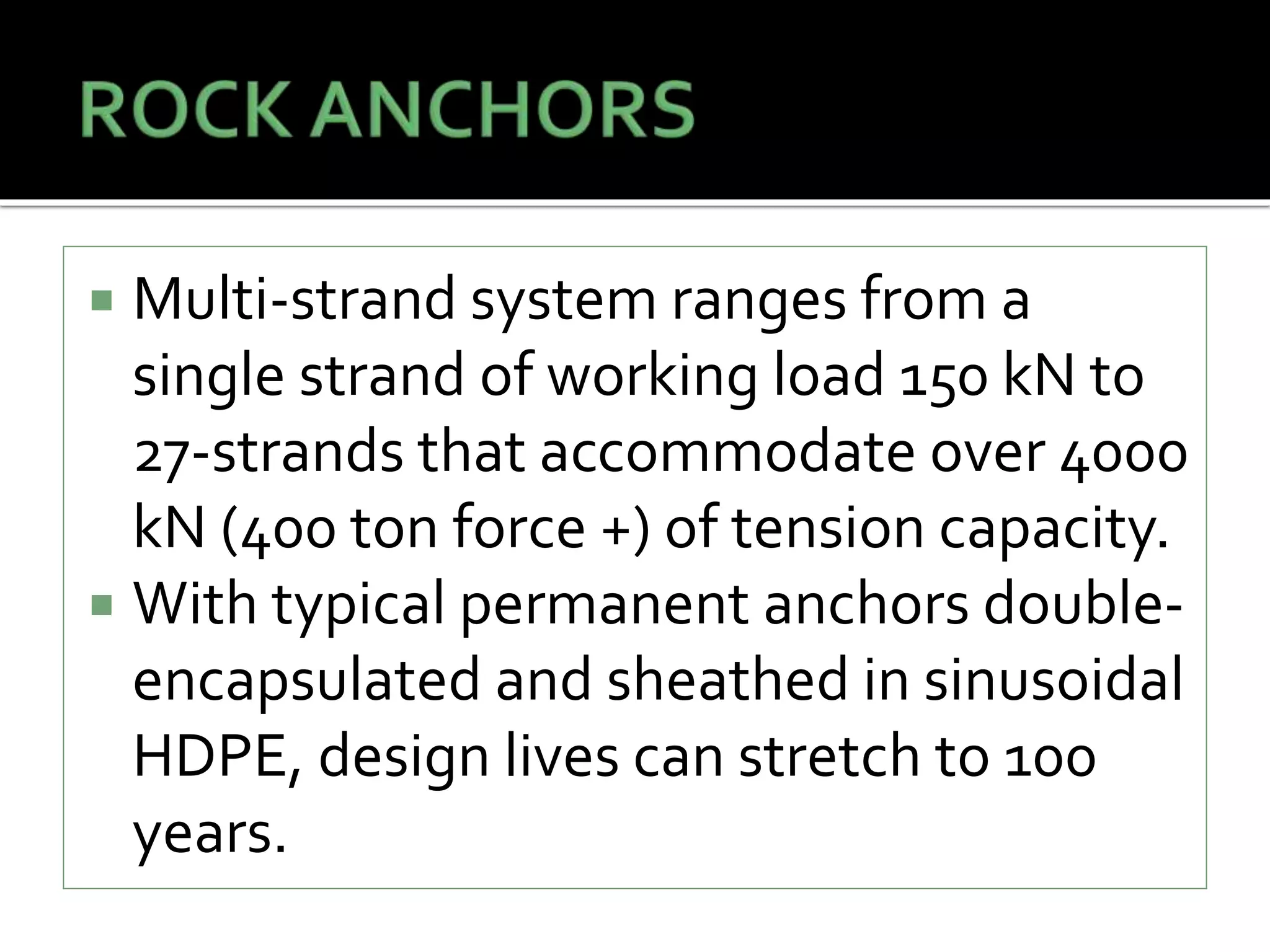
 Multi-strand system ranges from a
single strand of working load 150 kN to
27-strands that accommodate over 4000
kN (400 ton force +) of tension capacity.
 With typical permanent anchors double-
encapsulated and sheathed in sinusoidal
HDPE, design lives can stretch to 100
years.
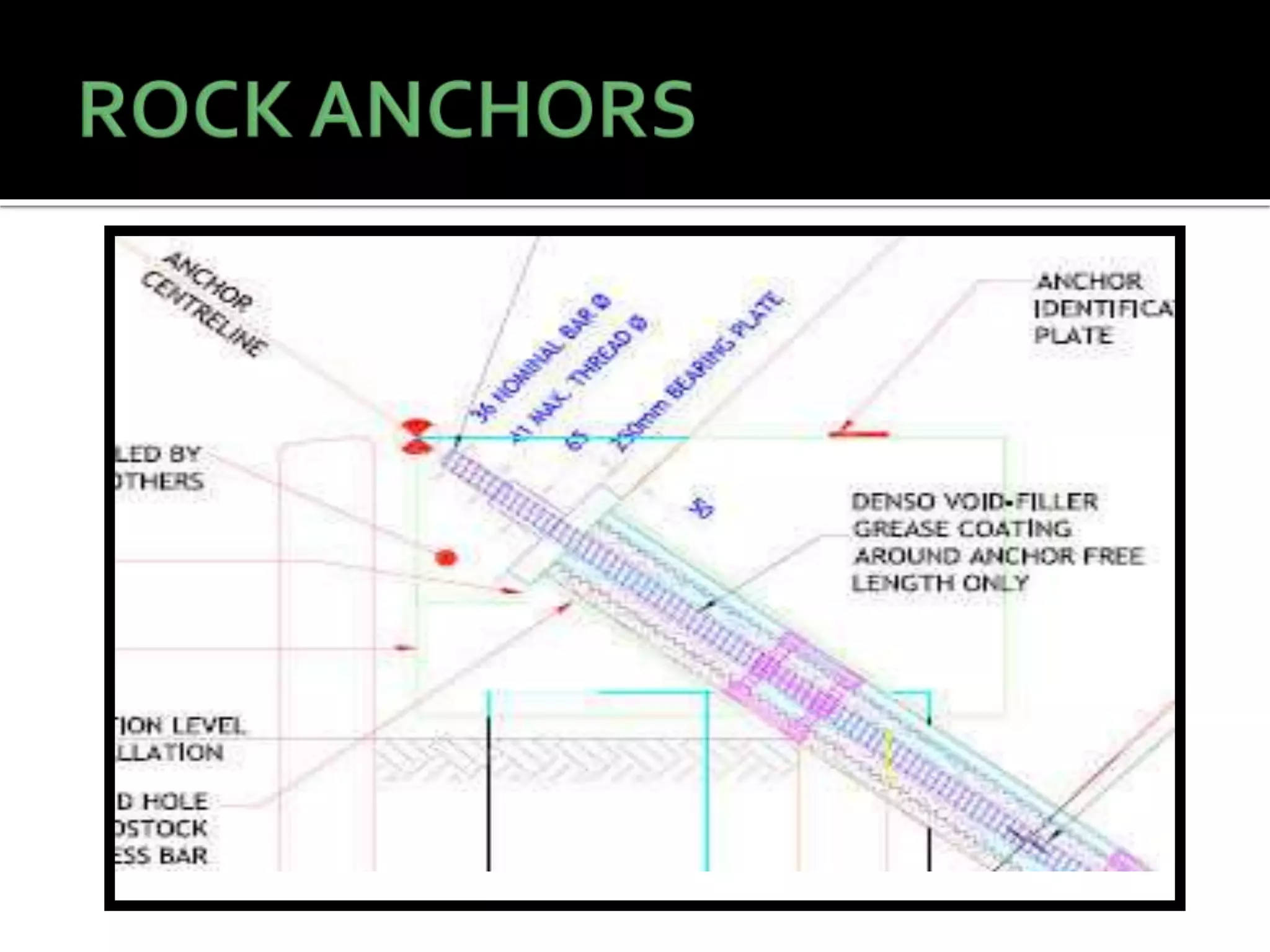
 Permanent Stressbar Anchors are high-strength,
1000 MPa grade threaded bar, used mainly in Civil &
Infrastructure retention and construction works.
 As with the multi-strand anchors, the stressbar is
encapsulated in a sinusoidal sheathing providing a
design life of up to 100 years.
 Standard thread bar sizes allow for a safe working
load of up to 660 kN, but non-standard sizes allow
for a far greater load.
 Similar to permanent stressbar anchors, rock
bolts are a lesser grade – 500 MPa – of
threaded and are more common.
 Ranging in size from 20 to 40mm in diameter,
rock bolts are most commonly found in
Infrastructure retention systems and can be
both actively or passively (nominally)
tensioned, usually against, or encapsulated-
in, shotcrete walls.
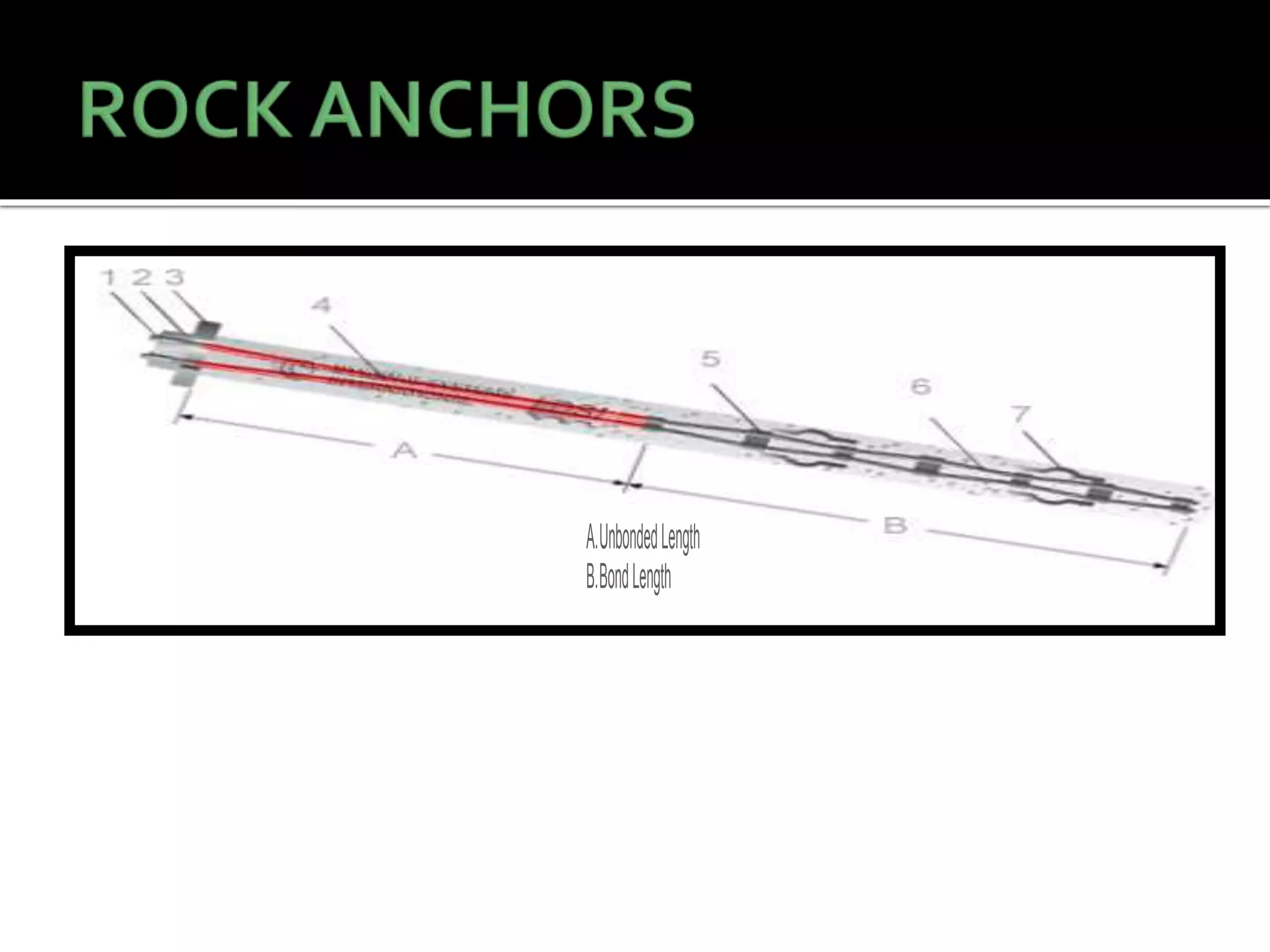
 Unbonded Length
 Bond Length
A.UnbondedLength
B.BondLength
1. Wedge
2. Wedge Plate
3. Bearing Plate
4. Greased & PE or PP Extruded
Strand in Unbonded Length
5. Spacers along Bond Length
6. Bare Strand in Bond Length
7. Centralizer
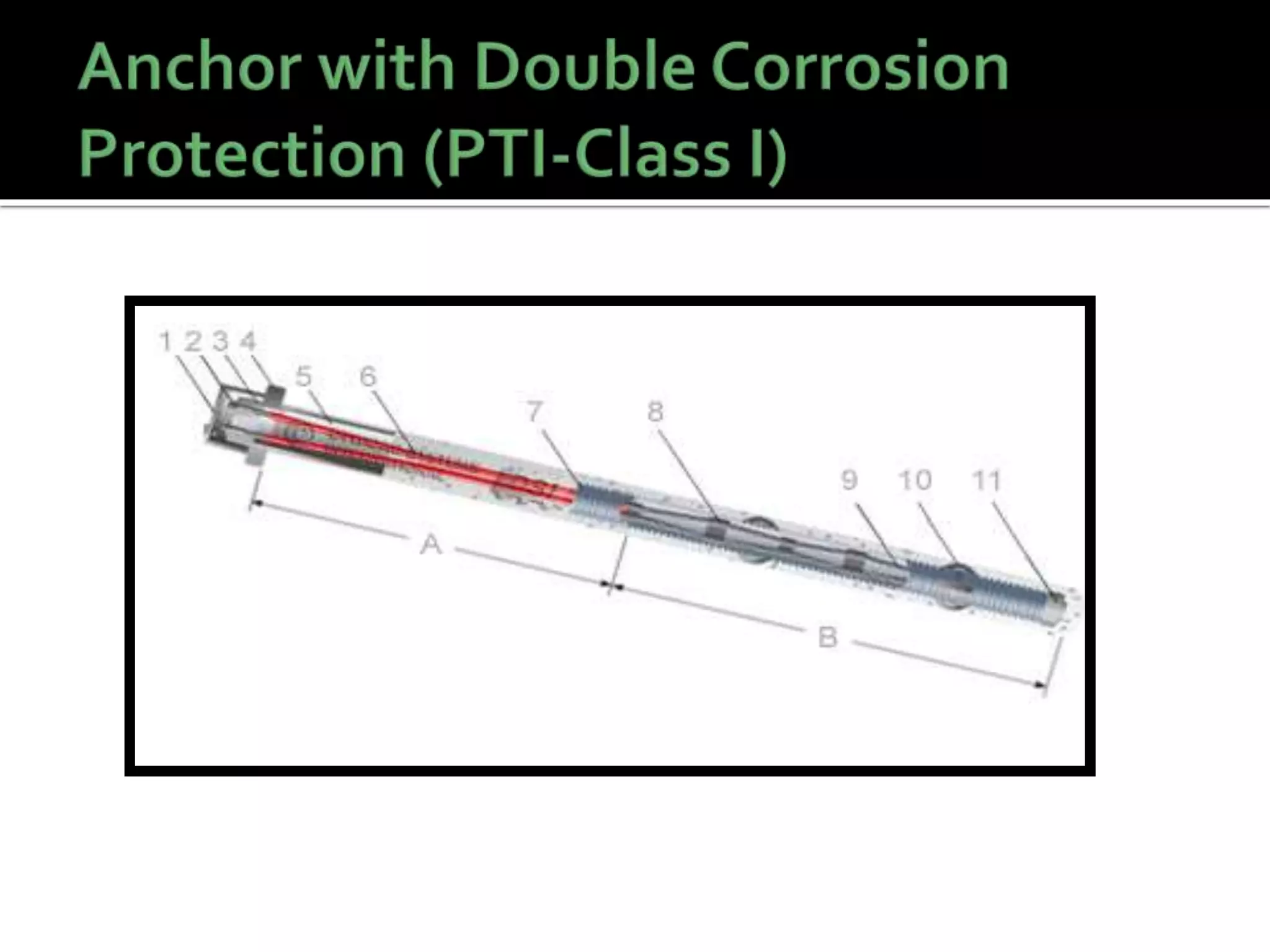
 Grout Filled Bond Length Encapsulated
 Greased & PE Extruded Unbonded Length
1. Cover Cap
2. Wedge
3. Wedge Plate
4. Bearing Plate
5. Trumpet
6. Greased & PE or PP Extruded Strand in Unbonded
Length
7. Corrugated Sheathing
8. Spacers along Bond Length
9. Bare Strand in Bond Length
10. Centralizer
11. End Cap

Anchors rock anchors

  • 1.
  • 4.
  • 5.
    ROCK ANCHORS • Ground anchorshad been used in the U.S. since the early 1960’s primarily as temporary “tie backs” and as permanent installations for dams since 1968.
  • 6.
    ROCK ANCHORS •How long willthe anchors last? •What is the cost? ROCK ANCHORS • Database of over 400 dam anchor projects completed in North America from 1968 to 2004
  • 7.
    Rock Anchor Components(PCI, 1974). (Note the lack of protection to the steel other than grout.)
  • 8.
    ROCK ANCHORS • 1996. Permanenceis now defined as a minimum of 24 months in a completely revise set of Recommendations. ROCK ANCHORS • A wider spectrum of issues than simple chemistry now have to be considered when selecting corrosion protection principles.
  • 9.
    A major breakthroughwas to identify two classes of protection (Class I and II) for permanent anchors It replaced the poorly defined “double” and “single” corrosion protection systems offered by various tendon manufacturers. ROCK ANCHORS
  • 10.
    The details aresummarized inTable 1 and a “decision tree” (Figure 2) was provided for the guidance of designers.
  • 12.
    Figure 2. CorrosionProtection DecisionTree (PTI, 1996).
  • 13.
    2004  The existingRecommendations were revalidated while it is stated that, for permanent anchors, “aggressive conditions shall be assumed if the aggressively of the ground has not been quantified by testing.”
  • 14.
     Table 1was revised, as shown inTable 1R, mainly to clarify the Class I status of epoxy protected steel in a “water proofed hole.”  The sophistication of contemporary tendons is shown in Figure 3 and 4. A long supplement is devoted to epoxy protected strand.
  • 20.
    Between 1974 and2006 (i) Extremely sophisticated corrosion protection systems were developed and (ii) (ii) the latitude offered to designers relative to choice of corrosion protection intensity and details was severely restricted: to install a permanent anchor in a dam without Class I protection is now not only impermissible, but unthinkable.
  • 24.
    Permanent Anchors  Permanentanchors come in many different shapes, sizes and types.  (supply of all materials, fabrication, installation, grouting, testing, tensioning, lift-off testing).
  • 27.
     Multi-strand systemranges from a single strand of working load 150 kN to 27-strands that accommodate over 4000 kN (400 ton force +) of tension capacity.  With typical permanent anchors double- encapsulated and sheathed in sinusoidal HDPE, design lives can stretch to 100 years.
  • 29.
     Permanent StressbarAnchors are high-strength, 1000 MPa grade threaded bar, used mainly in Civil & Infrastructure retention and construction works.  As with the multi-strand anchors, the stressbar is encapsulated in a sinusoidal sheathing providing a design life of up to 100 years.  Standard thread bar sizes allow for a safe working load of up to 660 kN, but non-standard sizes allow for a far greater load.
  • 31.
     Similar topermanent stressbar anchors, rock bolts are a lesser grade – 500 MPa – of threaded and are more common.  Ranging in size from 20 to 40mm in diameter, rock bolts are most commonly found in Infrastructure retention systems and can be both actively or passively (nominally) tensioned, usually against, or encapsulated- in, shotcrete walls.
  • 34.
     Unbonded Length Bond Length A.UnbondedLength B.BondLength
  • 35.
    1. Wedge 2. WedgePlate 3. Bearing Plate 4. Greased & PE or PP Extruded Strand in Unbonded Length 5. Spacers along Bond Length 6. Bare Strand in Bond Length 7. Centralizer
  • 37.
     Grout FilledBond Length Encapsulated  Greased & PE Extruded Unbonded Length 1. Cover Cap 2. Wedge 3. Wedge Plate 4. Bearing Plate 5. Trumpet 6. Greased & PE or PP Extruded Strand in Unbonded Length 7. Corrugated Sheathing 8. Spacers along Bond Length 9. Bare Strand in Bond Length 10. Centralizer 11. End Cap