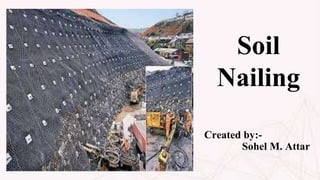
Soil
Nailing
Created by:-
Sohel M. Attar
Introduction
● Soil nailing is method of reinforcing the soil with bars or other material.
● The porpuse is to increase the tensile force, shear strength of the soil on sloping
side.
● Soil Nailing technique is used for retaining walls and for slope stabilization.
● Soil Nailing is typically used to stabilize existing slopes or excavation where top-
to-bottom construction is advantageous compared to other retaining wall systems.
Origins
● In Germany,the first use of soil nail wall was in 1975.(Stacker et al.1979).
● The first application of soil nailing was in 1972. For a railroad widening project
near Varsailles,France where an 18 m high.
● The United States first used soil nailing in 1976.For the support of 13.7 m deep
foundation excavation in dense silty sand.
● Soil nailing evolved from the New Austrian Tunneling system method which is a
system for underground excavations in rock.
Application
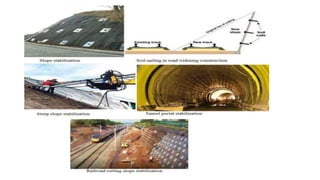
● Stabilization of existing retaining wall.
● Landslide redemption.
● Steep cutting stabilizations.
● Tunnel portals in unstable and steep stratified slopes.
● Stabilizing of over steep existing embankments.
● Stabilization of highway and roadway embankments and cut slopes.
Objectives
● To reinforce soil to make it more stable.
● To strengthen or stabilize the existing steep slopes and excavations for longer
period of time.
● Study on the beahavior of slop using soil nailing.
Types of Nailing
● Driven soil Nails
● Grouted soil Nails
● Drilled soil Nail
● Jet Grouted soil Nails
● Lounched soil Nails
Driven soil Nail
● These soil nails are relatively
small in diameter [19 to 25 mm
(¾ to 1 in.)] and are mechanically
driven into the ground.
● They are usually spaced
approximately 1 to 1.2 m (3 to 4
ft) apart.
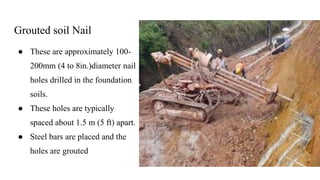
Grouted soil Nail
● These are approximately 100-
200mm (4 to 8in.)diameter nail
holes drilled in the foundation
soils.
● These holes are typically
spaced about 1.5 m (5 ft) apart.
● Steel bars are placed and the
holes are grouted
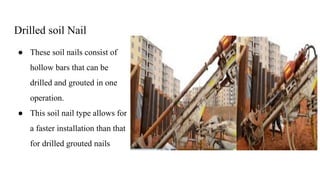
Drilled soil Nail
● These soil nails consist of
hollow bars that can be
drilled and grouted in one
operation.
● This soil nail type allows for
a faster installation than that
for drilled grouted nails
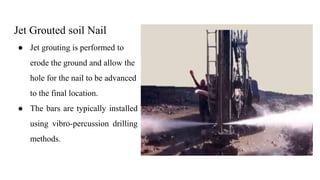
Jet Grouted soil Nail
● Jet grouting is performed to
erode the ground and allow the
hole for the nail to be advanced
to the final location.
● The bars are typically installed
using vibro-percussion drilling
methods.
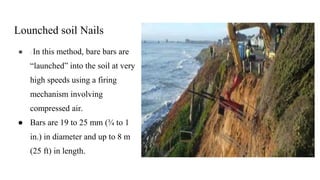
Lounched soil Nails
● : In this method, bare bars are
“launched” into the soil at very
high speeds using a firing
mechanism involving
compressed air.
● Bars are 19 to 25 mm (¾ to 1
in.) in diameter and up to 8 m
(25 ft) in length.
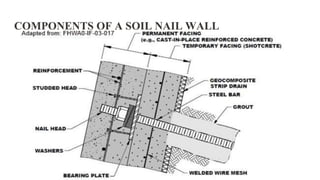
COMPONENTS OF A SOIL NAIL WALL
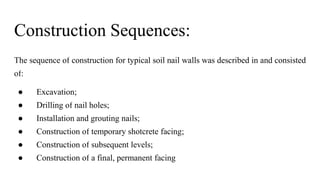
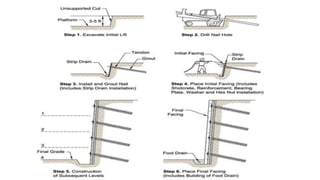
Construction Sequences:
The sequence of construction for typical soil nail walls was described in and consisted
of:
● Excavation;
● Drilling of nail holes;
● Installation and grouting nails;
● Construction of temporary shotcrete facing;
● Construction of subsequent levels;
● Construction of a final, permanent facing
Machineries used in a soil nailing
The following tools or machineries are used for soil nailing:
● Drilling Equipments
● Grout Mixing Equipments
● Shotcreting / Guniting Equipments
● Compressor
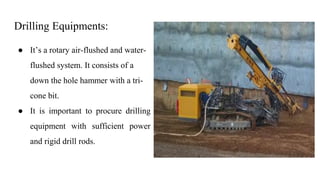
Drilling Equipments:
● It’s a rotary air-flushed and water-
flushed system. It consists of a
down the hole hammer with a tri-
cone bit.
● It is important to procure drilling
equipment with sufficient power
and rigid drill rods.
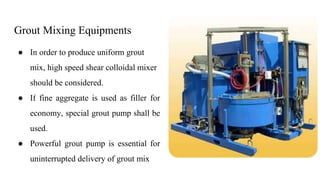
Grout Mixing Equipments
● In order to produce uniform grout
mix, high speed shear colloidal mixer
should be considered.
● If fine aggregate is used as filler for
economy, special grout pump shall be
used.
● Powerful grout pump is essential for
uninterrupted delivery of grout mix
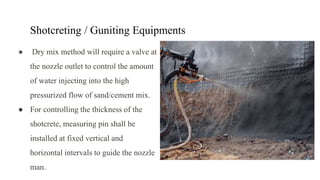
Shotcreting / Guniting Equipments
● Dry mix method will require a valve at
the nozzle outlet to control the amount
of water injecting into the high
pressurized flow of sand/cement mix.
● For controlling the thickness of the
shotcrete, measuring pin shall be
installed at fixed vertical and
horizontal intervals to guide the nozzle
man.
Compressor
● The compressor shall have minimum capacity to delivered shotcrete at the
minimum rate of 9m3/min.
● Sometimes, the noise of compressor can be an issue if the work is at close
proximity to residential area, hospital and school.
Materials used in soil nailing
● Steel Reinforcements.
● Grout Mix.
● Shotcrete / Gunite.
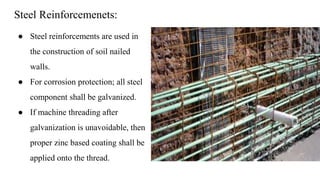
Steel Reinforcemenets:
● Steel reinforcements are used in
the construction of soil nailed
walls.
● For corrosion protection; all steel
component shall be galvanized.
● If machine threading after
galvanization is unavoidable, then
proper zinc based coating shall be
applied onto the thread.
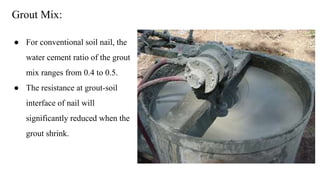
Grout Mix:
● For conventional soil nail, the
water cement ratio of the grout
mix ranges from 0.4 to 0.5.
● The resistance at grout-soil
interface of nail will
significantly reduced when the
grout shrink.
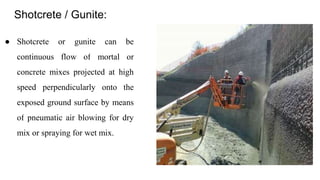
Shotcrete / Gunite:
● Shotcrete or gunite can be
continuous flow of mortal or
concrete mixes projected at high
speed perpendicularly onto the
exposed ground surface by means
of pneumatic air blowing for dry
mix or spraying for wet mix.
Design considerations
● Strength limit: The limit state at which potential failure or collapse occurs.
● Service limit: The limit state at which loss of service function occurs resulting
from excessive wall deformation.
● Height and length.
● Vertical and horizontal spacing of the soil nails.
● Inclination of the soil nails.
● Ground properties.
● Nail length, diameter and maximum force.
● Drainage, frost penetration, external loads due to wind and hydrostatic forces.
Advantages:
● They are good for confined spaces with restricted access.
● There is less environmental impact.
● They are relatively quick and easy to install.
● They use less materials and shoring.
● They are flexible enough to be used on new constructions, temporary
structures or on remodelling processes.
● The height is not restricted.
Disadvantages:
● They are not suitable for areas with a high water table.
● In soils of low shear strength, very high soil nail density may be required.
● They are not suitable for permanent use in sensitive and expansive soils.
● Specialist contractors are required.
● Extensive 3D modelling may be required
Conclusion
● The soil nailing is a useful method for protection of loose soil and slopes
from rainfall induced erosion.
● The soil nailing method does not require any skilled labour or sophisticated
tools.Hence it may be adopted at sites where soil stabilization is necessary.
● Nails grouted with cement are more effective than driven nails into the
ground.
● Soil nailing is an economical method.
Reference:
● Sharma, P. “Therotical analysis of soil nailing: design, performance and
future aspects (2015)”. International Journal Of Engineering Research And
General Science.
● Taib, S. N. L. (2010). A Review of Soil Nailing Design Approaches.
UNIMASE – Journal Of Civil Engineering, 1(2).
● Liew, S. S., & Liong, C. H. (2006). Two Case Studies On Soil Nailed Slope
Failure. Submitted In International Conference On Slopes, Malaysia.

Soil nailing

  • 1.
  • 2.
    Introduction ● Soil nailingis method of reinforcing the soil with bars or other material. ● The porpuse is to increase the tensile force, shear strength of the soil on sloping side. ● Soil Nailing technique is used for retaining walls and for slope stabilization. ● Soil Nailing is typically used to stabilize existing slopes or excavation where top- to-bottom construction is advantageous compared to other retaining wall systems.
  • 3.
    Origins ● In Germany,thefirst use of soil nail wall was in 1975.(Stacker et al.1979). ● The first application of soil nailing was in 1972. For a railroad widening project near Varsailles,France where an 18 m high. ● The United States first used soil nailing in 1976.For the support of 13.7 m deep foundation excavation in dense silty sand. ● Soil nailing evolved from the New Austrian Tunneling system method which is a system for underground excavations in rock.
  • 4.
    Application ● Stabilization ofexisting retaining wall. ● Landslide redemption. ● Steep cutting stabilizations. ● Tunnel portals in unstable and steep stratified slopes. ● Stabilizing of over steep existing embankments. ● Stabilization of highway and roadway embankments and cut slopes.
  • 6.
    Objectives ● To reinforcesoil to make it more stable. ● To strengthen or stabilize the existing steep slopes and excavations for longer period of time. ● Study on the beahavior of slop using soil nailing.
  • 7.
    Types of Nailing ●Driven soil Nails ● Grouted soil Nails ● Drilled soil Nail ● Jet Grouted soil Nails ● Lounched soil Nails
  • 8.
    Driven soil Nail ●These soil nails are relatively small in diameter [19 to 25 mm (¾ to 1 in.)] and are mechanically driven into the ground. ● They are usually spaced approximately 1 to 1.2 m (3 to 4 ft) apart.
  • 9.
    Grouted soil Nail ●These are approximately 100- 200mm (4 to 8in.)diameter nail holes drilled in the foundation soils. ● These holes are typically spaced about 1.5 m (5 ft) apart. ● Steel bars are placed and the holes are grouted
  • 10.
    Drilled soil Nail ●These soil nails consist of hollow bars that can be drilled and grouted in one operation. ● This soil nail type allows for a faster installation than that for drilled grouted nails
  • 11.
    Jet Grouted soilNail ● Jet grouting is performed to erode the ground and allow the hole for the nail to be advanced to the final location. ● The bars are typically installed using vibro-percussion drilling methods.
  • 12.
    Lounched soil Nails ●: In this method, bare bars are “launched” into the soil at very high speeds using a firing mechanism involving compressed air. ● Bars are 19 to 25 mm (¾ to 1 in.) in diameter and up to 8 m (25 ft) in length.
  • 13.
    COMPONENTS OF ASOIL NAIL WALL
  • 14.
    Construction Sequences: The sequenceof construction for typical soil nail walls was described in and consisted of: ● Excavation; ● Drilling of nail holes; ● Installation and grouting nails; ● Construction of temporary shotcrete facing; ● Construction of subsequent levels; ● Construction of a final, permanent facing
  • 16.
    Machineries used ina soil nailing The following tools or machineries are used for soil nailing: ● Drilling Equipments ● Grout Mixing Equipments ● Shotcreting / Guniting Equipments ● Compressor
  • 17.
    Drilling Equipments: ● It’sa rotary air-flushed and water- flushed system. It consists of a down the hole hammer with a tri- cone bit. ● It is important to procure drilling equipment with sufficient power and rigid drill rods.
  • 18.
    Grout Mixing Equipments ●In order to produce uniform grout mix, high speed shear colloidal mixer should be considered. ● If fine aggregate is used as filler for economy, special grout pump shall be used. ● Powerful grout pump is essential for uninterrupted delivery of grout mix
  • 19.
    Shotcreting / GunitingEquipments ● Dry mix method will require a valve at the nozzle outlet to control the amount of water injecting into the high pressurized flow of sand/cement mix. ● For controlling the thickness of the shotcrete, measuring pin shall be installed at fixed vertical and horizontal intervals to guide the nozzle man.
  • 20.
    Compressor ● The compressorshall have minimum capacity to delivered shotcrete at the minimum rate of 9m3/min. ● Sometimes, the noise of compressor can be an issue if the work is at close proximity to residential area, hospital and school.
  • 21.
    Materials used insoil nailing ● Steel Reinforcements. ● Grout Mix. ● Shotcrete / Gunite.
  • 22.
    Steel Reinforcemenets: ● Steelreinforcements are used in the construction of soil nailed walls. ● For corrosion protection; all steel component shall be galvanized. ● If machine threading after galvanization is unavoidable, then proper zinc based coating shall be applied onto the thread.
  • 23.
    Grout Mix: ● Forconventional soil nail, the water cement ratio of the grout mix ranges from 0.4 to 0.5. ● The resistance at grout-soil interface of nail will significantly reduced when the grout shrink.
  • 24.
    Shotcrete / Gunite: ●Shotcrete or gunite can be continuous flow of mortal or concrete mixes projected at high speed perpendicularly onto the exposed ground surface by means of pneumatic air blowing for dry mix or spraying for wet mix.
  • 25.
    Design considerations ● Strengthlimit: The limit state at which potential failure or collapse occurs. ● Service limit: The limit state at which loss of service function occurs resulting from excessive wall deformation. ● Height and length. ● Vertical and horizontal spacing of the soil nails. ● Inclination of the soil nails. ● Ground properties. ● Nail length, diameter and maximum force. ● Drainage, frost penetration, external loads due to wind and hydrostatic forces.
  • 26.
    Advantages: ● They aregood for confined spaces with restricted access. ● There is less environmental impact. ● They are relatively quick and easy to install. ● They use less materials and shoring. ● They are flexible enough to be used on new constructions, temporary structures or on remodelling processes. ● The height is not restricted.
  • 27.
    Disadvantages: ● They arenot suitable for areas with a high water table. ● In soils of low shear strength, very high soil nail density may be required. ● They are not suitable for permanent use in sensitive and expansive soils. ● Specialist contractors are required. ● Extensive 3D modelling may be required
  • 28.
    Conclusion ● The soilnailing is a useful method for protection of loose soil and slopes from rainfall induced erosion. ● The soil nailing method does not require any skilled labour or sophisticated tools.Hence it may be adopted at sites where soil stabilization is necessary. ● Nails grouted with cement are more effective than driven nails into the ground. ● Soil nailing is an economical method.
  • 29.
    Reference: ● Sharma, P.“Therotical analysis of soil nailing: design, performance and future aspects (2015)”. International Journal Of Engineering Research And General Science. ● Taib, S. N. L. (2010). A Review of Soil Nailing Design Approaches. UNIMASE – Journal Of Civil Engineering, 1(2). ● Liew, S. S., & Liong, C. H. (2006). Two Case Studies On Soil Nailed Slope Failure. Submitted In International Conference On Slopes, Malaysia.