Sport Books Publisher 1
Chapter 3
Sport Books Publisher 2
Learning Objectives
 To describe muscle’s macro and micro structures
 To explain the sliding-filament action of muscular
contraction
 To differentiate among types of muscle fibres
 To describe group action of muscles
Sport Books Publisher 3
Types of Muscle
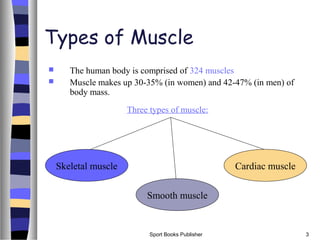
 The human body is comprised of 324 muscles
 Muscle makes up 30-35% (in women) and 42-47% (in men) of
body mass.
Three types of muscle:
Skeletal muscle
Smooth muscle
Cardiac muscle
Sport Books Publisher 4
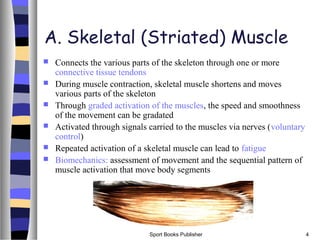
A. Skeletal (Striated) Muscle
 Connects the various parts of the skeleton through one or more
connective tissue tendons
 During muscle contraction, skeletal muscle shortens and moves
various parts of the skeleton
 Through graded activation of the muscles, the speed and smoothness
of the movement can be gradated
 Activated through signals carried to the muscles via nerves (voluntary
control)
 Repeated activation of a skeletal muscle can lead to fatigue
 Biomechanics: assessment of movement and the sequential pattern of
muscle activation that move body segments
Sport Books Publisher 5
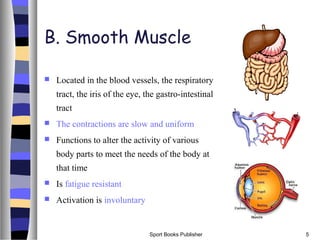
B. Smooth Muscle
 Located in the blood vessels, the respiratory
tract, the iris of the eye, the gastro-intestinal
tract
 The contractions are slow and uniform
 Functions to alter the activity of various
body parts to meet the needs of the body at
that time
 Is fatigue resistant
 Activation is involuntary
Sport Books Publisher 6
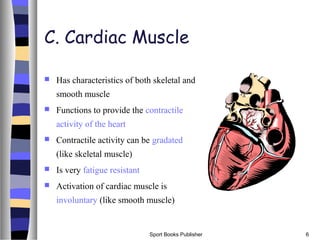
C. Cardiac Muscle
 Has characteristics of both skeletal and
smooth muscle
 Functions to provide the contractile
activity of the heart
 Contractile activity can be gradated
(like skeletal muscle)
 Is very fatigue resistant
 Activation of cardiac muscle is
involuntary (like smooth muscle)
Sport Books Publisher 7
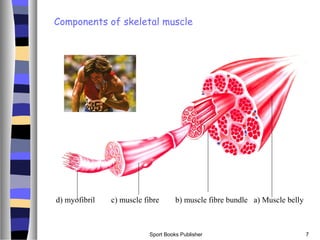
d) myofibril c) muscle fibre b) muscle fibre bundle a) Muscle belly
Components of skeletal muscle
Sport Books Publisher 8
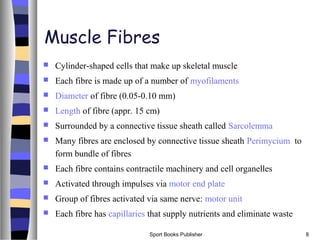
Muscle Fibres
 Cylinder-shaped cells that make up skeletal muscle
 Each fibre is made up of a number of myofilaments
 Diameter of fibre (0.05-0.10 mm)
 Length of fibre (appr. 15 cm)
 Surrounded by a connective tissue sheath called Sarcolemma
 Many fibres are enclosed by connective tissue sheath Perimycium to
form bundle of fibres
 Each fibre contains contractile machinery and cell organelles
 Activated through impulses via motor end plate
 Group of fibres activated via same nerve: motor unit
 Each fibre has capillaries that supply nutrients and eliminate waste
Sport Books Publisher 9
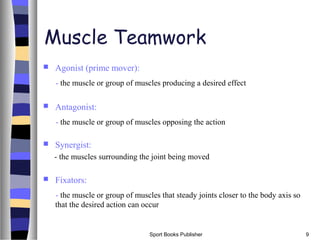
Muscle Teamwork
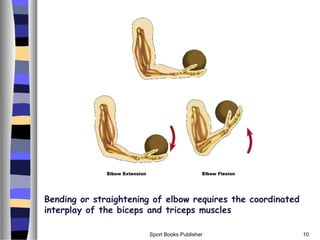
 Agonist (prime mover):
- the muscle or group of muscles producing a desired effect
 Antagonist:
- the muscle or group of muscles opposing the action
 Synergist:
- the muscles surrounding the joint being moved
 Fixators:
- the muscle or group of muscles that steady joints closer to the body axis so
that the desired action can occur
Sport Books Publisher 10
Bending or straightening of elbow requires the coordinated
interplay of the biceps and triceps muscles
Sport Books Publisher 11
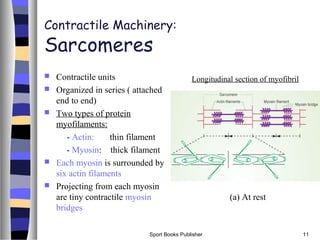
Contractile Machinery:
Sarcomeres
 Contractile units
 Organized in series ( attached
end to end)
 Two types of protein
myofilaments:
- Actin: thin filament
- Myosin: thick filament
 Each myosin is surrounded by
six actin filaments
 Projecting from each myosin
are tiny contractile myosin
bridges
Longitudinal section of myofibril
(a) At rest
Sport Books Publisher 12
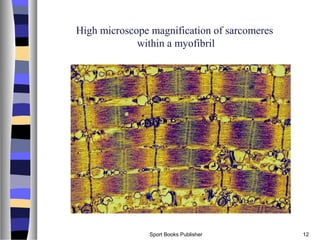
High microscope magnification of sarcomeres
within a myofibril
Sport Books Publisher 13
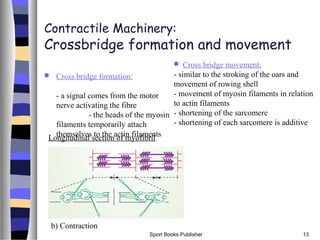
Contractile Machinery:
Crossbridge formation and movement
 Cross bridge formation:
- a signal comes from the motor
nerve activating the fibre
- the heads of the myosin
filaments temporarily attach
themselves to the actin filaments
 Cross bridge movement:
- similar to the stroking of the oars and
movement of rowing shell
- movement of myosin filaments in relation
to actin filaments
- shortening of the sarcomere
- shortening of each sarcomere is additive
b) Contraction
Longitudinal section of myofibril
Sport Books Publisher 14
Contractile Machinery:
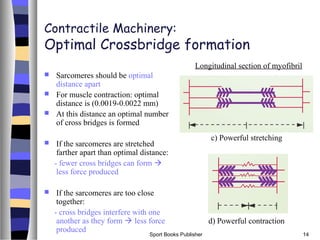
Optimal Crossbridge formation
 Sarcomeres should be optimal
distance apart
 For muscle contraction: optimal
distance is (0.0019-0.0022 mm)
 At this distance an optimal number
of cross bridges is formed
 If the sarcomeres are stretched
farther apart than optimal distance:
- fewer cross bridges can form 
less force produced
 If the sarcomeres are too close
together:
- cross bridges interfere with one
another as they form  less force
produced
Longitudinal section of myofibril
c) Powerful stretching
d) Powerful contraction

muscle structure_and_function

  • 1.
  • 2.
    Sport Books Publisher2 Learning Objectives  To describe muscle’s macro and micro structures  To explain the sliding-filament action of muscular contraction  To differentiate among types of muscle fibres  To describe group action of muscles
  • 3.
    Sport Books Publisher3 Types of Muscle  The human body is comprised of 324 muscles  Muscle makes up 30-35% (in women) and 42-47% (in men) of body mass. Three types of muscle: Skeletal muscle Smooth muscle Cardiac muscle
  • 4.
    Sport Books Publisher4 A. Skeletal (Striated) Muscle  Connects the various parts of the skeleton through one or more connective tissue tendons  During muscle contraction, skeletal muscle shortens and moves various parts of the skeleton  Through graded activation of the muscles, the speed and smoothness of the movement can be gradated  Activated through signals carried to the muscles via nerves (voluntary control)  Repeated activation of a skeletal muscle can lead to fatigue  Biomechanics: assessment of movement and the sequential pattern of muscle activation that move body segments
  • 5.
    Sport Books Publisher5 B. Smooth Muscle  Located in the blood vessels, the respiratory tract, the iris of the eye, the gastro-intestinal tract  The contractions are slow and uniform  Functions to alter the activity of various body parts to meet the needs of the body at that time  Is fatigue resistant  Activation is involuntary
  • 6.
    Sport Books Publisher6 C. Cardiac Muscle  Has characteristics of both skeletal and smooth muscle  Functions to provide the contractile activity of the heart  Contractile activity can be gradated (like skeletal muscle)  Is very fatigue resistant  Activation of cardiac muscle is involuntary (like smooth muscle)
  • 7.
    Sport Books Publisher7 d) myofibril c) muscle fibre b) muscle fibre bundle a) Muscle belly Components of skeletal muscle
  • 8.
    Sport Books Publisher8 Muscle Fibres  Cylinder-shaped cells that make up skeletal muscle  Each fibre is made up of a number of myofilaments  Diameter of fibre (0.05-0.10 mm)  Length of fibre (appr. 15 cm)  Surrounded by a connective tissue sheath called Sarcolemma  Many fibres are enclosed by connective tissue sheath Perimycium to form bundle of fibres  Each fibre contains contractile machinery and cell organelles  Activated through impulses via motor end plate  Group of fibres activated via same nerve: motor unit  Each fibre has capillaries that supply nutrients and eliminate waste
  • 9.
    Sport Books Publisher9 Muscle Teamwork  Agonist (prime mover): - the muscle or group of muscles producing a desired effect  Antagonist: - the muscle or group of muscles opposing the action  Synergist: - the muscles surrounding the joint being moved  Fixators: - the muscle or group of muscles that steady joints closer to the body axis so that the desired action can occur
  • 10.
    Sport Books Publisher10 Bending or straightening of elbow requires the coordinated interplay of the biceps and triceps muscles
  • 11.
    Sport Books Publisher11 Contractile Machinery: Sarcomeres  Contractile units  Organized in series ( attached end to end)  Two types of protein myofilaments: - Actin: thin filament - Myosin: thick filament  Each myosin is surrounded by six actin filaments  Projecting from each myosin are tiny contractile myosin bridges Longitudinal section of myofibril (a) At rest
  • 12.
    Sport Books Publisher12 High microscope magnification of sarcomeres within a myofibril
  • 13.
    Sport Books Publisher13 Contractile Machinery: Crossbridge formation and movement  Cross bridge formation: - a signal comes from the motor nerve activating the fibre - the heads of the myosin filaments temporarily attach themselves to the actin filaments  Cross bridge movement: - similar to the stroking of the oars and movement of rowing shell - movement of myosin filaments in relation to actin filaments - shortening of the sarcomere - shortening of each sarcomere is additive b) Contraction Longitudinal section of myofibril
  • 14.
    Sport Books Publisher14 Contractile Machinery: Optimal Crossbridge formation  Sarcomeres should be optimal distance apart  For muscle contraction: optimal distance is (0.0019-0.0022 mm)  At this distance an optimal number of cross bridges is formed  If the sarcomeres are stretched farther apart than optimal distance: - fewer cross bridges can form  less force produced  If the sarcomeres are too close together: - cross bridges interfere with one another as they form  less force produced Longitudinal section of myofibril c) Powerful stretching d) Powerful contraction